Build vs. Buy Integrations: Should Cybersecurity Vendors Build In-House or Use a Unified API Platform in 2026?
TL;DR
Cybersecurity vendors build their first integrations in-house, then hit a wall by integration number ten. Maintenance, API drift, and engineering opportunity cost compound faster than founders expect. There are three viable paths: build in-house, outsource to consultants, or adopt a unified API platform like Synqly. Build for strategic, ICP-aligned integrations. Outsource only for one-offs you can afford to babysit. Adopt a platform when you ship more than 5 integrations a year or when integration maintenance consumes more than 20% of engineering capacity. This article extends the research and findings from Synqly’s on-demand fireside chat with independent analyst Doug Cahill, see the full transcript here.
The Integration Black Hole Webinar (and transcript)
You are a founder or CPO at a cybersecurity company. Your first major customer asks for an integration with CrowdStrike. Your sales team says it will close a $500K deal. Your engineering team says it will take eight weeks to build, but only after you secure the mock data needed for testing.
You have three options:
- Build it in-house: four weeks of engineering time, plus ongoing maintenance forever.
- Outsource to a consulting firm or contractor: faster delivery, but the integration is still a liability once it is built.
- Use an integration platform: faster to ship and the integration becomes someone else’s problem to maintain.
This decision feels binary, but it is not. It is a question about where to place the bet: on your own engineering, on external partners, or on a platform approach.
The answer depends on your stage, your resource constraints, and your vision for how integrations fit into your product roadmap. As Doug Cahill put it in the Integration Black Hole webinar, integrations now sit on a feature-product-platform continuum, and the way you deliver them tells buyers exactly how serious you are about their ecosystem.
What is the Integration ROI Black Hole?
The integration ROI black hole is the gap between the cost of building and maintaining product integrations and a vendor’s ability to attribute revenue, usage, and customer value back to those integrations. In Doug Cahill’s research, the black hole opens when three things are missing: visibility into which customers use which integrations, pricing and packaging that lets you tie ARR to a specific connector, and feature discoverability so customers actually adopt what you have shipped. Build vs. buy is the operational decision. The black hole is the financial consequence of making that decision without a measurement plan.
The Build-In-House Trap
Most founders choose to build integrations in-house. It makes intuitive sense: you control the timeline, you understand the customer’s needs, and you can optimize for your product.
Research with cybersecurity product leaders, including the CPO interviews Doug Cahill ran for Synqly, reveals what comes next: building integrations in-house carries hidden costs that compound over time.
When you build an integration in-house, you own it forever. That means:
Maintenance burden: when the vendor updates their API (which they do constantly), your integration might break. You have to maintain it.
Quality burden: if the integration is brittle, with poor error handling, no retries, and no rate limiting, it will fail in production. You are on the hook for the incidents.
Opportunity cost: every engineer working on integrations is not working on core product features. As you grow, this opportunity cost compounds.
Scalability burden: if you ship ten integrations, you are managing ten separate codebases. If you ship fifty, you have a serious problem.
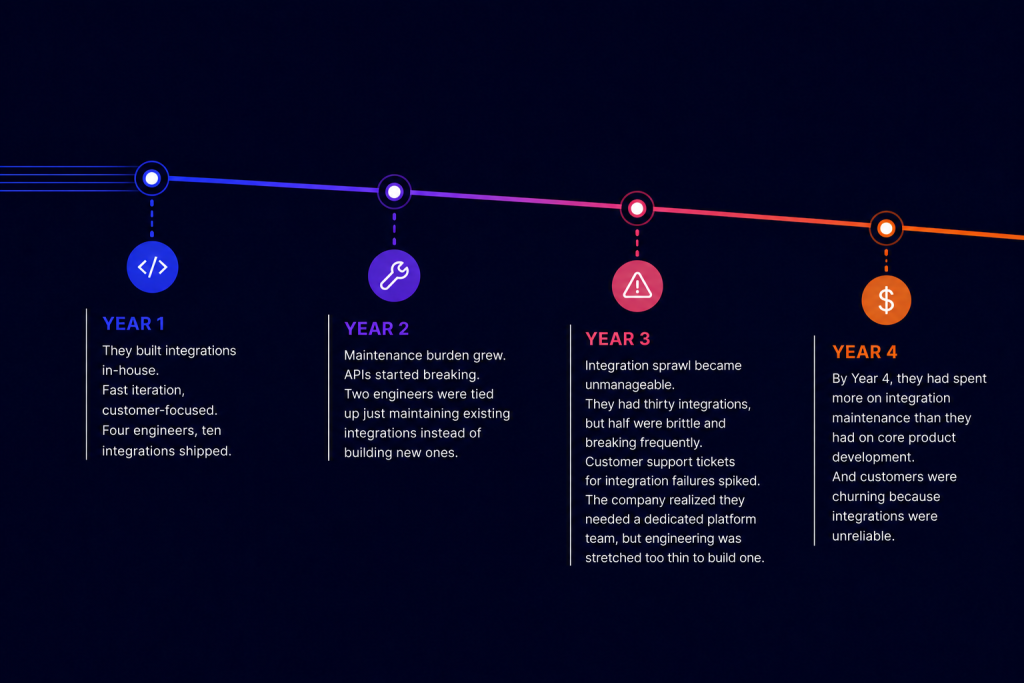
One cloud security vendor we know went through this cycle:
- Year 1: They built integrations in-house. Fast iteration, customer-focused. Four engineers, ten integrations shipped.
- Year 2: Maintenance burden grew. APIs started breaking. Two engineers were tied up just maintaining existing integrations instead of building new ones.
- Year 3: Integration sprawl became unmanageable. They had thirty integrations, but half were brittle and breaking frequently. Customer support tickets for integration failures spiked. The company realized they needed a dedicated platform team, but engineering was stretched too thin to build one.
- By Year 4, they had spent more on integration maintenance than they had on core product development. And customers were churning because integrations were unreliable.
This is the built-in-house trap. It feels fast at first. By Year 2 or 3, it is an anchor. This is exactly the dynamic Doug warns about when he describes integrations that are “clearly developed for the sale to close that deal, not developed to support the roadmap.”
When Building In-House Actually Makes Sense
There are times when building in-house is the right call.
Early stage (pre-Product-Market Fit): if you are a pre-PMF startup with one or two key customers, building a custom integration might be worth it. The upfront effort is small, and you have strategic input from the customer. You are not yet at scale.
Strategic integrations: if an integration is core to your product positioning, for example a cloud security tool that must integrate with Okta, AWS, and ServiceNow, building in-house might make sense. These are mission-critical integrations that you will maintain regardless of the vehicle.
Proprietary integrations: if a customer has a custom, proprietary tool that no one else uses, and that customer is large enough to warrant the investment, you might build a custom connector in-house. This is a deal-specific integration, not a product feature.
Unique requirements: if an integration requires deep customization or non-standard workflows that a platform approach cannot handle, in-house might be your only option.
A caution from the webinar: Doug Cahill shared a cautionary tale from his own time at a cloud security company. The team took a one-off deal that bent the product away from its ICP, set unrealistic revenue expectations with the board, and ate roadmap cycles before being wound down. “The big thing with startups is focus, focus, focus,” Doug said. A “yes” to an off-ICP integration is a “no” to focus.
For most cybersecurity vendors that ship product integrations at scale, building everything in-house is unsustainable.
The Outsourcing Approach: Faster, But With Risks
The second option is to outsource integration development to a consulting firm or contract engineering shop.
This is faster than building in-house. You can ship integrations on an accelerated timeline. A firm like Accenture or a smaller boutique consulting shop can handle the engineering work while your team focuses on strategy and product.
But outsourcing has risks:
Quality variability: consultants build to spec. If the spec is missing edge cases or error handling, the integration will be brittle. Consultants are measured on delivery, not on long-term maintainability.
Knowledge transfer problem: when the consultant finishes the integration and leaves, your team must understand and maintain code they did not write. Code quality, documentation, and architecture decisions might not match your internal standards.
Cost surprises: outsourcing looks cheaper upfront, but when integrations break and you need to bring consultants back in, the costs add up. You are paying for context switching and re-learning.
Lock-in risk: if your integrations are built by external parties and you lack strong documentation, you are locked into those partners for maintenance and updates.
Hidden pre-work: as Doug Cahill stressed in the Integration Black Hole webinar, the integration itself is only one slice of the cost. Before any code is written, you need a technical alliance agreement, the right vendor contact, an NFR (not for resale) copy of the partner’s product, mock or test data, and access to API documentation that may be incomplete. Consultants rarely scope or own this pre-work, which means it lands back on your team.
One product manager we spoke with outsourced five integrations to accelerate time-to-market. The integrations shipped on time. But six months later, when APIs changed and integrations broke, bringing the consultants back cost more than building in-house would have. And the knowledge was lost: the consultants’ institutional understanding of those integrations was gone.
Outsourcing makes sense for one-off, non-core integrations. It does not make sense for integrations that are core to your product.
The Platform Approach: Shifting the Burden
The third option is to use an integration platform or integration-as-a-service (IPaaS) solution.
This is the approach that is gaining traction in cybersecurity. Instead of building and maintaining integrations yourself, you use a platform that abstracts away the vendor-specific complexity. As Doug Cahill noted in the webinar, vendors now have “more options to bring integrations forward,” including the integration-as-a-service model, which handles delivery and maintenance.
Here is how it works:
You define which vendors you want to integrate with. The platform provides pre-built connectors for those vendors. You connect your product to the platform. The platform handles authentication, API versioning, rate limiting, error handling, and schema mapping.
When the vendor updates their API, the platform team updates the connector. Your integrations continue to work without any code changes on your end.
The benefits are clear:
- Reduced maintenance burden: you are not responsible for maintaining integrations. The platform is.
- Faster time to market: pre-built connectors mean you can ship integrations in days, not weeks.
- Reliability: platforms are built with production-grade error handling, monitoring, and incident response.
- Scalability: one platform can handle dozens of integrations. You do not need to scale your engineering team to match the number of integrations.
- Cost efficiency: for many vendors, the cost of a platform is lower than the cost of maintaining integrations in-house.
Platforms have trade-offs:
- Loss of control: you are dependent on the platform provider’s roadmap. If they do not support a vendor you need, you have to request it.
- Vendor lock-in: you are tied to the platform provider’s architecture for the integration
- Customization limits: platforms are good at standard integrations. If you need non-standard customizations, platforms might not support them.
- Latency and performance: adding a platform layer introduces potential latency and performance overhead.
For most cybersecurity vendors, the benefits of a platform approach outweigh the trade-offs. But it requires accepting that you are not building everything yourself, which is the same posture Doug describes when he talks about buyers wanting “many platforms of value,” open, interoperable, and ecosystem-friendly, rather than one platform to rule them all.
The Synqly Approach: A Unified API for Security and IT Integrations
Synqly is solving the integration problem specifically for cybersecurity and IT ops vendors. The company provides a unified API platform that abstracts away vendor complexity and centrally handles integration maintenance.
Synqly is the connected platform built for Security, IT, and AI, providing a durable integration layer that scales with your product and doesn’t drag down your roadmap. Synqly handles auth, retries, and schema drift so your team can focus on building the core product, not babysitting APIs.
The platform approach means:
Pre-built connectors: 200+ vendors across security and IT categories. If your customer needs to integrate with AWS, CrowdStrike, Okta, ServiceNow, or 50+ other vendors, Synqly has connectors ready to go.
Centralized maintenance: when an API changes, Synqly updates the connector once. All customers benefit automatically.
Standards-based mapping: integrations map to OCSF (Open Cybersecurity Schema Framework), reducing the need for custom schema mapping on your end. (For the analyst view on OCSF’s promise and where adoption still has gaps, see the OCSF section of the Integration Black Hole webinar.)
Model Context Protocol: for AI-driven integrations and agentic workflows, Synqly MCP provides a standardized way for AI to interact with security tools without custom code.
With Synqly, a security vendor can reduce integration delivery time from weeks to days and reduce integration maintenance from a full-team effort to minimal oversight.
Build, Outsource, or Platform: A 2026 Decision Framework
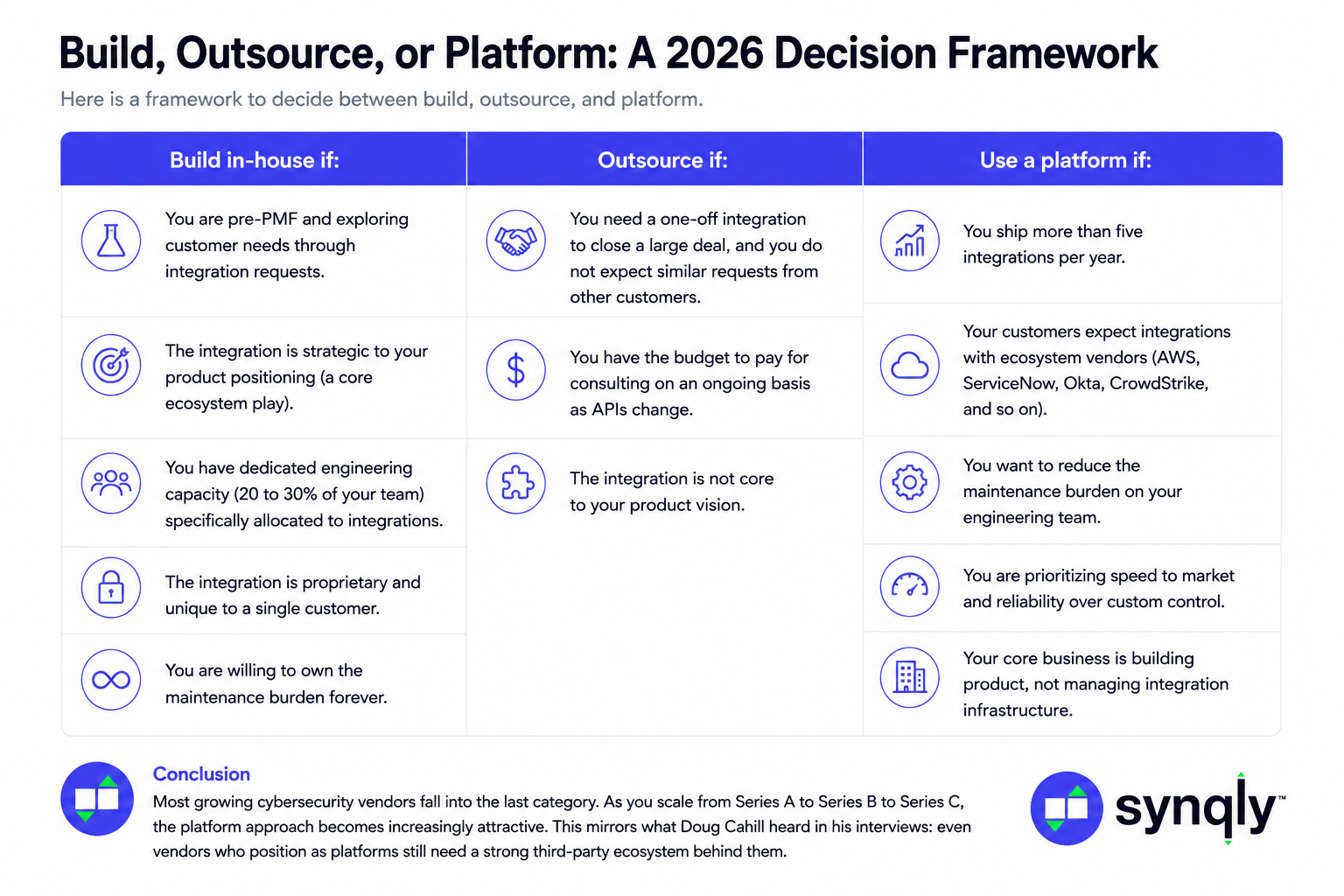
Here is a framework to decide between build, outsource, and platform.
Build in-house if:
- You are pre-PMF and exploring customer needs through integration requests.
- The integration is strategic to your product positioning (a core ecosystem play).
- You have dedicated engineering capacity (20 to 30% of your team) specifically allocated to integrations.
- The integration is proprietary and unique to a single customer.
- You are willing to own the maintenance burden forever.
Outsource if:
- You need a one-off integration to close a large deal, and you do not expect similar requests from other customers.
- You have the budget to pay for ongoing consulting as APIs change.
- The integration is not core to your product vision.
Use a platform if:
- You ship more than five integrations per year.
- Your customers expect integrations with ecosystem vendors (AWS, ServiceNow, Okta, CrowdStrike, and so on).
- You want to reduce the maintenance burden on your engineering team.
- You are prioritizing speed to market and reliability over custom control.
- Your core business is building products, not managing integration infrastructure.
Most growing cybersecurity vendors fall into the last category. As you scale from Series A to Series B to Series C, the platform approach becomes increasingly attractive. This mirrors what Doug Cahill heard in his interviews: even vendors who position themselves as platforms still need a strong third-party ecosystem behind them.
The Math: A Back-of-the-Envelope Cost Comparison
Let us do some back-of-the-envelope math.
Building In-House
Initial development:
4 weeks per integration, 1 engineer, $15K labor cost.
Ongoing maintenance:
1 engineer at 50% capacity managing 5 to 10 integrations, $150K annually.
Total cost for 10 integrations in Year 1:
($15K x 10) + $150K = $300K.
By Year 2, as integrations grow to 20 and the maintenance burden increases, you are looking at $30K for new integrations plus $300K for maintaining all of them. And you still need to pay for the engineer, who is no longer building core product features.
Total: $300K to $400K annually, plus the opportunity cost of engineering capacity diverted from product. Add the hidden pre-work Doug Cahill called out in the webinar (alliance agreements, NFR copies, mock data, API documentation chase), and the real number runs higher.
Using a platform like Synqly
Connector licensing:
$500 to $2,000 per vendor, depending on volume and complexity.
For 10 vendors at $1,500 average:
$15K annually.
Platform service:
$10K to $50K annually, depending on usage and volume.
Total:
$25K to $65K annually for unlimited integrations.
Plus, you have freed up engineering capacity. One engineer working half time on integration maintenance is now available for product work. At a $150K annual salary, that is $75K in freed capacity that can go to core features.
Break-even point: a platform approach pays for itself in Year 1 if you are shipping five or more integrations, or if you are spending more than 20% of engineering capacity on integration maintenance.
For most growing cybersecurity vendors, this is true by Series A.
The Founder’s Lesson
One founder of a Series B cybersecurity company shared this perspective:
“We built our first five integrations in-house. It was fast, and we felt like we were in control. By integration number ten, we realized we had made a mistake. We were spending more time maintaining integrations than building features. We switched to a platform approach, and it freed up engineering capacity to focus on what we were actually good at: building the core product.”
“The cost was less than what we were spending on integration maintenance. The speed to market was better. And most importantly, we stopped treating integrations like they were features, and started treating them like what they are: infrastructure.”
This is the path most successful vendors follow: build a few integrations in-house to understand the customer need, then switch to a platform approach to scale. Doug Cahill describes a similar arc in his research, vendors graduate from “deal of the day” thinking to a real integration lifecycle, with metrics, packaging, and go-to-market behind it.
The Decision Is Not Permanent
The decision to build, outsource, or use a platform is not a permanent one.
Most vendors do a mix:
Strategic integrations (core to your positioning): build in-house or use a platform with deep customization.
Market requirement integrations (table stakes for your category): use a platform to ship them quickly and maintain them reliably.
One-off integrations (customer-specific requests): evaluate case by case. For ICP customers, consider building or using a platform. For outliers, consider outsourcing or politely declining.
The vendors winning in 2026 are the ones who have made peace with not building everything themselves. They are using platforms strategically to accelerate delivery, reduce maintenance burden, and free up engineering to focus on core product innovation.
The vendors struggling are the ones who said no to integration requests, or who are drowning in integration maintenance overhead.
Choose your path wisely.
Resources for Your Integration Strategy
If you are evaluating integration strategy for your security vendor, start here:
Audit your current integrations: how many do you have? How much engineering time is spent maintaining them? Download a copy of our Integrations Prioritization Scorecard to help sort through the readiness.
Map to your strategy: which integrations are strategic to your positioning? Which are market requirements? Which are one-offs? Download our Integration Prioritization Scorecard to help with those insights.
Calculate the cost: is your in-house approach actually cheaper than a platform approach?
Explore options: if a platform approach makes sense, explore Synqly’s unified API or other cybersecurity-focused integration platforms.
Frequently Asked Questions
Should cybersecurity vendors build integrations in-house?
Sometimes. Building in-house makes sense pre-PMF, for proprietary or strategic integrations central to your product positioning, or for customer-unique connectors you can afford to maintain. For most vendors shipping more than five integrations a year, a unified API platform like Synqly removes the maintenance and API-drift burden that compounds with scale.
What is the integration ROI black hole?
The integration ROI black hole, a term introduced by industry analyst Doug Cahill in Synqly’s research, is the gap between the cost of building and maintaining integrations and a vendor’s ability to attribute usage, value, and revenue back to them. The fix is visibility into customer usage, pricing and packaging that allows ARR attribution, and feature discoverability so customers actually adopt what you have shipped.
When does using an integration platform make sense for a security vendor?
An integration platform makes sense when you ship more than five integrations per year, when your customers expect integrations with ecosystem vendors such as AWS, CrowdStrike, Okta, and ServiceNow, when integration maintenance is consuming more than 20% of engineering capacity, or when you want to prioritize speed to market and reliability over custom control.
What is a unified API for cybersecurity?
A unified API for cybersecurity is a single integration layer that abstracts away the differences between vendor APIs across security and IT ops categories. Synqly’s unified API gives security and IT vendors pre-built connectors for 200+ providers, handles authentication, retries, rate limiting, and schema mapping, and aligns with OCSF (Open Cybersecurity Schema Framework) for standards-based data normalization.
How much does it cost to maintain cybersecurity integrations in-house?
Industry estimates put the cost of maintaining ten in-house integrations at roughly $300K to $400K per year, including one engineer at 50% capacity, plus the hidden pre-work of alliance agreements, NFR partner licenses, mock data, and API documentation. A platform approach typically costs $25K to $65K annually for unlimited integrations, and it frees engineering capacity for core product work.
Talk to Synqly: If you are evaluating OCSF for your product, book a meeting with the Synqly team to discuss integration strategy and mapping options.

Richard Melick
https://www.synqly.comRichard brings over 15 years of experience in cybersecurity product strategy, threat intelligence, and marketing to Synqly. Drawing on his extensive background, he writes about market trends, enterprise attack surfaces, and the value of seamless security ecosystems. At Synqly, Richard is focused on eliminating "integration debt" and helping vendors effectively communicate the power of a faster, more secure approach to integrations.