# Synqly
> The Connected Platform for Security, IT, and AI
> Generated by All in One SEO Pro v5.0.4, this is an llms-full.txt file, used by LLMs to index the site.
## Posts
### [Blog | Synqly Integration Platform](https://www.synqly.com/blog/)
**Published:** January 15, 2024
**Author:** Synqly Product Team
**Content:**
## Stay updated with the latest at Synqly
The Synqly blog breaks down the real challenges behind security integrations, and how to fix them. From API design to platform strategy, our team shares practical insights for engineers, product leaders, and MSSPs building smarter, faster, more resilient cybersecurity solutions.
[ ](https://www.synqly.com/synqly-adds-knowbe4-ksat-integration-for-human-risk-data/ " View Post: Synqly Adds KnowBe4 KSAT Integration for Human Risk Data") [Integration Announcements](https://www.synqly.com/category/blog/integrations/ "View Integration Announcements posts")
[#### Synqly Adds KnowBe4 KSAT Integration for Human Risk Data ](https://www.synqly.com/synqly-adds-knowbe4-ksat-integration-for-human-risk-data/ "View Post: Synqly Adds KnowBe4 KSAT Integration for Human Risk Data ")[Steven Erickson](https://www.synqly.com/author/steven-erickson/)October 26, 20263 min read
[ ](https://www.synqly.com/best-security-integration-platforms-compared/ " View Post: Best Security Integration Platforms Compared") [Blog](https://www.synqly.com/category/blog/ "View Blog posts")
[#### Best Security Integration Platforms Compared ](https://www.synqly.com/best-security-integration-platforms-compared/ "View Post: Best Security Integration Platforms Compared ")[Richard Melick](https://www.synqly.com/author/richard/)October 20, 20267 min read
[ ](https://www.synqly.com/synqly-launches-grc-integration-category-with-secureframe-integration/ " View Post: Synqly Launches GRC Integration Category With Secureframe Integration") [Integration Announcements](https://www.synqly.com/category/blog/integrations/ "View Integration Announcements posts")
[#### Synqly Launches GRC Integration Category With Secureframe Integration ](https://www.synqly.com/synqly-launches-grc-integration-category-with-secureframe-integration/ "View Post: Synqly Launches GRC Integration Category With Secureframe Integration ")[Steven Erickson](https://www.synqly.com/author/steven-erickson/)October 19, 20263 min read
[ ](https://www.synqly.com/synqly-adds-ninjaone-integration-for-endpoint-remediation/ " View Post: Synqly Adds NinjaOne Integration for Endpoint Remediation") [Integration Announcements](https://www.synqly.com/category/blog/integrations/ "View Integration Announcements posts")
[#### Synqly Adds NinjaOne Integration for Endpoint Remediation ](https://www.synqly.com/synqly-adds-ninjaone-integration-for-endpoint-remediation/ "View Post: Synqly Adds NinjaOne Integration for Endpoint Remediation ")[Steven Erickson](https://www.synqly.com/author/steven-erickson/)October 15, 20263 min read
[ ](https://www.synqly.com/synqly-adds-threatfox-integration-for-malware-ioc-data/ " View Post: Synqly Adds ThreatFox Integration for Malware IOC Data") [Integration Announcements](https://www.synqly.com/category/blog/integrations/ "View Integration Announcements posts")
[#### Synqly Adds ThreatFox Integration for Malware IOC Data ](https://www.synqly.com/synqly-adds-threatfox-integration-for-malware-ioc-data/ "View Post: Synqly Adds ThreatFox Integration for Malware IOC Data ")[Steven Erickson](https://www.synqly.com/author/steven-erickson/)October 14, 20262 min read
[ ](https://www.synqly.com/synqly-adds-jupiterone-integration-for-asset-visibility/ " View Post: Synqly Adds JupiterOne Integration for Asset Visibility") [Integration Announcements](https://www.synqly.com/category/blog/integrations/ "View Integration Announcements posts")
[#### Synqly Adds JupiterOne Integration for Asset Visibility ](https://www.synqly.com/synqly-adds-jupiterone-integration-for-asset-visibility/ "View Post: Synqly Adds JupiterOne Integration for Asset Visibility ")[Steven Erickson](https://www.synqly.com/author/steven-erickson/)October 13, 20263 min read
[ ](https://www.synqly.com/synqly-adds-microsoft-azure-network-security-integration-for-traffic-visibility/ " View Post: Synqly Adds Microsoft Azure Network Security Integration for Traffic Visibility") [Integration Announcements](https://www.synqly.com/category/blog/integrations/ "View Integration Announcements posts")
[#### Synqly Adds Microsoft Azure Network Security Integration for Traffic Visibility ](https://www.synqly.com/synqly-adds-microsoft-azure-network-security-integration-for-traffic-visibility/ "View Post: Synqly Adds Microsoft Azure Network Security Integration for Traffic Visibility ")[Steven Erickson](https://www.synqly.com/author/steven-erickson/)October 12, 20263 min read
[ ](https://www.synqly.com/synqly-adds-servicenow-usem-integration-for-exposure-data/ " View Post: Synqly Adds ServiceNow USEM Integration for Exposure Data") [Integration Announcements](https://www.synqly.com/category/blog/integrations/ "View Integration Announcements posts")
[#### Synqly Adds ServiceNow USEM Integration for Exposure Data ](https://www.synqly.com/synqly-adds-servicenow-usem-integration-for-exposure-data/ "View Post: Synqly Adds ServiceNow USEM Integration for Exposure Data ")[Steven Erickson](https://www.synqly.com/author/steven-erickson/)October 8, 20263 min read
[ ](https://www.synqly.com/synqly-adds-bmc-helix-itsm-integration-for-ticket-workflows/ " View Post: Synqly Adds BMC Helix ITSM Integration for Ticket Workflows") [Integration Announcements](https://www.synqly.com/category/blog/integrations/ "View Integration Announcements posts")
[#### Synqly Adds BMC Helix ITSM Integration for Ticket Workflows ](https://www.synqly.com/synqly-adds-bmc-helix-itsm-integration-for-ticket-workflows/ "View Post: Synqly Adds BMC Helix ITSM Integration for Ticket Workflows ")[Steven Erickson](https://www.synqly.com/author/steven-erickson/)October 7, 20263 min read
[ ](https://www.synqly.com/integration-pains-a-unified-api-solves-for-cybersecurity-vendors/ " View Post: Integration Pains a Unified API Solves for Cybersecurity Vendors") [Blog](https://www.synqly.com/category/blog/ "View Blog posts")
[#### Integration Pains a Unified API Solves for Cybersecurity Vendors ](https://www.synqly.com/integration-pains-a-unified-api-solves-for-cybersecurity-vendors/ "View Post: Integration Pains a Unified API Solves for Cybersecurity Vendors ")[Richard Melick](https://www.synqly.com/author/richard/)October 6, 20265 min read
[ ](https://www.synqly.com/synqly-adds-pentera-integration-for-validated-exposure-data/ " View Post: Synqly Adds Pentera Integration for Validated Exposure Data") [Integration Announcements](https://www.synqly.com/category/blog/integrations/ "View Integration Announcements posts")
[#### Synqly Adds Pentera Integration for Validated Exposure Data ](https://www.synqly.com/synqly-adds-pentera-integration-for-validated-exposure-data/ "View Post: Synqly Adds Pentera Integration for Validated Exposure Data ")[Steven Erickson](https://www.synqly.com/author/steven-erickson/)October 5, 20264 min read
[ ](https://www.synqly.com/synqly-adds-microsoft-defender-easm-integration-for-exposure-data/ " View Post: Synqly Adds Microsoft Defender EASM Integration for Exposure Data") [Integration Announcements](https://www.synqly.com/category/blog/integrations/ "View Integration Announcements posts")
[#### Synqly Adds Microsoft Defender EASM Integration for Exposure Data ](https://www.synqly.com/synqly-adds-microsoft-defender-easm-integration-for-exposure-data/ "View Post: Synqly Adds Microsoft Defender EASM Integration for Exposure Data ")[Steven Erickson](https://www.synqly.com/author/steven-erickson/)October 1, 20264 min read
[ ](https://www.synqly.com/synqly-adds-xurrent-integration-for-unified-ticketing-workflows/ " View Post: Synqly Adds Xurrent Integration for Unified Ticketing Workflows") [Integration Announcements](https://www.synqly.com/category/blog/integrations/ "View Integration Announcements posts")
[#### Synqly Adds Xurrent Integration for Unified Ticketing Workflows ](https://www.synqly.com/synqly-adds-xurrent-integration-for-unified-ticketing-workflows/ "View Post: Synqly Adds Xurrent Integration for Unified Ticketing Workflows ")[Steven Erickson](https://www.synqly.com/author/steven-erickson/)September 30, 20264 min read
[ ](https://www.synqly.com/synqly-adds-sonarqube-server-integration-to-ecosystem-for-application-security/ " View Post: Synqly Adds a SonarQube Server Integration for OEM Application Security Platforms") [Integration Announcements](https://www.synqly.com/category/blog/integrations/ "View Integration Announcements posts")
[#### Synqly Adds a SonarQube Server Integration for OEM Application Security Platforms ](https://www.synqly.com/synqly-adds-sonarqube-server-integration-to-ecosystem-for-application-security/ "View Post: Synqly Adds a SonarQube Server Integration for OEM Application Security Platforms ")[Steven Erickson](https://www.synqly.com/author/steven-erickson/)September 29, 20263 min read
[ ](https://www.synqly.com/synqly-now-integrates-with-bitdefender-gravityzone-edr-for-endpoint-detection-and-response/ " View Post: Synqly Now Integrates with Bitdefender GravityZone EDR for Endpoint Detection and Response") [Integration Announcements](https://www.synqly.com/category/blog/integrations/ "View Integration Announcements posts")
[#### Synqly Now Integrates with Bitdefender GravityZone EDR for Endpoint Detection and Response ](https://www.synqly.com/synqly-now-integrates-with-bitdefender-gravityzone-edr-for-endpoint-detection-and-response/ "View Post: Synqly Now Integrates with Bitdefender GravityZone EDR for Endpoint Detection and Response ")[Steven Erickson](https://www.synqly.com/author/steven-erickson/)September 28, 20263 min read
[ ](https://www.synqly.com/network-security-integrations/ " View Post: Expanding the Synqly Ecosystem: Introducing the Network Security Integration Category") [Blog](https://www.synqly.com/category/blog/ "View Blog posts")
[#### Expanding the Synqly Ecosystem: Introducing the Network Security Integration Category ](https://www.synqly.com/network-security-integrations/ "View Post: Expanding the Synqly Ecosystem: Introducing the Network Security Integration Category ")[Steven Erickson](https://www.synqly.com/author/steven-erickson/)September 25, 20264 min read
[ ](https://www.synqly.com/synqly-adds-github-identity-integration-for-access-visibility/ " View Post: Synqly Adds GitHub Identity Integration for Access Visibility") [Integration Announcements](https://www.synqly.com/category/blog/integrations/ "View Integration Announcements posts")
[#### Synqly Adds GitHub Identity Integration for Access Visibility ](https://www.synqly.com/synqly-adds-github-identity-integration-for-access-visibility/ "View Post: Synqly Adds GitHub Identity Integration for Access Visibility ")[Steven Erickson](https://www.synqly.com/author/steven-erickson/)September 21, 20263 min read
[ ](https://www.synqly.com/synqly-adds-google-network-security-integration/ " View Post: Synqly Adds Google Network Security Integration for Cloud Traffic Visibility") [Integration Announcements](https://www.synqly.com/category/blog/integrations/ "View Integration Announcements posts")
[#### Synqly Adds Google Network Security Integration for Cloud Traffic Visibility ](https://www.synqly.com/synqly-adds-google-network-security-integration/ "View Post: Synqly Adds Google Network Security Integration for Cloud Traffic Visibility ")[Steven Erickson](https://www.synqly.com/author/steven-erickson/)September 9, 20263 min read
[ ](https://www.synqly.com/synqly-adds-aws-network-security-integration/ " View Post: Synqly Adds AWS Network Security Integration for Cloud Traffic Visibility") [Integration Announcements](https://www.synqly.com/category/blog/integrations/ "View Integration Announcements posts")
[#### Synqly Adds AWS Network Security Integration for Cloud Traffic Visibility ](https://www.synqly.com/synqly-adds-aws-network-security-integration/ "View Post: Synqly Adds AWS Network Security Integration for Cloud Traffic Visibility ")[Steven Erickson](https://www.synqly.com/author/steven-erickson/)September 8, 20263 min read
[ ](https://www.synqly.com/synqly-adds-wiz-integration-to-ecosystem-for-vulnerability-management/ " View Post: Synqly Adds Wiz Cloud Vulnerability Data to Its Vulnerabilities Connector") [Integration Announcements](https://www.synqly.com/category/blog/integrations/ "View Integration Announcements posts")
[#### Synqly Adds Wiz Cloud Vulnerability Data to Its Vulnerabilities Connector ](https://www.synqly.com/synqly-adds-wiz-integration-to-ecosystem-for-vulnerability-management/ "View Post: Synqly Adds Wiz Cloud Vulnerability Data to Its Vulnerabilities Connector ")[Steven Erickson](https://www.synqly.com/author/steven-erickson/)September 2, 20263 min read
[ ](https://www.synqly.com/synqly-adds-microsoft-defender-easm-integration-to-ecosystem-for-vulnerability-management/ " View Post: Synqly Adds Microsoft Defender EASM Integration to Ecosystem for Vulnerability Management") [Integration Announcements](https://www.synqly.com/category/blog/integrations/ "View Integration Announcements posts")
[#### Synqly Adds Microsoft Defender EASM Integration to Ecosystem for Vulnerability Management ](https://www.synqly.com/synqly-adds-microsoft-defender-easm-integration-to-ecosystem-for-vulnerability-management/ "View Post: Synqly Adds Microsoft Defender EASM Integration to Ecosystem for Vulnerability Management ")[Steven Erickson](https://www.synqly.com/author/steven-erickson/)September 1, 20263 min read
[ ](https://www.synqly.com/security-is-a-data-problem/ " View Post: Security is a Data Problem") [Blog](https://www.synqly.com/category/blog/ "View Blog posts")
[#### Security is a Data Problem ](https://www.synqly.com/security-is-a-data-problem/ "View Post: Security is a Data Problem ")[Steven Erickson](https://www.synqly.com/author/steven-erickson/)August 13, 20266 min read
[ ](https://www.synqly.com/black-hat-usa-2026-the-agent-governance-land-rush-and-what-actually-shipped/ " View Post: Black Hat USA 2026: The Agent Governance Land Rush, and What Actually Shipped") [Blog](https://www.synqly.com/category/blog/ "View Blog posts")
[#### Black Hat USA 2026: The Agent Governance Land Rush, and What Actually Shipped ](https://www.synqly.com/black-hat-usa-2026-the-agent-governance-land-rush-and-what-actually-shipped/ "View Post: Black Hat USA 2026: The Agent Governance Land Rush, and What Actually Shipped ")[Richard Melick](https://www.synqly.com/author/richard/)August 12, 20266 min read
[ ](https://www.synqly.com/your-integrations-are-your-value-prop/ " View Post: Your Integrations are Your Value Prop") [Blog](https://www.synqly.com/category/blog/ "View Blog posts")
[#### Your Integrations are Your Value Prop ](https://www.synqly.com/your-integrations-are-your-value-prop/ "View Post: Your Integrations are Your Value Prop ")[Steven Erickson](https://www.synqly.com/author/steven-erickson/)August 5, 20265 min read
[ ](https://www.synqly.com/ai-can-write-the-integration-but-ai-cant-own-the-integration/ " View Post: AI Can Write the Integration, but AI Can’t Own the Integration.") [Blog](https://www.synqly.com/category/blog/ "View Blog posts")
[#### AI Can Write the Integration, but AI Can’t Own the Integration. ](https://www.synqly.com/ai-can-write-the-integration-but-ai-cant-own-the-integration/ "View Post: AI Can Write the Integration, but AI Can’t Own the Integration. ")[Steven Erickson](https://www.synqly.com/author/steven-erickson/)July 29, 202611 min read
[ ](https://www.synqly.com/synqly-integrate-with-horizon3-nodezero/ " View Post: Synqly Customers Can Now Integrate with Horizon3 NodeZero for Exploitability-Driven Vulnerability Findings") [Integration Announcements](https://www.synqly.com/category/blog/integrations/ "View Integration Announcements posts")
[#### Synqly Customers Can Now Integrate with Horizon3 NodeZero for Exploitability-Driven Vulnerability Findings ](https://www.synqly.com/synqly-integrate-with-horizon3-nodezero/ "View Post: Synqly Customers Can Now Integrate with Horizon3 NodeZero for Exploitability-Driven Vulnerability Findings ")[Steven Erickson](https://www.synqly.com/author/steven-erickson/)July 23, 20263 min read
[ ](https://www.synqly.com/the-integration-mentor-the-security-focused-integration-platform/ " View Post: The Integration Mentor: The Security-Focused Integration Platform") [Blog](https://www.synqly.com/category/blog/ "View Blog posts")
[#### The Integration Mentor: The Security-Focused Integration Platform ](https://www.synqly.com/the-integration-mentor-the-security-focused-integration-platform/ "View Post: The Integration Mentor: The Security-Focused Integration Platform ")[Andy Curtis](https://www.synqly.com/author/andy/)July 21, 20269 min read
[ ](https://www.synqly.com/the-force-multiplier-relationships-and-experience/ " View Post: “The Force” Multiplier: Relationships and Experience") [Blog](https://www.synqly.com/category/blog/ "View Blog posts")
[#### “The Force” Multiplier: Relationships and Experience ](https://www.synqly.com/the-force-multiplier-relationships-and-experience/ "View Post: “The Force” Multiplier: Relationships and Experience ")[Andy Curtis](https://www.synqly.com/author/andy/)July 16, 20266 min read
[ ](https://www.synqly.com/synqly-integrate-with-linear/ " View Post: Integrate with Linear to Bring Modern Ticketing into Security and IT Operations Workflows") [Integration Announcements](https://www.synqly.com/category/blog/integrations/ "View Integration Announcements posts")
[#### Integrate with Linear to Bring Modern Ticketing into Security and IT Operations Workflows ](https://www.synqly.com/synqly-integrate-with-linear/ "View Post: Integrate with Linear to Bring Modern Ticketing into Security and IT Operations Workflows ")[Steven Erickson](https://www.synqly.com/author/steven-erickson/)July 15, 20263 min read
[ ](https://www.synqly.com/synqly-selected-for-googles-gemini-startup-forum-cybersecurity/ " View Post: Synqly Selected for Google’s Gemini Startup Forum: Cybersecurity") [Blog](https://www.synqly.com/category/blog/ "View Blog posts"), [News](https://www.synqly.com/category/news/ "View News posts")
[#### Synqly Selected for Google’s Gemini Startup Forum: Cybersecurity ](https://www.synqly.com/synqly-selected-for-googles-gemini-startup-forum-cybersecurity/ "View Post: Synqly Selected for Google’s Gemini Startup Forum: Cybersecurity ")[Richard Melick](https://www.synqly.com/author/richard/)July 14, 20261 min read
[ ](https://www.synqly.com/synqly-integrate-with-servicenow-application-vulnerability-response/ " View Post: Synqly Customers Can Now Integrate with ServiceNow Application Vulnerability Response for Application Security Findings") [Integration Announcements](https://www.synqly.com/category/blog/integrations/ "View Integration Announcements posts")
[#### Synqly Customers Can Now Integrate with ServiceNow Application Vulnerability Response for Application Security Findings ](https://www.synqly.com/synqly-integrate-with-servicenow-application-vulnerability-response/ "View Post: Synqly Customers Can Now Integrate with ServiceNow Application Vulnerability Response for Application Security Findings ")[Steven Erickson](https://www.synqly.com/author/steven-erickson/)July 14, 20263 min read
[Integration Announcements](https://www.synqly.com/category/blog/integrations/ "View Integration Announcements posts")
[#### Synqly Now Integrates with Microsoft Exchange Online for Email Security Visibility ](https://www.synqly.com/synqly-now-integrates-with-microsoft-exchange-online-for-email-security-visibility/ "View Post: Synqly Now Integrates with Microsoft Exchange Online for Email Security Visibility ")[Steven Erickson](https://www.synqly.com/author/steven-erickson/)July 13, 20263 min read
[ ](https://www.synqly.com/synqly-now-integrates-with-github-issues-for-unified-ticketing-workflows/ " View Post: Synqly Now Integrates with GitHub Issues for Unified Ticketing Workflows") [Integration Announcements](https://www.synqly.com/category/blog/integrations/ "View Integration Announcements posts")
[#### Synqly Now Integrates with GitHub Issues for Unified Ticketing Workflows ](https://www.synqly.com/synqly-now-integrates-with-github-issues-for-unified-ticketing-workflows/ "View Post: Synqly Now Integrates with GitHub Issues for Unified Ticketing Workflows ")[Steven Erickson](https://www.synqly.com/author/steven-erickson/)July 13, 20263 min read
[ ](https://www.synqly.com/synqly-integrate-with-azure-devops-boards/ " View Post: Synqly Customers Can Integrate with Azure DevOps Boards to Bring Microsoft Ticketing into Security and IT Workflows") [Integration Announcements](https://www.synqly.com/category/blog/integrations/ "View Integration Announcements posts")
[#### Synqly Customers Can Integrate with Azure DevOps Boards to Bring Microsoft Ticketing into Security and IT Workflows ](https://www.synqly.com/synqly-integrate-with-azure-devops-boards/ "View Post: Synqly Customers Can Integrate with Azure DevOps Boards to Bring Microsoft Ticketing into Security and IT Workflows ")[Steven Erickson](https://www.synqly.com/author/steven-erickson/)July 13, 20263 min read
[ ](https://www.synqly.com/the-droids-why-ai-cant-build-your-integration-strategy/ " View Post: The Droids: Why AI Can’t Build Your Integration Strategy") [Blog](https://www.synqly.com/category/blog/ "View Blog posts")
[#### The Droids: Why AI Can’t Build Your Integration Strategy ](https://www.synqly.com/the-droids-why-ai-cant-build-your-integration-strategy/ "View Post: The Droids: Why AI Can’t Build Your Integration Strategy ")[Andy Curtis](https://www.synqly.com/author/andy/)July 8, 20266 min read
[ ](https://www.synqly.com/hero-transformed-a-tightly-integrated-security-solution/ " View Post: The Hero Transformed: A Tightly Integrated Security Solution") [Blog](https://www.synqly.com/category/blog/ "View Blog posts")
[#### The Hero Transformed: A Tightly Integrated Security Solution ](https://www.synqly.com/hero-transformed-a-tightly-integrated-security-solution/ "View Post: The Hero Transformed: A Tightly Integrated Security Solution ")[Richard Melick](https://www.synqly.com/author/richard/)June 30, 20267 min read
[ ](https://www.synqly.com/synqly-integrate-with-greenhouse-identity/ " View Post: Synqly Now Integrates with Greenhouse Identity for Workforce Identity and Access Data") [Integration Announcements](https://www.synqly.com/category/blog/integrations/ "View Integration Announcements posts")
[#### Synqly Now Integrates with Greenhouse Identity for Workforce Identity and Access Data ](https://www.synqly.com/synqly-integrate-with-greenhouse-identity/ "View Post: Synqly Now Integrates with Greenhouse Identity for Workforce Identity and Access Data ")[Steven Erickson](https://www.synqly.com/author/steven-erickson/)June 29, 20263 min read
[ ](https://www.synqly.com/synqly-adds-trellix-endpoint-security-ens-to-bring-endpoint-detection-data-into-unified-security-workflows/ " View Post: Synqly Adds Trellix Endpoint Security (ENS) to Bring Endpoint Detection Data into Unified Security Workflows") [Integration Announcements](https://www.synqly.com/category/blog/integrations/ "View Integration Announcements posts")
[#### Synqly Adds Trellix Endpoint Security (ENS) to Bring Endpoint Detection Data into Unified Security Workflows ](https://www.synqly.com/synqly-adds-trellix-endpoint-security-ens-to-bring-endpoint-detection-data-into-unified-security-workflows/ "View Post: Synqly Adds Trellix Endpoint Security (ENS) to Bring Endpoint Detection Data into Unified Security Workflows ")[Steven Erickson](https://www.synqly.com/author/steven-erickson/)June 26, 20263 min read
[ ](https://www.synqly.com/synqly-integrate-with-ashby-identity/ " View Post: Synqly Now Integrates with Ashby Identity for Workforce Identity and Access Data") [Integration Announcements](https://www.synqly.com/category/blog/integrations/ "View Integration Announcements posts")
[#### Synqly Now Integrates with Ashby Identity for Workforce Identity and Access Data ](https://www.synqly.com/synqly-integrate-with-ashby-identity/ "View Post: Synqly Now Integrates with Ashby Identity for Workforce Identity and Access Data ")[Steven Erickson](https://www.synqly.com/author/steven-erickson/)June 25, 20263 min read
[ ](https://www.synqly.com/from-tool-to-solution-outsourcing-integrations-api-development/ " View Post: From Tool to Solution: Outsourcing API Development") [Blog](https://www.synqly.com/category/blog/ "View Blog posts")
[#### From Tool to Solution: Outsourcing API Development ](https://www.synqly.com/from-tool-to-solution-outsourcing-integrations-api-development/ "View Post: From Tool to Solution: Outsourcing API Development ")[Richard Melick](https://www.synqly.com/author/richard/)June 23, 20264 min read
[ ](https://www.synqly.com/microsoft-teams-integration/ " View Post: Synqly Now Integrates with Microsoft Teams for Enterprise Security Alerting and Communication Data Access") [Integration Announcements](https://www.synqly.com/category/blog/integrations/ "View Integration Announcements posts")
[#### Synqly Now Integrates with Microsoft Teams for Enterprise Security Alerting and Communication Data Access ](https://www.synqly.com/microsoft-teams-integration/ "View Post: Synqly Now Integrates with Microsoft Teams for Enterprise Security Alerting and Communication Data Access ")[Steven Erickson](https://www.synqly.com/author/steven-erickson/)June 18, 20262 min read
[ ](https://www.synqly.com/synqly-introduces-microsoft-365-copilot-integration/ " View Post: Synqly Introduces Microsoft 365 Copilot Integration for AI Session and Conversation Data Access") [Integration Announcements](https://www.synqly.com/category/blog/integrations/ "View Integration Announcements posts")
[#### Synqly Introduces Microsoft 365 Copilot Integration for AI Session and Conversation Data Access ](https://www.synqly.com/synqly-introduces-microsoft-365-copilot-integration/ "View Post: Synqly Introduces Microsoft 365 Copilot Integration for AI Session and Conversation Data Access ")[Steven Erickson](https://www.synqly.com/author/steven-erickson/)June 17, 20262 min read
[ ](https://www.synqly.com/integrations-are-an-investment-worth-making/ " View Post: Integrations Are an Investment Worth Making") [Blog](https://www.synqly.com/category/blog/ "View Blog posts")
[#### Integrations Are an Investment Worth Making ](https://www.synqly.com/integrations-are-an-investment-worth-making/ "View Post: Integrations Are an Investment Worth Making ")[Richard Melick](https://www.synqly.com/author/richard/)June 16, 20262 min read
[ ](https://www.synqly.com/synqly-adds-veracode-integration-application-security/ " View Post: Synqly Adds Veracode Integration to Bring Application Security Findings into Unified Security Workflows") [Integration Announcements](https://www.synqly.com/category/blog/integrations/ "View Integration Announcements posts")
[#### Synqly Adds Veracode Integration to Bring Application Security Findings into Unified Security Workflows ](https://www.synqly.com/synqly-adds-veracode-integration-application-security/ "View Post: Synqly Adds Veracode Integration to Bring Application Security Findings into Unified Security Workflows ")[Steven Erickson](https://www.synqly.com/author/steven-erickson/)June 16, 20262 min read
[ ](https://www.synqly.com/google-security-command-center-integration/ " View Post: Synqly Expands Cloud Security Coverage with Google Security Command Center Integration") [Integration Announcements](https://www.synqly.com/category/blog/integrations/ "View Integration Announcements posts")
[#### Synqly Expands Cloud Security Coverage with Google Security Command Center Integration ](https://www.synqly.com/google-security-command-center-integration/ "View Post: Synqly Expands Cloud Security Coverage with Google Security Command Center Integration ")[Steven Erickson](https://www.synqly.com/author/steven-erickson/)June 15, 20262 min read
[ ](https://www.synqly.com/synqly-adds-slack-integration-for-security-alerting/ " View Post: Synqly Adds Slack Integration for Real-Time Security Alerting and Collaborative Response") [Integration Announcements](https://www.synqly.com/category/blog/integrations/ "View Integration Announcements posts")
[#### Synqly Adds Slack Integration for Real-Time Security Alerting and Collaborative Response ](https://www.synqly.com/synqly-adds-slack-integration-for-security-alerting/ "View Post: Synqly Adds Slack Integration for Real-Time Security Alerting and Collaborative Response ")[Steven Erickson](https://www.synqly.com/author/steven-erickson/)June 11, 20262 min read
[ ](https://www.synqly.com/synqlys-chat-connector-why-messaging-belongs-in-your-security-and-it-ops-integration-stack/ " View Post: Synqly’s Chat Connector: Why Messaging Belongs in Your Security and IT Ops Integration Stack") [Blog](https://www.synqly.com/category/blog/ "View Blog posts"), [News](https://www.synqly.com/category/news/ "View News posts")
[#### Synqly’s Chat Connector: Why Messaging Belongs in Your Security and IT Ops Integration Stack ](https://www.synqly.com/synqlys-chat-connector-why-messaging-belongs-in-your-security-and-it-ops-integration-stack/ "View Post: Synqly’s Chat Connector: Why Messaging Belongs in Your Security and IT Ops Integration Stack ")[Richard Melick](https://www.synqly.com/author/richard/)June 10, 20265 min read
[ ](https://www.synqly.com/aws-iam-identity-integration/ " View Post: Synqly Now Integrates with AWS IAM Identity for Scalable Identity and Audit Log Access") [Integration Announcements](https://www.synqly.com/category/blog/integrations/ "View Integration Announcements posts")
[#### Synqly Now Integrates with AWS IAM Identity for Scalable Identity and Audit Log Access ](https://www.synqly.com/aws-iam-identity-integration/ "View Post: Synqly Now Integrates with AWS IAM Identity for Scalable Identity and Audit Log Access ")[Steven Erickson](https://www.synqly.com/author/steven-erickson/)June 9, 20262 min read
[ ](https://www.synqly.com/the-great-integration-quest-answering-the-sales-call/ " View Post: The Great Integration Quest: Answering the Sales Call") [Blog](https://www.synqly.com/category/blog/ "View Blog posts")
[#### The Great Integration Quest: Answering the Sales Call ](https://www.synqly.com/the-great-integration-quest-answering-the-sales-call/ "View Post: The Great Integration Quest: Answering the Sales Call ")[Richard Melick](https://www.synqly.com/author/richard/)June 4, 20265 min read
[ ](https://www.synqly.com/expanding-endpoint-management-integrations-with-microsoft-intune/ " View Post: Expanding Endpoint Management Integrations with Microsoft Intune") [Integration Announcements](https://www.synqly.com/category/blog/integrations/ "View Integration Announcements posts")
[#### Expanding Endpoint Management Integrations with Microsoft Intune ](https://www.synqly.com/expanding-endpoint-management-integrations-with-microsoft-intune/ "View Post: Expanding Endpoint Management Integrations with Microsoft Intune ")[Steven Erickson](https://www.synqly.com/author/steven-erickson/)June 2, 20262 min read
[ ](https://www.synqly.com/synqly-now-supports-jamf-pro-integration-for-endpoint-management/ " View Post: Synqly Now Supports Jamf Pro Integration for Endpoint Management") [Integration Announcements](https://www.synqly.com/category/blog/integrations/ "View Integration Announcements posts")
[#### Synqly Now Supports Jamf Pro Integration for Endpoint Management ](https://www.synqly.com/synqly-now-supports-jamf-pro-integration-for-endpoint-management/ "View Post: Synqly Now Supports Jamf Pro Integration for Endpoint Management ")[Steven Erickson](https://www.synqly.com/author/steven-erickson/)May 28, 20263 min read
[ ](https://www.synqly.com/build-vs-buy-integrations-should-cybersecurity-vendors-build-in-house-or-use-a-unified-api-platform-in-2026/ " View Post: Build vs. Buy Integrations: Should Cybersecurity Vendors Build In-House or Use a Unified API Platform in 2026?") [Blog](https://www.synqly.com/category/blog/ "View Blog posts")
[#### Build vs. Buy Integrations: Should Cybersecurity Vendors Build In-House or Use a Unified API Platform in 2026? ](https://www.synqly.com/build-vs-buy-integrations-should-cybersecurity-vendors-build-in-house-or-use-a-unified-api-platform-in-2026/ "View Post: Build vs. Buy Integrations: Should Cybersecurity Vendors Build In-House or Use a Unified API Platform in 2026? ")[Richard Melick](https://www.synqly.com/author/richard/)May 27, 202614 min read
[ ](https://www.synqly.com/synqly-adds-automox-to-its-endpoint-management-integration-ecosystem/ " View Post: Synqly Adds Automox to Its Endpoint Management Integration Ecosystem") [Integration Announcements](https://www.synqly.com/category/blog/integrations/ "View Integration Announcements posts")
[#### Synqly Adds Automox to Its Endpoint Management Integration Ecosystem ](https://www.synqly.com/synqly-adds-automox-to-its-endpoint-management-integration-ecosystem/ "View Post: Synqly Adds Automox to Its Endpoint Management Integration Ecosystem ")[Steven Erickson](https://www.synqly.com/author/steven-erickson/)May 26, 20262 min read
[ ](https://www.synqly.com/expanding-vulnerability-and-asset-integrations-with-iru/ " View Post: Expanding Vulnerability and Asset Integrations with Iru") [Integration Announcements](https://www.synqly.com/category/blog/integrations/ "View Integration Announcements posts")
[#### Expanding Vulnerability and Asset Integrations with Iru ](https://www.synqly.com/expanding-vulnerability-and-asset-integrations-with-iru/ "View Post: Expanding Vulnerability and Asset Integrations with Iru ")[Steven Erickson](https://www.synqly.com/author/steven-erickson/)May 20, 20261 min read
[ ](https://www.synqly.com/synqly-adds-iru-to-its-endpoint-management-integration-ecosystem/ " View Post: Synqly Adds Iru to Its Endpoint Management Integration Ecosystem") [Integration Announcements](https://www.synqly.com/category/blog/integrations/ "View Integration Announcements posts")
[#### Synqly Adds Iru to Its Endpoint Management Integration Ecosystem ](https://www.synqly.com/synqly-adds-iru-to-its-endpoint-management-integration-ecosystem/ "View Post: Synqly Adds Iru to Its Endpoint Management Integration Ecosystem ")[Steven Erickson](https://www.synqly.com/author/steven-erickson/)May 20, 20263 min read
[ ](https://www.synqly.com/synqly-adds-iru-asset-management-integration-to-its-ecosystem/ " View Post: Synqly Adds Iru Asset Management Integration to Its Ecosystem") [Integration Announcements](https://www.synqly.com/category/blog/integrations/ "View Integration Announcements posts")
[#### Synqly Adds Iru Asset Management Integration to Its Ecosystem ](https://www.synqly.com/synqly-adds-iru-asset-management-integration-to-its-ecosystem/ "View Post: Synqly Adds Iru Asset Management Integration to Its Ecosystem ")[Steven Erickson](https://www.synqly.com/author/steven-erickson/)May 20, 20263 min read
[ ](https://www.synqly.com/expanding-application-security-integrations-with-veracode/ " View Post: Expanding Application Security Integrations with Veracode") [Integration Announcements](https://www.synqly.com/category/blog/integrations/ "View Integration Announcements posts")
[#### Expanding Application Security Integrations with Veracode ](https://www.synqly.com/expanding-application-security-integrations-with-veracode/ "View Post: Expanding Application Security Integrations with Veracode ")[Steven Erickson](https://www.synqly.com/author/steven-erickson/)May 19, 20261 min read
[ ](https://www.synqly.com/ocsf-explained-cybersecurity-integration-standards/ " View Post: OCSF Explained: Why Cybersecurity Vendors Should Care About Integration Standards") [Blog](https://www.synqly.com/category/blog/ "View Blog posts")
[#### OCSF Explained: Why Cybersecurity Vendors Should Care About Integration Standards ](https://www.synqly.com/ocsf-explained-cybersecurity-integration-standards/ "View Post: OCSF Explained: Why Cybersecurity Vendors Should Care About Integration Standards ")[Steven Erickson](https://www.synqly.com/author/steven-erickson/)May 18, 202615 min read
[ ](https://www.synqly.com/synqly-adds-tenable-web-application-scanner-to-ecosystem-for-application-security/ " View Post: Synqly Adds Tenable Web Application Scanner to Ecosystem for Application Security") [Integration Announcements](https://www.synqly.com/category/blog/integrations/ "View Integration Announcements posts")
[#### Synqly Adds Tenable Web Application Scanner to Ecosystem for Application Security ](https://www.synqly.com/synqly-adds-tenable-web-application-scanner-to-ecosystem-for-application-security/ "View Post: Synqly Adds Tenable Web Application Scanner to Ecosystem for Application Security ")[Steven Erickson](https://www.synqly.com/author/steven-erickson/)May 14, 20262 min read
[ ](https://www.synqly.com/the-hidden-cost-of-broken-apis-how-cybersecurity-integration-maintenance-fuels-the-roi-black-hole/ " View Post: The Hidden Cost of Broken APIs: How Cybersecurity Integration Maintenance Fuels the ROI Black Hole") [Blog](https://www.synqly.com/category/blog/ "View Blog posts")
[#### The Hidden Cost of Broken APIs: How Cybersecurity Integration Maintenance Fuels the ROI Black Hole ](https://www.synqly.com/the-hidden-cost-of-broken-apis-how-cybersecurity-integration-maintenance-fuels-the-roi-black-hole/ "View Post: The Hidden Cost of Broken APIs: How Cybersecurity Integration Maintenance Fuels the ROI Black Hole ")[Richard Melick](https://www.synqly.com/author/richard/)May 13, 202612 min read
[ ](https://www.synqly.com/synqly-customers-can-integrate-with-datadog-cloud-siem/ " View Post: Synqly Adds Datadog Cloud SIEM to Ecosystem for Security and Observability Integrations") [Integration Announcements](https://www.synqly.com/category/blog/integrations/ "View Integration Announcements posts")
[#### Synqly Adds Datadog Cloud SIEM to Ecosystem for Security and Observability Integrations ](https://www.synqly.com/synqly-customers-can-integrate-with-datadog-cloud-siem/ "View Post: Synqly Adds Datadog Cloud SIEM to Ecosystem for Security and Observability Integrations ")[Steven Erickson](https://www.synqly.com/author/steven-erickson/)May 12, 20262 min read
[ ](https://www.synqly.com/expanding-email-security-integrations-with-microsoft-defender-for-office-365/ " View Post: Expanding Email Security Integrations with Microsoft Defender for Office 365") [Integration Announcements](https://www.synqly.com/category/blog/integrations/ "View Integration Announcements posts")
[#### Expanding Email Security Integrations with Microsoft Defender for Office 365 ](https://www.synqly.com/expanding-email-security-integrations-with-microsoft-defender-for-office-365/ "View Post: Expanding Email Security Integrations with Microsoft Defender for Office 365 ")[Steven Erickson](https://www.synqly.com/author/steven-erickson/)May 8, 20262 min read
[ ](https://www.synqly.com/how-to-prioritize-cybersecurity-integrations-in-2026/ " View Post: How to Prioritize Cybersecurity Integrations in 2026: A Framework for Tactical Deals vs. Strategic Roadmaps") [Blog](https://www.synqly.com/category/blog/ "View Blog posts")
[#### How to Prioritize Cybersecurity Integrations in 2026: A Framework for Tactical Deals vs. Strategic Roadmaps ](https://www.synqly.com/how-to-prioritize-cybersecurity-integrations-in-2026/ "View Post: How to Prioritize Cybersecurity Integrations in 2026: A Framework for Tactical Deals vs. Strategic Roadmaps ")[Richard Melick](https://www.synqly.com/author/richard/)May 7, 202612 min read
[ ](https://www.synqly.com/synqly-adds-wiz-to-ecosystem-for-cloud-security-integrations/ " View Post: Synqly Adds Wiz to Ecosystem for Cloud Security Integrations") [Blog](https://www.synqly.com/category/blog/ "View Blog posts"), [Integration Announcements](https://www.synqly.com/category/blog/integrations/ "View Integration Announcements posts")
[#### Synqly Adds Wiz to Ecosystem for Cloud Security Integrations ](https://www.synqly.com/synqly-adds-wiz-to-ecosystem-for-cloud-security-integrations/ "View Post: Synqly Adds Wiz to Ecosystem for Cloud Security Integrations ")[Steven Erickson](https://www.synqly.com/author/steven-erickson/)May 6, 20262 min read
[ ](https://www.synqly.com/cybersecurity-integrations-deal-velocity-customer-retention/ " View Post: Why Cybersecurity Integrations Drive Deal Velocity, Wallet Share, and Renewal Retention") [Blog](https://www.synqly.com/category/blog/ "View Blog posts")
[#### Why Cybersecurity Integrations Drive Deal Velocity, Wallet Share, and Renewal Retention ](https://www.synqly.com/cybersecurity-integrations-deal-velocity-customer-retention/ "View Post: Why Cybersecurity Integrations Drive Deal Velocity, Wallet Share, and Renewal Retention ")[Richard Melick](https://www.synqly.com/author/richard/)May 1, 20268 min read
[ ](https://www.synqly.com/what-is-data-orchestration/ " View Post: What Is Data Orchestration?") [Blog](https://www.synqly.com/category/blog/ "View Blog posts")
[#### What Is Data Orchestration? ](https://www.synqly.com/what-is-data-orchestration/ "View Post: What Is Data Orchestration? ")[Richard Melick](https://www.synqly.com/author/richard/)April 24, 20267 min read
[ ](https://www.synqly.com/synqlys-google-secops-integration-what-product-and-engineering-teams-need-to-know/ " View Post: Synqly’s Google SecOps Integration: What Product and Engineering Teams Need to Know") [Blog](https://www.synqly.com/category/blog/ "View Blog posts"), [Integration Announcements](https://www.synqly.com/category/blog/integrations/ "View Integration Announcements posts")
[#### Synqly’s Google SecOps Integration: What Product and Engineering Teams Need to Know ](https://www.synqly.com/synqlys-google-secops-integration-what-product-and-engineering-teams-need-to-know/ "View Post: Synqly’s Google SecOps Integration: What Product and Engineering Teams Need to Know ")[Steven Erickson](https://www.synqly.com/author/steven-erickson/)April 22, 20264 min read
[ ](https://www.synqly.com/synqly-adds-aws-network-security-integration-for-dns-and-traffic-data/ " View Post: Synqly Adds AWS Network Security Integration for DNS and Traffic Data") [Integration Announcements](https://www.synqly.com/category/blog/integrations/ "View Integration Announcements posts")
[#### Synqly Adds AWS Network Security Integration for DNS and Traffic Data ](https://www.synqly.com/synqly-adds-aws-network-security-integration-for-dns-and-traffic-data/ "View Post: Synqly Adds AWS Network Security Integration for DNS and Traffic Data ")[Steven Erickson](https://www.synqly.com/author/steven-erickson/)April 21, 20263 min read
[ ](https://www.synqly.com/integration-platforms-the-sword-and-shield-of-cybersecurity-products/ " View Post: Integration Platforms: The Sword and Shield of Cybersecurity Products") [Blog](https://www.synqly.com/category/blog/ "View Blog posts")
[#### Integration Platforms: The Sword and Shield of Cybersecurity Products ](https://www.synqly.com/integration-platforms-the-sword-and-shield-of-cybersecurity-products/ "View Post: Integration Platforms: The Sword and Shield of Cybersecurity Products ")[Richard Melick](https://www.synqly.com/author/richard/)April 17, 20269 min read
[ ](https://www.synqly.com/synqly-adds-upwind-to-ecosystem-for-cloud-security-integrations/ " View Post: Synqly Adds Upwind to Ecosystem for Cloud Security Integrations") [Blog](https://www.synqly.com/category/blog/ "View Blog posts"), [Integration Announcements](https://www.synqly.com/category/blog/integrations/ "View Integration Announcements posts")
[#### Synqly Adds Upwind to Ecosystem for Cloud Security Integrations ](https://www.synqly.com/synqly-adds-upwind-to-ecosystem-for-cloud-security-integrations/ "View Post: Synqly Adds Upwind to Ecosystem for Cloud Security Integrations ")[Steven Erickson](https://www.synqly.com/author/steven-erickson/)April 9, 20262 min read
[ ](https://www.synqly.com/rsac-2026-wrap-up-themes-takeaways-and-voices-from-the-floor/ " View Post: RSAC 2026 Wrap-Up: Themes, Takeaways, and Voices from the Floor") [Blog](https://www.synqly.com/category/blog/ "View Blog posts")
[#### RSAC 2026 Wrap-Up: Themes, Takeaways, and Voices from the Floor ](https://www.synqly.com/rsac-2026-wrap-up-themes-takeaways-and-voices-from-the-floor/ "View Post: RSAC 2026 Wrap-Up: Themes, Takeaways, and Voices from the Floor ")[Richard Melick](https://www.synqly.com/author/richard/)April 9, 20262 min read
[ ](https://www.synqly.com/synqly-adds-mimecast-cloud-gateway-as-first-integration-in-new-email-security-category/ " View Post: Synqly Adds Mimecast Cloud Gateway as First Integration in New Email Security Category") [Blog](https://www.synqly.com/category/blog/ "View Blog posts"), [Integration Announcements](https://www.synqly.com/category/blog/integrations/ "View Integration Announcements posts")
[#### Synqly Adds Mimecast Cloud Gateway as First Integration in New Email Security Category ](https://www.synqly.com/synqly-adds-mimecast-cloud-gateway-as-first-integration-in-new-email-security-category/ "View Post: Synqly Adds Mimecast Cloud Gateway as First Integration in New Email Security Category ")[Steven Erickson](https://www.synqly.com/author/steven-erickson/)April 7, 20262 min read
[ ](https://aka.ms/SentinelIntegrationsRSAC26 " View Post: RSAC 2026: New Microsoft Sentinel Connectors Announcement") [Blog](https://www.synqly.com/category/blog/ "View Blog posts")
[#### RSAC 2026: New Microsoft Sentinel Connectors Announcement ](https://aka.ms/SentinelIntegrationsRSAC26 "View Post: RSAC 2026: New Microsoft Sentinel Connectors Announcement ")[Synqly Product Team](https://www.synqly.com/author/synqlyproduct/)March 31, 20261 min read
[ ](https://www.synqly.com/rsac-2026-when-the-machines-became-the-attack-surface/ " View Post: RSAC 2026: When the Machines Became the Attack Surface") [Blog](https://www.synqly.com/category/blog/ "View Blog posts")
[#### RSAC 2026: When the Machines Became the Attack Surface ](https://www.synqly.com/rsac-2026-when-the-machines-became-the-attack-surface/ "View Post: RSAC 2026: When the Machines Became the Attack Surface ")[Richard Melick](https://www.synqly.com/author/richard/)March 28, 202610 min read
[ ](https://www.synqly.com/security-saas-integration-tco-unlocking-the-true-total-cost-of-ownership/ " View Post: Security SaaS Integration & TCO: Unlocking the True Total Cost of Ownership") [Blog](https://www.synqly.com/category/blog/ "View Blog posts")
[#### Security SaaS Integration & TCO: Unlocking the True Total Cost of Ownership ](https://www.synqly.com/security-saas-integration-tco-unlocking-the-true-total-cost-of-ownership/ "View Post: Security SaaS Integration & TCO: Unlocking the True Total Cost of Ownership ")[Richard Melick](https://www.synqly.com/author/richard/)March 3, 20266 min read
[ ](https://www.synqly.com/5-reasons-to-choose-a-security-focused-unified-api-platform-over-outsourced-development/ " View Post: 5 Reasons to Choose a Unified API Over Outsourced Development") [Blog](https://www.synqly.com/category/blog/ "View Blog posts")
[#### 5 Reasons to Choose a Unified API Over Outsourced Development ](https://www.synqly.com/5-reasons-to-choose-a-security-focused-unified-api-platform-over-outsourced-development/ "View Post: 5 Reasons to Choose a Unified API Over Outsourced Development ")[Richard Melick](https://www.synqly.com/author/richard/)February 26, 20265 min read
[ ](https://www.synqly.com/saas-integrations-the-security-solution-secret-sauce-for-success/ " View Post: SaaS Integrations: The Security Solution Secret Sauce for Success") [Blog](https://www.synqly.com/category/blog/ "View Blog posts")
[#### SaaS Integrations: The Security Solution Secret Sauce for Success ](https://www.synqly.com/saas-integrations-the-security-solution-secret-sauce-for-success/ "View Post: SaaS Integrations: The Security Solution Secret Sauce for Success ")[Richard Melick](https://www.synqly.com/author/richard/)February 23, 20267 min read
[ ](https://www.synqly.com/synqly-expands-panther-labs-integration-to-include-full-siem-capabilities/ " View Post: Synqly Expands Panther Labs Integration to Include Full SIEM Capabilities") [Blog](https://www.synqly.com/category/blog/ "View Blog posts"), [Integration Announcements](https://www.synqly.com/category/blog/integrations/ "View Integration Announcements posts")
[#### Synqly Expands Panther Labs Integration to Include Full SIEM Capabilities ](https://www.synqly.com/synqly-expands-panther-labs-integration-to-include-full-siem-capabilities/ "View Post: Synqly Expands Panther Labs Integration to Include Full SIEM Capabilities ")[Steven Erickson](https://www.synqly.com/author/steven-erickson/)February 23, 20262 min read
[ ](https://www.synqly.com/say-yaas-to-the-saas-give-buyers-the-experience-they-want/ " View Post: Say Yaas to the SaaS: Give Buyers the Experience They Want") [Blog](https://www.synqly.com/category/blog/ "View Blog posts")
[#### Say Yaas to the SaaS: Give Buyers the Experience They Want ](https://www.synqly.com/say-yaas-to-the-saas-give-buyers-the-experience-they-want/ "View Post: Say Yaas to the SaaS: Give Buyers the Experience They Want ")[Richard Melick](https://www.synqly.com/author/richard/)February 17, 20267 min read
[ ](https://www.synqly.com/synqly-adds-eset-connect-to-ecosystem-for-enhanced-endpoint-security/ " View Post: Synqly Adds ESET Connect to Ecosystem for Enhanced Endpoint Security") [Blog](https://www.synqly.com/category/blog/ "View Blog posts"), [Integration Announcements](https://www.synqly.com/category/blog/integrations/ "View Integration Announcements posts")
[#### Synqly Adds ESET Connect to Ecosystem for Enhanced Endpoint Security ](https://www.synqly.com/synqly-adds-eset-connect-to-ecosystem-for-enhanced-endpoint-security/ "View Post: Synqly Adds ESET Connect to Ecosystem for Enhanced Endpoint Security ")[Steven Erickson](https://www.synqly.com/author/steven-erickson/)February 10, 20262 min read
[ ](https://www.synqly.com/synqly-expands-microsoft-defender-for-endpoint-to-ecosystem-for-vulnerability-management/ " View Post: Synqly Expands Microsoft Defender for Endpoint to Ecosystem for Vulnerability Management") [Blog](https://www.synqly.com/category/blog/ "View Blog posts"), [Integration Announcements](https://www.synqly.com/category/blog/integrations/ "View Integration Announcements posts")
[#### Synqly Expands Microsoft Defender for Endpoint to Ecosystem for Vulnerability Management ](https://www.synqly.com/synqly-expands-microsoft-defender-for-endpoint-to-ecosystem-for-vulnerability-management/ "View Post: Synqly Expands Microsoft Defender for Endpoint to Ecosystem for Vulnerability Management ")[Steven Erickson](https://www.synqly.com/author/steven-erickson/)February 9, 20262 min read
[ ](https://www.synqly.com/synqly-expands-amazon-inspector-integration-to-vulnerability-management/ " View Post: Synqly Expands Amazon Inspector Integration to Vulnerability Management") [Blog](https://www.synqly.com/category/blog/ "View Blog posts"), [Integration Announcements](https://www.synqly.com/category/blog/integrations/ "View Integration Announcements posts")
[#### Synqly Expands Amazon Inspector Integration to Vulnerability Management ](https://www.synqly.com/synqly-expands-amazon-inspector-integration-to-vulnerability-management/ "View Post: Synqly Expands Amazon Inspector Integration to Vulnerability Management ")[Steven Erickson](https://www.synqly.com/author/steven-erickson/)February 4, 20262 min read
[ ](https://www.synqly.com/enable-a-composable-architecture-with-a-security-focused-unified-api/ " View Post: Enable a Composable Architecture with a Security-Focused Unified API") [Blog](https://www.synqly.com/category/blog/ "View Blog posts")
[#### Enable a Composable Architecture with a Security-Focused Unified API ](https://www.synqly.com/enable-a-composable-architecture-with-a-security-focused-unified-api/ "View Post: Enable a Composable Architecture with a Security-Focused Unified API ")[Richard Melick](https://www.synqly.com/author/richard/)February 2, 20266 min read
[ ](https://www.synqly.com/synqly-adds-panther-labs-to-ecosystem-for-high-scale-event-streaming/ " View Post: Synqly Adds Panther Labs to Ecosystem for High-Scale Event Streaming") [Blog](https://www.synqly.com/category/blog/ "View Blog posts"), [Integration Announcements](https://www.synqly.com/category/blog/integrations/ "View Integration Announcements posts")
[#### Synqly Adds Panther Labs to Ecosystem for High-Scale Event Streaming ](https://www.synqly.com/synqly-adds-panther-labs-to-ecosystem-for-high-scale-event-streaming/ "View Post: Synqly Adds Panther Labs to Ecosystem for High-Scale Event Streaming ")[Steven Erickson](https://www.synqly.com/author/steven-erickson/)January 27, 20262 min read
[ ](https://www.synqly.com/why-vendors-need-to-enable-customers-cybersecurity-mesh-architecture/ " View Post: Why vendors need to enable customers’ cybersecurity mesh architecture") [Blog](https://www.synqly.com/category/blog/ "View Blog posts")
[#### Why vendors need to enable customers’ cybersecurity mesh architecture ](https://www.synqly.com/why-vendors-need-to-enable-customers-cybersecurity-mesh-architecture/ "View Post: Why vendors need to enable customers’ cybersecurity mesh architecture ")[Richard Melick](https://www.synqly.com/author/richard/)January 20, 20268 min read
[ ](https://www.synqly.com/2026-starts-strong-synqlys-selection-for-the-crowdstrike-aws-and-nvidia-cybersecurity-startup-accelerator/ " View Post: 2026 Starts Strong: Synqly’s Selection for the CrowdStrike, AWS, and NVIDIA Cybersecurity Startup Accelerator") [Blog](https://www.synqly.com/category/blog/ "View Blog posts")
[#### 2026 Starts Strong: Synqly’s Selection for the CrowdStrike, AWS, and NVIDIA Cybersecurity Startup Accelerator ](https://www.synqly.com/2026-starts-strong-synqlys-selection-for-the-crowdstrike-aws-and-nvidia-cybersecurity-startup-accelerator/ "View Post: 2026 Starts Strong: Synqly’s Selection for the CrowdStrike, AWS, and NVIDIA Cybersecurity Startup Accelerator ")[Richard Melick](https://www.synqly.com/author/richard/)January 5, 20263 min read
[ ](https://www.synqly.com/behind-the-build-synqlys-latest-releases-for-security-it-and-ai-teams/ " View Post: Behind the Build: Synqly’s Latest Releases for Security, IT, and AI Teams") [Blog](https://www.synqly.com/category/blog/ "View Blog posts")
[#### Behind the Build: Synqly’s Latest Releases for Security, IT, and AI Teams ](https://www.synqly.com/behind-the-build-synqlys-latest-releases-for-security-it-and-ai-teams/ "View Post: Behind the Build: Synqly’s Latest Releases for Security, IT, and AI Teams ")[Richard Melick](https://www.synqly.com/author/richard/)November 19, 20256 min read
[ ](https://www.synqly.com/why-vendors-need-to-embrace-api-first-design-to-scale-revenue/ " View Post: Why Vendors Need to Embrace API-First Design to Scale Revenue") [Blog](https://www.synqly.com/category/blog/ "View Blog posts")
[#### Why Vendors Need to Embrace API-First Design to Scale Revenue ](https://www.synqly.com/why-vendors-need-to-embrace-api-first-design-to-scale-revenue/ "View Post: Why Vendors Need to Embrace API-First Design to Scale Revenue ")[Richard Melick](https://www.synqly.com/author/richard/)October 13, 20257 min read
[ ](https://www.synqly.com/building-an-api-first-strategy-for-security-integrations/ " View Post: Building an API First Strategy for Security Integrations") [Blog](https://www.synqly.com/category/blog/ "View Blog posts")
[#### Building an API First Strategy for Security Integrations ](https://www.synqly.com/building-an-api-first-strategy-for-security-integrations/ "View Post: Building an API First Strategy for Security Integrations ")[Richard Melick](https://www.synqly.com/author/richard/)October 6, 20255 min read
[ ](https://www.synqly.com/the-breach-between-the-saas-why-secure-integrations-must-be-engineered-not-assumed/ " View Post: The Breach Between the SaaS: Why Secure Integrations Must Be Engineered, Not Assumed") [Blog](https://www.synqly.com/category/blog/ "View Blog posts")
[#### The Breach Between the SaaS: Why Secure Integrations Must Be Engineered, Not Assumed ](https://www.synqly.com/the-breach-between-the-saas-why-secure-integrations-must-be-engineered-not-assumed/ "View Post: The Breach Between the SaaS: Why Secure Integrations Must Be Engineered, Not Assumed ")[Richard Melick](https://www.synqly.com/author/richard/)September 30, 20254 min read
[ ](https://www.synqly.com/moving-from-ok-to-best-in-class-20-quotes-from-experts-proving-the-need-for-security-integrations/ " View Post: Moving from OK to Best in Class: 20 Quotes from Experts Proving The Need for Security Integrations") [Blog](https://www.synqly.com/category/blog/ "View Blog posts")
[#### Moving from OK to Best in Class: 20 Quotes from Experts Proving The Need for Security Integrations ](https://www.synqly.com/moving-from-ok-to-best-in-class-20-quotes-from-experts-proving-the-need-for-security-integrations/ "View Post: Moving from OK to Best in Class: 20 Quotes from Experts Proving The Need for Security Integrations ")[Richard Melick](https://www.synqly.com/author/richard/)September 29, 20258 min read
[ ](https://www.synqly.com/third-party-vendor-risk-of-outsourcing-integrations/ " View Post: Third-Party Vendor Risk of Outsourcing Integrations") [Blog](https://www.synqly.com/category/blog/ "View Blog posts")
[#### Third-Party Vendor Risk of Outsourcing Integrations ](https://www.synqly.com/third-party-vendor-risk-of-outsourcing-integrations/ "View Post: Third-Party Vendor Risk of Outsourcing Integrations ")[Richard Melick](https://www.synqly.com/author/richard/)August 25, 20256 min read
[ ](https://www.synqly.com/black-hat-usa-2025-real-risks-real-product-moves-and-why-integration-still-decides-outcomes/ " View Post: Black Hat USA 2025: Real Risks, Real Product Moves, and Why Integration Still Decides Outcomes") [Blog](https://www.synqly.com/category/blog/ "View Blog posts")
[#### Black Hat USA 2025: Real Risks, Real Product Moves, and Why Integration Still Decides Outcomes ](https://www.synqly.com/black-hat-usa-2025-real-risks-real-product-moves-and-why-integration-still-decides-outcomes/ "View Post: Black Hat USA 2025: Real Risks, Real Product Moves, and Why Integration Still Decides Outcomes ")[Richard Melick](https://www.synqly.com/author/richard/)August 13, 20256 min read
[ ](https://www.synqly.com/doug-cahill-cybersecurity-integrations-are-table-stakes/ " View Post: Doug Cahill on Why Integrations Are the New Table Stakes for Cybersecurity Vendors") [Blog](https://www.synqly.com/category/blog/ "View Blog posts")
[#### Doug Cahill on Why Integrations Are the New Table Stakes for Cybersecurity Vendors ](https://www.synqly.com/doug-cahill-cybersecurity-integrations-are-table-stakes/ "View Post: Doug Cahill on Why Integrations Are the New Table Stakes for Cybersecurity Vendors ")[Richard Melick](https://www.synqly.com/author/richard/)July 29, 20255 min read
[ ](https://www.synqly.com/the-hidden-costs-of-outsourcing-security-api-development/ " View Post: The Hidden Costs of Outsourcing Security API Development") [Blog](https://www.synqly.com/category/blog/ "View Blog posts")
[#### The Hidden Costs of Outsourcing Security API Development ](https://www.synqly.com/the-hidden-costs-of-outsourcing-security-api-development/ "View Post: The Hidden Costs of Outsourcing Security API Development ")[Richard Melick](https://www.synqly.com/author/richard/)July 7, 202511 min read
[ ](https://www.synqly.com/adrift-in-a-sea-of-tools-6-questions-to-ask-your-integration-platform/ " View Post: Adrift in a Sea of Tools: 6 Questions to Ask Your Integration Platform") [Blog](https://www.synqly.com/category/blog/ "View Blog posts")
[#### Adrift in a Sea of Tools: 6 Questions to Ask Your Integration Platform ](https://www.synqly.com/adrift-in-a-sea-of-tools-6-questions-to-ask-your-integration-platform/ "View Post: Adrift in a Sea of Tools: 6 Questions to Ask Your Integration Platform ")[Richard Melick](https://www.synqly.com/author/richard/)June 30, 20257 min read
[ ](https://www.synqly.com/to-buy-or-to-build-6-questions-to-ask-about-security-integrations/ " View Post: To Buy or To Build: 6 Questions to Ask About Security Integrations") [Blog](https://www.synqly.com/category/blog/ "View Blog posts")
[#### To Buy or To Build: 6 Questions to Ask About Security Integrations ](https://www.synqly.com/to-buy-or-to-build-6-questions-to-ask-about-security-integrations/ "View Post: To Buy or To Build: 6 Questions to Ask About Security Integrations ")[Richard Melick](https://www.synqly.com/author/richard/)June 23, 20257 min read
[ ](https://www.synqly.com/workflow-automation-vs-unified-api-improving-cybersecurity-integrations/ " View Post: Workflow Automation vs Unified API: Improving Cybersecurity Integrations") [Blog](https://www.synqly.com/category/blog/ "View Blog posts")
[#### Workflow Automation vs Unified API: Improving Cybersecurity Integrations ](https://www.synqly.com/workflow-automation-vs-unified-api-improving-cybersecurity-integrations/ "View Post: Workflow Automation vs Unified API: Improving Cybersecurity Integrations ")[Richard Melick](https://www.synqly.com/author/richard/)June 16, 20258 min read
[ ](https://www.synqly.com/security-integration-kpis/ " View Post: 13 KPIs for Security Application Integrations") [Blog](https://www.synqly.com/category/blog/ "View Blog posts")
[#### 13 KPIs for Security Application Integrations ](https://www.synqly.com/security-integration-kpis/ "View Post: 13 KPIs for Security Application Integrations ")[Richard Melick](https://www.synqly.com/author/richard/)June 10, 20256 min read
## Synqly Unleashes Vendor Power
Deliver effective cybersecurity integrations and elevate the strength of your cybersecurity ecosystem with the Synqly integration platform.
---
### [Synqly Adds KnowBe4 KSAT Integration for Human Risk Data](https://www.synqly.com/synqly-adds-knowbe4-ksat-integration-for-human-risk-data/)
**Published:** October 26, 2026
**Author:** Steven Erickson
**Excerpt:** Every other integration in Synqly's catalog describes a piece of infrastructure: a cloud account, an endpoint, a ticket, a vulnerability scanner. The new KnowBe4 KSAT integration describes a person instead, specifically how that person responds when someone tries to trick them, and that makes it a genuinely different category of data for a security product to work with.
**Content:**
Every other integration in Synqly’s catalog describes a piece of infrastructure: a cloud account, an endpoint, a ticket, a vulnerability scanner. The new KnowBe4 KSAT integration describes a person instead, specifically how that person responds when someone tries to trick them, and that makes it a genuinely different category of data for a security product to work with.
[KnowBe4 Security Awareness Training](https://www.knowbe4.com/), known inside the platform as KSAT, is a security awareness and phishing simulation product that combines AI personalized training modules, simulated phishing and vishing tests, and real time coaching to reduce the human driven security risk that no firewall or scanner will ever catch. Human risk has always been the hardest input for a security product to quantify, not because it does not matter, but because the data lived in a training platform that most detection and response tools never talked to.
The KnowBe4 KSAT integration closes that gap directly. Through it, an OEM product can query phishing simulations and training campaigns configured for a customer, then get the full details of a specific simulation or campaign by ID once it needs to go deeper than the summary list. A query users capability, paired with a get user details call, returns the people enrolled in KnowBe4 along with their individual risk and training data, which is the piece that actually makes this integration useful for a security product rather than an HR reporting tool. A user who fails every phishing simulation and skips assigned training is a meaningfully different risk than one who has completed every module, and a product that can see both users side by side can weight its own alerting and access decisions accordingly, instead of treating every employee as an equal, unknown quantity. Configuration steps and authentication requirements are covered in the [KnowBe4 Security Awareness Configuration Guide](https://docs.synqly.com/guides/provider-configuration/knowbe4-securityawareness-setup) on the Synqly documentation site.
Consider how that plays out for an identity or access governance product built on Synqly. A finance team employee requests elevated access to a payment system, and the request lands in an approval queue the same way it would for anyone else. A product that has also pulled that employee’s KnowBe4 KSAT record, and sees three failed phishing simulations in the last two quarters alongside an overdue training assignment, can flag the request for closer review or require an additional approval step, rather than routing it through the same automatic approval a lower risk employee would receive. None of that requires the product to build its own phishing simulation program. It only requires seeing the result of one that is already running.
KnowBe4 is Synqly’s first partner in Security Awareness, which means this integration is both KnowBe4’s first appearance in the ecosystem and the category’s first provider overall. Full details on every supported operation live on the [KnowBe4 KSAT integration partner page](https://www.synqly.com/integration-partners/knowbe4-security-awareness-training-ksat/).
The reason this data belongs alongside infrastructure telemetry, rather than staying siloed in a training platform, is that a determined attacker rarely bothers attacking infrastructure that is well defended when a phishing email to the right person will get them in faster. A security product that already ingests identity, endpoint, and vulnerability data can layer in phishing susceptibility and training completion as one more signal for who represents elevated risk this week, not just who clicked a bad link once a year ago during a mandatory training review.
For OEM vendors building insider risk, security awareness reporting, or broader risk scoring products, the KnowBe4 KSAT integration is a chance to fold that human layer into a product without negotiating a separate data sharing agreement with a training vendor for every customer who happens to run KnowBe4. As Synqly adds more providers to the Security Awareness category over time, that same connector work carries forward automatically, the same pattern that already holds across every other category in the ecosystem.
**Categories:** Integration Announcements
---
### [OCSF Explained: Why Cybersecurity Vendors Should Care About Integration Standards](https://www.synqly.com/ocsf-explained-cybersecurity-integration-standards/)
**Published:** May 18, 2026
**Author:** Steven Erickson
**Excerpt:** OCSF, the Open Cybersecurity Schema Framework, is the Linux Foundation governed standard normalizing security data across vendors. Learn what OCSF is, why adoption is uneven, and how cybersecurity vendors can use it to close the integration ROI gap.
**Content:**
Originally published on May 18th, 2026. Updated October 21, 2026.
## TL;DR: OCSF in One Paragraph
[**OCSF (Open Cybersecurity Schema Framework)**](https://ocsf.io/) is a Linux Foundation governed, open-source schema that defines a common, vendor-agnostic way for cybersecurity, IT, and cloud tools to describe events, alerts, and findings. It was launched in August 2022 by AWS, Splunk, and a group of founding cybersecurity and technology companies, and joined the Linux Foundation family of projects in November 2024. OCSF matters because enterprises can run as many as 80 security tools, each emitting data in its own format. Standardizing on OCSF lets security teams write a detection once, run it everywhere, train AI on one schema, and stop burning engineering hours on custom schema mapping. The catch: adoption is uneven, and some vendors actively resist OCSF because they would rather be the aggregator their competitors map data to.
You’re building a security integration. Your data scientist is building detections that correlate alerts from multiple tools. Your SOC team is writing queries to hunt for threats across your environment.
All of this depends on one thing: a common language for describing security events.
If every vendor describes a “user login” differently, then your security team has to write custom parsers for each vendor. If “authentication event” means something different in Okta than it does in ServiceNow, then your analytics break down. If a file hash is stored differently across Palo Alto, CrowdStrike, and AWS, then threat hunting becomes a nightmare of manual data translation.
This is the problem OCSF (Open Cybersecurity Schema Framework) is trying to solve. And whether you’re a cybersecurity vendor, a security operations team, or an engineer building integrations, you need to understand why it matters.
## The Data Fragmentation Problem
Many companies can be running as many as 80 cybersecurity tools. Each tool generates logs, alerts, and telemetry in its own format.
A SIEM like [Splunk](https://www.splunk.com/) expects events in one format. An EDR like [CrowdStrike](https://www.crowdstrike.com/en-us/) generates events in another. A cloud security tool like [Palo Alto’s Prisma](https://www.paloaltonetworks.com/prisma/cloud) sends data in yet another. An identity platform like [Okta](https://www.okta.com/) has its own schema. Your security team must normalize all this data before they can do anything useful with it.
This normalization is expensive, brittle, and error-prone. Industry surveys consistently identify data normalization as one of the biggest bottlenecks in SIEM and XDR deployments. Security teams spend weeks building custom parsers and field mappers. A slight change in a vendor’s log format can [break entire detection pipelines](https://www.synqly.com/the-hidden-cost-of-broken-apis-how-cybersecurity-integration-maintenance-fuels-the-roi-black-hole/).
In conversations with Synqly customers, multiple cybersecurity engineering leaders have estimated that [30 to 40 percent of their integration effort](https://www.synqly.com/the-hidden-cost-of-broken-apis-how-cybersecurity-integration-maintenance-fuels-the-roi-black-hole/) *(Synqly customer estimate)* is spent on schema mapping and normalization rather than on the integration logic itself, a finding echoed in Doug Cahill’s 2026 analyst research on the integration ROI black hole.
OCSF was created to solve this problem. Instead of every vendor defining their own schema, OCSF provides a common, vendor-agnostic schema that all vendors can map to.
## What Is OCSF?
OCSF, the Open Cybersecurity Schema Framework, is an open-source project, governed by the Linux Foundation, that defines a vendor-agnostic schema for representing cybersecurity events, alerts, and findings across security, IT, and cloud tools.
The Open Cybersecurity Schema Framework delivers an extensible framework for developing schemas, along with a vendor-agnostic core security schema. Vendors and other data producers can adopt and extend the schema for their specific domains. Data engineers can map differing schemas to help security teams simplify data ingestion and normalization, so that data scientists and analysts can work with a common language for threat detection and investigation.
Here’s what that means in practice:
Instead of a SIEM parsing Splunk events, Datadog events, and CrowdStrike events all differently, each vendor maps their events to OCSF. The SIEM then consumes standardized OCSF events. One parser. One format. One source of truth.
The framework comprises three main components:
1. **Event Classes:** These are templates for different types of security activities. An authentication event always has the same fields (user information, source, destination, status) regardless of which tool generated it. These are organized into eight categories covering everything from system activity to network activity to findings.
2. **Attribute Dictionary:** This defines all the possible fields and their data types. What fields are in a “user authentication” event? What are the valid values for “outcome” (success, failure, unknown)?
3. **Taxonomy:** This organizes events hierarchically, so you can group related events together and identify patterns across categories.
The key innovation: OCSF is extensible. Vendors don’t have to throw out their existing schemas. They can map to OCSF or support it alongside their native formats. You can add custom attributes to OCSF events while maintaining compatibility with the base schema.
Categories include – view full list on: <https://schema.ocsf.io/>
#### [System Activity \[1\]](https://schema.ocsf.io/1.9.0/categories/system?extensions=)
[File System Activity \[1001\]](https://schema.ocsf.io/1.9.0/classes/file_activity?extensions=)
[Kernel Extension Activity \[1002\]](https://schema.ocsf.io/1.9.0/classes/kernel_extension_activity?extensions=)
[Kernel Activity \[1003\]](https://schema.ocsf.io/1.9.0/classes/kernel_activity?extensions=)
[Memory Activity \[1004\]](https://schema.ocsf.io/1.9.0/classes/memory_activity?extensions=)
[Module Activity \[1005\]](https://schema.ocsf.io/1.9.0/classes/module_activity?extensions=)
[Scheduled Job Activity \[1006\]](https://schema.ocsf.io/1.9.0/classes/scheduled_job_activity?extensions=)
[Process Activity \[1007\]](https://schema.ocsf.io/1.9.0/classes/process_activity?extensions=)
[Event Log Activity \[1008\]](https://schema.ocsf.io/1.9.0/classes/event_log_actvity?extensions=)
[Script Activity \[1009\]](https://schema.ocsf.io/1.9.0/classes/script_activity?extensions=)
[Peripheral Activity \[1010\]](https://schema.ocsf.io/1.9.0/classes/peripheral_activity?extensions=)
[Device Power State Activity \[1011\]](https://schema.ocsf.io/1.9.0/classes/device_power_state_activity?extensions=)
[Clipboard Activity \[1012\]](https://schema.ocsf.io/1.9.0/classes/clipboard_activity?extensions=)
#### [Findings \[2\]](https://schema.ocsf.io/1.9.0/categories/findings?extensions=)
[Vulnerability Finding \[2002\]](https://schema.ocsf.io/1.9.0/classes/vulnerability_finding?extensions=)
[Compliance Finding \[2003\]](https://schema.ocsf.io/1.9.0/classes/compliance_finding?extensions=)
[Detection Finding \[2004\]](https://schema.ocsf.io/1.9.0/classes/detection_finding?extensions=)
[Incident Finding \[2005\]](https://schema.ocsf.io/1.9.0/classes/incident_finding?extensions=)
[Data Security Finding \[2006\]](https://schema.ocsf.io/1.9.0/classes/data_security_finding?extensions=)
[Application Security Posture Finding \[2007\]](https://schema.ocsf.io/1.9.0/classes/application_security_posture_finding?extensions=)
[IAM Analysis Finding \[2008\]](https://schema.ocsf.io/1.9.0/classes/iam_analysis_finding?extensions=)
#### [Identity & Access Management \[3\]](https://schema.ocsf.io/1.9.0/categories/iam?extensions=)
[Authentication \[3002\]](https://schema.ocsf.io/1.9.0/classes/authentication?extensions=)
[Authorize Session \[3003\]](https://schema.ocsf.io/1.9.0/classes/authorize_session?extensions=)
[Entity Management \[3004\]](https://schema.ocsf.io/1.9.0/classes/entity_management?extensions=)
[Group Management \[3006\]](https://schema.ocsf.io/1.9.0/classes/group_management?extensions=)
[User Management \[3007\]](https://schema.ocsf.io/1.9.0/classes/user_management?extensions=)
[Role Management \[3008\]](https://schema.ocsf.io/1.9.0/classes/role_management?extensions=)
#### [Network Activity \[4\]](https://schema.ocsf.io/1.9.0/categories/network?extensions=)
[Network Activity \[4001\]](https://schema.ocsf.io/1.9.0/classes/network_activity?extensions=)
[HTTP Activity \[4002\]](https://schema.ocsf.io/1.9.0/classes/http_activity?extensions=)
[DNS Activity \[4003\]](https://schema.ocsf.io/1.9.0/classes/dns_activity?extensions=)
[DHCP Activity \[4004\]](https://schema.ocsf.io/1.9.0/classes/dhcp_activity?extensions=)
[RDP Activity \[4005\]](https://schema.ocsf.io/1.9.0/classes/rdp_activity?extensions=)
[SMB Activity \[4006\]](https://schema.ocsf.io/1.9.0/classes/smb_activity?extensions=)
[SSH Activity \[4007\]](https://schema.ocsf.io/1.9.0/classes/ssh_activity?extensions=)
[FTP Activity \[4008\]](https://schema.ocsf.io/1.9.0/classes/ftp_activity?extensions=)
[Email Activity \[4009\]](https://schema.ocsf.io/1.9.0/classes/email_activity?extensions=)
[NTP Activity \[4013\]](https://schema.ocsf.io/1.9.0/classes/ntp_activity?extensions=)
[Tunnel Activity \[4014\]](https://schema.ocsf.io/1.9.0/classes/tunnel_activity?extensions=)
#### [Discovery \[5\]](https://schema.ocsf.io/1.9.0/categories/discovery?extensions=)
[Device Inventory Info \[5001\]](https://schema.ocsf.io/1.9.0/classes/inventory_info?extensions=)
[User Inventory Info \[5003\]](https://schema.ocsf.io/1.9.0/classes/user_inventory?extensions=)
[Operating System Patch State \[5004\]](https://schema.ocsf.io/1.9.0/classes/patch_state?extensions=)
[Device Config State Change \[5019\]](https://schema.ocsf.io/1.9.0/classes/device_config_state_change?extensions=)
[Software Inventory Info \[5020\]](https://schema.ocsf.io/1.9.0/classes/software_info?extensions=)
[OSINT Inventory Info \[5021\]](https://schema.ocsf.io/1.9.0/classes/osint_inventory_info?extensions=)
[Cloud Resources Inventory Info \[5023\]](https://schema.ocsf.io/1.9.0/classes/cloud_resources_inventory_info?extensions=)
[Live Evidence Info \[5040\]](https://schema.ocsf.io/1.9.0/classes/evidence_info?extensions=)
#### [Application Activity \[6\]](https://schema.ocsf.io/1.9.0/categories/application?extensions=)
[Web Resources Activity \[6001\]](https://schema.ocsf.io/1.9.0/classes/web_resources_activity?extensions=)
[Application Lifecycle \[6002\]](https://schema.ocsf.io/1.9.0/classes/application_lifecycle?extensions=)
[API Activity \[6003\]](https://schema.ocsf.io/1.9.0/classes/api_activity?extensions=)
[Datastore Activity \[6005\]](https://schema.ocsf.io/1.9.0/classes/datastore_activity?extensions=)
[File Hosting Activity \[6006\]](https://schema.ocsf.io/1.9.0/classes/file_hosting?extensions=)
[Scan Activity \[6007\]](https://schema.ocsf.io/1.9.0/classes/scan_activity?extensions=)
[Application Error \[6008\]](https://schema.ocsf.io/1.9.0/classes/application_error?extensions=)
#### [Remediation \[7\]](https://schema.ocsf.io/1.9.0/categories/remediation?extensions=)
[Remediation Activity \[7001\]](https://schema.ocsf.io/1.9.0/classes/remediation_activity?extensions=)
[File Remediation Activity \[7002\]](https://schema.ocsf.io/1.9.0/classes/file_remediation_activity?extensions=)
[Process Remediation Activity \[7003\]](https://schema.ocsf.io/1.9.0/classes/process_remediation_activity?extensions=)
[Network Remediation Activity \[7004\]](https://schema.ocsf.io/1.9.0/classes/network_remediation_activity?extensions=)
#### [Unmanned Systems \[8\]](https://schema.ocsf.io/1.9.0/categories/unmanned_systems?extensions=)
[Drone Flights Activity \[8001\]](https://schema.ocsf.io/1.9.0/classes/drone_flights_activity?extensions=)
[Airborne Broadcast Activity \[8002\]](https://schema.ocsf.io/1.9.0/classes/airborne_broadcast_activity?extensions=)
## Why OCSF Matters: Three Concrete Use Cases
### Use Case 1: Faster Threat Detection and Investigation
If all your security tools emit events in OCSF format, your threat hunters and analysts can write detection rules once and apply them across your entire environment.
Instead of writing a query that says: “Look for failed authentication attempts in Okta AND unusual activity in CrowdStrike AND privilege escalation in Windows logs,” you write: “Look for failed authentication attempts in OCSF AND unusual activity in OCSF AND privilege escalation in OCSF.”
One query. Multiple data sources. No custom translation.
Splunk’s OCSF guidance notes that, with so many tools generating data in different formats, OCSF reduces the need for custom integrations, saving time and resources while enabling faster insights into threats (see Splunk’s OCSF post).
### Use Case 2: Vendor-Agnostic AI and Automation
Here’s where OCSF becomes truly powerful: AI-driven security operations.
If you’re building an AI copilot or security automation system, you need to understand security events across your entire stack. But if every vendor’s events are in a different format, your AI system has to be trained on fifty different schemas. That’s fragile, expensive, and doesn’t scale.
If all events are in OCSF, your AI system learns once. You can build agentic AI that can correlate events, investigate threats, and recommend actions across your entire security stack, without vendor-specific training.
Synqly MCP is a Model Context Protocol server built specifically to support integration development across the ever-expanding IT and security ecosystems. Synqly MCP enables AI copilots and operators to trigger actions, transmit data bi-directionally, or resolve issues across your stack using natural language by building your AI on a single OCSF data schema.
### Use Case 3: Multi-Vendor Platforms and Mesh Architecture
If you’re building a security platform that integrates multiple vendors (a mesh architecture), OCSF makes this possible at scale.
Without OCSF, every integration requires custom field mapping. Endpoint data looks different from cloud data, which looks different from network data. You’d need a [dedicated team to map all of it](https://www.synqly.com/the-hidden-cost-of-broken-apis-how-cybersecurity-integration-maintenance-fuels-the-roi-black-hole/).
With OCSF, you have a common language. All integrations map to OCSF. Your platform consumes standardized events. You can build features that work across vendors without building vendor-specific logic.
## The Adoption Landscape: Who’s Using OCSF?
Launched in August 2022 by AWS and Splunk with a group of founding cybersecurity and technology companies, and derived in part from schema work done by Broadcom (Symantec), OCSF provides a unified language to simplify and standardize how security data is managed, shared, and analyzed across diverse environments. The project has grown into an ecosystem of more than 1,280 contributors from about 200 organizations, according to AWS (March 2026).
Major vendors have implemented OCSF support, though adoption patterns vary:
Major security vendors like Datadog, SentinelOne, Rapid7, and Palo Alto Networks have implemented OCSF support. Some are using it as an export format, others as their native schema. The varied adoption patterns indicate the framework’s adaptability to diverse operational requirements.
In November 2024, the Linux Foundation welcomed OCSF to its family of projects, strengthening OCSF’s role as a leading open security data schema and accelerating its adoption across the industry.
But, and this is important to call out, adoption is uneven. Some vendors are all-in on OCSF. Others see it as a nice-to-have. And there are vendors who have questioned the value of OCSF, with some viewing it skeptically from a competitive standpoint, preferring to be the aggregator that vendors map data to rather than adopting a neutral standard.
This tension is real. Some vendors see OCSF as a way to reduce integration friction and build better solutions. Others see it as commoditizing their differentiators.
## The OCSF Adoption Problem: Why Some Cybersecurity Vendors Resist the Standard
OCSF has promise, but adoption is challenging. Here’s why:
1. **Competing standards:** OCSF isn’t the only schema framework in cybersecurity. You have STIX and TAXII for threat intelligence, ECS (Elastic Common Schema), which Elastic contributed to OpenTelemetry, for logging and observability data, and various vendor-specific schemas. Some vendors see OCSF as one more standard to support, not the standard to rule them all.
2. **Migration effort:** If you’re using a proprietary schema, migrating to OCSF means rewriting data pipelines, updating parsers, and retraining your team.
3. **Custom requirements:** Not every security event fits neatly into OCSF’s event classes. You’ll need to use extensions, which adds complexity.
4. **Vendor lock-in concerns:** Some vendors worry that adopting OCSF means they can’t differentiate on data representation. If everyone uses the same schema, what’s unique about my platform?
5. **Poor education:** Many vendors and security teams don’t fully understand what OCSF does or how to implement it. The goal of OCSF is to provide an open standard, adopted in any environment, application, or solution, while complementing existing security standards and processes. But the education hasn’t kept pace with adoption efforts.
## How to Evaluate OCSF for Your Use Case
If you’re a cybersecurity vendor or engineering leader [deciding whether to adopt OCSF](https://www.synqly.com/how-to-prioritize-cybersecurity-integrations-in-2026/), ask these questions:
1. **Is OCSF core to your data model or peripheral?** If your product is a SIEM, where data normalization is core, then OCSF is a natural fit. You’re already normalizing data; OCSF just gives you a standard way to do it. If your product is a point solution that only consumes data from one or two sources, OCSF is less critical.
2. **Is your competitive advantage in data representation or in analytics?** If your advantage is in how you store and structure data, then OCSF might limit your differentiation. But if your advantage is in analytics, threat hunting, or automation, then OCSF is just a foundation that lets you build faster.
3. **Are your customers asking for OCSF?** If your customers are asking for OCSF support, that’s a signal that they see value in standardization. If no one’s asking, it might be premature.
4. **How does OCSF integrate with your existing infrastructure?** Some vendors can adopt OCSF quickly because their architecture already supports schema flexibility. Others would need significant refactoring.
## Where OCSF Stands in 2026
The latest version, v1.9.0, released August 3, 2026, adds User Management and Role Management event classes, Clipboard Activity and Device Power State Activity classes, an ai\_agent object, delegation support in the AI operation profile, and record integrity support for cryptographic attestation of events.
OCSF is also moving quickly into AI. Version 1.8.0, released March 16, 2026, introduced the ai\_operation profile, with ai\_model and message\_context objects that capture model details, token usage, and role-based interactions. For vendors building AI copilots and agentic security operations, this means AI activity can be logged in the same schema as the rest of the security stack.
The framework is evolving to cover more use cases beyond just security events. The community-driven development process ensures the schema’s evolution is directly informed by practitioner requirements.
But adoption will likely remain uneven. Some vendors will fully embrace OCSF. Others will adopt it partially. Some will avoid it entirely and build their own proprietary ecosystems.
The vendors that win will be the ones who:
1. **Use OCSF pragmatically:** Adopt it where it makes sense (data normalization), but don’t feel obligated to retrofit your entire architecture.
2. **Build superior analytics:** Standardization is just a foundation. Your competitive advantage is in what you do with standardized data.
3. **Educate customers:** Help your customers understand the value of OCSF and how to implement it.
4. **Contribute to the standard:** If you’re using OCSF, contribute to its evolution. Help shape the standard so it serves your use cases.
## How Synqly Approaches OCSF Integration
At Synqly, the unified API platform is built with OCSF as a foundational data model. Synqly normalizes and unifies responses across connected tools so your teams get clear, actionable answers instead of fragmented data. Build your AI on a single OCSF data schema.
This means vendors using Synqly can map their integrations to OCSF through a unified platform, eliminating the need to build custom schema mappings for every integration. Map to OCSF or your own schema; reuse templates or fine-tune per integration/operation. No hard-coded transforms.
The platform approach removes the friction of OCSF adoption. Vendors don’t have to choose between supporting OCSF and supporting their existing schema. They can do both, with a unified platform managing the mappings centrally.
## The Bottom Line
OCSF is the right idea at the right time. The cybersecurity industry is drowning in data fragmentation. Vendors are building integration after integration, each with custom schema mapping. Security teams are manually normalizing data before they can detect threats.
OCSF solves this problem, but it requires adoption. Vendors need to see value in standardization. Security teams need to understand how OCSF improves their operations. And the standard itself needs to continue evolving to serve real-world use cases.
If you’re building a cybersecurity product that consumes data from multiple sources, OCSF is worth evaluating. If you’re managing a security operations team trying to reduce integration friction, pushing for OCSF adoption is worth the effort.
The future of cybersecurity will be built on standards. OCSF is the closest thing we have to an industry consensus. It’s imperfect, but it’s a step in the right direction.
## Frequently Asked Questions about OCSF
### **What is OCSF?**
OCSF, the Open Cybersecurity Schema Framework, is an open-source, vendor-agnostic schema for representing cybersecurity events, alerts, and findings. It is governed by the Linux Foundation and supported by vendors including AWS, Splunk, CrowdStrike, Palo Alto Networks, Cribl, Datadog, SentinelOne, and Rapid7.
### **When was OCSF launched, and who created it?**
OCSF was launched in August 2022 by AWS and Splunk with a group of founding cybersecurity and technology companies, derived in part from schema work originally done by Broadcom’s Symantec division. It joined the Linux Foundation family of projects in November 2024.
### Why does OCSF matter for cybersecurity vendors?
OCSF gives cybersecurity vendors a shared event vocabulary, which reduces integration cost, accelerates data ingestion into SIEMs and data lakes, and makes AI and automation use cases tractable across heterogeneous security stacks. Vendors that adopt OCSF can ship integrations faster, prove customer value to defend renewals, and participate in shared marketplaces.
### How does OCSF compare to STIX, TAXII, and ECS?
STIX and TAXII standardize threat intelligence sharing. ECS (Elastic Common Schema) standardizes logging and observability data; Elastic contributed it to OpenTelemetry, where it is converging with OpenTelemetry’s semantic conventions. OCSF is broader: it covers cybersecurity event, finding, and inventory data across vendors, with an extensible model that lets vendors map proprietary fields into a shared core.
### Is OCSF mandatory?
No. OCSF is voluntary, open-source, and extensible. Vendors can adopt OCSF as their native schema, support it as an export format, or ignore it. Synqly’s 2026 analyst research with Doug Cahill found mixed reception across cybersecurity product leaders, with some vendors fully committed and others resisting because they would rather be the aggregator.
### How does Synqly implement OCSF?
Synqly’s unified API platform uses OCSF as a foundational data model and provides bi-directional mapping between vendor-native schemas and OCSF. This eliminates per-integration schema engineering and lets cybersecurity vendors deliver OCSF-aligned integrations without rewriting their internal data model. Synqly’s Model Context Protocol layer applies the same OCSF foundation to AI copilots so they can reason across the full integration ecosystem on a single schema. See how Synqly implements OCSF.
## Learn More About OCSF and Integration Standards
### Authoritative OCSF Resources
- [Open Cybersecurity Schema Framework official site (ocsf.io)](https://ocsf.io/).
- [OCSF Schema Browser (schema.ocsf.io)](https://schema.ocsf.io/) for navigating event classes, attributes, and categories.
- [OCSF GitHub organization](https://github.com/ocsf) and the [ocsf-schema repository](https://github.com/ocsf/ocsf-schema) for the canonical specification and contribution guidelines.
- [Linux Foundation announcement welcoming OCSF as a project (November 2024)](https://www.linuxfoundation.org/press/linux-foundation-welcomes-the-open-cybersecurity-schema-framework).
- [AWS announcement of the OCSF project (August 2022)](https://aws.amazon.com/blogs/security/aws-announces-open-cybersecurity-schema-framework-ocsf-project/).
- [Splunk’s OCSF explanation post](https://www.splunk.com/en_us/blog/security/ocsf-open-cybersecurity-schema-framework-explained.html) cited in the analytics section of this blog.
### Adjacent Standards for Context
- [STIX (Structured Threat Information Expression)](https://oasis-open.github.io/cti-documentation/stix/intro.html) for threat intelligence sharing.
- [Elastic Common Schema (ECS)](https://www.elastic.co/guide/en/ecs/current/index.html) for ecosystem-level observability data normalization.
- [CISA logging and monitoring recommendations](https://www.cisa.gov/sites/default/files/2023-08/MS-ISAC%20Logging%20and%20Monitoring%20Recommendations.pdf) for the public sector context on standardized security telemetry.
### Synqly Resources
- [How OCSF Transforms Cybersecurity Integrations](https://www.synqly.com/how-ocsf-transforms-cybersecurity-integrations/), Synqly’s overview of how OCSF and the Synqly platform work together.
- [Synqly Model Context Protocol](https://www.synqly.com/synqly-model-context-protocol/), how Synqly builds AI on a single OCSF data schema.
- [The Synqly Mesh Integration Platform](https://www.synqly.com/platform/), a unified API for security, IT, and AI integrations.
- [Webinar: The Integration Black Hole with Doug Cahill](https://www.synqly.com/resources/webinar-integration-black-hole-ondemand-transcript/), the analyst conversation that pairs with this post.
- [The Hidden Cost of Broken APIs: How Cybersecurity Integration Maintenance Fuels the ROI Black Hole](https://www.synqly.com/the-hidden-cost-of-broken-apis-how-cybersecurity-integration-maintenance-fuels-the-roi-black-hole/), the companion post on integration drift and the maintenance burden that erodes integration ROI.
- [How to Prioritize Cybersecurity Integrations in 2026](https://www.synqly.com/how-to-prioritize-cybersecurity-integrations-in-2026/), Synqly’s framework for choosing tactical versus strategic integrations.
- [The Synqly Resource Center](https://www.synqly.com/resources/) for research, whitepapers, and additional integration content.
**Talk to Synqly:** If you are evaluating OCSF for your product, [get started with the Synqly team](https://www.synqly.com/demo/) to discuss integration strategy and mapping options.
[Get Started with Synqly](https://connected.synqly.com/get_started)
**Categories:** Blog
---
### [RSAC 2026: When the Machines Became the Attack Surface](https://www.synqly.com/rsac-2026-when-the-machines-became-the-attack-surface/)
**Published:** March 28, 2026
**Author:** Richard Melick
**Content:**
The RSA Conference just wrapped its 35th year in San Francisco, and if last year’s show was about separating agentic AI hype from practical integration reality, this year made one thing unmistakably clear: AI agents are not just a feature your product ships anymore. They are an attack surface your security team now has to own.
More than 43,000 attendees filled Moscone Center under the theme “The Power of Community”, a theme that landed with more weight than most conference slogans do. Because what the floor, the keynotes, and the Innovation Sandbox collectively told us is that no single vendor, framework, or platform is going to solve the agentic security problem alone. It is going to take the industry building together, and fast.
Here is what stood out.
## The Storyline That Ate the Show: Agentic AI Governance
At RSAC 2025, everyone was excited about AI agents. At RSAC 2026, everyone was scared of them and building products to match.
The dominant theme across the expo floor, breakout sessions, and press releases was MCP (Model Context Protocol) governance: how organizations discover, monitor, control, and audit autonomous AI agents operating inside their environments. Nearly every major vendor touched this in some form. The sheer density of agent-focused announcements from companies like Cisco, CrowdStrike, Palo Alto Networks, BeyondTrust, SentinelOne, Snyk, and Wiz signals something important: this is not a feature race. This is a race to define a new security category.
BeyondTrust put a sharp point on why the urgency is real: research from their Phantom Labs team found that the majority of enterprises are already running shadow AI agents with privileged access that their security teams cannot see or govern. You cannot secure what you cannot inventory. That is not a future problem. That is this quarter’s incident report.
## The Leaders Are Still Leading, and Executing
One of the best things about RSAC is that it sorts the companies doing marketing from the companies doing work. The established platforms showed up with real product depth in 2026.
### CrowdStrike
CrowdStrike launched Falcon AI Runtime Protection and Shadow AI Discovery, extending its endpoint detection reach to every surface where AI agents operate, including SaaS, browser, cloud, and beyond. The company reports detecting over 1,800 AI applications on enterprise devices already, which tells you something about the scale of the shadow AI problem. They also added Falcon Data Security, a new solution that discovers, classifies, and stops data theft in real time across agentic workflows. And for customers who want managed coverage, Agentic MDR brings Falcon Complete’s analysts into the loop to build and deploy intelligent agents that automate high-friction security workflows.
Perhaps most notable for the broader market: CrowdStrike announced that Falcon Next-Gen SIEM now ingests and correlates Microsoft Defender for Endpoint telemetry, as [Security Boulevard](https://securityboulevard.com/2026/03/crowdstrike-adds-microsoft-defender-support-to-falcon-next-gen-siem-at-rsac-2026/) reports. That is a meaningful bridge for the massive installed base of Microsoft endpoint customers who want modern security operations without ripping out their existing tooling. [Windows News AI](https://windowsnews.ai/article/crowdstrike-rsac-2026-falcon-platform-expands-with-ai-runtime-protection-and-shadow-ai-discovery.406686) has a full breakdown of the platform expansion.
### Palo Alto Networks
Palo Alto released Prisma AIRS 3.0, which now covers the full agentic AI lifecycle from development through runtime. They also launched Cortex Cloud, consolidating Prisma Cloud and Cortex CDR into a unified platform, and Prisma Browser for Business, a secure browser purpose-built for SMBs. [SDxCentral covered the full slate](https://www.sdxcentral.com/analysis/palo-alto-networks-microsoft-google-crowdstrike-ibm-announce-major-ai-security-news-at-rsac/). The pattern here is consolidation with depth: Palo Alto is not adding products, they are collapsing complexity.
### Google + Wiz: The Biggest Deal in Cybersecurity History
If there was one announcement that reshaped the competitive landscape before the show even opened, it was Google finalizing its [$32 billion acquisition of Wiz](https://techcrunch.com/2026/03/11/google-completes-32b-acquisition-of-wiz/), the largest acquisition of a venture-backed startup in history. Wiz joins Google Cloud while keeping its brand across all cloud environments, and the integration roadmap is ambitious: Wiz capabilities are being woven into Google Threat Intelligence, Google Security Operations, and Mandiant’s incident response services.
At RSAC, Google framed the combined entity as an agentic AI defense platform designed to operate at machine speed, as detailed on the [Google Cloud Blog](https://cloud.google.com/blog/products/identity-security/rsac-26-supercharging-agentic-ai-defense-with-frontline-threat-intelligence). Mandiant’s M-Trends 2026 report, also dropped at the conference, added context for why machine speed matters: cybercriminals have collapsed the defender window from hours to just 22 seconds. That is not a typo. Human response times do not win that race. [SiliconAngle](https://siliconangle.com/2026/03/23/google-cloud-unveils-agentic-ai-security-strategy-wiz-integration-threat-intelligence-upgrades/) has more on the combined security strategy.
### Microsoft
Microsoft launched the Zero Trust for AI (ZT4AI) framework alongside Agent 365, which goes GA on May 1. Their keynote centered on observability, governance, and security as non-negotiable foundations for the agentic era, and the Agent 365 launch is the execution of that thesis. Shadow AI detection and AI security dashboards round out the suite. Microsoft is positioning itself as the governance layer for enterprises already running Microsoft infrastructure, which is most of them. The [AppSec Santa RSAC 2026 newsletter](https://appsecsanta.com/newsletter/2026-w13) has a thorough breakdown of the full announcement stack.
### SentinelOne
SentinelOne announced Prompt AI Agent Security, a real-time discovery and governance control plane for AI agents and agentic workflows. The platform monitors, controls, and enforces policy on agent interactions at machine speed. They paired that with Prompt AI Red Teaming for security and product teams to test first-party AI applications, and announced general availability of their Auto Investigation feature. [Business Wire](https://www.businesswire.com/news/home/20260323615256/en/SentinelOne-Unveils-New-AI-Security-Offerings-to-Give-Defenders-a-Decisive-Advantage) has the full press release, and [Security Boulevard](https://securityboulevard.com/2026/03/sentinelone-announces-ai-agent-security-red-teaming-and-auto-investigation-ga-at-rsac-2026/) breaks down each product announcement in detail. SentinelOne continues to prove that they are not just an endpoint company. They are building a full AI security platform.
## New Directions Worth Watching
Not every story at RSAC 2026 came from the incumbents.
Cisco unveiled DefenseClaw, an automated open-source agent security framework built on Nvidia’s OpenShell that scans agent skills, sandboxes code, verifies MCP servers, and inventories AI assets. They paired it with AI Defense: Explorer Edition, a self-service developer tool with red teaming for agentic workflows. Cisco also shipped an Agent Runtime SDK for AWS, Google Cloud, and Microsoft. That breadth signals a platform play, not a point product.
Snyk launched Agent Security with MCP server governance capabilities, including Agent Scan for discovering and securing MCP servers, red teaming via CLI, and Snyk Studio integration, now working with Claude Code, Cursor, and Devin. With over 300 enterprises reportedly deployed on Snyk Studio already, this is not vaporware.
Rubrik introduced the Semantic AI Governance Engine (SAGE), bringing natural language semantic policy interpretation to data governance. The concept is compelling: instead of writing rigid rules, you define policy intent and let the engine interpret it. Adaptive policy improvement over time is baked in.
Databricks made a surprise entrance into security with Lakewatch, an AI-powered SIEM built on top of their data lakehouse platform. It is a meaningful bet that the future of security operations is built on the same infrastructure organizations already use for everything else, not a separate silo.
1Password launched its Unified Access platform, designed specifically to let organizations deploy AI agents and automated workflows securely. Discovery, audit, and access control for the agentic stack. The identity layer for AI is becoming a real product category.
[Constellation Research](https://www.constellationr.com/insights/news/rsac-2026-everyone-trying-secure-ai-agents-various-claws) and the [AppSec Santa RSAC newsletter](https://appsecsanta.com/newsletter/2026-w13) both have strong roundups of these newer entrants and their positioning.
## Innovation Sandbox: The Next Generation of the Industry
The RSAC Innovation Sandbox has launched careers and companies for two decades. Past finalists include Imperva, SentinelOne, Axonius, and Wiz, which collectively tells you how good the signal is. This year, every single finalist was integrating AI into their core product. Every single one.
The winner was Geordie AI, a London-based startup founded in 2025 by veterans of Snyk, Veracode, and Darktrace, and backed by Ten Eleven Ventures and General Catalyst. Geordie built a security and governance platform purpose-built for AI agents, giving enterprises real-time visibility into their agentic footprint, posture observation, behavior monitoring, and native risk mitigation. It is exactly the problem the rest of the show was wrestling with, solved as a dedicated product. The judges rewarded focus. [PR Newswire has the full winner announcement](https://www.prnewswire.com/news-releases/geordie-ai-named-most-innovative-startup-at-rsac-2026-conference-innovation-sandbox-contest-302722519.html).
Other finalists worth keeping an eye on include Token Security (non-human identity), ZeroPath (AI-powered code security), Crash Override (critical infrastructure), and Fig Security (SaaS identity governance). Hundreds of submissions narrowed to ten, as [PR Newswire’s finalists announcement](https://www.prnewswire.com/news-releases/finalists-announced-for-rsac-innovation-sandbox-contest-2026-302683184.html) details. The themes they represent, namely identity, agentic risk, and AI-native security, are where the next generation of the industry is being built. [Dark Reading covers the AI dominance across the sandbox well](https://www.darkreading.com/cybersecurity-operations/ai-dominates-rsac-innovation-sandbox).
---
## The Thread That Runs Through All of It
Zoom out from the individual announcements and a single thread ties everything together: the attack surface has changed faster than the governance model.
Security teams built their tooling, policies, and workflows around human actors operating at human speed. AI agents are non-human; they operate autonomously, they have privileged access, and they run at machine speed. The M-Trends 2026 finding about a 22-second defender window is not just a threat intelligence data point. It is an architectural requirement. If you cannot respond at machine speed, your security model has a structural gap.
The identity layer is where this gets especially complicated. Traditional IAM was built for people with credentials. Non-human identities, including AI agents, service accounts, and automated workflows, operate differently, scale differently, and represent a category that most enterprises are only beginning to inventory, let alone govern. The sessions and products at RSAC 2026 addressing non-human identity governance were among the most crowded, and for good reason. [Efficiently Connected’s RSAC roundup](https://www.efficientlyconnected.com/unified-identity-meets-post-quantum-security-at-rsac-2026/) covers the identity and post-quantum threads in depth.
Post-quantum cryptography remained a consistent thread as well, with the Cryptographers’ Panel, featuring Whitfield Diffie, Cynthia Dwork, and Adi Shamir, anchoring the academic side of the keynote program. The industry is not running out of problems to solve. [Xalient’s floor report](https://xalient.com/from-the-floor-at-rsac-2026-community-agentic-ai-and-the-need-to-keep-cybersecurity-grounded/) captures the grounded, community-first energy the conference carried this year.
## Synqly on the Main Floor
For Synqly, this RSAC was a milestone. After spending prior years in the early-stage expo, we moved to the main conference floor for the first time, reflecting the growth we have seen and the customers we have had the privilege of supporting.
We showcased two things that got a lot of attention: our unified API technology and Synqly MCP, which brings the power of the Model Context Protocol to complex, real-world security integrations. The response was strong, but what stood out even more than the demos was the consistency of the conversations happening around the booth.
Security vendors at every stage, from fast-growing startups to established platforms, are sitting on integration debt. The problem is not that they do not know what integrations their customers need. They know exactly what they need. The problem is that they are trying to satisfy that demand while simultaneously pushing their core product forward, and those two priorities are in constant competition for the same engineering hours.
The engineers we spoke with were even more direct: they do not want to build integrations. They did not get into security to write and maintain connector code. They want to build product. Every sprint cycle that goes toward a new SIEM connector or a ticketing system adapter is one that does not go toward the thing their company actually differentiates itself on.
That frustration is not new. But it was louder this year, and the reason is everything described above. When every major vendor at the show announces new agent security platforms, new SIEMs, new governance engines, and new data pipelines, the integration surface expands accordingly. The debt compounds faster than any single engineering team can pay it down.
That is the problem Synqly exists to solve, and RSAC 2026 made the case for it in every conversation we had.
## What It Means for Security Vendors
The product announcements at RSAC 2026 were impressive in depth and in range. But here is the integration reality behind all of it: every new product, every new agent security platform, every new SIEM, every new governance engine needs to connect to the rest of the stack.
The agentic era does not simplify the integration problem. It compounds it. More tools, more telemetry sources, more policy enforcement points, and a buying committee that increasingly demands pre-built connectivity before a deal closes. The vendors who figure out how to connect easily will earn more trust and accelerate faster. The vendors who require months of custom integration work on every new connector will feel the friction in every RFP.
That was the quiet theme at RSAC 2026: the operational reality of deploying these products across a heterogeneous enterprise environment is hard. The best technology in the world still has to plug in.
*Synqly helps security vendors integrate faster. If building and maintaining connectors to SIEMs, EDR platforms, ticketing systems, and data lakes is slowing your team down, [let’s talk](https://www.synqly.com/).*
**Categories:** Blog
---
### [13 KPIs for Security Application Integrations](https://www.synqly.com/security-integration-kpis/)
**Published:** June 10, 2025
**Author:** Richard Melick
**Content:**
The modern organization uses [anywhere from 70 to 130 different security tools](https://siliconangle.com/2024/08/05/cybersecurity-tool-sprawl-control-going-get-worse/), often creating a patchwork quilt of point solutions as the security team seeks to respond to new and evolving threats. Simultaneously, security teams need a centralized location for receiving and responding to alerts, often struggling with high volumes of false positives that lead to inefficient processes.
For security vendors, tool proliferation poses a different problem. Customers want interoperable technologies so their teams have broader visibility, yet building integrations is time-consuming and expensive. Developers need specialized skills to understand the various security data schemas, and working on integrations often takes them away from improving the core product.
As security vendors work to improve customer experiences, they need to deploy security application integrations rapidly and determine value with the appropriate key performance indicators (KPIs).
## What value do application integrations provide to security vendors?
Application integrations create a seamless flow of security data across various cybersecurity tools so customers can synchronize data effectively and reduce manual processes. From the customer’s perspective, the value lies in improved security metrics, like mean time to detect (MTTD) or mean time to respond (MTTR).
To remain competitive in today’s security solution market, vendors need to consider the value proposition for their customers, including the following benefits:
- **Improved insights**: To optimize their security analytics, organizations need to feed the models as much data from as many tools as possible, so providing integrations becomes a market differentiator.
- **Streamlining workflows**: Integrations enable customers to connect data sources and build automations across various internal stakeholders to meet their needs, like security information and event management (SIEM) solutions and governance, risk, and compliance (GRC) platforms.
- **Improved data consistency**: Integrations can normalize security data to a standardized format, enabling security teams to overcome usability challenges from diverse and often proprietary schemas.
## Common challenges when building integrations for security tools
Despite the business value that integrations offer, many security vendors struggle to deploy them. To improve revenue and differentiate themselves in the market, technology providers should plan how to overcome the following challenges:
- **Maintaining data security:** Cybersecurity tools generate sensitive data, like usernames and IP addresses, so building the integrations must consider how to prevent unauthorized access and meet compliance requirements.
- **Ensuring scalability**: Integrations must be able to manage increased data volumes as the user base expands without impacting performance or user experience, meaning that the vendor needs to have the appropriate infrastructure.
- **Achieving seamless interoperability**: Customers want all security tools to communicate cohesively, which can mean asking for integrations with homegrown or legacy tools, vendors with a smaller customer base, which increases the cost to build the integration, or competitors with similar or adjacent products.
- **Normalizing complex data schemas**: Security data has complex schemas for field names, structures, and nesting, and comes in various formats, including Syslog, JSON, XML, or vendor-specific formats, like Windows Event Logs.
## 13 Key Metrics for Security Integrations
When building integrations, security vendors should consider the following metrics that enable them to align their road maps with business objectives.
### Speed to Integration
This KPI measures response time and latency, with faster response times correlating to improved customer satisfaction. For security vendors, this is a crucial metric that customers will use to integrate security telemetry into their threat detection and response.
### Indirect Revenue
Most security solutions generate indirect revenue from their integrations. While direct revenue is typically charged on a pay-per-call model, indirect monetization relates to the value that the security solution provides. When security tools enhance their capabilities by integrating with other technologies, vendors can reach new markets, drive innovation, and improve customer satisfaction, ultimately leading to revenue growth.
### Cost Reduction
Integration reuse means that organizations ultimately reduce overall costs. With a build-once, integrate multiple times approach, security vendors reduce burdens on their development teams. For example, using an Integration as a Service platform (IPaaS) or providing a unified API across a category of tools, like SIEMs, optimizes reach while limiting costs.
### Number of Developers
The more developers interact with the integration, the more the integration contributes to direct and indirect revenue. Monitoring this metric and the increased traffic provides insight into how customers use a security tool.
### Documentation Quality
Proper documentation improves customer engagement and maintains integration reliability. By keeping documentation up-to-date as the security vendors make changes to the integration, it improves troubleshooting and reduces technical issues, reducing overall costs of building the integration and improving the customer experience.
### Developer Onboarding Time
A shorter developer onboarding time means that the integration provides user-friendly documentation and has an intuitive design. By reducing developers’ dependency on external support, security vendors foster improved integration adoption that contributes to direct and indirect revenue.
### Number of Customers
Tracking the number of customers using an integration provides insight into business performance, enabling security vendors to make strategic business decisions. Additionally, new customer acquisition metrics can help assess the integration’s strategic performance.
### Number of Partners
Integrations enable security vendors to partner with other technology vendors to optimize customers’ investments. Partner integrations can extend a security vendor’s customer reach and help identify strategic business partnerships.
### Partner-Developer Churn
Partner-Developer churn rates indicate service or support issues within an integration. High churn can suggest underlying problems that require additional review or potential deficiencies in the service offering.
### Number of Applications
Tracking the number of applications that integrate with a solution provides insight into how relevant that security tool is across the cybersecurity technology stack. Monitoring this metric offers insight into how security teams value a solution.
### Service Failure Rate
High failure rates suggest that the integration needs performance improvement. By monitoring this metric, vendors can address issues and prevent their integration from becoming a customer security blind spot or impacting their analytics.
### Usage Metrics
Security vendors can gauge utilization and adoption by tracking the number of calls the integration makes. These metrics enable strategic planning for business objectives and help optimize the integration’s performance.
### Latency
Security vendors gain insight into application and integration performance by measuring the delay between when a user takes an action and when the application responds. Tracking this metric helps troubleshoot and resolve issues while optimizing the customer experience.
## Synqly: Building Integrations that Connect Security Vendors and Customers
Building integrations is time-consuming and challenging for security vendors, yet they need to ensure that their solutions enable interoperability across a complex cybersecurity technology stack. As customers adopt security analytics to improve their incident detection and response capabilities, they want to aggregate and correlate more data from their diverse tools. To distinguish themselves in a crowded market, security vendors need to provide out-of-the-box integrations from the start.
Synqly provides a unified API and acts as a cybersecurity-focused integration platform so that security vendors can connect their solutions to their customers’ technology stacks more easily. Built by security veterans specifically for security vendors, Synqly’s platform provides a single API across multiple vendors within a security control category, reducing the time and resources required to deliver a broad, integrated security system.
[Contact us today](https://www.synqly.com/demo/) to see how a unified security API that understands you and your customers can help you achieve your business objectives.
**Categories:** Blog
---
### [Best Security Integration Platforms Compared](https://www.synqly.com/best-security-integration-platforms-compared/)
**Published:** October 20, 2026
**Author:** Richard Melick
**Excerpt:** Cybersecurity integration platform options compared.
**Content:**
If you lead product or engineering at a security vendor, the integration question rarely arrives as a strategy discussion. It arrives as a deal. A prospect asks whether you integrate with their SIEM, their ticketing system, or their identity provider, and someone has to answer.
Choosing a cybersecurity integration platform is how you stop answering that question one deal at a time. This post compares the five approaches security vendors use for security software integrations, scores them against the same criteria, and shows where each one fits.
## How We Evaluated
Every approach below is measured against the same six criteria.
1. **Time to production.** How long from requirement to a customer running the integration, including the work before any code is written.
2. **Maintenance burden.** What it costs to keep integrations working after launch.
3. **Scalability.** Whether adding the tenth, fiftieth, or hundredth integration costs less or more than the first.
4. **Data normalization.** Whether data from different security tools arrives in a consistent shape.
5. **Deployment fit.** Whether it works in the environments security buyers actually run, including on-premises and air-gapped.
6. **Fit for security product teams.** Whether it was designed for the way security vendors ship and sell.
## Build In-House
Your engineers write each integration directly against each partner’s API.
**Strengths:** Full control over design and behavior. No third-party dependency in your roadmap.
**Limits:** The code is rarely the slow part. Synqly’s research found that vendor relationships, Technology Alliance Program agreements, Not-for-Resale license access, and test environment provisioning typically extend the real timeline to a full quarter or more (Cahill). After launch, 92 percent of product leaders interviewed described maintenance as a variable, ongoing cost, and third-party APIs change without notice (Cahill). Each integration is built for one partner, so the work does not compound.
**Best fit:** One or two strategic integrations that are core to your product and unlikely to multiply.
## General-Purpose iPaaS and Workflow Automation
These tools connect applications through visual workflows and prebuilt connectors, typically for internal business automation.
**Strengths:** Fast for simple, low-volume workflows. Accessible to non-engineers.
**Limits:** They are generally built to connect a company’s own systems, not to embed integrations inside a product that thousands of customers configure. Depth in security categories varies, and normalization of security data is usually left to you. Multi-tenant credential handling inside a shipped product is a design problem you still own. *This is a general characterization of the category, not a finding from our research.*
**Best fit:** Internal automation and prototypes. Weaker as the foundation of a product’s customer-facing integration layer.
## Generic Unified API Providers
Unified APIs let you write to one interface and reach many providers in a category. Many established providers were built around horizontal software categories such as HR, CRM, or accounting.
**Strengths:** The unified model itself is sound. One integration reaches many providers, and the engineering effort is not repeated per vendor.
**Limits:** Security tooling has its own demands: deep categories such as SIEM, EDR, vulnerability management, and cloud security, bi-directional workflows, and customers that require on-premises or air-gapped deployment. A platform designed around other categories may not cover these well. *Coverage differs by provider. Verify each one against your own list of required integrations. Here is [our list](https://www.synqly.com/integration-partners/).*
**Best fit:** Products whose integration needs sit mostly outside security tooling.
## A Security-Specific Unified API Platform (Synqly)
This is where Synqly sits. At Synqly, we describe ourselves as The Connected Platform for Security, IT, and AI, built from the ground up for OEM and enterprise deployment. The model is to integrate once into a category and gain access to all providers in that category, including those added later.
**Strengths:**
- **Pre-development overhead is handled.** Synqly manages vendor relationships, Technology Alliance Program agreements, NDAs, and NFR license access across its connector ecosystem. Its stated position is weeks, not quarters.
- **Connectors are maintained.** Synqly says each connector is backed by active testing, vendor engagement, and continuous break monitoring, not public APIs alone.
- **Category coverage.** 150 integrations across 19 categories, including application security, asset management, cloud security, endpoint detection and response, identity, SIEM, ticketing, and vulnerability management. The full list is on the [integration partners page](https://www.synqly.com/integration-partners/).
- **Normalization.** Alignment with OCSF for data normalization and OSCAL for compliance data exchange.
- **Deployment range.** On-premises, cloud, and hybrid, with a bridge architecture for systems behind firewalls and in air-gapped environments.
- **Reliability and assurance.** SOC 2 certification and a 99.9 percent uptime SLA.
- **AI access.** Support for the Model Context Protocol (MCP), which extends the connector ecosystem to AI agents and LLMs.
**Limits:** It is a third-party dependency, so you are trusting a vendor with part of your product’s connectivity. Ask any platform, including this one, for named timelines, documented break-monitoring processes, and the SLA remediation terms.
**Best fit:** Security and IT software vendors that expect integrations to multiply and want them to stop competing with core roadmap work. Check your required integrations against the [full partner list](https://www.synqly.com/integration-partners/) before a first call.
## Custom Integration Services
A consultancy or contractor builds and sometimes maintains integrations for you.
**Strengths:** Adds capacity quickly without hiring. Useful for a defined, one-time project.
**Limits:** It solves the capacity problem but not the structural one. The work is typically point-to-point, so maintenance and knowledge transfer remain your issue. *The cost curve depends heavily on contract terms.*
**Best fit:** A short-term backlog burn-down with a clear end date.
## Side-by-Side Comparison
*Ratings are Synqly’s own assessment of each approach in general terms, not benchmarked results.*
| Criteria | In-house | iPaaS | Horizontal unified API | Security-specific unified API | Custom services |
|---|---|---|---|---|---|
| Time to production | Slow (often a quarter or more) | Fast for simple flows | Fast where categories are covered | Weeks, not quarters (Halcyon AI: 12-month roadmap to weeks) | Moderate |
| Maintenance burden | High, internal | Moderate | Low to moderate | Low, platform-managed | High, shared |
| Scalability | Weak | Moderate | Strong within covered categories | Strong: 150 integrations, 19 categories (Synqly) | Weak |
| Security data normalization | You build it | You build it | Varies | Built in (OCSF aligned) | You specify it |
| On-premises and air-gapped | You build it | Varies | Varies | Supported | You build it |
| Built for security vendors | Yes, by definition | No | Varies | Yes | Varies |
## What Sales Leaders Care About
Sales leaders do not evaluate platforms. They feel the consequences of the decision in the pipeline.
- **A credible yes.** When a prospect asks about a specific integration, a hopeful answer slows the deal. A specific one, with a timeline and an SLA, moves it.
- **Timeline certainty.** A close date inside the quarter does not survive a quarter-long build.
- **Category answers.** The best reply to “your list is shorter than your competitor’s” is category coverage, not connector count.
- **Deployment and AI questions.** Regulated buyers ask about on-premises options, and everyone now asks about AI.
For the full objection-handling framework and checklist, the [Sales Leader’s buyers’ guide](https://connected.synqly.com/synqly-buyers-guide-sales) goes into more detail.
## What Product and Engineering Leaders Care About
Product and engineering leaders carry the cost, so their criteria are different and more numerous.
- **Where the backlog goes.** In Synqly’s research, 69% of product leaders cited sales or prospects as the primary integration driver, and 46% cited partner ecosystem programs (Cahill). The people requesting integrations are optimizing for near-term revenue. The people building them are managing a backlog where the cost is immediate.
- **Whether you can prove the return.** Nine of the 13 leaders interviewed could not measure integration ROI (Cahill). That makes the work hard to justify in prioritization. Ask any platform how it tracks integration usage by customer and connector.
- **Whether it scales past the first use case.** Integrations tend to mature from basic alerting, to data enrichment, to automated remediation. Ask whether write access is native or an add-on, and whether you can expand use cases without re-integrating.
- **How it handles change.** Ask about schema drift, API version changes, and the escalation path when a connected vendor breaks something.
- **Whether it opens distribution.** Fifty-four percent of product leaders cited marketplace access as a core driver (Cahill). Ask how the platform’s ecosystem translates into marketplace and partner program participation.
The [Product and Engineering buyers’ guide](https://connected.synqly.com/synqly-buyers-guide-product) includes an evaluation checklist built around these questions.
## How to Choose
- If you need one or two deep, strategic integrations, building in-house can be the right call.
- If you need a defined backlog cleared fast, custom services can work.
- If integrations will keep multiplying, the choice is between unified API approaches. In that case, test coverage in the categories your customers use, deployment support, and how the platform handles breaks and API changes.
Whichever approach you evaluate, require named answers. “Rapid deployment” is not a timeline.
## Get the Buyer’s Guide for Your Role
Both guides use the same evaluation framework, applied to different priorities.
- **Sales and revenue leaders:** *[Integration Evaluation: A Sales Leader’s Guide to Unified API Platforms](https://connected.synqly.com/synqly-buyers-guide-sales)*
- **Product and engineering leaders:** *[Evaluating Unified API Platforms: A Guide for Product and Engineering Leaders](https://connected.synqly.com/synqly-buyers-guide-product)*
## Citations:
Cahill, Doug. *[The State of Cybersecurity Integrations 2026](https://www.synqly.com/resources/the-state-of-cybersecurity-integrations-2026/)*. Synqly, 2026.
**Categories:** Blog
---
### [Synqly Launches GRC Integration Category With Secureframe Integration](https://www.synqly.com/synqly-launches-grc-integration-category-with-secureframe-integration/)
**Published:** October 19, 2026
**Author:** Steven Erickson
**Excerpt:** GRC is a new connector category on Synqly, and the Secureframe integration is the provider opening it.
**Content:**
GRC is a new connector category on Synqly, and the Secureframe integration is the provider opening it. Every other announcement in this series has added a partner to a category that already existed. This one is different because it establishes governance, risk, and compliance as a category in its own right, alongside Synqly’s existing coverage of vulnerabilities, identity, and ticketing.
[Secureframe](https://secureframe.com/) is a compliance automation platform that helps organizations reach and maintain certifications such as SOC 2, ISO 27001, HIPAA, and PCI DSS, combining automated evidence collection, continuous control monitoring, and AI assisted risk management with expert support. For a security or IT product that already sits inside a customer’s stack, that compliance posture data has been effectively locked away in a separate tool, visible to the compliance team but invisible to the systems a security engineer actually watches day to day.
The Secureframe integration changes that by exposing compliance data as a first class connector rather than a report someone has to export by hand. An OEM product can query the compliance controls, tests, and frameworks Secureframe tracks for a customer, along with the evidence artifacts collected against them, filtering by control name, vendor code, or assessment status. It can also query the compliance state of every device and every person Secureframe monitors, returned as OCSF Compliance Findings, which puts device and personnel compliance status in the same normalized shape a product already uses for other finding types elsewhere in its pipeline. Individual lookups are available too, through get calls for a specific control, device, person, or test by ID, for a product that already knows exactly which record it needs rather than wanting the full list. The full set of supported operations and authentication steps is documented as part of the [GRC Connector Overview](https://docs.synqly.com/guides/connectors/grc/overview) on the Synqly documentation site.
A typical use of that data looks less like continuous monitoring and more like answering a specific question under time pressure. An auditor asks for evidence that access reviews happened on schedule for the last quarter, or a customer’s security questionnaire asks whether a specific control, encryption at rest, for instance, is currently passing across the environment. A product that has queried Secureframe’s controls and evidence ahead of time can answer both questions immediately, pulling the relevant compliance test results and evidence artifacts rather than asking a human to log into Secureframe separately and export a report. For a GRC focused product built on top of that data, or a broader security platform that wants to add compliance status as one more column next to its own findings, the integration turns what used to be a manual export into a query it can run whenever the question comes up.
This is Secureframe’s first integration within the Synqly ecosystem, and because GRC is a brand new category, it is also the first provider Synqly supports in that category overall. Full details on the [Secureframe integration partner page](https://www.synqly.com/integration-partners/secureframe/) cover every operation in the connector.
The case for treating compliance data as its own connector category rather than folding it into an existing one comes down to what that data actually represents. A vulnerability finding says a system has a specific technical weakness. A compliance finding says whether a control an auditor will eventually ask about is currently passing, and those two questions do not always have the same answer for the same asset. A device can be fully patched and still fail a configuration control, or pass every automated compliance test while sitting on a vulnerability that has not been scored yet. Products that only see one side of that picture end up giving customers an incomplete view of their actual risk, however good the underlying detection is.
For OEM vendors building governance, risk, and compliance features into a broader security or IT product, and for compliance-focused products looking to enrich their own findings with technical context, the Secureframe integration is the first entry point into that data through Synqly. As the GRC category grows to include additional compliance automation platforms, the same connector code a product team writes for Secureframe today will carry forward to whatever Synqly adds next, which is the same argument that has justified every other Unified API category Synqly has built, applied here to a category that did not exist on the platform until now.
**Categories:** Integration Announcements
---
### [Synqly Adds NinjaOne Integration for Endpoint Remediation](https://www.synqly.com/synqly-adds-ninjaone-integration-for-endpoint-remediation/)
**Published:** October 15, 2026
**Author:** Steven Erickson
**Excerpt:** Most connector announcements in this series describe a new way to see something in a customer's environment. The new NinjaOne integration is a little different, because part of what it hands OEM customers is the ability to act on a device, not only look at it.
**Content:**
Most connector announcements in this series describe a new way to see something in a customer’s environment. The new NinjaOne integration is a little different, because part of what it hands OEM customers is the ability to act on a device, not only look at it.
[NinjaOne](https://www.ninjaone.com/) is an endpoint management platform used by more than forty thousand organizations to unify patching, monitoring, remote access, and software deployment across Windows, Mac, and Linux devices from a single console. That breadth is the point of an RMM platform in the first place. A managed service provider or an internal IT team should not need five separate tools to patch a laptop, check what software is installed on it, and reboot it if something goes wrong, and NinjaOne has built its business on collapsing that into one place.
With the NinjaOne integration live, a security or IT operations product built on Synqly can query devices and pull the applications installed on any one of them, using filters for device name, operating system, and whether the device is currently online. A get device call retrieves the full record for a single machine, and a query device compliance capability returns compliance findings tied to a device, filterable by compliance status or finding title, which lets a product flag exactly which endpoints have drifted out of policy rather than treating a customer’s whole fleet as one undifferentiated risk score. None of that is unusual for an endpoint management connector on its own.
What is less common is what comes next. The integration also supports a remediate device action and a restart device action, meaning a product does not have to stop at telling a customer something is wrong with a machine. It can trigger the fix, or at minimum force the reboot that clears a stuck agent or applies a pending patch, directly through the same API it used to detect the problem. For a vulnerability management or endpoint security product whose entire value proposition depends on closing the loop between detection and remediation, that difference between reporting a problem and being able to act on it is not a small one. Configuration details for connecting a NinjaOne account, including the specific device actions supported, are documented as part of the [Endpoint Management Connector Overview](https://docs.synqly.com/guides/connectors/endpointmanagement/overview) on the Synqly documentation site, and we are pointing there rather than repeating that material in full.
A concrete version of that workflow looks like this. A vulnerability management product identifies a missing patch on a Windows endpoint and, separately, notices through its own monitoring that the endpoint agent has stopped reporting fresh data, a common symptom of a stuck update process. Instead of generating two disconnected alerts and waiting for a technician to notice both, the product calls query device compliance to confirm the patch is still missing, then calls restart device to clear whatever is blocking the agent, and checks compliance again once the device comes back online. If the patch still has not applied, the product can escalate to a human with real evidence that automated remediation was already attempted and failed, rather than asking someone to start troubleshooting from zero.
This is NinjaOne’s first integration within the Synqly ecosystem, joining Synqly’s Endpoint Management category alongside platforms that manage the same kind of fleet, patch, and configuration data from a different starting point. Full details on the integration, including every supported operation, live on the [NinjaOne integration partner page](https://www.synqly.com/integration-partners/ninjaone/).
Whether that action layer gets used at all is a decision the OEM product makes, not something Synqly forces on a customer. A product can choose to only read from NinjaOne and leave remediation to a human, or it can build automated response logic on top of the same connector once it has enough confidence in its own detections. Either way, the underlying engineering problem Synqly is solving here is the same one it solves for every provider it supports: building a real, tested connector to an RMM platform, including the parts that write back to a customer’s environment and therefore carry real operational risk if they are built carelessly, is a slower and more expensive project than it looks, and it is not the kind of work that differentiates one security product from another once it is done.
**Categories:** Integration Announcements
---
### [Synqly Adds ThreatFox Integration for Malware IOC Data](https://www.synqly.com/synqly-adds-threatfox-integration-for-malware-ioc-data/)
**Published:** October 14, 2026
**Author:** Steven Erickson
**Excerpt:** Synqly Adds ThreatFox Integration for Malware IOC Data
**Content:**
Not every useful threat intelligence source is a commercial product. Some of the most current malware indicators in circulation come from researchers who publish what they find for free. The new ThreatFox integration brings that community-sourced data into the Synqly ecosystem, alongside Synqly’s commercial threat intelligence providers.
## What is ThreatFox?
[ThreatFox](https://threatfox.abuse.ch/) is a free threat intelligence project run by abuse.ch, the Swiss non-profit security research group known for tracking botnet infrastructure, in partnership with Spamhaus. Rather than aggregating vendor opinions the way a commercial reputation service does, ThreatFox collects indicators of compromise, file hashes, URLs, domains, and IP addresses, submitted directly by the security research community as they are found tied to active malware and botnet campaigns.
That difference in sourcing matters. ThreatFox data tends to skew toward what is actively circulating right now among researchers tracking live threats, rather than a broader historical archive of everything ever flagged as suspicious. A hit is often a signal about a currently active campaign, not a stale reputation flag.
## What the ThreatFox Integration Does
The ThreatFox integration exposes its data through the same four lookup operations Synqly’s other threat intelligence connectors use, so a product treats it exactly like any other provider in its enrichment chain:
| **Lookup operation** | **What it checks** |
|---|---|
| **Lookup hash** | File hashes, supporting MD5, SHA-1, and SHA-256 with automatic type detection. |
| **Lookup URL** | URLs tied to active malware or botnet campaigns. |
| **Lookup domain** | Domains associated with malicious infrastructure. |
| **Lookup IP** | IP addresses, for both IPv4 and IPv6. |
Every lookup returns normalized reputation and context data. A lookup that finds no match comes back as a successful, empty response rather than an error, which matters for a product that wants to treat every provider the same way rather than writing special-case handling for a source that has nothing to report.
### A Note on Privacy
As with any live lookup against a third-party feed, the value being checked is disclosed to ThreatFox in the process. That is worth keeping in mind for anything internal or customer-specific a product might otherwise be tempted to submit. Setup details live in the technical documentation on the Synqly documentation site.
## Where the ThreatFox Integration Earns Its Keep
Network security and EDR products are typically where this integration proves its value first. Consider two events that look ordinary on their own: an endpoint agent observes a process reaching out to an IP address never seen in that environment before, and a network security product monitoring the same traffic sees a connection to a domain that resolved only minutes earlier.
Neither event alone is necessarily malicious, since plenty of legitimate software reaches new domains constantly. But a lookup IP or lookup domain call against ThreatFox that comes back matched to an active botnet campaign changes the calculus immediately. Because ThreatFox specifically tracks command-and-control infrastructure and botnet activity, a hit there tends to carry a different, often more urgent, meaning than a general-purpose reputation flag would.
**Categories:** Integration Announcements
---
### [Synqly Adds JupiterOne Integration for Asset Visibility](https://www.synqly.com/synqly-adds-jupiterone-integration-for-asset-visibility/)
**Published:** October 13, 2026
**Author:** Steven Erickson
**Excerpt:** We are announcing a new JupiterOne integration now live within the Synqly ecosystem.
**Content:**
We are announcing a new JupiterOne integration now live within the Synqly ecosystem. Security and IT vendors building on Synqly can connect directly to JupiterOne and give their OEM customers access to device inventory and software inventory data drawn from JupiterOne’s asset graph, without carrying the engineering cost of building and maintaining that connector on their own.
JupiterOne is a cyber asset attack surface management platform that ingests data from more than two hundred sources into a single graph of assets and the relationships between them. Rather than asking a security team to reconcile separate inventories from cloud providers, endpoint tools, identity systems, and code repositories, JupiterOne resolves all of it into one queryable model, so a laptop, a cloud instance, and the software installed on both show up as connected entities rather than disconnected records. Readers who want more background on the platform itself can visit the [JupiterOne website](https://www.jupiterone.com/).
With the JupiterOne integration live, OEM customers building their product on Synqly can query devices and software inventory records from a customer’s JupiterOne graph through one consistent API, rather than learning JupiterOne’s own query language and access model from scratch. The query devices capability supports filtering by hostname, IP address, MAC address, operating system name, and first seen or last seen time, which lets a product ask JupiterOne exactly which assets it needs rather than pulling the entire graph and filtering client side. The query software inventory capability works the same way, filtering by device, package name, package vendor, and package version, so a product can answer a specific question, such as which devices are running a named package, without building that logic itself.
The integration also supports writing data back into JupiterOne, not only reading it. A product can create a device record, create device records in bulk, and create a software inventory record for a device already tracked in JupiterOne’s graph, along with retrieving the labels already applied to assets in the inventory. Together, these operations give a security or IT product the pieces it needs to keep a customer’s JupiterOne graph current from its own detections, while still treating JupiterOne as the source of truth for asset context that other tools in the customer’s stack already rely on. Full configuration and setup instructions for this integration live in the JupiterOne Assets Configuration Guide on the Synqly documentation site at [docs.synqly.com/guides/provider-configuration/jupiterone-assets-setup](https://docs.synqly.com/guides/provider-configuration/jupiterone-assets-setup), and we are not restating capabilities beyond what is documented there.
This is JupiterOne’s first integration within the Synqly ecosystem. Full details on the JupiterOne integration, including supported operations and schema mappings, live on the [JupiterOne integration partner page](https://www.synqly.com/integration-partners/jupiterone/). For hands on setup instructions, the JupiterOne Assets Configuration Guide at [docs.synqly.com/guides/provider-configuration/jupiterone-assets-setup](https://docs.synqly.com/guides/provider-configuration/jupiterone-assets-setup) walks through provider configuration from start to finish.
This JupiterOne integration is part of Synqly’s Assets Unified API, which already connects OEM products to asset inventory and configuration management platforms including Axonius, ServiceNow CMDB, and Tenable Cloud. The problem that category solves is a familiar one for any security vendor that has tried to answer a simple question, such as which devices in a customer’s environment are missing a critical patch, and found that the answer depends on reconciling data from three or four separate inventory systems that were never designed to talk to each other. A CAASM platform like JupiterOne exists precisely to do that reconciliation once, and the JupiterOne integration gives OEM products a way to draw on that already reconciled view instead of attempting the same reconciliation work a second time downstream.
For a product team evaluating whether to build a JupiterOne connector in house, the calculus is straightforward. Building it means learning JupiterOne’s API and data model, handling authentication, and maintaining that code as JupiterOne’s platform evolves, all for a single integration among the dozens a modern security product is expected to support. Connecting through Synqly means shipping JupiterOne support alongside every other Assets provider Synqly already supports, and picking up new asset management platforms as Synqly adds them, without a repeat engineering effort each time. That difference tends to matter most for smaller product and engineering teams, where every week spent on connector maintenance is a week not spent on the detection and response work that actually sets a security product apart.
**Categories:** Integration Announcements
---
### [Synqly Adds Microsoft Azure Network Security Integration for Traffic Visibility](https://www.synqly.com/synqly-adds-microsoft-azure-network-security-integration-for-traffic-visibility/)
**Published:** October 12, 2026
**Author:** Steven Erickson
**Content:**
We are announcing a new Microsoft Azure network security integration now live within the Synqly ecosystem. Security vendors building on Synqly can connect directly to Microsoft Azure Network Security and give their OEM customers visibility into network traffic across Azure environments, without carrying the engineering cost of building and maintaining that connector on their own. For product and engineering teams that already support customers across more than one cloud, this is one more provider they no longer have to build and maintain in house.
Microsoft Azure is the cloud infrastructure platform operated by Microsoft, and Azure Network Security refers to the traffic monitoring capability built into that platform through Azure Network Watcher and its network security group flow logs. Those flow logs capture traffic allowed and denied by a network security group, giving a security team visibility into what actually crossed a network boundary rather than a partial view assembled after the fact. Organizations running workloads on Azure rely on this data to catch lateral movement between resources, spot early signs of data exfiltration, and flag network paths that were misconfigured during setup or a later change. That network security group level detail is what turns a network security signal into something a detection engine can act on directly, rather than a summary that arrives after the fact. Readers who want more background on the platform itself can visit the [Microsoft website](https://www.microsoft.com/).
With the Microsoft Azure network security integration live, OEM customers building their product on Synqly can query traffic events and pull traffic log configurations from a customer’s Azure environment through one consistent API, rather than writing a separate connector for Azure’s particular flow log format. The query traffic events capability returns network activity normalized to the OCSF Network Activity class (class\_uid 4001), so a vendor’s existing detection logic can treat Azure traffic data the same way it already treats traffic data from any other provider inside the Synqly ecosystem. That normalization is what makes multi cloud coverage practical. A product team should not need a separate parser and a separate set of edge cases for every cloud a customer happens to run on.
The query traffic log configurations capability lets a product discover which flow log configurations already exist across a customer’s Azure network security groups before it starts pulling data, which shortens onboarding and removes a good deal of the guesswork that usually comes with standing up a new cloud integration. Together, these two capabilities give security products the raw material to build detections for lateral movement, exfiltration, and misconfigured network paths across Azure infrastructure, without asking an engineering team to first reverse engineer how Azure structures its own network logs. Full configuration and setup instructions for this integration live in the Azure Network Security Configuration Guide on the Synqly documentation site at [docs.synqly.com/guides/provider-configuration/azure-networksecurity-setup](https://docs.synqly.com/guides/provider-configuration/azure-networksecurity-setup), and we are not restating those use cases beyond what is documented there.
This integration extends Microsoft’s presence inside the Synqly ecosystem rather than introducing Microsoft to it for the first time. Synqly customers already connect to Microsoft across several categories, including [email security](https://www.synqly.com/integration-partners/microsoft-defender-for-office-365/) through Microsoft Defender for Office 365, [identity](https://www.synqly.com/integration-partners/microsoft-entra-id-for-identity-integrations/) through Microsoft Entra ID, and [SIEM](https://www.synqly.com/integration-partners/microsoft-sentinel-for-siem-integrations/) through Microsoft Sentinel. This new Microsoft Azure network security integration adds another category to that already broad footprint. We are linking to those pages rather than repeating their use cases here, since each integration is documented in full on its own page.
Full details on the Microsoft Azure network security integration, including supported capabilities and schema mappings, live on the [Microsoft Azure Network Security integration partner page](https://www.synqly.com/integration-partners/microsoft-azure-network-security/). For hands on setup instructions, the Azure Network Security Configuration Guide at [docs.synqly.com/guides/provider-configuration/azure-networksecurity-setup](https://docs.synqly.com/guides/provider-configuration/azure-networksecurity-setup) walks through provider configuration from start to finish.
This Microsoft Azure network security integration is part of Synqly’s Network Security Unified API, built around a problem most OEM security vendors already know well. Customers rarely run on just one cloud, and building a separate integration for every provider is slow to ship and expensive to keep up to date as each platform changes its logging formats over time. Instead of standing up and maintaining separate connections to Microsoft Azure, AWS, and Google Cloud in-house, product teams can integrate with Synqly once and pick up new providers, including this Microsoft Azure network security integration, as Synqly adds them to the ecosystem. For a product team deciding where to spend limited engineering time, that tends to be the deciding factor: less time spent maintaining cloud-specific plumbing, and more time spent on the detection and response work that actually differentiates a security product in a crowded market.
**Categories:** Integration Announcements
---
### [Synqly Adds BMC Helix ITSM Integration for Ticket Workflows](https://www.synqly.com/synqly-adds-bmc-helix-itsm-integration-for-ticket-workflows/)
**Published:** October 7, 2026
**Author:** Steven Erickson
**Excerpt:** Through the BMC Helix ITSM integration, a security or IT operations product built on Synqly can create a ticket, retrieve one by ID, patch it to update status or fields as work progresses, and query tickets using filters for assignee, contact, priority, status, and both creation and update timestamps.
**Content:**
Large hybrid enterprises rarely run a single, tidy ticketing system, and the ones that have standardized on one often standardized on [BMC Helix ITSM](https://www.bmc.com/it-solutions/bmc-helix-itsm.html) specifically because it was built for that scale.
BMC’s enterprise IT service management suite handles incidents, service requests, and change processes across environments that mix mainframes, private cloud, and public cloud infrastructure in ways smaller ticketing platforms were never designed to support, and the new BMC Helix ITSM integration gives OEM vendors a direct line into that workflow.
Through the BMC Helix ITSM integration, a security or IT operations product built on Synqly can create a ticket, retrieve one by ID, patch it to update status or fields as work progresses, and query tickets using filters for assignee, contact, priority, status, and both creation and update timestamps.
Comment and note handling is fully supported on both sides, meaning a product can create a comment or a note and later delete either one, in addition to listing everything already attached to a ticket, which covers the full lifecycle of a discussion thread rather than just the initial creation step. A list remote fields capability returns the fields configured for each issue type in a customer’s BMC instance, information a product needs before it can populate a new ticket with fields BMC actually expects rather than guessing at a generic schema. Two capabilities around attachments, creating and downloading them, are present in the connector but are currently only implemented for Jira rather than BMC Helix specifically, so we are not describing them here as working capabilities of this integration and a product should not build against them expecting BMC support yet. Full configuration steps are documented in the [BMC Helix ITSM Configuration Guide](https://docs.synqly.com/guides/provider-configuration/bmchelix-ticketing-setup) on the Synqly documentation site.
Picture a security incident response product detecting anomalous access on a mainframe application that a customer’s newer, cloud native tools were never configured to watch. The product needs to open that incident somewhere a human on the infrastructure team will actually see it, and for a customer running BMC Helix, that somewhere is BMC, not whatever lighter weight ticketing tool the security team might otherwise prefer. Through the BMC Helix ITSM integration, the product creates the ticket directly, attaches context through comments as the investigation develops, and patches the ticket’s status as the incident moves toward resolution, all inside the system the infrastructure team already has open.
## BMC and Synqly Integration
This is BMC’s first integration within the Synqly ecosystem. Full details on the connector, including the complete list of supported operations, live on the [BMC Helix ITSM integration partner page](https://www.synqly.com/integration-partners/bmc-helix-itsm/), and it now sits inside Synqly’s Ticketing category alongside other enterprise service management platforms including Atlassian Jira, Xurrent, and ServiceNow’s ticketing applications.
### What Makes BMC Helix ITSM Different?
What makes BMC Helix ITSM a different proposition from most of the other ticketing providers in that category is less about the operations it exposes, which follow the same create, query, patch, and comment pattern common across the category, and more about who is already running it. Organizations that adopted BMC Helix generally did so because they had infrastructure complexity that outgrew a simpler service desk tool years ago, which means an OEM vendor’s customer running BMC Helix is disproportionately likely to also be running a genuinely hybrid, multi-generation infrastructure stack behind it. A security or IT product serving that segment cannot treat BMC support as optional the way it might for a smaller, more homogenous customer base.
Building a BMC Helix connector independently means learning an API and authentication model that most product teams have never touched, since BMC Helix shows up far less often in a typical engineer’s prior experience than Jira or ServiceNow do. Connecting through Synqly’s Ticketing Unified API instead means that unfamiliarity becomes Synqly’s problem to solve once, rather than each OEM vendor’s problem to solve independently the first time a large hybrid enterprise customer asks for it, and the same connector then carries forward as Synqly adds the next ticketing platform to the category.
See task progress for longer tasks.aws-network-security-blog.mdthreatfox-integration-blog.mdvirustotal-integration-blog.mdknowbe4-ksat-integration-blog.mdsecureframe-integration-blog.mdninjaone-integration-blog.mdservicenow-usem-integration-blog.mdbmc-helix-itsm-integration-blog.md
**Categories:** Integration Announcements
---
### [Synqly Adds ServiceNow USEM Integration for Exposure Data](https://www.synqly.com/synqly-adds-servicenow-usem-integration-for-exposure-data/)
**Published:** October 8, 2026
**Author:** Steven Erickson
**Excerpt:** Vulnerability data means little to a security team without asset context, and for organizations already running ServiceNow, that context usually lives in one place: the configuration management database (CMDB).
**Content:**
Vulnerability data means little to a security team without asset context, and for organizations already running ServiceNow, that context usually lives in one place: the configuration management database (CMDB).
[ServiceNow Unified Security Exposure Management](https://www.servicenow.com/products/vulnerability-response.html) (USEM) is the platform ServiceNow built by consolidating its Vulnerability Response application with findings from scanners, cloud workloads, containers, and code into a single workflow mapped against that CMDB. It is now live as a [ServiceNow USEM integration](https://www.synqly.com/integration-partners/servicenow-usem/) within the Synqly ecosystem. Security vendors building on Synqly can connect to it directly and give their OEM customers that same CMDB-grounded exposure data, without carrying the engineering cost of building and maintaining the connector themselves.
# What is ServiceNow USEM?
ServiceNow Unified Security Exposure Management (USEM) is ServiceNow’s platform for consolidating exposure data from scanners, cloud workloads, containers, and code into a single workflow, mapped against the CMDB so every finding carries the asset ownership and business context ServiceNow already tracks. It builds on and extends the ServiceNow Vulnerability Response application.
# A Two-Way Integration, Not Just a Read Connector
What sets this integration apart from a typical scanner connector is that it works in both directions. An OEM product can read exposure data and write back to it:
| **Operation** | **What it does** |
|---|---|
| **Query assets and findings** | Read assets and vulnerability findings, filtered by hostname, IP, MAC address, and finding title. |
| **Create assets** | Add new assets to the CMDB from data discovered elsewhere in the environment. |
| **Create findings in bulk** | Push newly discovered exposures into ServiceNow against the assets they belong to. |
| **Update asset or finding** | Update an existing asset or finding once it has been triaged, including closing a finding when the fix ships. |
| **Get labels** | Return the labels already applied inside the CMDB. |
That write path matters for a specific reason. A product that discovers a new exposure somewhere else in a customer’s environment can push that finding into ServiceNow directly, so the CMDB stays the single system of record it was already meant to be, rather than one of several inconsistent lists a security team has to reconcile by hand. Full setup instructions are covered in the technical documentation on the Synqly documentation site.
# What the Write Path Looks Like in Practice
Consider a cloud security posture tool that detects a misconfigured storage bucket a customer’s existing scanners never flagged, because they were looking at running workloads rather than API-level configuration. Rather than dropping that finding into a separate dashboard the security team has to remember to check, the product uses the ServiceNow USEM integration to create the finding directly against the asset already sitting in the CMDB, complete with the ownership and business context ServiceNow has attached to it.
A security engineer working inside ServiceNow sees the new exposure next to everything else tied to that asset, not in a fourth browser tab. When the fix ships, the same product can update the finding to closed, and the CMDB reflects that closure without anyone manually reconciling two systems.
# How This Fits Synqly’s Broader ServiceNow Coverage
ServiceNow is already one of the more deeply integrated partners in the Synqly ecosystem, and this is not the platform’s first appearance. Synqly customers can already connect to ServiceNow across several categories:
- Vulnerabilities: [ServiceNow Vulnerability Response](https://www.synqly.com/integration-partners/servicenow-vulnerability-response-for-vulnerabilities-integrations/), the application USEM builds on and extends.
- Assets: [ServiceNow Configuration Management Database (CMDB)](https://www.synqly.com/integration-partners/servicenow-configuration-management-database-cmdb-for-assets-integrations/).
- Ticketing: [ServiceNow IT Service Management (ITSM)](https://www.synqly.com/integration-partners/servicenow-it-service-management-itsm-for-ticketing-integrations/) and [ServiceNow Security Incident Response (SIR)](https://www.synqly.com/integration-partners/servicenow-security-incident-response-sir-for-ticketing-integrations/).
Each of those pages documents its own use cases in full. ServiceNow keeps showing up across so many Synqly categories because so many security and IT workflows already run through it as the underlying system of record inside large enterprises. An OEM vendor selling into that market will eventually be asked to support several ServiceNow applications, not just one, and building each connector separately on ServiceNow’s own API and authentication model, then maintaining it across CMDB, Vulnerability Response, USEM, ITSM, and SIR independently, is a meaningfully larger project than it looks from the outside.
# How the Vulnerabilities Unified API Changes the Math
Connecting through Synqly’s Vulnerabilities Unified API changes that math for this USEM integration and for every other vulnerability management platform Synqly already supports, including Tenable, Qualys, Rapid7, and Pentera. A product team gets ServiceNow USEM support without learning ServiceNow’s data model from scratch, and it gets the next vulnerability management provider Synqly adds without a second engineering project.
For a vendor whose customers span both point solutions and ServiceNow-heavy enterprises, that consistency across very different provider architectures is usually the more valuable outcome than any single connector on its own.
**Categories:** Integration Announcements
---
### [Integration Pains a Unified API Solves for Cybersecurity Vendors](https://www.synqly.com/integration-pains-a-unified-api-solves-for-cybersecurity-vendors/)
**Published:** October 6, 2026
**Author:** Richard Melick
**Excerpt:** 5 Integration Pains a Unified API Solves for Cybersecurity Vendors
**Content:**
A unified API solves five recurring pains for cybersecurity vendors and platform teams: integration sprawl and maintenance burden, slow time to market for new integrations, inconsistent data formats across vendors, security and compliance risk from fragmented authentication, and the inability to scale partner or marketplace ecosystems.
Each is expanded below, with a real example of a vendor that eliminated all five by adopting a unified API layer instead of building point-to-point connectors one at a time.
## Pain 1: Integration Sprawl and Maintenance Burden
Every new customer integration means custom code, custom authentication, and custom data mapping. Multiply that by dozens of security tools (SIEM, EDR, IAM, ticketing) and engineering ends up maintaining a patchwork of one-off connectors instead of a product.
[Halcyon AI](https://www.halcyon.ai/), a ransomware resilience vendor, hit this wall directly. Before adopting a unified API, its engineering organization of 40 to 50 people had already built and maintained roughly fifteen bespoke connectors, each with its own schema and API, alongside a generic webhook used as a stopgap. In Chief Product and Engineering Officer [Kris Lamb’s](https://www.synqly.com/how-halcyon-ai-skipped-12-months-of-sentinel-integration-work/) words, “Even at forty to sixty connectors, once you do the foundational work, iterating becomes less costly. But that is for just that one connector, and it does not account for the maintenance burden over time.”
A **unified API** collapses that sprawl into one schema and one authentication pattern maintained in a single place, rather than dozens maintained separately.
## Pain 2: Slow Time to Market for New Integrations
Sales promises an integration. Engineering says six to twelve weeks, sometimes longer, because every new connector starts from the foundation: connectivity, normalization, authentication, and testing, before anyone touches the workflow the customer actually wants.
Halcyon faced exactly this timeline when it opened a Microsoft Sentinel partnership conversation in the summer of 2025. Building a native Sentinel integration on its own platform was projected at a minimum of twelve months. As Lamb put it: “We were looking at least twelve months of development work across the team to get the foundation in place, iterate, build the workflows, validate, and test.”
By embedding Synqly’s unified API as the integration layer, Halcyon skipped that foundational year entirely. “By not having to do that foundational work, we could focus immediately on the specifics of the workflow and the native integration,” Lamb said. The result: a bidirectional, real-time Sentinel integration, mapped through the [Open Cybersecurity Schema Framework (OCSF) ](https://www.synqly.com/ocsf-explained-cybersecurity-integration-standards/)and Microsoft’s ASIM, now live in the Azure Marketplace. [Read the full Halcyon AI case study.](https://www.synqly.com/how-halcyon-ai-skipped-12-months-of-sentinel-integration-work/)
## Pain 3: Inconsistent Data Formats Across Vendors
Every security tool, SIEM, EDR, IAM, vulnerability scanner, has its own schema and terminology. A field called “severity” in one product means something different in another. Without normalization, every integration also becomes a translation project.
A **unified API** solves this with a normalization layer that maps disparate vendor formats to a common schema, often aligned with an industry standard such as the Open Cybersecurity Schema Framework (OCSF), so downstream systems consume one consistent data shape regardless of source.
| Approach | Setup Time | Maintenance Burden | Data Normalization | Scalability |
|---|---|---|---|---|
| Point-to-point integration | Weeks to months per connector | High, scales linearly with connector count | None, built per integration | Poor, each new partner repeats the work |
| Generic iPaaS | Days to weeks per workflow | Moderate, workflows still need custom mapping | Manual, mapping is user-configured | Moderate, depends on connector library |
| Unified API (security-specific) | Days per integration | Low, maintained centrally by the platform | Built-in, mapped to a common schema | High, one integration reaches many partners |
## Pain 4: Security and Compliance Risk from Fragmented Authentication
Managing dozens of separate credential sets, API keys, and authentication flows across every connector multiplies the attack surface and makes consistent access control difficult to enforce. Each bespoke integration is also a bespoke place for a misconfiguration to hide.
A unified API centralizes authentication and access control into one standardized layer instead of dozens of ad hoc ones. This reduces the attack surface and makes controls easier to audit consistently, but it is not a guarantee against all risk. Centralizing authentication concentrates the security posture in one well-maintained place rather than eliminating risk altogether, and deployment model still matters: Halcyon specifically valued that Synqly could run either cloud-to-cloud ([Synqly Mesh](https://www.synqly.com/platform/)) or embedded inside Halcyon’s own infrastructure ([Synqly Embedded](https://www.synqly.com/embedded/)) to meet customers with strict data sovereignty requirements. “We have customers with heavy data sovereignty requirements that must operate in specific regions, and Synqly can operate in those regions too,” Lamb said.
## Pain 5: Inability to Scale Partner or Marketplace Ecosystems
Without a unified integration layer, every new partner, marketplace listing, or channel relationship requires bespoke engineering work. That math does not improve with scale. As Lamb described it, the economics of integration “did not improve at scale so much as relocate”: the per-connector cost may drop once the foundational work is done, but the initial ramp and ongoing maintenance for every single new integration keeps adding up.
A unified API breaks that cycle. One integration standard supports many downstream partners instead of one bespoke build per partner. For Halcyon, this played out directly: establishing the native Microsoft Sentinel workflow did not just solve one integration, it unlocked a path to go deeper with Microsoft Defender, turning a single integration into a route through the broader Microsoft security ecosystem. Halcyon now treats the Synqly relationship as a scalable strategy rather than a one-time fix, expecting the same layer to absorb its next integration, and the one after that.
## Frequently Asked Questions
### **What is a unified API in cybersecurity?**
A unified API is a single integration and normalization layer that connects one platform to many security and IT tools through one schema and one authentication model, instead of requiring a separate custom connector for each tool.
### **How is a unified API different from a generic iPaaS?**
A generic iPaaS (integration platform as a service) provides connectivity and workflow automation but typically leaves data mapping and normalization to the user. A security-specific unified API includes built-in normalization to a common schema, such as OCSF, and is purpose-built for the authentication patterns and data types common to security and IT operations tools.
### **Does a unified API eliminate security risk?**
No. It reduces attack surface by centralizing authentication and access control into one standardized, maintained layer instead of dozens of separately managed ones. It does not eliminate risk, and deployment model (cloud-hosted versus embedded within a vendor’s own infrastructure) still matters for organizations with data sovereignty or regulatory requirements.
## Get Out of the Connector Business
Halcyon skipped twelve months of foundational engineering and shipped a native Microsoft Sentinel integration by embedding a unified API instead of building it alone. [Read the full case study](https://www.synqly.com/how-halcyon-ai-skipped-12-months-of-sentinel-integration-work/) or [book a demo](https://connected.synqly.com/get_started) to see how Synqly’s unified API applies to your own integration roadmap.
**Categories:** Blog
---
### [Synqly Adds Pentera Integration for Validated Exposure Data](https://www.synqly.com/synqly-adds-pentera-integration-for-validated-exposure-data/)
**Published:** October 5, 2026
**Author:** Steven Erickson
**Excerpt:** We are announcing a new Pentera integration now live within the Synqly ecosystem.
**Content:**
Synqly’s Vulnerabilities Unified API now supports [Pentera](https://www.synqly.com/integration-partners/pentera/). Security vendors building on Synqly can connect directly to Pentera and give their OEM customers access to validated exposure data pulled straight from Pentera’s automated attack emulations, without carrying the engineering cost of building and maintaining that connector on their own.
## What is Pentera?
[Pentera](https://pentera.io/) is an automated security validation platform that safely runs real attack emulations against a customer’s networks, cloud environments, and Active Directory in production, rather than only flagging theoretical vulnerabilities from a scan. Because Pentera actually attempts the attack path rather than inferring it from a signature match, the findings it produces reflect what an attacker could genuinely exploit in that environment on that day, not a list of every CVE present regardless of whether it is reachable.
## What the Synqly Pentera Integration Does
OEM customers building on Synqly can query a customer’s Pentera environment through one consistent API, rather than writing a separate connector for Pentera’s own reporting format. The connector exposes five operations:
| **Operation** | **What it returns** |
|---|---|
| **Query assets** | Discovered assets, filtered by hostname, IP address, and operating system type. |
| **Query findings** | Validated findings, filtered by finding title, severity, risk level, and the time a finding was created. |
| **Query scans** | Which scans have completed and their status. |
| **Query scan findings** | The findings tied to one specific scan. |
| **Get scan activities** | The execution history for a given scan definition, one record per run, so a product sees how often validation actually happens, not just what the last run found. |
Together, these capabilities let a security product route Pentera’s validated findings into its own risk scoring, ticketing, or prioritization workflows, treating a confirmed, exploitable exposure differently from an unconfirmed one still sitting on a generic vulnerability list. That distinction is the entire premise of automated security validation, and it only holds value downstream if the product consuming the data can act on it without first rebuilding Pentera’s own reporting logic.
Full configuration and setup instructions live in the [Pentera Vulnerabilities Configuration Guide](https://docs.synqly.com/guides/provider-configuration/pentera-vulnerabilities-setup) on the Synqly documentation site.
### Why Validated Exposure Data Is Different
This Pentera integration is part of Synqly’s Vulnerabilities Unified API, which already connects OEM products to vulnerability management platforms including Tenable, Qualys, Rapid7, and CrowdStrike Falcon Spotlight, among others. Most of those platforms report what could theoretically be exploited based on a signature or a version match. Pentera reports what was actually exploited during a real, controlled attack.
That makes it a meaningfully different kind of input for any product trying to prioritize a customer’s remediation queue by real-world risk rather than raw CVE volume. A confirmed, exploitable exposure earns a different place in the queue than a theoretical one, and a product that can consume both can prioritize accordingly.
### Where to Find More Details
This is Pentera’s first integration within the Synqly ecosystem. Full details, including supported operations and schema mappings, live on the [Pentera integration partner page](https://www.synqly.com/integration-partners/pentera/). For hands-on setup, the [Pentera Vulnerabilities Configuration Guide](https://docs.synqly.com/guides/provider-configuration/pentera-vulnerabilities-setup) walks through provider configuration, including the Client ID and Ticket Granting Ticket credentials Pentera requires. A full list of every live integration is also maintained on the [Synqly integrations page](https://www.synqly.com/integrations/).
## Build vs Buy: the Pentera Connector
For a product team weighing whether to build a Pentera connector in house, the math is the same as it is for any single-provider integration. Building it means learning Pentera’s authentication model, handling its rotating session tokens, and maintaining that code indefinitely for one provider among many a security product is expected to support.
Connecting through Synqly means shipping Pentera support alongside every other Vulnerabilities provider already in the ecosystem, and picking up new validation and scanning platforms as Synqly adds them, without repeating that engineering effort each time a customer asks for a new source of exposure data.
## Frequently Asked Questions
### **What is the Synqly Pentera integration?**
It is a connector that lets OEM security products access Pentera’s validated exposure data through Synqly’s Vulnerabilities Unified API. Vendors can query assets, findings, scans, scan findings, and scan activity from a customer’s Pentera environment without building or maintaining a dedicated Pentera connector.
### **What is automated security validation?**
Automated security validation safely runs real attack emulations against a live environment to confirm what an attacker could actually exploit, rather than inferring risk from a signature or version match. Pentera applies this across networks, cloud, and Active Directory, so its findings reflect genuinely reachable, exploitable exposures rather than every CVE present regardless of reachability.
### **How is Pentera different from a traditional vulnerability scanner?**
A traditional scanner reports what could theoretically be exploited based on a signature or version match. Pentera reports what was actually exploited during a real, controlled attack. That lets a product prioritize a remediation queue by real-world risk instead of raw CVE volume, treating a confirmed exposure differently from an unvalidated one.
### **What operations does the Pentera integration support?**
Five: query assets (by hostname, IP, OS type), query findings (by title, severity, risk level, created time), query scans, query scan findings for a specific scan, and get scan activities, which returns per-run execution history for a scan definition so a product can see how often validation is actually happening.
### **Who is the Pentera integration for?**
It is built for OEM security vendors building risk scoring, exposure management, prioritization, or ticketing products that benefit from validated, exploitable findings. It is especially useful for vendors whose customers run automated security validation and want those confirmed exposures prioritized alongside traditional scanner output.
**Categories:** Integration Announcements
---
### [Synqly Adds Microsoft Defender EASM Integration for Exposure Data](https://www.synqly.com/synqly-adds-microsoft-defender-easm-integration-for-exposure-data/)
**Published:** October 1, 2026
**Author:** Steven Erickson
**Excerpt:** We are announcing a new Microsoft Defender EASM integration now live within the Synqly ecosystem.
**Content:**
Synqly’s Vulnerabilities Unified API now supports [Microsoft Defender External Attack Surface Management](https://www.synqly.com/integration-partners/microsoft-defender-external-attack-surface-management/). Security vendors building on Synqly can connect directly to Defender EASM and give their OEM customers visibility into internet-facing assets and the findings tied to them, without carrying the engineering cost of building and maintaining that connector on their own.
## What is Microsoft Defender EASM?
[Microsoft Defender External Attack Surface Management](https://www.microsoft.com/en-us/security/business/cloud-security/microsoft-defender-external-attack-surface-management), generally shortened to Defender EASM, is part of Microsoft’s security portfolio and is built to discover and inventory the assets an organization exposes to the public internet, including domains, hosts, and infrastructure a security team may not know it owns.
Rather than starting from an asset list the organization already maintains, Defender EASM builds that list from the outside in, the same way an attacker doing reconnaissance would. That approach is what makes it useful for finding shadow IT, forgotten subdomains, and infrastructure left behind after an acquisition or a migration.
## What the Synqly Microsoft Defender EASM Integration Does
OEM customers building on Synqly can query assets and query findings from a customer’s Defender EASM environment through one consistent API, rather than writing a separate connector for Defender EASM’s own data model. Both operations support filtering, so a product asks for exactly the subset of the external attack surface it needs:
| **Operation** | **Filter by** |
|---|---|
| **Query assets** | Device hostname, IP address, device name, device type, status, and labels applied within Defender EASM, so a product pulls a targeted subset rather than every discovered asset. |
| **Query findings** | Severity, confidence, finding title, and remediation state, so a product can tell a high-confidence, high-severity exposure from a low-confidence one still awaiting validation before routing it downstream. |
Together, these two capabilities give security products the raw material to fold externally discovered attack surface data into the same risk view they already build from internally sourced vulnerability data, closing a gap that exists whenever an organization only scans what it already knows it owns.
Full configuration and setup instructions are covered as part of the [Vulnerabilities Connector documentation](https://docs.synqly.com/guides/connectors/vulnerabilities/overview) on the Synqly documentation site.
### How This Fits Synqly’s Existing Microsoft Coverage
This integration extends Microsoft’s presence inside the Synqly ecosystem rather than introducing Microsoft for the first time. Synqly customers already connect to Microsoft across several categories:
- Vulnerability management through [Microsoft Defender for Endpoint](https://www.synqly.com/integration-partners/microsoft-defender-for-endpoint-for-vulnerabilities-integrations/).
- SIEM through [Microsoft Sentinel](https://www.synqly.com/integration-partners/microsoft-sentinel-for-siem-integrations/).
- Identity through [Microsoft Entra ID](https://www.synqly.com/integration-partners/microsoft-entra-id-for-identity-integrations/).
- Network security through [Microsoft Azure Network Security](https://www.synqly.com/integration-partners/microsoft-azure-network-security/).
This new Defender EASM integration adds a second Microsoft provider to the Vulnerabilities category specifically, alongside Defender for Endpoint. Each integration is documented in full on its own page.
### Where to Find More Details
Full details on the Microsoft Defender EASM integration, including supported capabilities and schema mappings, live on the [Microsoft Defender EASM integration partner page](https://www.synqly.com/integration-partners/microsoft-defender-external-attack-surface-management/). A full list of every live integration is also maintained on the [Synqly integrations page](https://www.synqly.com/integrations/).
## How the Vulnerabilities Unified API Works
This Defender EASM integration is part of Synqly’s Vulnerabilities Unified API, built around a problem most OEM security vendors already know well. A vulnerability scanner can only report on what it has been pointed at, and an organization’s own asset inventory is rarely a complete map of what it has actually exposed to the internet over the years.
Instead of standing up and maintaining a separate connection to Defender EASM alongside every other vulnerability and exposure management platform a customer might run, product teams integrate with Synqly once and pick up new providers, including this Defender EASM integration, as Synqly adds them. For a team deciding where to spend limited engineering time, that tends to be the deciding factor: less time on provider-specific schemas, and more time on the detection and prioritization work that differentiates a security product in a crowded market.
### **What is the Synqly Microsoft Defender EASM integration?**
It is a connector that lets OEM security products access Microsoft Defender External Attack Surface Management data through Synqly’s Vulnerabilities Unified API. Vendors can query externally discovered assets and their findings without building or maintaining a dedicated Defender EASM connector against Microsoft’s data model.
### **What is external attack surface management?**
External attack surface management (EASM) is the practice of discovering and inventorying the assets an organization exposes to the public internet from the outside in, the way an attacker would. Defender EASM builds that inventory without relying on the organization’s own asset list, which is how it surfaces shadow IT, forgotten subdomains, and infrastructure left over from acquisitions or migrations.
### **What data can OEM products pull from Defender EASM through Synqly?**
Two operations. Query assets returns discovered internet-facing assets, filterable by hostname, IP address, device name, device type, status, and labels. Query findings returns the exposures tied to those assets, filterable by severity, confidence, finding title, and remediation state, all normalized to Synqly’s Vulnerabilities schema.
### **Do engineering teams need to build a custom Defender EASM connector?**
No. Synqly handles the connection and normalizes Defender EASM’s data model into its Vulnerabilities schema. A product team integrates with Synqly once and gets ongoing access to both operations, and picks up other vulnerability and exposure providers as Synqly adds them, without maintaining a provider-specific client.
### **Who is the Microsoft Defender EASM integration for?**
It is built for OEM security vendors building vulnerability, exposure management, or attack surface products that need external asset and finding data. It is especially relevant for vendors whose customers want externally discovered attack surface folded into the same risk view as their internally scanned vulnerabilities.
**Categories:** Integration Announcements
---
### [Synqly Adds Xurrent Integration for Unified Ticketing Workflows](https://www.synqly.com/synqly-adds-xurrent-integration-for-unified-ticketing-workflows/)
**Published:** September 30, 2026
**Author:** Steven Erickson
**Excerpt:** We are announcing a new Xurrent integration now live within the Synqly ecosystem.
**Content:**
We are announcing a new [Xurrent](https://www.synqly.com/integration-partners/xurrent/) integration now live within the Synqly ecosystem. Security and IT operations vendors building on Synqly can connect directly to Xurrent and give their OEM customers a path to create, update, and query tickets inside a customer’s Xurrent environment, without carrying the engineering cost of building and maintaining that connector on their own.
## What is Xurrent?
[Xurrent](https://www.xurrent.com/), formerly known as 4me, is a cloud-based IT and enterprise service management (ITSM/ESM) platform built around a shared service model that connects internal teams with external service providers on a single system of record. Where many ticketing platforms assume a single organization managing its own tickets end to end, Xurrent is designed for the more common enterprise reality: an internal IT team, a managed service provider, and one or more external vendors all need to see and act on the same request without losing track of who owns the next step.
## What the Synqly Xurrent Integration Does
OEM customers building on Synqly can manage a customer’s Xurrent tickets through one consistent API, rather than learning Xurrent’s own ticketing model from scratch. Because Xurrent tickets are created and retrieved within the context of a specific project, the connector also exposes project and field discovery so a product can populate a new ticket correctly. Supported operations:
| **Operation group** | **What it does** |
|---|---|
| **Create and retrieve tickets** | Create a ticket, retrieve a ticket by ID, and patch a ticket to update its status or fields. |
| **Query tickets** | Filter by assignee, creator, priority, status, project, tags, and due date or completion date. |
| **Comments and notes** | Create a comment or a note, and list all comments or notes on a ticket to keep collaborators updated. |
| **List projects** | List the projects a customer has configured in Xurrent, the context every ticket is created and retrieved within. |
| **List remote fields** | Return the fields configured for each issue type across those projects, which a product needs before it can populate a new ticket. |
Together, these operations let a security or IT product open a ticket in a customer’s Xurrent instance automatically when it detects an issue, track that ticket through resolution, and keep collaborators updated through comments and notes, all through Synqly’s normalized Ticketing API.
### Built on Synqly’s Standard Ticketing Interface
Because the integration is built on Synqly’s standard Ticketing interface, the same code a product team wrote to support Jira, ServiceNow, or another ticketing provider works with Xurrent without additional development. That matters most for vendors selling into managed service provider and enterprise service management environments where Xurrent is already the system of record. Full configuration and setup instructions live in the [Xurrent Ticketing Configuration Guide](https://docs.synqly.com/guides/provider-configuration/xurrent-ticketing-setup) on the Synqly documentation site.
### Where to Find More Details
This is Xurrent’s first integration within the Synqly ecosystem. Full details, including supported operations and schema mappings, live on the [Xurrent integration partner page](https://www.synqly.com/integration-partners/xurrent/). For hands-on setup, the [Xurrent Ticketing Configuration Guide](https://docs.synqly.com/guides/provider-configuration/xurrent-ticketing-setup) walks through generating a personal access token and locating the account and service instance identifiers Xurrent requires. A full list of every live integration is also maintained on the [Synqly integrations page](https://www.synqly.com/integrations/).
### How the Ticketing Unified API Works
This Xurrent integration is part of Synqly’s Ticketing Unified API, which already connects OEM products to ticketing platforms including Atlassian Jira, ServiceNow, Zendesk, and PagerDuty, among others. The value of adding Xurrent is the same value the category delivers with every provider it supports.
A security or IT operations vendor whose customers already run on Xurrent should not have to choose between building a bespoke connector for that one account or asking the customer to adopt a different ticketing system just to work with the vendor’s product. Connecting through Synqly means a product team ships Xurrent support alongside every other ticketing platform Synqly supports, and picks up new platforms as Synqly adds them, without repeating that engineering effort for each customer who happens to run something different from the last.
## Frequently Asked Questions
### **What is the Synqly Xurrent integration?**
It is a connector that lets OEM security and IT operations products create, update, and query tickets in a customer’s Xurrent environment through Synqly’s Ticketing Unified API. Vendors get full ticket, comment, note, project, and field operations without building or maintaining a dedicated Xurrent API client.
### **What is Xurrent, and is it the same as 4me?**
Yes. Xurrent is the current name for the platform formerly known as 4me. It is a cloud-based IT and enterprise service management platform built around a shared service model, connecting internal teams, managed service providers, and external vendors on a single system of record for a request.
### **What ticketing operations does the integration support?**
Create a ticket, retrieve by ID, and patch to update status or fields; query tickets by assignee, creator, priority, status, project, tags, and due or completion date; create and list comments and notes; list projects; and list remote fields per issue type, which a product needs to populate a new ticket correctly.
### **Do engineering teams need to build a custom Xurrent connector?**
No. The integration is built on Synqly’s standard Ticketing interface, so the same code a team wrote for Jira or ServiceNow works with Xurrent without additional development. Synqly handles authentication and normalization, and the product team configures the provider once instead of maintaining a bespoke Xurrent API client.
### **Who is the Xurrent integration for?**
It is built for security and IT operations vendors whose customers use Xurrent as their system of record, especially those selling into managed service provider and enterprise service management environments. It lets those vendors support Xurrent customers without a one-off connector or asking the customer to switch ticketing systems.
**Categories:** Integration Announcements
---
### [Synqly Adds GitHub Identity Integration for Access Visibility](https://www.synqly.com/synqly-adds-github-identity-integration-for-access-visibility/)
**Published:** September 21, 2026
**Author:** Steven Erickson
**Excerpt:** We are announcing a new GitHub identity integration now live within the Synqly ecosystem.
**Content:**
We are announcing a new GitHub identity integration now live within the Synqly ecosystem. Security vendors building on Synqly can connect directly to GitHub as an identity provider and give their OEM customers visibility into a customer’s GitHub users, teams, and organization level activity, without carrying the engineering cost of building and maintaining that connector on their own.
GitHub is the platform where most software organizations already manage who can access their code, and that access model, organizations, teams, and roles, is itself a form of identity data that security teams increasingly need to account for. A developer’s GitHub permissions determine what source code, secrets, and deployment pipelines that person can reach, which makes GitHub organization membership a meaningful input for identity governance and insider risk programs, not just a developer productivity concern. Readers who want more background on the platform itself can visit [GitHub](https://github.com/).
With the GitHub identity integration live, OEM customers building their product on Synqly can query users and groups from a customer’s GitHub organization through one consistent API, rather than writing a separate connector for GitHub’s own identity endpoints. The get user and query users capabilities return user objects that include a person’s current groups and roles where GitHub exposes that data, while the get group and query groups capabilities return group objects along with the roles assigned to them. A get group members capability lists the users who belong to a specific group, which lets a product answer a direct question, such as who currently has access through a given team, without assembling that answer from several separate calls. A query audit log capability rounds this out by returning events from the organization’s audit log, though this capability requires a GitHub Enterprise plan or a GitHub Enterprise Server instance, since GitHub does not expose organization audit log data on lower plan tiers.
Together, these capabilities let a security product fold GitHub organization access into the same identity picture it already builds from providers like an identity provider or a directory service, rather than treating developer access to source code as a blind spot separate from the rest of a customer’s identity posture. Full configuration and setup instructions for this integration live in the GitHub Identity Configuration Guide on the Synqly documentation site at [docs.synqly.com/guides/provider-configuration/github-identity-setup](https://docs.synqly.com/guides/provider-configuration/github-identity-setup), and we are not restating capabilities beyond what is documented there.
This integration extends GitHub’s presence inside the Synqly ecosystem rather than introducing GitHub to it for the first time. Synqly customers already connect to GitHub through a [ticketing integration](https://www.synqly.com/integration-partners/github-issues/) built on GitHub Issues and an [application security integration](https://www.synqly.com/integration-partners/github-for-application-security-integrations/) that surfaces findings from GitHub’s own application security tooling. This new GitHub identity integration adds a third category of GitHub coverage to that list. We are linking to those pages rather than repeating their use cases here, since each integration is documented in full on its own page.
Full details on the GitHub identity integration, including supported capabilities and schema mappings, live on the [GitHub Identity integration partner page](https://www.synqly.com/integration-partners/github-identity/). For hands on setup instructions, the GitHub Identity Configuration Guide at [docs.synqly.com/guides/provider-configuration/github-identity-setup](https://docs.synqly.com/guides/provider-configuration/github-identity-setup) walks through generating a fine grained personal access token and configuring the organization slug Synqly needs to connect.
This GitHub identity integration is part of Synqly’s Identity Unified API, which already connects OEM products to identity providers including Microsoft Entra ID and Google Workspace, among others. Source code access rarely appears in the same identity review as an employee’s email or single sign-on account, even though a compromised or overprivileged GitHub account can expose far more than either. Instead of standing up and maintaining a separate connection to GitHub’s identity endpoints alongside every other identity provider a customer already runs, product teams can integrate with Synqly once and pick up new identity sources, including this GitHub identity integration, as Synqly adds them to the ecosystem.
**Categories:** Integration Announcements
---
### [Synqly Now Integrates with Microsoft Exchange Online for Email Security Visibility](https://www.synqly.com/synqly-now-integrates-with-microsoft-exchange-online-for-email-security-visibility/)
**Published:** July 13, 2026
**Author:** Steven Erickson
**Content:**
We are announcing that a new integration is live within the Synqly ecosystem. Security vendors can now [integrate with Microsoft Exchange Online](https://www.synqly.com/integration-partners/microsoft-exchange-online/) through the Synqly platform, adding one of the most widely deployed enterprise email systems in the world to our Email Security connector category. This Microsoft Exchange Online integration gives OEM customers a direct path to email event data, supporting the visibility security operations teams need to detect and respond to communication-based threats.
Microsoft is the world’s largest enterprise technology company and a dominant force in cybersecurity, with a security portfolio spanning identity, endpoint, cloud, and threat intelligence solutions trusted by organizations of every size. Exchange Online, the cloud-based email service inside Microsoft 365, is the primary email platform for a large share of enterprise organizations, which makes visibility into its message and event data a foundational requirement for any security product focused on email or communications risk. Because Exchange Online sits at the center of so many organizations’ daily communication, it generates a continuous stream of event data that security teams depend on to investigate phishing attempts, business email compromise, and other email-borne attacks. As a supported provider in the Email Security category, Microsoft Exchange Online is now an essential telemetry source for vendors building detection and response features on top of Synqly.
Synqly customers can use the Microsoft Exchange Online integration to query email events directly from a customer’s environment. The connector returns email events matching a query, defaulting to the last thirty days of activity, with the ability to override that window using a time filter. This gives security products a straightforward way to pull recent message activity into their own platform for correlation, alerting, or investigation, without needing to build a direct connection to Microsoft Graph or manage the underlying authentication themselves. For security operations teams, that means a suspicious message flagged in one system can be traced back through the relevant Exchange Online event history in the same interface, rather than requiring an analyst to open a separate Microsoft admin console to reconstruct what happened.
The value of this integration is that OEM customers can offer Microsoft Exchange Online support without navigating the complexity of the Microsoft Graph API or maintaining that connection over time. Email security remains one of the most commonly requested integrations from enterprise buyers, and Exchange Online in particular is a near-universal requirement given Microsoft’s dominant share of enterprise email. By choosing to integrate with Microsoft Exchange Online through Synqly’s unified API, product and engineering teams gain access to normalized email event data using the same interface they already use for other Email Security providers, which means the work of adding Exchange Online support is measured in hours rather than a multi-week engineering project. That efficiency lets product teams spend their time building detection logic and customer-facing features instead of maintaining API plumbing.
For OEM customers evaluating where to prioritize new integrations, Exchange Online is a reasonable default. It is the email backbone for a large share of the mid-market and enterprise accounts most security vendors are trying to close, and prospects increasingly expect email visibility as a baseline capability rather than a differentiator. Supporting it well, without a multi-month build, keeps a vendor’s roadmap focused on the features that actually set their product apart.
This integration also extends a broader pattern in Synqly’s Microsoft coverage. We have recently added connectors for Microsoft Teams, Microsoft 365 Copilot, and Microsoft Defender for Office 365, giving OEM customers a consistent way to pull identity, communication, and threat signals from across the Microsoft 365 environment through the same unified API. A security platform that already integrates with Microsoft Defender for Office 365 can add Microsoft Exchange Online support using the same authentication pattern and the same normalized event structure, rather than starting from zero. For vendors building toward full coverage of a customer’s Microsoft footprint, that consistency compounds with every additional Microsoft provider Synqly brings online.
For teams ready to configure this connector, Synqly has published setup guidance in the [Email Security Configuration Guide](https://docs.synqly.com/guides/connectors/emailsecurity/overview) within the Synqly documentation. To see the complete list of supported capabilities and learn more about this partnership, visit the [Microsoft Exchange Online integration partner page](https://www.synqly.com/integration-partners/microsoft-exchange-online/) or explore the rest of the [Email Security connector category](https://www.synqly.com/connectors/email-security/) on Synqly. We encourage all current and prospective customers to explore how they can integrate with Microsoft Exchange Online to strengthen their email security offering.
**Categories:** Integration Announcements
---
### [Synqly Adds a SonarQube Server Integration for OEM Application Security Platforms](https://www.synqly.com/synqly-adds-sonarqube-server-integration-to-ecosystem-for-application-security/)
**Published:** September 29, 2026
**Author:** Steven Erickson
**Excerpt:** We have introduced SonarQube Server as a supported provider under the Application Security connector. Vendor customers can now integrate with SonarQube Server through the Synqly ecosystem.
**Content:**
Synqly’s Application Security connector now supports [SonarQube Server](https://www.synqly.com/integration-partners/sonarqube-server/). OEM product and engineering teams building application security, DevSecOps, or code quality tools can integrate with SonarQube Server through a single Synqly connector, giving customers access to static analysis findings without a dedicated build cycle. It joins providers such as Snyk, Veracode, and GitHub as options an OEM platform can support through the same integration surface.
## What is SonarQube Server?
[SonarQube Server](https://www.sonarsource.com/products/sonarqube/server/) is Sonar’s self-managed platform for continuous static code analysis, deployed on a customer’s own infrastructure so the organization retains control over its code quality workflow and meets its own data residency requirements. It inspects code at every stage of the pipeline, from individual commits through pull requests to release, identifying bugs, code smells, and security vulnerabilities using built-in static application security testing (SAST) along with secrets detection to catch exposed credentials before they ship.
SonarQube Server also analyzes AI-generated code alongside human-written code, and it enforces quality gates that block a deployment when a codebase fails to meet a customer’s own thresholds for bugs, vulnerabilities, or test coverage. It supports more than forty programming languages and maps findings to standards such as OWASP, CWE, and NIST SSDF. Sonar reports that more than seven million developers and roughly seventy-five percent of the Fortune 100 use its products, which makes SonarQube Server a common presence inside the engineering organizations an OEM application security product is trying to serve.
## What the Synqly SonarQube Server Integration Does
Synqly’s Application Security connector exposes SonarQube Server through four operations. All normalize SonarQube Server’s data model into the same schema Synqly uses across its Application Security connector, so an OEM product filters SonarQube findings the same way it filters findings from every other provider:
| **Operation** | **What it returns** |
|---|---|
| **Query applications** | The list of applications configured in a customer’s SonarQube Server instance, filtered by application name or unique identifier. |
| **Query application findings** | Findings tied to one application, filtered by severity (critical to informational), status (new, in progress, suppressed, or resolved), or when a finding was first seen. |
| **Get application finding details** | The full detail behind a single finding, once the OEM platform already has its identifier. |
| **Query findings across all applications** | Findings and application details aggregated across a customer’s entire SonarQube Server footprint in one call, for a portfolio-level view. This broader query can take longer, since it may execute multiple calls against the provider. |
### Use Case: One Findings View Across Every Scanner
These operations let an OEM vendor building an application security or DevSecOps product show a customer’s SonarQube Server findings inside its own interface, filtered and prioritized the same way the OEM already handles findings from other providers. A customer’s security team gets one consistent view across every scanner it runs, rather than a separate tab for each vendor.
An engineering team using the OEM’s product can pull findings scoped to a single application during a release review, or pull findings across the full portfolio when reporting on overall application risk. For the OEM vendor, being able to say the platform integrates with SonarQube Server, not as a generic import but as a live, filterable connection, is a meaningful point in a competitive evaluation against products that support a narrower set of scanners.
## How Synqly Manages the Integration
As with every provider in the Synqly ecosystem, the SonarQube Server integration handles authentication through the [Synqly unified API](https://www.synqly.com/5-reasons-to-choose-a-security-focused-unified-api-platform-over-outsourced-development/) and normalizes SonarQube Server’s own data model into Synqly’s Application Security schema. An OEM engineering team configures the provider once and does not need to maintain a bespoke SonarQube Server API client alongside its own product code.
### Where to Find More Details
Full technical documentation for the SonarQube Server integration, including the filters available on each of the four operations, is available at [docs.synqly.com](https://docs.synqly.com/), on the [Application Security connector overview page](https://docs.synqly.com/guides/connectors/appsec/overview).
That page also lists the other application security providers supported alongside SonarQube Server, so engineering teams can compare coverage across the connector.
A full list of every live integration is also maintained on the [Synqly integrations page](https://www.synqly.com/integrations/).
### Get Started
If your product needs a SonarQube Server integration, or you want to see how it fits alongside the rest of Synqly’s application security connectors, you can [book time with the Synqly team](https://connected.synqly.com/get_started).
**Categories:** Integration Announcements
---
### [Synqly Adds AWS Network Security Integration for DNS and Traffic Data](https://www.synqly.com/synqly-adds-aws-network-security-integration-for-dns-and-traffic-data/)
**Published:** April 21, 2026
**Author:** Steven Erickson
**Excerpt:** Traffic logs answer where data moved. DNS logs answer what a system was trying to reach before it moved anywhere, and a security product that only has one of those two signals is working with half the picture on a compromised host. The new AWS network security integration is one of the few in Synqly's Network Security category that covers both.
**Content:**
Traffic logs answer where data moved. DNS logs answer what a system was trying to reach before it moved anywhere, and a security product that only has one of those two signals is working with half the picture on a compromised host. The new AWS network security integration is one of the few in Synqly’s Network Security category that covers both.
AWS Network Security connects to two separate logging sources inside [Amazon’s cloud platform](https://aws.amazon.com/): VPC Flow Logs, which capture accepted and rejected traffic at the network interface level, and Route 53 Resolver query logs, which record the DNS queries resources inside a VPC actually made. Most cloud network security integrations, including Synqly’s own Azure and Google Cloud connectors, expose traffic data alone. Because AWS also exposes resolver level DNS logging as a first class capability, the AWS network security integration gets four operations instead of two.
Through the [AWS network security integration](https://www.synqly.com/integration-partners/aws-network-security/), an OEM product can query traffic events and traffic log configurations, the same pair of capabilities available for Azure and Google Cloud, normalized to the OCSF Network Activity class. It can also query DNS events, normalized separately to the OCSF DNS Activity class, and query DNS log configurations to discover what resolver logging is already active in a customer’s account before requesting data from it. That DNS layer is what lets a product catch a command and control beacon or a DNS tunneling attempt at the moment a compromised instance starts resolving a suspicious domain, rather than waiting for that instance to actually establish an outbound connection that shows up in a traffic log. Full setup instructions, including how to configure both Flow Logs and Resolver query logging for Synqly to read, are in the [AWS Network Security Configuration Guide](https://docs.synqly.com/guides/provider-configuration/aws-networksecurity-setup) on the Synqly documentation site.
A concrete detection benefits directly from having both signals available in one place. Consider a compromised EC2 instance that begins resolving a sequence of algorithmically generated domain names, a common pattern for malware calling home to infrastructure that rotates faster than static IP based blocklists can keep up with. Query DNS events on the AWS network security integration surfaces that unusual resolution pattern the moment it starts, well before the instance necessarily completes an outbound connection worth flagging in a traffic log. A detection product watching both signals can correlate the DNS anomaly with whatever traffic follows it, building a stronger case for a real compromise than either signal would support on its own.
AWS has one of the broadest footprints of any partner in the Synqly ecosystem, and network security is a late addition to that footprint rather than an early one. Synqly customers already connect to AWS through [Amazon Inspector](https://www.synqly.com/integration-partners/amazon-inspector-for-vulnerabilities-integrations/) in Vulnerabilities, through [AWS Cloud Security](https://www.synqly.com/integration-partners/aws-cloud-security-for-cloud-security-integrations/), and through [AWS IAM Identity](https://www.synqly.com/integration-partners/aws-iam-identity/). This new AWS network security integration adds to that already substantial list rather than opening AWS coverage for the first time, and each of those other pages documents its own use cases without repetition here.
The DNS and traffic combination matters most for detection engineering teams building lateral movement and exfiltration detections specifically for AWS workloads, since the two signals catch different stages of the same attack. A traffic log shows that a workload talked to an unexpected external IP. A DNS log can show that same workload resolving a domain associated with known malicious infrastructure before that connection ever happened, which gives a detection engine an earlier and often more reliable signal to act on. Building both of those pipelines independently, on top of Flow Logs and Resolver logs that have their own separate configuration and delivery mechanisms inside AWS, is meaningfully more work than building either one alone.
This AWS network security integration is part of Synqly’s Network Security Unified API, and it now sits alongside Azure and Google Cloud coverage with a genuinely different, and in this case broader, capability set. For an OEM product supporting customers across all three major clouds, Synqly’s job is making that difference in underlying provider capability invisible to a product’s own detection logic, wherever a customer happens to be running.
**Categories:** Integration Announcements
---
### [Synqly Now Integrates with GitHub Issues for Unified Ticketing Workflows](https://www.synqly.com/synqly-now-integrates-with-github-issues-for-unified-ticketing-workflows/)
**Published:** July 13, 2026
**Author:** Steven Erickson
**Excerpt:** We are announcing that a new integration is live within the Synqly ecosystem. Security and IT operations vendors can now integrate with GitHub Issues through the Synqly platform, adding one of the most widely used issue trackers in software development to our Ticketing connector category.
**Content:**
We are announcing that a new integration is live within the Synqly ecosystem. Security and IT operations vendors can now [integrate with GitHub Issues](https://www.synqly.com/integration-partners/github-issues/) through the Synqly platform, adding one of the most widely used issue trackers in software development to our Ticketing connector category. This GitHub Issues integration gives OEM customers a direct path to create, update, and query tickets inside a customer’s GitHub repositories without building a custom connector.
GitHub is the world’s leading software development and DevSecOps platform, trusted by millions of developers and security engineers to build, collaborate on, and secure software at scale. As a Microsoft company and the de facto home of open source development, GitHub is a central hub for software supply chain security, vulnerability disclosure, and secure development practices across enterprise and open source communities alike. GitHub Issues, the platform’s native issue tracker, is where many engineering and security teams already manage bugs, vulnerabilities, and remediation work, which makes it a practical ticketing destination for any vendor whose customers live inside the GitHub ecosystem. As a supported provider in the Ticketing category, GitHub Issues is now available alongside the rest of Synqly’s ticketing catalog.
Synqly customers can use the GitHub Issues integration to manage the full lifecycle of a ticket without leaving their own product. The connector supports creating a ticket, retrieving a ticket by ID, querying tickets, and patching a ticket to update its status or fields as work progresses. It also supports comment management, including creating a comment, listing all comments on a ticket, and deleting a comment when needed. Together, these operations let a security or IT product open a GitHub issue automatically when it detects a finding, track that issue through remediation, and keep collaborators updated through comments, all through Synqly’s normalized Ticketing API.
The value of this integration is that vendors can now support GitHub Issues as a ticketing destination without learning the GitHub API, handling authentication, or maintaining a connector as GitHub evolves its platform. Many security and IT operations products are increasingly asked to integrate with GitHub Issues by customers whose engineering teams already work inside GitHub daily, and supporting that request through Synqly means shipping the capability in days rather than months. Because the integration is built on Synqly’s standard Ticketing interface, the same code a product team wrote for Jira, ServiceNow, or another ticketing provider will work with GitHub Issues without additional development. That consistency is what allows OEM customers to expand their list of supported integrations quickly, rather than treating each new ticketing system as its own project.
This matters most for vendors serving development-heavy customers, including application security, code scanning, and DevSecOps products, where findings need to land directly in the same tool engineers already use to track their work. A vulnerability that surfaces as a ticket in a separate system is easy to ignore. A vulnerability that shows up as a GitHub issue, in the repository where the vulnerable code lives, gets fixed. The GitHub Issues integration gives Synqly customers a way to close that gap without engineering a bespoke connector for every customer who asks for it.
Consider a typical workflow. A vulnerability scanner or application security platform identifies a flaw in a customer’s codebase. Instead of generating an alert that sits in a separate console, the product uses the GitHub Issues integration to create a ticket directly in the affected repository, complete with the finding details. As engineers work the issue, the product can list comments to track discussion, patch the ticket as status changes, and close the loop once the fix ships, all without a developer ever leaving GitHub. That is a meaningfully different experience than asking a development team to check yet another dashboard, and it is the kind of workflow enterprise buyers increasingly expect from any security or IT operations tool that touches their codebase. Because Synqly maintains the connector, GitHub Issues support does not become a maintenance burden as GitHub’s API evolves. It is a capability that keeps working.
For teams ready to configure this connector, Synqly has published guidance covering supported operations and setup requirements in the [Ticketing Connector Overview](https://docs.synqly.com/guides/connectors/ticketing/overview) within the Synqly documentation. To see the complete list of supported capabilities and learn more about GitHub as a partner, visit the [GitHub Issues integration partner page](https://www.synqly.com/integration-partners/github-issues/) or explore the rest of the [Ticketing connector category](https://www.synqly.com/connectors/ticketing-notifications/) on Synqly. We encourage all current and prospective customers to explore how they can integrate with GitHub Issues to bring findings closer to the engineers who resolve them.
**Categories:** Integration Announcements
---
### [Synqly Now Integrates with Bitdefender GravityZone EDR for Endpoint Detection and Response](https://www.synqly.com/synqly-now-integrates-with-bitdefender-gravityzone-edr-for-endpoint-detection-and-response/)
**Published:** September 28, 2026
**Author:** Steven Erickson
**Excerpt:** Synqly's new Bitdefender GravityZone EDR integration gives OEM security vendors normalized endpoint alert, incident, and response data through one unified API, no custom connector required.
**Content:**
Synqly’s Endpoint Security catalog now supports [Bitdefender GravityZone EDR](https://www.synqly.com/integration-partners/bitdefender-gravityzone-edr/) integrations, one of the most widely deployed endpoint detection and response solutions on the market. Security vendors and OEM customers can integrate with GravityZone EDR through the Synqly platform, giving product and engineering teams a direct path to endpoint alert, incident, and response data without building a custom connector from scratch.
## What is Bitdefender GravityZone EDR?
Bitdefender GravityZone EDR is Bitdefender’s dedicated endpoint detection and response product. It instruments a single lightweight agent across Windows, Linux, and macOS endpoints, operating in both kernel and user mode to capture process execution, file and registry changes, network connections, and user activity. Using machine learning, behavioral analysis, and threat intelligence, it identifies and helps remediate ransomware, zero-day attacks, and advanced persistent threats.
GravityZone EDR is also one of the few EDR products that automatically correlates related activity across multiple endpoints into a single incident, which shortens investigation time for security analysts. As a supported provider in Synqly’s Endpoint Security category, it becomes a data source vendors can build detection, response, and asset visibility features on top of.
## What OEM Customers Can Do with the GravityZone EDR Integration
Synqly customers can query and manage GravityZone EDR endpoint data directly inside their own products. Each capability is exposed through Synqly’s normalized API, so a product team that has already built against one EDR provider can support Bitdefender with much of the same code. The connector supports:
| **Capability** | **What it does** |
|---|---|
| **Query endpoints and details** | Retrieve the endpoint inventory and individual endpoint details to maintain an accurate asset inventory alongside detection data. |
| **Query alerts and threat events** | Pull active alerts and threat events so security teams get visibility into incidents as they unfold. |
| **Quarantine and restore endpoints** | Trigger containment actions and reverse them, directly from the OEM product’s response workflow. |
| **Create and delete IOCs** | Manage indicators of compromise programmatically without leaving the OEM platform. |
| **Create threat notes** | Document investigation findings directly inside Bitdefender to keep the record with the incident. |
## Why the GravityZone EDR Integration Matters for OEMs
OEM customers no longer need to build and maintain a dedicated Bitdefender connector to support their end users. Bitdefender GravityZone EDR is a common requirement in RFPs for security operations, extended detection and response (XDR), and managed detection and response (MDR) products, and vendors who cannot support it risk losing deals to competitors who can.
By integrating through Synqly’s unified API, product and engineering teams gain access to endpoint quarantine actions, IOC management, and threat event data without learning the Bitdefender API, managing authentication, or tracking API changes over time. That work belongs to Synqly, freeing engineering resources to focus on differentiated product features rather than integration maintenance. Every new provider Synqly adds removes one more custom build from an OEM customer’s roadmap.
## Fitting GravityZone EDR into a Multi-Vendor Endpoint Stack
Many organizations run more than one endpoint tool. Normalizing GravityZone EDR data against other providers through a single API reduces the engineering burden of supporting a multi-vendor environment, and analysts get one consistent view of endpoint activity regardless of which underlying product generated it. That consolidation is precisely what OEM customers ask for when they issue an RFP.
Bitdefender built GravityZone EDR around a three-tier investigation model, moving from a high-level Incident Advisor narrative mapped to MITRE ATT&CK tactics, to an organization-wide Extended Root Cause Analysis, down to endpoint-level execution detail. That depth is a large part of why the product is well regarded among analysts, and it is why the underlying alert and threat event data is worth pulling into a broader security platform rather than leaving it isolated inside the GravityZone console. Vendors that query alerts and threat events through the integration can surface that same investigative context inside their own dashboards, correlate it against data from other providers, and give customers one place to work instead of pivoting between tools mid-investigation.
### Where to Find More Details
Synqly has published a full configuration guide covering API key generation, required permissions, and supported operations. See the [Bitdefender GravityZone EDR Configuration Guide](https://docs.synqly.com/guides/provider-configuration/bitdefender-edr-setup) in the Synqly documentation.
For the complete list of supported capabilities, visit the [Bitdefender GravityZone EDR integration partner page](https://www.synqly.com/integration-partners/bitdefender-gravityzone-edr/), or browse the full [Endpoint Security connector category](https://www.synqly.com/connectors/endpoint-security/).
A full list of every live integration is also maintained on the [Synqly integrations page](https://www.synqly.com/integrations/).
**Categories:** Integration Announcements
---
### [Expanding the Synqly Ecosystem: Introducing the Network Security Integration Category](https://www.synqly.com/network-security-integrations/)
**Published:** September 25, 2026
**Author:** Steven Erickson
**Excerpt:** As cloud perimeters expand and threats become more sophisticated, managing and securing network traffic is more critical than ever. Today, I am excited to announce the latest addition to Synqly’s integration ecosystem: the Network Security category.
**Content:**
As cloud perimeters expand and threats become more sophisticated, managing and securing network traffic is more critical than ever. Today, I am excited to announce the latest addition to Synqly’s integration ecosystem: the Network Security category.
### What is Network Security and Why is it Important?
Network security is the foundational layer of defense for any organization. It encompasses the policies, controls, and tools designed to monitor and protect the integrity, confidentiality, and accessibility of computer networks and data.
In today’s cloud-first world, network security is vitally important because the traditional perimeter has disappeared. Organizations need dynamic firewall configurations, strict access controls, and automated threat responses to secure their infrastructure. For cybersecurity vendors and OEMs, seamlessly integrating with the network security controls your customers already use is no longer optional—it is a requirement to deliver a comprehensive, automated defense.
### The First Products in Our Network Security Category
To launch this category, we are starting with the foundational cloud providers that power modern infrastructure. Through the Synqly platform, your product can now seamlessly interact with the following services:
**[AWS Network Security](https://www.synqly.com/integration-partners/aws-network-security/)**
Amazon Web Services (AWS) provides comprehensive network protection to secure cloud boundaries and segment traffic. By integrating with AWS Network Security, your product can interact with:
- **Security Groups and Network ACLs**: Automate the management of inbound and outbound traffic rules at the instance and subnet levels.
- **AWS Network Firewall**: Programmatically manage stateful inspection, intrusion prevention, and web filtering rules across Amazon VPCs.
- **AWS WAF**: Deploy and manage web traffic filtering rules to protect web applications from common exploits.
**[Microsoft Azure Network Security](https://www.synqly.com/integration-partners/microsoft-azure-network-security/)**
Azure’s network security services deliver robust traffic filtering and routing controls for hybrid and cloud environments. Integrating with Azure allows your product to leverage:
- **Network Security Groups (NSGs):** Automate the creation and updating of security rules that allow or deny network traffic to Azure resources.
- **Azure Firewall:** Manage central network security policies, threat intelligence-based filtering, and deep packet inspection.
- **Azure Web Application Firewall (WAF):** Centralize protection for web applications against common vulnerabilities like SQL injection and cross-site scripting.
**[Google Network Security](https://www.synqly.com/integration-partners/google-network-security/)**
Google Cloud offers planetary-scale protection and micro-segmentation for modern applications. Our integration enables your product to connect with:
- **VPC Firewall Rules:** Dynamically configure allow/deny rules to manage traffic to and from Google Cloud virtual machine instances.
- **Google Cloud Next Generation Firewall (NGFW):** Automate advanced threat protection, intrusion prevention systems (IPS), and granular access controls.
- **Google Cloud Armor:** Manage enterprise-grade DDoS defense and WAF policies at the network edge.
### Why Vendors and OEMs Rely on Synqly for These Integrations
We know that building and maintaining API connectors is a massive drain on your engineering resources. At Synqly, we approach integrations differently so you can focus on your core product.
- **Real Relationships, Real Testing:** Every integration in Synqly’s ecosystem starts as a real relationship with the vendor. We build against their live product, test on real data, and validate every integration on the vendor’s live environment. What you get from Synqly is exactly what your customers will actually run in production.
- **Engineer-Led Scoping:** When you request a connection, an engineer reviews it—not a form queue. Every request goes directly to someone who can scope the vendor’s API and tell you exactly what is possible.
- **Skip the Build:** Building integrations shouldn’t derail your roadmap. With Synqly, there is no sprint work, no vendor SDK research, and no pulling engineers off your core features to write a connector that was never your product’s job to own.
- **Skip the Maintenance:** Once it ships, we own the connector for good. When a vendor changes their API, we catch it proactively because we have the relationship—not because your monitoring caught a failure in production.
## Frequently Asked Questions (FAQs)
### **What is a Network Security integration?**
A network security integration enables disparate software applications, such as a SIEM, SOAR, or posture management tool, to communicate directly with network defense systems (such as cloud firewalls and security groups). This enables automated threat response, policy management, and traffic visibility without manual intervention.
### **How does Synqly maintain these API connections?**
Synqly takes over the complete lifecycle of the connector. Because we maintain direct relationships with vendors like AWS, Microsoft, and Google, we are alerted to API changes, deprecations, and updates. We update the connector on our end to ensure your customers never experience a broken integration.
### **Why shouldn’t my engineering team build these in-house?**
Building a single API integration often takes weeks of sprint work, SDK research, and testing. Maintaining it takes even more time as APIs inevitably change. By using Synqly, you offload the development and maintenance burden, allowing your highly-paid engineers to focus on your core product roadmap rather than chasing third-party API documentation.
### **How do I request a new integration?**
We built Synqly to take the burden of integrations off your team. Explore our [technical documentation](https://docs.synqly.com/) to see how our unified API works, and reach out to tell us what you need connected next. We scope and build based on your actual customer needs. You can request a specific integration via our [website here](https://connected.synqly.com/request-an-integration-with-synqly).
**Categories:** Blog
---
### [Synqly Adds Google Network Security Integration for Cloud Traffic Visibility](https://www.synqly.com/synqly-adds-google-network-security-integration/)
**Published:** September 9, 2026
**Author:** Steven Erickson
**Excerpt:** Synqly adds a Google network security integration, giving OEM security vendors one API to query Google Cloud VPC Flow Log events and configurations.
**Content:**
Synqly’s Network Security Unified API now supports [Google Network Security](https://www.synqly.com/integration-partners/google-network-security/). Security vendors building on Synqly can connect directly to Google Cloud network traffic data and give their OEM customers visibility into traffic moving across Google Cloud environments, without asking an internal engineering team to stand up and babysit a custom log pipeline. For product and engineering teams already supporting customers across more than one cloud, this is one more provider they no longer have to build and maintain a connector for on their own.
## What is Google Network Security?
Google Network Security is the traffic-monitoring capability built into Google Cloud, surfaced through **VPC Flow Logs**. Flow Logs on Google Cloud capture both accepted and denied traffic at the instance and subnet level, giving a security team a granular view of what is actually moving through a customer’s network rather than a summary after the fact. That instance-level and subnet-level detail is what turns a network security signal into something a detection engine can act on.
Teams running workloads on Google Cloud rely on this data to catch lateral movement between instances, spot early signs of data exfiltration, and flag network paths that were misconfigured somewhere along the way.
For more background on the platform itself, visit [Google Cloud](https://cloud.google.com/).
## What OEM Customers Can Do with the Google Network Security Integration
With the integration live, OEM customers building on Synqly can query traffic events and pull traffic log configurations from a customer’s Google Cloud environment through one consistent API, rather than writing a separate connector for Google Cloud’s particular logging format. The connector exposes two capabilities:
| **Capability** | **What it does** |
|---|---|
| **Query traffic events** | Returns Google Cloud network activity normalized to the OCSF Network Activity class (class\_uid 4001), so a vendor’s existing detection logic treats Google Cloud traffic the same way it treats traffic from any other Synqly provider. |
| **Query traffic log configurations** | Discovers which flow log configurations already exist in a customer’s Google Cloud project before pulling data, which shortens onboarding and removes the trial and error of a brand new cloud integration. |
That consistency is the point. A product team should not have to write and maintain a new parser every time a customer happens to run on a different cloud. Taken together, these two capabilities give security products what they need to build detections for lateral movement, exfiltration, and misconfigured network paths across Google Cloud infrastructure, without requiring an engineering team to first reverse-engineer how Google structures its own logs.
Full configuration and setup instructions live in the [Google Network Security Configuration Guide](https://docs.synqly.com/guides/provider-configuration/google-networksecurity-setup) on the Synqly documentation site.
## How This Fits Synqly’s Existing Google Coverage
This integration extends Google’s presence inside the Synqly ecosystem rather than introducing Google for the first time. Synqly customers already connect to Google through [SIEM](https://www.synqly.com/integration-partners/google-security-operations-for-siem-integrations/), by way of Google Security Operations, and [identity](https://www.synqly.com/integration-partners/google-workspace-for-identity-integrations/), through Google Workspace. This Google network security integration adds a third category of Google coverage. Each integration stands on its own, so the pages above cover their respective use cases in full.
### How the Network Security Unified API Works
This Google network security integration is part of Synqly’s Network Security Unified API, built around a straightforward reality. Most OEM security vendors serve customers who run workloads across more than one cloud, and building a separate integration for each provider is slow to ship and expensive to keep current as each platform evolves its own logging formats.
Instead of standing up and maintaining separate connections to Google Cloud, AWS, and Microsoft Azure in house, product teams integrate with Synqly once and pick up new providers, including this Google network security integration, as Synqly adds them. For a team deciding where engineering time is best spent, that tends to be the deciding factor: less time maintaining cloud-specific plumbing, and more time on the detection and response work that actually sets a security product apart.
### Where to Find More Details
Full details on the Google network security integration, including supported capabilities and schema mappings, live on the [Google Network Security integration partner page](https://www.synqly.com/integration-partners/google-network-security/). For hands-on setup, the [Google Network Security Configuration Guide](https://docs.synqly.com/guides/provider-configuration/google-networksecurity-setup) walks through provider configuration from start to finish. A full list of every live integration is maintained on the [Synqly integrations page](https://www.synqly.com/integrations/).
**Categories:** Integration Announcements
---
### [Synqly Now Integrates with AWS IAM Identity for Scalable Identity and Audit Log Access](https://www.synqly.com/aws-iam-identity-integration/)
**Published:** June 9, 2026
**Author:** Steven Erickson
**Excerpt:** Synqly now integrates with AWS IAM Identity, enabling OEM customers to query IAM users, groups, and CloudTrail audit logs through a single unified API without managing bespoke AWS connectors.
**Content:**
Synqly is announcing a new **AWS IAM Identity integration** that allows OEM customers to connect AWS identity data and CloudTrail audit logs to their security and IT workflows through Synqly’s unified API. Teams that need to query IAM users, enumerate groups, and pull management event logs across AWS environments can now do so without building or maintaining a bespoke AWS connector.
## What Is AWS IAM Identity?
Amazon Web Services (AWS) is the world’s most widely deployed cloud computing platform. [AWS Identity and Access Management (IAM)](https://aws.amazon.com/iam/) is the native service that controls who and what can access AWS resources. IAM manages users, groups, roles, and policies, while AWS CloudTrail records the management events generated by those identities. Together, they form the audit and access control foundation for virtually every organization running workloads in the cloud.
## What OEM Customers Can Do with This Integration
With the Synqly AWS IAM Identity integration, OEM customers can query IAM users and groups, retrieve detailed user objects that include group membership and role assignments, and pull CloudTrail management events as normalized audit log data. This matters for security vendors building identity governance workflows, SIEM pipelines that need cloud audit telemetry, and compliance-driven tools that must demonstrate who did what inside an AWS environment.
The integration supports the following capabilities through Synqly’s normalized API: Get User, Get Group, Get Group Members, Query Users, Query Groups, and Query Audit Log. The Query Audit Log function pulls CloudTrail LookupEvents data, returning event objects that can feed directly into downstream SIEM, ticketing, or case management platforms. Because Synqly normalizes all output into OCSF-aligned entity management events, the data is consistent regardless of which identity provider sits behind the connector.
For product and engineering teams, this eliminates the cost of writing and maintaining direct AWS SDK integrations for each customer deployment. Rather than managing IAM credential rotation, regional client configuration, and policy enforcement per customer, the integration is handled once through Synqly. Role-based access using AWS IAM role assumption is supported and recommended for production, aligning with AWS security best practices and reducing the risk of long-lived credential exposure.
The use cases are broad. A vulnerability management platform can cross-reference CVEs against the IAM users and groups that own affected resources. An incident response tool can pull CloudTrail events tied to a specific user or session within a defined time window. A compliance reporting tool can enumerate group membership and generate access reviews for auditors, all through a single API call, normalized and ready.
This integration is part of Synqly’s expanding [Identity Access Management connector category](https://www.synqly.com/connectors/identity-security-synqly/), which supports a growing set of providers under one standardized interface. OEM customers already using Synqly for SIEM, ticketing, or endpoint integrations can add AWS IAM Identity to the same pipeline without any additional abstraction work.
## Where to Find More Details
Full setup instructions, required IAM policy actions, and credential configuration options are available in the [AWS IAM Identity Configuration Guide on Synqly Docs](https://docs.synqly.com/guides/provider-configuration/aws-iam-identity-setup). You can also explore the [AWS IAM Identity integration partner page](https://www.synqly.com/integration-partners/aws-iam-identity/) for a summary of supported capabilities. To see the full list of Synqly’s integration partners or to get started, visit [synqly.com/integration-partners](https://www.synqly.com/integration-partners/).
**Categories:** Integration Announcements
---
### [Synqly Adds Slack Integration for Real-Time Security Alerting and Collaborative Response](https://www.synqly.com/synqly-adds-slack-integration-for-security-alerting/)
**Published:** June 11, 2026
**Author:** Steven Erickson
**Excerpt:** Synqly now integrates with Slack, enabling OEM customers to route security alerts and incident notifications to Slack channels through a single unified chat API without custom Slack development.
**Content:**
Synqly is announcing a **Slack integration** that enables OEM customers to route alerts, incident notifications, and operational messages to Slack channels and users through Synqly’s unified chat API. For security and IT vendors whose customers rely on Slack as a collaboration hub, this means delivering real-time security alerting into the places where teams are already working, without building or managing a separate Slack API connector.
## What Is Slack?
[Slack](https://slack.com/features) is a cloud-based team communication platform used by engineering, security, and operations teams across organizations of all sizes. Channels, direct messages, and workspace-scoped conversations make Slack the real-time coordination layer for incident response, DevSecOps workflows, and cross-functional security operations. When a critical alert fires, Slack is often where the people who need to act on it are already watching.
## What OEM Customers Can Do with This Integration
The Synqly Slack integration connects to the Slack API through a normalized chat interface that is consistent across all of Synqly’s supported messaging providers. OEM customers can query conversations, retrieve channel membership, and pull messages, all through the same API calls they use for other notification destinations. This means a security product that already delivers alerts to one messaging platform can extend to Slack with minimal engineering overhead.
The integration supports Query Conversations, Query Conversation Messages, Query Conversation Members, Query User Conversations, Query User Conversation Messages, and Query Users. For security vendors, the practical application is straightforward: when an alert is triggered, a finding is created, or an incident is opened, Synqly can deliver that event to the appropriate Slack channel with structured context. Teams can configure routing logic so that critical vulnerability findings land in a dedicated security channel, compliance violations go to the governance team, and IT operations incidents route to the on-call queue, all driven by the same normalized Synqly payload.
Beyond alerting, the ability to query conversation messages has investigative value. Security products can retrieve conversation context around a specific incident timeline, correlate discussion activity with event data, or surface Slack message history as supporting evidence in a case management workflow. This is particularly relevant for insider threat investigations, compliance audits, or any scenario where communication context matters alongside technical telemetry.
The Synqly approach removes the need for each OEM customer to handle Slack OAuth flows, token management, and API versioning independently. Synqly’s [Ticketing and Notifications connector category](https://www.synqly.com/connectors/ticketing-notifications/) normalizes Slack alongside other notification providers, so customers can deliver to Slack, Teams, email, and ticketing systems through one API surface. Adding Slack to an existing Synqly deployment is a configuration step, not a development project.
For product teams shipping to enterprise customers where Slack is a standard tool, this integration closes a gap that previously required either a bespoke Slack connector or relying on the customer to build webhook-based workarounds. The integration supports both workspace-level and user-scoped conversation queries, handling the distinction between public channels and direct message threads that Slack’s API requires.
## Where to Find More Details
Setup instructions, authentication requirements, and configuration options are available in the [Slack Configuration Guide on Synqly Docs](https://docs.synqly.com/guides/provider-configuration/slack-chat-setup). You can also review the [Slack integration partner page](https://www.synqly.com/integration-partners/slack/) for a full list of supported capabilities. To explore all of Synqly’s integration partners, visit [synqly.com/integration-partners](https://www.synqly.com/integration-partners/).
**Categories:** Integration Announcements
---
### [Synqly Expands Cloud Security Coverage with Google Security Command Center Integration](https://www.synqly.com/google-security-command-center-integration/)
**Published:** June 15, 2026
**Author:** Steven Erickson
**Excerpt:** Synqly now integrates with Google Security Command Center, enabling OEM customers to query cloud threats, misconfigurations, compliance findings, and resource inventory through one unified API.
**Content:**
Synqly is announcing a **Google Security Command Center integration** that enables OEM customers to query cloud threat detections, compliance findings, indicators of misconfiguration, and resource inventory from Google Cloud through Synqly’s unified cloud security API. Security vendors building CNAPP, CSPM, or SIEM workflows that need to ingest Google Cloud posture data can now do so through a single normalized connector without writing directly to the Security Command Center API.
## What Is Google Security Command Center?
[Google Security Command Center](https://cloud.google.com/security/products/security-command-center) (SCC) is Google Cloud’s built-in security and risk management platform. It provides centralized visibility into security threats, misconfigurations, compliance violations, and asset inventory across Google Cloud environments. SCC aggregates findings from Google’s native security services, including threat detection, vulnerability scanning, and compliance benchmarks, into a single interface that security teams and automated tools can query for posture and risk data.
## What OEM Customers Can Do with This Integration
The Synqly Google Security Command Center integration surfaces four categories of data through Synqly’s normalized cloud security API. OEM customers can query cloud resource inventory to enumerate assets and their properties, query compliance findings to retrieve benchmark violations and regulatory findings, query Indicators of Misconfiguration (IOMs) to surface configuration weaknesses across Google Cloud services, and query threats to pull active threat detections generated by SCC’s detection engines.
For security vendors, this opens up several concrete workflow paths. A SIEM or security data lake platform can ingest SCC threat detections as normalized events alongside findings from other cloud providers, building a unified cross-cloud threat timeline without provider-specific parsing logic. A vulnerability management platform can pull IOM findings from Google Cloud and correlate them with findings from AWS and Azure through Synqly’s consistent schema. A compliance tool can retrieve SCC compliance findings and map them to control frameworks without needing to understand the structure of the Security Command Center API directly.
The resource inventory query capability is particularly valuable for asset context. When a threat or misconfiguration finding is generated, understanding which resource it applies to, what project it belongs to, and what its configuration looks like adds investigation context that raw finding data alone does not provide. Synqly surfaces that inventory data through the same normalized interface as the findings themselves.
This integration fits within Synqly’s [Cloud Security connector category](https://www.synqly.com/connectors/cloud-security-synqly/), which normalizes cloud security posture data from multiple providers under one API. OEM customers who already query cloud security data from other providers through Synqly can add Google Security Command Center as an additional source without changing the structure of their integration or their data pipelines. The normalization layer handles provider-specific schema differences so the consuming application does not have to.
For product teams whose customers operate multicloud environments that include Google Cloud, the absence of an SCC integration has been a gap. This closes it. Enterprise customers running workloads in Google Cloud expect their security platforms to have visibility into SCC findings. Synqly’s integration delivers that visibility through a production-ready connector available from day one of a customer deployment.
## Where to Find More Details
Full configuration instructions are available in the [Google Security Command Center Configuration Guide on Synqly Docs](https://docs.synqly.com/guides/provider-configuration/google-security-command-center-cloudsecurity-setup). For a summary of supported capabilities, visit the [Google Security Command Center integration partner page](https://www.synqly.com/integration-partners/google-security-command-center/). To explore all available integrations, visit [synqly.com/integration-partners](https://www.synqly.com/integration-partners/).
**Categories:** Integration Announcements
---
### [Synqly Adds Veracode Integration to Bring Application Security Findings into Unified Security Workflows](https://www.synqly.com/synqly-adds-veracode-integration-application-security/)
**Published:** June 16, 2026
**Author:** Steven Erickson
**Excerpt:** Synqly now integrates with Veracode, enabling OEM customers to query SAST, DAST, and SCA findings and route application security data to SIEM, ticketing, or vulnerability management through one API.
**Content:**
Synqly is announcing a **Veracode integration** that enables OEM customers to query application security findings and application inventory from Veracode and route that data into vulnerability management, SIEM, ticketing, and remediation workflows through Synqly’s unified application security API. For security vendors building platforms that need to ingest AppSec findings alongside infrastructure and cloud vulnerabilities, this integration provides a normalized path to Veracode data without the overhead of a custom Veracode API connector.
## What Is Veracode?
[Veracode](https://www.veracode.com/) is a leading application security testing platform that provides static analysis (SAST), dynamic analysis (DAST), software composition analysis (SCA), and manual penetration testing capabilities. Veracode helps development and security teams identify and remediate vulnerabilities across web applications, APIs, and open source dependencies throughout the software development lifecycle. It is widely used by enterprises that need to demonstrate application security posture for compliance, risk management, and secure development programs.
## What OEM Customers Can Do with This Integration
The Synqly Veracode integration supports two core data access capabilities. Query Applications returns a normalized list of applications registered in the Veracode platform, including application metadata that provides context for findings. Query Application Findings returns the vulnerability findings associated with a specific application, including SAST, DAST, and SCA results, normalized through Synqly’s application security schema so they are consistent with findings from other AppSec providers in the ecosystem.
For vulnerability management platforms, this closes a significant coverage gap. Many organizations treat application security findings as a separate data stream from infrastructure vulnerabilities, managed in different tools with different ownership. Synqly’s Veracode integration enables platforms to pull AppSec findings from Veracode and correlate them with endpoint vulnerabilities, cloud misconfigurations, and network exposures in a single unified risk view. The same normalized schema that describes a CVE from a traditional vulnerability scanner describes an application finding from Veracode, which means the consuming platform does not need to write separate parsing or prioritization logic.
The integration also enables ticketing and remediation workflows. A platform that routes confirmed vulnerabilities to Jira, ServiceNow, or a custom remediation system can use the Veracode integration to pull application findings and generate tickets with full context, including the affected application, the finding severity, the scan type that identified it, and the remediation guidance from Veracode. This automates a process that otherwise requires manual export from Veracode and import into the ticketing system, reducing the gap between identification and remediation assignment.
SIEM platforms that need to incorporate application security posture into their detection and investigation workflows can ingest Veracode findings as structured security events alongside findings from other tools. This gives analysts visibility into application risk as part of the broader security picture rather than as a separate report in a separate tool.
This integration is part of Synqly’s [Application Security connector category](https://www.synqly.com/connectors/application-security-synqly), which normalizes AppSec data from multiple providers under one API. OEM customers already using Synqly for infrastructure or cloud security data can add Veracode to the same pipeline. Customers that already use Veracode and need to connect its findings to Jira, ServiceNow, Splunk, or any other platform in Synqly’s ecosystem can do so through a single, pre-built integration layer rather than a custom point-to-point build.
## Where to Find More Details
Setup instructions, required API credential configuration, and supported parameters are available in the [Veracode Configuration Guide on Synqly Docs](https://docs.synqly.com/guides/provider-configuration/veracode-appsec-setup). For a summary of supported capabilities, visit the [Veracode integration partner page](https://www.synqly.com/integration-partners/veracode/). To explore all of Synqly’s integration partners, visit [synqly.com/integration-partners](https://www.synqly.com/integration-partners/).
**Categories:** Integration Announcements
---
### [Synqly Introduces Microsoft 365 Copilot Integration for AI Session and Conversation Data Access](https://www.synqly.com/synqly-introduces-microsoft-365-copilot-integration/)
**Published:** June 17, 2026
**Author:** Steven Erickson
**Excerpt:** Synqly now integrates with Microsoft 365 Copilot, giving OEM customers access to AI session conversations and user data through a unified chat API for security and compliance workflows.
**Content:**
Synqly is announcing a **Microsoft 365 Copilot integration** that enables OEM customers to access Copilot AI session conversations, user-scoped chat data, and tenant user information through Synqly’s unified chat API. As enterprise AI adoption accelerates, security and compliance vendors that need visibility into AI-generated conversations within Microsoft 365 environments now have a direct path to that data without building bespoke Microsoft Graph connectors.
## What Is Microsoft 365 Copilot?
[Microsoft 365 Copilot](https://www.microsoft.com/en-us/microsoft-365/copilot/microsoft-365-copilot) is Microsoft’s AI assistant embedded across the Microsoft 365 suite, including Word, Excel, PowerPoint, Outlook, and Teams. Copilot generates responses, drafts content, summarizes documents, and interacts with users through AI sessions that are scoped to individual users within a tenant. Because Copilot operates on enterprise data, the conversations it generates and the context it surfaces are increasingly relevant to security posture, data governance, and compliance monitoring programs.
## What OEM Customers Can Do with This Integration
The Synqly Microsoft 365 Copilot integration provides access to AI session conversations through user-scoped queries. OEM customers can use Query User Conversations to enumerate Copilot sessions for a given user, Query User Conversation Messages to retrieve the message history within those sessions, Query User Conversation Members to identify participants, and Query Users to enumerate the tenant user list for coverage and scoping decisions.
This is a distinct capability from traditional chat integrations because Copilot sessions are AI-generated rather than human-to-human message exchanges. The sessions are only addressable via the user who initiated them, which is why Synqly’s user-scoped API variants are the primary access path. Security vendors building data loss prevention (DLP), insider threat, or compliance monitoring products can use this integration to pull Copilot session content and analyze it for sensitive data exposure, policy violations, or anomalous AI usage patterns.
Consider a data security posture management (DSPM) platform that monitors how enterprise data is referenced within AI interactions. Through the Synqly Microsoft 365 Copilot integration, that platform can retrieve Copilot session messages and apply its classification and detection logic to the conversation content, surfacing instances where sensitive data categories appeared in AI responses or where users prompted Copilot with information that should be restricted. This workflow runs through the same normalized API that the platform uses for Teams and Slack, with no additional integration development required.
For compliance teams and the vendors who serve them, the audit value is significant. AI session conversations in Copilot are a new category of enterprise communication that existing e-discovery, records retention, and compliance monitoring tools were not designed to capture. Synqly’s integration provides a structured, API-driven way to incorporate Copilot session data into those workflows.
This integration is part of Synqly’s [Chat and Notifications connector category](https://www.synqly.com/connectors/ticketing-notifications/), which normalizes conversation and messaging data from Slack, Teams, Copilot, and other providers through a single interface. OEM customers who already integrate with other Microsoft 365 services through Synqly can add Copilot access without restructuring their integration layer.
## Where to Find More Details
Setup instructions, authentication requirements, and supported scopes are documented in the [Microsoft 365 Copilot Configuration Guide on Synqly Docs](https://docs.synqly.com/guides/provider-configuration/microsoft-copilot-chat-setup). For a summary of supported capabilities, visit the [Microsoft 365 Copilot integration partner page](https://www.synqly.com/integration-partners/microsoft-365-copilot/). To see all available Synqly integrations, visit [synqly.com/integration-partners](https://www.synqly.com/integration-partners/).
**Categories:** Integration Announcements
---
### [Synqly Now Integrates with Microsoft Teams for Enterprise Security Alerting and Communication Data Access](https://www.synqly.com/microsoft-teams-integration/)
**Published:** June 18, 2026
**Author:** Steven Erickson
**Excerpt:** Synqly now integrates with Microsoft Teams, enabling OEM customers to route security alerts to Teams channels and query conversation data through a single unified chat API.
**Content:**
Synqly is announcing a **Microsoft Teams integration** that enables OEM customers to route security alerts to Teams channels and query Teams conversation data, membership, and user information through Synqly’s unified chat API. For security vendors whose enterprise customers run Microsoft 365 environments, Teams is often the primary communication platform where alerts need to land and where incident coordination happens. This integration delivers that connectivity through a single, normalized API without requiring custom Microsoft Graph development.
## What Is Microsoft Teams?
[Microsoft Teams](https://www.microsoft.com/en-us/microsoft-teams/group-chat-software) is Microsoft’s enterprise collaboration platform, combining persistent chat channels, video conferencing, file sharing, and application integrations within the Microsoft 365 ecosystem. With hundreds of millions of active users, Teams is the dominant enterprise messaging platform in organizations that standardize on Microsoft. Security operations teams, incident responders, and IT operations staff coordinate work through Teams channels, making it a critical destination for security tool alerting and a relevant source of communication data for security investigations.
## What OEM Customers Can Do with This Integration
The Synqly Microsoft Teams integration supports the full range of conversation access patterns that Teams requires. OEM customers can query workspace-level conversations through Query Conversations and Query Conversation Messages, retrieve channel membership via Query Conversation Members, and access direct messages and user-scoped threads through the user-scoped variants: Query User Conversations, Query User Conversation Messages, and Query User Conversation Members. The Query Users capability enumerates the tenant user list, enabling scoping decisions across large organizations.
For security alerting workflows, the integration means that when a SIEM rule fires, a vulnerability is confirmed, or an incident ticket is opened, that notification can be delivered to the appropriate Teams channel with structured context. Security vendors can configure routing logic within their platform so that critical alerts reach the security operations channel, compliance events go to the governance team, and IT incidents surface in the on-call channel, all driven by normalized Synqly payloads that do not require per-customer Teams API customization.
The conversation query capabilities open additional use cases beyond alerting. Insider threat platforms can retrieve Teams message history to correlate communication patterns with behavioral analytics findings. E-discovery and compliance tools can query specific channels or user conversations to gather evidence for investigations or audit requirements. Incident response platforms can pull conversation threads from relevant Teams channels during a post-incident review, surfacing what was communicated and when alongside the technical event timeline.
Unlike a webhook-only integration, Synqly’s Teams connector supports both delivering to Teams and retrieving from it through the same normalized API surface that Synqly uses for Slack, Microsoft 365 Copilot, and other chat providers. This means an OEM product can handle multi-messaging-provider deployments through one integration layer rather than one per provider.
The integration handles the Teams-specific addressing model, including the distinction between tenant-wide channels and user-mailbox conversations such as direct messages and group chats, which require different API paths in Microsoft Graph. Synqly abstracts this so the OEM application uses the same query pattern regardless of whether the target is a public channel or a 1:1 direct message thread. Configuration details are covered in Synqly’s [Ticketing and Notifications documentation](https://www.synqly.com/connectors/ticketing-notifications/).
## Where to Find More Details
Setup instructions, authentication requirements, and configuration options are available in the [Microsoft Teams Configuration Guide on Synqly Docs](https://docs.synqly.com/guides/provider-configuration/teams-chat-setup). For a summary of supported capabilities, visit the [Microsoft Teams integration partner page](https://www.synqly.com/integration-partners/microsoft-teams/). To explore all of Synqly’s available integrations, visit [synqly.com/integration-partners](https://www.synqly.com/integration-partners/).
**Categories:** Integration Announcements
---
### [Synqly Now Integrates with Ashby Identity for Workforce Identity and Access Data](https://www.synqly.com/synqly-integrate-with-ashby-identity/)
**Published:** June 25, 2026
**Author:** Steven Erickson
**Content:**
We are announcing that a new integration is live within the Synqly ecosystem. As security operations teams work to extend identity coverage across every platform that hosts workforce accounts, we remain focused on giving our customers fast access to the identity providers their end users depend on. We have introduced Ashby Identity as a supported provider. Vendor customers can now [integrate with Ashby Identity](https://www.synqly.com/integration-partners/ashby-identity/) through the Synqly integration platform. This addition enables security vendors to work with normalized identity and access data from an organization’s recruiting layer, creating immediate value for end users who run their hiring operations within Ashby.
[Ashby Identity](https://www.ashbyhq.com/) is Ashby’s recruiting and talent acquisition platform, providing applicant tracking, candidate relationship management, and hiring analytics, along with employee identity data such as users, groups, and access records for organizations managing their workforce. Recruiting platforms quietly accumulate accounts and access credentials for recruiters, coordinators, interviewers, and hiring managers, making Ashby Identity a useful source of identity context for any vendor building identity governance, threat detection, or security operations features. As a supported Synqly identity provider, Ashby Identity becomes a standardized source of user and access intelligence, rather than a custom connector that each vendor must build and maintain on its own.
Synqly customers can use this integration to perform core identity data functions directly within their own products. The connector operates in the Identity and Access Management category and allows vendors to retrieve a single user and query a list of users against a customer’s Ashby Identity instance. Each user record is returned wrapped in an OCSF Entity Management event, which means the identity data arrives in a normalized, standards-aligned shape, and depending on what the provider exposes, that record can include the user’s current groups and roles. Because the data is normalized on the way in, downstream detection and reporting tools can consume Ashby identity records without custom parsing.
The practical value of this connector is that it brings workforce identity context into active security operations. By integrating via the Synqly unified API, we enable our OEM customers to support Ashby Identity as a source of users and access events without writing or maintaining a custom adapter. Customers can incorporate this identity and access context into their SIEM, their threat detection logic, and their broader security operations workflows, enabling identity-aware security operations across the organizations they serve. Synqly handles authentication and connection management, so product teams can focus on the security insights they deliver rather than on maintaining another identity API. Ashby Identity also joins a growing set of identity sources, so customers can standardize on the [Synqly Identity and Access Management connectors](https://www.synqly.com/connectors/identity-security-synqly/) and add new providers from the same platform over time.
This release reflects how the definition of an identity source keeps expanding. Recruiting and hiring tools sit outside the systems most identity programs watch closely, yet they grant real access to real people. Pulling Ashby Identity into the same normalized pipeline as your other providers closes a visibility gap that is easy to overlook. When you can query users and their groups from Ashby alongside the rest of your identity stack, your access reviews and your detections reflect a fuller picture of who holds access inside the business, which is exactly the context security operations teams need to act with confidence.
For OEM customers, this integration shortens the distance between a customer request and a shipped feature. When an end user runs hiring on Ashby and asks whether your product can see those identities, you can answer yes without committing an engineering team to building and maintaining a direct Ashby connection. Synqly already handles the connector, the authentication, and the OCSF normalization, so enabling Ashby Identity is a configuration step rather than a development project. As more identity providers join the Synqly ecosystem, the same approach scales, and each new provider your customers ask for becomes another supported source rather than another backlog item. Building the integration once and reusing it across providers lets product and engineering teams spend their time on differentiated security capabilities rather than integration upkeep. For teams ready to implement this capability, we have published documentation that walks through the setup process end-to-end.
You will find detailed configuration steps and the available endpoints in the Ashby Identity Configuration Guide within the Synqly documentation. We encourage current and prospective customers to explore how integrating with Ashby Identity can strengthen their product offerings. You can also browse the full set of supported providers on our [integration partners](https://www.synqly.com/integration-partners/) page to see how Ashby Identity fits alongside the rest of the Synqly identity ecosystem.
**Categories:** Integration Announcements
---
### [Synqly Customers Can Now Integrate with Horizon3 NodeZero for Exploitability-Driven Vulnerability Findings](https://www.synqly.com/synqly-integrate-with-horizon3-nodezero/)
**Published:** July 23, 2026
**Author:** Steven Erickson
**Excerpt:** Synqly now lets OEM customers integrate with Horizon3 NodeZero to bring normalized, exploitability-driven vulnerability findings into SIEM and SOAR workflows.
**Content:**
## We are announcing that Horizon3 NodeZero, a new integration, is live within the Synqly ecosystem.
As security operations teams work to separate the vulnerabilities that matter from the noise of theoretical severity scores, we remain focused on giving our customers fast access to the vulnerability sources their end users depend on. We have introduced [Horizon3 NodeZero](https://horizon3.ai/nodezero/) as a supported Vulnerabilities provider. Vendor customers can now integrate with Horizon3 NodeZero through the Synqly integration platform. This addition enables security vendors to work with normalized, exploitability-driven vulnerability and finding data from an organization’s offensive security testing, creating immediate value for end users who rely on continuous penetration testing to understand their real risk.
Horizon3 NodeZero is Horizon3.ai’s autonomous penetration testing platform, and it continuously assesses enterprise environments to identify exploitable vulnerabilities, misconfigurations, and attack paths from an attacker’s perspective. Rather than ranking findings on theoretical severity alone, NodeZero safely exploits weaknesses across networks, identities, and cloud environments, giving defenders a true attacker’s-eye view of their exposure. Security teams rely on the platform to prioritize remediation based on real-world exploitability, so they can focus effort where it measurably reduces the attack surface. You can learn more about the platform on the [Horizon3 NodeZero product page](https://horizon3.ai/nodezero/). As a supported Synqly Vulnerabilities provider, Horizon3 NodeZero becomes a standardized source of validated vulnerability intelligence, rather than a custom connector that each vendor must build and maintain on its own.
### What This Integration Offers for Customers
Synqly customers can use this integration to perform core vulnerability data functions directly within their own products. The connector operates in the Vulnerability Management category and gives vendors a consistent way to query the data that NodeZero produces. Customers can query assets in the vulnerability scanning system, query vulnerability findings, query findings for a specific scan, and query the scans themselves, all through one standardized connector. Because the findings are normalized on the way in, downstream detection, reporting, and remediation tools can consume Horizon3 NodeZero data without custom parsing, and product teams do not have to reconcile a proprietary schema against the rest of their pipeline. When you integrate with Horizon3 NodeZero this way, exploitability context arrives in the same shape as the rest of your security data.
The practical value of the Horizon3 NodeZero integration is that it brings validated, attacker-validated exposure data into active security operations. By integrating via the Synqly unified API, we enable our OEM customers to support Horizon3 NodeZero as a source of assets, findings, and scans without writing or maintaining a custom adapter. Customers can route these exploitability-driven vulnerability findings into their SIEM, their SOAR, or their broader security operations platform for faster, risk-based remediation. Synqly handles authentication and connection management, so product teams can focus on the security insights they deliver rather than on maintaining another vulnerability API. Horizon3 NodeZero also joins a growing set of vulnerability sources, so customers can standardize on the [Synqly Vulnerability Management connectors](https://www.synqly.com/connectors/vulnerability-management/) and add new providers from the same platform over time.
This release reflects how the definition of vulnerability data keeps maturing. For years, vulnerability management meant long lists of findings ranked by severity scores that rarely mapped to genuine business risk. Autonomous penetration testing changes that equation by proving which weaknesses an attacker could actually exploit and chain into an attack path. Pulling Horizon3 NodeZero into the same normalized pipeline as your other providers means your detections and your remediation queues reflect what is truly exploitable, not merely what is theoretically severe. When you can query assets, findings, and scans from NodeZero alongside the rest of your security stack, your teams can act on risk with far more confidence.
For OEM customers, this integration shortens the distance between a customer request and a shipped feature. When an end user runs continuous testing on NodeZero and asks whether your product can ingest those findings, you can answer yes without committing an engineering team to building and maintaining a direct Horizon3 connection. Synqly already handles the connector, the authentication, and the normalization, so enabling the Horizon3 NodeZero integration is a configuration step rather than a development project. As more vulnerability providers join the Synqly ecosystem, the same approach scales, and each new source your customers ask for becomes another supported integration rather than another backlog item.
You will find detailed configuration steps and the available endpoints in the Horizon3 NodeZero configuration guide within the [Synqly documentation](https://docs.synqly.com/). We encourage current and prospective customers to explore how the ability to integrate with Horizon3 NodeZero can strengthen their product offerings, and to browse the full set of supported providers on our [integration partners](https://www.synqly.com/integration-partners/) page to see how Horizon3 NodeZero fits alongside the rest of the Synqly ecosystem.
**Categories:** Integration Announcements
---
### [Synqly Adds AWS Network Security Integration for Cloud Traffic Visibility](https://www.synqly.com/synqly-adds-aws-network-security-integration/)
**Published:** September 8, 2026
**Author:** Steven Erickson
**Excerpt:** Synqly adds an AWS network security integration, giving OEM security vendors one API to query VPC Flow Log traffic events and configurations.
**Content:**
Synqly’s Network Security Unified API now supports [AWS Network Security](https://www.synqly.com/integration-partners/aws-network-security/). Security vendors building on Synqly can connect directly to AWS network traffic data and give their OEM customers visibility into traffic across AWS environments, without carrying the engineering cost of a custom log pipeline built and maintained in house. For product and engineering teams already juggling several cloud providers inside a single customer base, this is one more piece of coverage they no longer have to build themselves.
## What is AWS Network Security?
AWS Network Security is the traffic-monitoring capability built into Amazon Web Services, surfaced most visibly through **VPC Flow Logs**. VPC Flow Logs capture both accepted and rejected traffic at the network interface level, so a security team can see not only what got through a network path but also what was blocked. That interface-level detail is what separates a genuinely useful network security signal from a summarized report that arrives too late to act on.
Organizations running production workloads on AWS rely on this data to catch lateral movement inside a VPC, spot early signs of data exfiltration, and flag network paths that were misconfigured during a deployment.
For the full picture of the platform itself, visit the [AWS website](https://aws.amazon.com/).
## What OEM Customers Can Do with the AWS Network Security Integration
With the integration live, OEM customers building on Synqly can query traffic events and pull traffic log configurations from a customer’s AWS environment through one consistent API, instead of writing and maintaining a bespoke AWS connector. The connector exposes two capabilities:
| **Capability** | **What it does** |
|---|---|
| **Query traffic events** | Returns AWS network activity normalized to the OCSF Network Activity class (class\_uid 4001), so a vendor’s existing detection logic consumes AWS traffic the same way it consumes traffic from any other Synqly provider. |
| **Query traffic log configurations** | Discovers which flow log configurations already exist in a customer’s AWS account before pulling data, which shortens onboarding and removes the guesswork of standing up a new cloud integration. |
The normalization step matters more than it sounds. Because AWS traffic arrives in the OCSF Network Activity schema, a product team does not have to write separate parsing logic every time it adds a cloud provider. Taken together, these two capabilities give security products the raw material to build detections for lateral movement, exfiltration, and misconfigured network paths across AWS infrastructure, without asking an engineering team to reverse-engineer AWS’s own logging formats first.
Full configuration and setup instructions live in the [AWS Network Security Configuration Guide](https://docs.synqly.com/guides/provider-configuration/aws-networksecurity-setup) on the Synqly documentation site.
## How This Fits Synqly’s Existing AWS Coverage
This integration extends AWS’s footprint inside the Synqly ecosystem rather than introducing AWS for the first time. Synqly customers already connect to AWS through [cloud security](https://www.synqly.com/integration-partners/aws-cloud-security-for-cloud-security-integrations/) and [identity](https://www.synqly.com/integration-partners/aws-iam-identity/) integrations, and this AWS network security integration adds a third category of AWS coverage. Each one stands on its own, so the pages above cover their respective use cases in full.
## How the Network Security Unified API Works
This AWS network security integration is part of Synqly’s Network Security Unified API, which is built around a simple problem. Most OEM security vendors need to support every major cloud provider a customer might run on, and building that support one integration at a time is slow and expensive to maintain as each provider changes its logging formats over time.
Instead of standing up and maintaining separate connections to AWS, Google Cloud, and Microsoft Azure on their own, product teams integrate with Synqly once and pick up new providers, including this AWS network security integration, as Synqly adds them. For a team weighing whether to build these connectors in house or bring in a partner, that difference shows up directly on the roadmap: less time spent on plumbing, and more time spent on the detection and response features that actually differentiate a security product.
## Where to Find More Details
Full details on the AWS network security integration, including supported capabilities and schema mappings, live on the [AWS Network Security integration partner page](https://www.synqly.com/integration-partners/aws-network-security/). For hands-on setup, the [AWS Network Security Configuration Guide](https://docs.synqly.com/guides/provider-configuration/aws-networksecurity-setup) walks through provider configuration from start to finish. A full list of every live integration is maintained on the [Synqly integrations page](https://www.synqly.com/integrations/).
**Categories:** Integration Announcements
---
### [Synqly Adds Wiz Cloud Vulnerability Data to Its Vulnerabilities Connector](https://www.synqly.com/synqly-adds-wiz-integration-to-ecosystem-for-vulnerability-management/)
**Published:** September 2, 2026
**Author:** Steven Erickson
**Excerpt:** Synqly's new Wiz integration gives OEM security platforms normalized cloud vulnerability findings through one unified API, so customers can triage Wiz vulnerabilities alongside every other scanner.
**Content:**
Synqly’s Vulnerabilities connector now supports [Wiz](https://www.synqly.com/integration-partners/wiz-2/), giving OEM security platforms access to Wiz’s cloud vulnerability findings through a single unified connector. OEM product and engineering teams building vulnerability management, asset inventory, or exposure management tools can surface Wiz vulnerability data to their customers without a dedicated build cycle. Wiz joins Tenable, Rapid7, and Qualys as vulnerability providers an OEM platform can support through the same normalized integration surface.
The addition reflects a broader shift in where vulnerability data lives. As organizations move most of their workloads to the cloud, cloud-native scanners like Wiz are becoming the primary source of vulnerability findings, not a secondary feed. An OEM vendor whose product cannot ingest Wiz vulnerability data is missing a growing share of its prospective customers’ actual risk picture, and the findings that security teams treat as most urgent.
## What is Wiz?
[Wiz](https://www.wiz.io/platform) is a cloud and AI security platform used by a majority of Fortune 100 companies to secure development, infrastructure, data, and runtime environments. It takes an agentless approach, connecting directly to AWS, Azure, Google Cloud, and Kubernetes environments to discover resources, containers, and workloads without deploying sensors across every asset.
What makes Wiz relevant here is the vulnerability output. Wiz correlates its inventory against a security graph to prioritize exploitable attack paths and toxic combinations of risk, and those prioritized vulnerability findings are exactly what the Synqly integration exposes to OEM platforms. Because Wiz already sits at the center of many customers’ cloud vulnerability management programs, an OEM product that can ingest Wiz findings natively saves its own customers a meaningful integration step and strengthens the case for choosing that OEM’s platform in the first place.
## What Wiz Vulnerability Data the Integration Exposes
Synqly’s Vulnerabilities connector exposes Wiz through two core operations, with the vulnerability findings as the centerpiece. Both return data through the same normalized schema Synqly applies across every vulnerability provider, so an OEM product does not need a separate data model for Wiz findings, and the same severity and remediation-state filter logic an engineering team already wrote for one provider carries over to Wiz without modification.
| **Operation** | **What it pulls** | **Filter by** |
|---|---|---|
| Query findings | The prioritized Wiz vulnerability findings tied to a customer’s cloud assets (the primary payload) | Severity (critical to informational), remediation state (new, resolved, or suppressed), or when a finding was first seen |
| Query assets | The inventory of cloud devices and resources those findings map back to | Hostname, device name, unique device identifier, or when an asset was first seen |
Pulling findings and their underlying assets through one normalized schema means an OEM platform can present a Wiz critical the same way it presents a Tenable or Qualys critical, in a single severity-sorted queue rather than a per-scanner silo.
### Use Case: Unified Vulnerability Management for OEM Platforms
An OEM vendor building a unified vulnerability management or exposure management product can now fold Wiz’s cloud vulnerability findings into the same view as findings from other scanners, without asking a customer to export a report or maintain a second login.
A security team using the OEM’s product gets one place to triage vulnerability findings regardless of which underlying scanner produced them, and it can filter that combined view by severity or remediation state the same way it already does for every other provider. For the OEM vendor, offering a Wiz integration is also a meaningful differentiator with prospects that have already standardized on Wiz for cloud vulnerability management and expect their other vendors to plug into it cleanly.
## How Synqly Manages the Integration
Synqly manages the authentication, query translation, and field normalization behind this integration through the [Synqly unified API](https://www.synqly.com/5-reasons-to-choose-a-security-focused-unified-api-platform-over-outsourced-development/), so the OEM engineering team configures the Wiz provider once and gets ongoing access to both operations without maintaining API client code against Wiz’s own interfaces. That is time an engineering team can put back into product features rather than integration maintenance, and one more reason for a prospective customer already running Wiz to choose that OEM’s product over a competitor’s.
### Documentation and Full Integration List
Full technical documentation for the Wiz integration, including the exact filters supported on both the query assets and query findings operations, is available at [docs.synqly.com](https://docs.synqly.com/), on the [Vulnerabilities connector overview page](https://docs.synqly.com/guides/connectors/vulnerabilities/overview). That page also lists the rest of the vulnerability management providers supported alongside Wiz, so engineering teams can see how it fits into the broader connector. A full list of every live integration is also maintained on the [Synqly integrations page](https://www.synqly.com/integrations/).
### Get Started
If your product needs a Wiz integration, or you want to see how it fits alongside the rest of Synqly’s vulnerability management connectors, you can [book time with the Synqly team](https://connected.synqly.com/get_started).
**Categories:** Integration Announcements
---
### [Synqly Adds Microsoft Defender EASM Integration to Ecosystem for Vulnerability Management](https://www.synqly.com/synqly-adds-microsoft-defender-easm-integration-to-ecosystem-for-vulnerability-management/)
**Published:** September 1, 2026
**Author:** Steven Erickson
**Excerpt:** Synqly's new Microsoft Defender EASM integration lets OEM security platforms pull externally discovered assets and vulnerability findings through one unified API connector.
**Content:**
Synqly now offers a [Microsoft Defender External Attack Surface Management (EASM) integration](https://www.synqly.com/integration-partners/microsoft-defender-external-attack-surface-management/), live within the Synqly ecosystem. OEM product and engineering teams building vulnerability management, asset inventory, or exposure management tools can integrate with Microsoft Defender EASM through a single Synqly connector, giving customers access to externally discovered assets and findings without a dedicated build cycle. This addition rounds out Synqly’s Vulnerabilities connector with a provider that specializes in the assets a customer does not already know they own.
## What is Microsoft Defender External Attack Surface Management?
[Microsoft Defender EASM](https://www.microsoft.com/en-us/security/business/cloud-security/microsoft-defender-external-attack-surface-management) is a service that gives organizations continuous visibility into their internet-facing assets and digital presence. It maps a customer’s external attack surface across cloud, software-as-a-service, and infrastructure-as-a-service environments, finding, analyzing, and categorizing resources as they appear rather than relying on a periodic scan.
That continuous inventory is built specifically to surface unmanaged and shadow IT resources: the servers, domains, and services that were never entered into a customer’s asset register but are still reachable from the internet. Microsoft positions the product as a way to see an organization’s exposure the way an outside attacker would. Because Defender EASM sits inside the broader Microsoft Defender family, it is frequently already in use at organizations that have standardized on Microsoft security tooling, which makes a native integration valuable to any OEM platform serving that customer base.
## What the Synqly Microsoft Defender EASM Integration Does
Synqly’s Vulnerabilities connector exposes Microsoft Defender EASM through two core operations. Both return data through the same normalized schema Synqly applies across every vulnerability provider, so an OEM product does not need a separate data model for the assets Defender EASM surfaces.
| **Operation** | **What it pulls** | **Filter by** |
|---|---|---|
| Query assets | The inventory of assets Defender EASM has discovered | Hostname, IP address, device name, device type, label, and current asset status |
| Query findings | Vulnerability findings tied to those assets | Confidence level (high to unknown), severity (critical to informational), finding title, and remediation state |
## Use Case: Unified Exposure Management for OEM Platforms
An OEM vendor building a unified exposure management or vulnerability aggregation product can now fold Defender EASM’s externally discovered assets and findings into the same view as internally scanned vulnerability data from other providers, without asking a customer to export a report or maintain a second login.
A security team using the OEM’s product gets one place to see both what their internal scanners found and what Defender EASM found sitting outside the network perimeter, which is often the more urgent gap to close. For the OEM vendor, offering a Microsoft Defender EASM integration is also a meaningful differentiator with prospects that have already standardized on Microsoft security tooling and expect their other vendors to plug into it cleanly.
## How Synqly Manages the Integration
Synqly manages the authentication, query translation, and field normalization behind this integration through the [Synqly unified API](https://www.synqly.com/5-reasons-to-choose-a-security-focused-unified-api-platform-over-outsourced-development/), so the OEM engineering team configures the Microsoft Defender EASM provider once and gets ongoing access to both operations without maintaining API client code against Microsoft’s own interfaces. That is time an engineering team can put back into product features rather than integration maintenance.
### Documentation and Full Integration List
Full technical documentation for the Microsoft Defender EASM integration, including the exact filters supported on both the query assets and query findings operations, is available at [docs.synqly.com](https://docs.synqly.com/), on the [Vulnerabilities connector overview page](https://docs.synqly.com/guides/connectors/vulnerabilities/overview). That page also lists the rest of the vulnerability management providers supported alongside Microsoft Defender EASM, so engineering teams can see how it fits into the broader connector. A full list of every live integration is also maintained on the [Synqly integrations page](https://www.synqly.com/integrations/).
### Get Started
If your product needs a Microsoft Defender EASM integration, or you want to walk through how it fits alongside the rest of Synqly’s vulnerability management connectors, you can [book time with the Synqly team](https://connected.synqly.com/get_started).
**Categories:** Integration Announcements
---
### [Black Hat USA 2026: The Agent Governance Land Rush, and What Actually Shipped](https://www.synqly.com/black-hat-usa-2026-the-agent-governance-land-rush-and-what-actually-shipped/)
**Published:** August 12, 2026
**Author:** Richard Melick
**Excerpt:** Black Hat USA 2026 observations from someone who has been attending for over 15 years. 235 exhibitors, more than half the show floor, marketed AI or autonomous agents as part of their value proposition.
**Content:**
[Black Hat USA](https://www.synqly.com/blackhat-2026/ "Synqly at Black Hat 2026") 2026 closed on August 6 with more than 23,000 verified attendees, over 15 percent year-over-year growth, and a new product category that did not meaningfully exist five months ago. When you strip away the branding, nearly all of it addressed one problem: an autonomous agent was handed credentials, tools, and permission to act within production systems without a human approving every step.
## **One theme, roughly 235 ways**
[CybrSec Media](https://www.cybrsecmedia.com/black-hat-2026-ai-security-trends-andy-ellis-finds-an-industry-better-at-finding-risk-than-fixing-it/) put a number on the messaging problem everyone felt: “**235 exhibitors,** more than half the show floor, **marketed AI** or autonomous agents as part of their value proposition.”
[Forkast](https://forkast.news/black-hats-mcp-vendor-wave-agent-infrastructure-security-crystallizes-as-a-market/) counted the product side more narrowly, reporting “**more than 15 vendors launched specialized products in 48 hours**” aimed at agent infrastructure security.
### That is the shape of the week.
Not AI in general, which has been the headline since 2023, but the specific problem of an autonomous agent handed credentials, tools, and permission to act inside production systems without a human approving every step. That category barely existed at RSAC. By Thursday it had a dozen competing control planes.
## **The offensive side got uncomfortably real**
The most substantive launches were not the governance products. They were the ones proving autonomous offense already works.
Palo Alto Networks published the strongest evidence of the week, and it came from [Unit 42](https://unit42.paloaltonetworks.com/frontier-ai-vulnerability-burst/) rather than a product team. Unit 42 built an agentic research system it calls NOVA, pointed it at 3,915 open-source projects across six ecosystems over roughly two months, and came back with 14,090 confirmed vulnerabilities, 99.4 percent previously unreported, nearly 40 percent High or Critical under CVSS 4.0. Scoping, discovery, proof-of-concept, and gatekeeper agents ran an iterative loop “requiring no human in the loop until final review,” each finding validated deterministically before disclosure. Read that against the accompanying launch, [PAN-OS 12.2 Ceres](https://www.paloaltonetworks.com/blog/2026/08/redefining-network-security-for-the-frontier-ai-era/) and its Advanced Virtual Patching, and the pitch clarifies: the industry-average 55-day patch lag is not survivable when discovery costs this little.
Snyk made [Evo Continuous Offensive Security](https://snyk.io/news/snyk-launches-evo-continuous-offensive-security/) generally available on August 4, and the interesting half is Agent Red Teaming, which detects LLMs in the application stack and simulates the full chain from user prompt through prompt injection to tool abuse and data exfiltration against running agents. Manoj Nair, Snyk’s Chief Technology and Innovation Officer, framed it as preparing for the moment “when autonomous AI attacks move from a research breakthrough to a mainstream operating model for attackers.” Snyk also [reports](https://snyk.io/blog/evo-continuous-offensive-security/) prompt injection reports to HackerOne up 540 percent.
Horizon3 extended [NodeZero to web applications](https://horizon3.ai/news/press-release/nodezero-webapp-launch/) and [raised $250 million](https://horizon3.ai/news/press-release/horizon3-raises-250m-series-e-at-2b-valuation-to-lead-the-ai-vs-ai-cybersecurity-era/) in a Series E co-led by NightDragon and NEA at a valuation above $2 billion, roughly tripling its Series D mark from a year earlier. Snehal Antani, co-founder and CEO, took the expected shot at incumbents: “Legacy web application security tools are notoriously noisy. They flood teams with theoretical findings that lack context or business impact.”
## **Governing the agent, from every direction at once**
On the defensive side, [Synqly integration partners](https://www.synqly.com/integrations/ "Integrations") covered nearly the full surface of the problem, and each picked a different enforcement point.
[ServiceNow](https://newsroom.servicenow.com/press-releases/details/2026/ServiceNow-delivers-Autonomous-Security-the-industrys-most-complete-security-offering/default.aspx) shipped six unified autonomous security solutions spanning exposure management, continuous vulnerability detection, cyber-physical security, identity and access security, agentic incident response, and cyber risk and compliance. The cyber-physical piece is the Armis capability arriving post-acquisition. Yevgeny Dibrov, SVP and GM of Cybersecurity and Risk, made the consolidation argument directly: “Machine identities double every 18 months. Fragmented security tools can’t match the curve AI is creating.” Roughly half the portfolio is available now, the rest expected in December.
[Tanium](https://www.tanium.com/press-releases/tanium-delivers-autonomous-security-at-black-hat-usa-2026) introduced Atlas alongside an MCP server that exposes governed Tanium data and actions to Claude, Microsoft Security Copilot, and other MCP clients, as well as External Attack Surface Management built on Censys data. Harman Kaur, Tanium’s CTO, positioned it as governance first: “every action is auditable, boundaries are enforced, and everything is grounded in what’s actually happening on the endpoint right now.”
SentinelOne took the trust-boundary angle with a governed, closed-loop response across Singularity, so Purple AI can investigate, reach a verdict, and act autonomously within the limits the security team sets, with every AI-driven action traceable, auditable, and overridable. [Wayfinder Frontier AI Services](https://www.businesswire.com/news/home/20260803713600/en/SentinelOne-Expands-Wayfinder-Frontier-AI-Services) expanded to Anthropic’s latest models and extended threat hunting into Okta and Microsoft Entra ID.
Torq went after institutional memory with [SOC Brain](https://torq.io/news/soc-brain/), which learns from a customer’s investigation history and past analyst decisions rather than starting cold on every alert. Mimecast put [Agent Risk Center](https://www.globenewswire.com/news-release/2026/08/03/3337536/0/en/Mimecast-Unveils-Agent-Risk-Center-and-Managed-Threat-Response-at-Black-Hat-2026.html) into beta, inventorying every AI tool and connection in an organization, sanctioned or not, and surfacing who is behind each one. Tenable did the most unusual thing of the week and gave something away, launching [CyberAgents Exchange](https://www.tenable.com/press-releases/tenable-launches-industrys-first-open-source-ai-agent-exchange), a free open-source registry of agents, skills, MCP servers, and playbooks, with SentinelOne and Recorded Future as founding members.
Qualys attacked latency instead of agents. [InstaScan](https://www.qualys.com/company/newsroom/news-releases/usa/qualys-launches-instascan-to-detect-vulnerabilities-within-minutes-of-disclosure) ingests newly published vendor advisories and correlates them against live asset inventory, surfacing confidence-scored detections within minutes of publication rather than at the next scheduled scan. Sumedh Thakar, Qualys President and CEO, reduced it to one line: “A slow vulnerability management program is now the biggest vulnerability an organization has.” Given 46,048 CVEs published in the first seven months of 2026, that is hard to wave off.
CrowdStrike supplied the threat data underneath all of it. The [2026 Threat Hunting Report](https://www.crowdstrike.com/en-us/press-releases/crowdstrike-2026-threat-hunting-report/) found that 88 percent of observed exploitations with a public proof of concept occurred within 48 hours of that PoC’s release, including DPRK-nexus actor STARDUST CHOLLIMA injecting a malicious npm package into 131 trusted Mastra AI frameworks.
Outside the partner list the pattern repeated at different layers. Delinea shipped [runtime authorization](https://delinea.com/news/delinea-delivers-runtime-authorization-for-ai-agents) evaluating individual agent actions before they execute, and CEO Art Gilliland gave the week its best framing: “You can have perfect credential hygiene and still have an agent tear through your production environment in milliseconds.” [Varonis](https://www.globenewswire.com/news-release/2026/08/03/3337561/33473/en/Varonis-Introduces-Agent-Intent-Based-Access-Control.html) compares an agent’s reasoning against the task it was assigned and blocks the identity or session on drift. [Rubrik](https://www.rubrik.com/company/newsroom/press-releases/26/rubrik-unveils-agent-identity-to-secure-agentic-actions-in-real-time) mints short-lived tokens per tool call. [Zero Networks](https://www.businesswire.com/news/home/20260803185432/en/Zero-Networks-Launches-New-Capability-to-Enforce-OWASPs-Least-Agency-Principle-for-Enterprise-AI) applied microsegmentation and just-in-time MFA under OWASP’s Least Agency principle. [Airlock Digital](https://www.airlockdigital.com/airlock-digital-unveils-agentic-ai-control-governance) extended endpoint application control into agent behavior, citing a [Cloud Security Alliance survey](https://cloudsecurityalliance.org/press-releases/2026/04/21/new-cloud-security-alliance-survey-reveals-82-of-enterprises-have-unknown-ai-agents-in-their-environments) finding 82 percent of organizations had unknown AI agents already running in their environments.
The most underrated launch of the week was Zimperium’s [Deep Insights](https://www.prnewswire.com/news-releases/zimperium-deep-insights-cuts-mobile-incident-investigation-time-from-weeks-to-minutes-302842300.html), which automates mobile forensics, cutting investigation time from weeks to minutes. CEO Shridhar Mittal named the real constraint: security teams are being forced to “investigate more incidents with fewer resources.”
## **The research nobody put on a booth wall**
The Briefings were where the agent problem stopped being a product category and became a set of demonstrated attacks.
Zenity Labs laid out the [full scope of PleaseFix](https://zenity.io/research/pleasefix-vulnerabilities), a vulnerability class that enables zero-click agent hijacking across leading agentic browsers, in which an attacker takes control via malicious instructions hidden in ordinary content. Separately, Artem Chaikin of Brave Software showed that Opera’s AI browser, Perplexity Comet, and ChatGPT Atlas remain vulnerable to prompt injection despite multiple security guardrails, and concluded that there is “currently no known perfect solution.”
## **The question the show mostly avoided**
[Halcyon](https://www.halcyon.ai/blog/ai-at-black-hat-2026-real-question) published the most useful postmortem of the week. By their count, AI or LLM terminology appeared in roughly 50 of the 115 total briefings, but only 6 described attackers already using AI offensively in the wild. [Seth Geftic](https://www.linkedin.com/in/geftic/)’s conclusion: “very little of it answers the question that we as defenders really care about: what will attackers do now that they have the power of AI at their disposal?”
Chase Cunningham, Chief Strategy Officer at Demo-Force, [said](https://www.informationweek.com/cybersecurity/at-black-hat-2026-security-leaders-go-deeper-to-get-ahead) the quieter version of the same thing about the floor: “You cannot walk 20 feet without encountering agentic, AI-powered or autonomous attached to a product that, in some cases, was apparently doing just fine without those words last year.”
Anyone who walked that hall recognizes the sentence.
What I take from the week is that roughly a dozen vendors independently found the same real gap and built genuinely different answers to it: the network layer, the identity layer, the tool call, the endpoint, and the intent. Convergence like that is usually a signal rather than a fad. Which layer turns out to be the right place to enforce is a question the teams running agents in production will answer long before the next keynote does.
We can compare notes in Las Vegas next year.
**Categories:** Blog
---
### [Security is a Data Problem](https://www.synqly.com/security-is-a-data-problem/)
**Published:** August 13, 2026
**Author:** Steven Erickson
**Excerpt:** Modern cybersecurity has evolved into a fundamental data problem. While organizations collect massive amounts of security data into SIEMs and data lakes from endpoints, identity systems, and configuration databases, 70% lack a dedicated data orchestration layer. Without standardized formats and query languages to correlate information seamlessly across systems, security teams face severe operational stress and struggle to address core threats effectively.
**Content:**
In the beginning, security was a technology problem solved by adding tools that created boundaries between an organization’s environment and the outside world. When cloud technologies entered the picture, it became equal parts a technology and people problem as people used passwords to connect to remote resources and stolen credentials became increasingly prevalent.
Today, security is a data problem. Most organizations collect and ingest data into a SIEM from a complex collection of security tools, like [endpoint detection and response (EDR),](https://www.synqly.com/connectors/endpoint-security/) [identity and access management (IAM),](https://www.synqly.com/connectors/identity-governance/) or [configuration management databases (CMDB)](https://www.synqly.com/connectors/asset-management/). To cost-effectively aggregate this data, many organizations implement a security data lake or warehouse. However, these only solve the storage solution. They fail to solve the bigger problem.
Data security is a data problem. Every workflow is data movement wearing a detection costume. Despite this, [70% of security organizations](https://www.synqly.com/behind-the-build-synqly-quarterly-product-recap-whats-next-for-may-2025/) lack a data orchestration layer. For APIs and AI to work correctly, organizations need standardized formats and query languages to transmit and correlate data across complex systems.
## Lack of Data Orchestration Creates Severe Stress for Security Engineers and Data Analysts
Without data orchestration, organizations rely on systems to determine the data’s value. Sometimes the systems work. Sometimes it fails. Without normalized data, organizations have to focus on the underlying systems they use rather than the business problem they want to solve.
### Difficulty managing ad hoc issues
Security engineers and data analysts are under severe stress. Even in an AI security operations center (SOC) solution, running ad hoc taste requires knowing the threats facing the organization and the current compliance state.
However, the data that answers these questions may be pulled from various security tools, like:
- EDR
- Asset management repository
- Vulnerability management system
- Governance, risk, and compliance (GRC) solution
Security practitioners need to know what the problems are and the steps to take to remediate compliance issues. However, without a data orchestration layer, they need to sift through siloed data across multiple systems.
### Time-consuming manual processes
Many organizations still maintain data in spreadsheets. A security practitioner may need a list of critical vulnerabilities, but searching through spreadsheets can take hours. Organizations want to push data into a SIEM or other centralized location so they can enrich the data.
However, to appropriately mitigate risk, they need to build an ad hoc query or agent that creates the ad hoc query then pull data into the spreadsheet. Then, they normalize it and access all the systems that collect and store vulnerability information. Finally, the workflow may require manually creating a ticket for it.
### Data and operational silos
Across the average enterprise, every team has its own controls, governance mechanisms, and environments. For example, an organization may have a security, DevOps, and AI operations teams who all need similar data but use specialized tools. This complexity exists before looking into business applications and infrastructure.
These various teams have no way to work across systems. Even if they did, they would require different permissions. At a minimum, collaboration requires a platform that can pull data from these disparate systems, normalize the data, and forward it to where users can access it. A giant database is inefficient.
## Platformization Relies on Data Orchestration
Realistically, organizations need to adopt platformization because they need to connect their IT, DevOps, and business applications because all provide different data points related to security. Platformization is nothing new. Back in 2008 to 2010, McAfee, Symantec, Cisco, and IBM all provided platformatized solutions that covered most security requirements. Then, the cloud expanded the attack surface and the number of security tools exploded.
Organizations went from using 10 to 12 different tools to between 80 and 100. Looking at spend data, the top 40 platforms remain approximately 60% of sales, leaving the other 40% for new and best of breed technologies.
### Dynamic workflows
Data orchestration enables security practitioners to create dynamic workflows where a security engineer or security analyst can interact with systems without knowing what those underlying systems are. Whether through an agent or API, they can ask their core questions.
A data orchestration layer normalizes and maps security data into a vendor-agnostic format, like the Open Cybersecurity Schema Framework (OCSF). By mapping various data formats to a standardized one, security teams have usable data flowing between systems so that they have easy access to all the information they need without worrying about the underlying system providing it.
### Rapid tool onboarding
As threats evolve, organizations deploy new detection and response technologies To gain that tool’s benefit, they need out-of-the-box integrations that allow them to drop the solution into their broader ecosystem.
With a data orchestration layer, they have the option of a common, industry standard data model or their own data model. The orchestration layer accelerates data integration and reduces implementation delays by enabling the team to change, expand, or modify the data model.
## Considerations for Data Orchestration
According to a [Palo Alto and IBM study](https://www.paloaltonetworks.com/content/dam/pan/en_US/assets/pdf/reports/ibm-study-platforms-deliver-value.pdf), the average organization has 83 different security solutions from 29 different vendors. To manage these tools, many organizations take a platform approach, with 96% of executives who have adopted platformization saying that security is a source of value. For organizations to move security from a necessary cost to a value generator, they need a data orchestration layer that enables data movement across complex systems. Whether looking to build or buy a data orchestration tool, organizations should consider these fundamental requirements.
### Vendor Relationship
Owning the vendor relationship at the platform level removes the months of partnership overhead that otherwise stand between a requirement and a working integration.
- Established Technology Alliance Program agreements and NDAs already in place with target vendors
- Not-for-Resale license access secured on your behalf, not negotiated per integration
- A named technical contact and support path at each vendor for production issues
- No per-customer or per-deal renegotiation required to add a new target
### Normalization Layer
A single, unified data model means every new connector extends what already exists instead of requiring its own bespoke mapping work.
- Alignment to an open standard, like the OCSF, rather than a proprietary schema
- One consistent data shape across vendors within the same category
- New providers added to a category without changes to your existing integration code
- A schema that can be extended or re-mapped without a rebuild
### Built Environments
Provisioned, ready-made sandboxes let engineering start building the moment a requirement is identified, rather than waiting on environment access.
- Sandboxed test environments with mock data available for every supported target
- Environment access decoupled from your own vendor relationship or approval process
- Consistent environment provisioning across cloud, on-prem, and hybrid deployments
- No dependency on production customer data to begin development
### Testing & Validation
Going beyond a vendor’s reference API to validate against real, varied customer environments and determine whether an integration actually holds up in production.
- Active testing against live vendor APIs, not just published documentation
- QA coverage across a broad range of real-world customer configurations
- Ongoing monitoring for schema drift and API changes, not one-time validation
- A defined process for catching and absorbing breaking changes before they reach customers
### Security Controls
Sitting in the middle of credentials and customer data, an orchestration layer needs security controls that hold up under enterprise scrutiny not just provide partial answers.
- Credentials encrypted at rest and never stored in plain text
- Role-based access control enforced at the tenant level
- True data isolation between customers in multi-tenant deployments
- Credential lifecycle management, including rotation and revocation, without manual intervention
### Confidence & Visibility
Continuous, centralized monitoring enables organizations to create a proactive approach to managing integration health and preventing service disruptions.
- Real-time visibility into which integrations are live, healthy, and in use
- Centralized monitoring across all targets, not siloed per-integration dashboards
- A clear, published SLA for uptime and issue resolution
- Change and break detection that surfaces issues before customers notice them
## Security Mesh Architecture Is the Future
With APIs as the user interface and a data orchestration layer normalizing data, organizations can implement a security mesh architecture that breaks down organizational silos. However, for it to fulfill its promise, vendors must maintain APIs in a way that allows them to handle updates without causing system disruptions. As organizations move toward this model, they need to consider the different ways that agents, custom agents, and data orchestration solutions work together for improved data sharing that reduces engineering costs, improves compliance, and speeds up threat detection and response.
**Categories:** Blog
---
### [Your Integrations are Your Value Prop](https://www.synqly.com/your-integrations-are-your-value-prop/)
**Published:** August 5, 2026
**Author:** Steven Erickson
**Excerpt:** Separate teams. Separate controls. Separate environments. Across security, DevOps, AI operations, IT, network, and vulnerability management teams have their own tools for monitoring and managing security.
**Content:**
Separate teams. Separate controls. Separate environments. Across the many companies, security, DevOps, AI operations, IT, network, and vulnerability management teams have their own tools for monitoring and managing security. Individually, organizations purchase these tools for their specific purpose, yet the technologies often create overlapping data or support other teams.
Incident detection and response requires collaboration across these distributed teams, yet the tools and data often remain siloed. For many organizations, detection and response relies on 80 to 100 products plus extensive research, aggregation, correlation, and planning. No single analyst or product can manage today’s threat landscape.
Every environment is different. Every customer has unique needs. Unfortunately, limited vendor integrations cap the customizable experience that cohesive detection and response requires. When tools integrate differently and teams manage them differently, organizations struggle to gain visibility and coverage across the full ecosystem.
The rise of AI combined with the concept of a [security mesh architecture](https://www.synqly.com/why-vendors-need-to-enable-customers-cybersecurity-mesh-architecture/) offers a true solution. To realize the promise of these solutions, organizations need their vendors to provide out-of-the-box integrations for seamless data sharing across complex
## 3 Requirements for Using AI with a Security Mesh Architecture
With 20,000 security and IT products on the market built by 9400 different vendors, the average enterprise purchases between 80 and 100 different products. According to a [Palo Alto and IBM study,](https://www.paloaltonetworks.com/content/dam/pan/en_US/assets/pdf/reports/ibm-study-platforms-deliver-value.pdf) organizations that adopted security platforms took an average of 72 days **less** to detect a security incident and 84 days **less** to contain it.
### APIs as User Interface
With the explosion of AI and new security tools, organizations need to augment systems to make them more secure without requiring more processes and people. Today, APIs are the user interface. Most security teams are moving away from the neck strain from swivel chair investigations across various product dashboards.
While having an easy-to-use UI can be a benefit, most security teams use products through the APIs, including the model context protocol (MCP). Integrations are now a core product feature rather than a marketing tool. Increasingly, customers look for stable integrations. For vendors, this means creating a sustainable API layer that reduces or eliminates breaking changes that impact customers’ environments.
### Proper data orchestration
Historically, organizations have sent their data to a central repository, like a data warehouse or data lake. AI is more effective when organizations feed it more data. For AI SOC solutions to function as intended, organizations need normalized data across systems.
To break down organizational silos, companies need to break data silos. For example, security teams need information generated by identity and access management tools to identify potentially anonymous behavior then search across the SIEM and data warehouses for similar issues or compromised devices so they can quarantine the appropriate endpoint.
To focus on the business problem, organizations need structured APIs and structured data so they have the ability to share across systems without needing to know which underlying system is being used.
### Consistency, stability, scalability, and security
Building integrations and using a common data format, like the [Open Cybersecurity Schema Framework (OCSF)](https://www.synqly.com/ocsf-explained-cybersecurity-integration-standards/), ensure that data transfers between systems. For the long term, security teams and vendors need stable APIs with consistent availability to prevent missed detections or broken automation.
When vendors own and manage the integration, they need to ensure that the APIs continue to function and need rapid root cause identification. A security mesh architecture requires more than connecting two points. For security vendors, it means re-using APIs to reduce engineering costs associated with building multiple “one off” integrations and having internal monitoring to fix API changes that stop data flows. When integrating AI into the architecture, security teams need to know that vendors have guardrails and governance around data access.
## Security Mesh Platform is a Truly Integrated Security System
With a security mesh platform, organizations reach the ideal end state, sharing data across systems, having AI and SOC automation tools take action across silos, and granting secure visibility across various teams. With access to API documentation, the organization can add products to the platform automatically and normalize data for sharing across systems.
A security mesh platform reduces engineering costs and means that security engineers no longer need to build ad hoc queries while jumping across multiple dashboards. Product engineers no longer need to build one-off integrations across 20,000 products, leaving them focused on core roadmap features.
### The AI Agent
A security mesh platform uses a custom AI Agent granted limited access across all underlying products, the system finds data, then normalizes data, queries, and calls across all of the different products.
Users no longer need to know the different underlying products so they can focus on the problem they need to solve, like compliance or security. They can trust that when the system takes an automated action that it is a governed action, allowing them to quarantine only impacted endpoints rather than disconnecting all systems because they have the appropriate checks and balances.
### Unified API and Unified MCP
Running a common data model and common query language across all solutions abstracts the underlying vendor API, ensuring completeness. Instead of creating connections to 450 SIEMS, 60 vulnerability management tools, and 15 ticketing systems, a single connection provides clean access to the right data at the right time, sharing it across all systems.
### Stability and testing
A dashboard provides visibility that makes investing the root cause of an API issue easier. Whether part of onboarding a new product or fixing a problem with an existing API, the dashboard details what broke, when it broke, and why it broke, preventing a gap in security data. Further, it offers a lab that autogenerates a full test harness on test data so vendors no longer need to use customer data.
## Synqly: The Unified API That Enables a Truly Integrated Security System
A security mesh platform is the desired end state that shares data across systems, enables AI and SOC automation acting across silos, and ensures visibility without the dashboard-hopping. Synqly is the unified API and unified MCP layer that makes a security mesh possible. By abstracting hundreds of vendor APIs into one common data model and query language, the platform grows without a rebuild every time.
Synqly’s data orchestration and normalization layer spans thirteen security and IT categories, with connectors that are relationship-backed and actively tested, not thin wrappers around public APIs that break the moment a vendor ships an update. Aligned to open standards like OCSF, OSCAL, and MCP, it extends as the industry and AI use cases evolve by eliminating vendor lock-in.
These capabilities translate into four things that actually matter:
- **Add without rebuilding:** New integrations and data sources plug in on day one, no bespoke build per vendor.
- **AI Agents on clean data:** AI and automation act on a normalized model they can trust, with governed, scoped access.
- **Predictable cost:** Maintenance becomes a known line item instead of a long tail of breakage
- **Unblocked roadmap:** Engineering teams focus on the work that actually differentiates a product.
Security is a data problem. With a data orchestration layer as the infrastructure that solves this problem, organizations create a foundation everything else gets built on.
**Categories:** Blog
---
### [AI Can Write the Integration, but AI Can’t Own the Integration.](https://www.synqly.com/ai-can-write-the-integration-but-ai-cant-own-the-integration/)
**Published:** July 29, 2026
**Author:** Steven Erickson
**Excerpt:** Integration Platforms vs. DIY: Why Managed APIs Cost Less Than Building In-House
**Content:**
## Integration Platforms vs. DIY: Why Managed APIs Cost Less Than Building In-House
AI can accelerate connector code. It cannot handle vendor relationships, scale operations, or own production incidents. That’s the 80% of integration work that separates platforms from perpetual engineering debt.
If you lead engineering at a B2B software company, you have almost certainly had this conversation in the past year: “Now that we have AI, can’t we just generate all our integrations?”
It is a reasonable question. Writing the connector code, the part engineers historically dreaded, is exactly the kind of bounded, pattern-heavy work that large language models are genuinely good at. Point a capable coding agent at a well-documented REST API and it will scaffold a client, map fields, and stub out error handling faster than any human. For the narrow task of “turn this API doc into working code,” AI is a real accelerant.
But here is the uncomfortable truth that gets lost in the demo: Writing the code was never the expensive part of an integration. The code is the visible tip of a much larger iceberg, and almost everything below the waterline is work that AI cannot do for you. That is not because the models are not smart enough, but because the work is not a coding problem at all.
We map this out internally as a simple comparison across three ways to build and operate an integration portfolio: doing it yourself internally, doing it with AI assistance, and doing it on Synqly. When you lay the full lifecycle out row by row, a pattern jumps out immediately. AI moves a handful of rows from “manual” to “assisted.” It moves nothing to “done.” And on the rows that matter most for a production integration program, AI stays stubbornly in the “manual” column, right alongside building it all yourself.
### Integration Development Options
| Integration Lifecycle | Build In-House | AI | Synqly |
|---|---|---|---|
| Vendor relationships and access agreements | Manual | Manual | Included |
| NDA, TAP and developer program management | Manual | Manual | Included |
| Developer accounts, test licenses and product access | Manual | Manual | Included |
| Unified API and normalized data model | Build Yourself | AI-Assisted | Included |
| Development environments and data provisioning | Manual | AI-Assisted | Included |
| Engineering build of new connectors | Full Burden | AI-Assisted | Minimal Lift |
| Testing and validation | Manual | AI-Assisted | Included |
| Security controls, including RBAC and data isolation | Manual | AI-Assisted | Included |
| API change monitoring and breakage remediation | Manual | AI-Assisted | Included |
| Continuous compatibility validation | Manual | Manual | Included |
| Centralized monitoring and operational visibility | Full Burden | AI-Assisted | Included |
| Access to a team of integration experts | Build Internally | Manual | Included |
Manual or Full Burden means your team owns it. Assisted means AI drafts it, and your team still reviews, corrects, and owns it. Included or Minimal Lift means the Synqly platform handles it.

# The work AI doesn’t touch: access, trust, and relationships
Before a single line of integration code gets written, someone on your team still has to do work that no model can do on your behalf.
You need to establish a vendor relationship with each integration target: contact the right people, build trust, and negotiate access. You must execute nondisclosure agreements and technology access agreements, because most vendors will not hand over preproduction documentation, roadmaps, or sandbox data without them. You must obtain product access itself: developer licenses, test tenants, and API keys scoped to the right environments.
This is unglamorous, slow, human work. It runs on email threads, partner program applications, legal review cycles, and the occasional favor from someone you met at a conference. An AI agent cannot sign your nondisclosure agreement, cannot get added to a vendor’s design partner program, and cannot conjure a sandbox tenant for a SaaS product it has no account with. On every one of these rows, the “AI” path and the “do it yourself” path are identical: manual, and entirely on you.
For a single integration, this is annoying. For a portfolio of dozens or hundreds, which is what a serious connected product requires, it becomes a standing organizational tax. You are effectively running a small business development and procurement operation as a prerequisite to engineering, and it never goes away, because the vendor list keeps growing.
This is the first place the AI narrative quietly breaks. The bottleneck in most integration programs was never typing speed. It was getting in the door.
# The work AI assists with, but doesn’t finish
Once you have access and documentation, AI can genuinely help. It can assist with:
- Building a unified API and data normalization layer across integrations
- Standing up environments and data provisioning for each target
- The engineering build of each new connector
- Testing and validation of integration behavior
- Security controls like role-based access and data isolation
- Change monitoring and breakage remediation when an upstream API shifts
Notice the word on every one of those rows: assisted. Not done. That distinction is the whole argument.
AI can draft the normalization mapping, but a human still must decide what the canonical schema should be, reconcile the dozen ways vendors model the same concept, and own the result when an edge case corrupts customer data. AI can generate test cases, but someone still has to validate them against real tenant behavior across the messy variety of customer configurations. AI can flag that an endpoint changed, but a human still must triage the breakage, ship the fix, and confirm it didn’t regress the other forty connectors that share the same code path.
“Assisted” means the burden moves from “write everything from scratch” to “review, correct, and own everything the AI produced.” That is a real productivity gain, and it is also a trap if you mistake it for ownership. The accountability, the on-call rotation, and the long tail of maintenance all stay exactly where they were: with your team. AI made the first draft cheaper. It did nothing about the second decade of upkeep.
And maintenance is where integration programs go to die. A connector is not a feature you ship once; it is a living dependency on someone else’s product that you do not control. They reprice their API, deprecate a version, change an authentication flow, throttle you differently, or quietly alter a field’s semantics, and your “finished” integration breaks in production, usually at a customer’s worst possible moment. AI lowered the cost of the first 20%. The other 80%, keeping hundreds of integrations alive across constant upstream change, is still full-burden manual work.
# The work that only exists at scale: confidence, visibility, and expertise
There is a third tier of the lifecycle that the build-it-yourself and AI-assisted paths both struggle with, and it’s the tier that separates a handful of integrations from a real platform.
Integration confidence, continuous validation that every connector works across the broad range of real customer environments, not just the one sandbox you tested in, is manual in both the internal and AI columns. AI can help you write a validation suite; it cannot run continuous validation across thousands of live customer configurations you do not have visibility into. That confidence only comes from operating integrations at scale across many customers and watching how they behave in the wild.
Centralized visibility and monitoring across your entire integration estate is a full burden internally and, at best, assisted with AI. Someone must build the observability, the dashboards, the alerting, and the connective tissue that tells you which of your integrations is degrading right now. AI can help write that tooling; it cannot be that tooling.
And access to a team of integration experts, people who have already negotiated with that vendor, already hit that API’s undocumented rate limit, already solved that authentication quirk, is, unsurprisingly, something AI cannot provide at all. On that row, the AI column reads manual, just like doing it alone. A model trained on public text does not have your specific battle scars, and it certainly does not have a relationship with the vendor’s partner team.
# What “Included” actually means
This is the column that reframes the whole build-vs-buy question. On Synqly, every row above is included, and the one engineering row that is not fully eliminated drops to minimal lift rather than full burden.
That word matters because it is categorically different from “manual” or “assisted.” Synqly has already done the vendor relationship work, executed the access agreements, and provisioned the environments. The unified API and normalization layer already exist across every integration. Security controls, including role-based access and data isolation, are built in, not something you reconstruct per connector. Change monitoring and breakage remediation are handled as a service across the whole estate, so an upstream API change becomes our problem to fix once for everyone, not your incident at 2 a.m. Continuous validation runs across a broad base of real customer environments, which is the only thing that produces integration confidence. And a team of people who do nothing but integrations is available at every step.
The point is not that AI is useless here. It is that AI optimizes the one part of the problem that was already the most tractable, while leaving the genuinely hard parts exactly where they were. “Assisted everywhere” still adds up to a full-time integration program that you staff, own, and maintain forever. “Included” means that program already exists and you consume it through a single interface.
## And yes, Synqly uses AI too. You just don’t carry it.
Here is the part that makes this a force multiplier rather than a trade-off: Synqly itself uses AI to build and maintain the integrations on our platform. The same acceleration that tempts you to generate connectors in-house, we apply on our side of the line, but wrapped in the vendor relationships, provisioned environments, security controls, continuous validation, and monitoring that turn generated code into a production-grade integration. So you do not have to choose between “AI-fast” and “fully owned.” You get both: AI-accelerated build velocity, delivered to you as included.
Concretely, that means new integrations land faster and existing ones stay healthier, because we use AI to draft connectors, expand normalization coverage, and triage upstream API changes at a scale no single customer’s team would ever staff for. The benefit of AI compounds across our entire customer base instead of being rebuilt, in isolation, inside every company that needs the same connector. When you build on Synqly, your customers feel the speed of AI-built integrations without your engineers ever inheriting the burden, the maintenance, or the on-call pager that normally comes attached to them.
# The strategic question for engineering leaders
So when someone asks, “can’t AI just build our integrations now?” the honest answer is: It can help write some of the code, and that is worth having. But the question itself is aimed at the wrong cost center.
The expensive parts of an integration program are the parts AI does not change: getting access to vendors, earning their trust, normalizing a chaotic landscape of data models, proving your integrations work across every customer’s environment, keeping hundreds of living dependencies from breaking, and staffing the expertise to do all of it well. Those are problems of relationships, operations, and scale, not problems of code generation.
AI shifts a few rows from manual to assisted. It is a better pickax. But you are still the one running the mine, recruiting the vendors, hauling the ore, and getting paged when a shaft collapses.
The real choice for an engineering leader in the AI era is not “AI-built integrations vs. hand-built integrations.” Both of those leave you owning the entire iceberg. The choice is whether building and operating integrations is a core competency you want to staff and maintain indefinitely, or infrastructure you would rather have included. With Synqly, you do not give up AI’s speed to get there; you get AI-accelerated integrations as a managed platform, so your engineers can spend their own AI-accelerated hours building the product only you can build.
AI can write the integration. It still cannot own it. That is the part worth buying.
Want to see what “included” looks like across your specific integration targets? [Talk to our team](https://connected.synqly.com/get_started "Talk to our team") about mapping your road map onto the Synqly platform.
---
## FAQS
This is the 2 a.m. page scenario you want to avoid. When a vendor deprecates an endpoint, changes authentication, throttles differently, or alters field semantics, your “finished” integration breaks in production.
With internal builds, your team triages it, ships a fix, validates it doesn’t regress other connectors that share code paths, and deploys it. That’s 8 to 12 hours of engineering time per incident, plus the reputational cost with your customer.
With an AI, you have no on to call to help solve the challenge. With Synqly, we probably already know and are fixing any issues before you even realize there is an issue. No on-call rotation, no incident management, no customer communication friction. That fix propagates to every customer using that integration simultaneously.
We monitor every integration we support 24/7 for upstream breakage. Vendors change; Synqly’s monitoring catches it before your customers do.
Building integrations internally can make sense when a company only needs a small number of strategic integrations or when an integration provides unique competitive differentiation.
As the number of customer-requested integrations grows, however, the economics often change. Engineering teams must support more APIs, monitor more vendors, maintain additional authentication methods, and respond to an increasing number of upstream changes. Over time, integration maintenance can compete directly with core product innovation for engineering resources.
A unified API platform becomes valuable when integrations are no longer isolated projects but an ongoing capability that customers expect. By centralizing connector development, normalization, security, monitoring, and maintenance, organizations can deliver integrations faster while reducing long-term engineering overhead and improving reliability across their ecosystem.
**Categories:** Blog
---
### [The Integration Mentor: The Security-Focused Integration Platform](https://www.synqly.com/the-integration-mentor-the-security-focused-integration-platform/)
**Published:** July 21, 2026
**Author:** Andy Curtis
**Excerpt:** Across all the Star Wars movies, droids and Jedi work side-by-side. Anakin relies on R2D2 and rebuilds C-3PO before transforming into a Sith lord. R2D2 and C-3PO become Luke’s stalwart robotic supporters.
**Content:**
Across all the *Star Wars* movies, droids and Jedi work side-by-side. Anakin relies on R2D2 and rebuilds C-3PO before transforming into a Sith lord. R2D2 and C-3PO become Luke’s stalwart robotic supporters. Despite being Poe Dameron’s astromech, BB-8 forms a friendship with Rey, becoming her sidekick. While most Jedi work with droids, only a few Jedi understand Binary, the droid language, in ways that make these true partnerships.
Mechanics, pilots, and scrappers learn droidspeak the way software engineers learn coding, through hands-on time spent working with the technology. Jedi learn how to wield the Force by training with the Order. A Jedi who knows Binary is often rare, someone able to be connected to the universe while having experience working with technology.
In the security integration universe, these dual powered Jedi are the security-focused integrations platforms. However, when choosing one, vendors need to understand why the overlap matters and what capabilities they need to have.
## The Integration Jedi: Technical Expertise and Industry Relationships
As a child, Anakin Skywalker was both a pilot and mechanic, two roles that often meant learning Binary. As an adult, he became one of the most powerful Jedi and, later, Sith to wield the Force. While many could learn both skills, few in the *Star Wars* universe would acquire both.
### Technical Fluency through Experience
Technical fluency is foundational for any integration strategy. When organizations start their journeys, software engineers work with AI to code the first API, then apply those skills as they build more.
At their core, integration platforms are technologies. Vendors must review the technical expertise of the people who design and build the platform, especially since security comes with unique challenges, like varied and proprietary schemas. For an integration platform to augment the product, organizations need to know that the platform has built integrations across dozens of vendors, hundreds of times, to ensure that it can knows how to handle issues like:
- Undocumented authentication quirks.
- Silent schema field changes.
- Deployment edge cases, like those showing up in hybrid environments.
Documentation can explain how the integration works, but it cannot explain the experience the people building the solution have that ensures they can fix problems.
### Industry Influence through Relationships
In security, relationships matter as much as technical experience. For an integration platform to provide the operational layer that vendors often lack, the leadership team must build trust across the industry that supports Technical Alliance agreements and not-for-resale (NFR) access.
Building these relationships takes years of consistent engagement. For vendors, reputation matters. Managing these relationships in-house are possible, but they take time. Further, the personal relationships between business partners often rely on people staying with the organization. If that point of contact leaves, the partnership can dissipate. When reviewing an integration platform, vendors must consider whether the technical and executive leadership has shown consistent engagement over the years by:
- Showing up to industry events.
- Maintaining relationships with vendor leadership over time.
- Proving that they have the technical credibility so the partner is willing to grant more than simply a standard API key.
A platform with established relationships may get advance notice before a breaking change ships or more rapidly connect with the partner’s engineer team to fix issues faster. A platform without that history is no different than reading the same public changelog everyone else has.
### Speaking the Language of Security
While traditional integration platforms exist, they rarely respond to security-specific issues. They focus on moving data between relatively uniform and rarely sensitive systems.
Security telemetry comes with unique challenges:
- Security data formats shift constantly as vendors respond to new threats.
- Formats stay inconsistent with Syslog, JSON, XML, and vendor-specific structures all following different conventions.
- Authentication goes beyond API keys, spanning OAuth scopes, rotating credentials, certificate-based auth, and tenant-specific trust models.
Security vendors need an integration platform that understands how their technologies communicate so they ensure that the connectivity enhances customer experiences.
## What the Integration Mentor Actually Provides
As a mentor, Obi-Wan is one of the few Jedi who could speak Binary and achieved the highest rank possible. Obi-Wan had completed the Jedi training, allowing him to guide Anakin through his early years.
For vendors, an integration platform acts as a mentor that supports a product so it can evolve into the best version of itself.
### Foundational Capabilities
At baseline, an integration platform should provide:
- **Configuration management**: [Defining an integration once](https://www.synqly.com/resources/synqly-unified-api-connect-once-to-many/) and provisioning consistently across every customer tenant rather than repeatedly rebuilding the logic.
- **Bi-directional data access**: Ingesting data and taking action on it, like isolating a device, opening a ticket, updating an identity configuration.
- **Data normalization**: Mapping custom, vendor-specific data formats to an industry standard like the Open Cybersecurity Schema Framework (OCSF) to make scaling sustainable.
These capabilities are the baseline requirements that any security-focused integration platform should offer, but they are not the only ones.
### Advanced Capabilities
To truly transform integrations from a functionality into a strategy, organizations need platforms that go beyond the bare minimum. A true integration mentor, provides:
- **Credential management:** Encrypting credentials and managing access and lifecycle so a single compromise doesn’t become a single point of failure.
- **Compliance alignment:** Supporting frameworks like OCSF and OSCAL without forcing organizations to build that mapping themselves.
- **Native query language:** Filtering, aggregating, and correlating data across systems without custom logic for every tool.
- **Flexible deployment:** Supporting cloud, on-premises, hybrid, and FedRAMP-compatible environments without separate engineering effort.
- **AI and MCP support:** Extending the connector ecosystem to AI agents, not just human analysts.
These capabilities go beyond connecting systems so that the integration platform becomes the infrastructure underlying an organization’s long-term strategy.
### The Operational Layer
Even the most advanced technical capabilities only solve half the problem. A true mentor introduces mentees to others who can help them. The platform must also provide:
| **Vendor Relationship Management** | **NFR** L**icense and Test Environment Access** | **Break and Change Monitoring** |
|---|---|---|
| Holding Technology Alliance agreements, Collaborative Support Agreements, and NDAs directly, so customers aren’t negotiating that relationship from scratch with every new connector request. | Making sandboxed environments available immediately, rather than gating them behind a multi-month partnership process. | Actively tracking connected vendor APIs for breaking changes and absorbing schema drift or deprecated endpoints at the platform layer before they reach a customer’s production environment. |
- **Vendor relationship management:** Holding Technology Alliance agreements, Collaborative Support Agreements, and NDAs directly, so customers aren’t negotiating that relationship from scratch with every new connector request.
- **NFR license and test environment access:** Making sandboxed environments available immediately, rather than gating them behind a multi-month partnership process.
- **Break and change monitoring:** Actively tracking connected vendor APIs for breaking changes and absorbing schema drift or deprecated endpoints at the platform layer before they reach a customer’s production environment.
An integration mentor is a platform that provides the often hidden operational layer that supports the technical capabilities.
## Evaluating the Mentor: Questions to Ask an Integration Platform Provider
Before Luke was willing to accept Yoda as a mentor, he needed to ask the questions that would build trust. Similarly, vendors need to examine and vet an integration platform before committing to a contract. A platform should respond to various stakeholder needs, including those across [sales](https://connected.synqly.com/synqly-buyers-guide-sales) who must communicate with potential buyers, engineers who work directly with the platform, and product leaders who must [justify the investment](https://www.synqly.com/integrations-are-an-investment-worth-making/).
### Speed and Delivery
A platform that provides the technical expertise and the industry relationships should compress timeliness from quarters to days by absorbing the partnership work upfront.
Some questions to ask include:
- Does the platform manage NFR license access on the customer’s behalf, so development can begin without a separate partnership process?
- How quickly can a new integration be live in a customer’s production environment, measured from first engagement?
- Can the platform provide a specific, defensible delivery commitment a sales team can put directly in a proposal, rather than a vague roadmap estimate?
### Connector Breadth and Architecture
True ecosystem leverage means every new connector strengthens the platform for every customer, not just the one who requested it.
Some questions to ask include:
- When a new provider is added within a category a customer has already integrated, does access extend automatically without a new build cycle?
- Does the platform offer pre-built connectors across the categories relevant to the vendor’s product, or does development begin from scratch each time?
- Is there a public, current list of available connectors a sales team can share during a technical evaluation?
### Data Normalization and Standards
Standardized data enables organizations to mature their integration strategy without rebuilding the foundation at every stage.
Some questions to ask include:
- Does the platform natively align with OCSF, or does normalization get pushed back onto the customer’s engineering team?
- Does it support the full integration maturity arc without requiring a re-architecture at each stage beginning with basic connectors through to enrichment and automated, action-based workflows?
- Does its connector coverage actually match what’s showing up in competitive evaluations in the market?
- Does my engineering team have to update code when the integration product’s APIs change?
### Security, Credentials, and Compliance
Since integrations transmit sensitive data, the platform’s security posture should be the same as the solution it supports.
Some questions to ask include:
- Are credentials encrypted at rest, with role-based access control enforced at the tenant level and lifecycle management handled without manual intervention?
- Is the platform SOC 2 certified, and does it align with OSCAL for regulated procurement processes?
- Can it produce documentation that satisfies an enterprise security review without a follow-up call?
### Deployment Flexibility
Customers run in different environments so an integration must support various deployments.
Some questions to ask include:
- Does the platform support on-premises and hybrid deployment through a bridge or private architecture, without requiring inbound firewall changes?
- Can I self host the platform?
- Is the platform FEDRAMP compliant or can it run within my FEDRAMP boundary?
- Does the integration embed natively into the customer-facing product, rather than exposing a third-party tool to end users?
### Vendor Relationships and Change Management
The operational layer provides value when the integration platform can absorb change rather than passing it along to the vendor.
Some questions to ask include:
- Does the platform actively monitor connected provider APIs and absorb breaking changes at the platform layer before they reach customers?
- Does it manage vendor relationship establishment and NDAs directly, or does the customer’s alliances team still own that work?
- When a third-party API changes, is the change absorbed automatically, or does the customer’s team need to patch and redeploy?
### Business Value and AI-Readiness
An integration platform should make measuring value and enabling AI built-in product components so a vendor can future-proof its integration strategy.
Some questions to ask include:
- Is the platform’s connector ecosystem accessible to AI agents through MCP, without separate development work?
- Does the platform provide instrumentation for the data needed to build an actual business case, like connecting integration usage to churn, renewal, and customer lifetime value?
- Does it support co-selling and OEM arrangements with partners who require integration depth as a condition of the relationship?
## Synqly: The Integration Mentor that Supports Product Maturity
[Synqly’s Mesh Integration Platform](https://www.synqly.com/platform/) delivers the technical fluency of adaptive data mapping, OCSF normalization, and MCP support. These functionalities exist because the platform begins with the operational fluency of established vendor relationships, NFR access, and active monitoring for breaking changes.
Synqly is built around a combined five decades of experience in cybersecurity that included leading partnerships and alliances at companies like McAfee, Cylance, and Illumio. This experience means that the platform is founded on hands-on work to solve the problems that typically slow down integration strategies, like negotiating partnerships, chasing down NFR access, and absorbing maintenance fire drills.
By leveraging the combined technical experience and industry relationships, organizations that work with Synqly can focus on core product roadmap while still creating the integration strategy that integrates the solution into customer cybersecurity stacks.
**Categories:** Blog
---
### [Synqly Selected for Google's Gemini Startup Forum: Cybersecurity](https://www.synqly.com/synqly-selected-for-googles-gemini-startup-forum-cybersecurity/)
**Published:** July 14, 2026
**Author:** Richard Melick
**Excerpt:** Synqly is proud to share that we have been selected as one of the first 33 startups joining Google's Gemini Startup Forum: Cybersecurity, the flagship Google for Startups program announced this week.
**Content:**
## Synqly is proud to share that we have been selected as one of the first 33 startups joining Google’s Gemini Startup Forum: Cybersecurity, the flagship Google for Startups program announced this week.
Google’s Gemini Startup Forum brings together a cohort of AI-native cybersecurity companies to work directly alongside specialists from [Google DeepMind](https://deepmind.google/), [Google Cloud](https://cloud.google.com/), and [Wiz](https://www.synqly.com/synqly-adds-wiz-to-ecosystem-for-cloud-security-integrations/).
This year’s group is organized into six focus areas, spanning autonomous agent protection, application security, cloud and infrastructure defense, data protection, SOC automation, and post-quantum cryptography. Synqly joins under security infrastructure and specialized services, alongside companies tackling deep-fake fraud and IT lifecycle management.
We see our selection as a signal of where the market is heading. As Google notes, this cohort reflects the industry’s transition from perimeter defense to autonomous AI agent security. That shift is producing an explosion of new tools, and each one needs to exchange data with the rest of the stack. Fragmented, one-off integrations do not scale in that world.
Synqly exists to solve exactly that problem. Our connectivity platform and unified API deliver the fastest path to integration-ready security and IT ecosystems for vendors and enterprises. We normalize data schemas and act as a deterministic middleware layer, enabling security products to share data bidirectionally without the engineering overhead of building and maintaining connectors one at a time.
Being included in this forum gives us the chance to sharpen our roadmap against the hardest problems in the field, working with the teams building the frontier of AI and security. We are grateful for the recognition and energized by the company we are keeping.
Read Google Cloud’s full announcement and meet all 33 startups in the cohort here: [Meet the 33 cybersecurity startups joining the Gemini Startup Forum](https://cloud.google.com/blog/products/identity-security/meet-the-33-cybersecurity-startups-joining-the-gemini-startup-forum).
**Categories:** Blog, News
---
### ["The Force" Multiplier: Relationships and Experience](https://www.synqly.com/the-force-multiplier-relationships-and-experience/)
**Published:** July 16, 2026
**Author:** Andy Curtis
**Excerpt:** In the Star Wars universe, the Force connects all living beings, similar to how a cybersecurity mesh architecture integrates various security tools. Using connectivity as their philosophy’s foundation, the Jedi Order built an infrastructure based on relationships and institutional knowledge. By focusing on domination, the Sith create brittle alliances that cause the empire to collapse rather than building a sustainable power structure.
**Content:**
In the *Star Wars* universe, [the Force](https://www.starwars.com/databank/the-force) connects all living beings, similar to how a cybersecurity mesh architecture integrates various security tools. Using connectivity as their philosophy’s foundation, the Jedi Order built an infrastructure based on relationships and institutional knowledge. By focusing on domination, the Sith create brittle alliances that cause the empire to collapse rather than building a sustainable power structure.
For vendors, a third-party integration should consider more than an API’s code. Every integration is a business partnership, and every business partnership relies on an intangible operational layer.
To build a sustainable integration strategy, vendors should consider the human side of technology, the expertise that AI lacks, and the business relationships that outsourced developers struggle to develop.
## Stuck in the Swamp: The Strategy Maturity Challenge
When Luke lands on Dagobah, his trusty sidekick R2-D2 joins him. Despite the help that R2 has always provided, the little droid can do nothing more than sit next to Luke, beeping his encouragement and, then, his disappointment. Yoda explains to him, “for my ally is the Force, and a powerful ally it is.” Luke remains stuck in the swamp until he believes in and embraces the Force.
When security vendors rely solely on AI, their integration strategy remains stuck in a swamp of tactical builds, unverified outcomes, and reactive decisions.
### The Wrong Mental Model
Most organizations start their integration journey with a high-value prospect asking sales if the product natively connects with something in their stack. According to [Synqly’s 2026 State of Cybersecurity Integrations report](https://www.synqly.com/resources/the-state-of-cybersecurity-integrations-2026/), 9 of 13 (69.2%) respondents mentioned sales or prospects as the driving force behind building integrations.
When pushed to their limit, the engineering team built a single integration that helped close the deal. While the team rushed a single integration, the organization needs to consider that every time it builds an integration using AI, the team will have to:
- Discuss options with the partner.
- Negotiate a non-disclosure agreement.
- Work with the partner to create a not-for-resale (NFR) license.
While the team can absorb and accelerate all these background activities once, the process is unsustainable as the organization scales its integrations, and from an engineering perspective, this model creates one-off integrations that are not built on a solid platform.
### Inability to Measure Outcomes
This ad hoc mentality creates a domino effect across the integration’s lifecycle. While that one API may have helped close a single deal, the organization has no way to measure the value. When asked about metrics, [9 of 13 (69.2%) of product leaders](https://www.synqly.com/resources/the-state-of-cybersecurity-integrations-2026/) also reported that they have no identified way to calculate value.
Often this means that the organization has no way to:
- Measure the impact the integration had on the deal.
- Determine whether the customer deployed it in production.
- Identify whether it contributed to customer retention.
- Calculate whether it justified the engineering time consumed.
### Lack of Strategic Information
Beyond evaluating the ad hoc builds, the organization struggles with making strategic investment decisions. The result becomes a continuous cycle where an internal stakeholder, like sales or customer success, asks for an integration. Product makes a generic decision around whether to build it. Engineering absorbs the work, even if it takes them away from core product roadmap functionalities.
Prioritizing builds as part of a broader strategy enables leadership to allocate financial resources and staff more appropriately. Many organizations lack insight into:
- Churn reduction among customers using two or more integrations in production.
- Renewal rate improvement correlated with integration depth.
- Customer Lifetime Value for integrated versus non-integrated accounts.
## The Padawan Who Left: Strategy without Structure
A talented Padawan with a strong connection to the Force, Ahsoka Tano left the Jedi Order after being betrayed by the Council. While Ahsoka rejected the Jedi philosophy, she continued to embrace the Force, which allowed her to build and maintain relationships as she fought with allies against the Sith and the Empire.
As security vendors move from one-off APIs to a more mature integration strategy, they realize that connectivity means more than simply AI code. They realize that they need to build an operational layer into their strategy.
### Technical Partnerships
A Technology Alliance Program (TAP) agreement is more than legal paperwork that grants API access. It is the foundation for a relationship that can grow into:
- **Co-selling arrangements:** Partner sales teams actively recommending the product to their customers, shortening the sales cycle.
- **OEM partnerships:** Getting the technology embedded directly into a partner product, reaching new customer demographics.
- **Joint go-to-market motions:** Shared campaigns, events, and marketplace listings that put the product in front of a partner’s audience at a fraction of the cost.
A TAP acts as the first maturity step for many organizations. Instead of responding to individual customer or buyer requests, the organization begins building allies across the cybersecurity technology market.
Those business relationships also fix the specific problems that surface when an integration is coded by AI alone. The table below shows where the AI-only approach falls short and what a direct partner relationship provides instead.
| Challenge area | The AI-only gap | What the partner relationship provides |
|---|---|---|
| Documentation | AI guesses at what the documentation leaves out. | Direct access to the partner’s engineering team clarifies gaps and errors. |
| Edge cases | The team discovers quirks and undocumented behaviors only after the integration breaks in production. | Partners flag known quirks and undocumented behaviors up front. |
| Change management | API changes arrive as surprises when the integration silently fails. | A real relationship means advance notice before the partner’s API changes. |
| Testing | Validation happens against guesswork. | NFR access and a partner-supported sandbox provide a realistic environment to validate the integration. |
### Getting to Best
While tactical integrations may be good, strategic integrations often highlight the product’s value more. As the organization matures its integration strategy, it innately builds better connectivity, both within the product and across the partner market. As the vendor partners with more organizations across the market, its integrations become more useful for customers, and its reputation expands beyond its traditional customer base.
Integrations mature in three stages, and each stage makes the product harder to remove. The table below compares what an integration delivers at each level of maturity and why it drives retention.
| Maturity level | What the integration delivers | Why customers stay |
|---|---|---|
| Tactical | A minimum viable product offering basic alerting and data ingestion. | Responds to the buyer’s immediate request but provides limited product differentiation and limited retention value. |
| Strategic | Data enrichment for higher-fidelity detection, correlation across multiple data sources, actionable analytics, and security workflows beyond simple alerting. | Becomes more useful to customers day to day, and the vendor’s reputation expands beyond its traditional customer base. |
| Embedded | Automated remediation, bi-directional operational workflows, and cross-product orchestration across the customer’s stack. | Removal means losing automated protection, disrupting daily operations, and breaking automated processes across other tools, not just losing a dashboard. |
### Ecosystem Leverage
A managed ecosystem of partnerships connects the product to various technologies across security categories, deployment models, and the tools customers use.
When integrations are built as an infrastructure, the organization can respond to customer requests faster. Integrations become more than a product feature. They mature the product into something deeply embedded in the customer’s operating infrastructure.
## Mastering the Force Multiplier
As Luke and Ahsoka master the Force, they both realize that they need allies to ensure success. Luke relies on and listens to Yoda, who has the experience to guide him through training. Ahsoka’s connection to the Force allows her to battle the Sith and the Empire, but she ultimately works with other experienced Rebellion leaders. Both heroes win by recognizing that they need others who have more or different experience than they have.
Security vendors often reach the same crossroads. Realizing that connectivity means both technical and business relationships allows leaders to mature their products and integration strategies. However, every TAP, NFR negotiation, and partner relationship takes time and experience that some organizations lack. Building the operational layer from scratch may seem cost effective at the beginning. However, over time, organizations can no longer support the infrastructure alone, especially when they need people with more experience to manage the relationships and technology.
Organizations seeking true connectivity need a partner with experience across both the technical and operational layers, a partner who has mastered the Force.
**Categories:** Blog
---
### [Integrate with Linear to Bring Modern Ticketing into Security and IT Operations Workflows](https://www.synqly.com/synqly-integrate-with-linear/)
**Published:** July 15, 2026
**Author:** Steven Erickson
**Excerpt:** Synqly now lets OEM customers integrate with Linear to create, update, and query tickets from inside their own security and IT operations products.
**Content:**
We are announcing that a new integration is live within the Synqly ecosystem. As product teams push to meet customers wherever their work already happens, we stay focused on giving our OEM customers fast access to the tools their end users rely on every day. We have introduced Linear as a supported ticketing provider. Vendor customers can now [integrate with Linear](https://www.synqly.com/integration-partners/linear/) through the Synqly integration platform, which means a security or IT product can create, update, and read Linear issues without any team writing a bespoke connector. This addition brings modern software issue tracking into the same normalized workflow our customers already use for the rest of their ticketing integrations, and it creates immediate value for end users who run their engineering and operations work inside Linear.
## What Is Linear?
[Linear](https://linear.app/) is a purpose-built issue tracking and project management platform used by software, product, and operations teams to plan work, track issues, and manage projects. It has become a standard workspace for fast-moving engineering organizations that want a clean, keyboard-driven way to manage tickets, comments, and project structure. Because so many teams now coordinate their day-to-day work in Linear, it holds exactly the kind of ticket and project data that security and IT operations products need to reach when they open, enrich, or resolve issues on a customer’s behalf. When you integrate with Linear as a supported Synqly provider, that ticketing data becomes a standardized source of issues and comments rather than a one-off connector each vendor has to build and maintain alone.
## What Can OEM Customers Do with the Linear Integration?
Synqly customers can use this integration to perform core ticketing functions directly within their own products. Operating in the Ticketing category, the connector lets a vendor create a ticket, retrieve a specific ticket, patch or update an existing ticket, and query a list of tickets against a customer’s Linear workspace. Teams can also work with the conversation around each issue by creating a comment, listing all comments on a ticket, and deleting a comment when it is no longer needed. To keep tickets scoped correctly, the connector can list the projects in a Linear workspace, since tickets are created and retrieved within the context of a specific project, and it can list remote fields so a product can map its own data to the fields Linear expects. A set of attachment capabilities, including creating, downloading, and listing attachment metadata, is available in beta as it rolls out across ticketing providers. Because the ticket data is normalized through the Synqly unified API, downstream logic in a customer’s product can consume Linear issues without custom parsing for every field.
The practical value of this connector is that it lets our OEM customers support Linear as a ticketing destination without committing an engineering team to building and maintaining a direct Linear connection. Synqly handles authentication and connection management, so product teams can focus on the workflows they deliver rather than on maintaining another ticketing API. When a security or IT product detects an issue, it can open a Linear ticket, attach context, and track the response through the same interface it uses for every other ticketing provider. Linear also joins a growing set of ticketing and notification sources, so customers can standardize on the [Synqly Ticketing and Notifications connectors](https://www.synqly.com/connectors/ticketing-notifications/) and add new providers from the same platform over time.
For OEM customers, this integration shortens the distance between a customer request and a shipped feature. When an end user runs their engineering work in Linear and asks whether your product can create and update issues there, you can answer yes without opening a new development project. Synqly already handles the connector, the authentication, and the normalization, so enabling Linear is a configuration step rather than a build. As more ticketing providers join the Synqly ecosystem, the same approach scales, and each new tool your customers ask for becomes another supported option rather than another backlog item.
## Where to Find More Details
You will find detailed configuration steps and the available endpoints in the [Linear Configuration Guide](https://docs.synqly.com/guides/provider-configuration/linear-ticketing-setup) within the Synqly documentation. We encourage current and prospective customers to explore how the ability to integrate with Linear can strengthen their product offerings. You can also browse the full set of supported providers on our [integration partners](https://www.synqly.com/integration-partners/) page to see how Linear fits alongside the rest of the Synqly ticketing ecosystem.
**Categories:** Integration Announcements
---
### [Synqly Customers Can Now Integrate with ServiceNow Application Vulnerability Response for Application Security Findings](https://www.synqly.com/synqly-integrate-with-servicenow-application-vulnerability-response/)
**Published:** July 14, 2026
**Author:** Steven Erickson
**Excerpt:** Synqly now lets OEM customers integrate with ServiceNow Application Vulnerability Response to pull normalized application security findings into their products.
**Content:**
We are announcing that a new integration is live within the Synqly ecosystem. As application security programs generate more findings than any team can triage by hand, we stay focused on giving our OEM customers direct access to the systems where those findings already live. We have introduced ServiceNow Application Vulnerability Response as a supported application security provider. Vendor customers can now [integrate with ServiceNow Application Vulnerability Response](https://www.synqly.com/integration-partners/servicenow-application-vulnerability-response/) through the Synqly integration platform, which means a security product can read application findings and the applications they belong to without building and maintaining a custom ServiceNow connector. This addition pulls enterprise application vulnerability data into the same normalized application security workflow our customers already use, and it creates immediate value for end users who manage their vulnerability response inside ServiceNow.
## What Is ServiceNow Application Vulnerability Response?
ServiceNow Application Vulnerability Response, often shortened to AVR, is a module within [ServiceNow’s](https://www.servicenow.com/products/) Security Operations suite that helps organizations import, track, prioritize, and remediate vulnerabilities found in their applications. It brings application security findings from scanning and testing tools into ServiceNow’s workflow engine, where teams can assign, escalate, and resolve them alongside the rest of their IT and security operations. ServiceNow is the global leader in enterprise service management and a central system of record for security and IT work in the world’s largest organizations, so the findings managed in Application Vulnerability Response represent an authoritative view of an enterprise’s application risk. When you integrate with ServiceNow Application Vulnerability Response as a supported Synqly provider, that finding data becomes a standardized application security source rather than a bespoke ServiceNow connector each vendor must build and maintain alone.
## What Can OEM Customers Do with the ServiceNow Application Vulnerability Response Integration?
Synqly customers can use this integration to perform core application security functions directly within their own products. Operating in the Application Security category, the connector lets a vendor query the list of applications tracked in a customer’s ServiceNow instance, query the findings for a specific application, and retrieve the full details of an individual finding by its identifier. It also provides a query that returns findings across all applications, combining each finding’s details with its application context in a single call, which is useful when a product needs a complete picture of application risk rather than a single application’s results. Because that call can make multiple provider requests per execution, it can take longer to respond, and it is built for the cases where breadth matters more than speed. Since the finding data is normalized through the Synqly unified API, downstream detection, reporting, and prioritization logic in a customer’s product can consume ServiceNow findings without custom parsing.
The practical value of this connector is that it brings enterprise application vulnerability context into a vendor’s own product without an engineering team building and maintaining a direct ServiceNow connection. Synqly handles authentication and connection management, so product teams can focus on the security insights they deliver rather than on maintaining another application security API. A vendor can pull application findings from ServiceNow, correlate them with the rest of its security data, and present a unified view of application risk through the same interface it uses for every other provider. ServiceNow Application Vulnerability Response also joins a growing set of application security sources, so customers can standardize on the [Synqly Application Security connectors](https://www.synqly.com/connectors/application-security-synqly) and add new providers from the same platform over time.
For OEM customers, this integration shortens the distance between a customer request and a shipped feature. When an end user manages application vulnerabilities in ServiceNow and asks whether your product can read those findings, you can answer yes without committing to a new development effort. Synqly already handles the connector, the authentication, and the normalization, so enabling ServiceNow Application Vulnerability Response is a configuration step rather than a build. As more application security providers join the Synqly ecosystem, the same approach scales, and each new tool your customers ask for becomes another supported source rather than another backlog item.
## Where to Find More Details
You will find detailed configuration steps and the available endpoints in the [ServiceNow Application Vulnerability Response Configuration Guide](https://docs.synqly.com/guides/provider-configuration/appsec-servicenow-setup) within the Synqly documentation. We encourage current and prospective customers to explore how the ability to integrate with ServiceNow Application Vulnerability Response can strengthen their product offerings. You can also browse the full set of supported providers on our [integration partners](https://www.synqly.com/integration-partners/) page to see how ServiceNow Application Vulnerability Response fits alongside the rest of the Synqly application security ecosystem.
**Categories:** Integration Announcements
---
### [Synqly Customers Can Integrate with Azure DevOps Boards to Bring Microsoft Ticketing into Security and IT Workflows](https://www.synqly.com/synqly-integrate-with-azure-devops-boards/)
**Published:** July 13, 2026
**Author:** Steven Erickson
**Excerpt:** Synqly now lets OEM customers integrate with Azure DevOps Boards to create, update, and query Microsoft work items from inside their own products.
**Content:**
We are announcing that a new integration is live within the Synqly ecosystem. As development and security teams increasingly share the same backlog, we stay focused on giving our OEM customers fast access to the work tracking systems their end users depend on. We have introduced Azure DevOps Boards as a supported ticketing provider. Vendor customers can now [integrate with Azure DevOps Boards](https://www.synqly.com/integration-partners/azure-devops-boards/) through the Synqly integration platform, which lets a security or IT product create, update, and read work items in Azure DevOps without building a direct Microsoft connector. This addition brings one of the most widely used enterprise work tracking tools into the same normalized ticketing workflow our customers already rely on, and it creates immediate value for end users who plan and track their work inside Azure DevOps.
## What Is Azure DevOps Boards?
[Azure DevOps Boards](https://azure.microsoft.com/en-us/products/devops/boards) is Microsoft’s work item tracking service within Azure DevOps, used by software and IT teams to plan, track, and manage work through boards, backlogs, sprints, and work items. It is part of Microsoft’s broader development and cloud platform, and it serves as a system of record for engineering and operations work in many large organizations, particularly those already invested in the Microsoft and Azure ecosystem. Because so many enterprises coordinate their delivery work in Azure DevOps Boards, it holds the ticket and project data that security and IT products need when they open, update, or track issues for a customer. When you integrate with Azure DevOps Boards as a supported Synqly provider, that work item data becomes a standardized source of tickets and comments rather than a custom Microsoft connector each vendor has to build and keep running on its own.
## What Can OEM Customers Do with the Azure DevOps Boards Integration?
Synqly customers can use this integration to perform core ticketing functions directly within their own products. Operating in the Ticketing category, the connector lets a vendor create a ticket, retrieve a specific ticket, patch or update an existing ticket, and query a list of tickets against a customer’s Azure DevOps project. Teams can also manage the discussion on each work item by creating a comment, listing all comments on a ticket, and deleting a comment when it is no longer needed. Because tickets are created and retrieved within the context of a specific project, the connector can list the projects available in a customer’s Azure DevOps organization, and it can list remote fields so a product can map its own data to the fields Azure DevOps expects across issue types. A set of attachment capabilities, including creating, downloading, and listing attachment metadata, is available in beta as it rolls out across ticketing providers. Because the ticket data is normalized through the Synqly unified API, a customer’s product can consume Azure DevOps work items without writing custom parsing for every field.
The practical value of this connector is that it lets our OEM customers support Azure DevOps Boards as a ticketing destination without committing an engineering team to building and maintaining a direct Microsoft connection. Synqly handles authentication and connection management, so product teams can focus on the workflows they deliver rather than on maintaining another ticketing API. When a security or IT product needs to raise or update an issue, it can open an Azure DevOps work item, add context, and track the response through the same interface it uses for every other ticketing provider. Azure DevOps Boards also joins a growing set of ticketing and notification sources, so customers can standardize on the [Synqly Ticketing and Notifications connectors](https://www.synqly.com/connectors/ticketing-notifications/) and add new providers from the same platform over time.
For OEM customers, this integration shortens the distance between a customer request and a shipped feature. When an end user manages their engineering work in Azure DevOps and asks whether your product can create and update work items there, you can answer yes without starting a new development effort. Synqly already handles the connector, the authentication, and the normalization, so enabling Azure DevOps Boards is a configuration step rather than a build. As more ticketing providers join the Synqly ecosystem, the same approach scales, and each new tool your customers ask for becomes another supported option rather than another backlog item.
## Where to Find More Details
You will find detailed configuration steps and the available endpoints in the [Azure DevOps Boards Configuration Guide](https://docs.synqly.com/guides/provider-configuration/azuredevops-ticketing-setup) within the Synqly documentation. We encourage current and prospective customers to explore how the ability to integrate with Azure DevOps Boards can strengthen their product offerings. You can also browse the full set of supported providers on our [integration partners](https://www.synqly.com/integration-partners/) page to see how Azure DevOps Boards fits alongside the rest of the Synqly ticketing ecosystem.
**Categories:** Integration Announcements
---
### [The Droids: Why AI Can't Build Your Integration Strategy](https://www.synqly.com/the-droids-why-ai-cant-build-your-integration-strategy/)
**Published:** July 8, 2026
**Author:** Andy Curtis
**Excerpt:** Across the Star Wars universe, droids are a constant. In IT, artificial intelligence (AI) agents are the droids of coding. For many security vendors, AI is the helper droid used to build the initial integrations.
**Content:**
Across the *[Star Wars](https://www.starwars.com/)* universe, droids are a constant. From the Sith Lords to the Master Jedi, droids are often the under-appreciated mechanical helpers. Leia would never get her message to Obi Wan without R2D2’s help. The evil General Grievous used his battle droid army as an unrelenting military force. Droids are as integral to the *Star Wars* narrative as Luke and Han Solo are. However, even the most intelligent droids, like R2D2 and C-3PO, are limited by their programming.
In IT, artificial intelligence (AI) agents are the droids of coding. For many security vendors, AI is the helper droid used to build the initial integrations. When software engineers need to build an API to support a large sales deal, AI makes the process faster. Unfortunately, many organizations find that relying on AI limits their ability to scale from on-demand API build to long-term integration strategy.
Just like the *Star Wars* droids, AI is a tool that software engineers can use for initial builds rather than a solution that supports a business objective.
## AI: The Battle Droids of Integrations
The *Star Wars* prequels introduced the battle “Roger! Roger!” droids. When the Separatists deployed battle droids en masse, they could overwhelm enemies. However, battle droids are only capable of following orders and taking limited autonomous actions. When software engineers use AI to build integrations, they face a similar problem. AI can provide the code, but the development team must manage everything else.
### The 80% Problem
When engineers feed an AI agent clean API documentation, a clear schema, and a well-defined use case, the technology can generate most of the necessary code, completing 80% of the work. Unfortunately, this scenario only operates under ideal conditions, and the real world is never that simple, and in software, we’ve long known that 80% of the work is the fast part. That last 20% is where the majority of time is spent.
When security and development teams build APIs, they often face incomplete documentation, like:
- Missing endpoints that were added post-launch and never documented.
- Authentication flows documented for the first version that fail to reflect how OAuth actually behaves today.
- Schema descriptions written at release that no longer match what the API returns.
- Edge cases that exist in production but never made it into the original documentation.
- Version-specific behavior differences with no changelog to explain them.
### The Hidden Maintenance Fees
Building the API is only the first phase of the integration’s lifecycle. After deploying the integration, the development team must:
- Fix bugs and triage issues.
- Test and engage in quality assurance (QA) before releasing fixes.
- Implement minor feature updates.
- Push security updates live.
- Tune performance.
- Update documents and SDKs.
- Answer questions and help users with the integration.
- Check dashboards and handle incidents.
These [maintenance activities](https://www.synqly.com/the-hidden-costs-of-outsourcing-security-api-development/) can take up to hours per month per integration, and the team needs to maintain integration indefinitely or until the organization retires the integration.
### Scaling the Strategy
When looking at one integration, build and maintenance costs may not seem overwhelming. However, as the organization scales its integration strategy, these activities become time-consuming, expensive, and burdensome. Often, leaders must balance core product roadmap capabilities against integrating with more security tools.
Further, once the vendor starts building integrations, customers start asking for more. According to [Synqly’s 2026 State of Cybersecurity Integrations report](https://www.synqly.com/resources/the-state-of-cybersecurity-integrations-2026/), nine out of thirteen respondents said sales or prospects were the primary driver behind building an integration. Over time, the ad hoc approach becomes a:
- Maintenance backlog that grows faster than the team can manage.
- Rotating fire drill every time a third-party updates an API or deprecates an endpoint.
- Engineering capacity problem hiding as an integration problem.
- Negotiation between sales and product leadership around prioritizing customer requests.
- Roadmap speed bump that slows time-to-market for key product feature updates.
- Hiring and coordination burden if outsourced teams absorb the work.
Tactical integration builds are not a strategy; they are a long term resource drain.
## Even the Smartest Droids (AI) Need a Jedi (Developer)
Unlike the battle droids, R2D2 is clever and adaptable. He overrides the trash compactor ‘’’s controls to save Luke, Leia, and Han. He navigates asteroid fields. He’s critical to the Rebellion’s overall success. However, he still needs Luke to pilot the ship.
When building integrations, AI is a similar sidekick. It enables software engineers to:
- Generate API code faster.
- Map data models.
- Accelerate test creation.
However, integration development is more than coding. It’s a whole lifecycle that requires developer oversight.
### Preparation
Product leaders interviewed for [Synqly’s 2026 State of Cybersecurity Integrations report](https://www.synqly.com/resources/the-state-of-cybersecurity-integrations-2026/) noted that while most of their teams could complete an integration’s technical work during a two- week sprint, the preparation work often meant that the integration took a full calendar quarter to complete.
This initial background work includes:
- Establishing a partnership with the third-party vendor to get technical access.
- Obtaining a sandboxed not-for-resale testing environment, and once obtained, setting that test environment up with enough data to test the integration.
- Identifying the actual use cases the integration needs to support.
- Generating enough documentation for the AI to use.
Many organizations are unprepared to handle these staffing and financial costs.
### Documentation
While AI can be a developer’s best sidekick, it needs the right information and directions to perform correctly. Problematically, documentation is usually incomplete. Software engineering teams often face challenges like:
- Incomplete endpoint documentation.
- Outdated authentication guides.
- Missing descriptions for edge cases that are common in production but never appear in the reference documents.
- Fields that exist in the API response that the official documentation fails to mention.
- Undocumented behavior that differs across product versions.
AI attempts to continue working on the integration by using logic that produces code that fails to work in production. This gap between documentation and product behavior requires someone with experience building lab environments and the documentation for both products.
### Testing
Testing a security integration requires realistic conditions in a lab environment with all agents running and vulnerabilities triggered. Developers need to test against the API behaviors that actually matter, like:
- Authentication issues.
- Rate limits.
- Response structures deviating from documentation.
While engineers can use AI to help write test cases, they still need to stand up the lab environment and interpret the failure.
Testing security integrations is a continuous process. Customers rely on these integrations to feed their security alerts, and a service disruption can impact detection quality. Further, security integrations transmit sensitive data outside the traditional business context, like:
- Personally identifiable information (PII) subject to GDPR, CCPA, and other regional privacy regulations.
- Threat intelligence feeds that could expose detection logic if intercepted.
- Vulnerability scan data that maps an organization’s attack surface.
- Audit logs and incident records governed by compliance frameworks like SOC 2 and ISO 27001.
- Authentication credentials and API keys that grant access to critical systems.
Ultimately, the testing obligation continues as part of ongoing maintenance until the organization retires the integration.
## Conquering the Cybersecurity Market Requires Human Management
Security vendors relying primarily on AI to build and guide integrations struggle because their engineers need additional support. AI can rapidly write code, but it cannot create the business partnerships that an integration strategy requires.
Creating a long-term, sustainable integration strategy requires more than the robots. Organizations need the relationships and institutional knowledge that comes from building dozens of integrations.
They need the power of The Force.
**Categories:** Blog
---
### [Synqly Now Integrates with Greenhouse Identity for Workforce Identity and Access Data](https://www.synqly.com/synqly-integrate-with-greenhouse-identity/)
**Published:** June 29, 2026
**Author:** Steven Erickson
**Content:**
We are announcing that a new integration is live within the Synqly ecosystem. As security operations teams work to extend identity visibility across every system that touches the workforce, we remain focused on giving our customers fast access to the identity providers their end users depend on. We have introduced Greenhouse Identity as a supported provider. Vendor customers can now [integrate with Greenhouse Identity](https://www.synqly.com/integration-partners/greenhouse-identity/) through the Synqly integration platform. This addition enables security vendors to work with normalized identity and access data from an organization’s recruiting and hiring layer, creating immediate value for end users who manage their talent acquisition workforce in Greenhouse.
[Greenhouse Identity](https://www.greenhouse.com/) is Greenhouse’s hiring and talent acquisition platform, providing applicant tracking, structured interviewing, and onboarding, along with identity data such as users, groups, and access records for organizations managing their recruiting workforce. Because hiring platforms hold accounts, roles, and access events for recruiters, coordinators, and hiring managers, Greenhouse Identity is a meaningful source of identity context for any team building identity governance, threat detection, or security operations features. As a supported Synqly identity provider, Greenhouse Identity becomes a standardized source of user and access intelligence rather than a one-off connector that each vendor has to build and maintain alone.
Synqly customers can use this integration to perform essential identity data functions directly within their own products. The connector operates in the Identity and Access Management category and allows vendors to retrieve a single user, query a list of users, or enable or disable a user in a customer’s Greenhouse Identity instance. Each user record is returned wrapped in an OCSF Entity Management event, so the identity data arrives in a normalized, standards-aligned format that downstream detection and reporting tools can consume without custom parsing. By disabling or reenabling a user through the same connector, OEM customers can also support identity-driven response actions, not just read operations.
The practical value of this connector is that it brings workforce identity context into active security operations. By integrating via the Synqly unified API, we enable our OEM customers to support Greenhouse Identity as a source of users, groups, and access events without writing or maintaining a custom adapter. Customers can incorporate this identity and access context into their SIEM, their threat detection logic, and their broader security operations workflows, enabling identity-aware security operations across the organizations they serve. Synqly handles authentication and connection management, so product teams can focus on the security insight they deliver rather than the plumbing of yet another identity API. For background on why teams choose a unified API over custom builds, see our overview of the [Synqly Mesh Integration Platform](https://www.synqly.com/platform/).
This release also reflects a broader pattern in how modern security teams think about identity. Recruiting and hiring systems are often outside the traditional identity perimeter, yet they hold real accounts with real access. Bringing Greenhouse Identity into the same normalized pipeline as your other identity sources closes a visibility gap that attackers are happy to exploit. When you can query users and access events from Greenhouse alongside the rest of your identity providers, your detections and your access reviews reflect a more complete picture of who can do what inside the business.
For OEM customers, the speed advantage is just as important as the coverage. When an end user asks whether your product supports Greenhouse Identity, the answer can be yes without a multi-week engineering project, because Synqly already handles the connector, authentication flow, and OCSF normalization. Product and engineering teams can enable Greenhouse Identity, validate it against a live tenant, and ship support to their own customers on a far shorter timeline than a hand-built integration would allow. As the catalog of identity providers in the Synqly ecosystem grows, the same pattern repeats, so each new request to integrate with an identity source becomes a configuration step rather than a fresh development effort. That is the core promise of building integrations once and reusing them across every provider your customers ask for.
For teams ready to implement this capability, we have published documentation that walks through the setup process end-to-end. You will find detailed configuration steps and the available endpoints in the [Greenhouse Identity Configuration Guide](https://docs.synqly.com/guides/provider-configuration/greenhouse-identity-setup) within the Synqly documentation. We encourage current and prospective customers to explore how the ability to integrate with Greenhouse Identity can strengthen their own product offerings. You can also browse the full set of supported providers on our [integration partners](https://www.synqly.com/integration-partners/) page, or review the [Identity and Access Management connectors](https://www.synqly.com/connectors/identity-security-synqly/) to see how Greenhouse Identity fits alongside the rest of the Synqly identity ecosystem.
**Categories:** Integration Announcements
---
### [Synqly Adds Trellix Endpoint Security (ENS) to Bring Endpoint Detection Data into Unified Security Workflows](https://www.synqly.com/synqly-adds-trellix-endpoint-security-ens-to-bring-endpoint-detection-data-into-unified-security-workflows/)
**Published:** June 26, 2026
**Author:** Steven Erickson
**Excerpt:** This addition lets security vendors work with normalized endpoint detection and response data, creating immediate value for end users who depend on Trellix to defend their endpoints against malware, ransomware, and advanced attacks.
**Content:**
We are announcing that a new integration is live within the Synqly ecosystem. As security operations teams push to consolidate endpoint visibility across a fragmented tool stack, we stay focused on giving our customers fast access to the endpoint platforms their end users rely on. We have introduced Trellix Endpoint Security (ENS) as a supported provider. Vendor customers can now [integrate with Trellix Endpoint Security](https://www.synqly.com/integration-partners/trellix-endpoint-security-ens/) through the Synqly integration platform. This addition lets security vendors work with normalized endpoint detection and response data, creating immediate value for end users who depend on Trellix to defend their endpoints against malware, ransomware, and advanced attacks.
[Trellix Endpoint Security (ENS)](https://www.trellix.com/products/) is Trellix’s integrated endpoint protection platform, delivering threat prevention, firewall, web control, and adaptive threat protection. Trellix itself was formed from the merger of McAfee Enterprise and FireEye, combining decades of threat intelligence heritage with extended detection and response capabilities trusted by enterprises and governments worldwide. This Synqly connector targets tenants running Trellix ENS through ePolicy Orchestrator, rather than the separate Trellix EDR product, so customers can map the integration to the exact Trellix deployment their end users operate. As Synqly’s endpoint detection and response provider, Trellix Endpoint Security provides vendors with a standardized source of detections, alerts, and endpoint telemetry, rather than a brittle, hand-built connection.
Synqly customers can use this integration to perform critical endpoint data functions directly within their own products. The connector operates in the Endpoint Security category and enables vendors to retrieve a single endpoint by its unique identifier, query a list of endpoint assets, and query EDR and threat events against a customer’s Trellix instance. By querying endpoint assets and their associated detections in one normalized flow, security vendors can ensure that their investigation, correlation, and reporting tools reflect the real-time state of an organization’s endpoints. Synqly handles authentication and connection management, so the data pipeline remains robust and secure without the vendor having to manage the underlying ePolicy Orchestrator API complexity.
The practical value of this connector lies in its ability to bridge endpoint protection and active security operations. By integrating via the Synqly unified API, we enable our OEM customers to support Trellix Endpoint Security as a source of endpoint and threat intelligence without building a custom adapter. Customers can incorporate endpoint threat context into their SIEM, their threat detection logic, and their broader security operations workflows, enabling faster investigation and response. Because the connector returns endpoint and event data in a normalized form, product teams can correlate Trellix detections with telemetry from other providers in the [Synqly endpoint security ecosystem](https://www.synqly.com/connectors/endpoint-security/) without writing separate parsing logic for each source.
This release matters because endpoint data is often where an investigation begins and where it stalls. When a vendor has to build and maintain a direct Trellix integration, every schema change and authentication update becomes an ongoing maintenance cost that pulls engineers away from product work. Routing Trellix Endpoint Security through Synqly turns that recurring burden into a single, supported connector. The result is that an OEM customer can quickly offer Trellix support to its own end users, then keep adding endpoint providers from the same platform as customer demand grows, all through a single, consistent interface.
There is also a standards advantage worth calling out. Trellix has a deep threat intelligence heritage, and its endpoint data is rich, but every endpoint vendor models detections, alerts, and assets differently. Synqly normalizes that data on the way in, so an OEM customer writing detection or correlation logic does not have to learn the specific shape of Trellix output and then relearn it for the next endpoint provider. The same query patterns that retrieve endpoints and threat events from Trellix also apply to other supported endpoint sources, enabling a security vendor to offer broad endpoint coverage to its end users without increasing its maintenance surface. That consistency is what lets product teams add providers in response to customer demand rather than in response to engineering capacity.
For teams ready to implement this capability, we have published documentation that walks through the setup process and the available endpoints. You will find detailed configuration steps in the [Trellix Endpoint Security (ENS) Integration Docs](https://docs.synqly.com/guides/provider-configuration/trellix-ens-edr-setup) within the Synqly documentation. We encourage current and prospective customers to explore how integrating with Trellix Endpoint Security can strengthen their product offerings. You can also browse the full set of supported providers on our [integration partners](https://www.synqly.com/integration-partners/) page to see how Trellix fits alongside the rest of the Synqly integration ecosystem.
**Categories:** Integration Announcements
---
### [The Hero Transformed: A Tightly Integrated Security Solution](https://www.synqly.com/hero-transformed-a-tightly-integrated-security-solution/)
**Published:** June 30, 2026
**Author:** Richard Melick
**Excerpt:** As the integration ecosystem expands, the organization begins to treat it as a product asset. This evolution from ad hoc build into strategic product differentiator means that the organization needs to develop APIs faster and implement automation to improve processes. Despite their early assistance, the outsourced development team may no longer provide the necessary support as the strategy matures.
**Content:**
As the integration ecosystem expands, the organization begins to treat it as a product asset. This evolution from ad hoc build into strategic product differentiator means that the organization needs to develop APIs faster and implement automation to improve processes. Despite their early assistance, the outsourced development team may no longer provide the necessary support as the strategy matures.
Rather than relying on a service that comes with human constraints, the organization pursues an automated solution. As the integration strategy matures into its final form, many organizations face their true opposition, the complexity of the security ecosystem and its telemetry.
## The Final Hurdle: The Business Integration Platform
Once organizations realize that they need an integration platform, they often find themselves turning to traditional business enablement tools. An integration platform that uses unified APIs appears to answer the product’s needs.
For business applications, a traditional integration platform makes onboarding and connecting new technologies easier, enabling organizations to embed integrations into business processes and cross functional workflow. The platform provides an intuitive end-user experience to support customizations, third-party integrations, and modular architectures.
Traditional integration platforms provide broad connectivity that enables organizations to achieve traditional business objectives, like predicting sales or analyzing market peers. They provide integrations that can manage:
- Only data formats that all contain similar field names and structures.
- Stable and predictable schemas.
- Limited types of sensitive data transmitted between applications.
With its integration strategy approaching the final desired state, the organization realizes that it needs to combat the challenges that security telemetry creates so that it can achieve its desired product end state.
## Transforming the Solution: Security-Focused Integration Platform
The catalyst for transforming a security tool into a tightly integrated customer solution is a security-focused integration. The internal teams working to drive revenue and product innovation can use a security-focused integration platform to rapidly mature their ecosystem strategies while protecting the core roadmap. Working with an integration platform built for security companies by security practitioners enables cross-team alignment.
### Technical, Real-World Security Experience
[Software engineers ](https://connected.synqly.com/synqly-buyers-guide-product)need an integration platform that understands security telemetry’s unique quirks, including:
- **Data normalization**: Mapping data to an industry standard like the Open Cybersecurity Schema Framework (OCSF) to prevent the customized data mapping that makes scaling impossible.
- **Configuration management**: Consistent definitions of integration points, provider categories, and data mapping rules.
- **Bi-directional data access**: Query and write capabilities across connected systems with a consistent API surface.
- **Credentials management**: Ensuring appropriate encryption, role-based access control, and credential life cycle management at the integration layer to prevent a single point of failure.
- **Native query language**: Ability to filter, aggregate, and transform data across connected systems without building custom query logic for each tool.
- **Model Context Protocol (MCP) support:** Extending AI capabilities across every connected system in the ecosystem without building separate data bridges for each integration.
Beyond this, the right integration platform will provide an operational layer that most technical teams need, including:
- **Vendor relationship management**: Cultivating Technology Alliance Program agreements, Collaborative Support Agreements, and joint go-to-market arrangements.
- **Not-for-Resale (NFR) license access and test environments**: Sandboxed pre-production environments across the connector ecosystem based on an established vendor relationship and formal approval process.
- **Break and change monitoring**: Actively monitoring connected vendor APIs for changes, testing against the live integration, detecting schema drift, and absorbing breaking changes at the platform layer.
### Sales Enablement
With a true security integration platform, sales teams can compress delivery timelines, credibly commit to a wider range of integration, and eliminate per-integration engineering overhead. The integration platform enables the sales team to respond specifically and positively to various scenarios, including:
- **Integration questions**: Delivery completed within days not quarters.
- **Mid-deal connector requests**: Managed partner relations for immediate connector development.
- **Response to competitors**: Access to the largest security/IT connector ecosystem for competitive advantage.
- **New vendors within a category**: Integration with a security category means new providers can be automatically added at the platform.
- **Regulated environment requirements:** On-premises, hybrid, and FedRAMP-compatible deployments that the platform supports.
- **AI-driven integrations**: MCP support for AI agent connections across the full connector ecosystem.
### Strategic Integration Prioritization
Evolving from ad hoc integration development to a matured integration strategy that supports revenue means product leaders must prioritize revenue-generating connections without sacrificing product innovation. With a security-focused integration platform, organizations can prioritize integrations that support long-term growth by considering:
- **Integration category expansion**: Supporting all security categories to scale integrations across adjacent vendors without rebuilding workflows for every provider.
- **Customer-driven prioritization**: Responding to customer integration requests based on strategic value and deployment demand.
- **Roadmap protection**: Shared APIs, reusable schemas, and adaptive data mapping to keep development teams focused on core platform innovation.
- **Partner ecosystem growth:** Managed partner relationships and pre-built connector ecosystems that simplify onboarding new technology alliances and expanding interoperability.
- **Operational sustainability**: Centralized monitoring, maintenance, and lifecycle management to reduce long-term integration overhead.
- **Security telemetry normalization**: Using standards like OCSF, STIX, and TAXII that enable adaptive data mapping for vendor-specific telemetry and workflows.
- **AI and orchestration readiness:** Unified APIs and MCP to extend integrations across AI workflows, automation pipelines, and cross-platform operational orchestration.
## The Winner Takes It All: Hitting Revenue Targets with a True Integration Strategy
In the final stage of the product’s transformation, the coordinated effort across all three stakeholders forges a true, revenue-generating integration strategy. A security-focused integration platform allows the organization to highlight and innovate the product’s core capabilities while ensuring that connectivity is a key differentiator in the market.
### Faster Time-To-Market
Initially, building integrations was a battle of resources, starting with ad hoc AI use and outsourced development teams. As sales teams carried customer expectations into deal cycles, product leaders designed a path toward ecosystem growth while software engineers navigated solution stability and an expanding integration landscape.
With a security-focused integration platform, organizations overcome the operational barriers at the platform level. Product leaders, software engineers, and sales teams have the technical and operational ammunition necessary for delivering integrations within days instead of calendar quarters. Product leaders can strategically prioritize integrations while still responding to sales team needs, all while empowering the software engineers to focus efforts on core capabilities.
### Measurable Annual Recurring Revenue (ARR) Impact
With the product transformed into a tightly integration solution, the organization can leverage integrations as measurable drivers of key revenue metrics, like:
- Customer retention
- Platform adoption
- Recurring revenue growth
The security-focused integration platform provides the operational visibility that allows leaders to connect integration usage directly to customer outcomes. As product leadership identifies actively deployed integrations and customer workflow usage, sales can validate that integrated customers remain more engaged while software engineers can easily scale stable integrations to ensure ongoing customer satisfaction.
### Ecosystem Leverage
The security-focused integration platform eliminates the barrier to connectivity, elevating the product from an isolated platform into a deeply embedded solution within the broader security ecosystem. The product leader can prioritize and scale partnerships without adding operational burdens on their software engineers, providing sales with the strategic advantage necessary to combat competitors.
By integrating with entire security categories, the organization can leverage the ecosystem to transform integrations into long-term sustained growth. Scalable connectivity rewards the organization by building operational trust and customer value across the full security ecosystem without sacrificing innovation, stability, or growth.
### Clear Integration Value
By moving away from isolated API connections, the organization begins building an ecosystem that supports long-term strategies focused on:
- Product leader vision for how integrations should evolve.
- Sales team positioning the workflows as differentiators.
- Software engineers sustain complex operational requirements.
As customers demand deeper interoperability, the security-focused integration platform goes beyond simple data ingestion, enabling the organization to mature the initial integration into bi-directional operational workflows without rebuilding the architecture at every stage.
## Synqly: Transform Products to Win Deals
[Synqly](https://www.synqly.com?utm_source=chatgpt.com) enables security, IT, and AI vendors to transform isolated products into tightly integrated ecosystem participants through a unified API platform purpose-built for cybersecurity integrations. Synqly provides a connected integration layer designed specifically for the operational realities of security ecosystems. Its platform combines adaptive data mapping, reusable connector frameworks, MCP support, and embedded integration workflows so product leaders can scale ecosystem strategies, sales teams can respond confidently to integration requests, and software engineers can remain focused on core platform innovation instead of maintaining brittle API connections.
Through Synqly’s unified API architecture, organizations can rapidly mature from tactical integration delivery into scalable ecosystem operations without sacrificing roadmap execution, operational resilience, or customer trust. Security-focused capabilities allow organizations to accelerate time-to-market while reducing integration debt and long-term maintenance overhead.
As the product completes its transformation from standalone tool into integrated security platform, the reward extends beyond a larger connector catalog. The organization gains the ability to scale connectivity, operational trust, and revenue growth across the broader security ecosystem while delivering the stable, interoperable customer experience modern security teams expect.
**Categories:** Blog
---
### [From Tool to Solution: Outsourcing API Development](https://www.synqly.com/from-tool-to-solution-outsourcing-integrations-api-development/)
**Published:** June 23, 2026
**Author:** Richard Melick
**Excerpt:** For most organizations, success changes how they view their product roadmap. While they start seeing the strategic integration vision, they face financial and staffing limitations. To balance core capability innovation with ecosystem demands, these organizations begin outsourcing their integration builds.
**Content:**
The [first integration](https://www.synqly.com/the-great-integration-quest-answering-the-sales-call/) built creates a new reputation that begins a broader product journey. In this context, integrations are table stakes that provide access to a broader ecosystem of customers and technical partners. Customers stop asking, “can the product integrate?” They transition to, “what else does the product integrate with?”
For most organizations, success changes how they view their product roadmap. While they start seeing the strategic integration vision, they face financial and staffing limitations. To balance core capability innovation with ecosystem demands, these organizations begin outsourcing their integration builds.
As the integration ecosystem expands, outsourced developers provide the support the product and internal teams need to maintain momentum as the organization scales its connectivity strategy.
## Seeking Support: Outsourcing API Development
Outsourcing integration development enables the organization to deliver more integrations in the near future. These external reinforcements support the immediate operational needs. At this point in the integration journey, the organization faces cost and timing tensions that outsourcing reduces:
- **Hiring costs:** Just recruiting a new developer to focus on APIs can cost up to $15,000 and take several months.
- **Salary**: The [average salary](https://arc.dev/freelance-developer-rates/software-development) for developers who build APIs can start around $100,000, not including benefits.
- **Onboarding and training**: New employee onboarding takes two to three months to complete onboarding and training before working independently on projects.
Outsourcing the integration’s development often enables organizations to accelerate project timelines, with a potential per-integration build cost of [$16,560–$22,080](https://www.synqly.com/the-hidden-costs-of-outsourcing-security-api-development/).
Often organizations work with outsourced development teams who have API build experience but lack security knowledge and industry partnerships. While vendors recognize that normalizing security telemetry requires experience, outsourced development teams may not realize the challenges that cybersecurity products create, including the need to:
- **Establish technical partnerships**: True third-party integrations require a technical alliance agreement that provides access to the target product.
- **Access a Not-for-Resale (NFR) environment**: A sandboxed NFR environment provides mock data for testing.
- **Use case development**: Building the use cases for the integration requires reviewing API documentation, setting up integration scaffolding, and running anonymized test cases.
As integrations become part of customer acquisition, the organization’s sales department needs to provide buyers with concrete answers. Customers that need an integration to go live before signing the contract need [sales teams](https://connected.synqly.com/synqly-buyers-guide-sales) to provide a specific answer. Even accelerating the process with outsourced development teams can take a full calendar quarter since the preparation work is time-consuming.
## A Mountain of Maintenance: The Cost Containment Challenge
With these integrations supported by outsourced developers, the organization experienced early wins and expanded its ecosystem. The internal teams remained focused on product roadmap progression. However, interruptions can often still impact their productivity, especially when an integration faces a service outage and customers need an immediate response.
Maintaining integrations is an ongoing, expensive, time-consuming, and unpredictable cost. According to the product leaders surveyed in [The State of Cybersecurity Integrations 2026](https://www.synqly.com/resources/the-state-of-cybersecurity-integrations-2026/) report, twelve of thirteen, 92%, noted that ongoing maintenance was a long tail, variable cost.
### Broken Security APIs Have Customer Security Impact
Under the pressure of service level agreements (SLAs), internal or external teams must maintain uptime across integrations and core products. Working with outsourced development teams adds another layer of time and coordination that can extend the product’s downtime.
When a traditional API breaks, it disrupts a workflow or business process. When a security API breaks, the customer can experience reduced visibility, delayed incident detection and response, and monitoring gaps that can impact compliance.
### Security Telemetry Is Dynamic
Security integrations have dynamic schemas that change as vendors respond to new threats and risks. These create unique data mapping challenges when security tools use diverse data formats that can include:
- Syslog
- JSON
- XML
- Vendor specific formats, like Palo Alto, Cisco, Microsoft Windows Event logs
Even when outsourced teams have the required security-specific expertise, the time spent coordinating data mapping updates across internal and external developers can increase the overall time it takes to fix the issue.
### Security Auth Models Are Complex
Security integrations do more than exchange data. They establish trusted access between highly privileged systems that generate and ingest sensitive telemetry. Security auth models often include:
- OAuth with granular scopes.
- Rotating service account credentials.
- Short-lived tokens.
- Certificate-based auth.
- Tenant-specific authentication models.
- Delegated trust relationships.
- Role-based access constraints.
Every vendor approaches the problem differently. As the organization expands its ecosystem, building custom integrations for individual products or vendors exponentially increases the work necessary to maintain them.
### API-Security Becomes Mission Critical
As the organization builds more integrations, it expands the attack surface. Threat actors increase target security vendors as part of deploying a supply chain attack and compromising customers’ security. In isolation, the organization can manage each integration’s security. However, continuously validating trust between the product and third-party tools can become overwhelming, especially when every external API evolved independently.
For each integration that the organization provides to customers, it must manage security related to:
- Credentials
- Tokens
- Permissions
- Ponitoring
- Audits
- Deployment variations
- Vendor-specific auth requirements
This expansive integration landscape means that the organization’s security program must monitor more systems. Integrations now fall within compliance audit and assurance scope, like SOC 2 reports that customers use to validate vendor security.
## Final Battle Preparations: Speed through Automation
Every attempt to scale integrations sits within an existing structure that increases operational load. Over time, organizations create a collection of APIs, yet they remain constrained by coordination overhead.
As the organization matures its integration strategy, it often finds that outsourced development services fail to scale along with business objectives. Without the ability to standardize connectivity across diverse systems, the organization seeks a more unified approach that reduces fragmentation and consolidates integration management into a single layer.
Integration platforms emerge as a way to overcome the cost and staffing constraints that still prevent the organization from achieving the revenue benefits that connectivity creates.
**Categories:** Blog
---
### [The Great Integration Quest: Answering the Sales Call](https://www.synqly.com/the-great-integration-quest-answering-the-sales-call/)
**Published:** June 4, 2026
**Author:** Richard Melick
**Excerpt:** Building a security tool and the company that brings it to market is a quest. Founders develop the technology to solve a problem, but they rely on the internal teams to build awareness and adoption.
**Content:**
Building a security tool and the company that brings it to market is a quest. Founders develop the technology to solve a problem, but they rely on the internal teams to build awareness and adoption. Product leaders know that even the best technology requires a team with the powers to tell the company’s story, carry the solution to buyers, and refine the technical capabilities.
While the product remains the quiet hero, the people supporting the technology transform it from a point solution into an integrated solution that customers can trust. In a crowded security market, new products and companies struggle to find customers unless they can prove that the solution integrates into the larger ecosystem.
To compete in this market, security tools must be API-ready so that sales teams can respond “yes” to any buyer integration question. Problematically, most product leaders and development teams struggle to balance integration requests from important buyers with managing core platform features.
While the sales, product, and development teams want their product to triumph, their long journey often begins with isolated, tactical integrations that win early victories before transforming connectivity into a broader strategy that supports long-term sustainability.

## The Call to Connectivity: The Integration-Driven Deal
Most security companies know the story. A qualified prospect with the budget and urgency talks to the sales representative. Either during discovery, demo, or near close, the prospect asks the question that becomes the call to action: does the solution integrate with the rest of their security stack?
This scenario is the reality for most vendors. In the [2026 The State of Cybersecurity Integrations](https://www.synqly.com/resources/the-state-of-cybersecurity-integrations-2026/) report, 9 of 13 respondents mentioned that sales or prospects were the driving force behind building an integration.
The [sales team](https://connected.synqly.com/synqly-buyers-guide-sales "sales team") wants to forge ahead and take up the challenge before the prospect chooses a competitor. Sales must convince the product and development teams to build the integration so they can say yes. Otherwise, they must disappoint the prospect, probably losing the deal.
When evaluating the request, sales teams know that integrations can help drive revenue through:
| Stickiness | Deal Economics | Objection Handling |
|---|---|---|
| Customers using two or more integrations in production are more loyal because disabling a connection might impact the security team’s ability to do their job. | Integrations become a deal-quality multiplier that have better NRR, renewal rates, and expansion trajectories. | Sales teams must be able to answer questions with specificity, especially when buyers have been disappointed by integration promises in the past. |
## To Integrate or Not to Integrate: Core Capabilities vs API Builds
Often, product leaders hesitate to answer this call to action. For them the answer is more complicated than a simple yes or no. They recognize that customers seek out the platform for its core capabilities and the operational outcomes that it provides. However, building an integration creates tension for the product leadership and the development team. Every minute that developers spend building and maintaining a connector is time not spent on advancing the platform.
Large, mature vendors share this experience with small, new-to-market solutions. The engineering team has limited capacity, and product roadmaps are often bold. Product leaders constantly balance immediate customer requests against the long term platform advancement. While a single integration appears manageable on its own, repeated exceptions gradually shift priorities away from product innovation toward custom support work.
When [product leaders](https://connected.synqly.com/synqly-buyers-guide-product) refuse to enable sales teams, their reluctance often comes from considering:
- **Tactical cost**: Sales teams optimize for near-term revenue while the product and engineering manage a backlog where integrations compete against features, infrastructure improvements, and technical debt.
- **Business value**: Product leaders have no clear metrics for proving the integration’s value.
- [**Hidden costs**](https://www.synqly.com/the-hidden-costs-of-outsourcing-security-api-development/): Integration maintenance is a long-tail, variable cost that can lead to service outages and reduced engineering productivity.
## Asking the AI for Aid: Building a Quick Integration
Once product leaders approve the request, the software engineers bear the burden of developing and maintaining the integration. While the team can complete the technical work during a two-week sprint, the preparation work can span nearly an entire calendar quarter as they:
- Establish a partnership with the third-party company.
- Obtain a sandboxed not-for-resale testing environment.
- Identify use cases.
- Generate documentation.
When development teams take up the integration mantle, they often equip themselves with AI-assisted development tools. AI accelerates an integration’s development timeline, enabling developers to map data more easily. Software engineers use AI to withstand the additional pressures that come from navigating these competing priorities.
As they embark upon the build process, they must overcome challenges like:
| Normalizing Data | Security and Compliance | Diverse Customer Environments |
|---|---|---|
| Security integrations often require custom data mapping that depends on the third-party vendor’s chosen schema. | Integrations require credential management across API keys, OAuth token, service account credentials, and certificates distributed across connected systems. | Deployment models can be cloud-hosted, on-premises, or hybrid models, each requiring a significant re-engineering. |
## The Quest Continues: Creating an Integration Strategy
In pursuit of company growth and product maturity, these three teams must coordinate activities so they can evolve from tactical, ad hoc API builds into a cohesive integration strategy. Over time, the isolated integration requests become overwhelming, especially as customer expectations evolve, partner alliances grow, and operations scale.
To meet these new demands, the company must mature its processes for stable, scalable, and resilient connectivity. Every new API brings additional maintenance responsibilities, testing requirements, and support considerations that expand over time.
Without a sustainable strategy, development and engineering teams risk journeying down a long path of reactive integrations and maintenance tasks that divert them from improving the platform’s core capabilities. Meanwhile, product leadership struggles to hit the roadmap targets that sales is working to sell to prospects.
In response, companies often hire reinforcements in the form of outsourced development teams. These teams allow the organization to move forward down the path of integration strategy to meet customer demands while ensuring that the core software engineering team focuses on the product roadmap.
However, outsourcing integration development adds another layer of operational complexity. As the integration strategy expands, the company must coordinate across distributed external teams, ensure consistency across all integrations, and implement plans for long-term maintenance. The capacity management solution slowly evolves into a set of coordination challenges across both internal and external teams.
**Categories:** Blog
---
### [Integrations Are an Investment Worth Making](https://www.synqly.com/integrations-are-an-investment-worth-making/)
**Published:** June 16, 2026
**Author:** Richard Melick
**Excerpt:** Modern security vendors need to integrate with their customers security stack for core use case support. The more tools integrated, the larger the value and impact delivered. This also means a sticker solution when renewal time comes along.
**Content:**
[ Buyers Guide for Sales Leaders ](https://connected.synqly.com/synqly-buyers-guide-sales)
[ Buyers Guide for Product & Engineering Leaders ](https://connected.synqly.com/synqly-buyers-guide-product)
## Integration Evaluation: Buyers Guide to Unified API Platforms
Modern security vendors need to integrate with their customers security stack for core use case support. The more tools integrated, the larger the value and impact delivered. This also means a sticker solution when renewal time comes along.
Integrations have a reputation as a cost which can include engineering time, vendor paperwork, maintenance, and ongoing upkeep. Integrations don’t have to be an [ROI Black hole](https://www.synqly.com/resources/webinar-integration-black-hole-ondemand-transcript/). With that said, is building it worth it? How about buying it? What about a partner as an option? How does AI fit into the mix?
## The right platform makes integrations pay off
Building internally can have benefits with getting things launched quickly, but what comes later can cost time and money. Considerations for ongoing management and upkeep need to factored in and are usually a thought for “later.”
A unified API platform takes on the heavy lifting, including the vendor relationships, data translation and normalization that can otherwise stretch a single integration into a quarter-long project. You integrate once into a category, such as SIEM, and gain immediate support every provider in it, today and as new ones are added. That is how integrations shift from a maintenance burden into a growing asset, and [54% of leaders](https://www.synqly.com/resources/the-state-of-cybersecurity-integrations-2026/) point to marketplace access through these ecosystems as a real growth driver.
Choosing the right option comes down to a few good questions: How quickly can a new integration go live? How is integration usage measured and tied to net-new revenue and retention? Does the architecture scale with you, from basic alerting to automated workflows, without rebuilding? Clear, specific answers are the sign of a platform that will reward the investment.
## **Two guides to help you decide**
To make this easy, Synqly created two targeted buyer’s guides. Each one offers practical insights for Sales Leaders or Product and Engineering Leaders, which also include a ready-to-use evaluation checklist:
[](https://connected.synqly.com/synqly-buyers-guide-sales?utm_campaign=341532385-Buyers%20Guide&utm_source=website&utm_medium=blog)
**For CROs, VPs of Sales, and revenue leaders**
[Integration Evaluation, A Sales Leader’s Guide to Unified API Platforms](https://connected.synqly.com/synqly-buyers-guide-sales?utm_campaign=341532385-Buyers%20Guide&utm_source=website&utm_medium=blog), with guidance on objections and a speed, breadth, and credibility checklist.
[Download Sales Leaders Buyer’s Guide >](https://connected.synqly.com/synqly-buyers-guide-sales?utm_campaign=341532385-Buyers%20Guide&utm_source=website&utm_medium=blog)
[](https://connected.synqly.com/synqly-buyers-guide-product?utm_campaign=341532385-Buyers%20Guide&utm_source=website&utm_medium=blog)
**For CPOs, VPs of Product, and product leaders**
[Evaluating Unified API Platforms, A Guide for Product and Engineering Leaders](https://connected.synqly.com/synqly-buyers-guide-product?utm_campaign=341532385-Buyers%20Guide&utm_source=website&utm_medium=blog), with the integration maturity model and a full evaluation checklist.
[Download Product and Engineering Leaders Buyer’s Guide >](https://connected.synqly.com/synqly-buyers-guide-product?utm_campaign=341532385-Buyers%20Guide&utm_source=website&utm_medium=blog)
**Categories:** Blog
---
### [Synqly's Chat Connector: Why Messaging Belongs in Your Security and IT Ops Integration Stack](https://www.synqly.com/synqlys-chat-connector-why-messaging-belongs-in-your-security-and-it-ops-integration-stack/)
**Published:** June 10, 2026
**Author:** Richard Melick
**Excerpt:** Security tools have always had an alerting problem. Not a detection problem, not a data problem. An alerting problem. The findings exist. The detections fire. The incidents get logged.
**Content:**
Security tools have always had an alerting problem. Not a detection problem, not a data problem. An alerting problem. The findings exist. The detections fire. The incidents get logged. And then someone has to decide where to send the notification, which means deciding which messaging platform the right people are actually watching, and then figuring out how to get data there.
For years that last step has been a manual integration project. Every security vendor that wanted to deliver alerts to Slack had to build a Slack connector. Every platform that wanted to reach Microsoft Teams customers had to navigate the Microsoft Graph API, handle OAuth flows, manage token refresh, and account for the difference between a public Teams channel and a direct message thread. And now, with Microsoft 365 Copilot introducing an entirely new category of AI-generated conversation data inside the enterprise, the surface area has expanded again.
Synqly’s new Chat Connector category is the answer to that problem. It brings [Slack](https://www.synqly.com/integration-partners/slack/), [Microsoft Teams](https://www.synqly.com/integration-partners/microsoft-teams/), and [Microsoft 365 Copilot](https://www.synqly.com/integration-partners/microsoft-365-copilot/) into a single normalized API, so security and IT ops vendors can deliver to any of these platforms and read from them through one unified API instead of three.
## **Messaging Is Not Optional Anymore**
Messaging platforms are not peripheral to security operations. They are where security operations happen.
When a SIEM rule fires at 2 am, the alert goes to a Slack channel. When an incident escalates, the on-call engineer gets a Teams notification. When a compliance finding needs a response, the right person gets a direct message. The assumption that security tools can route their outputs to email or a ticketing system and call it done has been obsolete for years. The people who need to act on security events are in messaging platforms, full stop.
The pressure from the buying side reflects this. Enterprise customers now routinely ask whether the product integrates with Slack or Teams when evaluating security vendors. This has moved from a differentiator to a baseline expectation in procurement conversations. Vendors who cannot answer yes either lose the deal or commit engineering time to building a one-off connector that will require maintenance indefinitely.
That is the build-versus-integrate calculus that Synqly was built to resolve. The Chat Connector category extends that logic specifically to messaging and collaboration platforms.
## **What Synqly’s Chat Connector Actually Does**
The Chat API in Synqly’s platform normalizes the conversation model across providers. Every supported messaging platform, whether Slack, Teams, or Microsoft 365 Copilot, exposes its data through the same set of operations: Query Conversations, Query Conversation Messages, Query Conversation Members, Query Users, and their user-scoped equivalents for providers where conversations live in a user’s direct messages rather than a shared workspace.
The user-scoped variants matter more than they might seem. Slack and Teams both have conversations that are only addressable through a specific user: direct messages, group DMs, and, in the case of Microsoft 365 Copilot, AI sessions that have no workspace-level address at all. Synqly’s API abstracts the addressing model so the consuming application uses the same query pattern regardless of whether it is hitting a public Slack channel or a 1:1 Teams DM. The provider-specific complexity is handled inside the connector, not pushed back to the OEM engineering team.
Authentication is also normalized.[ Slack’s setup](https://docs.synqly.com/guides/provider-configuration/slack-chat-setup) uses OAuth 2.0 with bot token scopes. Teams and Copilot use Microsoft Graph with its own permission model. Each of these is a distinct configuration effort when approached individually. Through Synqly, the configuration is handled once per provider, not once per customer deployment.
The three providers currently in the Chat Connector category are not interchangeable. Each occupies a different position in how security and IT ops teams use messaging.
### **Slack Connector**
[Slack](https://www.synqly.com/integration-partners/slack/) is the dominant messaging platform for technical teams outside the Microsoft ecosystem. Security operations, DevSecOps, and engineering teams in organizations that have not standardized on Microsoft 365 are likely running on Slack. Alert routing to Slack channels, incident coordination in shared channels, and conversation-as-evidence in insider threat investigations are the primary use cases.
### **Microsoft Teams Connector**
[Microsoft Teams](https://www.synqly.com/integration-partners/microsoft-teams/) covers the Microsoft 365 enterprise base, which is enormous. For vendors selling into enterprise accounts, especially regulated industries, Teams is often the only messaging platform that matters. The integration supports both workspace-level channels and user-scoped conversations, which means both broadcast alerting to a security operations channel and targeted messaging to an individual’s direct messages are accessible through the same API.
### **Microsoft 365 Copilot Connector**
[Microsoft 365 Copilot](https://www.synqly.com/integration-partners/microsoft-365-copilot/) is categorically different from the other two even though it has a chat-like interaction model. Copilot sessions are AI-generated interactions, not human conversations, and they are surfacing enterprise data inside AI responses at a scale that compliance and data security teams are only beginning to grapple with. Security vendors building DLP, DSPM, or compliance monitoring products now have a structured API path to Copilot session content. This is not a messaging integration in the traditional sense. It is access to a new class of enterprise data that did not exist at this scale two years ago.
## **Data Normalization Is the Point**
A security platform that integrates with Slack is not automatically compatible with Teams. The APIs are different, the authentication is different, the data models are different, and the edge cases, like the distinction between a Teams channel and a Teams DM, require separate handling. This is why “we integrate with Slack” and “we integrate with Teams” are two separate engineering projects, each with its own maintenance team.
Synqly’s Chat Connector closes that gap by treating messaging as a category rather than a list of point integrations. A vendor that builds on Synqly’s Chat API provides Slack, Teams, and Copilot through a single integration. When Synqly adds the next provider to the category, existing customers get it without a new engineering cycle.
This is the same logic Synqly applies across all connector categories: SIEM, vulnerability management, identity, cloud security, and ticketing. The value is not in any individual connector. It is in having a consistent, normalized API across a category so that adding the tenth provider in a category costs a fraction of what adding the second one cost when each was built independently.
## **What This Means for OEM Vendors**
If you are building a security or IT ops product and your customers are asking for Slack or Teams integrations, the choice is straightforward: build a bespoke connector for each platform and maintain it, or connect to Synqly and get them both, plus Copilot, through a single integration.
The build path is not zero cost. Slack’s API changes. Microsoft Graph versioning requires attention. OAuth token management adds operational surface area. Each customer deployment may have different workspace configurations, bot permission requirements, or channel structures that require configuration logic. These are solvable problems, but they do not deliver product value. They are an integration infrastructure that takes engineering time away from the features customers are actually paying for.
The Chat Connector category is live now. Documentation for each provider is available on Synqly Docs:[ Slack configuration](https://docs.synqly.com/guides/provider-configuration/slack-chat-setup),[ Microsoft Teams configuration](https://docs.synqly.com/guides/provider-configuration/teams-chat-setup), and[ Microsoft 365 Copilot configuration](https://docs.synqly.com/guides/provider-configuration/microsoft-copilot-chat-setup).
If you are ready to talk about adding chat integrations to your product, [book a meeting with the Synqly team](https://meetings-na2.hubspot.com/jonemery/synqly-introduction?uuid=ea9d649d-6f0e-4d6e-8b87-b1eb17eeaf59).
[Book a meeting ](https://meetings-na2.hubspot.com/jonemery/synqly-introduction?uuid=ea9d649d-6f0e-4d6e-8b87-b1eb17eeaf59)
**Categories:** Blog, News
---
### [How to Prioritize Cybersecurity Integrations in 2026: A Framework for Tactical Deals vs. Strategic Roadmaps](https://www.synqly.com/how-to-prioritize-cybersecurity-integrations-in-2026/)
**Published:** May 7, 2026
**Author:** Richard Melick
**Excerpt:** The integration black hole is the gap cybersecurity vendors fall into when they ship integrations without measuring how customers use them or attributing revenue to them.
**Content:**
## Quick Answer: How Should Cybersecurity Vendors Prioritize Integrations?
Cybersecurity vendors should prioritize integrations using three lenses: (1) Ideal Customer Profile (ICP) fit, (2) go-to-market leverage (joint marketing, channel partners, marketplace access), and (3) alignment with the product roadmap. [Strategic integrations](https://www.synqly.com/integration-partners/) with ecosystem leaders such as AWS, Okta, ServiceNow, Splunk, and Palo Alto Networks deserve dedicated investment, while tactical, deal-driven requests should only be approved when the customer fits the ICP and the integration can be shipped at a minimal viable level.
Every week, your product team gets three types of requests:
1. “Close this $500K deal if you integrate with Jira”
2. “We need to connect to Okta to unlock our identity-driven security roadmap”
3. “Our customers are asking for ServiceNow integration across the industry”
Each looks urgent. Each claims to be critical. But they’re not all created equal. And how you prioritize them determines whether you build a sustainable integration strategy or a fragmented mess of one-off connectors.
Most cybersecurity vendors operate without a clear framework for prioritization. The result is a backlog where tactical, deal-driven integrations compete with strategic, architecture-shaping ones. Meanwhile, engineering is [burnt out maintaining integrations](https://www.cisa.gov/zero-trust-maturity-model) built for customers that left years ago.
## The Integration Prioritization Problem
In 2026 research conducted by independent industry analyst [Doug Cahill](https://www.linkedin.com/in/dougcahill/) on behalf of Synqly, every product leader interviewed (a mix of CPOs, engineering leads, alliances leads, and CEOs across startups through large-cap cybersecurity vendors) said they handle both tactical and strategic integration requests. The problem isn’t the mix. It’s the lack of a framework to decide which is which.
Here’s how most teams currently decide:
**Top sales rep has the loudest voice.** If the VP of Sales says, “We have a $5M deal pending on this integration,” the work gets prioritized. Engineering stops what it’s doing. A separate team scrambles to deliver. Six months later, the customer has churned for unrelated reasons, and you’re still maintaining an integration that doesn’t serve your larger roadmap.
**Or it’s whoever asked first.** Product teams triage integration requests in the order they arrive, applying a first-in-first-out logic. But an integration that came in week one might be strategic, while an integration that came in week two might be a one-off for a customer who’s unlikely to stay.
**Or it’s based on perceived effort.** Some integrations look “easy” because they’re on public APIs with good documentation. Others look harder because the vendor is known for difficult integrations. So teams prioritize the easy ones, regardless of business impact.
None of these approaches is wrong, but none of them is right either.
## The Framework: Tactical vs. Strategic
Let’s start with definitions, because the language matters.
### Tactical Integrations
Tactical integrations are immediate, deal-driven, and customer-specific. They solve a specific customer’s problem for a specific use case. They often:
- Close an in-pipe deal that’s currently stuck
- Address a unique requirement of a single customer
- Have a clear, near-term revenue impact
- Are requested by a high-value customer or strategic account
Example: Your product sells to security teams managing cloud environments. A prospect says, “We’ll buy if you integrate with our custom ITSM tool.” That’s tactical.
### Strategic Integrations
Strategic integrations are roadmap-aligned, market-enabling, and foundational to your positioning. They often:
- Address a category of customer need, not a single customer
- Open up new market segments or expand serviceable addressable market
- Align with your product vision and ecosystem positioning
- Have go-to-market leverage (partnerships, marketplaces, co-selling opportunities)
Example: Your cloud security product decides to integrate with Okta, ServiceNow, and Datadog across all deployments. That’s strategic because these are ecosystem standards that every prospective customer uses.
### Tactical vs. Strategic Cybersecurity Integrations: At a Glance
| **Dimension** | **Tactical Integration** | **Strategic Integration** | **Decision Lens** |
|---|---|---|---|
| **Trigger** | Single in-pipe deal or named account request | Market or category requirement | Does the request represent a category, or just one buyer? |
| **Source | Field sales, account exec, customer success | Product, alliances, GTM strategy, analyst feedback | Where in the org did this surface, and why? |
| **Time horizon** | This quarter; close-the-deal urgency | Multi-year roadmap; ecosystem positioning | Will this matter to renewals two years from now? |
| **GTM leverage | Limited; one customer reference at most | Joint marketing, marketplace listings, channel co-sell | Can a partner field amplify this? |
| **Build depth** | Crawl: read-only data pull, MVI | Walk to Run: bidirectional, webhooks, deep workflows | What is the minimum viable integration that proves value? |
| **Examples | Custom ITSM tool, niche regional SIEM | AWS, Okta, ServiceNow, Splunk, Palo Alto Networks, Google SecOps | Are these names that buyers expect to see on your partner page? |
*Source: Synqly analysis of 2026 product-leader research conducted by Doug Cahill, Independent Industry Analyst. Watch the full discussion in* [*The Integration Black Hole webinar*](https://www.synqly.com/resources/webinar-integration-black-hole-ondemand-transcript/)*.*
## The Decision Matrix: When to Prioritize Tactical Integrations
Here’s the hard truth that many product leaders avoid: some tactical integrations are worth doing, even if they’re not strategic.
The question is: Does this tactical integration move us closer to our ICP (ideal customer profile)?
If you’re building a cloud security solution for mid-market enterprises, and a mid-market cloud customer is stuck on a single integration request, it might be worth the trade-off. That customer is likely to stay, likely to expand, and likely to reference you with similar companies in their industry.
But if a customer who is outside your ICP, in a vertical you don’t serve, asks for a custom integration to close a deal, the answer should be no. That’s a distraction.
Doug Cahill describes exactly this pattern from his time leading product at an early cloud security company: “We had a really big, prominent beta customer who wanted a different delivery model. It was going to be good revenue for a pre-revenue company. We naively thought we could do both, have one codebase and satisfy this one-off while delivering our core product. I made the wrong decision. I went for that business.” The deal set false revenue expectations with the board, and the integration consumed engineering resources for years before the team could refocus on its core product and Ideal Customer Profile (ICP). As Cahill puts it: a “yes” off-ICP is a “no” to focus.
The lesson: Tactical integrations that don’t fit your ICP are not strategic shortcuts. They’re distractions.
## The Decision Matrix: When Strategic Integrations Matter
Strategic integrations are the ones that scale. They address a use case that hundreds of prospective customers need. They open doors to marketplaces, channel partnerships, and joint go-to-market plays.
But how do you know if a strategic integration is worth the investment?
Ask these questions:
### 1. Is this integration a market requirement?
If customers in your target segment all use a specific platform (Palo Alto Networks, Okta, AWS, Splunk, Google Security Operations), and you don’t integrate with it, you’re disqualifying yourself from their consideration set. That’s not a feature request. That’s a market requirement. The same logic applies to industry data standards: support for the [Open Cybersecurity Schema Framework (OCSF)](https://schema.ocsf.io/) is increasingly a buyer-side filter, especially for SIEM and data-lake-adjacent products. Cahill’s research found OCSF adoption uneven across vendors but trending toward table stakes for serious platform plays.
### 2. Does this integration unlock go-to-market leverage?
Splunk, ServiceNow, AWS, and other ecosystem leaders have partner marketplaces. Getting into these marketplaces means:
- Co-selling opportunities with channel partners
- Joint marketing programs
- Access to sales resources
- Higher visibility with prospective customers
These aren’t nice-to-have. They’re accelerators of growth.
### 3. Does this integration align with our platform vision?
If your product is positioning as a “mesh security architecture” that connects security controls across the stack, then integrations that enable that vision are strategic. An integration that adds a data source to your SIEM isn’t strategic; it’s compliance.
## The Go-to-Market Multiplier
One thing many product teams underestimate is the go-to-market impact of strategic integrations.
When you announce that you integrate with Palo Alto Networks, you’re not just shipping a feature. You’re:
- Creating a partnership announcement that both companies can market
- Enabling Palo Alto’s sales team to recommend you as a complementary solution
- Getting placement in Palo Alto’s partner marketplace
- Creating an excuse to engage with prospects who use Palo Alto (which is most enterprises)
This isn’t worth the effort for tactical integrations. But it’s worth significant investment for strategic ones.
## The Crawl, Walk, Run Approach
Another framework worth considering: Crawl, Walk, Run.

Instead of asking, “Should we build this integration?” ask “What’s the minimal viable integration?”
**Crawl**: A basic read-only integration that pulls data from the external system. Low effort, demonstrates integration commitment.
**Walk**: A bidirectional integration that allows data exchange in both directions. Medium effort, useful for automated workflows.
**Run**: A full ecosystem integration with webhooks, real-time updates, and deep customization. High effort, required for strategic platforms.
Many tactical integrations can be shipped at “Crawl” level. You prove the integration exists, the customer gets value, and you can upgrade to “Walk” or “Run” later if it becomes strategic.
## The Maintenance Burden
Here’s something that doesn’t appear in product roadmaps but should: integration maintenance overhead.
Every integration you ship is a liability. APIs change. Vendors update endpoints. Security requirements evolve. If you’re not continuously maintaining integrations, they break.
In the [Cahill research](https://www.mulesoft.com/lp/reports/connectivity-benchmark), one large cybersecurity vendor described setting up a dedicated team to manage integrations separately from core product development, specifically so they could “control their own destiny.” That team’s job isn’t to build new integrations. It’s to monitor existing ones, handle API drift, and support customers when integrations break in production.
This is the cost of scale. At some point, you can’t treat integrations like features. You have to treat them like products.
## A Decision Framework in Practice
Let’s walk through an example:
**Scenario**: A deal-closing opportunity requires an integration with a custom ITSM tool. The customer is a $2M ARR prospect. Your product targets mid-market enterprises, and this customer fits that profile perfectly. However, the integration is with a custom tool that only this customer uses.
**Decision**: This is a tactical integration, but the customer fits your ICP. It’s worth the effort, but with conditions:
1. You commit to building the integration at “Crawl” level (read-only, basic data pull).
2. You document the integration so another team can maintain it.
3. You set expectations with the customer that “Walk” and “Run” level features require additional investment.
4. You add the customer’s custom ITSM tool to your backlog, not your next sprint.
This way, you close the deal without derailing your strategic roadmap.
**Another scenario**: A low-touch customer from a vertical you don’t serve asks for an integration with an obscure tool. The customer is outside your ICP.
**Decision**: No. Not because the integration isn’t valuable. But because maintaining it distracts from strategic work that serves your core market.
## Building a Sustainable Integration Culture
The best product teams we’ve seen operate with a clear integration prioritization framework:
1. Market requirements are non-negotiable. If your ICP uses it, you integrate with it.
2. Strategic partnerships get significant investment. Partnerships with ecosystem leaders like [AWS](https://aws.amazon.com/marketplace/b/2649367011), Okta, and Splunk deserve dedicated resources.
3. Tactical deals are evaluated against your ICP and maintenance burden. Only close them if they fit your profile and don’t create long-term liabilities.
4. Maintenance is budgeted separately. You allocate 20–30% of engineering capacity to integration maintenance, not as an afterthought.
## The Real Cost of Poor Prioritization
Here’s what happens when you don’t prioritize well:
- Your backlog fills with one-off integrations that serve single customers.
- Engineering spends more time maintaining broken integrations than building new ones.
- Strategic integrations get delayed because tactical ones consume resources.
- Your product never reaches the level of ecosystem maturity that would unlock partnerships and scale.
Doug Cahill’s 2026 research with cybersecurity CPOs found that vendors managing integrations strategically allocate significant upfront effort to partnerships with ecosystem leaders (AWS, ServiceNow, Palo Alto Networks, Okta, Splunk), then use that foundation to rapidly deliver additional integrations through a unified platform approach. Buyers, Cahill notes, don’t want one vendor to rule them all; they want what an Enterprise Strategy Group colleague famously called “many platforms of value”: open, interoperable platforms with a strong third-party ecosystem of best-of-breed controls.
The vendors struggling with integrations are the ones treating each one as a unique snowflake.
## The Integration Prioritization Scorecard
[](https://www.synqly.com/resources/the-integration-prioritization-scorecard/)
We’ve built a simple [scorecard](https://www.synqly.com/resources/the-integration-prioritization-scorecard/) to see help you sort through your integration prioritizations.
No for needed. Visit the page, and download immediately.
[Download Scorecard](https://www.synqly.com/resources/the-integration-prioritization-scorecard/)
## Next Steps
If you’re building a cybersecurity product and struggling with integration prioritization, here’s what to do:
1. Audit your integration backlog. Categorize every pending integration as tactical or strategic.
2. Map to your ICP. Which tactical integrations serve customers in your ideal profile? Which ones are outliers?
3. Identify market requirements. Which integrations are table stakes for your target market?
4. Plan for maintenance. Budget 20–30% of engineering capacity for ongoing integration support.
The vendors winning in 2026 are making integrations a core part of their strategy, not an afterthought. That starts with clear prioritization.
## Frequently Asked Questions: Cybersecurity Integration Prioritization
A tactical cybersecurity integration is a deal-driven, customer-specific connection built to close an in-pipe opportunity or solve a single account’s problem. It typically targets a non-standard system, has near-term revenue impact, and does not generalize to other customers in the Ideal Customer Profile (ICP).
A strategic cybersecurity integration is a roadmap-aligned, market-enabling connection with an ecosystem leader (for example AWS, Okta, ServiceNow, Splunk, Palo Alto Networks, or Google Security Operations). It serves a category of customer need, unlocks go-to-market leverage through marketplaces and channel co-sell, and reinforces the vendor’s platform positioning.
Cybersecurity vendors should prioritize integrations using three filters: (1) market requirement (would the absence of this integration disqualify you from the ICP’s consideration set?), (2) go-to-market leverage (joint marketing, marketplace listings, channel co-sell), and (3) maintainability (can you support it post-launch as APIs drift?). Tactical, deal-only requests should be approved only when the customer fits the ICP and the integration can be shipped at a Crawl-level minimum viable scope.
Coined in Doug Cahill’s 2026 Synqly research, the “integration ROI black hole” describes the gap that opens when vendors ship integrations but cannot see which customers use them, cannot attribute Annual Recurring Revenue (ARR) to them, and cannot defend them at renewal. Closing the black hole requires customer usage telemetry, pricing and packaging that maps revenue to integrations, and ongoing feature-discoverability marketing.
Cybersecurity vendors that operate integration roadmaps sustainably typically allocate 20 to 30 percent of integration-related engineering capacity to ongoing maintenance: monitoring API drift from third parties, refreshing authentication flows, regression-testing schema changes, and supporting customers when integrations break in production. Treat integrations as products with a lifecycle, not as one-time features.
## Learn More
Watch the on-demand fireside chat behind this article: [The Integration Black Hole: How Cybersecurity Vendors Can Close the ROI Gap](https://www.synqly.com/resources/webinar-integration-black-hole-ondemand-transcript/), with industry analyst Doug Cahill and Synqly’s Richard Melick. The full transcript is published alongside the recording.
For more on the business case for cybersecurity integrations, read [Why Cybersecurity Integrations Drive Deal Velocity, Wallet Share, and Renewal Retention](https://www.synqly.com/cybersecurity-integrations-deal-velocity-customer-retention/), and for a deeper look at standards and data normalization, see [How OCSF Transforms Cybersecurity Integrations](https://www.synqly.com/how-ocsf-transforms-cybersecurity-integrations/).
To see how a unified API can help your team move from a one-off connector backlog to a repeatable integration lifecycle, explore the [Synqly Mesh Integration Platform](https://www.synqly.com/platform/), browse [current integrations](https://www.synqly.com/integration-partners/), or read about the [Synqly Model Context Protocol for AI-driven integrations](https://www.synqly.com/synqly-model-context-protocol/). Ready to compare? [Book a meeting with Synqly](https://www.synqly.com/demo/).
**Categories:** Blog
---
### [Expanding Endpoint Management Integrations with Microsoft Intune](https://www.synqly.com/expanding-endpoint-management-integrations-with-microsoft-intune/)
**Published:** June 2, 2026
**Author:** Steven Erickson
**Excerpt:** OEM customers can seamlessly integrate with Microsoft Intune to retrieve device data and execute remediation actions. This capability empowers security vendors to deliver immediate value to organizations that rely on Microsoft for endpoint management and device compliance tracking.
**Content:**
Microsoft Intune is now a supported provider in the [Synqly Unified API ecosystem](https://www.synqly.com/resources/synqly-unified-api-connect-once-to-many/ "Synqly Unified API. Connect Once to Many."). OEM customers can seamlessly [integrate with Microsoft Intune](https://www.synqly.com/integration-partners/microsoft-intune/) to retrieve device data and execute remediation actions. This capability empowers security vendors to deliver immediate value to organizations that rely on Microsoft for endpoint management and device compliance tracking.
Microsoft Intune is a premier cloud-based endpoint management solution that manages user access and simplifies application and device management across mobile devices, desktop computers, and virtual endpoints. By enforcing policies and tracking device compliance, the platform allows IT and security teams to protect corporate data while ensuring users have secure access to the resources they need. The service is trusted by enterprises globally to deliver highly accurate endpoint inventories and actionable security posture data. As a supported provider, Microsoft Intune serves as a vital source of asset and compliance context, making it an invaluable integration for vendors building robust zero-trust, threat intelligence, and vulnerability management products.
Customers can use this new integration to extract crucial endpoint management data directly into their own applications. The connector is specifically tailored for the Endpoint Management category, empowering vendors to query managed devices, retrieve specific device details, and query device compliance findings directly from a customer’s Microsoft Intune environment. By querying devices, security platforms can easily compile accurate asset inventories. Furthermore, the ability to remediate a device directly ensures that security analysts can take immediate action to isolate or update an endpoint when threats are detected. The integration abstracts away the underlying authentication and Graph API management, ensuring that data flows securely without requiring the vendor to build complex data pipelines from scratch.
This connector successfully synchronizes deep endpoint telemetry with broader operational workflows. By connecting through the Synqly Unified API ecosystem, we enable our OEM customers to access Microsoft Intune data effortlessly. Customers can now offer a product experience where endpoint assets and compliance states are automatically standardized and ingested, making the intelligence instantly actionable. This operational efficiency frees software engineering teams to focus on delivering core product features rather than maintaining brittle API connections.
We have published comprehensive documentation to assist with the setup process. You can find detailed configuration steps and endpoint instructions in our developer resources. We encourage all current and prospective customers to explore how they can improve their product capabilities with this new integration. To learn more about the specific endpoints and configuration steps, please visit the [Microsoft Intune Configuration Guide](https://docs.synqly.com/guides/provider-configuration/intune-endpointmgmt-setup) within the Synqly documentation.
**Categories:** Integration Announcements
---
### [Build vs. Buy Integrations: Should Cybersecurity Vendors Build In-House or Use a Unified API Platform in 2026?](https://www.synqly.com/build-vs-buy-integrations-should-cybersecurity-vendors-build-in-house-or-use-a-unified-api-platform-in-2026/)
**Published:** May 27, 2026
**Author:** Richard Melick
**Excerpt:** Should cybersecurity vendors build integrations in-house, outsource, or use an integration platform? A 2026 decision framework with cost math from Synqly.
**Content:**
## TL;DR
Cybersecurity vendors build their first integrations in-house, then hit a wall by integration number ten. Maintenance, API drift, and engineering opportunity cost compound faster than founders expect. There are three viable paths: build in-house, outsource to consultants, or adopt a unified API platform like Synqly. Build for strategic, ICP-aligned integrations. Outsource only for one-offs you can afford to babysit. Adopt a platform when you ship more than 5 integrations a year or when integration maintenance consumes more than 20% of engineering capacity. This article extends the research and findings from Synqly’s on-demand fireside chat with independent analyst [Doug Cahill](https://www.linkedin.com/in/dougcahill/), see the full transcript [here](http://The%20Integration%20Black%20Hole:%20How%20Cybersecurity%20Vendors%20Can%20Close%20the%20ROI%20Gap%20(on-demand%20webinar)).
## *The Integration Black Hole Webinar (and transcript)*
You are a founder or CPO at a cybersecurity company. Your first major customer asks for an integration with CrowdStrike. Your sales team says it will close a $500K deal. Your engineering team says it will take eight weeks to build, but only after you secure the mock data needed for testing.
You have three options:
1. Build it in-house: four weeks of engineering time, plus ongoing maintenance forever.
2. Outsource to a consulting firm or contractor: faster delivery, but the integration is still a liability once it is built.
3. Use an integration platform: faster to ship and the integration becomes someone else’s problem to maintain.
This decision feels binary, but it is not. It is a question about where to place the bet: on your own engineering, on external partners, or on a platform approach.
The answer depends on your stage, your resource constraints, and your vision for how integrations fit into your product roadmap. As Doug Cahill put it in the [Integration Black Hole webinar](http://www.synqly.com/resources/webinar-integration-black-hole-ondemand-transcript "ntegration Black Hole webinar"), integrations now sit on a feature-product-platform continuum, and the way you deliver them tells buyers exactly how serious you are about their ecosystem.
## What is the Integration ROI Black Hole?
The [integration ROI black hole](https://www.synqly.com/the-hidden-cost-of-broken-apis-how-cybersecurity-integration-maintenance-fuels-the-roi-black-hole/ "integration ROI black hole") is the gap between the cost of building and maintaining product integrations and a vendor’s ability to attribute revenue, usage, and customer value back to those integrations. In Doug Cahill’s research, the black hole opens when three things are missing: visibility into which customers use which integrations, pricing and packaging that lets you tie ARR to a specific connector, and feature discoverability so customers actually adopt what you have shipped. Build vs. buy is the operational decision. The black hole is the financial consequence of making that decision without a measurement plan.
## The Build-In-House Trap
Most founders choose to build integrations in-house. It makes intuitive sense: you control the timeline, you understand the customer’s needs, and you can optimize for your product.
Research with cybersecurity product leaders, including the CPO interviews Doug Cahill ran for Synqly, reveals what comes next: building integrations in-house carries hidden costs that compound over time.
When you build an integration in-house, you own it forever. That means:
**Maintenance burden:** when the vendor updates their API (which they do constantly), your integration might break. You have to maintain it.
**Quality burden:** if the integration is brittle, with poor error handling, no retries, and no rate limiting, it will fail in production. You are on the hook for the incidents.
**Opportunity cost:** every engineer working on integrations is not working on core product features. As you grow, this opportunity cost compounds.
**Scalability burden:** if you ship ten integrations, you are managing ten separate codebases. If you ship fifty, you have a serious problem.
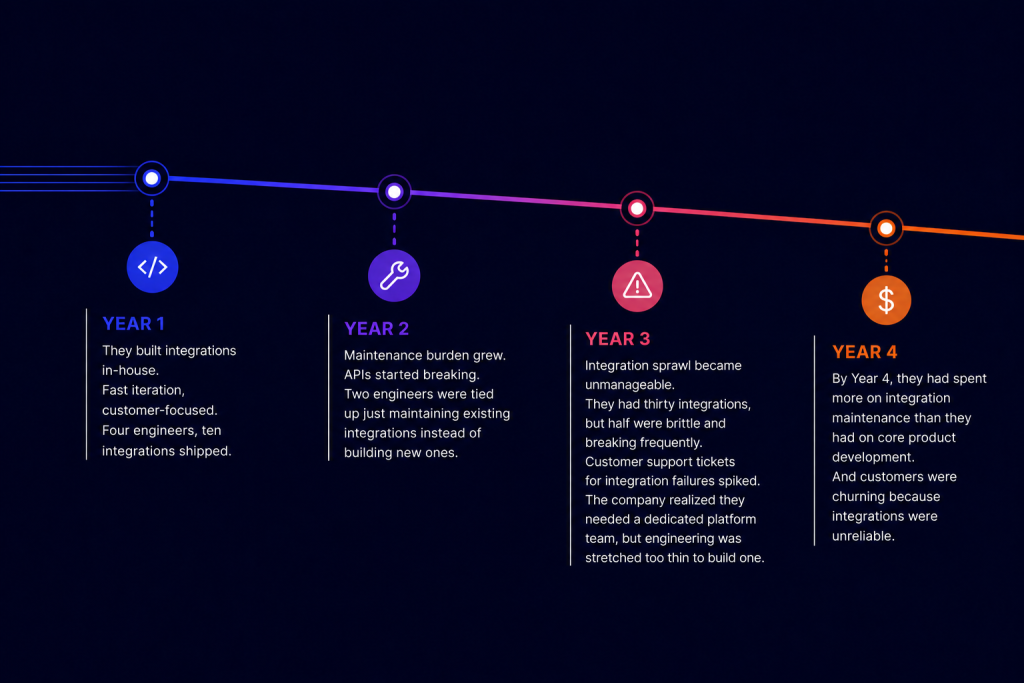
One cloud security vendor we know went through this cycle:
- Year 1: They built integrations in-house. Fast iteration, customer-focused. Four engineers, ten integrations shipped.
- Year 2: Maintenance burden grew. APIs started breaking. Two engineers were tied up just maintaining existing integrations instead of building new ones.
- Year 3: Integration sprawl became unmanageable. They had thirty integrations, but half were brittle and breaking frequently. Customer support tickets for integration failures spiked. The company realized they needed a dedicated platform team, but engineering was stretched too thin to build one.
- By Year 4, they had spent more on integration maintenance than they had on core product development. And customers were churning because integrations were unreliable.
This is the built-in-house trap. It feels fast at first. By Year 2 or 3, it is an anchor. This is exactly the dynamic Doug warns about when he describes integrations that are “clearly developed for the sale to close that deal, not developed to support the roadmap.”
## When Building In-House Actually Makes Sense
There are times when building in-house is the right call.
**Early stage (pre-Product-Market Fit)**: if you are a pre-PMF startup with one or two key customers, building a custom integration might be worth it. The upfront effort is small, and you have strategic input from the customer. You are not yet at scale.
**Strategic integrations:** if an integration is core to your product positioning, for example a cloud security tool that must integrate with Okta, AWS, and ServiceNow, building in-house might make sense. These are mission-critical integrations that you will maintain regardless of the vehicle.
**Proprietary integrations:** if a customer has a custom, proprietary tool that no one else uses, and that customer is large enough to warrant the investment, you might build a custom connector in-house. This is a deal-specific integration, not a product feature.
**Unique requirements:** if an integration requires deep customization or non-standard workflows that a platform approach cannot handle, in-house might be your only option.
A caution from the webinar: Doug Cahill shared a cautionary tale from his own time at a cloud security company. The team took a one-off deal that bent the product away from its ICP, set unrealistic revenue expectations with the board, and ate roadmap cycles before being wound down. “The big thing with startups is focus, focus, focus,” Doug said. A “yes” to an off-ICP integration is a “no” to focus.
For most cybersecurity vendors that ship product integrations at scale, building everything in-house is unsustainable.
## The Outsourcing Approach: Faster, But With Risks
The second option is to outsource integration development to a consulting firm or contract engineering shop.
This is faster than building in-house. You can ship integrations on an accelerated timeline. A firm like Accenture or a smaller boutique consulting shop can handle the engineering work while your team focuses on strategy and product.
But outsourcing has risks:
**Quality variability:** consultants build to spec. If the spec is missing edge cases or error handling, the integration will be brittle. Consultants are measured on delivery, not on long-term maintainability.
**Knowledge transfer problem:** when the consultant finishes the integration and leaves, your team must understand and maintain code they did not write. Code quality, documentation, and architecture decisions might not match your internal standards.
**Cost surprises:** outsourcing looks cheaper upfront, but when integrations break and you need to bring consultants back in, the costs add up. You are paying for context switching and re-learning.
**Lock-in risk:** if your integrations are built by external parties and you lack strong documentation, you are locked into those partners for maintenance and updates.
Hidden pre-work: as Doug Cahill stressed in the Integration Black Hole webinar, the integration itself is only one slice of the cost. Before any code is written, you need a technical alliance agreement, the right vendor contact, an NFR (not for resale) copy of the partner’s product, mock or test data, and access to API documentation that may be incomplete. Consultants rarely scope or own this pre-work, which means it lands back on your team.
One product manager we spoke with outsourced five integrations to accelerate time-to-market. The integrations shipped on time. But six months later, when APIs changed and integrations broke, bringing the consultants back cost more than building in-house would have. And the knowledge was lost: the consultants’ institutional understanding of those integrations was gone.
Outsourcing makes sense for one-off, non-core integrations. It does not make sense for integrations that are core to your product.
## The Platform Approach: Shifting the Burden
The third option is to use an integration platform or integration-as-a-service (IPaaS) solution.
This is the approach that is gaining traction in cybersecurity. Instead of building and maintaining integrations yourself, you use a platform that abstracts away the vendor-specific complexity. As Doug Cahill noted in the webinar, vendors now have “more options to bring integrations forward,” including the integration-as-a-service model, which handles delivery and maintenance.
Here is how it works:
You define which vendors you want to integrate with. The platform provides pre-built connectors for those vendors. You connect your product to the platform. The platform handles authentication, API versioning, rate limiting, error handling, and schema mapping.
When the vendor updates their API, the platform team updates the connector. Your integrations continue to work without any code changes on your end.
The benefits are clear:
- **Reduced maintenance burden:** you are not responsible for maintaining integrations. The platform is.
- **Faster time to market**: pre-built connectors mean you can ship integrations in days, not weeks.
- **Reliability**: platforms are built with production-grade error handling, monitoring, and incident response.
- **Scalability**: one platform can handle dozens of integrations. You do not need to scale your engineering team to match the number of integrations.
- **Cost efficiency**: for many vendors, the cost of a platform is lower than the cost of maintaining integrations in-house.
Platforms have trade-offs:
- **Loss of control**: you are dependent on the platform provider’s roadmap. If they do not support a vendor you need, you have to request it.
- **Vendor lock-in**: you are tied to the platform provider’s architecture for the integration
- **Customization limits**: platforms are good at standard integrations. If you need non-standard customizations, platforms might not support them.
- **Latency and performance**: adding a platform layer introduces potential latency and performance overhead.
For most cybersecurity vendors, the benefits of a platform approach outweigh the trade-offs. But it requires accepting that you are not building everything yourself, which is the same posture Doug describes when he talks about buyers wanting “many platforms of value,” open, interoperable, and ecosystem-friendly, rather than one platform to rule them all.
## The Synqly Approach: A Unified API for Security and IT Integrations
Synqly is solving the integration problem specifically for cybersecurity and IT ops vendors. The company provides a unified API platform that abstracts away vendor complexity and centrally handles integration maintenance.
Synqly is the connected platform built for Security, IT, and AI, providing a durable integration layer that scales with your product and doesn’t drag down your roadmap. Synqly handles auth, retries, and schema drift so your team can focus on building the core product, not babysitting APIs.
The platform approach means:
Pre-built connectors: over 150 vendors across security and IT categories. If your customer needs to integrate with AWS, CrowdStrike, Okta, ServiceNow, or over 150 other vendors, Synqly has connectors ready to go.
Centralized maintenance: when an API changes, Synqly updates the connector once. All customers benefit automatically.
Standards-based mapping: integrations map to OCSF (Open Cybersecurity Schema Framework), reducing the need for custom schema mapping on your end. (For the analyst view on OCSF’s promise and where adoption still has gaps, see the OCSF section of the Integration Black Hole webinar.)
Model Context Protocol: for AI-driven integrations and agentic workflows, Synqly MCP provides a standardized way for AI to interact with security tools without custom code.
With Synqly, a security vendor can reduce integration delivery time from weeks to days and reduce integration maintenance from a full-team effort to minimal oversight.
## Build, Outsource, or Platform: A 2026 Decision Framework
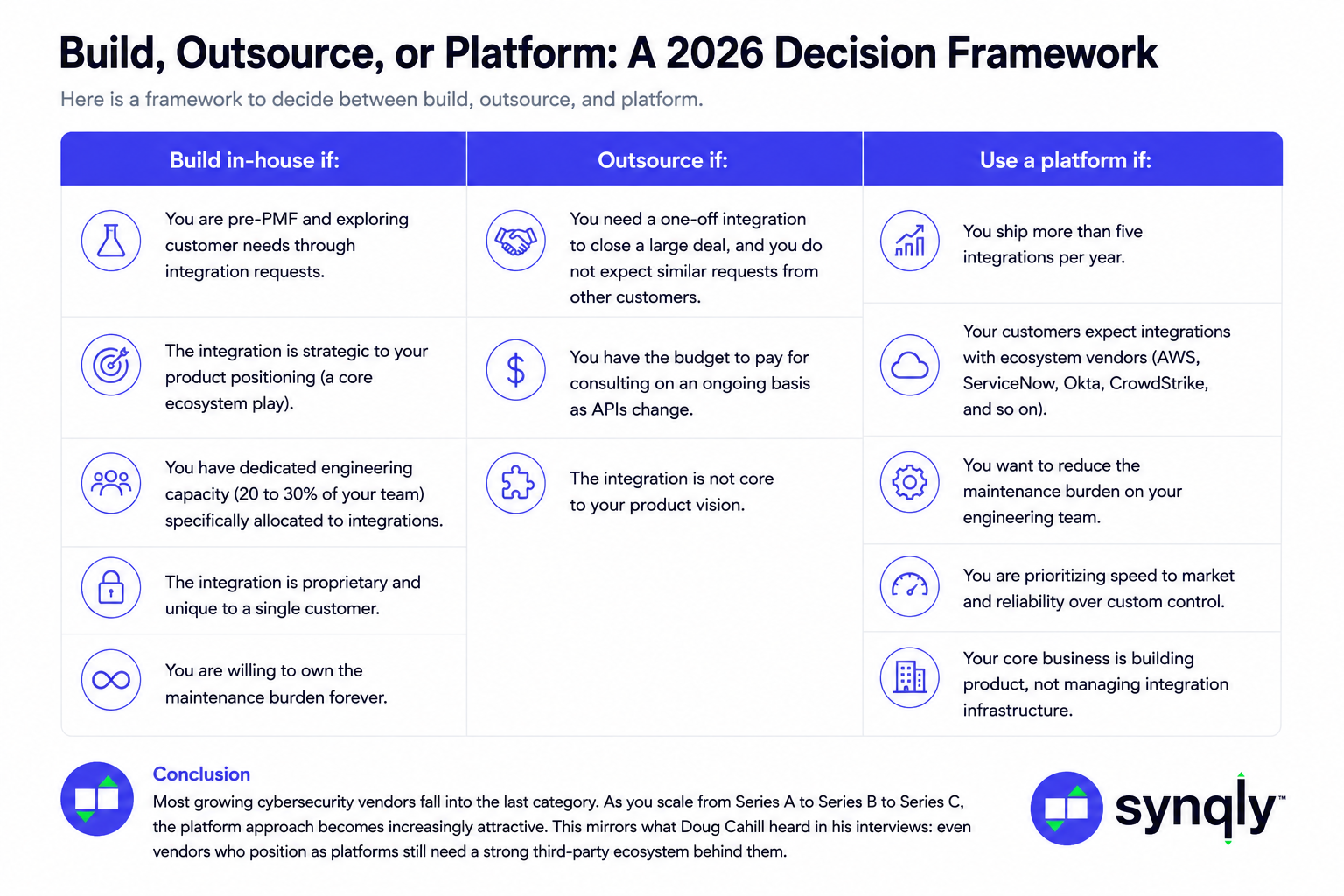
Here is a framework to decide between build, outsource, and platform.
**Build in-house if:**
- You are pre-PMF and exploring customer needs through integration requests.
- The integration is strategic to your product positioning (a core ecosystem play).
- You have dedicated engineering capacity (20 to 30% of your team) specifically allocated to integrations.
- The integration is proprietary and unique to a single customer.
- You are willing to own the maintenance burden forever.
**Outsource if:**
- You need a one-off integration to close a large deal, and you do not expect similar requests from other customers.
- You have the budget to pay for ongoing consulting as APIs change.
- The integration is not core to your product vision.
**Use a platform if:**
- You ship more than five integrations per year.
- Your customers expect integrations with ecosystem vendors (AWS, ServiceNow, Okta, CrowdStrike, and so on).
- You want to reduce the maintenance burden on your engineering team.
- You are prioritizing speed to market and reliability over custom control.
- Your core business is building products, not managing integration infrastructure.
Most growing cybersecurity vendors fall into the last category. As you scale from Series A to Series B to Series C, the platform approach becomes increasingly attractive. This mirrors what Doug Cahill heard in his interviews: even vendors who position themselves as platforms still need a strong third-party ecosystem behind them.
## The Founder’s Lesson
One founder of a Series B cybersecurity company shared this perspective:
*“We built our first five integrations in-house. It was fast, and we felt like we were in control. By integration number ten, we realized we had made a mistake. We were spending more time maintaining integrations than building features. We switched to a platform approach, and it freed up engineering capacity to focus on what we were actually good at: building the core product.”*
*“The cost was less than what we were spending on integration maintenance. The speed to market was better. And most importantly, we stopped treating integrations like they were features, and started treating them like what they are: infrastructure.”*
This is the path most successful vendors follow: build a few integrations in-house to understand the customer need, then switch to a platform approach to scale. Doug Cahill describes a similar arc in his research, vendors graduate from “deal of the day” thinking to a real integration lifecycle, with metrics, packaging, and go-to-market behind it.
## The Decision Is Not Permanent
The decision to build, outsource, or use a platform is not a permanent one.
Most vendors do a mix:
**Strategic integrations (core to your positioning):** build in-house or use a platform with deep customization.
**Market requirement integrations (table stakes for your category):** use a platform to ship them quickly and maintain them reliably.
**One-off integrations (customer-specific requests):** evaluate case by case. For ICP customers, consider building or using a platform. For outliers, consider outsourcing or politely declining.
The vendors winning in 2026 are the ones who have made peace with not building everything themselves. They are using platforms strategically to accelerate delivery, reduce maintenance burden, and free up engineering to focus on core product innovation.
The vendors struggling are the ones who said no to integration requests, or who are drowning in integration maintenance overhead.
Choose your path wisely.
## Resources for Your Integration Strategy
If you are evaluating integration strategy for your security vendor, start here:
**Audit your current integrations:** how many do you have? How much engineering time is spent maintaining them? [Download a copy of our Integrations Prioritization Scorecard](https://www.synqly.com/resources/the-integration-prioritization-scorecard/) to help sort through the readiness.
**Map to your strategy:** which integrations are strategic to your positioning? Which are market requirements? Which are one-offs? Download our Integration Prioritization Scorecard to help with those insights.
**Calculate the cost:** is your in-house approach actually cheaper than a platform approach?
**Explore options:** if a platform approach makes sense, [explore Synqly’s unified API](https://www.synqly.com/platform/) or other cybersecurity-focused integration platforms.
## Frequently Asked Questions
Sometimes. Building in-house makes sense pre-PMF, for proprietary or strategic integrations central to your product positioning, or for customer-unique connectors you can afford to maintain. For most vendors shipping more than five integrations a year, a unified API platform like Synqly removes the maintenance and API-drift burden that compounds with scale.
The integration ROI black hole, a term introduced by industry analyst Doug Cahill in Synqly’s research, is the gap between the cost of building and maintaining integrations and a vendor’s ability to attribute usage, value, and revenue back to them. The fix is visibility into customer usage, pricing and packaging that allows ARR attribution, and feature discoverability so customers actually adopt what you have shipped.
An integration platform makes sense when you ship more than five integrations per year, when your customers expect integrations with ecosystem vendors such as AWS, CrowdStrike, Okta, and ServiceNow, when integration maintenance is consuming more than 20% of engineering capacity, or when you want to prioritize speed to market and reliability over custom control.
A unified API for cybersecurity is a single integration layer that abstracts away the differences between vendor APIs across security and IT ops categories. Synqly’s unified API gives security and IT vendors pre-built connectors for over 150 providers, handles authentication, retries, rate limiting, and schema mapping, and aligns with OCSF (Open Cybersecurity Schema Framework) for standards-based data normalization.
Industry estimates put the cost of maintaining ten in-house integrations at roughly $300K to $400K per year, including one engineer at 50% capacity, plus the hidden pre-work of alliance agreements, NFR partner licenses, mock data, and API documentation. A platform approach typically costs $25K to $65K annually for unlimited integrations, and it frees engineering capacity for core product work.
**Talk to Synqly:** If you are evaluating OCSF for your product, [book a meeting with the Synqly team](https://www.synqly.com/demo/) to discuss integration strategy and mapping options.
[Meet with Synqly](https://www.synqly.com/demo/)
**Categories:** Blog
---
### [Expanding Vulnerability and Asset Integrations with Iru](https://www.synqly.com/expanding-vulnerability-and-asset-integrations-with-iru/)
**Published:** May 20, 2026
**Author:** Steven Erickson
**Excerpt:** OEM customers can seamlessly integrate with Iru to retrieve endpoint asset data and vulnerability findings. This capability empowers security vendors to deliver immediate value to organizations relying on Iru for endpoint detection and response and vulnerability visibility.
**Content:**
Iru is now a supported provider in the [Synqly Unified API](https://www.synqly.com/resources/synqly-unified-api-connect-once-to-many/ "Synqly Unified API. Connect Once to Many.") ecosystem. OEM customers can seamlessly integrate with Iru to retrieve endpoint asset data and vulnerability findings. This capability empowers security vendors to deliver immediate value to organizations relying on Iru for endpoint detection and response and vulnerability visibility.
Iru is an endpoint detection and response platform that provides critical visibility into endpoint assets and security monitoring. By tracking endpoint behavior and system details, the platform allows security teams to identify vulnerabilities and maintain a clear picture of their endpoint inventory. The service is trusted by organizations to deliver highly accurate endpoint data and actionable security findings. As a supported provider, Iru serves as a vital source of asset and vulnerability context, making it an invaluable integration for vendors building robust security posture, threat intelligence, and vulnerability management products.
Customers can use this new integration to extract crucial security data directly into their own applications. The connector is specifically tailored for the [Vulnerabilities category](https://www.synqly.com/connectors/vulnerability-management/), empowering vendors to query assets and query vulnerability findings directly from a customer’s Iru environment. By querying assets, security platforms can easily compile accurate asset inventories and track specific endpoints. Furthermore, querying findings ensures that security analysts have the exact vulnerability details required to prioritize remediation efforts effectively. The integration abstracts away the underlying authentication and API management, ensuring that data flows securely without requiring the vendor to build complex data pipelines from scratch.
This connector successfully synchronizes deep endpoint telemetry with broader operational workflows. By connecting through the Synqly Unified API ecosystem, we allow our OEM customers to interact with Iru data effortlessly. Customers can now offer a product experience where endpoint assets and vulnerabilities are automatically standardized and ingested, making the intelligence instantly actionable. This operational efficiency frees software engineering teams to focus on delivering core product features rather than maintaining brittle API connections.
We have published comprehensive documentation to assist with the setup process. You can find detailed configuration steps and endpoint instructions in our developer resources. We encourage all current and prospective customers to explore how they can improve their product capabilities with this new integration. To learn more about the specific endpoints and configuration steps, please visit the [Iru Configuration Guide](https://docs.synqly.com/guides/provider-configuration/iru-assets-setup) within the Synqly documentation.
**Categories:** Integration Announcements
---
### [Synqly Adds Iru Asset Management Integration to Its Ecosystem](https://www.synqly.com/synqly-adds-iru-asset-management-integration-to-its-ecosystem/)
**Published:** May 20, 2026
**Author:** Steven Erickson
**Excerpt:** Synqly is announcing an Iru asset management integration, adding Iru as a supported provider within Synqly's Assets category.
**Content:**
Synqly is announcing an Iru asset management integration, adding Iru as a supported provider within Synqly’s Assets category. This is a separate connector from the Iru Endpoint Management integration, purpose-built for teams that need to query Iru as a source of device inventory data within a broader asset management workflow.
[Iru](https://www.iru.com/products/endpoint/endpoint-detection-response) is an endpoint detection and response platform that unifies EDR, endpoint management, and vulnerability management through a single lightweight agent across Mac and Windows. One of the platform’s core strengths is the depth of endpoint asset data it collects. Every managed device running the Iru agent becomes a source of rich inventory information, covering hardware, operating system, application state, and security posture, all kept up to date as endpoints check in.
That asset visibility is what makes Iru a meaningful data source for teams building workflows that depend on knowing what devices exist in an environment, what they are running, and whether they are in a healthy state. Security operations teams use this data to scope investigations, enrich alerts, and validate that coverage is complete. IT operations teams use it to maintain accurate inventories, identify gaps in agent deployment, and support compliance reporting. For product and engineering teams building security or IT software, connecting to Iru as an asset source gives customers a fast path to pulling authoritative device inventory without building a bespoke integration against the Iru API.
The Iru asset management integration through Synqly supports a single, focused capability: querying devices from the Iru-linked asset inventory system. Through Synqly’s normalized query interface, OEM customers can retrieve a filtered list of devices from a customer’s connected Iru environment, using a consistent query language that works across the other asset management providers in Synqly’s ecosystem.
That consistency is the operational value here. A product team that builds a device query workflow against Synqly’s Assets connector does not write different code for every asset source their customers use. Whether the underlying provider is Iru or another supported asset management platform, the query returns data in the same normalized format. Iru just becomes another provider that the workflow covers, without any additional integration work on the product team’s side.
For customers whose asset of record is Iru, this means their endpoint inventory is accessible inside the products they use without manual exports, CSV imports, or API wrangling. Queries can be scoped by criteria defined by the product team, returning only the devices relevant to the workflow at hand. That could mean surfacing all devices in a specific group for a compliance check, pulling devices that have not checked in recently to trigger a follow-up workflow, or identifying endpoints missing expected software.
It is worth being clear about what this integration is and is not. The Iru Assets connector is a read-only query path into Iru’s device inventory. It does not include the compliance assessment, remediation, or active response capabilities covered by the separate Iru Endpoint Management integration. Teams that need both visibility and action should evaluate both connectors. Teams that specifically need Iru as an asset inventory source but not the full endpoint management surface can connect via this integration alone.
Because the integration is built on Synqly’s unified Assets connector architecture, coverage extends across multiple asset management providers through a single integration contract. Adding Iru support today does not require revisiting the underlying workflow when the next provider is added to the ecosystem.
## Where to Find More Details
The Iru asset management integration is now live and available to Synqly OEM customers. Full configuration details are available in the [Iru Assets Configuration Guide](https://docs.synqly.com/guides/provider-configuration/iru-assets-setup) in Synqly’s technical documentation.
To explore the full list of asset management providers and other integration categories available through Synqly, visit the [Synqly Integration Partners](https://www.synqly.com/integration-partners/) page. To see how the Iru asset management integration fits into your product’s workflow, [book a meeting](https://www.synqly.com/demo/) with the Synqly team.
**Categories:** Integration Announcements
---
### [Synqly Adds Iru to Its Endpoint Management Integration Ecosystem](https://www.synqly.com/synqly-adds-iru-to-its-endpoint-management-integration-ecosystem/)
**Published:** May 20, 2026
**Author:** Steven Erickson
**Excerpt:** Synqly is announcing the addition of Iru to its integration ecosystem. Iru is now available as a supported provider in Synqly's Endpoint Management category, giving OEM customers a direct path to building Iru integrations without having to stand up point-to-point connections from scratch.
**Content:**
Synqly is announcing the addition of [Iru](https://www.iru.com/products/endpoint/endpoint-detection-response) to its integration ecosystem. Iru is now available as a supported provider in Synqly’s Endpoint Management category, giving OEM customers a direct path to building Iru integrations without having to stand up point-to-point connections from scratch.
[Iru](https://www.iru.com/products/endpoint/endpoint-detection-response) is an endpoint detection and response platform built to prevent, detect, and contain attacks in real time across Mac and Windows environments. It operates through a single, low-overhead agent that unifies endpoint management, EDR, and vulnerability management on a single platform. Rather than stitching together multiple tools, Iru gives IT and security teams a unified view of device health, threat behavior, and compliance posture from a single console.
On the detection side, Iru uses real-time behavioral analysis and proprietary AI models to identify both known and unknown threats, including zero-day exploits, before lateral movement can occur. Its in-house security research team continuously tracks emerging attack techniques and feeds that intelligence back into the platform’s detection models. On the response side, Iru supports both Protect Mode, which terminates malicious processes and automatically quarantines files, and Detect Mode, which provides observability without enforcement for teams that need visibility before taking action. Device isolation is also available for serious threats, allowing compromised endpoints to be cut off from the network while Iru retains a secure remote connection.
For product and engineering teams building security and IT operations software, Iru is a meaningful target for integration. It serves organizations that have moved away from fragmented endpoint tooling in favor of a consolidated platform, and its combination of EDR and endpoint management data makes it a rich source for detection, compliance, and response workflows.
With Iru connected through Synqly’s unified API, OEM customers can query endpoint assets, surface compliance findings, and trigger remediation actions, all through the same normalized interface that applies across Synqly’s endpoint management ecosystem.
Device visibility is available at two levels. A single device can be retrieved by ID, pulling a specific endpoint record from the Iru-linked environment for use in alerts, dashboards, or investigation workflows. Broader queries return a filtered list of devices matching specified criteria, whether that means surfacing endpoints by operating system, identifying devices that have not recently checked in, or scoping to a particular group. Either way, that data flows through Synqly’s universal query language without requiring a custom Iru API client on the product team’s side.
Compliance data is surfaced through a separate query that returns device compliance findings from the connected Iru source. For teams building workflows around patch posture, configuration drift, or audit readiness, this gives them access to Iru’s compliance signal in a consistent format that travels across other endpoint management providers in the Synqly ecosystem, not just Iru alone.
Where the integration moves into active response is remediation. Product teams can trigger a remediation action on a specific Iru-managed device through Synqly, enabling a workflow to detect a compliance gap or threat condition and act on it immediately, without a manual handoff between systems. For teams building detection pipelines that need to close the loop on response, this capability makes the integration operationally useful rather than purely informational.
Because the Iru integration runs on Synqly’s unified endpoint management connector, the same workflow logic that calls Iru today can extend to other endpoint management providers in the future. Product teams build once and inherit coverage across the ecosystem as it grows, without revisiting the underlying integration architecture.
The Iru integration is now live and available to Synqly OEM customers. Full configuration details are available in the [Iru Endpoint Management Configuration Guide](https://docs.synqly.com/guides/provider-configuration/iru-endpointmanagement-setup) in Synqly’s technical documentation.
To explore the full list of endpoint management providers and other integration categories available through Synqly, visit the [Synqly Integration Partners](https://www.synqly.com/integration-partners/) page. To see how the Iru integration fits into your product’s workflow, [book a meeting](https://www.synqly.com/demo/) with the Synqly team.
**Categories:** Integration Announcements
---
### [Expanding Application Security Integrations with Veracode](https://www.synqly.com/expanding-application-security-integrations-with-veracode/)
**Published:** May 19, 2026
**Author:** Steven Erickson
**Excerpt:** Veracode is now a supported provider in the Synqly Unified API ecosystem. OEM customers can seamlessly integrate with Veracode to directly ingest powerful application security intelligence.
**Content:**
Veracode is now a supported provider in the Synqly Unified API ecosystem. OEM customers can seamlessly integrate with Veracode to directly ingest powerful application security intelligence. This capability empowers security vendors to create immediate value for organizations relying on Veracode to protect their proprietary code and software supply chains.
Veracode is a premier application security testing platform designed to help development teams find and fix flaws in their software. By offering static, dynamic, and software composition analysis, the platform provides a holistic view of application vulnerabilities from development through production. The service is trusted by enterprises because it delivers highly accurate vulnerability discovery and actionable remediation guidance. As a supported provider, Veracode serves as a critical source of application risk context, making it an invaluable integration for vendors building robust security posture, threat intelligence, and vulnerability management products.
Customers can use this new integration to extract crucial security data directly into their own applications. The connector is specifically tailored for the Application Security category, empowering vendors to query applications and query specific application findings from a customer’s Veracode environment. By querying applications, security platforms can easily compile accurate asset inventories. Furthermore, querying application findings ensures that security analysts have the exact vulnerability details required to prioritize remediation efforts effectively. The integration abstracts away the underlying authentication and API management, ensuring that data flows securely without requiring the vendor to build complex data pipelines from scratch.
This connector successfully synchronizes deep application security telemetry with broader operational workflows. By connecting through the Synqly Unified API ecosystem, we allow our OEM customers to interact with Veracode data effortlessly. Customers can now offer a product experience where application flaws are automatically standardized and ingested, making the intelligence instantly actionable. This operational efficiency frees software engineering teams to focus on delivering core product features rather than maintaining brittle API connections.
We have published comprehensive documentation to assist with the setup process. You can find detailed configuration steps and endpoint instructions in our developer resources. We encourage all current and prospective customers to see how they can improve their product capabilities by using this new integration. To learn more about the specific endpoints and configuration steps, please visit the [Veracode Configuration Guide](https://docs.synqly.com/guides/provider-configuration/veracode-appsec-setup) within the Synqly documentation.
**Categories:** Integration Announcements
---
### [Synqly Now Supports Jamf Pro Integration for Endpoint Management](https://www.synqly.com/synqly-now-supports-jamf-pro-integration-for-endpoint-management/)
**Published:** May 28, 2026
**Author:** Steven Erickson
**Content:**
Synqly is announcing support for Jamf Pro integration, adding Jamf Pro as a supported provider within Synqly’s Endpoint Management category. OEM customers building on the Synqly platform can now connect to Jamf Pro and deliver Apple device management workflows to their customers without writing and maintaining a point-to-point integration against the Jamf API.
[Jamf Pro](https://www.jamf.com/products/jamf-pro/) is the enterprise standard for Apple device management. Trusted by over 73,500 organizations and managing more than 31.3 million Apple devices worldwide, Jamf Pro handles the full lifecycle of Mac, iPhone, iPad, and Apple TV devices, from zero-touch deployment through ongoing configuration, security enforcement, and compliance monitoring.
Where Jamf Pro stands apart from general-purpose MDM platforms is its depth of Apple-native capability. It manages devices using Apple’s own frameworks, including Declarative Device Management for OS patching and configuration enforcement, which means device management actions happen efficiently and without requiring user interaction. Inventory management is automatic: hardware details, software state, and security configuration are collected from every managed device and kept up to date as endpoints check in. IT and security teams use that inventory to enforce compliance benchmarks, push software, restrict configurations, and issue remote commands ranging from software updates to device lock and wipe.
For product and engineering teams building security and IT operations software that serves Apple-heavy environments, Jamf Pro is often the system of record for endpoint data. Connecting to it means connecting to the authoritative source of Apple device inventory and compliance state for the organizations that use it.
With Jamf Pro connected through Synqly’s unified API, OEM customers can query Apple device inventory, retrieve individual device records, surface compliance findings, and trigger remediation actions, all through the same normalized endpoint management interface that applies across Synqly’s ecosystem.
Device lookup works at two levels. A single device can be retrieved by ID, pulling a specific Jamf-managed record directly into an alert, dashboard, or investigation workflow. Broader queries return a filtered list of devices that match specified criteria, tapping into Jamf Pro’s inventory data via Synqly’s universal query language. Whether the goal is scoping an incident to a set of affected Macs, identifying devices that have not checked in recently, or pulling device context to enrich a SIEM alert, that data is accessible without a custom Jamf API client on the product team’s side.
Compliance data is retrieved via a separate query that returns device compliance findings from the Jamf-linked environment. For teams building workflows around patch posture, configuration drift, or audit readiness, this surfaces Jamf Pro’s compliance signal in a normalized format that can be used across other endpoint management providers in the ecosystem. A product that uses Synqly to query Jamf Pro compliance today does not need to rewrite that logic when a customer uses a different endpoint management platform.
The integration also supports device remediation, where the workflow moves from visibility to action. Product teams can trigger a remediation action on a specific Jamf-managed Apple device through Synqly, enabling automated response to detected issues without requiring a manual handoff. For teams building detection pipelines or compliance enforcement workflows, this closes the loop between identifying a problem on an Apple device and addressing it.
Because the Jamf Pro integration is built on Synqly’s unified endpoint management connector, adding Jamf Pro support extends the same workflow logic that covers the rest of the ecosystem. A product team that integrates once with Synqly inherits coverage across endpoint management providers as the ecosystem grows, without revisiting the underlying integration architecture each time a new provider is added.
The Jamf Pro integration is now live and available to Synqly OEM customers. Full configuration details, including how to connect your Jamf Pro environment and authenticate via token, are available in the [Jamf Pro Endpoint Management Configuration Guide](https://docs.synqly.com/guides/provider-configuration/jamf-endpointmanagement-setup) in Synqly’s technical documentation.
To explore the full list of endpoint management providers and other integration categories available through Synqly, visit the [Synqly Integration Partners](https://www.synqly.com/integration-partners/) page. To evaluate how the Jamf Pro integration fits into your product’s workflow, [book a meeting](https://www.synqly.com/demo/) with the Synqly team.
**Categories:** Integration Announcements
---
### [Synqly Adds Automox to Its Endpoint Management Integration Ecosystem](https://www.synqly.com/synqly-adds-automox-to-its-endpoint-management-integration-ecosystem/)
**Published:** May 26, 2026
**Author:** Steven Erickson
**Content:**
Synqly is announcing the addition of [Automox](https://www.automox.com/) to its growing ecosystem of integration partners. Automox is now available as a supported provider within Synqly’s Endpoint Management category, giving OEM customers a fast path to delivering Automox integrations without building point-to-point connections from scratch.
[Automox](https://www.automox.com/) is a cloud-native endpoint management platform built for modern IT environments. Unlike legacy tools that require servers, distribution points, or VPN access to function, Automox manages Windows, macOS, and Linux endpoints entirely over HTTPS from a single console. It automates patch management for operating systems and over 580 third-party applications, enforces security configurations, and supports custom scripting through its Worklet automation library. IT and security operations teams use Automox to gain visibility and control over on-premises, remote, and virtual endpoints without the overhead of deploying and maintaining costly infrastructure. For product and engineering teams building security and IT operations software, Automox represents one of the most widely adopted platforms in the endpoint management space.
With Automox connected via Synqly’s unified API, OEM customers can query device inventory, assess patch and configuration compliance, and trigger remediation actions, all through a single normalized interface that spans Synqly’s broader endpoint management ecosystem.
On the visibility side, the integration supports pulling a single managed device record by ID or returning a filtered list of devices matching a given query. Whether a product team needs to surface endpoint inventory by operating system, identify devices that have not checked in recently, or pull specific device context into an alert pipeline, that data is accessible through Synqly’s universal query language without the need to maintain a bespoke Automox API client.
Compliance is covered by a separate capability that returns device compliance findings that match the query. For teams building workflows around patch posture, configuration drift, or regulatory requirements, this surfaces Automox compliance data in a consistent format that can be acted on regardless of which endpoint management provider sits behind the integration.
Where the integration moves beyond read-only is remediation. Product teams can trigger a remediation action directly on a managed Automox device through Synqly, enabling a workflow to detect a compliance gap or threat condition and close the loop without a manual handoff. That kind of automated response, tied to a standardized API contract, is what makes the Automox integration useful within a broader detection and response workflow, not just a data source.
Because the integration is built on Synqly’s unified endpoint management connector, a product team that adds Automox support today inherits the same integration logic used for other providers in the ecosystem. There is no need to rewrite the underlying workflow when the next endpoint management provider gets added.
This matters operationally. Engineering teams that have historically spent weeks building and maintaining a single vendor integration can now redirect that effort toward the features and workflows that differentiate their product. Synqly handles the translation layer, the connection management, and the normalization, so the integration does not become a maintenance liability over time.
The Automox integration is live and available to Synqly OEM customers today. Full configuration details, including how to connect your Automox account and authenticate via token, are available in the [Automox Endpoint Management Configuration Guide](https://docs.synqly.com/guides/provider-configuration/automox-endpointmanagement-setup) in Synqly’s technical documentation.
To explore the full list of endpoint management providers and other integration categories available through Synqly, visit the [Synqly Integration Partners](https://www.synqly.com/integration-partners/) page. If you are ready to evaluate how the Automox integration fits into your product’s workflow, [book a meeting](https://www.synqly.com/demo/) with the Synqly team.
**Categories:** Integration Announcements
---
### [Synqly Adds Tenable Web Application Scanner to Ecosystem for Application Security](https://www.synqly.com/synqly-adds-tenable-web-application-scanner-to-ecosystem-for-application-security/)
**Published:** May 14, 2026
**Author:** Steven Erickson
**Excerpt:** We have introduced Tenable Web Application Scanner as a supported provider. Vendor customers can now integrate with Tenable Web Application Scanner through the Synqly ecosystem.
**Content:**
We are sharing that a new integration is live within the Synqly integration ecosystem. As modern security operations teams expand their visibility across web applications, we are dedicated to ensuring our customers can access the tools they need. We have introduced Tenable Web Application Scanner as a supported provider. Vendor customers can now [integrate with Tenable Web Application Scanner](https://www.synqly.com/integration-partners/tenable-web-application-scanner/) through the Synqly ecosystem. This addition enables security vendors to seamlessly interact with dynamic application security testing data, creating immediate value for end users who rely on Tenable for securing their web interfaces and applications.
[Tenable Web Application Scanner](https://www.tenable.com/products/web-app-scanning) provides comprehensive vulnerability scanning for modern web applications. By automating dynamic application security testing, the platform identifies critical web application vulnerabilities, including cross-site scripting, SQL injection, and other common threats. As a supported provider, Tenable Web Application Scanner serves as a critical source of application risk data, making it an essential integration for any vendor building security operations, vulnerability management, or automated remediation features.
Synqly customers can use this integration to perform vital data retrieval functions within their own products. The connector is specifically designed to function within the Application Security category, enabling vendors to query findings, retrieve vulnerability details, and assess asset inventories directly from a customer’s Tenable instance. By using the capability to query application findings, security vendors can ensure that their risk assessments and reporting tools reflect the real-time vulnerability status of an organization’s web assets. The integration handles the authentication and connection management, ensuring that the data pipeline remains robust and secure without requiring the vendor to manage the underlying API complexity.
The value of this connector lies in its ability to bridge the gap between application security testing and active security operations. By integrating through the [Synqly unified API](https://www.synqly.com/5-reasons-to-choose-a-security-focused-unified-api-platform-over-outsourced-development/ "5 Reasons to Choose a Unified API Over Outsourced Development"), we enable our OEM customers to support Tenable Web Application Scanner as a source of intelligence without building a custom adapter. Customers can now deliver a streamlined experience in which application security events are automatically formatted and synced, ready for immediate operational use. This efficiency allows product teams to focus on generating high-quality security insights rather than maintaining infrastructure for complex API interactions.
For those interested in implementing this new capability, we have provided documentation to guide you through the setup process. You can find detailed instructions for configuring the connector and using the available endpoints in our documentation. We encourage all current and prospective customers to explore how they can enhance their product offerings by using this new integration.
To learn more about the specific endpoints and configuration steps, please visit the [Application Security Configuration Guide](https://docs.synqly.com/guides/provider-configuration/tenable-vulns-setup) within the Synqly documentation.
**Categories:** Integration Announcements
---
### [Expanding Email Security Integrations with Microsoft Defender for Office 365](https://www.synqly.com/expanding-email-security-integrations-with-microsoft-defender-for-office-365/)
**Published:** May 8, 2026
**Author:** Steven Erickson
**Excerpt:** Learn how to integrate with Microsoft Defender for Office 365 using Synqly. Our connector enables seamless email security integrations for OEM customers.
**Content:**
We are adding another powerful connector to the Synqly integrations ecosystem. As threat actors continue to target organizational communications, providing robust visibility into email security is paramount for modern security operations. We have established [Microsoft Defender for Office 365](https://learn.microsoft.com/en-us/azure/defender-for-cloud/defender-for-cloud-introduction) as a supported provider within our platform. Vendor customers can now [integrate with Microsoft Defender ](https://www.synqly.com/integration-partners/microsoft-defender-for-office-365/ "Microsoft Defender for Office 365")for Office 365 through the Synqly ecosystem. This functionality enables security vendors to seamlessly integrate critical email threat data into their platforms, creating significant value for end users who depend on Microsoft to guard against malicious links, phishing attempts, and advanced malware.
Microsoft Defender for Office 365 is a comprehensive cloud-based email filtering service designed to protect corporate environments from advanced threats. By scanning email messages, attachments, and links in real time, the service identifies and neutralizes attacks before they reach the inbox. Because it is deeply embedded in the Microsoft ecosystem, the platform provides unparalleled visibility into communication-based risks. As a supported provider in the Email Security category, Microsoft Defender for Office 365 acts as an essential telemetry source, making it a critical integration for vendors developing incident response, threat intelligence, and security operations solutions.
Synqly customers can use this integration to extract vital security data directly into their own applications. The connector is specifically engineered for the Email Security category, empowering vendors to query email events, uncover threats, and extract detailed threat intelligence from a customer’s Microsoft environment. By querying email events, security platforms can aggregate communication logs for deeper analysis. Furthermore, the capability to retrieve specific threat details ensures that security analysts have the comprehensive context required to triage and respond to incidents accurately. The integration handles all underlying authentication and connection management, ensuring that data flows securely without requiring the vendor to navigate complex Microsoft Graph API architectures.
The true value of this connector rests in its ability to synchronize email security telemetry with broader security workflows. By integrating through the Synqly unified API, we allow our OEM customers to tap into Microsoft Defender for Office 365 without building a custom data adapter from scratch. Customers can now offer a seamless experience where email threats and event logs are automatically standardized and ingested, making the data instantly actionable. This operational efficiency frees product engineering teams to focus on building innovative security features rather than maintaining brittle API connections.
For teams ready to implement this new feature, we have published thorough documentation to assist with the setup process. You can find detailed configuration steps and endpoint instructions in our developer resources. We encourage all current and prospective customers to explore how they can improve their product capabilities with this new integration.
To learn more about the specific endpoints and configuration steps, please visit the [Email Security Configuration Guide](https://docs.synqly.com/guides/connectors/emailsecurity/overview) within the Synqly documentation.
**Categories:** Integration Announcements
---
### [Synqly Adds Datadog Cloud SIEM to Ecosystem for Security and Observability Integrations](https://www.synqly.com/synqly-customers-can-integrate-with-datadog-cloud-siem/)
**Published:** May 12, 2026
**Author:** Steven Erickson
**Excerpt:** Learn how to integrate with Datadog Cloud SIEM using Synqly. Our new connector enables seamless security and observability integrations for OEM customers.
**Content:**
We are sharing that a new integration is live within the Synqly integration ecosystem. As modern security operations teams require unified visibility across their cloud infrastructure and applications, we continue to expand our library of supported connectors. We have introduced Datadog Cloud SIEM as a supported provider. OEM customers can now [integrate with Datadog Cloud SIEM](https://www.synqly.com/integration-partners/datadog-cloud-siem/) through the Synqly ecosystem. This addition enables security vendors to seamlessly interact with a leading cloud-scale observability platform, creating immediate value for end users who rely on Datadog for their security and log management needs.
[Datadog](https://www.datadoghq.com/) is a cloud-scale observability and security platform that provides infrastructure monitoring, application performance management, log management, and cloud security capabilities in a unified SaaS platform. By bringing together operational metrics and security signals, Datadog allows teams to break down silos and correlate security events with infrastructure changes. As a supported provider in the SIEM category, Datadog serves as a critical destination and source for security data, making it an essential integration for any vendor generating security telemetry or building incident response workflows.
Synqly customers can use this integration to perform vital bi-directional data functions within their own products. The connector is specifically designed to function within the SIEM category, enabling vendors to write batches of event objects directly to a customer’s Datadog instance using the Post Events capability. In addition to functioning as a destination, vendors can also query alerts, retrieve specific alert details, and query available log providers. By using these capabilities, security vendors can ensure their tools have the most accurate, real-time security intelligence and can seamlessly push their own telemetry into Datadog’s unified platform. The integration handles the authentication and connection management, ensuring that the data pipeline remains robust and secure without requiring the vendor to manage the underlying API complexity.
The value of this connector lies in its ability to bridge the gap between product telemetry and centralized observability. By integrating through the Synqly unified API, we enable our OEM customers to support Datadog Cloud SIEM as both a source of intelligence and a destination for events without building a custom adapter. Customers can now deliver a streamlined experience in which their product data is automatically formatted for Datadog, while simultaneously pulling critical alert data back into their own interfaces. This efficiency allows product teams to focus on generating high-quality security insights rather than maintaining infrastructure for complex API interactions.
For those interested in implementing this new capability, we have provided documentation to guide you through the setup process. You can find detailed instructions for configuring the connector and using the available endpoints in our documentation. We encourage all current and prospective customers to explore how they can enhance their product offerings by using this new integration.
To learn more about the specific endpoints and configuration steps, please visit the [Datadog Cloud SIEM Configuration Guide](https://docs.synqly.com/guides/provider-configuration/datadog-sink-setup) within the Synqly documentation.
**Categories:** Integration Announcements
---
### [Synqly Adds Panther Labs to Ecosystem for High-Scale Event Streaming](https://www.synqly.com/synqly-adds-panther-labs-to-ecosystem-for-high-scale-event-streaming/)
**Published:** January 27, 2026
**Author:** Steven Erickson
**Content:**
We are pleased to announce that a new integration is live within the Synqly integration partner ecosystem. As modern security operations teams increasingly move toward cloud-native architectures, we are dedicated to ensuring our customers can access the most advanced tools on the market. We are excited to share that OEM customers can now [integrate with Panther Labs](https://www.synqly.com/integration-partners/panther-siem-for-sink-integrations/) through the Synqly Mesh. This addition empowers security vendors to seamlessly stream events to one of the most powerful detection-as-code platforms, creating immediate value for end users who rely on Panther for real-time security analytics.
[Panther Labs](https://panther.com/) has redefined the traditional [SIEM](https://csrc.nist.gov/glossary/term/security_information_and_event_management_tool "SIEM") model by building a serverless, cloud-native platform designed for extreme scale and flexibility. Unlike legacy systems that struggle with the volume of modern data, Panther uses a detection-as-code approach, allowing security teams to write Python-based detections and automate their response workflows.
Panther’s platform enables organizations to centralize security data in a data lake for real-time analysis, ensuring threats are identified and remediated quickly and precisely. As a supported provider, Panther serves as a critical destination for high-volume security logs, making it an essential integration for any vendor generating security telemetry.
Synqly customers can leverage this integration to perform vital data streaming functions within their own products. The connector is specifically designed to function as a “Sink,” enabling vendors to write batches of event objects directly to a customer’s Panther instance. By using the “Post Events” capability, security vendors can ensure that their alerts, logs, and audit trails are reliably delivered to the SOC for analysis. This capability is particularly important for vendors whose data provides the context needed for threat hunting and incident response. Furthermore, the integration handles the authentication and connection management, ensuring that the data pipeline remains robust and secure without requiring the vendor to manage the underlying API complexity.
The value of this connector lies in its ability to bridge the gap between product telemetry and security operations. By integrating through the [Synqly unified API](https://www.synqly.com/resources/synqly-unified-api-connect-once-to-many/ "Synqly Unified API. Connect Once to Many."), we enable our OEM customers to support Panther as a destination without building a custom exporter.
Customers can now deliver a streamlined experience in which their product data is automatically formatted and ingested by Panther, ready for immediate application of detection logic. This efficiency allows product teams to focus on generating high-quality security insights rather than maintaining infrastructure for data delivery.
For those interested in implementing this new capability, we have provided documentation to guide you through the setup process. You can find detailed instructions for configuring the connector and using the available endpoints in our documentation. We encourage all current and prospective customers to explore how they can enhance their product offerings by leveraging this powerful new integration.
To learn more about the specific endpoints and configuration steps, please visit the [Sink Configuration Guide](https://docs.synqly.com/guides/connectors/sink/overview#supported-providers) within the Synqly documentation.
**Categories:** Blog, Integration Announcements
---
### [Synqly Expands Amazon Inspector Integration to Vulnerability Management](https://www.synqly.com/synqly-expands-amazon-inspector-integration-to-vulnerability-management/)
**Published:** February 4, 2026
**Author:** Steven Erickson
**Content:**
We are pleased to announce that a new integration is live within the [Synqly integration partner ecosystem](https://www.synqly.com/synqly-explore-our-cybersecurity-integration-partners/ "Synqly | Explore our Cybersecurity Integration Partners"). As modern security operations teams increasingly adopt cloud-native architectures, we are dedicated to ensuring our customers have access to the most advanced tools on the market. We are excited to share that Synqly customers can now [integrate with Amazon Inspector](https://www.synqly.com/integration-partners/amazon-inspector-for-vulnerabilities-integrations/) through the Synqly Mesh. This addition empowers security vendors to seamlessly sync vulnerability data with the premier automated vulnerability management service for AWS, creating immediate value for end users who rely on Inspector for continuous security assessment.
[Amazon Inspector](https://aws.amazon.com/inspector/) has redefined how organizations secure their AWS workloads by offering an automated vulnerability management service that continually scans AWS workloads for software vulnerabilities and unintended network exposure. Unlike legacy systems that require manual agent management and struggle with the dynamic nature of cloud environments, Inspector uses an automated scanning engine that triggers instantly upon resource deployment.
Inspector’s platform enables organizations to centralize vulnerability data across their entire AWS Organization for real-time analysis, ensuring threats are identified and remediated quickly and precisely. As a supported provider, Amazon Inspector serves as a critical source of truth for cloud vulnerabilities, making it an essential integration for any vendor managing cloud security posture.
Synqly customers can leverage this integration to perform vital data synchronization functions within their own products. The connector is specifically designed to function within the Vulnerability Management category, enabling vendors to query findings and assets directly from a customer’s Inspector instance. By using the “Query Findings” capability, security vendors can ensure that their risk assessments, dashboards, and reports reflect the most current state of an environment.
This capability is particularly important for vendors whose data provides the context needed for risk prioritization and compliance reporting. Furthermore, the integration handles authentication and connection management, ensuring the data pipeline remains robust and secure without requiring the vendor to manage the underlying AWS SDK or the complexity of role assumption.
The value of the Amazon Inspector integration lies in its ability to bridge the gap between cloud infrastructure and security operations. By integrating through the Synqly unified API, we enable our OEM customers to support Amazon Inspector as a source without building a custom collector. Customers can now deliver a streamlined experience in which their product data is automatically formatted and ingested from Inspector, ready for immediate application of risk logic. This efficiency allows product teams to focus on generating high-quality security insights rather than maintaining infrastructure for data delivery.
For those interested in implementing this new capability, we have provided documentation to guide you through the setup process. You can find detailed instructions for configuring the connector and using the available endpoints in our documentation. We encourage all current and prospective customers to explore how they can enhance their product offerings by leveraging this powerful new integration.
To learn more about the specific endpoints and configuration steps, please visit the [AWS Inspector Configuration Guide](https://docs.synqly.com/guides/provider-configuration/amazon-inspector-appsec-setup) within the Synqly documentation.
**Categories:** Blog, Integration Announcements
---
### [Synqly Expands Microsoft Defender for Endpoint to Ecosystem for Vulnerability Management](https://www.synqly.com/synqly-expands-microsoft-defender-for-endpoint-to-ecosystem-for-vulnerability-management/)
**Published:** February 9, 2026
**Author:** Steven Erickson
**Content:**
We are pleased to announce that a new integration is live within the Synqly integration partner ecosystem. As modern security operations teams increasingly adopt unified endpoint protection strategies, we are committed to ensuring our customers have access to the most advanced tools on the market. We are excited to share that OEM customers can now [integrate with Microsoft Defender for Endpoint](https://www.synqly.com/integration-partners/microsoft-defender-for-endpoint-for-vulnerabilities-integrations/) with Synqly. This addition empowers security vendors to seamlessly sync vulnerability data with Microsoft’s industry-leading endpoint security platform, creating immediate value for end users who rely on Defender for comprehensive threat and vulnerability management.
Microsoft Defender for Endpoint has redefined how organizations approach endpoint security by delivering a unified platform for preventative protection, post-breach detection, automated investigation, and response. A core component of this platform is Threat and Vulnerability Management, which provides real-time visibility into the endpoint fleet posture without requiring additional agents. Unlike legacy systems that rely on periodic scans, Defender uses the operating system’s built-in sensors to continuously discover vulnerabilities and misconfigurations. As a supported provider, Microsoft Defender for Endpoint serves as a critical source of truth for endpoint risk, making it an essential integration for any vendor assessing organizational security posture.
Synqly customers can leverage this integration to perform critical data synchronization within their products. The connector is designed for the Vulnerability Management category, enabling vendors to query findings and assets directly from a customer’s Microsoft Defender instance. By using the “Query Findings” capability, security vendors can ensure that their risk assessments, dashboards, and reporting tools reflect the real-time vulnerability status of the endpoint estate. This capability is particularly important for vendors whose data provides the context needed for prioritizing remediation based on active threat intelligence. Furthermore, the integration handles the authentication and connection management, ensuring that the data pipeline remains robust and secure without requiring the vendor to manage the underlying Graph API complexity.
The value of this connector lies in its ability to bridge the gap between endpoint telemetry and broader security operations. By integrating through the Synqly unified API, we enable our OEM customers to support Microsoft Defender for Endpoint as a source without building a custom collector. Customers can now deliver a streamlined experience in which their product data is automatically formatted and ingested from Defender, ready for immediate analysis. This efficiency allows product teams to focus on generating high-quality security insights rather than maintaining infrastructure for data delivery.
For those interested in implementing this new capability, we have provided documentation to guide you through the setup process. You can find detailed instructions for configuring the connector and using the available endpoints in our documentation. We encourage all current and prospective customers to explore how they can enhance their product offerings by leveraging this powerful new integration.
To learn more about the specific endpoints and configuration steps, please visit the [Vulnerability Management Configuration Guide](https://docs.synqly.com/guides/connectors/vulnerabilities/overview#supported-providers) within the Synqly documentation.
**Categories:** Blog, Integration Announcements
---
### [Synqly Adds ESET Connect to Ecosystem for Enhanced Endpoint Security](https://www.synqly.com/synqly-adds-eset-connect-to-ecosystem-for-enhanced-endpoint-security/)
**Published:** February 10, 2026
**Author:** Steven Erickson
**Content:**
We are pleased to announce that a new integration is live within the Synqly integration partner ecosystem. As modern security operations teams face increasingly sophisticated threats, we are committed to ensuring our customers have access to the most advanced tools on the market. We are excited to share that OEM customers can now [integrate with ESET](https://www.synqly.com/integration-partners/eset-connect-for-edr-integrations/) Connect through Synqly. This addition enables security vendors to seamlessly integrate with ESET’s endpoint detection and response capabilities, delivering immediate value to end users who rely on ESET for multilayered protection.
ESET Connect is the gateway to the ESET PROTECT Platform, providing a comprehensive security management solution that combines automated threat prevention with granular visibility. Known for its lightweight agents and high detection rates, ESET has established itself as a global leader in endpoint security, protecting millions of users worldwide. The platform enables organizations to manage their security posture across diverse environments, from workstations to mobile devices. As a supported provider, ESET Connect acts as a central hub for endpoint telemetry and response actions, making it an essential integration for any vendor looking to incorporate robust EDR capabilities into their offering.
Synqly customers can leverage this integration to perform critical security operations within their own products. The connector is designed for use in the Endpoint Security category, enabling vendors to query alerts, endpoints, and threat events directly from a customer’s ESET instance. By using the “Quarantine Endpoints” capability, security vendors can even trigger automated response actions, isolating compromised devices to prevent lateral movement.
The integration supports advanced use cases, such as creating and deleting Indicators of Compromise (IOCs), enabling dynamic threat hunting and blocking. This capability is particularly important for vendors whose solutions rely on real-time data to orchestrate incident response. Furthermore, the integration handles authentication and connection management, ensuring robust, secure interactions with the ESET Connect API without requiring the vendor to manage complex token lifecycles.
The value of this connector lies in its ability to bridge the gap between detection logic and enforcement. By integrating through the Synqly unified API, we enable our OEM customers to support ESET Connect as both a source of high-fidelity data and a control point without building a custom adapter. Customers can now deliver a streamlined experience in which their product data is automatically formatted and synced with ESET, ready for immediate operational use. This efficiency allows product teams to focus on generating high-quality security insights rather than maintaining infrastructure for API connectivity.
For those interested in implementing this new capability, we have provided documentation to guide you through the setup process. You can find detailed instructions for configuring the connector and using the available endpoints in our documentation. We encourage all current and prospective customers to explore how they can enhance their product offerings by leveraging this powerful new integration.
To learn more about the specific endpoints and configuration steps, please refer to the [ESET Integration Configuration Guide](https://docs.synqly.com/guides/provider-configuration/eset-edr-setup#1-introduction) in the Synqly documentation.
**Categories:** Blog, Integration Announcements
---
### [Synqly Expands Panther Labs Integration to Include Full SIEM Capabilities](https://www.synqly.com/synqly-expands-panther-labs-integration-to-include-full-siem-capabilities/)
**Published:** February 23, 2026
**Author:** Steven Erickson
**Content:**
We are pleased to announce that a new integration is live within the Synqly integration partner ecosystem. As modern security operations teams increasingly adopt cloud-native architectures, we are dedicated to ensuring our customers have access to the most advanced tools on the market. We are excited to share that OEM customers can now [integrate with Panther Labs](https://www.synqly.com/integration-partners/panther-siem-for-siem-integrations/) via the Synqly unified API to enable comprehensive SIEM use cases. This addition empowers security vendors to seamlessly interact with Panther’s detection-as-code platform beyond just event streaming, creating immediate value for end users who rely on Panther for incident response and threat investigation.
Panther Labs has redefined the traditional SIEM model by building a serverless, cloud-native platform designed for extreme scale and flexibility. Unlike legacy systems that struggle with the volume of modern data, Panther uses a detection-as-code approach, allowing security teams to write Python-based detections and automate their response workflows. Panther’s platform enables organizations to centralize security data in a data lake for real-time analysis, ensuring threats are identified and remediated quickly and precisely. As a supported provider in the SIEM category, Panther serves as a critical hub for security telemetry and investigation workflows, making it an essential integration for any vendor building security operations features.
Synqly customers can leverage this integration to perform vital bi-directional data functions within their own products. The connector is specifically designed for the SIEM category, enabling vendors to query alerts, events, and investigations directly from a customer’s Panther instance. By using the “Query Alerts” and “Get Investigation” capabilities, security vendors can ensure that their analysts have the most up-to-date context when responding to incidents. The integration enables vendors to update investigations and retrieve evidence, streamlining case management across tools. The integration handles the authentication and connection management, ensuring that the data pipeline remains robust and secure without requiring the vendor to manage the underlying API complexity.
The value of this connector lies in its ability to bridge the gap between product telemetry and active security operations. By integrating through the Synqly unified API, we enable our OEM customers to support Panther as both a source of intelligence and a destination for events without building a custom adapter. Customers can now deliver a streamlined experience in which their product data is automatically formatted for Panther, while simultaneously pulling critical alert data back into their own interfaces. This efficiency allows product teams to focus on generating high-quality security insights rather than maintaining infrastructure for complex API interactions.
For those interested in implementing this new capability, we have provided documentation to guide you through the setup process. You can find detailed instructions for configuring the connector and using the available endpoints in our documentation. We encourage all current and prospective customers to explore how they can enhance their product offerings by leveraging this powerful new integration.
To learn more about the specific endpoints and configuration steps, please visit the [Panther SIEM Configuration Guide](https://docs.synqly.com/guides/provider-configuration/panther-siem-setup) within the Synqly documentation.
**Categories:** Blog, Integration Announcements
---
### [Synqly Adds Mimecast Cloud Gateway as First Integration in New Email Security Category](https://www.synqly.com/synqly-adds-mimecast-cloud-gateway-as-first-integration-in-new-email-security-category/)
**Published:** April 7, 2026
**Author:** Steven Erickson
**Content:**
We are sharing that a new integration is live within the Synqly integration partner ecosystem. As modern security operations teams expand their visibility across all threat vectors, email remains a critical focus area. Synqly has launched the new Email Security category and introduced [Mimecast Cloud Gateway](https://www.synqly.com/integration-partners/mimecast-cloud-gateway/ "Mimecast Cloud Gateway") as the inaugural supported provider. Synqly vendor customers can now integrate with Mimecast Cloud Gateway through the [Synqly Unified API](https://www.synqly.com/platform/ "Synqly Mesh | Cybersecurity Integration Platform"). This addition empowers security vendors to seamlessly integrate with Mimecast’s email security events and threat intelligence, delivering immediate value to end users who rely on Mimecast for protection against phishing, ransomware, and business email compromise.
Mimecast is an email security and cyber resilience platform that provides advanced threat protection, data leak prevention, email continuity, and archiving capabilities. Because email remains a primary vector for cyberattacks, Mimecast is widely adopted by organizations to defend their communications and data. As a supported provider in the Email Security category, Mimecast serves as a critical source of threat telemetry, making it an essential integration for any vendor building security operations, incident response, or threat intelligence features.
Synqly customers can leverage this integration to perform vital data retrieval functions within their own products. The connector is specifically designed to function within the new Email Security category, enabling vendors to query threats and retrieve threat details directly from a customer’s Mimecast instance. By using the “Query Threats” capability, security vendors can access a list of automated detections that Mimecast deems threats. Furthermore, the “Get Threat Details” endpoint allows analysts to pull granular information about specific threats, ensuring that they have the comprehensive context needed for investigation and remediation. The integration handles the authentication and connection management, ensuring that the data pipeline remains robust and secure without requiring the vendor to manage the underlying API complexity.
The value of this connector lies in its ability to bridge the gap between email telemetry and active security operations. By integrating through the [Synqly unified API](https://www.synqly.com/resources/synqly-unified-api-connect-once-to-many/ "Synqly Unified API. Connect Once to Many."), we enable our OEM customers to support Mimecast as a source of intelligence without building a custom adapter. Customers can now deliver a streamlined experience in which email security events are automatically formatted and synced, ready for immediate operational use. This efficiency allows product teams to focus on generating high-quality security insights rather than maintaining infrastructure for complex API interactions.
For those interested in implementing this new capability, we have provided documentation to guide you through the setup process. You can find detailed instructions for configuring the connector and using the available endpoints in our documentation. We encourage all current and prospective customers to explore how they can enhance their product offerings by leveraging this new integration.
To learn more about the specific endpoints and configuration steps, please visit the [Mimecast Cloud Gateway Configuration Guide](https://docs.synqly.com/guides/provider-configuration/mimecast-cloud-gateway-emailsecurity-setup) within the Synqly documentation.
**Categories:** Blog, Integration Announcements
---
### [Synqly Adds Upwind to Ecosystem for Cloud Security Integrations](https://www.synqly.com/synqly-adds-upwind-to-ecosystem-for-cloud-security-integrations/)
**Published:** April 9, 2026
**Author:** Steven Erickson
**Content:**
We are sharing that a new integration is live within the Synqly integration ecosystem. As modern security operations teams expand their visibility across diverse environments, cloud security remains a critical focus area. We have introduced Upwind as a supported provider in our Cloud Security category. OEM customers can now [integrate with Upwind](https://www.synqly.com/integration-partners/upwind-cloud-security/ "Upwind Cloud Security") Cloud Security through the Synqly ecosystem. This addition enables security vendors to seamlessly integrate with Upwind’s runtime-powered cloud security findings, delivering immediate value to end users who rely on Upwind for comprehensive cloud-native application protection.
Upwind is a runtime-powered cloud security platform that provides cloud-native application protection by combining real-time runtime context with posture management. Upwind uses lightweight eBPF-based sensors to understand actual runtime behavior, enabling teams to distinguish exploitable vulnerabilities from theoretical ones across cloud workloads, containers, APIs, and identities. As a supported provider in the Cloud Security category, Upwind provides critical runtime-aware cloud telemetry, making it an essential integration for any vendor building security operations, incident response, or vulnerability management features.
Synqly customers can use this integration to perform vital data retrieval functions within their own products. The connector is specifically designed to function within the Cloud Security category, enabling vendors to query a variety of data points directly from a customer’s Upwind instance. Security vendors can query cloud resource inventories, compliance findings, events, and threats. By leveraging these capabilities, vendors can integrate runtime-aware cloud security intelligence into SIEM, ticketing, and incident response platforms without requiring custom API development. The integration handles the authentication and connection management, ensuring that the data pipeline remains robust and secure without requiring the vendor to manage the underlying API complexity.
The value of this connector lies in its ability to bridge the gap between cloud security telemetry and active security operations. By integrating through the Synqly unified API, we enable our OEM customers to support Upwind as a source of intelligence without building a custom adapter. Customers can now deliver a streamlined experience in which cloud security events and compliance findings are automatically formatted and synced, ready for immediate operational use. This efficiency allows product teams to focus on generating high-quality security insights rather than maintaining infrastructure for complex API interactions.
For those interested in implementing this new capability, we have provided documentation to guide you through the setup process. You can find detailed instructions for configuring the connector and using the available endpoints in our documentation. We encourage all current and prospective customers to explore how they can enhance their product offerings by using this new integration.
To learn more about the specific endpoints and configuration steps, please visit the [Cloud Security Configuration Guide ](https://docs.synqly.com/guides/connectors/cloudsecurity/accessed-provider-endpoints)within the Synqly documentation.
**Categories:** Blog, Integration Announcements
---
### [Synqly's Google SecOps Integration: What Product and Engineering Teams Need to Know](https://www.synqly.com/synqlys-google-secops-integration-what-product-and-engineering-teams-need-to-know/)
**Published:** April 22, 2026
**Author:** Steven Erickson
**Content:**
Building a SOC integration takes longer than it should. Most engineering teams spend weeks, sometimes months, mapping data schemas, wiring up API calls, handling auth flows, and keeping everything working as vendors update their platforms. That time does not go toward your core product. It goes toward plumbing. Synqly’s [Google Security Operations integration](https://www.synqly.com/synqly-explore-our-cybersecurity-integration-partners/integrate-with-google-secops/) changes that equation for product and engineering teams looking to deliver the integrations their customers need without relying on internal development or outsourcing.
## **Two Integration Modes, Built for Different Use Cases**
The [Google Security Operations](https://cloud.google.com/security/products/security-operations) integration ships in two configurations: SOC platform and Sink. Both sit behind Synqly’s unified API. The difference is scope.
The SOC platform integration gives you full bi-directional access to Google Security Operations . You can push event data in, query it back out, pull alerts, and enumerate available log types. This is the right choice for product teams who need to read from and write to Google Security Operations as part of a detection, response, or analytics workflow.
The Sink integration is scoped to event ingestion only. If your product collects security telemetry and needs to forward it to a customer’s Google Security Operations instance, the Sink configuration covers that without requiring the broader SOC platform permission set.
Both configurations use Google Security Operations’ modern customer-credentialed Chronicle APIs. This is not the legacy Chronicle compatibility layer. Customers provision a Google Cloud service account, collect their Customer ID, Region, and Project ID from the Google Cloud console, and supply those values to Synqly. Synqly automatically constructs the correct region-specific endpoint.
## **The API Surface**
Once connected, Synqly exposes the following operations through its unified API:
- **PostEvents** pushes raw event data into Google Security Operations for ingestion and downstream processing. You call Synqly’s API. Synqly handles the transformation and delivery to Google Security Operations.
- **QueryEvents** retrieves event data from Google Security Operations at scale. Run searches against ingested telemetry without writing UDM-specific query logic yourself.
- **QueryLogProviders** returns the list of available log type values for a given Google Security Operations instance. This is useful when building dynamic integrations that need to reflect the actual log sources a customer has configured.
- **QueryAlerts** surfaces active alerts from Google Security Operations in real time. Feed those alerts into your response workflows, dashboards, or orchestration logic.
- **GetAlert** retrieves the full detail record for a single alert by ID. Use this when you need to enrich or act on a specific detection without pulling the entire alert set.
These operations map to Synqly’s standard SOC platform integration interface, meaning the same code that works with Google Security Operations today will work with other SOC platform providers in Synqly’s catalog without rework.
## **Schema Normalization: UDM and OCSF**
This is where most teams spend the most time when building SOC platform integrations manually.
Google Security Operations uses Unified Data Model (UDM) as its native schema. UDM is expressive and well-suited to Google’s detection and analytics engine. However, it is not the schema that most security products work in natively. The [Open Cybersecurity Schema Framework (OCSF)](https://www.synqly.com/how-ocsf-transforms-cybersecurity-integrations/) has emerged as the cross-vendor standard for security event data. Many security products, data pipelines, and platforms now produce and consume OCSF natively.
Synqly performs bi-directional normalization between UDM and OCSF automatically. Your product sends and receives OCSF-formatted data. Synqly translates to and from UDM as needed to interact with Google Security Operations. You do not write field mappings. You do not maintain a translation layer. Synqly owns that work.
This matters at scale. A single schema change in Google Security Operations’ UDM definition could require updates across every product that built its own connector. With Synqly, that update happens once, in one place, and every customer inherits it.
## **Security by Default: Least-Privilege IAM Setup**
The SOC platform integration requires three Chronicle IAM permissions:
- `chronicle.events.import` (can be omitted if not using event ingestion)
- `chronicle.events.udmSearch`
- `chronicle.logTypes.list`
- `chronicle.legacies.legacySearchDetections`
- `chronicle.legacies.legacyGetDetection`
The Sink integration requires only chronicle.events.import.
Synqly’s setup guides walk through creating a custom IAM role scoped to exactly these permissions, so customers are not forced to use the Chronicle API Admin role when a more limited role fits their needs. Security teams should operate on least-privilege principles, and Synqly’s integration supports that from the start.
Synqly’s full setup documentation can be found here:
- [Google Security Operations platform Setup Guide](https://docs.synqly.com/guides/provider-configuration/google-security-operations-siem-setup)
- [Google Security Operations Sink Setup Guide](https://docs.synqly.com/guides/provider-configuration/google-security-operations-sink-setup)
## **What This Means for Your Product Roadmap**
Security product teams face constant pressure to expand the list of SOC platforms their product supports. Each new SOC platform is a project: auth patterns to learn, schemas to map, API quirks to handle, and a connector to maintain indefinitely.
Synqly changes that model. You write to one API. Synqly handles the integration surface for every provider in its catalog, including Google Security Operations. When Google Security Operations updates its APIs or extends UDM, Synqly handles that change, and your product keeps working.
For product teams, that means a faster time-to-market for SOC platform support. For engineering teams, that means fewer interruptions from connector maintenance. For customers, that means a product that reliably supports the security stack they already run.
The Google Security Operations integration is available now to all Synqly customers. To get started, visit [synqly.com/demo](https://www.synqly.com/demo/) or head directly to the [Synqly documentation](https://docs.synqly.com).
**Categories:** Blog, Integration Announcements
---
### [Synqly Adds Wiz to Ecosystem for Cloud Security Integrations](https://www.synqly.com/synqly-adds-wiz-to-ecosystem-for-cloud-security-integrations/)
**Published:** May 6, 2026
**Author:** Steven Erickson
**Excerpt:** We have introduced Wiz as a supported provider within our platform. Vendor customers can now integrate with Wiz through the Synqly ecosystem.
**Content:**
We are sharing that a new integration is live within the Synqly integration ecosystem. As modern security operations teams expand their visibility across complex cloud environments, we are dedicated to ensuring our customers can access the most advanced tools on the market. We have introduced Wiz as a supported provider within our platform. Vendor customers can now [integrate with Wiz](https://www.synqly.com/integration-partners/wiz/) through the Synqly ecosystem. This addition enables security vendors to seamlessly integrate with comprehensive cloud security findings, delivering immediate value to end users who rely on Wiz for cloud-native application protection and visibility.
[Wiz is a cloud security platform](https://www.wiz.io) that secures everything organizations build and run in the cloud. It provides complete visibility into cloud environments by scanning across compute, storage, and identity architectures to identify critical risks. By analyzing the toxic combinations of vulnerabilities, misconfigurations, network exposure, and overly permissive identities, Wiz allows security teams to prioritize and remediate the most pressing threats. As a supported provider, Wiz serves as a critical source of cloud context, making it an essential integration for any vendor building security operations, posture management, or incident response features.
Synqly customers can use this integration to perform vital data retrieval functions within their own products. The connector is specifically designed to enable vendors to query assets, vulnerabilities, and security issues directly from a customer’s Wiz instance. By leveraging the ability to query findings, security vendors can ensure their platforms reflect the most accurate and prioritized cloud security intelligence. This data can then be seamlessly incorporated into SIEM, ticketing, and vulnerability management workflows. The integration handles the authentication and connection management, ensuring that the data pipeline remains robust and secure without requiring the vendor to manage the underlying API complexity.
The value of this connector lies in its ability to bridge the gap between cloud infrastructure risk and active security operations. By integrating through the [Synqly unified API](https://www.synqly.com/resources/synqly-unified-api-connect-once-to-many/ "Synqly Unified API. Connect Once to Many."), we enable our OEM customers to support Wiz as a source of intelligence without building a custom adapter. Customers can now deliver a streamlined experience in which cloud security events and asset inventories are automatically formatted and synced, ready for immediate operational use. This efficiency allows product teams to focus on generating high-quality security insights rather than maintaining infrastructure for complex API interactions.
For those interested in implementing this new capability, we have provided documentation to guide you through the setup process. You can find detailed instructions for configuring the connector and using the available endpoints in our documentation. We encourage all current and prospective customers to explore how they can enhance their product offerings by using this new integration.
To learn more about the specific endpoints and configuration steps, please visit the Configuration Guide within the Synqly documentation.
**Categories:** Blog, Integration Announcements
---
### [How OCSF Transforms Cybersecurity Integrations](https://www.synqly.com/how-ocsf-transforms-cybersecurity-integrations/)
**Published:** August 27, 2024
**Author:** Steven Erickson
**Content:**
Written by **Steven Erickson** Chief Product Officer and Co-Founder Synqly, Inc.
The cybersecurity industry relies on a large ecosystem of bespoke integrations to various security tools to facilitate an integrated security ecosystem. This results in a patchwork cybersecurity ecosystem requiring a huge effort to deal with proprietary data models. The business impact of these disparate data models includes:
- Delayed threat detection and response
- Increased workload for security teams
- Higher risk of overlooking potential threats
- Inefficient use of resources and budget
## The Cybersecurity Integration Landscape
Before diving into the solutions, let’s examine the current state of cybersecurity integration:
- Fragmented Ecosystems: Organizations often rely on multiple security vendors and security teams, each with its own proprietary data output.
- Manual Processes: Security analysts spend significant time manually correlating data from different sources.
- Integration Complexity: Building and maintaining integrations between various security tools is time-consuming and resource-intensive.
- Scalability Issues: As organizations grow, adding new security tools becomes increasingly challenging and costly.
As the security industry as a whole has struggled to build and maintain industry standards, Synqly and the Open Cybersecurity Schema Framework (OCSF) offer a means of building to a standard without the cost, complexity, and lock-in that has hampered earlier standards endeavors.
## The OCSF Advantage
The Open Cybersecurity Schema Framework (OCSF) is a collaborative effort led by industry giants like AWS, CrowdStrike, and Okta. At its core, OCSF is an open-source framework that provides a standardized schema for security-related data. Think of it as a universal translator for security tools, ensuring that data from various sources can be easily understood and processed across different products and systems.
OCSF plays a significant role in improving cybersecurity integrations. Here’s how OCSF helps:
- **Standardization**: OCSF provides a common language and structure for security data. This standardization makes it easier for different security tools and platforms to communicate and share information.
- **Improved interoperability**: By adhering to OCSF, various security products can more easily integrate and exchange data without the need for custom connectors or complex data transformations.
- **Reduced complexity**: OCSF simplifies the process of integrating multiple security tools by providing a unified schema, reducing the time and effort required for implementation.
- **Enhanced data analysis:** With a standardized format, security teams can more easily correlate and analyze data from different sources, leading to better threat detection and response.
- **Faster deployment:** OCSF-compliant tools can be integrated more quickly, allowing organizations to implement new security solutions with less downtime.
- **Vendor-neutral approach:** OCSF is an open, collaborative effort, which means it’s not tied to any specific vendor. This allows for broader adoption and compatibility across the cybersecurity industry.
- **Improved automation:** Standardized data formats facilitate better automation of security processes, as tools can more easily understand and act on data from various sources.
- **Cost reduction:** By adopting OCSF, vendors no longer need to develop custom parsers for each security tool, resulting in significant cost savings.
- **Future-proofing:** As more vendors adopt OCSF, it becomes easier for organizations to switch or add new tools without major integration hurdles.
## OCSF in Action: Use Cases
To better understand the impact of OCSF, let’s explore some practical use cases:
- **Security** Information and Event Management (SIEM): OCSF standardizes log data from various sources, making it easier for SIEM solutions to ingest, correlate, and analyze security events across the entire IT infrastructure.
- **Security Orchestration, Automation, and Response (SOAR):** OCSF-compliant data allows SOAR platforms to automate workflows and responses across multiple security tools more efficiently.
- **Cloud Security:** As organizations adopt multi-cloud strategies, OCSF provides a consistent way to collect and analyze security data across different cloud environments.
## Synqly’s Unique Approach to Cybersecurity Integrations
Synqly offers the first Integration-as-a-Service Platform designed to address the challenges of cybersecurity integration. Our aim is to enhance security through improved communication, coordination, and integration of security tools. Here’s how Synqly stands out:
- Standard-Focused Approach: We’re committed to industry standards like OCSF and STIX, ensuring our connectors meet the highest specifications.
- Seamless Connectivity: Our platform enables security vendors to integrate with a wide range of products without burdening their engineering and product teams.
- Universal Language: By leveraging OCSF, Synqly creates a common language for security tools, facilitating effortless communication across diverse cybersecurity ecosystems.
- Scalable Architecture: Our cloud-native platform easily scales to meet the needs of growing organizations.
## How Synqly and OCSF work together
Synqly harnesses the power of OCSF to transform cybersecurity integration:
- **Integrate Once, Access Many:** Build a single set of integrations to access all ecosystem providers within a Connector.
- **Simplify and Enhance Efficiency:** Eliminate complex custom integrations and data transformations, leading to faster time to market and lower operational costs.
- **Data Correlation:** Easily correlate data from multiple sources using our unified query language and data model.
- **OCSF SDK:** We provide a software development kit to help developers transition to OCSF more easily.
## The Future of Cybersecurity Integration
While still in its early stages, OCSF has the potential to revolutionize the security industry. As more vendors adopt the framework, we expect to see an expansion of the schema to cover more use cases and broader adoption by security vendors. Synqly is committed to driving the OCSF evolution. While the benefits of standardized integration are clear, organizations may face challenges in adoption:
- Legacy Systems: Older security tools may not support OCSF natively. Synqly provides custom connectors to bridge this gap.
- Data Privacy Concerns: We implement robust data protection measures to ensure compliance with regulations like GDPR and CCPA.
- Skill Gap: Our comprehensive training and support will help your team quickly become proficient with the new integration paradigm.
- Resistance to Change: We work closely with stakeholders to demonstrate the tangible benefits of improved integration, easing the transition.
Discover how Synqly can empower your security operations – contact us today for a demo and take the first step towards a more integrated, efficient, and secure future. [Book a meeting.](https://www.synqly.com/demo/)
**Categories:** Blog
---
### [The Hidden Cost of Broken APIs: How Cybersecurity Integration Maintenance Fuels the ROI Black Hole](https://www.synqly.com/the-hidden-cost-of-broken-apis-how-cybersecurity-integration-maintenance-fuels-the-roi-black-hole/)
**Published:** May 13, 2026
**Author:** Richard Melick
**Excerpt:** The integration black hole is the gap cybersecurity vendors fall into when they ship integrations without measuring how customers use them or attributing revenue to them.
**Content:**
**TL;DR:** Cybersecurity vendors lose renewal revenue when integrations break in production. Ongoing maintenance often costs three to five times the initial build, customers with broken integrations churn at higher rates, and the burden compounds with every new connector. The fix: treat integrations as a managed product with monitoring, abstraction layers, and a dedicated maintenance budget, or centralize them on a unified integration platform. This article extends the conversation Synqly hosted with independent industry analyst Doug Cahill in our recent fireside chat, *[The Integration Black Hole: How Cybersecurity Vendors Can Close the ROI Gap](https://www.synqly.com/resources/webinar-integration-black-hole-ondemand-transcript/)* (watch on demand).
Three weeks after you ship an integration, the customer calls. The integration was working last week. Now it’s broken. The vendor updated their API, didn’t document the change, and your integration is throwing authentication errors.
Your team doesn’t find out because customers report it in production. Not in UAT. Not in a staging environment. In production, where your integration has been silently failing for hours.
This scenario plays out at cybersecurity vendors every single week. And it’s costing you far more than you realize.
## The True Cost of Integration Maintenance
Most vendors measure the cost of an integration as the upfront engineering effort to build it. Four weeks of development. Maybe a week of testing. Ship it. Move on.
What they don’t measure is the maintenance burden that follows.
Research into API integration costs reveals that ongoing maintenance often exceeds the initial build by 300% to 500%. A Gartner survey found that organizations spend between $500,000 and $2 million on traditional integration projects, with timelines stretching from six to twelve months. But most of that cost isn’t upfront. It’s in the endless cycle of updates, patches, monitoring, and incident response.
For cybersecurity products specifically, the stakes are higher. An integration breaking in production isn’t just a customer frustration. It’s a security incident. If your SOAR integration breaks, then security alerts aren’t being routed to incident response. If your ticketing system integration fails, then security findings aren’t being tracked. The business impact can be measured in breach risk, not just customer satisfaction.
## Why APIs Break: The Change Management Problem
API providers change their endpoints, authentication methods, and response formats all the time. Sometimes it’s documented. Often, it’s not.
Here’s a real example shared by independent industry analyst Doug Cahill in our recent fireside chat on the integration ROI black hole: [Bit9](https://www.globenewswire.com/news-release/2015/04/29/730032/26208/en/Bit9-Carbon-Black-Joins-Microsoft-Virus-Initiative-and-Virus-Information-Alliance.html), an endpoint security company in its early days, integrated with McAfee EPO (Endpoint Protection Platform) to distribute software and manage policies. The integration worked. But when McAfee updated their API (which they did frequently), the integration would break without warning. The Bit9 team would spend hours debugging, only to discover that McAfee had changed an endpoint parameter or authentication requirement.
This isn’t a one-time problem. It’s systemic.
In 2024, [IBM research](https://www.ibm.com/reports/data-breach) on API-related breaches found that the average cost per API-related data breach was $4.5 million, with 84% of incidents traced to lack of proper access controls and lack of monitoring. But even integrations that don’t result in breaches have staggering hidden costs:
- A 20-person engineering team loses 15 hours per week to debugging and documenting poorly designed APIs (according to research on developer productivity). At $100 per hour, that’s $78,000 in lost productivity per person, or $1.56 million annually for the team.
- Each poor API change that breaks an integration requires incident response, customer communication, hotfixes, and regression testing.
- Every undocumented API change creates technical debt that compounds over time.
## Integration Sprawl: The Maintenance Nightmare
Most cybersecurity vendors have dozens of integrations. A SIEM might integrate with fifty different tools. A cloud security platform might connect with twenty vendors across identity, ticketing, cloud providers, and monitoring.
Managing that sprawl is a full-time job. And most vendors don’t allocate dedicated resources for it.
Here’s the problem: when you have fifty integrations and each one can break independently, you need monitoring, alerting, and incident response at scale. Some vendors do this. Most don’t.
They ship the integration, declare success, and move the team to the next project. When integrations break, they’re handled reactively: a customer reports it, engineering investigates, patches are deployed.
This is integration bankruptcy. You’re managing integrations like they are one-off features, not like they are systems that require continuous care.
## The API Versioning Problem
Another source of hidden costs: API versioning and deprecation.
A vendor updates their API from v1 to v2. They say, “v1 is deprecated and will be removed in 12 months.” But v1 and v2 have different response formats, different authentication, and different rate limiting. To support both, you need to maintain dual code paths. Or you rapidly migrate all customers off of v1 to v2, which creates its own support burden.
Slack does this well. They maintain multiple API versions and give developers time to migrate. But many smaller vendors don’t. They break integrations and expect integrations partners to scramble.
The cost to you? Engineering effort to migrate integrations to new API versions, customer downtime, incident response, and reputation damage.
## The Schema Drift Problem
Here’s a subtler problem that most vendors don’t talk about, schema drift.
Your integration assumes a specific data format from the vendor’s API. You’re parsing JSON responses and extracting specific fields. But the vendor adds a new field, removes a field, or changes a field name. If your parser is brittle (and most are), it breaks.
This is why some vendors are adopting standards like OCSF (Open Cybersecurity Schema Framework). Instead of building integrations that depend on each vendor’s unique schema, you map all vendor data to a standardized schema. If a vendor changes their schema, you update the mapping, not the entire integration. For a deeper look at OCSF and its role in cybersecurity integrations, see [How OCSF Transforms Cybersecurity Integrations](https://www.synqly.com/how-ocsf-transforms-cybersecurity-integrations/).
But OCSF adoption is still evolving. Most integrations are still hand-rolled, schema-specific code.
## What’s a Realistic Maintenance Budget?
Here’s the uncomfortable truth: its based on the total number of integrations needed. Cost is higher from the onset, but with the right engineer, or partner in place, that cost reduces significatnly overtime as the integration is managed and maintained.
For example, Acme Anvils, there were about 40 integrations; and fewer than half worked. The rest were sort of supported by sales engineering. They hired a full-time integrations engineer. His first year, he spent 90% of his time on maintenance for the integrations they had that actually worked and only touched about 5 of them. Because of this, he had no time to build net new (in 1 year, he built a total of 1 new SOAR integration while updating the other products).
The major cost of integration maintenance, though, is customer satisfaction and customer experience. Many vendors maintain who is actually using the integrations and if they break, who maintains them. They also generally don’t provide enough information to customer support to successfully triage an issue. The next result is that:
1. Customers experience breakage and then must call in to get help (no proactive support)
2. The customer support team then has difficulty figuring out what’s going on and must pull in engineering
3. A fix is then needed if the engineer can figure out what is going on
4. The issue often results in the customer getting both – vendors involved on a call. At this point, the vendor with the strongest salesperson wins, even if they are ultimately responsible for the integration breakage.
## The ROI Impact: How Broken Integrations Affect Revenue
Here’s where this gets concrete.
Research from independent [industry analyst Doug Cahill](https://www.synqly.com/resources/the-state-of-cybersecurity-integrations-2026/), based on interviews with cybersecurity product leaders across startups and large-cap vendors, revealed that customers using multiple integrations with a product renew at significantly higher rates and spend more on expansion. But the inverse is also true: customers with broken integrations are at high risk for churn.
If a customer integrated your product with their ticketing system and that integration breaks, they immediately experience friction. They have to file tickets manually. Security findings don’t flow into their SOC. Alerts pile up. The product becomes more of a burden than a benefit.
At renewal, they churn.
This is the silent cost of integration maintenance. It’s not measured in engineering hours. It’s measured in lost ARR.
One large cybersecurity platform did an analysis and found that customers with broken integrations had a 30% higher churn rate than customers with functional integrations. If that platform has $100M in ARR and 5% of integrations are broken at any given time, that’s potentially $1.5M in annual revenue at risk.
## Building for Resilience: The Anti-Brittleness Framework
So how do you engineer integrations that don’t break when vendors change their APIs?
1. **Abstraction layers**: Don’t hardcode API calls directly into your product. Build an abstraction layer that normalizes vendor APIs. If a vendor changes their API, you update the abstraction layer, not fifty lines of product code.
2. **Continuous monitoring**: Set up alerts for integration failures. Monitor every integration you ship, in production, with real-time visibility into error rates and latency.
3. **Graceful degradation**: If an integration breaks, can your product still function? Or does it fail completely? The best designs let your core product work even if integrations are down.
4. **API testing**: Test integrations against vendor APIs continuously. Don’t wait for customers to report breakage.
5. **Standards-based mapping**: If possible, map integrations to standards like OCSF. This reduces vendor-specific brittle code.
6. **Dedicated maintenance team**: Allocate permanent resources to integration maintenance. This isn’t a rotation. This is a real team.
## The Synqly Approach: Solving Integration Maintenance at Scale
Here’s the core problem most vendors face: they’re trying to manage integrations like point solutions when they could be managing them through a platform.
Synqly’s unified API handles authentication, retries, and schema drift so your team can focus on building the core product instead of babysitting APIs. The platform centralizes integration maintenance, meaning you don’t have to patch fifty different integrations when an API changes.
All connections are maintained by Synqly so you don’t need to track and patch every vendor’s API changes. This is the real value of a unified integration platform: it converts integration maintenance from a distributed, error-prone problem into a centralized, controllable one. And with that, the engineering capacity freed up can go to actual product development.
## Frequently Asked Questions About Cybersecurity Integration Maintenance
The integration black hole is the gap between what cybersecurity vendors spend on building and maintaining product integrations and what they can actually measure or attribute to revenue. As industry analyst Doug Cahill describes it, the black hole opens when vendors lack visibility into which customers use which integrations, cannot tie integrations to ARR through pricing and packaging, and have not made integration features discoverable to customers.
Ongoing API integration maintenance often exceeds the initial build cost by three to five times. Gartner estimates traditional integration projects cost between $500,000 and $2 million, with timelines stretching six to twelve months, and most of that cost lives in updates, patches, monitoring, and incident response, not the initial build. IBM research on API-related breaches puts the average cost per API-related data breach at $4.5 million, with eighty-four percent of incidents traced to a lack of access controls and monitoring.
Cybersecurity API integrations break for four common reasons: undocumented vendor API changes, API version deprecation without migration runway, schema drift when vendors add or rename data fields, and authentication updates that invalidate stored credentials. The fix is defensive engineering: abstraction layers, contract testing, continuous monitoring, and standards-based mapping like OCSF.
A mature cybersecurity vendor should allocate roughly twenty to thirty percent of engineering capacity to integration maintenance as a planned line item rather than an afterthought. For a 50-person engineering team, that is 10 to 15 dedicated maintainers. Vendors that consolidate maintenance through a unified integration platform can typically run with two to three engineers managing the same scope.
Unified API platforms centralize authentication, retries, schema mapping, and version handling so a single update fixes every integration that uses a given provider. Instead of patching fifty integrations when a vendor changes its API, an engineering team updates one mapping. The Synqly platform applies this approach to security and IT ops integrations and reduces development cost and time to integration by up to ninety percent.
## The Bottom Line
Building an integration is not the end of the story. It’s the beginning.
Every integration you ship creates an ongoing maintenance obligation. An API change, a vendor update, a security patch, a feature addition by the vendor, any of these can break your integration.
The vendors that are thriving in 2026 are the ones treating integration maintenance as a first-class problem. They’re allocating resources, building monitoring, investing in abstraction layers, and using unified platforms to centralize the maintenance burden.
The vendors that are struggling are the ones that shipped integrations and moved on. They’re drowning in technical debt, losing customers to churn, and burning out their engineering teams.
The choice is yours. You can invest in integration maintenance now, or you can pay for it later in lost revenue, wasted engineering effort, and customer churn.
## Next Steps
If you’re managing a cybersecurity product and concerned about integration maintenance costs, here’s where to start:
1. Audit your integration health: How many integrations do you have? What percentage are currently broken or at risk?
2. Track churn correlation: Do customers with broken integrations churn at higher rates?
3. Estimate maintenance capacity: How much of your engineering time is currently spent on integration maintenance versus new product development?
4. Explore unified platforms: [Synqly’s](https://www.synqly.com/platform/) approach centralizes integration maintenance and reduces the ongoing burden.
The ROI on fixing integration maintenance is real and measurable. It directly affects revenue retention and engineering productivity.
Or book a [meeting with us, here at Synqly](https://www.synqly.com/demo/), let’s have a chat about how we can help and if a Unified Platform is the right fit for you.
[Meet with Synqly](https://www.synqly.com/demo/)
**Categories:** Blog
---
### [Synqly Announces Integration with Google Security Operations, Expanding Connectivity for Cybersecurity Providers of All Sizes](https://www.synqly.com/synqly-announces-integration-with-google-security-operations-expanding-connectivity-for-cybersecurity-providers-of-all-sizes/)
**Published:** April 22, 2026
**Author:** Steven Erickson
**Content:**
**\[Los Gatos, CA\], April 14, 2026** – Synqly, The Connected Platform for Security, IT, and AI, today announced its integration with Google Security Operations, a cloud-native security operations platform that empowers security teams to better detect, investigate, and respond to cyber threats. The response workflow integration gives cybersecurity vendors and enterprises immediate and more seamless access to Google Security Operations through Synqly’s unified API, all with no custom connector required.
The integration supports two configurations to fit a range of use cases. The response workflow integration delivers full bi-directional connectivity, enabling customers to push events, query event and alert data, and enumerate log providers through a single, normalized interface. The Sink integration offers a streamlined path for teams focused on event ingestion. Both configurations are built on Google Security Operations API helping to ensure customers are on a fully supported integration path from day one.
Synqly handles the hard parts: bi-directional data normalization between Google Security Operations Unified Data Model (UDM) and the industry-standard Open Cybersecurity Schema Framework (OCSF), region-aware API routing, and ongoing compatibility maintenance as Google Security Operations evolves. Security providers write to Synqly’s unified API once and inherit all of it.
“Security product teams shouldn’t have to choose between supporting best-in-class SecOps platforms and keeping their engineering teams focused on their core product,” said Steve Erickson, Chief Product Officer at Synqly. “Synqly’s Google Security Operations integration does the heavy lifting, normalizing data formats, managing the API lifecycle, and exposing every relevant capability through our unified layer. Now our vendor customers can deliver Google Security Operations support to their end users in a fraction of the time it would take to build it themselves.”
The integration is available now to all Synqly customers. For more information, visit [Synqly.com](https://synqly.com/).
**About Synqly**
Synqly is The Connected Platform for Security, IT, and AI. Built from the ground up for vendors and enterprises, Synqly’s patent-pending data orchestration and normalization layer streamlines product integrations, leveraging a unified API. Synqly delivers the secure integrations that customers demand, continuing to set the standard for scalable, secure, and efficient integrations across the industry.
**Categories:** News
---
### [Why Cybersecurity Integrations Drive Deal Velocity, Wallet Share, and Renewal Retention](https://www.synqly.com/cybersecurity-integrations-deal-velocity-customer-retention/)
**Published:** May 1, 2026
**Author:** Richard Melick
**Excerpt:** The integration black hole is the gap cybersecurity vendors fall into when they ship integrations without measuring how customers use them or attributing revenue to them.
**Content:**
The integration black hole is the gap cybersecurity vendors fall into when they ship integrations without measuring how customers use them or attributing revenue to them. The result: integrations slow deals, fail at renewal, and erode wallet share. This article explains how to close the gap, drawn from Synqly’s 2026 research with industry analyst Doug Cahill.
If you are managing a sales organization in cybersecurity, you’ve heard it before: “We can’t buy your product unless you integrate with ServiceNow” or “We’re moving forward with the competitor who already connects to our ticketing system.”
Integration requirements have quietly become a primary driver of deal velocity. They’re no longer a nice-to-have. For many CROs and sales leaders, they are the difference between closing a deal in the current quarter and watching it slip.
But here’s the uncomfortable truth that many sales leaders aren’t talking about: integrations affect far more than just your current pipeline. They drive customer retention, expansion revenue, and, most critically, your ability to reduce the chances of churn at renewal.
## **“The Integration Black Hole: How Cybersecurity Vendors Can Close the ROI Gap”**
OnDemand Webinar and Transcript now available
[View Webinar](https://na2.hubs.ly/H05f0Rm0)
## The Hidden Cost of Saying “No” to Integration Requests
When your product doesn’t integrate with tools your customer already relies on, you’re creating friction at every critical moment: onboarding, daily operations, renewal negotiations, and expansion conversations.
[Synqly’s 2026 research](https://na2.hubs.ly/H05f0Vm0) with industry analyst Doug Cahill found that integration requests come from three sources: tactical (a deal that won’t close without it), strategic (the roadmap bet), and mandatory (compliance or organizational security requirements). What many sales leaders don’t realize is that customers often weaponize integration gaps at renewal time.
Here’s the pattern we’re seeing:
A prospect says, “We’ll commit to a multi-year deal if you integrate with Jira” or “ServiceNow is non-negotiable.” You either:
- Say yes and defer the build to engineering, creating roadmap friction.
- Say no and lose the deal.
- Commit to building it on a timeline that misses the deal close.
In 80 to 120 cybersecurity controls that [Cahill’s 2026 research](https://na2.hubs.ly/H05f0Vm0) found running inside the average enterprise, the lack of a central integration layer means your customers are manually stitching together disconnected systems. Data doesn’t flow. Alerts pile up in multiple tools. Your product becomes one more system they need to check instead of a system that works seamlessly with their existing environment.
And when renewal comes? Those friction points compound.
## How Integrations Drive Wallet Share, Expansion, and Net Revenue Retention
Here’s what’s often overlooked in the integration conversation: customers using multiple integrations renew at higher rates and spend more.
In the 2026 fireside chat, Cahill summarized the finding directly: “Customers that use more than one integration are more likely not only to renew, but it gives us an expansion opportunity.” Enterprises that actively use integrations with your product are significantly stickier. They’re less likely to churn, and they’re more likely to expand their footprint with you.
This is not because the integrations themselves are profitable. It’s because integrations represent ecosystem alignment. When your product works seamlessly with ServiceNow, Slack, Palo Alto Networks, and Okta, you’re no longer a point solution. You’re a mesh component (in Cahill’s words, one of the “many platforms of value” enterprises actually want) in their security architecture.
The moment you become integrated into their workflow, you become harder to remove.
Consider the economics of the situation: a customer that uses your product in isolation versus a customer that has integrated your product with three other tools. The second customer:
- Experiences fewer gaps in their security visibility.
- Reduces mean time to response by automating handoffs.
- Justifies higher spend because you’re reducing operational overhead.
- Recommends you to other teams within the organization.
Integration adoption directly correlates to revenue retention and expansion opportunity.
## First-in-Category vs. Second-in-Category: How Cybersecurity Buyers Decide
Cahill’s research surfaced a clear buyer pattern. For a first-in-category integration (the first time you integrate with a given category, say SIEM or ticketing), the buyer waits and runs a POC before issuing a PO. They want to see it work end-to-end in their stack. The deal will not close on a promise.
For a second-in-category integration (you already integrate with one ticketing system, now they want a second), the buyer moves faster because you have a track record. They look at your partner page, your data sheets, and your implementation guide for proof of commitment.
The top-performing cybersecurity sales organizations lead with integration confidence.
Don’t bury your integrations on a partner page. Surface them prominently in your sales collateral. Talk about which ticketing systems you support. Show your customers the 80-plus vendors you integrate with. Demonstrate that you understand their ecosystem.
[Salesforce’s MuleSoft Connectivity Benchmark Report](https://www.salesforce.com/news/stories/connectivity-report-announcement-2026/) (cited in Cahill’s 2026 research) found that vendors who actively communicate their integration roadmap and partnerships see higher deal velocity, because customers perceive less implementation risk. The customer isn’t just buying your product; they’re buying your commitment to working within their existing stack.
## The Renewal Trap: When Unmaintained Integrations Trigger Churn
Here’s where many cybersecurity vendors fail at scale.
A customer buys your product because it solves an immediate pain. But at renewal, if that customer has discovered gaps, if your integrations weren’t maintained, if APIs changed and broke workflows, if your product has drifted further from their ecosystem, you’re at risk.
**The integration black hole is most dangerous at renewal time.**
Cahill’s research distilled the closure formula into three components: visibility (do you know which customers use which integrations?), pricing and packaging (can you attribute ARR to the integration?), and discoverability (do customers know the integration exists?). When any of the three are missing, the black hole opens.
Some vendors have built customer visibility into how integrations are being used. They track:
- Which integrations each customer has enabled.
- How often those integrations are being invoked.
- Whether integration usage correlates to product value.
- Which customers are at risk because integrations aren’t working.
But most vendors don’t have this visibility. They ship an integration, check it off the roadmap, and hope it continues to work. When an API changes or a feature shifts, customers discover the break in production, not in a lab.
The companies that prevent churn at renewal are the ones managing integrations like products, not like features. That means:
- **Ongoing maintenance and support:** APIs change. Vendors update endpoints. Your integrations must be monitored and maintained continuously.
- **Customer education:** Integrations are only valuable if customers know they exist and understand the use cases.
- **Metrics that prove value:** Attribute revenue impact. Show the customer that the integration has reduced their operational overhead or improved their security posture.
- **Go-to-market alignment:** Jointly market integrations with your partners. Appear on their partner pages. Co-invest in customer success stories.
## How to Turn Integrations into a Sales Advantage in 2026
Sales leaders winning in 2026 are repositioning integrations from an engineering burden to a sales lever, and Cahill’s research lays out exactly how.
Instead of waiting for engineering to deliver integrations, they’re:
- **Prioritizing integrations to deals that fit the ICP:** If an integration will land a customer that meets every attribute of your ideal customer profile, it’s a strategic trade-off worth making. (Cahill’s caution: a “yes” to an out-of-ICP integration is a “no” to focus, and even Series B and C companies fall into the trap.)
- **Demonstrating ecosystem commitment:** Showing that you play well with others is a competitive advantage. It signals maturity, market awareness, and partnership capability.
- **Tracking integration ROI:** Creating financial models that attribute ARR expansion and churn prevention to integration adoption.
- **Managing the integration lifecycle:** Recognizing that an integration is not a one-time delivery. It requires maintenance, monitoring, and continuous support.
- **Budgeting for the hidden pre-work:** Cahill flagged this as the most underestimated cost: NFR (not-for-resale) copies, test data, API documentation, alliance agreements. None of that is a line item in most engineering plans, but it is real work.
The sales organizations winning deals and retaining customers understand that integrations are not obstacles to overcome. They’re proof of your commitment to your customers’ success.
If your sales team is still saying “no” to integration requests because engineering is backlogged, you’re losing deals today and customers at renewal.
The question for your CRO or VP of Sales is: how are you prioritizing integrations in your deal strategy? And more importantly, how are you measuring their impact on velocity and retention?
Those metrics will tell you whether your integration strategy is a competitive advantage or a competitive liability.
## *Frequently Asked Questions*
The integration black hole is the gap that opens when cybersecurity vendors ship integrations without measuring how customers use them, attributing revenue to them, or maintaining them through API changes. The result is slowed deals, broken renewals, and lost wallet share. The fix is to manage integrations like products, not features.
Integration requirements are now table stakes in enterprise cybersecurity buying decisions. Customers will not issue a PO for a first-in-category integration without a successful POC. For follow-on integrations, a visible partner ecosystem (data sheets, implementation guides, partner pages) signals commitment and accelerates the close.
Yes. Customers who actively use multiple integrations with a vendor renew at higher rates and expand their footprint more often. Conversely, integrations that break in production due to API drift erode customer satisfaction and create renewal risk, particularly when the vendor lacks visibility into integration usage.
Vendors should prioritize integrations along three axes: ICP fit (does the deal land a customer that matches your ideal customer profile?), go-to-market leverage (joint marketing, channel partners, marketplace access), and roadmap alignment (does it ladder up to strategic positioning, not just close a one-off deal?).
Tactical integrations are sales-driven: a specific deal will not close without them. Strategic integrations come from the roadmap and expand market reach over time. Mature vendors run both in parallel, while vetting tactical requests against ICP fit so the urgent does not bend the product away from its strategy.
**Categories:** Blog
---
### [What Is Data Orchestration?](https://www.synqly.com/what-is-data-orchestration/)
**Published:** April 24, 2026
**Author:** Richard Melick
**Excerpt:** Data orchestration is the automated coordination of data collection, transformation, and delivery across an organization's systems.
**Content:**
Data orchestration is the automated coordination of data collection, transformation, and delivery across an organization’s systems. In cybersecurity, it manages how security telemetry flows from tools like SIEMs, EDRs, and vulnerability scanners into analytics and response workflows, so security teams can turn terabytes of raw data into usable insight.
A symphony orchestra consists of various instruments, including the marching brass, the thundering percussion, the harmonious woodwinds, and the soaring strings. Each instrumental category has its own unique tone and musical purpose. In symphonic music, the composer must create balance across all the varied instruments so that no single sound interrupts the music’s broader story.
In much the same way, data orchestration combines a composer’s musical intent with a conductor’s ability to create balance across many different systems. At its core, data orchestration is the overarching process that manages and coordinates data from origin to insight.
By understanding what data orchestration is and how it functions, security vendors can understand customers’ needs and find solutions that differentiate their product.
**Key takeaways**
- Data orchestration automates how data moves from source to insight across disparate systems.
- It’s broader than ETL, it also coordinates sequencing, task dependencies, retries, and observability.
- In cybersecurity, data orchestration normalizes telemetry from SIEMs, EDRs, and other tools into usable, actionable data.
- The three steps are data organization, data transformation, and data activation.
## What Is Data Orchestration?
Data orchestration uses automation to manage and coordinate complex data workflows across an organization’s diverse data landscape. By systematically collecting, processing, transforming, integrating, and delivering data to its intended destinations, organizations ensure reliability and efficiency across their data workflows.
Data orchestration encompasses the entire data movement and manipulation life cycle so that organizations ensure:
- Individual tasks execute in the correct sequence.
- Processes manage task dependencies appropriately.
- Data handlers can manage errors effectively and efficiently.
In cybersecurity, data orchestration often includes managing various data schemas and formats across a wide variety of security tools, including those that help manage:
- Security event management
- Ticketing and notification
- Vulnerability management
- Data storage
- Identity management
- Endpoint security
- Network security
- Cloud security
- Asset management
- Email security
Common general-purpose data orchestration platforms include Apache Airflow, Prefect, Dagster, and dbt. Security-specific orchestration, however, requires platforms built to handle the unique schemas, integrations, and compliance requirements of security telemetry.
## What Is the Difference Between Data Orchestration and ETL (Extract, Transform, and Load)?
Although data orchestration and ETL both sit within the data collection and normalization process, they are distinct concepts. The table below summarizes the key differences at a glance.
| | **ETL** | **Data orchestration** |
|---|---|---|
| **Scope** | Moves data from one place to another and transforms it along the way. | Coordinates many moving parts across systems, workflows, teams, and tools — ensuring the right order, timing, and dependencies. |
| **Process vs. coordination** | Perform extract, transform, and load actions. | Governs triggers, sequencing, retries, dependencies, and monitoring so data flows end-to-end. |
| **Complexity** | Well-defined, linear data pipelines. | Complex environments spanning APIs, cloud apps, real-time feeds, ML jobs, and compliance checks. |
| **Visibility** | Logs and job status updates identify failed jobs. | Dashboards, data lineage, alerts, SLA tracking, and end-to-end observability across workflows. |
| **Adaptability** | Scheduled batch processing with predefined logic. | Event-driven and reactive to new files, API responses, customer actions, and upstream failures. |
## Why Is Data Orchestration Important?
Security and IT teams are drowning in tool sprawl and data volume. Industry research has consistently found that organizations use dozens of discrete security tools across their stack. That reality makes disciplined data orchestration a prerequisite for modern security operations. Data orchestration strategies offer several significant advantages that improve business and security outcomes:
**Cost reduction:** Automation frees up IT and data engineers’ time while ensuring data quality and preventing costly errors.
**Bottleneck elimination:** Identifying and managing data pipeline dependencies ensures visibility into performance.
**Data governance:** Workflow automation enforces data governance policies, including compliance checks, data validation rules, and security protocols so organizations handle data consistently across all data flows.
**Data quality:** Data cleansing, transformation, and validation systematically apply rules that standardize formats, correct errors, and enrich data for accurate, consistent, reliable downstream use.
**Real-time processing:** Data pipeline management to process data as it arrives for real-time analysis and immediate decision-making.
## What Are the 3 Steps of Data Orchestration?
Data orchestration uses a series of logical steps for data movement so that data analysis tools can provide insights.
### 1. Data organization
Data organization is the process that involves data identification, data collection, and data cataloguing. Often, data resides in disparate systems that can include:
- Security data lakes
- SaaS applications
- APIs
- Cloud storage
- Log management systems
Data orchestration platforms, such as [Apache Airflow](https://airflow.apache.org/), [Prefect](https://www.prefect.io/), or [Dagster](https://dagster.io/) on the general-purpose side, and security-focused platforms like Synqly for cybersecurity teams, connect diverse data sources and ingest relevant data, enabling organizations to:
- Establish data inventories
- Manage metadata
- Understand data lineage
### 2. Data transformation
Data analysis requires clean, standardized, and enriched data. The transformation process helps ensure data quality by:
- Cleansing data to address inaccuracies, inconsistencies, and missing values.
- Normalizing it to align diverse fields and naming conventions.
- Enriching it by adding context and depth.
Transformation tools like dbt are common in general data practice; in cybersecurity, transformation typically involves mapping telemetry to shared schemas like the [Open Cybersecurity Schema Framework (OCSF)](https://www.synqly.com/how-ocsf-transforms-cybersecurity-integrations/).
### 3. Data activation
During this step, the data is available and actionable for intended consumers, which can include:
- Loading data into security data warehouses, data lakes, or data analysis tools.
- Delivering data to business intelligence or security tools to create reporting dashboards or AI/ML models.
- Routing enriched or normalized data into downstream operational systems such as SIEM, SOAR, ticketing, or incident response platforms for automated action.
## Why Security Vendors Need Cybersecurity-Aware Data Orchestration Solutions
When customers ask for integrations, they really mean that they want data workflows that orchestrate outcomes across systems. They want more than an API that connects a tool into a security information and event management (SIEM) system, they want workflows that take alerts, generate tickets, incorporate context, and trigger remediations.
### Prebuilt connectors with rapid deployment
Security buyers need immediate compatibility with existing tools, cloud platforms, and data platforms. Security vendors can expedite deals and differentiate themselves when they offer prebuilt connectors that accelerate data integration and reduce implementation delays. By delivering workflow automation faster, vendors improve customer time-to-value.
### Data normalization and schema mapping
Customers need consistent data across previously disconnected tools. By normalizing data and mapping to the Open Cybersecurity Schema Framework (OCSF), vendors ensure that data flowing between systems is usable for reporting, automation, and machine learning. By providing these capabilities from onboarding, vendors can differentiate themselves in the crowded market.
### Bi-directional data flow and action execution
Customers need solutions that ingest alerts, enrich records, and trigger actions back into the security stack. So security customers can automate remediation activities, security vendors need to provide bi-directional data integrations combined with workflow orchestration and event-based triggers. Without offering these capabilities, vendors face customer churn or lost deals.
### Security, compliance, and access controls
Security integrations interact with sensitive data. When customers engage in security reviews, they need to know that a vendor offers strong access controls, audit logging, and encryption that help protect data flowing between connected tools.
### Reliability, error handling, and observability
To maintain customer trust, security vendors must have reliable integration that enables monitoring, retry logic, alerting, and visibility into workflow orchestration. Without this observability, vendors can experience customer churn related to unsatisfactory issue resolution and inconsistent data flows.
## FAQs about Data Orchestration
Common general-purpose data orchestration tools include Apache Airflow, Prefect, Dagster, and dbt. Security teams and security vendors typically require cybersecurity-aware orchestration that handles schemas like OCSF, supports bi-directional integrations with SIEMs and SOARs, and meets compliance requirements such as SOC 2 Type 2 and GDPR.
No. Workflow automation executes predefined sequences of tasks, while data orchestration specifically coordinates how data moves, transforms, and becomes available across systems. Data orchestration often uses workflow automation as a building block, but it also governs task dependencies, error handling, data lineage, and end-to-end observability.
AI and ML models require clean, standardized, and enriched training and inference data. Data orchestration ensures that data is collected, normalized, and delivered to ML pipelines reliably and on schedule, and that model outputs are routed back into downstream systems where they can drive automated actions.
Data integration focuses on connecting systems and unifying data from multiple sources. Data orchestration goes further, it governs the sequencing, timing, dependencies, error handling, and monitoring of those data flows end to end. Integration is a component of orchestration.
In security operations, data orchestration normalizes telemetry from disparate tools, routes enriched data to the right destinations (SIEM, SOAR, data lakes), triggers automated responses, and provides the observability teams need to trust their alerting and reporting. The result is faster detection, fewer false positives, and more reliable automated remediation.
## Synqly: The Security-Focused Integration Platform for Data Orchestration
Synqly is the security integration solution that enables security vendors to reduce costs, accelerate their product’s time-to-value, and ensure secure, scalable growth. With Synqly, vendors can provide pre-built connectors across key security and IT categories with data normalized to industry standards and built-in monitoring for troubleshooting.
Built by security practitioners, Synqly’s platform embeds security and compliance best practices, evidenced by our GDPR Data Privacy Agreement and SOC-2 Type 2 certification.
[Contact us today](https://www.synqly.com/demo/) to see how Synqly can provide the SaaS integrations that lead to your security solution’s success.
**Categories:** Blog
**Tags:** Benefits & Use Cases, What Is Data Orchestration? Definition
---
### [Integration Platforms: The Sword and Shield of Cybersecurity Products](https://www.synqly.com/integration-platforms-the-sword-and-shield-of-cybersecurity-products/)
**Published:** April 17, 2026
**Author:** Richard Melick
**Content:**
“It’s dangerous to go alone! Take this.” In 1986’s *[The Legend of Zelda](https://zelda.nintendo.com/),* the unnamed old man said these words before giving the main character, Link, a sword to help him fight monsters in the fictional realm. Like any good adventurer, Link uses his sword to attack while protecting himself with a shield.
In many ways, a security vendor’s success depends on the harmony between its “sword” (sales) and its “shield” (product roadmap). Although sales teams focus on aggressive growth, the engineering team’s roadmap is what ultimately protects a brand’s integrity. Nevertheless, the two often clash over integration priorities. For example, sales views integrations as essential for winning deals, whereas product teams must weigh the heavy resource investment required to build them.
Security vendors can accelerate their sales cycles without compromising product roadmaps. By using a cybersecurity-focused integration platform, teams can automate complex workflows and close deals faster.
## The Sword: Giving Sales a “Yes”
In the cybersecurity industry, closing a deal typically takes 12 to 18 months. Consequently, this cycle is significantly longer than traditional software timelines. Because of this delay, vendors must find ways to add value quickly. Specifically, customers now demand integrations so that their [Software-as-a-Service (SaaS)](https://www.synqly.com/say-yaas-to-the-saas-give-buyers-the-experience-they-want/) security tools function like daily business applications. Unfortunately, many vendors cannot integrate rapidly, which makes it difficult for sales teams to close deals. However, an integration platform built for cybersecurity allows your team to compete effectively while accelerating the sales cycle.
### Closing the Deal
According to [The State of Cybersecurity Integrations 2026](https://www.synqly.com/resources/the-state-of-cybersecurity-integrations-2026/), 9 of 13 respondents noted that sales or prospects were the driving forces behind building integrations. All the interviewed product leaders noted that tactical near-term sales opportunities often depend on a new integration.
To reduce the sales cycle, sales teams need to be able to say an immediate “yes” when asked, “do you integrate with…?”. When organizations use an integration platform, sales can say yes while delivering a near-real-time API, meaning prospects are more likely to move to close faster.
### Renewal Rates
Renewal rates are the bread and butter of SaaS delivered security solutions. In an era where customers can more easily swap out technologies, vendors need to ensure that they maintain “stickiness,” year-over-year and annual recurring revenue (ARR) related to subscription renewals.
Integrations provide the sustained value that enables compelling use cases, which positively impact these business-critical ARR metrics:
- **Reduced churn**: Maintaining churn below the industry ceiling of 10%.
- **Renewal rates**: Maximizing renewals above 90% expansion.
When vendors can achieve these metrics, every new customer is additional revenue, not simply replaced revenue for lost subscriptions. As customers request additional integrations, organizations that use an integration platform can continue to meet these evolving needs and maintain ARR.
### Customer Lifetime Value (CLV/TLV)
Related to renewal rates, Customer Lifetime Value (CLV) is a holistic representation of reduced churn, renewal rates, and expanded recurring revenue. Customer acquisition in the cybersecurity technology space is already high. When customers realize value from integrations, each customer’s revenue increases over the relationship’s lifetime. By leveraging a platform that provides a [unified API](https://www.synqly.com/workflow-automation-vs-unified-api-improving-cybersecurity-integrations/), vendors can reduce overall integration costs that directly correlate to increasing CLV.
### Reduced Customer Total Cost of Ownership
Security vendors often promote reduced [total cost of ownership (TCO)](https://www.synqly.com/security-saas-integration-tco-unlocking-the-true-total-cost-of-ownership/) as a primary value proposition. Embedded within TCO calculations lies the integrations that drive a solution’s larger security value. To fulfill the promise of reduced TCO, vendors must provide built-in integrations to improve customer adoption rates. By providing and maintaining the API with an integration platform enables vendors to reduce direct and indirect customer costs related to:
- API implementation and configuration.
- Data migration and transformation.
- Employee onboarding training.
- Code maintenance and API changes.
- Manual data management.
- Service disruptions.
### Partner Alliances
In cybersecurity, partner alliances are often a strategic business initiative. According to The State of Cybersecurity Integrations 2026, many vendors build strategic integrations so that they can gain access to a partner’s marketplace. By expanding their reach through these business relationships, vendors augment their own capabilities to showcase the value their customers can obtain. Faster time-to-market enables them to meet revenue targets on time.
## The Shield: Reduced Integration Costs
Many security vendors struggle to deploy the sword of integrations while protecting overall revenue. Building integrations is time-consuming and resource-intensive. Organizations struggle to balance an integration’s potential value against the costs of building and the impact on product features. An integration platform is the shield that protects product roadmaps and reduces costs, enabling organizations to create integration strategies that drive short and long-term revenue.
### Build Costs
[Building a single integration](https://www.synqly.com/the-hidden-costs-of-outsourcing-security-api-development/) can cost anywhere from $16,560 to $22,080. Further, all these estimates can change depending on an integration’s complexity, like whether it requires understanding another vendor’s proprietary data format. An integration platform that orchestrates data and uses the Open Cybersecurity Schema Framework (OCFS), vendors have an at-a-click solution that ensures data normalization without having to hire experts who understand security data formats like:
- Syslog
- JSON
- XML
- Vendor specific formats, like Palo Alto, Cisco, Microsoft Windows Event logs
Further, these solutions prevent the difficulties arising from format and schemas using their own:
- Field names
- Structures
- Nesting
### Engineering Time
When vendors use their internal development teams to build an integration, they take these team members away from working on core product enhancements. According to The State of Cybersecurity Integrations 2026, many product leaders admit that their teams can complete an integration’s technical work during a two-week sprint, but the necessary preparation activities often expand the overall time frame into a full calendar quarter.
These activities that can take an average of 276 hours include:
- Defining requirements (20 hours)
- Database design (32 hours)
- Research (32 hours)
- Building the prototype (40 hours)
- Writing documentation (48 hours)
- Security testing (80 hours)
- Building monitoring dashboards (24 hours)
With an integration platform, engineering teams can focus on the vendor’s product roadmap, protecting core feature delivery.
### Maintenance Costs
When vendors outsource or internally build integrations, they absorb the maintenance costs. In The State of Cybersecurity Integrations 2026, 92% (12 of 13) said ongoing maintenance was a long-tail, variable cost. A rough estimate of ongoing monthly maintenance costs is somewhere between [$2,700 and $3,600](https://www.synqly.com/the-hidden-costs-of-outsourcing-security-api-development/), consisting of the following activities:
- **12 hours**: Fixing bugs and triaging issues:
- **6 hours**: Testing and quality assurance (QA) before releasing fixes
- **8 hours:** Minor feature updates
- **5 hours:** Security updates
- **4 hours:** Performance tuning
- **4 hours:** Updating documents and SDKs
- **4 hours:** Answering questions and helping users with the integration
- **2 hours:** Checking dashboards and handling incidents
Aggregating by year, these costs can range from $32,400 to $43,200 until the organization retires the integration. By offloading these costs to an integration platform provider, organizations protect customer satisfaction, revenue, and product roadmaps.
## 5 Key Requirements for a Cybersecurity Integration Platform
An integration platform enables organizations to compete effectively against competitors while protecting them from hidden costs. However, not all integration platforms are equally effective in the cybersecurity space. Cybersecurity vendors should consider these key requirements when choosing an integration platform.
### 1. Experience
Security is a unique niche within the broader technology space. While a traditional SaaS integration platform can easily connect business applications, vendors need solutions built by people who understand the unique challenges of integrating security tools. When vetting an integration platform, vendors should look for solutions built and driven by experience, asking questions like:
- What background do the founders have?
- Have the founders or product staff ever built and scaled an in-house connector?
- How do the founders and subject matter understand the security buyer persona?
- How much experience do the developers and owners have with security data formats and schemas?
- What business relationships has the company built?
- Does the company have the right protections in place, like non-disclosure agreements (NDAs) to protect any trade secrets or proprietary information?
### 2. Unified API
A unified API breaks down integrations into categories, simplifying integration development and usage by providing pre-built connectors and standardized endpoints. In security, these categories often align with cybersecurity control groups and security team technologies, including:
- Security event management
- Ticketing and notification
- Vulnerability management
- Data Storage
- Identity management
- Endpoint security
- Network security
- Cloud security
- Asset management
- Email security
When vetting an integration platform, some questions to ask include:
- How consistent are APIs across different integrations?
- How does the platform enforce standards or does each integration behave differently?
- How does the platform prevent fragmentation when adding more integrations?
- How does the platform ensure API stability over time, and what are the SLAs?
### 3. Data Normalization and Mapping
When the people building a cybersecurity-focused integration platform have experience, they build the solution to achieve real-world objectives. They know the data normalization and mapping challenges. An integration platform that uses the OCSF with leadership that works closely on maturing the framework further proves both knowledge of and commitment to building purposeful, security-focused integrations.
When vetting an integration platform, some questions to ask include:
- Does the solution use a canonical data model or is mapping handled per integration?
- How much work is required to normalize data across multiple providers?
- What tools exist to manage and maintain mappings over time?
- How does the platform ensure consistent data handling across integrations?
### 4. Ease of Use
[Many SaaS application integration platforms](https://www.synqly.com/saas-integrations-the-security-solution-secret-sauce-for-success/) have easy-to-use interfaces that allow users to:
- Click on an application name.
- Identify an action to take.
- Connect a second application.
Representing these connections like a flow chart enables users to easily identify why an integration fails, especially since SaaS apps typically use static data and data schemas.
For security integrations, organizations need solutions that respond to dynamic data and schemas that update in response to new threats. A security-focused integration platform can manage these changes and provide easier root cause investigation capabilities.
When vetting an integration platform, some questions to ask include:
- How much engineering effort does the team need before pushing a production-ready integration live?
- What does the solution provide out-of-the-box?
- What does the developer team need to build?
- How do teams manage and monitor integrations at scale?
- What tooling is available for debugging and troubleshooting?
### 5. Security and Compliance
Integrations behave like privileged users, passing sensitive data between different applications. Security integrations handle traditional sensitive data and sensitive security telemetry, including:
- Personally Identifiable Information (PII)
- Payment card information
- IP addresses
- Host names
- User credentials
A cybersecurity-focused integration platform provides the necessary controls for protection and attestations for compliance that security teams and their companies need.
When vetting an integration platform, some questions to ask include:
- What built-in controls exist for securing integrations across tenants?
- How are API keys, tokens, and credentials managed and rotated?
- What compliance frameworks does the platform support?
- How does the platform enforce consistent security policies across all integrations?
### Synqly: The Enterprise-Grade Security Integration Platform that Enables Sales Revenue and Cost Reduction
Synqly is the security integration solution that enables security vendors to reduce costs, accelerate their product’s time-to-value, and ensure secure, scalable growth. With Synqly, vendors can provide pre-built connectors across key security and IT categories with data normalized to industry standards and built-in monitoring for troubleshooting.
Built by security practitioners, Synqly’s platform embeds security and compliance best practices, evidenced by our GDPR Data Privacy Agreement and SOC-2 Type 2 certification. [Contact us today](https://www.synqly.com/demo/) to see how Synqly can provide the SaaS integrations that lead to your security solution’s success.
**Categories:** Blog
---
### [RSAC 2026 Wrap-Up: Themes, Takeaways, and Voices from the Floor](https://www.synqly.com/rsac-2026-wrap-up-themes-takeaways-and-voices-from-the-floor/)
**Published:** April 9, 2026
**Author:** Richard Melick
**Content:**
Sky-high views. Big stories. An incredible team. And 60lbs of burritos.
This year’s RSAC 2026 Conference was a success, but more importantly, it was a reflection of the people, conversations, and community that make this industry what it is. From early mornings hosting roundtables to our team handing out b reakfast burritos to our booth neighbors in the early morning, the energy never slowed despite the long days on the show floor. What stood out most wasn’t just the volume of activity, but the quality of discussions, connections, and collaboration.
## Key Themes from RSAC 2026
Across the Synqly team’s reflections, a few consistent themes stood out:
Unsurprisingly, AI dominated conversations and vendor marketing. But the focus remained grounded in solving long-standing security challenges using AI as a tool in the equation instead of the end-all, be-all, all supported by the need to navigate a rapidly expanding vendor landscape and rethinking how platforms and integrations come together.
**Key Themes:**
- AI continues to be the dominant force shaping conversations and innovation – Foundational security challenges like DLP, GRC, and identity governance remain central
- The security market is expanding, with ongoing growth in vendors despite rising M&A activity
- Platformization is resurging, with a focus on connecting disparate tools
- The pace of change is accelerating, shortening planning cycles and increasing demand for adaptability
A few takeaways that are noteworthy to share:
*“Foundational elements of security remain the focus. Leveraging AI and newer tools to solve long-term problems like DLP, GRC, and identity governance were leading topics of conversation.” – Joel Joel https://www.linkedin.com/in/joelbauman/*
*“Security is not consolidating… There will be consolidation in spaces, including AI security and SOC Automation.” Joel <https://www.linkedin.com/in/joelbauman/>*
*” The pace of change given AI has meant that roadmaps longer than 6 months no longer exist.” Joel https://www.linkedin.com/in/joelbaum*
I want to personally thank the team as well. We graduated from the start-up section to the main floor this year, and the team all came together before, during, and after the show, representing Synqly in an incredible way. If you’d like to read individual thoughts, visit:
- Steve <https://www.linkedin.com/posts/ericksonsteven_id-like-to-thank-the-folks-from-synqly-who-activity-7445181341744402432-gHtN?utm_source=share&utm_medium=member_desktop&rcm=ACoAAACONHkB5CO112vjS8CYfWAz5SzP6xchvD0>
- Jon [https://www.linkedin.com/posts/jonemeryenablessales\_synqly-integrations-RSACc-activity-7445955572002361344-zfdy?utm\_source=share&utm\_medium=member\_desktop&rcm=ACoAAACONHkB5CO112vjS8CYfWAz5SzP6xchvD0](https://www.linkedin.com/posts/jonemeryenablessales_synqly-integrations-rsac-activity-7445955572002361344-zfdy?utm_source=share&utm_medium=member_desktop&rcm=ACoAAACONHkB5CO112vjS8CYfWAz5SzP6xchvD0)
- Richard <https://www.linkedin.com/posts/richardmelick_sky-high-views-big-stories-an-incredible-activity-7445320305209745408-C50P?utm_source=share&utm_medium=member_desktop&rcm=ACoAAACONHkB5CO112vjS8CYfWAz5SzP6xchvD0>
- Joel [https://www.linkedin.com/posts/joelbauman\_its-been-a-little-over-a-week-since-RSAC-activity-7447326876978786305-mu3W?utm\_source=share&utm\_medium=member\_desktop&rcm=ACoAAACONHkB5CO112vjS8CYfWAz5SzP6xchvD0](https://www.linkedin.com/posts/joelbauman_its-been-a-little-over-a-week-since-rsa-activity-7447326876978786305-mu3W?utm_source=share&utm_medium=member_desktop&rcm=ACoAAACONHkB5CO112vjS8CYfWAz5SzP6xchvD0)
A huge thank you to the [Stifel Financial Corp.](https://www.linkedin.com/company/stifel-financial-corp-/) team – [Danny Hatfield](https://www.linkedin.com/in/danny-hatfield-7050a974/), [Andrew Kidder](https://www.linkedin.com/in/andrew-kidder-78012782/), and [Jessie Chin](https://www.linkedin.com/in/jessie-chin-7253671b3/) – for hosting us,
## Closing Thoughts
RSAC 2026 reinforced what many in the industry are already feeling: while new technologies like AI are accelerating change, the core challenges and opportunities remain rooted in connection, integration, and execution. More than anything, it’s the people behind the technology who continue to drive the industry forward.
If you haven’t already, snag a copy of our report [State of Cybersecurity Integrations 2026 report](https://www.synqly.com/resources/the-state-of-cybersecurity-integrations-2026/ "The State of Cybersecurity Integrations 2026"). This report discusses how the industry’s most successful vendors are shifting toward a “strategic multiplier” mindset to win and keep customers.
**Categories:** Blog
---
### [5 Reasons to Choose a Unified API Over Outsourced Development](https://www.synqly.com/5-reasons-to-choose-a-security-focused-unified-api-platform-over-outsourced-development/)
**Published:** February 26, 2026
**Author:** Richard Melick
**Content:**
Building a best-in-class cybersecurity technology is hard. According to research, the cybersecurity market is projected to reach [$351.92 billion](https://www.marketsandmarkets.com/Market-Reports/cyber-security-market-505.html) to [$500.70 billion](https://www.grandviewresearch.com/industry-analysis/cyber-security-market) by 2030. In a crowded market, companies must focus on their core product’s capabilities. As threats evolve, the detection and incident response tools must keep pace.
When a cybersecurity solution fails to integrate into customers’ IT and security stacks, it becomes nothing more than another expensive tool. Integrations have become the [new table stakes for cybersecurity vendors](https://www.synqly.com/doug-cahill-cybersecurity-integrations-are-table-stakes/). As customers integrate [70 to 130 different security tools](https://siliconangle.com/2024/08/05/cybersecurity-tool-sprawl-control-going-get-worse/), they need a cohesive, connected ecosystem.
The move to the cloud created overlaps among different technologies. Today, they must correlate identity and access management (IAM) data with firewall and web application firewall (WAF) data to monitor for network and web application access and authorization. Building on that, these datasets must integrate with endpoint and mobile device management (MDM) solutions so organizations can link device security to user network access.
According to [Sacumen](https://sacumen.com/connector-development/), the average security vendor needs to build 150-200 connectors that help to enhance the capabilities of their product. While outsourcing API development enables organizations to scale their sales, using a security-focused Unified API platform offers faster time-to-market and various other benefits.
1. Integrate within Minutes with Unified APIs
With a Unified API, organizations can integrate their security solutions with multiple categories of product at the literal click of a mouse. A Unified API simplifies development and usage by providing pre-built connectors and standardized endpoints to reduce integration workflow complexity.
A Unified API platform reduces the total number of APIs while expanding the overall number of integrations. Once vendors integrate with the Unified API platform, they gain access to all connectors across product categories. Within minutes, organizations can integrate their solution with products across:
- Security event management
- Ticketing and notification
- Vulnerability management
- Data Storage
- Identity management
- Endpoint security
- Network security
- Cloud security
- Asset management
- Email security
With a [Unified API](https://docs.synqly.com/guides/getting-started/overview), organizations simply need to:
- Sign up for the service.
- Create an access token to provide an access token.
- Explore the list of connectors that offer a single interface for multiple providers in the same category.
- Create an allow/deny list of available providers within the category of connectors that end users can set up, controlling their product’s integrations if they want to offer additional features or configurations.
The Unified API platform means security vendors no longer need to go through the time-consuming processes of:
- Discussing use cases.
- Choosing initial vendor connectors.
- Setting up systems.
2. Rapidly Integrate with More Technologies so Sales Can Always Answer “Yes!”
The key to an effective sales and customer retention strategy is always being able to answer client questions with a confident, “yes we do!” When organizations use a Unified API platform, they unlock a broad ecosystem of connectivity that improves the sales pipeline and acts as a market differentiator.
An individual security function Unified API enables integrations with more tools. For example, a customer may have any or all of the following identity management technologies in their security stack:
- Internal user Identity and Access Management (IAM)
- Customer identity and access management (CIAM)
- Privileged access or account management (PAM)
- Identity governance for single sign-on, multi-factor authentication, lifecycle management
- API access management
While developers may offer marketplaces with prebuilt APIs, they typically focus on individual technologies rather than on security functions. Before approving requests from buyers and customers, vendors must customize each connector for each tool to ensure it works with their product.
By easily onboarding any new technology, the Unified API reduces costs associated with:
- Delayed sales cycles.
- Deal loss.
- Customer churn.
With a Unified API, all these technologies fall within the identity management function, meaning that sales teams and customer support teams can answer “yes we do integrate with them!”
3. Automatically Map Data to the Open Cybersecurity Schema Framework (OCSF)
A Unified API uses a unified data schema based on the OCSF and incorporates other industry standards, like STIX/TAXII for integration across all security products. Additionally, the security-focused platform provides a single query language for access to data stored across all security products.
The Unified API eliminates the costs associated with:
- Data model mapping.
- Studying log format interfaces.
- Parsing data.
Once a vendor integrates their product into the platform, they automatically enable bidirectional connections across various cybersecurity functions without having to consider proprietary formats and schemas.
4. Use Pre-Tested and Validated APIs
A Unified API provides security vendors with pre-tested and validated connections to as many other technologies as their customers want. Once the security vendor connects to the integration platform, they can integrate with each category’s API which then communicates with all other technologies under that function.
This eliminated the time-consuming and expensive costs associated with developing integrations across individual security tools, including:
- Code coverage analysis
- Internal code review
- Test planning
- Deployment
- Internal quality assurance reviews for all connected technologies.
- Client testing.
- UAT environment setup.
- Bug fixing.
- Checking against the validator.
- Fixing additional reported issues.
When using an integration platform, security vendors reduce costs by conducting due diligence across Unified APIs for different security functions, rather than reviewing all integrations.
**Rather than reviewing code and quality testing all 150 -200 APIs, they review documentation for 10 – 20 APIs.**
5. Ensure Continuous Availability with Paying for Customer Support Services
Integrations are only useful when they work. Security connectors can be fragile with service disruption arising from schema changes related to:
- Adding new fields.
- Changing field names.
- Updating log structures.
When a security vendor uses an Unified API platform, they reduce the number of overall APIs which, in turn, reduces the potential service disruptions. Further, the integration platform maintains all connectors’ availability to ensure continued uptime.
This eliminates the costs associated with outsourced developer customer support packages that can include:
- 24/7 support to resolve technical issues.
- Proactive maintenance and upgrades that become costly as the organization adds more integrations.
- Maintaining documentation for each API built.
- Gathering user feedback to inform ongoing development and refinement.
- Building tailor configurations and integrations.
Since the integration platform maintains the Unified APIs, vendors can take a “set it and forget it” approach for providing connectors.
## Synqly: Building Connections to Reduce Costs and Achieve Growth Objectives
Built by security veterans specifically for security vendors, Synqly addresses the use cases that our customers need. Security teams need and want integrated solutions, and we understand how to build and maintain security tool APIs. Our security-focused integration platform provides a unified API across multiple vendors within a security control category, reducing the time and resources required to deliver a broad, integrated security system.
[Contact us today](https://www.synqly.com/demo/) to see how choosing our integration platform eliminates costs that outsourcing would create.
**Categories:** Blog
---
### [Security SaaS Integration & TCO: Unlocking the True Total Cost of Ownership](https://www.synqly.com/security-saas-integration-tco-unlocking-the-true-total-cost-of-ownership/)
**Published:** March 3, 2026
**Author:** Richard Melick
**Content:**
Security teams continue to struggle to achieve the same objectives as their enterprise IT counterparts. While business departments gain insights through integrated technologies and correlated datasets, the security team’s data remains siloed, creating visibility gaps and alert fatigue arising from disconnected tools and information.
Security vendors often position their solutions as a way for customers to reduce the total cost of ownership (TCO) for a given cybersecurity challenge. Marketing and sales promote the out-of-the-box connectors that buyers want. Unfortunately, many security vendors offer only a limited number of native integrations, often telling buyers that custom integrations are available during onboarding.
Disappointingly for customers, these integrations may not be available immediately. Even more distressing, customers may find themselves onboarding the solution, asking repeatedly for the integration, and waiting for months or years before the vendor fulfills its promise. For dissatisfied customers, the same ease of onboarding that a SaaS solution provides also makes offboarding easy, increasing customer churn and reducing revenue.
For security vendors to fulfill their promise of reducing their customers’ total cost of ownership, they need to provide true native SaaS integrations across the entire cybersecurity technology stack.
## What is Total Cost of Ownership (TCO) in a SaaS Security World?
Total cost of ownership (TCO) is the financial estimate that buyers and owners use to understand a security solution’s direct and indirect costs. Integrations enable data transfers across the complex security stack, breaking down data silos and automating threat detection and incident response.
For a SaaS security solution, TCO encompasses the following costs:
- **Subscription fee**: the solution’s direct cost.
- **Implementation**: hourly rate of staff time spent deploying the technology.
- **Customization**: hourly rate of staff time spent configuring the solution.
- **Training**: hourly rate of staff time spent learning how to use the technology.
- **Support**: hourly rate of staff time spent working with the solution’s customer success staff when experiencing issues.
- **Integration**: hourly rate of staff time spent connecting the solution into the security technology stack so that automations and workflows work as intended.
## How Does a Failure to Provide Native Integrations Increase a Security Solution’s TCO?
Security vendors often position their solutions as a way to reduce the overall TCO of a customer’s security program. However, the failure to provide broad integrations across the security technology ecosystem often increases TCO, leaving customers dissatisfied enough to choose a competitor’s product.
### Lack of Integrations Increases Direct Costs
Direct costs are the tangible, predictable expenses associated with acquiring and implementing SaaS solutions and their integrations. When security vendors fail to provide native integrations, they essentially pass on those costs to customers, increasing the following:
- **Subscription fees**: Fees for integration platforms the customer needs to connect the solution to the ecosystem.
- **Implementation and configuration**: Fees for professional services, consultants, or the internal staff hours required to configure integration flows.
- **Data Migration and transformation**: Transforming data from on-premises systems and cloud-native solutions so that all solutions use the same data schema which becomes even more expensive with security solutions that have diverse schemas and proprietary data formats.
- **Training and onboarding**: Training employees on the new technology which increases when a lack of integration leads to ineffective workflows.
### Lack of Integrations Increase Hidden Costs
Despite being more difficult to quantify, indirect costs are the ongoing operational costs related to managing a system. When security vendors fail to provide native integrations, they drive up these costs by increasing the following:
- **Ongoing maintenance and support**: Developers maintaining custom code, managing API changes, and troubleshooting integration failures.
- **Manual data management:** Manually exporting, re-formatting, and importing data across non-integrated systems.
- **Service disruption**: Missed detections from data failures or lost productivity from getting the services running again.
- **Scalability limitations**: Customer-developed APIs failing to grow with the security stack add to future expenses.
## Why Providing Application Integrations Improves Customer Security Tool Adoption
When security vendors offer limited native integrations, they often promise customers custom integrations to fill the gap. In the long term, providing built-in customizations improves customer adoption, increasing annual recurring revenue (ARR) and acting as a competitive differentiator.
Providing the depth and breadth of native security integrations that customers need enables them to:
- **Gain operational efficiencies**: Data transfer across the security ecosystem fulfills a vendor’s assertions about reducing repetitive, low-value tasks, like automating incident response activities.
- **Eliminating data silos**: Connecting datasets from across various security SaaS applications meets customers’ expectations by enabling them to leverage data analytics models that inform decision-making.
- **Enhancing data accuracy**: Transforming security data enables customers to eliminate manual processes that can lead to errors or false positives..
- **Improving security and risk management**: Integrating security SaaS applications enables teams to gain the promised visibility into security measures and control effectiveness across their environment.
- **Elevating user experience**: Seamless workflows across the security ecosystem improve analysts’ user experience, enabling them to leverage data without being tied to multiple platform interfaces.
## Using a Security SaaS Integration Platform to Drive Customer Adoption by Fulfilling TCO
As buyers move closer to contract, they begin asking more pointed questions about integrations. The more times that the sales team can say “yes” to the solution’s ability to integrate with other security technologies, the more times customers will say “yes” to completing the purchase. For many security vendors, the costs of building integrations internally mean that developers step away from improving the core product. However, [outsourcing API development ](https://www.synqly.com/the-hidden-costs-of-outsourcing-security-api-development/)can cost anywhere from $331,200 to $441,600 with annual maintenance increasing the costs by $32,400 – $43,200 every year until retiring the integration.
Using a SaaS integration platform built for security enables security vendors to provide a breadth and depth of integrations across critical security control categories, including:
- Security event management
- Ticketing and notification
- Vulnerability management
- Data Storage
- Identity management
- Endpoint security
- Network security
- Cloud security
- Asset management
- Email security
When choosing a security SaaS integration platform to provide a faster, more cost-efficient path to meeting customer integration demands, security vendors should consider how the platform responds to the unique issues related to security tool APIs.
### Align integrations to business objectives
Integrations tie directly to customer experience and sales promises. By leveraging a unified integration platform, vendors can:
- **Scale efficiently:** Support the security categories most critical to customers, from SIEM to IAM, without the overhead of building from scratch.
- **Adapt quickly:** Onboard new tools or respond to customer requirements with flexible mapping and runtime configuration.
- **Deliver confidence:** Provide operational visibility and troubleshooting dashboards that strengthen customer trust and reduce support overhead.
### Reduce internal and customer TCO
Integrations reduce the customer’s TCO for implementing the security solution. However, adopting an integration platform built for security reduces the costs associated with owning the integration integration itself through:
- **Connector reuse:** One connector for multiple providers in the same category drastically cuts engineering effort.
- **Standardization support:** Common schemas like OCSF accelerate data normalization and reduce custom coding.
- **Developer enablement:** Well-documented APIs, SDKs, and prebuilt UI components shorten time-to-market while improving user experience.
- **Accelerated time-to-market:** Faster integration delivery helps sales close deals sooner and with fewer custom commitments.
Ultimately, the security integration platform lowers costs for both the security vendor and the customers improving overall revenue.
### Extend value across the customer lifecycle
When integrations are easy to deploy and manage, they become a selling point that drives adoption. The integrations that fulfill sales and marketing promises differentiate the security vendor’s solution, maintaining customer expectations and leading to upselling opportunities. Some considerations when working with a security-focused integration platform include:
- **Streamlined setup:** Automated credential handling and schema mapping accelerate onboarding.
- **Operational ease:** Built-in monitoring and logging tools reduce friction for both customers and vendor support teams.
- **Configurable at runtime:** Customers can adjust integrations without waiting on vendor releases, increasing satisfaction and stickiness.
## Synqly: A Security-Focused SaaS Integration Platform That Improves Vendor and User TCO
Synqly is the security integration solution that enables security vendors to reduce costs, accelerate their product’s time-to-value, and ensure secure, scalable growth. With Synqly, vendors can provide pre-built connectors across key security and IT categories with data normalized to industry standards and built-in monitoring for troubleshooting.
Built by security practitioners, Synqly’s platform embeds security and compliance best practices, evidenced by our GDPR Data Privacy Agreement and SOC-2 Type 2 certification.
[Contact us today](https://www.synqly.com/demo/) to see how Synqly can provide the SaaS integrations that lead to your security solution’s success.
**Categories:** Blog
---
### [SaaS Integrations: The Security Solution Secret Sauce for Success](https://www.synqly.com/saas-integrations-the-security-solution-secret-sauce-for-success/)
**Published:** February 23, 2026
**Author:** Richard Melick
**Content:**
As organizations adopt new technologies, threat actors evolve their attack methodologies. In response to these changes, security teams are integrating additional cybersecurity tools to enhance their monitoring capabilities. While this cycle enables security vendors to generate revenue, it means that security teams struggle with data silos, which ultimately create security blind spots or lead to alert fatigue.
Security vendors market their solutions under the Software-as-a-Service (SaaS) subscription model, yet they often fail to provide the same level of integration capability as business SaaS tools. As security teams consolidate their technology stacks, SaaS integrations become increasingly important. Today’s security operations centers (SOCs) need their security tool ecosystem to function like the business SaaS environment. However, for security vendors, building SaaS integrations often diverts developers from work on the core product.
As buyers increasingly want SaaS integrations for their security tools, vendors need to respond quickly or risk deal loss and customer churn.
## What are the Benefits of SaaS integration for Security Buyers?
Effective security integrations are more than a technical convenience. They enable security teams to gain visibility into risk and automate response activities.
### Reduced Costs
When security vendors provide SaaS integrations, customers eliminate the costs of building and maintaining the application programming interface (API). Developers can focus on internally built applications without having the security team request additional work. OVer time, this lowers operational overhead and the security tool’s total cost of ownership (TCO).
### Improved Visibility
Integrating security tools enables SOCs to gain a unified view of all activities occurring across their environment. By leveraging SaaS integrations for their security solutions, customers can enrich telemetry with context, creating a comprehensive view of the effectiveness of their security controls.
### Increased Efficiency
SaaS integrations enable customers to connect various security tools. By aggregating and correlating data, they can implement automations to remediate or respond to security issues. By automating these manual processes, the security team can focus on strategic activities like threat hunting.
## What Are the Benefits of SaaS integration for Security Vendors?
On the flip side of the integration coin, security vendors gain various benefits from providing out-of-the-box APIs.
### Faster Time to Value
Built-in SaaS integrations accelerate deployment and adoption, enabling customers to realize their return on investment (ROI) faster. Vendors reduce sales cycles and improve the customer experience, ultimately building a repuation within a crowded market.
### Improved Customer Retention and Expansion
Delivering a SaaS security solution means using a subscription model. By providing out-of-the-box integrations, the vendor integrates the solution into the customer’s daily workflows quickly. Ultimately, the security solution becomes embedded in security operations and improves the customer experience, increasing renewal rates, reducing churn, and providing opportunities for upselling.
### Competitive Differentiation
Providing a library of prebuilt integrations signals that the vendors designed the solution for interoperability and ease of use. Security buyers increasingly expect vendors to integrate into their current security ecosystem so having a variety of out-of-the-box options can make the product stand out from other tools covering the same threat.
## What SaaS Integration Challenges Do Security Vendors Face?
While native SaaS integrations for security tools improve revenue and the customer experience, vendors often face unique challenges as they try to build them.
### Inadequate API documentation
Writing and maintaining API documentation is time-consuming and often leaves it incomplete and inconsistent. Inadequate API documentation leads to customer confusion, onboarding dealtes, and additional support tickets. Security vendors often face a trade-off between delivering customer-requested integrations and improving the core product.
### Difficult to diagnose and troubleshoot broken integrations
Application integrations can fail for various reasons, including:
- Changes to a dependent service.
- Credentials expiring.
- Updates to data schemas.
Unlike static business SaaS app’s data, security applications and their data are dynamic, often updating in response to new threats. Security vendors struggle to identify where integration failures occurred, leaving customers with data and service disruptions. Missing security data may can lead to alert trigger failures or customer compliance issues, negatively impacting the vendor’s customer loyalty and brand reputation.
### Never-ending demand for integrations
Many vendors face constant customer pressure to develop new integrations, especially when adopting new technologies to address evolving threats. Security vendors struggle to keep pace with these requests because new ones often require custom integrations that divert developer and engineering teams from core product work.
### Maintaining data security and privacy
Security APIs often transmit sensitive security data, like external APIs or credentials. Maintaining the API means that security vendors need to continuously monitor security and privacy.
### Standardizing data
Different security tools and platforms often use different schemas, data models, naming conventions, and event formats, including:
- Syslog
- JSON
- XML
- Vendor specific formats, like Palo Alto, Cisco, Microsoft Windows Event logs
If the vendor has to normalize the data for each integration, the process requires developers to understand the different data schemas and customize the API accordingly.
### Financial impact
At core, the aggregated challenges drive up the cost to build the integration. The initial [cost to build the API](https://www.synqly.com/the-hidden-costs-of-outsourcing-security-api-development/) can be anywhere from $16,560 – $22,080 while the continued maintenance can be another $32,400 – $43,200. When security vendors have to build each integration on their own, they often limit their out-of-the-box options to the most popular tools.
## Considerations When Choosing a SaaS Integration Platform
Instead of building integrations internally, many business-to-business SaaS companies use an integration platform. For security vendors, using a Unified API provider can scale their ability to provide native integrations. However, since security tools come with unique issues, vendors need to consider the provider’s business and security capabilities.
### Assess business needs
Security vendors should start by identifying their core integration needs. Some considerations include:
- **Scalability and use cases**: Connectors or integrations for the security tool categories that matter most.
- **Flexibility and adaptability**: Features like [adaptive data mapping](https://www.synqly.com/connectors/adaptive-data-mapping/) and runtime configuration that make onboarding new tools easier.
- **Operational visibility and monitoring**: Dashabords for monitoring integration health which enables prioritization and troubleshooting.
Some examples of security categories to look for include:
- Security event management
- Ticketing and notification
- Vulnerability management
- Data Storage
- Identity management
- Endpoint security
- Network security
- Cloud security
- Asset management
- Email security
### Integration capabilities
An integration platform should offer one connectors across many providers in the same category to reduce engineering effort and maintenance costs. Some considerations include:
- **Standardization support**: Data normalization across sources by supporting standard schemas like the Open Cybersecurity Schema Framework (OCSF).
- **API and Software Development Kit (SDK) support**: Well-documented APIs and SDKs in multipl language with example code and testing support.
- **Embeddable, configurable user interface (UI)**: UI components for selecting, configuring, and managing integrations that embed within the security solution to improve user experience and reduce development overhead.
### Ease of use
An integration platform should empower technical and non-technical users. Some considerations include:
- **Easy setup**: Efficient onboarding with minimal developer effort by providing authorization, credentials, UI, and schemas.
- **Operational tools**: Dashboards or consoles for monitoring, logging that enable troubleshooting integration status and usage metrics.
- **Runtime flexibility**: Integration configuration without redeploying code.
### Security and compliance
Since the integrations handle sensitive and connect across multiple systems, an integration platform should have a [security-first architecture](https://www.synqly.com/security/). Some considerations include:
- **Strong data protection**: Encryption in transit and at rest, security token storage, credential handling, customer data isolation.
- **Role-based access controls (RBAC) for enabling least privilege**: Ability to set edit/read access for people in the customer and vendor organizations.
- **Regulatory certifications**: Vendor compliance via SOC-2 report and platform ability to support customer compliance needs.
### Cost considerations
The SaaS integration platform’s pricing model should cost less than internal development. Some considerations include:
- **TCO**: Licensing, onboarding, support, and maintenance to reduce integration, developer effort, and API updating costs while reducing custom work.
- **Flexible pricing**: “Pay for what you use” model that allows scaling and choosing only necessary connectors without requiring a large up front investment.
- **AI capabilities**: Providing AI assistants to reduce costs related to integration setup, data access, and automation.
## Synqly: A SaaS Integration Platform Built for Security Solutions
Synqly is the security integration solution that enables security vendors to reduce costs, accelerate their product’s time-to-value, and ensure secure, scalable growth. With Synqly, vendors can provide pre-built connectors across key security and IT categories with data normalized to industry standards and built-in monitoring for troubleshooting.
Built by security practitioners, Synqly’s platform embeds security and compliance best practices, evidenced by our GDPR Data Privacy Agreement and SOC-2 Type 2 certification.
[Contact us today](https://www.synqly.com/demo/) to see how Synqly can provide the SaaS integrations that lead to your security solution’s success.
**Categories:** Blog
---
### [Say Yaas to the SaaS: Give Buyers the Experience They Want](https://www.synqly.com/say-yaas-to-the-saas-give-buyers-the-experience-they-want/)
**Published:** February 17, 2026
**Author:** Richard Melick
**Content:**
While many security tools follow a Software-as-a-Service (SaaS) business model, few provide a truly SaaS-based user experience. While this seems like a bold statement, security SaaS-alike solutions grew from different end-user needs when compared against traditional business-to-business (B2B) SaaS products. Despite growing in parallel and appearing similar, the divergent history of these two technologies has created many of the current problems that security teams face when trying to integrate tools.
Today, security is a business concern as much as an IT issue. To remain competitive in an increasingly crowded market, security vendors should reassess how they build their products by understanding business buyers’ needs and providing solutions that respond to them.
By understanding how B2B SaaS integrations improve end-user workflows, security vendors can bridge the gap between protecting systems and providing insights.
## How Did B2B SaaS and Cloud-Based Security Solutions Evolve Differently?
Business SaaS and cloud-based security solutions evolved in parallel, yet they initially responded to different customer needs. While business SaaS technologies can trace their beginnings to the 1999 release of Salesforce’s customer relationship management (CRM) solution, cloud-first security tools evolved as a direct response to the business solutions. Essentially, from the very beginning, cloud-based security tools existed as reactive measures, with Virtual Private Networks (VPNs) surfacing in the early 2000s and Gartner coining the phrase Cloud Access Security Broker (CASB) in 2012.
Simultaneously, as SaaS technologies matured, business-focused Application Programming Interfaces (APIs) evolved with them, becoming increasingly integral to business operations throughout the 1990s and into the 2000s.
As business SaaS and cloud-based security tools evolved, their different buyer personas impacted their development trajectories.
## How Do Business SaaS Integrations Differ from Security Tool Integrations?
Business SaaS solutions often offer a more seamless integration experience than cloud-based security tools because the technologies evolved in response to different buyer needs.
### Integration Focus
From the beginning, these two categories of technologies integrated with other tools for different reasons:
- **Business SaaS**: Flexible, open integrations embedded into business processes and cross-functional workflows to enhance productivity.
- **Security solutions**: Security telemetry collection, event correlation, and threat intelligence sharing to improve risk visibility and mitigation.
### User Experience and Workflows
Similarly, the two technologies had different end-users with divergent priorities:
- **Business SaaS**: Intuitive interfaces that prioritizes user experiences for streamlined end-to-end business workflows.
- **Security solutions**: Specialized user experiences that prioritize control, compliance, and auditability over workflow flexibility, often creating data and tool silos.
### Extensibility and Customization
With a focus on different end-users, the technologies took different approaches to integration:
- **Business SaaS**: Extensible design to support customizations, third-party integrations, and modular architectures.
- **Security solutions**: Rigid design constrained by predefined security controls and policies, often using proprietary data schemas.
### Deployment and Agility
The different objectives changed the deployment models that have led to current integration challenges:
- **Business SaaS**: Rapid deployment and frequent updates responding to dynamic market and user needs.
- **Security solutions**: Stable and compliance deployments with formal change management process to maintain security posture.
### Automation Goals
For both technologies, automation has become a critical selling point yet the end-user needs historically led to different outcomes:
- **Business SaaS**: Targeting business efficiency and workflow optimization.
- **Security solutions**: Focused on incident response, continuous monitoring, and security policy enforcement.
### Data Handling and Privacy
Finally, the technologies transmit and generate extremely different types of data which impacts how they integrate within an organization’s IT environment:
- **Business SaaS**: Border business data with varying privacy and security needs depending on function.
- **Security solutions**: Highly sensitive security data, often in proprietary formats, that require data isolation, auditing, and compliance adherence.
## Why Do Security Buyers Want a B2B SaaS Experience from Their Vendors?
Increasingly, the security function is a business function that extends beyond the boundaries of the IT department. With cross-functional stakeholders, security teams need their continuous monitoring activities to provide business insights. However, siloed tools and data prevent them from achieving these objectives.
To maintain revenue and differentiate themselves in a crowded market, security vendors need to respond to security buyers who demand the B2B SaaS experience that brings smooth integration, scalability, and usability. Today’s security buyers increasingly demand:
- Centralized, scalable security management compatible with their cloud-first environments.
- Seamless integrations with other security tools and core business SaaS platforms.
- Clear, actionable insights from the telemetry generated from their collection of security tools and business applications.
- Real-time workflows that streamline incident response processes.
- Cross-team collaboration capabilities so security, IT, and business units can work together.
## Creating True Security SaaS Solutions with a Unified API
Integrations are the new [table stakes for cybersecurity vendors](https://www.synqly.com/doug-cahill-cybersecurity-integrations-are-table-stakes/). Whether using integrations to bring in new customers or to create stickiness with existing customers, security vendors must provide the same seamless integrations as the business SaaS platforms. A Unified API provides a cost-effective way to give customers the best of both worlds, continued updates to core product capabilities and integrations across the complex security ecosystem.
### One API, Many Connections: Seamless Integration for Extensibility, Deployment, and Agility
A [Unified API](https://www.synqly.com/workflow-automation-vs-unified-api-improving-cybersecurity-integrations/) creates a general software category to provide a single, standardized endpoint, making it easier to integrate across diverse tools. In cybersecurity, this looks like creating an API based on various security controls:
Alerting and event management
Incident response communications
Vulnerability management
Data storage
Identity and access management
Network security
Asset management
Endpoint security
Cloud security
Email security
With seamless, native integrations, customers can more easily deploy the solution and incorporate it into their current environment. Streamlined integration capabilities enable agility, ensuring that a security solution can integrate across multiple vendors, reducing the time and resources required for delivering a broad, integrated security ecosystem.
Ultimately, the Unified API enables security vendors to generate net new customer relationships while creating stickiness with existing customers.
### Data Normalization: Customization, Workflows, and Automation
Unlike business SaaS applications, security solutions often use a variety of data formats, including:
Syslog
JSON
XML
Vendor specific formats, like Palo Alto, Cisco, Microsoft Windows Event logs
Even more challenging, each of these has their own:
Field names
Structures
Nesting
The Unified API then parses and normalizes the data against a vendor agnostic schema, like the [Open Cybersecurity Schema Framework (OCSF)](https://www.synqly.com/how-ocsf-transforms-cybersecurity-integrations/). With the ability to integrate all data from across the security ecosystem, customers can create custom, high-fidelity alerts and leverage analytics to gain true security insights.
Interoperability allows customers to build the security technology stack they need and want, rather than confining them to a specific vendor’s ecosystem. Ultimately, this builds the long-term customer relationships that generate annual recurring revenue.
Further, by normalizing data, no security solution becomes a barrier to automation. Security vendors can live up to their promises around improving key security metrics through automation without conditions or limitations.
### Secure, Managed APIs: Data Handling and Protection
While APIs are expensive to build, they are even more expensive to maintain. While the initial cost to build a [security API can cost ](https://www.synqly.com/the-hidden-costs-of-outsourcing-security-api-development/)an average of $16,560 – $22,080, the maintenance adds another $32,400 – $43,200 until the organization retires it. Beyond that, attackers increasingly target APIs to gain unauthorized access to the sensitive data they maintain.
A Unified API provider builds and maintains the integration. When the provider understands the dynamic natures of security APIs, they can ensure continued availability when updating schemas in response to new threats. This reduces the cost of management by ensuring that the API maintains connectivity even when the security solution:
Adds new fields
Changes field names
Updates the entire log structure
Further, a Unified API built for security can manage the sensitive and dynamic information that a customer’s IT environment generates beyond traditional personally identifiable information (PII), like:
IP addresses
Hostnames
User credentials
## Synqly: The Connected Platform that Transforms Cloud-Native Tool into SaaS Solution
Synqly is the first unified API for cybersecurity, IT Ops, and Managed Service Providers. With simple, secure, and scalable product integrations, security vendors can transform their model from a cloud-native tool into a SaaS solution that connects to customer security ecosystems.
Security vendors need to provide native integrations to remain competitive. With Synqly, customers can provide any request integrations without sacrificing time, quality, or expensive resources.
Built by security veterans for security vendors, Synqly follows security best practices so that security vendors can meet customer deployment requirements, improving the customer experience and enabling continued revenue.
**Categories:** Blog
---
### [Enable a Composable Architecture with a Security-Focused Unified API](https://www.synqly.com/enable-a-composable-architecture-with-a-security-focused-unified-api/)
**Published:** February 2, 2026
**Author:** Richard Melick
**Content:**
The modern security operations center (SOC) needs the cybersecurity equivalent of LEGO systems. LEGO systems are interlocking plastic bricks that unlock creativity for kids and adults. The secret to LEGO systems lies in their innovative design, the bumpy studs on the top, and the holes known as anti-studs. The patented design and its “clutchability” enable people to realize their imaginations in the real world.
For SOC teams, a composable architecture is the core foundation of an innovative, interoperable cybersecurity stack. Enabling security teams to design the security system that responds to their unique needs and risks. As more organizations seek to adopt a [cybersecurity mesh architecture (CMSA)](https://www.synqly.com/why-vendors-need-to-enable-customers-cybersecurity-mesh-architecture/ "Why vendors need to enable customers’ cybersecurity mesh architecture"), a security-focused Unified API becomes the digital equivalent of the LEGO brick’s studs and anti-studs, the building block that connects different security solutions into a whole that is greater than the sum of any individual part.
As SOCs move away from monolithic architectures built around a single security alert solution, security vendors need to leverage integrations [as a competitive differentiator](https://www.synqly.com/doug-cahill-cybersecurity-integrations-are-table-stakes/) that enables customers’ composable architectures.
## What Is a Composable Architecture?
A composable architecture emphasizes building applications and systems from components that communicate through well-defined Application Programming Interfaces (APIs). These systems allow organizations to select and connect best-of-breed components that meet their specific needs by being:
- **Modular**: Each component operated independently, reducing dependencies and simplifying development.
- **Interoperable:** APIs allow the components to communicate and share data seamlessly.
- **Flexible**: Businesses can adapt to a changing landscape and implement new solutions as needs evolve.
## Understanding the Building Blocks of a Composable Architecture for Security Use Cases
Recent discourse around security technology stacks can be summarized as “tell me you want a composable architecture without telling me you want a composable architecture.” Security teams manage an average of [70 to 130 discrete tools](https://siliconangle.com/2024/08/05/cybersecurity-tool-sprawl-control-going-get-worse/), yet still struggle to consolidate these tools in ways that provide insights.
Composable architectures are the answer to these challenges, and vendors must respond to these needs or lose out on market share.
### Modularity: Self-Contained Independent Components and Point Solutions
Modularity is the foundation of the composable architecture. At the core, each service can be developed and maintained independently. In security, this might look like having a different vendors across each tool category, like:
- Security event management
- Ticketing and notification
- Vulnerability management
- Data Storage
- Identity management
- Endpoint security
- Network security
- Cloud security
- Asset management
- Email security
### Interoperability: Flexibility: Seamless Communications through APIs
APIs are the core building blocks that enable seamless communication and data exchange across these independent components. For example, security teams need to integrate their cloud security and configuration management tools with their identity lifecycle management and authentication tools. While each provides separate data, seamless integration and communication enables security teams to leverage security analytics.
### Flexibility: Adaptability and Ease of Change
With a composable architecture, organizations can quickly swap or modify the individual components without affecting the entire system. In security this flexibility enables security teams to address evolving threats and purchase point solutions without compromising their current tooling deployments. Security vendors with solutions that integrate into these architectures can provide additional value either by:
- Augmenting the data that these new tools generate to improve alerts.
- Supplementing the original tool’s data to improve analytics.
### Scalability: Growing and Shrinking Resources On-Demand
With a composable architecture, organizations can add new technologies or modify existing components without affecting the entire system. In security, composable architectures allow SOCs to scale resources on demand when data volume spikes then reduce them again when the noise clears. Composable architectures enable SOCs to scale their security tooling capacity during an incident, enabling them to pull data from security data lakes and use it to feed security automations.
### Reusability: Maximizing Value from Existing Components
In a composable architecture, reusability is the ability to apply the same component, workflow, or integration across multiple use cases without having to rebuild it from the beginning. For SOC teams, reusable data pipelines and integrations enable building automation steps across pre-tested response actions, like isolating a network segment or enriching an alert. Since the security team can mix and match the building blocks, they can scale their security monitoring and response activities more efficiently.
## Increasing Revenue by Enabling Customer Composable Architectures
As customers move toward composable security architectures and analysts advocate for CSMAs, security vendors must provide native integrations to maintain current revenue streams and appeal to new customers. As more new security solutions arrive on the market, vendors must create customer stickiness, or they will find themselves easily replaced in these new architectures.
### Baseline Expectations
Composability is no longer optional for the modern SOC. Security teams need best-of-breed technologies, often integrating new point solutions that respond to new threats. Whether a security vendor is new to the market or established, it must integrate or risk being excluded.
### Customer Retention
As SOCs increasingly adopt cloud-native solutions, they can switch between vendors more easily. To maintain annual recurring revenue (ARR), security vendors must fit into their customers’ security architectures. Vendors who offer a wide variety of integrations play a central role in customers’ security operations and workflows. By providing integrations, vendors improve stickiness.
### Rapid Onboarding
New customers must provide a return on investment (ROI) for all security tools. By offering native integrations, vendors streamline deployments and lower the total cost of ownership. These integrations ultimately mean that customers can more easily defend their security investments internally.
## The Value of a Security-Focused Unified API
For security vendors, integrations can take developers away from working on core product features and updates. Over time, the cost to [develop and maintain a single API](https://www.synqly.com/the-hidden-costs-of-outsourcing-security-api-development/) can be anywhere between $48,960 and $65,280. However, with a security-focused Unified API, vendors can give customers the experience they need while reducing the overall go-to-market costs.
### Normalize Complex Security Data Format and Schemas
Security data has a wider array of data formats and schemas than traditional business APIs can handle. Security solutions may use any of the following formats:
- Syslog
- JSON
- XML
- Vendor specific formats, like Palo Alto, Cisco, Microsoft Windows Event logs
A security-focused solution understands these unique challenges and can also manage the different schemas across field names and structures. For example, working with a solution that parses and normalizes security data to the Open Cybersecurity Schema Framework (OCSF) improves overall integration across these diverse technologies, enabling customer composable architectures.
### Maintain Availability
Unlike business APIs, security APIs have dynamic schemas that change in response to new threats and risks. Changes to APIs often disrupt the data flows, leaving customers without important security telemetry. For customers, these service disruptions can impact their ability to detect, investigate, or respond to an incident in a timely manner. For vendors, that disruption can lead to customer distrust and churn. A security-focused Unified API understands how these changes can impact availability, even when the vendor makes schema changes like:
- Adding new fields
- Changing field names
- Updating the log structure
### Manage Security and Compliance
Security APIs manage sensitive data beyond the information that traditional business technologies store and transmit. A Unified API that enables security vendors to provide the native integrations for customer composable architectures should understand static customer data and dynamic IT environment data, including:
- Names
- Birthdates
- Bank account information
- IP addresses
- Hostnames
- User credentials
## Synqly: Unified APIs for Composable Security Architectures
Built by security veterans for security vendors, Synqly is the first unified API for cybersecurity, IT Ops, and Managed Service Providers. With Synqly, you can provide the native integrations that customers want without the hassle and costs of building the APIs internally. Our cybersecurity integration platform connects your solution to dozens of other security tools so that customers have the connectivity they want for the visibility they need.
Synqly provides a single API that enables integrations across multiple vendors, reducing the time and resources required to deliver a broad, integrated security ecosystem. You can simplify the integration support and maintenance with our real-time monitoring and management dashboards that provide insight into API usage and availability.
Learn how you can extend your product’s value by [contacting us today.](https://www.synqly.com/demo/)
**Categories:** Blog
---
### [Why vendors need to enable customers' cybersecurity mesh architecture](https://www.synqly.com/why-vendors-need-to-enable-customers-cybersecurity-mesh-architecture/)
**Published:** January 20, 2026
**Author:** Richard Melick
**Content:**
For anyone who lived through the late 1900s, the word “mesh” conjures an image of brightly (sometimes painfully so) colored stretchy tops that resemble a net. In the fashion world, mesh is a loosely woven fabric with a pattern of holes that makes it flexible.
As with many things, the technology world has adopted the term “mesh” to refer to a network design with interconnecting, non-hierarchical nodes to promote flexibility and redundancy. In parallel, the cybersecurity world has adopted the phrase [Cybersecurity Mesh Architecture (CSMA)](https://www.gartner.com/en/information-technology/glossary/cybersecurity-mesh) to describe a unified system that integrates diverse security tools and methodologies.
To differentiate themselves in a crowded market, security vendors must embrace the cybersecurity mesh architecture and build integrations to support their customers’ journeys.
## What Is a Mesh Architecture?
A mesh architecture is a network design in which each node, such as devices, servers, or systems, connects directly to others rather than relying on a central hub. To extend the textile to technology analogy:
- A mesh in fashion has holes where a mesh technology has nodes.
- A mesh in fashion connects the holes with threads while a mesh technology connects the nodes with networks.
A mesh architecture typically promotes:
- **Decentralized communication**: Nodes can communicate directly with other nodes or through intermediate nodes.
- **Resilience**: If one connection or node fails, traffic takes alternative paths.
- **Scalability**: Adding new nodes does not disrupt the existing network.
## What is a cybersecurity mesh architecture (CSMA)?
A CSMA starts with the premise of decentralized communication, emphasizing interoperability among diverse cybersecurity tools to build a scalable framework that integrates security controls. The decentralized security architecture integrates controls across various network components, creating a modular architecture that responds to complex environments, including hybrid and multi-cloud infrastructures.
By focusing on integrations across security products, this approach streamlines operations, reduces tool sprawl, and improves an organization’s security posture. With this vendor-agnostic architecture, security teams can create a tailored security response by combining various products and technologies.
At a high level, a CSMA supports securing digitally transformed business models by:
- **Decentralizing security controls**: Integrations across various network elements and security tools enable adaptability.
- **Promoting integrations:** Focusing on interoperability enables security teams to leverage analytics models for improved threat detection and incident response.
- **Vendor-agnostic security management**: Eliminating vendor lock-in enables a customized cybersecurity technology stack.
- **Monitoring security in real-time**: Integrated tools generate real-time data across various security vectors to build resilience and ensure continuous insights.
## What Are the Five Layers of a Cybersecurity Mesh?
The CSMA framework redefines the traditional security perimeter to ensure adaptability by breaking down conventional security data silos. Each of the five integrated layers makes connecting security tools easier while emphasizing a context-aware approach for continuous monitoring.
1. Security Analytics Intelligence Layer (SAIL)
These technologies ingest data to enable organizations to adopt quantitative risk scoring. By leveraging data analytics, organizations gain a greater understanding of cybersecurity risk and can use it to make decisions about their programs. At this security intelligence layer, organizations should have the ability to:
- Use native integrations to normalize data ingested from other components.
- Classify data to trace it back to the original source.
- Calculate risk scores for behaviors, activity, history, and criticality with machine learning (ML) models.
- Identify likely threat actor targets using data about tactics, techniques, and procedures.
- Suggest response actions based on available integrations.
- Quantify the threat landscape to reduce threat exposures.
- Simulate attacks against the environment using data from threat intelligence and dark web monitoring.
- Provide safety assurance around artificial intelligence (AI) models.
- Model risk across development, test, preproduction, and production environments.
- Incorporate third-party risk management data to drive analytical risk models.
2. Infrastructure Management Layer
A CSMA must have two-way communications across security, identity, and IT technology stacks. Essentially, this layer consists of application programming interfaces (APIs) that share data across the various tools for data analytics and automated response capabilities, thereby improving the organization’s security posture.
This layer facilitates these interactions to enable:
- Visibility and observability across all digital assets to ensure appropriate protections.
- Data collection to build accurate asset inventories and baseline behaviors.
- Direct change orchestration for faster incident response, containment, and eradication.
3. Distributed Identity Fabric Layer
In a digitally transformed business world, identity has become the perimeter. However, as organizations onboard more users and machines, their identity and access management (IAM) needs to grow, too. CSMA accounts for organizations’ current IAM needs and challenges while preparing for future use cases and requirements. While tool consolidation at the layer may be appealing, organizations need the flexibility that a CSMA provides as they manage emerging identities, like machine identities.
Often, they need multiple tools to address the diverse identity and access control needs related to zero trust architectures, like:
- **Identity lifecycle management**: onboarding, recovering, provisioning, and microcertifying users.
- **Authentication hubs**: validating user identity and issuing access tokens.
- **Identity threat detection and response (ITDR)**: protecting the infrastructure’s identity.
- **Existing standards**: including JSON Web Tokens (JWT), OAuth, and Fast IDentity Online (FIDO)
4. Consolidated Policy, Posture, and Playbook Management Layer (PPPM)
Even the smartest technologies require directions. The PPPM layer is the centralization location for building security policies and posture configurations that drive the automations and workflows. Orchestrating configurations and translating security policies across diverse toolsets becomes even more critical as organizations integrate point products into their CSMA using APIs.
At this layer, security teams select their policy standard framework then compare internal and external standards and frameworks to:
- Identify the necessary policies and postures across security tools.
- Create playbooks.
- Orchestrate configurations and postures.
- Inform the intelligence layer about configurations and postures.
- Monitor security tools to ensure compliance.
5. Consolidated Dashboard for Operations
Ultimately, the first four layers exist to generate the dashboard layer that provides security teams with data-driven insights. Increasingly, consolidated, intelligent dashboards across various technologies offer real-time visibility by ingesting security data from various sources and applying analytics models. This layer should provide:
- Customization for reporting.
- Centralized correlation across the different layers and their days.
- Audio and other new ways to view attacks in real-time.
- Map behavioral changes to known attack chains and patterns.
- Recommend automated response and containment activities to prevent attackers from achieving objectives.
## Why Must CSMA Be Vendor-Agnostic?
CSMA responds to a very specific customer need: the ability to choose the right technology for the organization’s use case. Increasingly, customers manage anywhere from [70 to 130 discrete tools to manage security](https://siliconangle.com/2024/08/05/cybersecurity-tool-sprawl-control-going-get-worse/), yet they still struggle to gain insights. CSAM’s focus on integration allows customers to choose the products that best suit their unique needs.
Often, security teams find themselves forced to choose between the point product that solves their problem and the tools that integrate into their current vendor landscape. However, CSMA provides the way through with the ability to integrate technologies and enabling interoperability across the diverse spectrum of security controls, including:
- Alerting and event management
- Incident response communications
- Vulnerability management
- Data storage
- Identity and access management
- Network security
- Asset management
- Endpoint security
- Cloud security
- Email security
To achieve this objective, CSMA must be vendor-agnostic as no single security vendor can provide the best-in-breed technology across all these categories.
## Why Security Vendors Struggle To Effectively Enable CSMA
Unlike traditional product categories, CSMA requires customers to integrate disparate technologies. While vendors claim their products are interoperable, many provide limited out-of-the-box integrations.
Instead of offering vendor-agonistic options, they provide customers with a vendor-limited approach.
### Cost
The reality is that building native integrations across every security tool is overwhelmingly expensive. When organizations build the APIs internally, they have to reallocate internal developers, meaning they spend less time enhancing the core product, ultimately creating an operational cost. Simultaneously, [the costs of outsourcing API integration development](https://www.synqly.com/the-hidden-costs-of-outsourcing-security-api-development/) and the necessary ongoing maintenance have longer-term financial impacts that many organizations forget to take into account.
### Technical skill
Security APIs present unique challenges that business APIs do not. Security APIs require experience with a wider array of data formats and schemas. Formats could be any of the following:
- Syslog
- JSON
- XML
- Vendor specific formats, like Palo Alto, Cisco, Microsoft Windows Event logs
Meanwhile, each schema comes with its own:
- Field names
- Structures
- Nesting
### Instability
While any API outage is a problem, a security API that breaks can lead to customers failing to detect a potential incident. Security APIs are more fragile than business-level integrations because they are dynamic. In security, APIs often undergo updates to respond to new threats or use cases, which means they can break any time the vendor:
- Adds new fields
- Changes field names
- Updates the entire log structure
## Synqly: The CSMA Infrastructure Management Solution that Connects Security Tools, Securely and Cost-Effectively
The Synqly Mesh Integration Platform makes it easy for security vendors to integrate with a wide array of partners, empowering vendors to deliver the most comprehensive and effective cybersecurity solutions and elevate the collective strength of our cybersecurity ecosystem.
Synqly, built by security veterans specifically for security vendors, understands how to build and maintain security tool APIs. Our unified security API extends the value of security tools’ capabilities by aggregating multiple APIs into a single, standardized endpoint, enabling easier integration across diverse tools.
Designed around the premise that APIs should be core to a security solution’s product, Synqly enables vendors to offer out-of-the-box integrations across any number of other security tools. As customers increasingly seek to implement CSMA across their security stack, vendors can differentiate themselves by leveraging Synqly’s platform as the infrastructure management layer that connects their solutions to other nodes across the mesh architecture.
With our simple, secure, and scalable integrations, organizations can rapidly meet customer needs without incurring the high costs, in both time and money, associated with building integrations.
**Categories:** Blog
---
### [2026 Starts Strong: Synqly's Selection for the CrowdStrike, AWS, and NVIDIA Cybersecurity Startup Accelerator](https://www.synqly.com/2026-starts-strong-synqlys-selection-for-the-crowdstrike-aws-and-nvidia-cybersecurity-startup-accelerator/)
**Published:** January 5, 2026
**Author:** Richard Melick
**Content:**
2026 is going be Synqly’s year, and we’re kicking it off strong with this incredible news and inclusion in one of the most diverse and successful cybersecurity startup programs.
We are thrilled to announce that Synqly has been selected for the third annual [Cybersecurity Startup Accelerator](https://www.vestbee.com/aws-and-crowdstrike-cybersecurity-accelerator), an incredible program launched by CrowdStrike, Amazon Web Services (AWS), and NVIDIA through its [Inception program](https://www.nvidia.com/en-us/startups/). This selection places us among incredible visionaries we cannot wait to learn from, and marks a pivotal moment in our journey as we continue to redefine security integrations for OEMs and Enterprises.
The Cybersecurity Startup Accelerator has quickly established itself as a premier launchpad for the next generation of security innovators. Being chosen from hundreds of global applicants is not just an honor; it is validation of Synqly’s mission and the critical problem we are solving for the cybersecurity industry.
For us at Synqly, this opportunity comes at the perfect time. Integrations in the cybersecurity landscape are becoming increasingly fragmented. Enterprises and OEMs are burdened with dozens of disconnected security tools that create complexity rather than clarity. Our inclusion in this accelerator signals that the industry giants recognize this challenge and understand that the future of security depends on seamless integration and interoperability.
“We are incredibly grateful for this recognition and for the opportunity to collaborate with such visionary leaders,” said Joel Bauman, CEO and Co-Founder of Synqly. ” The problem of integration fragmentation in cybersecurity is one that affects every OEM and customer, and it is a challenge that we are passionately committed to solving. This program provides us with the resources and mentorship to accelerate our solution and bring true interoperability to the market. We are thankful that CrowdStrike, AWS and NVIDIA see the value in what we are building, and we are eager to leverage their expertise to better serve our customers and partners.”
The structure of the accelerator offers us unparalleled access to technical and business expertise, and by working closely with experts from the three powerhouses – CrowdStrike, AWS, and NVIDIA – we will be able to refine our platform and ensure that our integration technology meets the highest standards of performance and scalability.
Synqly is joining a collective of 34 innovative startups, each working on groundbreaking cybersecurity solutions. We look forward to exchanging ideas and learning from our peers. The diversity of these providers ensures we will be exposed to a wide range of perspectives and approaches, ultimately making our own product stronger.
The focus on [artificial intelligence](https://www.synqly.com/connectors/mcp-integration-synqly-integration-platform/ "MCP Integration | Synqly Integration Platform") in this year’s cohort is also highly relevant to our work. As AI continues to reshape the threat landscape, security defenses must evolve to keep pace. NVIDIA’s involvement in the accelerator will be instrumental in helping us harness the power of “agentic AI” to enhance our integration capabilities. We are exploring new ways to use these advanced AI frameworks to automate complex integration workflows and provide deeper insights into security data.
This announcement is a fantastic way to start 2026, but it is just the beginning. The work we do over the next eight weeks will set the stage for a year of explosive growth and innovation. We are committed to making the most of this opportunity and delivering even greater value to the security ecosystem. The prospect of potentially presenting at the RSA Conference in March adds an extra layer of excitement and motivation for our team.
We want to extend a heartfelt thank you to our team, our customers, and our advisors who have supported us on this journey. Your belief in our vision has helped get us to this point, and we are excited to take the next steps with you. The road ahead is bright. We are ready to get to work. We are ready to learn. We are ready to lead.
Stay tuned for updates as we progress through the program. We will be sharing more about our experiences and the insights we gain along the way. This is a big win for Synqly, and we are just getting started.
**Categories:** Blog
---
### [Behind the Build: Synqly’s Latest Releases for Security, IT, and AI Teams](https://www.synqly.com/behind-the-build-synqlys-latest-releases-for-security-it-and-ai-teams/)
**Published:** November 19, 2025
**Author:** Richard Melick
**Content:**
Our latest *Behind the Build* session wrapped up the year with a clear theme: make integrations more flexible, more scalable, and easier to own long-term, for vendors, MSSPs, and internal platform teams alike.
This recap focuses on what actually shipped: new core platform capabilities, deeper category coverage (especially in cloud security and AppSec), and important updates to Synqly MCP and Synqly Embedded.
Watch the full webinar below:
## Introducing The Connected Platform
Synqly’s mission is now explicitly defined as building the indispensable infrastructure that connects cybersecurity, IT, and AI. That shows up in a few key ways:
- **The Connected Platform for Security, IT, and AI** – Our new and focused messaging positions Synqly as the trusted infrastructure that powers connections between tools, not just another point solution.
- **Integrations as connections** – Whether we’re talking about “integrations,” “connections,” or “providers,” the goal is the same: move data between systems without forcing humans to constantly jump between consoles.
- **Unified API + categories** – You connect once to a category (EDR, SIEM, Cloud Security, AppSec, Asset, etc.), and Synqly manages the growing ecosystem of individual products underneath. As new integrations are added, you turn them on via the console—no new engineering work required.
Under the hood, Synqly continues to maintain what we believe is the largest ecosystem of IT and security integrations in the industry, with over [150 integration partners](https://www.synqly.com/integration-partners/) and growing.
## Core Platform Upgrades
### Adaptive Data Mapping is Now Fully Rolled Out
Adaptive Data Mapping is now generally available across the platform and all connectors. At its core, this is Synqly’s translation layer:
- It normalizes data from any vendor schema down to OCSF, and then
- Translates from OCSF back out to whatever schema you need.
Out of the box, Synqly ships with deep, built-in mappings. Adaptive Data Mapping takes that further by letting you:
- **Extend Synqly’s mappings** when you want to tweak how specific values map between systems.
- **Override mappings entirely** when you need full control.
- **Map your *own* internal schema to OCSF**, so Synqly becomes the bridge between your internal model and every external provider.
This isn’t just a nice-to-have. it is one of the core pieces of long-term value in the platform, and it’s increasingly hard to replicate. It also sets the stage for what’s coming next: using Synqly MCP to automatically generate and update mappings instead of managing them manually.
### Async Operations: Scheduled Jobs for Large Data Sets
Traditionally, Synqly’s usage pattern has been straightforward:
> Synchronous request → Synqly Unified API → Vendor → Response
Now we’ve added a second way to work: scheduled, asynchronous operations.
With async operations you can:
- Configure scheduled jobs (for example, “pull vulnerabilities every 24 hours”).
- Dump results into your own S3 bucket (or other sink providers).
- Let Synqly handle retries, paging, and error handling across all the upstream products.
This is ideal when you’re:
- Moving large volumes of data on a regular cadence.
- Feeding data into security data lakes, analytics platforms, or warehousing layers.
- Trying to avoid tight coupling to individual vendor APIs and rate limits.
The result: you can treat Synqly as an ongoing data pipeline, not just a request/response broker.
### SDK and Management UX Improvements
On the usability side, the team delivered several quality-of-life enhancements:
- **Python SDK stability**: A more rigorous schema validation process before SDKs go out, reducing edge-case mismatches for customers who rely on the SDK heavily.
- **Management console polish**: Ongoing improvements across configuration, filters, and workflows to keep Synqly aligned with the goal of being “the easiest integration you’ll ever build.”
## Expanding the Integration Ecosystem
### New Providers, Especially in Cloud Security and AppSec
Customer demand has strongly shaped where we’ve invested this quarter:
- **Cloud Security**: Major new integrations and expanded capabilities, with more on the way.
- **Application Security (AppSec)**: A category that went from “on the roadmap” to “high priority” almost overnight based on customer requests.
Synqly continues to operate with a simple rule:
> *If customers need it and it fits the platform, we prioritize it.*
That’s reflected in both new connectors and deeper capabilities within existing ones.
### Mock Providers: Faster Integration Build-Outs
Mock providers continue to be a quiet but powerful feature:
- They let you build and test integrations without standing up real environments for every product.
- Data isn’t random, it’s representative of what the vendor actually returns, so you can validate mappings and flows realistically.
- This removes a big source of friction and speeds teams towards “functionally complete” integrations.
*If you need a mock provider for a product you don’t see yet, Synqly can prioritize it based on customer requests.*
## Deepening Cloud Security Coverage
Cloud security has emerged as one of our biggest focus areas over the last few months. Recent and upcoming capabilities include:
- **[AWS Security Hub](https://www.synqly.com/integration-partners/amazon-security-lake-for-sink-integrations/)**: Integrated as a core CSPM data source.
- **[Palo Alto Cloud Security](https://www.synqly.com/integration-partners/palo-alto-networks-cortex-cloud-security-for-cloud-security-integrations/)**: Added as another heavy hitter in the category.
- **Wiz and others**: In progress, as part of a broader push to comprehensively support the major cloud security platforms.
Customers have been clear: they want a complete, vendor-agnostic view of cloud security events and posture. Synqly is building out that coverage as quickly and as thoughtfully as possible.
## Growing AppSec Integrations
AppSec went from “planned” to “urgent” based on customer input. What’s live and what’s coming:
- **Live**
- An initial AppSec connector set
- **[AWS Inspector](https://www.synqly.com/integration-partners/amazon-inspector-for-application-security-integrations/)**
- **[GitLab](https://www.synqly.com/integration-partners/gitlab-for-application-security-integrations/)** for relevant AppSec/security data
- **In development**
- **Snyk**
- **GitHub**
- **JFrog**
- On-prem versions of key AppSec tools
The goal is to give customers a single, consistent way to pull, normalize, and act on AppSec data, whether their tools are SaaS, self-hosted, or hybrid.
## Better SIEM Integrations and Event Flows
SIEM and security analytics integrations have always been foundational to Synqly. This quarter focused on making them more consistent and more transparent.
### Standardizing Alert Queries
Synqly has been working across all SIEM vendors to provide a clean, unified way to query alerts, and is now in the homestretch of that effort. Recent work includes:
- **[Google SecOps](https://www.synqly.com/integration-partners/google-security-operations-for-siem-integrations/)** (formerly Google Chronicle, reflected as a “Google SecOps” SIEM)
- **[CrowdStrike Next-Gen SIEM](https://www.synqly.com/integration-partners/crowdstrike-falcon-next-gen-siem-for-siem-integrations/)**
- **[Microsoft Sentinel](https://www.synqly.com/integration-partners/microsoft-sentinel-for-siem-integrations/)**
The aim is a more predictable experience across SIEMs when querying alerts, regardless of the underlying vendor.
### Event Ingest Acknowledgements
A new feature came directly from customer feedback around event flows: When you send bulk events into a SIEM, Synqly can now:
- Provide response messages confirming which events were accepted.
- Flag which events were rejected and why.
This gives you confidence and visibility into your ingest pipelines instead of treating SIEMs as black boxes.
## Synqly MCP: Powering Agentic Workflows
Synqly MCP (Model Context Protocol) continues to evolve to support AI agents and “agentic” workflows that interact with security and IT tools. Recent updates include:
- **JWT-based authentication** for MCP: Making it easier to securely connect agents to Synqly.
- **Support for new AppSec connectors via MCP**: Bringing the growing AppSec category into AI-driven workflows.
- **Improved help text and filtering**: Making agent–MCP interactions more reliable and predictable.
Next up: integrating **[Adaptive Data Mapping into MCP](https://www.synqly.com/connectors/adaptive-data-mapping/ "Adaptive Data Mapping | Synqly Integration Platform")**, so agents can help automatically generate and update mappings, removing even more manual overhead from integration ownership.
## Synqly Embedded: Scaling Self-Hosted Deployments
For customers who self-host, [Synqly Embedded](https://www.synqly.com/embedded/ "Synqly Embedded | Air Gapped Cybersecurity Integrations") is the on-premise deployment option that’s kept in lockstep with the SaaS version. Recent work focused on performance and horizontal scale:
- Support for Memcached as a caching layer between Synqly Embedded and the database.
- Additional improvements to enable horizontal scaling across nodes.
- Continued binary compatibility with SaaS, so new capabilities land in both worlds together.
For customers with strict data residency requirements or fully private environments, Synqly Embedded is becoming an increasingly powerful option.
## Stay Close to What’s Shipping Next
A few ways to keep up with what’s changing between Behind the Build sessions:
- **Changelog**: The week-to-week details of what shipped live on our documentation site.
- **Customer Slack workspaces**: If you’re a customer, you’re likely already in our shared Slack; Monday updates summarize what changed recently.
- **Future Behind the Build sessions**: This was the final session of the year; the next one is scheduled for early next quarter.
If you’re already using Synqly and want to learn more about any of these new capabilities, from Adaptive Data Mapping, async operations, new cloud/AppSec connectors, MCP improvements, or Synqly Embedded scaling, [book a demo today](https://www.synqly.com/demo/).
**Categories:** Blog
---
### [Why Vendors Need to Embrace API-First Design to Scale Revenue](https://www.synqly.com/why-vendors-need-to-embrace-api-first-design-to-scale-revenue/)
**Published:** October 13, 2025
**Author:** Richard Melick
**Content:**
Anyone who watched Gordon Ramsey’s “Kitchen Nightmares” knows one truth to be self-evident: Too many menu items reduce the food’s quality. In nearly every episode, Ramsey takes a menu and reduces it down to a bare five to seven items, enabling the kitchen staff to focus on making the best versions of these few items as possible.
For security vendors, this Gordon Ramsay principle holds true. Nearly every security vendor excels in one area, even when they offer multiple tools to address various security threats. A company may offer tools for monitoring:
- Endpoint detection and response (EDR)
- Cloud security
- Software-as-a-Service (SaaS) security posture management (SSPM)
However, while a security vendor may offer the widest menu of security technology choices, the different offerings may not be equally robust. A company that started with EDR likely has a more mature solution for that challenge, even though it can manage both cloud and SSPM. When customers buy into the vendor’s ecosystem, they often recognize that they must make a trade-off between the best solution for their use cases and integration for comprehensive visibility.
Increasingly, security vendors must adopt an API-first design approach to achieve revenue targets while delivering a better customer experience.
## How API-first Works
API-first design is a software development approach where application programming interfaces (APIs) are foundational to the development process. By prioritizing APIs as the central component, this design approach influences all other system elements, including the user interface (UI). The API-first design approach supports creating flexible and modular systems that seamlessly integrate with various services.
The core principles of API-first development are:
- **API as a product**: The API aligns with the offering’s core services and capabilities.
- **Based on business requirements**: The API serves specific use cases, data flows, and integrations to create a functional system that directly addresses customer objectives.
- **Testing early and often**: Testing a core component early in the design process, using diverse testing methods like unit, integration, and load testing to confirm behavior against the specifications.
- **Foundational design rather than ad hoc retrofit**: The API is a central building block from the start of the development process, and its contracts guide the implement process to support modular, easy-to-integrate systems.
- **Modular, scalable, and reusable API design**: The design breaks APIs into smaller, more manageable components to facilitate their reuse across different applications and services.
- **Easy-to-use with clear documentation**: Well-defined, comprehensive documentation that lowers the barrier for API adoption, providing detailed information such as available endpoints, error handling, and usage examples.
- **Prioritizing security and performance**: Developers define and consistently apply security protocols early in the design process to mitigate risk while ensuring APIs can handle high traffic volumes efficiently.
- **Iteration and collaboration**: Incorporating feedback during the API design process ensures that all stakeholders, including developers, analysts, product owners, and end-users, can verify that the API meets their needs.
By positioning APIs as foundational to the software development process, this design approach prioritizes developing them ahead of other components, enhancing API consistency, reusability, and quality.
## What Is the Difference between API-first vs. Code-first Design?
The API-first approach emphasises designing and documenting APIs before writing code to ensure consistent and reusable interfaces. Meanwhile, the code-first approach started by coding the software, which can speed up time to market.
### Starting Point
The difference between the two approaches begins with when in the development lifecycle teams consider APIs:
- **API-first**: Developers write API specifications before implementation by designing the API contract first.
- **Code-First**: Developers complete code and business logic first, writing API definitions after implementation.
### Design Philosophy
Each approach structures the system differently and focuses on different concerns:
- **API-first**: Developers focus on user needs and integration, treating the API as a standalone product.
- **Code-first**: Developers focus on the problem the application solves first, treating the API as an output of existing functionality.
### Team Collaboration
Connected systems need both frontend and backend development teams to collaborate, but the two design approaches handle this process differently:
- **API-first**: Teams can mock and test early, enabling parallel development using shared contracts.
- **Code-first**: Teams struggle to work independently in the early development stages with backend developers working on the API last.
### Documentation
Each approach handles writing the instructions for using and integrating the API differently:
- **API-first**: API documentation is typically auto-generated and version-controlled, created alongside the specifications.
- **Code-first**: API documentation is typically generated from code comments which can lead to outdated or incomplete documentation.
### Development Speed
The different approaches can impact how rapidly developers complete a project:
- **API-first**: By encouraging deliberate design, developers may start slowly but complete the project faster and with less rework.
- **Code-first**: Often used when prototyping software or with small teams, developers can get started quickly.
### Change Management
When developers make changes to the software or API, the different design approaches impact how well developers track and communicate them:
- **API-first**: Developers can more easily track and communicate changes with versioned specification, leading to fewer integration failures.
- **Code-first**: API changes respond to code changes which can increase the likelihood that the integration will fail.
## Why Security Vendors Should Adopt API-First Design
Historically, the cybersecurity technology space began with people who sought to solve a problem that organizations face, like malware on devices or risky credentials. In the early years, a code-first design approach worked because the technologies had limited interaction and little overlap.
In a digitally transformed world, connectedness is critical. The modern corporate environment is a complex ecosystem consisting of devices, networks, and applications. As attack vectors become more intertwined, customers need connected security tools to build comprehensive risk management strategies.
Today, siloed security technologies are a primary problem vendors need to solve. By adopting an API-first design mentality, security vendors can solve the dual security and connectivity challenges that customers face.
### A Composable Cybersecurity Architecture
A composable security technology architecture enables customers to integrate independent services into a customizable stack. APIs support this approach by allowing the customers to choose the security tools that best respond to their needs, eliminating the trade-off between integration and risk management.
By adopting an API-first design methodology, security vendors can provide a better customer experience, ultimately leading to improved annual recurring revenue (ARR). Adopting an API-first approach to design means that vendors offer customers the flexibility to access and manage traditionally siloed technologies. By integrating connectivity into their product, security vendors respond to changing market demands by empowering customers to combine functionalities across different security technologies for improved insights.
### A Single Source of Truth
An API-first design approach establishes a single source of truth that ensures the front-end user interface and back-end components interact with the same API, enabling consistency in data and functional access. By treating the APIs as a central component of the security product, this approach facilitates a cohesive ecosystem. When a customer’s development team seeks to build the integrations, this approach streamlines their ability to manage and consume API specifications.
When vendors provide a single source of API truth, they empower customers
For security vendors, this means that customers achieve a return on investment faster. When customers can fully leverage their security technology deployment, they are more likely to maintain their relationship with a vendor.
### Better Developer Experience
Comprehensive API documentation improves the developer experience by providing thorough explanations of resources and parameters. Security APIs often come with unique complexities, like diverse and proprietary data formats or dynamic schemas. Clear documentation alleviates the challenges that customer developers face when trying to adopt security APIs.
When security vendors take an API-first design approach, they generate documentation directly from API contracts so it remains updated. Internally, this means that a vendor’s developers can focus more on implementation rather than documentation tasks. Meanwhile, customers gain dual benefits. They get better security technology because the vendor’s developers can focus on core capabilities. Additionally, their developers have immediate access to the necessary information, enabling them to integrate the tool into their security stack easily.
## Synqly: Enabling Security Vendors to Adopt API-First Design Methodologies
Built by security veterans specifically for security vendors, Synqly addresses the use cases that our customers need. Security teams need and want integrated solutions, and we understand how to build and maintain security tool APIs. Our security-focused integration platform provides a single API across multiple vendors within a security control category, reducing the time and resources required to deliver a broad, integrated security system.
[Contact us today](https://synqly.com/demo/) to see how to improve revenue with a unified security API that understands you and your customers.
**Categories:** Blog
---
### [Building an API First Strategy for Security Integrations](https://www.synqly.com/building-an-api-first-strategy-for-security-integrations/)
**Published:** October 6, 2025
**Author:** Richard Melick
**Content:**
Historically, security operations centers (SOCs) struggled to gather enough data to gain visibility into their environments. To gain insights, they connected more security tools, growing their cybersecurity technology stacks into behemoths, creating an entirely different challenge.
Today, SOCs have access to vast quantities of data, yet they still lack insights because they have no way to connect the different tools or operationalize the information. Increasingly, organizations use Application Programming Interfaces (APIs) to [integrate their security tools](https://www.synqly.com/extending-the-value-of-cybersecurity-integrations/) and build a single hub of security management, like with a security information and event management (SIEM) tool. In conjunction with these single sources of security information, they also utilize data lakes to cost-effectively store the data. As customers change their security data collection and storage capabilities, they increasingly need [integrations across their sea of tools](https://www.synqly.com/adrift-in-a-sea-of-tools-6-questions-to-ask-your-integration-platform/).
To achieve their security objectives, many customers are adopting an API-first approach to security telemetry and monitoring, seeking vendors that have built-in integrations. Security vendors who want to remain competitive must align their technology offerings with customer API-first strategies to achieve their revenue outcomes.
## What is API-first?
API-first is an approach that prioritizes developing APIs as a core functionality of an application. This design approach emphasizes creating comprehensive API specifications and documentation to support the development team, enabling them to align the API with client application and user interface requirements.
The key components of an API-first strategy include:
- **API design**: Initial development stage focuses on the API definition.
- **API specification**: Detailed documentation outlines the API’s functionalities.
- **API management**: Maintenance includes ongoing API service governance and optimization.
## Why is API-first popular today?
Over the past few years, API-first approaches to development have become increasingly popular among business-level applications, as they enable organizations to remain agile and responsive to market needs.
### Reduce Costs and Time to Market
By establishing a strong API contract, development teams can work in parallel, improving efficiency by simultaneously developing back-end services and client applications. These contracts outline information like:
- API’s expected behavior.
- Data formats.
- Authorization and authentication processes.
- Error handling.
- Limitations.
Additionally, API mocking enables developers to simulate endpoint functionalities and test integrations, allowing them to mitigate errors earlier in the development lifecycle.
#### Security Vendor Challenges: Diverse and Proprietary Data Formats
For business applications, API contracts often use pre-existing specifications and their data format schemas, like OpenAPI or GraphSQL. For security vendors, these specifications fail to respond to the unique challenges around the diverse data formats that security solutions use, including:
- Syslog
- JSON
- XML
- Vendor specific formats, like Palo Alto, Cisco, Microsoft Windows Event logs
Additionally, many security vendors struggle to implement simulated environments for API mocking that allow the rapid testing an API-first strategy requires.
### Reduce Application Failure Risks
Starting with detailed API design and documentation reduces application failure risk by ensuring that client applications and user interfaces function seamlessly. Further, consistent data models and response formats across various services minimizes potential failure related to discrepancies.
#### Security Vendor Challenges: Dynamic Schemas
Unlike business applications where schemas are stable and predictable, security solutions respond to new threats and risks, meaning that their API schemas change. Security APIs require more flexibility to ensure continued uptime and must be able to respond to:
- New fields
- Changes to field names
- Updates to the log structure
### Improved Developer Experience (DX)
An API-first strategy fosters a better developer experience. By starting with a clear API specification, developers gain a better understanding of how to build their applications, enabling more efficient workflows. With well-structured API documentation, they can integrate and adapt applications more rapidly.
#### Security Vendor Challenges: Data Security and Privacy
Creating a consistent, generic specification for security solutions is often difficult because the technologies generate highly sensitive information that can include:
- IP addresses
- Hostnames
- User credentials
To protect this data, the APIs often need to return vague error messages, making debugging and testing a challenge for developers.
## What are the Advantages of API-First Development for Security Vendors?
By defining the API specification, including data models and response formats, before designing and creating the user interface or application code, organizations have a clear API contract to guide the API lifecycle. Some of the benefits that an API-first development strategy provides are:
- **Scalable system**s: Clearly defined API endpoints and specifications as a core functionality enable systems to scale with user demand without impacting the whole security architecture.
- **Flexibility for upgrading and updating systems**: Stable APIs allow client applications and internal systems to evolve independently so that the security tool can introduce new features or update existing ones without disrupting customers’ security monitoring.
- **Lowered development costs and faster time to market:** Clearly defining API specifications early in the development processes reduces ambiguity and enables collaboration that leads to less time spent resolving integration issues.
- **Activate data and inject intelligence into security monitoring**: API-first design facilitates integration across various security tools so that SOCs can leverage real-time data for improved incident detection and response capabilities.
## Benefits of Adopting the Open Cybersecurity Schema Framework (OCSF) for API-First Strategies
While the OCSF is not an API specification in the traditional sense, it provides security vendors with a way to represent security telemetry and alert data consistently. The OCSF standardizes the way data looks while the specification tells the API how to interact. By standardizing data formats, security vendors make their APIs more developer-friendly and interoperable.
### Standardized Event Formats
The OCSF standardizes security event field names and values, eliminating the challenges arising from disparate and proprietary data formats. When security vendors normalize data to OCSF, customers no longer need to write custom parsers for their APIs.
### Interoperability
As customers add new security solutions, they want to integrate them with their existing tools. By standardizing they data formats, the tools can exchange data without custom mappings, enabling interoperability across security and IT investments, like:
- Security event management
- Ticketing and notification
- Vulnerability management
- Data Storage
- Identity management
- Endpoint security
- Network security
- Cloud security
- Asset management
- Email security
### Improved Customer Experience
When security vendors use the OCSF, customers’ developers only need to learn a single schema that they can reuse across various tools. A standardized schema means that developers no longer need to have deep knowledge about security data schemas, reducing customer costs and improving the customer’s time to value. Further, developers can more easily build integrations across different security solutions so that SOCs can leverage analytics and gain true insights.
## Synqly: Enabling an API-First Approach with Adaptive Data Mapping
Synqly Adaptive Data Mapping provides a highly configurable, schema-based mapping framework that security vendors can align to standards like the OCSF or fully customize, enabling their solutions to meet customer API-first strategy needs. Using Synqly’s [Unified API](https://www.synqly.com/workflow-automation-vs-unified-api-improving-cybersecurity-integrations/), security vendors can reduce the operational overhead and improve responsiveness to deliver integrations at scale. Synqly is the first integration platform purpose-built for security IT Ops, and managed service vendors that allows them to build rapid, seamless integrations while reducing development costs and complexity by up to 90%.
To learn how Synqly solves the [cybersecurity integration burden](https://www.synqly.com/resources/solving-the-cybersecurity-integration-burden/), contact us today to [schedule a demo](https://www.synqly.com/demo/).
**Categories:** Blog
---
### [The Breach Between the SaaS: Why Secure Integrations Must Be Engineered, Not Assumed](https://www.synqly.com/the-breach-between-the-saas-why-secure-integrations-must-be-engineered-not-assumed/)
**Published:** September 30, 2025
**Author:** Richard Melick
**Content:**
When a major brand announces a breach, the headline often stops at the name on the badge, not the weakness in the architecture. The [latest disclosure from Stellantis](https://www.reuters.com/sustainability/boards-policy-regulation/stellantis-detects-breach-third-party-provider-north-american-customers-2025-09-21/), the global automaker behind Chrysler, Jeep, Dodge, and Ram, follows a familiar pattern: a third-party platform supporting North American customer service operations was compromised, exposing customer contact information. The company notified the authorities and affected individuals, urging them to remain vigilant against phishing. While the category of data involved limits the immediate impact, the lesson is broader than any single incident. The infrastructure connecting systems has become critical infrastructure. If that fabric is not engineered, operated, and governed with the same rigor as application code, it will remain a soft target for threat actors.
Stellantis’ statement on the breach was measured, but also a familiar story in the current era of breach disclosures. “We recently detected unauthorized access to a third-party service provider’s platform that supports our North American customer service operations. Upon discovery, we immediately activated our incident response protocols, initiated a comprehensive investigation, and took prompt action to contain and mitigate the situation. We are also notifying the appropriate authorities and directly informing affected customers.”
While the breach has been revealed as part of an integration, the event itself adds to the piling evidence that integration development and management needs to change. Regardless of whether the integration supports customer interaction, go-to-market workflows, or critical infrastructure, time and time again, the space between the products enterprises rely on continues to be targeted due to poor security, unpatched vulnerabilities, or exposed API credentials.
Over the past several weeks, multiple investigations and advisories have described a broader campaign abusing OAuth tokens and connected app permissions across integrations to Salesforce customer environments. [Google’s Threat Intelligence Group](https://cloud.google.com/blog/topics/threat-intelligence/data-theft-salesforce-instances-via-salesloft-drift) has detailed the activity of an actor they track as UNC6395, including the theft and misuse of OAuth tokens associated with Salesloft’s Drift and Drift Email integrations. The [FBI’s public FLASH](https://www.ic3.gov/CSA/2025/250912.pdf) likewise warns about two clusters, UNC6040 and UNC6395, and urges tightened controls around third-party connected apps, enforced rotation of tokens, and active hunting for anomalous API behavior.
Even though the victims differ, the pattern is consistent: attackers are not breaking through obscure zero-days in core platforms so much as walking the hallways with borrowed badges that were too broad, too long-lived, or too loosely monitored. In other words, this is less a single-vendor flaw and more a governance gap in the integrated ecosystem that enterprises are relying on.
That distinction matters because it shifts the remedy from “wait for the vendor to patch” to “raise the engineering standard for integrations you approve and operate.”
Integrations now behave like privileged users. They review customer records, initiate workflows, and transfer data to analytics stores. If they are not treated as first-class software with owners, version history, test coverage, and rollback plans, the seams between tools will continue to tear under load. If their tokens are not short-lived and least-privileged by default, the impact of a stolen credential will remain larger than it needs to be. If the integration’s behavior is not observable end-to-end, the time to detect, contain, and recover will continue to be measured in days rather than disciplined minutes.
This is not an argument for eliminating integrations. The need for these across security and IT is real, as teams work with an ever-increasing set of products that rely on input from other systems. Instead, this is an evidence-based call to action for enabling the company to scale with a [security mindset](https://www.synqly.com/security/ "security mindset"). Integrations built and operated with explicit ownership, scoped access, comprehensive logging, and rapid revocation give teams the confidence to move faster because the cost of a mistake is bounded, the audit trail is intelligible, and the recovery path is practiced.
That discipline is how leaders convert security from a tax into a growth enabler. Scalability depends on trustworthy integrations that are built and maintained by a team dedicated to its security and reliability. Peace of mind depends on knowing that if an integration is misused, the integration management team can identify the issue, limit the damage, and shut the door without disrupting mission-critical workflows downstream.
While not easy to implement overnight, the practical path forward is to build integrations like products, not projects. Assign owners who have the authority to change scopes and the responsibility to attest that those scopes remain justified. Prefer short-lived tokens and narrowly granted permissions, and encourage vendors to provide them where they do not yet exist. Invest in observability that correlates non-human identities to any activity in a way responders can trust under pressure. Practice revocation as a muscle, not a myth, and report “time-to-revoke” alongside patch windows and MFA adoption. Treat missing logs as control failures, evergreen credentials as exceptions to be eliminated, and undocumented connections as incidents waiting for timing. Finally, ensure that integrations are always up-to-date, using the latest APIs from each of the vendors integrated.
The Stellantis disclosure is yet another reminder that security promises can break at the seams if the underlying engineering is not done correctly. The good news is that the fix is within reach. When integrations are designed, maintained, and governed with a security mindset, owned, least-privileged, observable, and revocable, organizations minimize the marginal risk of the next connection, compress incident timelines from days to hours, and preserve continuity even when something goes wrong. The better headline is not that the industry will never have another breach, but that the following statement can truthfully be added: we contained the exposure in minutes because every integration was scoped, logged, maintained, and revocable by design.
**Categories:** Blog
---
### [Moving from OK to Best in Class: 20 Quotes from Experts Proving The Need for Security Integrations](https://www.synqly.com/moving-from-ok-to-best-in-class-20-quotes-from-experts-proving-the-need-for-security-integrations/)
**Published:** September 29, 2025
**Author:** Richard Melick
**Content:**
In the beginning, there was the SIEM. And it was, well, ok. Organizations wanted to implement security information and event management (SIEM) solutions because they needed real-time security alerts.
Back in 2005, the impossible dream of the SIEM was to ingest log data from across the organization’s environment so that security teams could respond to threats faster. In these nascent days of digital business operations, the security tools, telemetry, and threats were less dispersed. However, as the public internet and cloud services became the IT norm, security teams found themselves reactively adopting new technologies in an attempt to respond to each new threat.
And it was, again, ok.
Today, balancing the cost of SIEMs has changed the cybersecurity technology landscape. Organizations need to connect more tools, collect more data, and leverage analytics models. Modern security teams manage anywhere between [70 and 130 discrete tools](https://siliconangle.com/2024/08/05/cybersecurity-tool-sprawl-control-going-get-worse/), yet many remain isolated from the broader security analytics solution because security vendors struggle with time-consuming, expensive integration development processes.
And this time, it is not ok. Customers and security experts tell the tale of disconnected tools and need better than any other resource could. For security vendors to go from “ok” to “best in class,” they need an integration strategy.
To create a cost-effective, optimized integration strategy, they need a [cybersecurity-focused integration platform](https://synqly092525bu.synqly.dev/adrift-in-a-sea-of-tools-6-questions-to-ask-your-integration-platform/).
## 2022: Survey Says “Standardization Is the Key”
By early 2021, organizations were already noting that the COVID pandemic accelerated their digital transformation strategies. Both the [e-commerce](https://www.forbes.com/sites/johnkoetsier/2020/06/12/covid-19-accelerated-e-commerce-growth-4-to-6-years/) and [pharmaceutical industries](https://www.pharmaceutical-technology.com/news/covid-19-accelerated-digital-transformation-of-the-pharma-industry-by-five-years-poll/?cf-view) reported fast-tracking their digital transformation strategies by four to six years. In short, organizations suddenly expanded their IT environments beyond the castle walls of their internal networks, creating new risks and generating far more security data.
To mitigate these new risks, they adopted even more point solutions because they needed to rapidly onboard security tools, and cloud-based monitoring technologies answered the call.
Problematically, security teams faced a new challenge. Each tool solved a problem, but security teams had no way to easily integrate them into a single, cohesive view.
> “The sheer volume of disparate security tools and a lack of native interoperability between them is one of the biggest challenges facing cybersecurity operations today… Each new security tool must be integrated with dozens of others, creating a compounding number of custom integrations that must be managed… at a scale which has become unfeasible.” – *Chris Meenan, VP of Product Management at IBM Security* [csoonline.com](https://www.csoonline.com/article/572023/7-top-challenges-of-security-tool-integration.html#:~:text=%E2%80%9CThe%20sheer%20volume%20of%20disparate,has%20become%20unfeasible%2C%E2%80%9D%20he%20says)
> “When new tools are introduced but can’t communicate with other platforms or security tools, it makes it even more difficult to get a useful view of the true threat landscape.” – *Kelly Bissell, Global Managing Director at Accenture Security* [*Csoonline.com*](https://www.csoonline.com/article/572023/7-top-challenges-of-security-tool-integration.html#:~:text=The%20result%20is%20often%20a,true%20threat%20landscape%2C%E2%80%9D%20he%20says)
While security vendors sold technologies labeled as “best in class” and “next-gen” and cloud-native,” security teams had no way to optimze their purchases because vendors failed to provide the necessary APIs and integrations.
> “Security leaders are wrestling with integration gaps across an expanding set of application, service, and infrastructure providers.” – *Patrick Coughlin, Group VP Security Market at Splunk* [ironnet.com](https://www.ironnet.com/news/cybersecurity-and-technology-industry-leaders-launch-open-source-project#:~:text=%E2%80%9CSecurity%20leaders%20are%20wrestling%20with,%E2%80%9D)
> “In the security landscape, it hasn’t necessarily been an easy thing to get integrations to happen between different solutions, but they are happening at an increasing level.” – *Mauricio Sanchez, Research Director for Network Security at Dell’Oro Group* [Sdxcentral.com](https://www.sdxcentral.com/news/what-security-tech-will-cisos-buy-in-2022/#:~:text=CISOs%20Want%20Choice)
> “Too many security tools are making it hard to implement security. So we’re looking for more and more integrated solutions.” – *Frank Dickson, VP, IDC Security & Trust* [Sdxcentral.com](https://www.sdxcentral.com/news/what-security-tech-will-cisos-buy-in-2022/#:~:text=CISOs%20Want%20Choice)
Simultaneously, security vendors wanted to provide the integrations, but they faced their own struggles. Security APIs were just different from traditional business APIs.
> “These APIs are not necessarily built on the same standards, so specific, custom code is still required to integrate product A with product B.” – *Chris Meenan (commenting on the lack of standardized APIs for security tools)* [*Csoonline.com*](https://www.csoonline.com/article/572023/7-top-challenges-of-security-tool-integration.html#:~:text=The%20result%20is%20often%20a,true%20threat%20landscape%2C%E2%80%9D%20he%20says)
Security vendors found themselves making difficult decisions about allocating developers time. Should they focus on their core product or should they shift to building the APIs that customers kept requesting?
> “Security and risk management leaders are dissatisfied with their current operational inefficiencies and lack of integration of their existing heterogeneous security stacks… Many organizations are seeking more efficient and integrated solutions rather than point security products.” – *John Watts, VP Analyst at Gartner* [darkreading.com](https://www.darkreading.com/cyber-risk/note-to-security-vendors-companies-are-picking-favorites#:~:text=,rather%20than%20point%20security%20products)
In response to these challenges, security companies banded together to develop a new, vendor agnostic data format, the[ Open Cybersecurity Schema Framework (OCSF)](https://synqly092525bu.synqly.dev/how-ocsf-transforms-cybersecurity-integrations/).
> “Normalizing data prior to ingestion has been one of the biggest pain points for security professionals, and the universal framework proposed by the OCSF… simplifies this time-consuming step, ultimately enabling better and stronger security for all.” – *Erkang Zheng, CEO of JupiterOne* [ironnet.com](https://www.ironnet.com/news/cybersecurity-and-technology-industry-leaders-launch-open-source-project#:~:text=%E2%80%9CThe%20OCSF%20initiative%20is%20truly,%E2%80%9D)
Fundamentally, they realized that collaboration was more important than competition. If their technologies could integrate, they could expand their customer base.
> “If we can minimize the complexity of using security data from disparate sources, we can save security professionals millions of hours every year.” – *Sam Adams, VP of Detection and Response at Rapid7* [ironnet.com](https://www.ironnet.com/news/cybersecurity-and-technology-industry-leaders-launch-open-source-project#:~:text=%E2%80%9CWe%2C%20as%20security%20vendors%2C%20need,removing%20a%20heavy%20burden%20that)
## 2023: No One View to Rule Them All
Without security vendors giving customers what they needed, security teams failed to gain the “comprehensive, holistic insights in a single pane of glass” that they so desperately sought. While solving the initial security problems, these deployments created a new set of blindspots that undermined organizations’ security objectives.
> “\[You have\] one analyst trying to respond to feeds from multiple systems and, in some cases, multiple dashboards. This leads to missed alerts that could have prevented an incident from becoming a major crisis.” – *Steve Winterfeld (writing on Security Boulevard)* [securityboulevard.com](https://securityboulevard.com/2023/07/cybersecurity-needs-to-mitigate-complexity/#:~:text=capabilities%20can%20lead%20to%20a,that%20could%20have%20prevented%20an)
As security teams struggled to reduce key metrics, like mean time to detect (MTTD) and mean time to respond (MTTR), security vendors began discussing the challenges and inching toward improving these experiences.
> “The interlacing of multiple tools complicated coordination and control of the architecture… additionally, the lack of integration across tools made investigating and resolving security and performance issues a complex and time-consuming effort.” – *Security team at Carrefour* [blog.cloudflare.com](https://blog.cloudflare.com/welcome-to-connectivity-cloud/#:~:text=The%20multinational%20retail%20and%20wholesaling,consuming%20effort.%E2%80%9D)
## 2024: Languishing Security Tools and Increasing Costs
With no way to integrate the tools, organizations had no solutions, but they did have a lot of expensive, ornamental technologies collecting dust.
> “Many products just sit on the shelf because they don’t integrate well, they overlap, or they’re too labor-intensive to implement.” – *Olivia Rose, former CISO and founder of Rose CISO Group* [*Siliconeangle.com*](https://siliconangle.com/2024/08/05/cybersecurity-tool-sprawl-control-going-get-worse/#:~:text=%E2%80%9CSecurity%20teams%20keep%20buying%20new,intensive%20to%20implement.%E2%80%9D)
Further, these expensive, disconnected technologies exacerbated security team problems. The security team needed the information, but it had no way to incorporate into alerts. In the end, inability to integrate and monitor these security tools became another security risk.
> “The lack of integration often results in siloed data, a higher risk of misconfiguration, inconsistent security policies and increased administrative overhead… Adding more tools has exacerbated vulnerabilities rather than alleviated them.” – *Taimur Aslam, CTO at Cytex (unified resilience platform vendor)* [*Siliconeangle.com*](https://siliconangle.com/2024/08/05/cybersecurity-tool-sprawl-control-going-get-worse/#:~:text=%E2%80%9CSecurity%20teams%20keep%20buying%20new,intensive%20to%20implement.%E2%80%9D)
## 2025: To Correlate Is Insight, To Integrate Is Divine
These collections of dusty security tools are the enterprise ITl verison of the unpacked box leftover from the last move. Security teams don’t want to throw them away because they need the coverage. However, they have no way to gain insights from them.
Today, the voices asking for [security integrations](https://synqly092525bu.synqly.dev/to-buy-or-to-build-6-questions-to-ask-about-security-integrations/) have become louder.
> “When CISOs want to tame tool sprawl, they should start by focusing on integration and consolidation, rather than adding more tools… Instead of expanding the toolset, CISOs should prioritize ensuring that the existing tools work together seamlessly, creating a unified security ecosystem.” – [*Piyush Sharma, CEO of Tuskira* ](https://www.helpnetsecurity.com/2025/04/07/ciso-security-platform-fatigue/)
> “Cybersecurity investments will continue to favour multiple point solutions that do not play well together. This will lead to detrimental effects on reporting and visibility, and security teams will bear the brunt — more gaps, more vectors, more paths to privilege.” – [*Morey Haber, Chief Security Officer at BeyondTrust*](https://www.intelligentcio.com/me/2025/02/03/cisos-need-to-prepare-for-disruptions-caused-by-ai-in-2025/) *(2025 prediction)*
Calls to eliminate data silos come from every part of the industry. Without integrations, the security tools fail to live up to their promises.
> “There’s the lack of integration that comes from standalone tools, and the silos of data that inevitably arise as a result.” – [*MSP Success Magazine*](https://mspsuccess.com/2025/02/win-win-how-to-consolidate-your-cybersecurity-stack-without-compromising-client-needs/)
Security teams and CISOs know that the key to protecting sensitive data is correlating data from security tools. In a word where the perimeter no longer exists, correlating security telemetry across users, devices, networks, data, and applications is the answer.
> “All events, logs, etc., should allow integration into the corporate SIEM… Even something as simple as remote access should allow for detailed logging to ensure all access is appropriate.” – [*Morey J. Haber, Chief Security Advisor at BeyondTrust*](https://www.helpnetsecurity.com/2025/04/07/ciso-security-platform-fatigue/)
To correlate, however, [security teams need to integrate.](https://synqly092525bu.synqly.dev/cracking-the-integration-challenge/)
> “In isolation these tools are effective; however… if not properly integrated, they at best become another overhead, at worse impact the effectiveness of the existing stack.” – [*Simon Phillips, CTO at SecureAck*](https://www.secureack.com/news/the-real-challenge-of-security-tool-integration-and-value-realization/)
> “Tools that are hard to use or overly complex to integrate are dead on arrival. Integration and automation are table stakes today.” – [*Buzz Hillestad, Information Security Officer and Security Architect*](https://abcbyd.substack.com/p/ciso-interview-transparency-isnt)
## Synqly: Powering Integrations for Weaving a Tapestry of Security Insights
Hovering in the background behind these challenges was the whisper of a solution, the cybersecurity fabric.
> “A well-integrated cybersecurity fabric, facilitated through high-quality integrations across a broad ecosystem of best-in-breed technologies, enables organizations to focus on digital transformation initiatives and other business priorities.” – [James Young](https://synqly092525bu.synqly.dev/the-critical-role-of-modern-cybersecurity-integration-a-conversation-with-james-young/)
The security fabric architecture offers a solution – a true solution – that allows organizations to connect their disparate security tools so that they can correlate data and use data analytics to gain insights.
Customers need built-in integrations to gain the full value of your security solution, and you need a partner to [eliminate the burden](https://synqly092525bu.synqly.dev/resources/solving-the-cybersecurity-integration-burden-download/) of developing them. Built by security professionals who understand the challenges that these integrations bring, Synqly’s [Unified API](https://synqly092525bu.synqly.dev/workflow-automation-vs-unified-api-improving-cybersecurity-integrations/) enables security vendors a solution for simple, secure, scalable product integrations.
With Synqly’s bi-directional integrations, security vendors solve their customers’ challenges by eliminating data silos. Meanwhile, customers can optimize their use of your solution by receiving and sending data across their interconnected security technology stack. Our embeddable user interface means that your customers can select the integrations they need, directly from your solution, to gain an immediate return on investment.
To see how you can improve the value your solution provides customers and how to give them the visibility they need, contact us today.
**Categories:** Blog
---
### [Third-Party Vendor Risk of Outsourcing Integrations](https://www.synqly.com/third-party-vendor-risk-of-outsourcing-integrations/)
**Published:** August 25, 2025
**Author:** Richard Melick
**Content:**
Cybersecurity vendors occupy a unique contractual and operational space within customers’ environments. Customers have higher expectations around security vendors’ ability to understand the digital threat landscape, which translates into higher expectations for how vendors will comply with contractual security and operational requirements.
As a security vendor, your third-party risk management (TPRM) strategy becomes increasingly complex as you develop an integration strategy that delivers the interoperability customers desire. Many security vendors opt to outsource API development, allowing their internal programmers to concentrate on enhancing the product’s core capabilities. However, outsourcing not only comes with hidden costs related to developing and maintaining these integrations, but the process also impacts your TPRM and other contractual requirements.
Security vendors must consider how outsourcing API development affects their security, which in turn impacts their customers’ security. Additionally, they need to consider how outsourcing potentially impacts other contractual obligations. To maintain a cost-effective integration strategy that achieves business objectives while living up to the contract’s terms and conditions, security vendors should consider using a cybersecurity-focused Unified API or Integration Platform as a Service (IPaaS).
## What Are Some Common Clauses in Security Vendor Contracts?
When developing your integration strategy, consider how outsourcing API development will impact your existing customer contracts. Your contract typically includes a vendor risk management (VRM) requirement, but you may need to consider additional contract clauses, like service level agreements (SLAs).
### Use of Subcontractors
In some cases, your customer may reserve the right to approve subcontractors who perform services under the contract. If you’re outsourcing the development of a custom API, the customer may require you to notify them so they can engage in their own due diligence.
### Subcontracts
Your contract may require that you incorporate the contract’s cybersecurity requirements into any contracts you have with outsourced talent. At the enterprise level, you can often access corporate cybersecurity compliance documentation. However, suppose you’re working with smaller development firms or individual developers. In that case, you might find that managing their adherence to these requirements requires more resources, especially if they have no external audit reports that document their security posture.
### Audit
In response to your customers’ TPRM requirements, you will likely need to agree to allowing them to audit you and any sub-vendors. For example, they may require you to provide reasonable and timely annual access to your contractors’:
- Facilities
- Installations
- Operations
- Documentation
- Databases
- IT systems and devices
- Personnel involved in performing the contract
Fundamentally, your customer contracts will define how you write contracts for outsourcing your API development. Your contract with the subcontracted developers will likely include clauses allowing you to do these things as well. When building out your integration strategy, you should consider how you plan to handle:
- Assessing developers and their security processes.
- Documenting your due diligence.
- Managing their access to your resources.
- Requesting security documentation.
### Documentation Requirements
When you deliver hardware, software, or services, your contract may stipulate that you provide documentation about functions, ports, protocols, and services, including:
- Administration documentation that details how the customers’ internal teams can secure the technology.
- User documentation that details how to use the technologies and the customers’ responsibilities.
When you outsource the API development, you may need to ensure that your subcontractor provides and maintains the appropriate documentation so that you can comply with your contractual obligations.
### Service Availability
Most contracts will establish hosting and uptime targets that include a maximum allowed downtime. For example, some contracts might require greater than or equal to 99% uptime. Your integrations are part of your product and services which means that they, too, may need to meet these same uptime requirements.
When you outsource your APIs’ development and maintenance, you may still need to supply the resources necessary to monitor the integration’s availability and work with the contractors to fix any issues within the boundaries of these shared contractual requirements.
### Support Availability
Similar to service availability, many contracts include help desk availability clauses. Your internal support team knows how to help customers troubleshoot and fix issues with your product.
However, when you outsource the development and maintenance of an integration, you may end up relying on a contractor’s support team and their ability to respond to customer needs regarding issues with the API.
## Benefits of Using a Cybersecurity-Focused, Unified API for Your Integration Strategy
While your contracts may not contain all of these clauses, you should consider how working with a third party developer impacts your ability to meet your obligations. While working with contractors alleviates financial burdens and free up internal team members, the process can create other issues that may not be as obvious.
### Enterprise Level Security Attestation
When you work with an IPaaS that provides a [Unified API](https://synqly.com/workflow-automation-vs-unified-api-improving-cybersecurity-integrations/), your vendor will have the same security attestations that you incorporate for your customers. For example, a platform that provides a Unified API will have completed independent third-party security audits so it can provide you with attestations, like a SOC2 report or a General Data Protection Regulation (GDPR) [Data Privacy Agreement (DPA)](https://synqly.com/data-privacy-agreement/).
A cybersecurity-focused integration platform will understand the unique challenges that you face. The data that security APIs transmit is often different from the data that traditional business APIs transmit. For example, a cybersecurity-focused integration platform’s security audits will review its ability to protect data like:
- Personally Identifiable Information (PII)
- Payment card information
- IP addresses
- Host names
- User credentials
By providing an integration platform’s audit documentation, you streamlines processes related to contractual obligations like:
- **Approving subcontractors**: Customers have the information necessary to approve your use of the platform.
- **Customer audit requirements**: Customers may not need to engage in their own independent audits of the platform, improving their experience with your product.
- **Third-party risk management**: Customers have proof that you engage in due diligence to manage your own vendor risk.
### Integration Documentation
Working with an integration platform enables you to have continuously updated documentation. A Unified API means that the platform builds and maintains integrations across a category of technologies. For example, a cybersecurity-focused IPaaS would create a single API for each of the security technologies like:
- Security event management
- Ticketing and notification
- Vulnerability management
- Data Storage
- Identity management
- Endpoint security
- Network security
- Cloud security
- Asset management
- Email security
Since you can provide your customers with a “one click” integration capability, they worry less about documentation. Additionally, by consolidating various tools into a limited number of APIs, the integration platform can more efficiently update documentation, helping you meet your contractual obligations.
### Service and Support Availability
By working with an integration platform, you transfer risks around uptime and support. Since the integration platform’s only responsibility is building and maintaining the Unified APIs, it allocates more resources to ensuring their health than your internal team could. Further, by focusing on categories of security solutions, the integration platform streamlines its API health monitoring, which improves overall availability.
From the support services perspective, using the integration platform enables your help desk to respond to customer issues quickly and efficiently. Your support team only needs to work with the integration platform or the internal person assigned to it, unlike trying to contact the original third-party developer or identify an internal developer who understands one of several hundred APIs that various contractors developed.
**Categories:** Blog
---
### [Black Hat USA 2025: Real Risks, Real Product Moves, and Why Integration Still Decides Outcomes](https://www.synqly.com/black-hat-usa-2025-real-risks-real-product-moves-and-why-integration-still-decides-outcomes/)
**Published:** August 13, 2025
**Author:** Richard Melick
**Content:**
Hacker Summer Camp did its thing in Vegas once again. The briefings were sharp, the hallway talk was blunt, and the expo floor buzzed with new features that promise to make life easier for all defenders. This year’s storyline came into focus quickly. Secrets and firmware are fragile, AI is both a superpower and an attack surface, and policy is not background noise. But one common thread is simple: buyers want fewer silos with more shared context. More tools and more data help only when they work together.
**The talks that set the tone**
Black Hat’s keynote slate read like a state of the union for the security industry. Mikko Hypponen, Nicole Perlroth, Ron Deibert, Jennifer Granick, and Chris Inglis connected the technical with the political, and pushed for systems thinking over point fixes. That mix carried into the Locknote, where the review board hammered home that future strategies will live or die on how well teams coordinate across domains.
**Biggest research moments: secrets and firmware**
If you only [skim one thread](https://www.darkreading.com/cybersecurity-operations/critical-zero-day-bugs-cyberark-hashicorp-password-vaults) from the week, make it the secrets manager work. Researchers disclosed chains of issues in HashiCorp Vault and CyberArk Conjur, including logic flaws that created paths to remote code execution in some configurations. Vendors moved on mitigations, but the headline is bigger than a patch cycle. When the systems that guard tokens, keys, and credentials can be bent, you have an identity resilience problem, not only a bug. Read the deep dives if you can.
Firmware also had a moment that will land in board updates. [Cisco Talos detailed “ReVault,”](https://blog.talosintelligence.com/revault-when-your-soc-turns-against-you/) five vulnerabilities across Broadcom ControlVault3 firmware and Windows interfaces used in more than one hundred Dell laptop models. Post compromise, an attacker could gain persistence that survives a reinstall, and in some cases, bypass local authentication. Dell published an advisory and updates. If your fleet includes affected Latitude or Precision devices, prioritize the patch window, then add firmware integrity checks to your standard playbooks.
**AI moved from buzz to blast radius**
AI security progressed from interesting to urgent. [Zenity’s “AgentFlayer”](https://labs.zenity.io/p/agentflayer-chatgpt-connectors-0click-attack-5b41) research showed how poisoned content can hijack enterprise assistants and agents without a click, exfiltrating data or manipulating workflows inside tools people already trust. The research highlighted mainstream stacks, which transformed a hallway debate into a practical checklist for anyone piloting agents. If you are experimenting with connectors, treat them like privileged integrations with guardrails, audit, and rollback.
There was also a clear demonstration of indirect prompt injection, which transformed a calendar invite into a path to take actions through an assistant. The lesson is not to fear assistants, but to run them through hardened intermediaries and consistent governance, just as we should with any new automation tier.
**Product news that actually matters**
The expo floor was busy, but a few patterns stood out above the noise.
Vendors leaned into openness and shared context. Arctic Wolf added integrations with Microsoft Defender XDR, Oracle, OneLogin, and CyberArk, a nod to real-world stacks. Contrast Security integrated runtime-informed fixes into GitHub Copilot and directly sent telemetry to Sumo Logic to reduce swivel chair work. HPE discussed zero-trust policy enforcement that spans Aruba, Juniper, and third-party devices, and introduced an integration hub that exposes Zerto data, with CrowdStrike as the first launch partner. These are not flashy features. They are connective tissue, and buyers noticed.
Agentic AI showed up in security operations and in the developer seat. CrowdStrike added services for AI system assessments and rolled out CrowdStrike Signal, a new class of detection engines. Netskope previewed a Model Context Protocol (MCP) server to bridge assistants with real tenant context. Snyk announced an AI Bill of Materials and an MCP server to embed scanning and guardrails inside agent workflows. Vectra AI launched an MCP server to help investigators move faster with traceable actions.
The consolidation around AI risk continues to move from claims to code, hinting at a near future where AI security is not a separate category, but a capability that rides along with what you already deploy. Tenable added an end-to-end view for AI exposure, Qualys brought agent-based insights into a marketplace of AI agents, and SentinelOne said it plans to acquire Prompt Security to fold AI and agent governance directly into its platform.
**Policy was not background music**
Policy conversations stepped into the spotlight, and when trust erodes, the cost shows up in slower sharing and slower response. Current and former officials debated CISA’s role and resources, including the impact of staffing cuts and scope changes. The exchange underscored a hard truth. Public and private capabilities are interdependent, and trust is the multiplier.
Around the same theme, ESET’s coverage of a panel on compliance and policy asked a timely question. If you rely on AI to prove compliance and the tool is wrong, who is accountable? The takeaway was practical. Use AI to scale verification while keeping humans in the loop, and make sure evidence is portable across systems.
Outside Mandalay Bay, DEF CON’s Franklin initiative announced a significant expansion to help secure under-resourced water systems with volunteer support and donated tools. It is a reminder that policy, partnership, and hands on help all matter, especially for critical infrastructure that lacks budgets.
**Emerging trends to take home**
**Identity is still the control plane.** The vault research and the growth of non-human identities put the focus back on how secrets are issued, stored, rotated, and monitored. Enterprises must continue to treat digital vaults like a high-value asset with live detection, tamper evidence, and break-glass plans.
**Firmware is a real operating environment.** The ReVault work was (hopefully) a wake-up call. Add firmware checks to routine hygiene, track versions like you track agents, and rehearse response paths that survive a wipe and reinstall.
**AI needs scaffolding and supervision.** The agent hijacks showed that content you already trust can become an attack path. Prefer architectures where assistants talk through auditable brokers with consistent policy, logging, and least privilege, not direct access. Make “can the agent do this” and “should the agent do this” two separate questions.
**Platform gravity comes from integration.** The announcements that drew crowds were not only new features. They were credible bridges into the rest of the stack. Integrations with SIEM and data lakes, MCP servers for safe assistant access, and partnerships that reduce duplicate consoles all point the same direction. Buyers want fewer blind spots, shared context, and faster action.
**How to act on this, starting now**
1. **Harden secrets and identity flows.** Patch and verify if you run Vault or Conjur. Map your non-human identities, rotate long lived credentials, and alert on unusual vault access. Build a short list of compensating controls you can apply if your secrets system is degraded.
2. **Make firmware integrity part of fleet care.** Track affected Dell models, push updates, and add firmware telemetry to your detection. Validate that your incident response can handle persistence below the operating system.
3. **Stand up a safe lane for assistants and agents.** If you are piloting agents, route them through a broker with policy and audit, and prefer vendors that support MCP or equivalent patterns. Centralize approvals, logging, and revocation.
4. **Prioritize platforms that plug in cleanly.** Ask every vendor how they integrate with the tools you already run, what context they share, and how you will prove that to auditors. Reward open interfaces, real partnerships, and transparent roadmaps.
Black Hat did not crown a silver bullet in the grand sense but instead stood as a reminder that even in interesting times, enterprise security still cannot rest. It exposed where our foundations crack and showed that the best product news is the news that reduces friction between tools and teams. More tools and more data can help with outcomes, but without integrated tools and services, they just add to the complexity of security.
**Categories:** Blog
---
### [The Hidden Costs of Outsourcing Security API Development](https://www.synqly.com/the-hidden-costs-of-outsourcing-security-api-development/)
**Published:** July 7, 2025
**Author:** Richard Melick
**Content:**
Corporate IT environments occupy a significant amount of digital real estate, providing attackers with numerous opportunities to achieve their objectives. As security teams continue to identify and close monitoring and visibility gaps, security vendors strive to introduce new solutions to the market in response to emerging threats. As security teams adopt new technologies, they expand their digital footprint, with most organizations utilizing 70 to 130 distinct[ tools](https://siliconangle.com/2024/08/05/cybersecurity-tool-sprawl-control-going-get-worse/).
For security vendors, having the coolest, shiniest, newest technology is no longer the primary differentiator. Security teams need your solution to fit into their security stack. Otherwise, you become just another technology in an overcrowded market.
As a security vendor, developing an effective integration strategy is crucial to achieving your revenue goals. However, if you plan to outsource integration development, consider the upfront and hidden costs associated with it.
## What Are the Benefits of Custom APIs?
Just like no man is an island, no security vendor is a comprehensive, single pane of glass that eliminates the security analyst’s swivel chair.
With custom APIs, you can create a market advantage that drives customer satisfaction and revenue. When you tell your customers that your solution enables “holistic visibility” across a “complex IT and security stack,” you admit that your technology needs to augment or support other security tools.
At a very high level, building a custom API to integrate into your customers’ overarching security stack provides benefits like:
- Controlling the data that your solution generates and sends to a customer’s security information and event management (SIEM) solution.
- Improving customer satisfaction by enabling them to optimize your solution’s value rapidly.
- Proving you understand customer needs, including how your solution’s monitoring data complements or augments other security telemetry.
- Building partner relationships that support your long-term business goals.
## What Are the Costs Associated with Building One API Integration?
Building an API can cost anywhere from [$10,000 to $50,000](https://apievangelist.com/2024/11/27/how-much-does-it-cost-to-develop-an-api/), depending on the integration’s complexity. For security vendors, that word complexity is critical because security technology APIs begin with general requirements for all integrations and then introduce their own unique challenges that drive up costs.
For the following analysis, the outsourced web developers building the API charge an average hourly rate of [$61 to $80](https://arc.dev/freelance-developer-rates/web-development).
### Defining Requirements: $1200 to $1600
Before you begin building the integration, you need to define the project’s scope and the API’s use cases. As part of this process, you need to:
- Identify core functionalities.
- Determine data types and formats.
- Assess compatibility needs and potential issues
- Define outcomes and key performance indicators.
- Detail security and compliance requirements.
**Time estimate: 20 hours**
### Database Design: $1920 – $2560
Database design tells the API how to ask for what it needs. Typically, this process defines the data’s structure and schema to:
- Reduce bugs
- Enable scalability
- Improve maintenance
For example, a typical business-level API uses:
- JSON (JavaScript Object Notation)
- XML (eXtensible Markup Language)
- Form-Encoded (application/x-www-form-urlencoded)
**Time estimate: 32 hours**
### Research: $1920 – $2560
To build the API around your requirements, the developers usually engage in research that can include:
- Understanding the problem the API solves, data it sends/receives, and end-user workflows
- Determining whether existing APIs or standards exist to prevent inconsistencies.
- Insight into the endpoints, request and response formats, naming conventions, and versioning.
- Exploring the authentication and security models, like whether it uses API keys, OAuth2, JWTs, or session tokens as well as how it handles roles, permissions, and access controls.
- Researching backend systems and data models, including databases, services, and legacy systems and whether they expose the necessary data.
- Exploiting documents and tools, like SDKs, client libraries, or API gateways.
**Time estimate: 32 hours**
### Developing the Prototype: $2400 – $3200
Once all the initial work is completed, the developers can start working on the API’s “first draft.” This process includes activities like:
- **Planning routes and payloads**: Defining HTTP methods, routes, and request and response formats.
- **Creating a basic environment**: Choosing the language and framework, deploying a lightweight server, and testing requests.
- **Using mock data**: Storing data in a simple variable to test flows without connecting to the real database.
- **Building a minimum viable product (MVP)**: Coding necessary routes to see how they work.
- **Testing**: Using common cases to test that requests and responses work as intended.
**Time estimate: 40 hours**
### Writing Documentation: $2880 – $3840
THe API documentation tells end-users how the API functions and how to use it. This process includes activities like:
- **Documenting structure**: Base URL, HTTP methods, endpoint paths.
- **Explaining requests**: Required parameters, headers, request body structure, authentication/authorization required.
- **Describing responses**: Status codes, response body examples, field descriptions.
- **Listing possible errors**: What causes errors, what responses look like, how to resolve errors.
- **Explaining authentication**: Defining how authentication works and when tokens expire or require refreshing.
- **Creating a quick-start guide**: Explaining where to get API keys, first calls to make, and initial request/responses.
- **Providing references**: Defining the versioning strategy, documenting deprecated endpoints, and linking to SDKs or libraries
**Time estimate: 48 hours**
### Security Testing: $4800- $6400
Since APIs transmit sensitive information, attackers target them. Your customers are increasingly worried about API security, and, as a security vendor, they have high expectations for your ability to protect sensitive data. Simultaneously, your technology generates and transmits important information about customer environments, making attackers even more fierce. Testing your API security is even more critical to your reputation than for a traditional business-level application.
This process includes activities like testing:
- **Authentication**: Ensuring only valid users or systems can access the API.
- **Authorization**: Ensuring users can only access what they need to complete job functions.
- **Data validation and input sanitization**: Ensuring the API handles all inputs safely, including different types, ranges, and formats to mitigate risks like SQL injections and cross-site scripting (XSS) attacks.
- **Rate limiting and throttling**: Limiting the number of calls made to an endpoint to mitigate brute-force login and API key guessing risks.
- **Error handling**: Ensuring that error messages are consistent and secure by not leaking sensitive information, like stack traces, system paths, or internal logic.
- **Sensitive data exposure**: Transmitting data over encrypted HTTPS and preventing secrets from being logged or echoed to protect data, like passwords or tokens.
- **Endpoint enumeration and discovery**: Ensuring that undocumented or admin-only endpoints are not exposed by looking for hidden routes via fuzzing or error messages and ensuring that deprecated and test endpoints are no longer active.
- **Logging and monitoring**: Ensuring the API appropriately records and alerts users about suspicious activities, like failed logins, abuse patterns, authentication failures.
**Time estimate: 80 hours**
### Building Monitoring Dashboards: $1440 – $1920
Once the developers complete building the integration, you need them to create monitoring dashboards that give you real-time visibility into API performance, security, and use. As a security vendor, your customers rely on your technology to ensure their controls work effectively. If your API has performance issues or experiences a disruption, this can ultimately impact their ability to detect an incident.
This process includes activities like:
- **Defining availability and uptime metrics**: Response time trends, health check responses.
- **Defining performance metrics**: Latency, throughout, and endpoint speed.
- **Defining errors for tracking**: HTTPS status codes, top failing endpoints, and error rates over time.
- **Defining usage and traffic metrics**: Most called endpoints, active users/API keys, geographic locations or IP addresses making the most calls.
- **Defining security monitoring metrics:** Unauthorized requests, rate limit violations, unusual access patterns.
- **Collecting API metrics and logs**: Data sources, like API Gateway and load balancer logs, application logs, and APM/monitoring agent logs.
- **Designing layout**: Organization for different sections and how to represent them visually, like using charts, heatmaps, or tables.
- **Setting up alerts and thresholds**: Alert types, like downtime thresholds, error rates allows, latency minimums, and traffic spikes
- **Validating with real traffic**: Test environments for simulating load, triggering known errors, and ensuring that visualizations and alerts work as intended.
**Time estimate: 24 hours**
### Ongoing Monthly Maintenance Costs: $2700 – $3600
Once your integration is built, either you or the outsourced developer, needs to maintain it. You need to meet the service level agreement (SLA) terms defined in the contract and support customers’ ongoing use.
On a monthly basis, you can expect to spend approximately 45 hours per month on various tasks:
- **12 hours**: Fixing bugs and triaging issues:
- **6 hours**: Testing and quality assurance (QA) before releasing fixes
- **8 hours:** Minor feature updates
- **5 hours:** Security updates
- **4 hours:** Performance tuning
- **4 hours:** Updating documents and SDKs
- **4 hours:** Answering questions and helping users with the integration
- **2 hours:** Checking dashboards and handling incidents
### Total Cost Estimate
Based on these assumptions, the initial cost to build an API is an average of **$16,560 – $22,080.**
However, once you include the annual costs of maintaining the API, you’re looking at another **$32,400 – $43,200** every year until you retire the integration.
Even more costly, your customers want integrations into all the different tools across their security stack. For example, if you *only* need to integrate with SIEMs, you may need to build 20 or more APIs, one for each of the major players in the market.
Now, instead of $16,560 – $22,080 to build the integration, you’re looking at an initial cost of **$331,200 – $441,600.**
Your annual maintenance costs multiply by that number, too, bringing your total annual costs to **$648,000 – $864,000**.
But wait… there’s more.
## Why Are Security APIs More Expensive than Typical Business Application Integrations?
The above cost estimate makes the generous assumption that you will find a developer who understands the quirks of security APIs at an average hourly rate. Realistically, for someone who has experience in the security world, you’re more likely looking at paying $150 – $300 per hour.
### Diverse Security Data Formats and Schemas
Unlike business-level APIs, security APIs require experience with a wider array of data formats and schemas. For example, security solutions may use a variety of formats, including:
- Syslog
- JSON
- XML
- Vendor specific formats, like Palo Alto, Cisco, Microsoft Windows Event logs
As if this wasn’t complex enough, each schema comes with its own:
- Field names
- Structures
- Nesting
Only an experienced security developer understands these but even an experienced one may still need to figure out certain things, like proprietary formats. The more hours spent learning; the more the cost increases.
Ultimately, these increase the costs of the following stages of API development:
- Defining requirements
- Database design
- Research
- Developing the prototype
- Writing the documentation
- Security testing
### Dynamic Schemas
To a certain extent, APIs are fragile. When a developer updates a schema, the API can experience an outage which leads to customer dissatisfaction. While business APIs are fairly stable, security APIs are dynamic and require flexibility. For example, a security API can break when you:
- Adds new fields
- Changes field names
- Updates the entire log structure
When you update schemas, you increase the maintenance costs associated with:
- Identifying and triaging issues.
- Testing and QA before releasing fixes.
- Performance tuning
- Updating documents and SDKs.
### Unique Compliance Requirements
For business applications, the sensitive data is fairly similar across the board, like:
- Names
- Birthdates
- Payment card information
- Social security numbers
However, security tools generate sensitive and dynamic information about a customer’s IT environment, including:
- IP addresses
- Hostnames
- User credentials
As part of your customers’ compliance posture, your APIs need to secure this data, and you need a developer who understands what it looks like in the logs and where attackers can find it in them.
This increases the development and maintenance costs associated with:
- Security testing
- Building dashboards
- Ongoing maintenance activities
### Total Cost Estimates for Security APIs
Taking the unique needs of security integrations under consideration, the need for a security-focused developer is clearer. Assuming the project stays within the initial scope and the integration requires only basic maintenance, you will be paying a premium for your integration that looks like:
- **$41,400 – $82,800** for the initial build
- **$81,000 – $162,000** in annual maintenance
To make this even more realistic, if you want to build out an integration for 20 different SIEMs, you’re looking at:
- **$72,000 – $144,000**: Initial build
- **$1,620,000 – $3,240,000**: Ongoing maintenance
## Synqly: Build Once and Connect Infinitely for Reduced Costs and Improved Customer Outcomes
When you seek to outsource your integrations, your strategy becomes expensive and unwieldy. To complicate complex matters further, you may have customers who want a one-off integration for a legacy tool. Even with all your customer research, you will never be able to afford every integration that every customer wants, ultimately leading to lost sales.
As the first AI-enabled, integration platform purpose-built for cybersecurity use cases, you can reduce integration costs, maintenance, and complexity by up to 90%.
Synqly solves this problem for you. Our security-focused Unified API, integration platform solution was built by security professionals for security vendors. We built out a wide collection of integrations across key security technology categories, including:
- Security event management
- Ticketing and notification
- Vulnerability management
- Data Storage
- Identity management
- Endpoint security
- Network security
- Cloud security
- Asset management
- Email security
Once you build an API into Synqly’s platform, your solution can natively connect with any of the technologies you and your customers need. Instead of building 20 different SIEM APIs, you can build one API into Synqly and connect your solution into an infinite number of SIEMs.
Using Synqly’s abstraction layer, you eliminate the need to manage multiple APIs, enabling you rapid, seamless integrations across your customers’ cybersecurity and infrastructure ecosystems. Our continuous performance monitoring alleviates the financial and staffing burdens of maintaining the integrations, giving you back the resources necessary to improve your core product.
Since we understand the unique requirements and data schemas that security integrations require, our ‘build once and connect all’ approach is akin to hiring an experienced security developer at a steep discount. Our [easy-to-follow documentation](https://docs.synqly.com/guides/getting-started/overview) means that even the less experienced developers on your team can build your connection with Synqly, allowing you to keep these activities in-house while reducing the burdens on your internal teams.
[Contact us today](https://synqly.com/demo/) to see how to unlock the power of autonomous security with Synqly.
**Categories:** Blog
---
### [Synqly Emerges from Stealth to Revolutionize Security Product Integrations](https://www.synqly.com/synqly-emerges-from-stealth-to-revolutionize-security-product-integrations/)
**Published:** October 3, 2023
**Author:** Joel Bauman
**Content:**
**$4M in seed funding from SYN Ventures, Okta Ventures and Secure Octane will enhance security product ROI with scalable and secure integration platform.**
**San Jose, Calif., October 03, 2023** – [Synqly](https://www.synqly.com/), Inc., a security company revolutionizing the way security vendors and enterprise security teams integrate security and infrastructure products, today announced it has emerged from stealth and raised $4 million in seed funding from SYN Ventures, Okta Ventures, and Secure Octane. Founded by a team of industry veterans with decades of experience building security and infrastructure partnerships and products, Synqly enables organizations to securely scale product integrations to maximize the value of their security technology stack. The average security team manages 76 security products, with this number expected to grow, according to a [2022 study](https://panaseer.com/reports-papers/report/2022-security-leaders-peer-report/). To maximize investment in the tools they implement, enterprise security teams now require products to work together. Security vendors must develop and maintain technical integrations to address their customers needs and maximize ROI. However, given no two enterprise environments are the same, it’s nearly impossible for security vendors to keep up with a growing backlog of integration requests. Synqly provides the industry’s first security product integration platform. The product enables integration of multiple security and infrastructure products with a single API, dramatically shrinking the time and resources required. It ensures that integration best practices are followed, and simplifies integration development, ongoing support and maintenance. Finally, it provides monitoring and metrics so that it’s easier for vendors to troubleshoot problems and track integration usage. “Integrated security and infrastructure products are needed to improve security, stop attacks, and solve for compliance requirements. Security vendors need a secure and scalable way to provide integrations while using fewer resources, “ says Joel Bauman, CEO and Co-Founder of Synqly. “At Synqly, we are simplifying and automating security product integrations to strengthen the security ecosystem.” Synqly was founded by Joel Bauman and Steve Erickson, to address the pain that they experience every day while managing technology alliances and building integrations at market-leading security and infrastructure companies. With the completion of hundreds of partnerships and development of related integrations from companies including Illumio, Cylance, McAfee, Juniper, and BMC, the two know first-hand the challenge of balancing enterprise security teams’ integration requirements and the vendor’s need to focus on their own products. At Synqly, Joel and Steve hope to help alleviate this pain, while increasing the ROI from security investments. “In order to thrive in an interconnected world, security practitioners, vendors, and the broader industry need to work together to address the ever-evolving cybersecurity challenges,” said Ryan Permeh, Operating Partner, SYN Ventures. “Synqly plays a key role in support of this mission. We’re excited to partner with this outstanding team to ensure security solutions work together seamlessly.” “We believe a robust security ecosystem is essential to our ability to stop attacks. For this to be true, security products must be integrated.” said Austin Arensburg, Senior Director at Okta Ventures. “Synqly is filling a critical need in the security industry through its innovative security product integration platform. We’re excited to work alongside Synqly’s impressive team to further this mission.”
**About Synqly**Founded in 2023 and headquartered in San Jose, CA, Synqly is the only Integration as a Service Platform built for security. Revolutionizing the way products connect and integrate, Synqly empowers security vendors with easy-to-use integrations, seamless scalability, and flexible deployments. Delivering advanced security best-practices with continuous quality, Synqly envisions supporting every security product integration and is on a mission to remove barriers and unlock the potential of the security ecosystem.
[https://www.synqly.com](https://www.synqly.com/)
**About SYN Ventures**SYN Ventures is a venture capital firm focused on investing in disruptive and innovative security companies in the cybersecurity, industrial security, national defense, privacy, regulatory compliance, and data governance industries. The firm’s dedicated security team of former CISOs, CEOs and Founders has a proven track record with over 250 years of security investing and operational experience. SYN also has a highly distinguished network of seasoned security advisors and CISOs. For more information on SYN Ventures, please visit: <https://www.synventures.com/>
**Media Contact**<info@synqly.com>
**Categories:** News
---
### [The Shift Towards Integrated Solutions: A Deep Dive Into ESG Survey](https://www.synqly.com/the-shift-towards-integrated-solutions-a-deep-dive-into-esg-survey/)
**Published:** February 13, 2024
**Author:** Joel Bauman
**Content:**
As the attack surface expands, companies find themselves adopting an array of cybersecurity solutions. However, the adoption of more solutions inadvertently gives rise to a complex and challenging cybersecurity ecosystem.
The proliferation of diverse tools results in a fragmented defense strategy, creating difficulties in managing and orchestrating these solutions cohesively. Recognizing the need for efficiency and streamlined operations, organizations are increasingly compelled to seek consolidation solutions.
A report by Enterprise Strategy Group (ESG), ‘[The Buyer’s Journey to Integrated Solutions from Strategic Partners](https://www.techtarget.com/esg-global/research-report/report-the-buyers-journey-to-integrated-solutions-from-strategic-partners/),’ shows that the current shift from stand-alone best of breed solutions towards integrated solutions is in full swing. The report reveals that a resounding 78% of respondents acknowledge the imperative need for vendor consolidation efforts. This sentiment strongly aligns with the insights offered by [Gartner](https://www.gartner.com/en/newsroom/press-releases/2022-09-12-gartner-survey-shows-seventy-five-percent-of-organizations-are-pursuing-security-vendor-consolidation-in-2022) that reported that 75% of companies surveyed are actively looking into security vendor consolidation.
> *“Enabling companies to build a more robust ecosystem that integrates best-of-breed products could provide a win-win resolution for both security vendors and their customers.”*
While consolidation is strongly desired, the ESG report found that 80% of companies surveyed are still looking at Best of Breed solutions in their procurement process. This suggests that enabling companies to build a more robust ecosystem that integrates best-of-breed products could provide a win-win resolution for both security vendors and their customers.
In the following Blog, we’ll dig deeper into the ESG research findings.
What Is Driving The Shift to Integrated Solutions? What Are Customers Looking For?
The ESG report provides insight into the growing demand for integrated solutions. It is attributed to several key factors:
First, businesses and individuals are increasingly seeking streamlined and efficient processes. As technology advances and becomes more complex, there is a greater recognition of the benefits of interoperability. Integrated solutions facilitate seamless communication and data sharing between various systems, promoting a more connected and collaborative environment. Integrated solutions bring together different tools and functionalities into a cohesive platform, eliminating the need for separate, standalone applications. This not only enhances convenience but also improves overall productivity.
Another key reason for companies considering the move to integrated offerings according to the report, is the belief that integration drives faster time to value, lower operating cost, faster/simpler evaluation of products, and improved economics . This all translates into a significant boost in Return on Investment (ROI). Since integrated solutions consolidate various tools and functionalities into a unified platform, they increase operational efficiency, as users can seamlessly navigate and manage tasks within a centralized environment.

Cost savings also play a crucial role in enhancing ROI. Integrated solutions often result in reduced expenses associated with maintaining and managing multiple standalone tools. Businesses save on training costs and the overall overhead of maintaining disparate systems. Furthermore, the efficiency gained from integrated solutions translates into time savings. When tasks and processes are streamlined, employees can focus on more strategic activities, increasing overall productivity. Ultimately, the interconnected nature of integrated solutions ensures more cohesive and efficient operations, contributes to higher productivity, reduced costs, and, consequently, an improved Return on Investment.
Finally, the ESG report shows that companies are looking for vendor integrated solutions to improve overall customer support. Having supported integrations, means companies can rely on vendors when issues arise. That said, deployment complexity of integrated solutions was mentioned as a key challenge, and troubleshooting root cause analysis was an issue that vendors need to address.
A Positive Experience
Businesses overall reported strong positive sentiment for integrated solutions. Many reported better than expected results. An increase in employee productivity was cited as the biggest benefit, followed closely by an overall decrease in complexity.
What Does This Mean For Security Vendors?
Vendors that provide integrated solutions and can deliver the benefits mentioned above are seeing stronger demand for their products. The ESG study found that many companies are increasing their budget for integrated offerings and that the decision is being driven from senior members of corporate executive teams.
The ESG study notes that vendors are expected to demonstrate the ease of implementation, improved return on investment, and customer support availability. Vendors also need to be able to demo their integrations for potential customers and provide a cohesive explanation of the joint solution’s benefits and configuration options.
Conclusion
The ESG report sheds light on the shift to integrated solutions. As the attack surface expands, new threats are identified, and compliance requirements change, companies look for new, best of breed security offerings to fill the gaps. As tools proliferate, companies feel the pain of managing a broad number of offerings, which in return raises the need for consolidation.
The reality is that today no single vendor can provide a complete security offering to solve all of their customers’ security needs. Companies are seeking more integrations and coordination across their security stack, in order to build a robust ecosystem. This requires vendors to have the ability to quickly build, maintain, support, and demo integrated, best-of-breed solutions.
The Synqly Cybersecurity Integration Platform addresses the growing need to enable a more integrated ecosystem and solves the challenge for both vendors and customer companies. Synqly enables vendors to easily develop desired integrations in a fraction of the time, and minimal resource investment. It allows vendors to easily demonstrate the supported use cases and benefits, as well as provide long-term support as these integrations are implemented in customer environments. It makes vendor solutions more desirable for customers that, as shown in the ESG report, look for integrated solutions for improved efficiency, cost-savings, and product ROI.
To learn more about Synqly’s Cybersecurity Integration Platform [contact us](https://www.synqly.com/contact-us/) today.
**Categories:** Blog
---
### [Synqly Launches the First Cybersecurity Integration Platform](https://www.synqly.com/synqly-launches-the-first-cybersecurity-integration-platform/)
**Published:** April 30, 2024
**Author:** Synqly Product Team
**Content:**
Synqly, Inc., a leader in security product integration, announced today the General Availability of its first-of-its-kind Integration Platform-as-a-Service (IPAAS) for Security and ITOps products. Synqly uniquely enables organizations to integrate multiple security and infrastructure products with a single API, creating a cost-effective path for vendors to deliver the cross-product capabilities security teams need to improve cybersecurity outcomes.
*“Synqly’s platform is a game changer,” explained Dan Wachtler, CEO at DarkLight. “Working with Synqly has helped us integrate with a broad set of other security products at a fraction of the cost and engineering resources it would have otherwise required. DarkLight customers directly benefit from an integrated ecosystem powered by Synqly.”*
The average security team manages over 75 security products, with this number expected to grow, according to a [2022 study](https://panaseer.com/reports-papers/report/2022-security-leaders-peer-report/). To address this challenge, Synqly provides a secure and scalable platform that simplifies integration development, maintenance, and support. Synqly provides monitoring and metrics for easy troubleshooting and tracking of integration usage, improving overall customer experience and enabling vendors to focus resources on the most demanded partner applications.
*“Security vendors need a secure and scalable way to provide integrations using fewer resources,” said Joel Bauman, CEO and Co-Founder of Synqly. “At Synqly, we are simplifying and automating security product integrations to reduce the burden on product teams and strengthen the security ecosystem.”*
Through Synqly, security, ITOps, and MSSP vendors are reducing the cost and complexity of building, maintaining, and supporting integrations by as much as 90%. The company’s platform ensures integrations are always current and performance monitoring and metrics are continuously available, making it easier for vendors to identify integration issues in real-time and track integration usage statistics. Synqly’s approach to integrations enables a Cybersecurity Mesh Architecture (CSMA) for companies that want to address the fragmentation of traditional cybersecurity approaches by promoting an integrated defense stack.
**Synqly’s Integration-Platform-as-a-Service**
The Synqly Abstraction Layer acts as a unifying force, eliminating the need for vendors to learn every API and enabling them to integrate seamlessly with a rich array of partners. This innovative approach not only simplifies the integration process but also promotes harmony between cybersecurity and ITOps, bolstering the collective security of the cybersecurity ecosystem. Security teams enjoy enhanced security from the tight integration and benefit from the additional time spent on core security, not integrations.
Synqly’s Multiplex Connectors™ simplify and accelerate integration processes across the cybersecurity landscape. The Multiplex Connectors uniquely support bi-directional connections for SIEM, Ticketing & Notifications, Vulnerability Management, Identity Access Management, Asset Management, and Endpoint Security, with additional connectors under development based on customer and partner feedback. The unique technology provides unparalleled value by streamlining connectivity with various solutions and offering a single connection for multiple integrations.
With a commitment to focusing on industry standards such as OCSF, STIX, and TAXI, Synqly ensures that its connectors are built to the highest specifications, guaranteeing seamless connectivity across diverse cybersecurity ecosystems. By implementing best integration practices, Synqly empowers its customers to achieve faster time-to-market through security-conscious integration development and standardization.
[Synqly](https://www.synqly.com/) delivers the first on-demand product integration platform for security and infrastructure vendors. Synqly’s platform reduces the cost and complexity of building, maintaining, and supporting integrations by as much as 90%. The company’s platform removes longstanding barriers to product integrations, enabling cybersecurity and infrastructure vendors to seamlessly integrate and empower their customers to stay ahead of evolving threats. Synqly is an early-stage company; investors include SYN Ventures, Okta Ventures, Secure Octane, and angels with extensive security industry expertise. For more information about Synqly and its platform, visit [www.synqly.com](https://www.synqly.com) or follow us on [Linkedin](https://www.linkedin.com/company/synqly/).
**Categories:** News
---
### [Q&A with Nick Allen, VP of Engineering for Threat Hunt Products at Intel 471](https://www.synqly.com/qa-with-nick-allen-vp-of-engineering-for-threat-hunt-products-at-intel-471/)
**Published:** December 18, 2024
**Author:** Joel Bauman
**Content:**
**Q: Can you tell us about your current role and focus?**
**A:** I’m the VP of Engineering for our threat hunt products at Intel 471. A couple of months ago, we were acquired as Cyborg Security. My role involves overseeing product and development for our Hunter product, covering everything from product management to implementation and monitoring. We’re a small team, so I’m responsible for what we’re building, how we’re building it, and getting it out there.
**Q: How did you end up in your current career path?**
**A:** I’ve been in this field for about 15 years but didn’t plan on being in cybersecurity. I’m more of an engineer and product person in cybersecurity than a cybersecurity expert. I started with a software development internship during my first year of university, which led to my joining a small startup MSSP. We built a threat intelligence product, which was my first experience with integrations. From there, I moved to Swimlane, leading the integrations team and building integrations for about 300 security products. Then I joined Cyborg Security as head of product and development before our recent acquisition by Intel 471.
**Q: Do you have an engineering motto or philosophy by which you work?**
**A:** One principle I often share with our team is “build no more than you absolutely need to – no more, no less.” Getting caught up in the excitement of adding features during the idea phase is easy, but that can lead to unrealistic plans. I focus on addressing the next main blocker or objection, moving forward efficiently, and not overbuilding. The goal is to deliver what matters today without getting distracted by every little idea.
**Q: Do you think development for cybersecurity products is inherently different from other types of products?**
**A:** It’s hard to say definitively, but from what I’ve observed, cybersecurity tends to lag behind the broader tech and development ecosystem by about 3 to 5 years. We often adopt concepts that other industries have pushed forward, but we’re not very forward-thinking in terms of principles, philosophies, or approaches. Security and stability come first, with innovation and speed second.
This lag might be because cybersecurity product companies are often led by security practitioners first rather than engineers, developers, or product people. The industry isn’t always seen as exciting, which might not attract people interested in general tech products. Unless you have leaders who have been security developers their entire careers, the mentality and background of security practitioners often shape the culture from the top down.
**Q: What do you think about the current trends in AI and its application in cybersecurity?**
**A:** I think we’re moving past the hype cycle of AI right now. Companies that have been heavily promoting AI as a central feature might reconsider whether it’s truly crucial to their offering or if they just jumped on the bandwagon.
In cybersecurity, AI is a great starting point for many tasks. It’s useful for sifting through mass data or helping you get started on things like building queries for tools or starting integrations. However, it’s not yet at the point where it can fully replace a tier 3 person. We’re probably more than 10 years away from that level of capability.
**Q: What tools do you find valuable in your engineering work?**
**A:** I’m particularly enjoying tools that simplify infrastructure management. Platforms as a service like Render.com, Netlify, or Vercel are interesting because they allow us to focus on our core product without worrying about managing the underlying infrastructure. These tools represent a shift towards simplifying deployment and management processes, allowing teams to concentrate on building their actual product rather than maintaining infrastructure.
Interested to see where other tools like https://encore.dev/, neon.tech, and https://coolify.io/ go as the next wave of infrastructure abstractions.
**Q: What’s your favorite aspect of creating security products?**
**A:** My favorite aspect isn’t necessarily security-specific, but I love making products in general. There’s something magical about going from zero to creating something valuable. The ability to turn ideas into bytes that deliver real value feels almost like magic. As a tinkerer at heart, it’s incredibly fulfilling to create something from nothing that can significantly impact someone’s life.
**Q: Where do you get your information? Are there any publications, podcasts, or influencers you follow?**
**A:** Recently, I’ve been enjoying startup podcasts like “Acquired,” which deep dives into corporate history, and “Masters of Scale” by Reid Hoffman. I’ve focused less on engineering-specific topics and more on general startup discussions and communities. This shift is because I feel I’ve got a good handle on the engineering side, and now I’m looking to expand my knowledge in areas like marketing, raising capital, and overall startup building. These resources help me gauge what’s normal and exceptional in the startup world.
**Q: What trends are you seeing in cybersecurity right now?**
**A:** From my perspective in threat hunting, we’ve been focusing on how to arm professionals to look for behaviors rather than relying on traditional IOC-based alerting. It’s less about specific IPs or connections and more about understanding and detecting malware behaviors.
A persistent theme in cybersecurity is how to operationalize intelligence effectively. It’s not just about having more data but about condensing it into something actionable. We’re always asking: How can we coalesce this data into something consumable that we can actually act on, and what are the least friction points to doing that?
**Q: What do you find most challenging about security integrations?**
**A:** Integrations are challenging for several reasons. Customers often expect them, but they’re time-intensive to build and maintain. Getting access to develop integrations for security products can be difficult, let alone keeping them up to date with the latest versions of the tools you’re integrating.
There’s also a constant need for monitoring and troubleshooting. The breadth of integrations required keeps growing – you start with one, then you need three, then five, then a hundred. Often, the amount of work that goes into integrations versus the payoff can be skewed. It frequently feels like there could be better uses of time and resources.
**Q: What are the implications if integrations are not a focus and resourced correctly?**
**A:** If integrations aren’t properly focused on and resourced, the systems’ communication ability is greatly diminished. This means you can’t achieve optimal outcomes by having these tools work together.
You might see portfolio companies grow and build walled gardens where they maintain their own integrations within their product suite. This could lead to customers being required to buy all products from a single vendor to ensure they work well together.
Alternatively, you might end up with a kind of “black market” of integrations, where individual engineers build their own scripts to fill the gaps. This leads to a disjointed approach without cohesiveness, potentially losing a lot of value due to these tools’ inability to communicate effectively.
**Q: What are your thoughts on Synqly?**
**A:** I was excited when I first heard about Synqly. Their vision aligns with what I felt was needed in the industry – a solution that handles integrations seamlessly, like Stripe does for payments. At Intel 471, we’re building queries for security tools but don’t want to build all the plumbing for integrations. We don’t want to manage the systems or handle permissions – we just want to be able to run queries and get results. If Synqly can hide away all that complexity, I think they have a great opportunity.
**Q: How would you describe the most valuable aspect of Synqly to a fellow engineering leader?**
**A:** For anyone who has built more than a couple of integrations, I’d simply say that Synqly can be your integration provider – essentially, integration as a service. They’ll immediately understand why that’s valuable. For those new to integrations, I’d advise them not to build integrations themselves. It starts with one or two, but quickly grows to many more that you have to maintain. My advice would be to find someone like Synqly who can handle this for you. You don’t want to maintain this yourself – it’s a complex, ongoing task that’s better left to specialists.
**About Synqly**
Synqly offers the first Integration Platform-as-a-Service (IPAAS) for security and infrastructure vendors. The platform dramatically simplifies development, maintenance, and support of software integrations for product and engineering teams, reducing time, costs and complexity by up to 90%. Vendors use a single, standards-based data schema and query language for every integration with Synqly’s innovative abstraction layer to connection cybersecurity and infrastructure software, eliminating the need for vendors to learn every API for every target product. The platform’s Multiplex Connectors allow integration across multiple solutions within the same category from a single integration. With continuous performance monitoring and usage statistics, Synqly ensures integrations remain current and issues are swiftly identified and rectified. This empowers vendors to meet integration demands without sacrificing valuable engineering resources.
**Categories:** Blog
---
### [Synqly Partnership: ServiceNow](https://www.synqly.com/synqly-partnership-servicenow/)
**Published:** December 18, 2024
**Author:** Joel Bauman
**Content:**
Our strategic partnership with ServiceNow reduces the integration development and maintenance workload for product and engineering teams at security and IT Ops vendors. These teams can seamlessly integrate with ServiceNow Ticketing System and ServiceNow CMDB solutions through the Synqly Integration-as-a-Service Platform (IPAAS). This collaboration brings several key benefits to security and IT Ops software vendors integrating their products with ServiceNow:
- **Single Unified API:** Access all Synqly ecosystem partners through one consistent API.
- **Standards-Based Data Schema:** Utilize a uniform, industry-standard data structure across integrations.
- **Consistent Query Language:** Simplify data retrieval with a standardized query approach.
- **Continuous Maintenance:** Benefit from ongoing updates and support for your integrations.
- **Enhanced Visibility:** Gain marketing and support advantages within the Synqly ecosystem.
**ServiceNow Ticketing Management**
Synqly’s integration with ServiceNow Ticketing Management enables you to query, create, update, receive change notifications, and close service tickets as an embedded part of your solution. Once completed, you can also leverage the implementation of the Synqly IPAAS to integrate with other ticketing systems that Synqly supports without any additional development.
Synqly enables you to create and manage tickets using our REST API and optionally with one of its SDKs (currently available in GO, Python, and Typescript). These programming language-specific SDKs allow you to integrate your application with Synqly quickly and easily.
Ticketing systems like ServiceNow are also extremely flexible, and the Synqly IPAAS enables you to take advantage of these capabilities. Leveraging Synqly, you can not only build using the standard templates and schemas but also allow your customers to take advantage of more advanced capabilities, such as custom fields and custom dates like those available on the ServiceNow platform. With the Synqly IPASS, you can map data located in custom fields to Synqly’s standards-based schema, providing the flexibility to support these more extensible ticketing platforms like ServiceNow.
Synqly provides the capabilities and flexibility to easily integrate with various ticketing platforms and use cases. With the ServiceNow integration, we provide the easiest path for security and IT Ops vendors to build a ServiceNow ticketing integration for your application.
**ServiceNow Ticketing Management**
Security and IT Ops vendors frequently need to integrate with asset management solutions. Synqly’s IPASS platform provides a bidirectional interface, allowing Security and IT OPs vendors to query, create, and update assets within the ServiceNow CMDB solution. There are a number of common use cases Synqly customers pursue with a ServiceNow CMDB integration:
- **Asset Mapping:** Import asset information into your product to visualize the total enterprise architecture to prioritize risks or craft a cohesive security posture
- **Threat Enrichment:** Query for asset information as new information is identified around a specific threat or security event
- **Asset Enrichment:** Pass data back to the ServiceNow CMDB to expand information on existing assets or add newly discovered assets for a more complete asset repository. Customers may need to enrich asset data with their data collected as part of their application or via other integrations.
- **Asset Posture:** Broaden your solution’s understanding of an asset’s posture for risk or compliance purposes
Regardless of the need, Synqly’s integration with ServiceNow CMDB can provide an efficient and easy path to add an integration to this platform to your own application.
By leveraging Synqly’s integration platform, security and IT Ops vendors can significantly reduce the time and resources required to build and maintain robust integrations with ServiceNow and other leading solutions in the ecosystem.
For more information on how to get started with Synqly’s ServiceNow integration, visit.
**Categories:** Blog
---
### [Synqly Welcomes Cybersecurity Veteran James Young as Strategic Advisor](https://www.synqly.com/synqly-welcomes-cybersecurity-veteran-james-young-as-strategic-advisor/)
**Published:** March 25, 2025
**Author:** Richard Melick
**Content:**
**Synqly Welcomes Cybersecurity Veteran James Young as Strategic Advisor**
Synqly, Inc., a leader in security product integration, today announced the appointment of James Young, Splunk’s Global Principal Security Strategist, as a strategic advisor to the company. James brings over 25 years of cybersecurity expertise to Synqly, with extensive experience in technical field sales, product management, and architectural open ecosystem approaches.
Today’s cybersecurity landscape is complex, with more than 9,500 vendors in the market offering over 20,000 security and IT Ops products. With increased product and engineering teams at security vendors, they increasingly require additional resources to integrate and operationalize security products. Synqly’s Integration Platform as a Service (IPaaS) stands out in this challenge with its unique and standardized approach to integrations across a broad ecosystem of technologies. This approach enables faster time to value and improved security outcomes, distinguishing Synqly in the market.
> “Integrations are critical to cybersecurity, but the complexity has grown tremendously,” says James. “Synqly’s standardized approach across a broad ecosystem of technologies is truly unique and addresses a long-ignored problem in our industry. By removing complexity and enabling customers to be operational as soon as possible, Synqly is helping end-users and vendors become more effective and strategic, while also enabling them to choose best of bread solutions.”
James is an experienced cybersecurity professional with nearly three decades of career. He has held leadership roles at major cybersecurity companies, including his current position at Splunk, where he focuses on ecosystem approaches and streamlining customers’ time to value. James’ experience spans multiple roles across a range of industry vendors as well as experience as an enterprise security architect working for several different types of end-user organizations, giving him an invaluable perspective on integration challenges.
Synqly delivers the first on-demand product integration platform for security and infrastructure vendors. The company’s platform reduces the cost and complexity of building, maintaining, and supporting integrations by up to 90%. Synqly’s approach removes longstanding barriers to product integrations, empowering cybersecurity and infrastructure vendors to seamlessly integrate and help customers stay ahead of evolving threats. Synqly is an early-stage company; investors include SYN Ventures, Okta Ventures, Secure Octane, and angels with extensive security industry expertise.
For more information, visit [www.synqly.com](https://www.synqly.com) or follow us on [LinkedIn](https://www.linkedin.com/company/synqly/).
**Categories:** News
---
### [The Critical Role of Modern Cybersecurity Integration: A Conversation with James Young](https://www.synqly.com/the-critical-role-of-modern-cybersecurity-integration-a-conversation-with-james-young/)
**Published:** March 25, 2025
**Author:** Richard Melick
**Excerpt:** Learn how Synqly’s Integration-as-a-Service streamlines cybersecurity integration, reducing complexity and accelerating time-to-value for security teams.
**Content:**
We recently had the opportunity to connect with [James Young](https://www.sans.org/profiles/james-young/), Principal Security Strategist for Splunk and newly appointed strategic advisor for Synqly. With over 25 years of experience in technical field sales, product management, and cybersecurity ecosystem development, Young shares his insights on the evolving landscape of cybersecurity integration and the growing importance of streamlined, standardized approaches to technology partnerships.
#### Q: Can you tell us about your background and expertise in cybersecurity?
**James:** I decided to focus on cybersecurity about 25-30 years ago, believing it would be a perpetual sector of the IT industry that would continue to evolve and enable me to work across a range of technology categories. After graduating from university in the mid-90s and spending about a decade in cybersecurity, I transitioned from the end-user space to the vendor side in the early 2000s.
My motivation for joining the vendor space was straightforward: I needed clarification on the gap between what vendors promised and what customers received. I wanted to help improve the outcomes that security vendors provided to customers and focus on solving real security challenges.
More recently, I’ve moved into product management and product strategy at Splunk, focusing on ecosystem approaches and AI driven workflows to deal with the complexity customers face in cybersecurity. I aim to find ways to transform and streamline time-to-value when solving key security challenges.
#### Q: How are integrations critical to cybersecurity?
**James:** The criticality of high-quality integrations has become increasingly apparent, particularly in data analytics and security operations and incident response. The complexity and scale of data make it challenging and time-consuming for customers to integrate various pieces of technology to achieve their desired outcomes.
As security solutions become more prevalent across companies of all sizes and maturity levels, the ecosystem approach that enables faster time to value is becoming crucial. Customers are growing disillusioned with buying solutions they struggle to operationalize within their existing security architecture. This often leads to a cycle of swapping technologies and getting caught up in marketing hype without improving security outcomes.
Organizations don’t have the time and resources to invest in making their complicated security architectures work together. Vendors need to be part of the solution and work together to help solve these problems. A well-integrated cybersecurity fabric, facilitated through high-quality integrations across a broad ecosystem of best-in-breed technologies, enables organizations to focus on digital transformation initiatives and other business priorities.
#### Q: What’s the significance of having a strong integration ecosystem when evaluating vendors?
**James:** The importance of integration capabilities depends on the technology category and maturity level. For newer technologies, well-documented APIs that fit into a DevOps culture might be sufficient for mature customers. However, as technologies become commoditized, integrations must become out-of-the-box features rather than customer-built or customer-customized solutions.
We’re never going to have a single vendor offering best-in-breed solutions across all areas of cybersecurity given the rate of evolution in this space. Additionally, security technologies increasingly need to integrate with other security tools, cloud infrastructure, and DevOps pipelines. Balancing flexible API-based integration capabilities for skilled teams and rapid, out-of-the-box integrations for commoditized technologies is key.
#### Q: What makes Synqly’s approach to integration unique?
**James:** Synqly’s uniqueness lies in its standardized integration framework across many different categories of technologies. Currently, integration is typically done either by vendors choosing to build specific integrations or through case-by-case outsourcing. Given the vast size of the security technology landscape, no single vendor can maintain a comprehensive ecosystem of integrations across different vendors, no matter how much they invest.
Synqly’s Integration as a Service technology enables consistent integration building that will scale over time, reducing the need for vendors to focus on case-by-case integrations. Their IPaaS solution is unique, and importantly, they also offer non-cloud options, which is crucial for many customers who can’t or won’t move everything to the cloud.
#### Q: What would you say to heads of engineering and product about the benefits of a platform like Synqly?
**James:** From a product and engineering perspective, teams want to dedicate time to improving their core product. We never have enough engineers, product managers, or time, so we must maximize how we spend our resources on solving our primary problems and delivering key capabilities for our customers. The breadth of the security product landscape and the rate of evolution means that it is impossible for one vendor organization to dedicate sufficient resources to cover all integrations that may be required.
However, a product’s success largely depends on how quickly customers can deploy and operationalize it within their existing technology ecosystem. Each customer implementation becomes bespoke without a standardized integration approach, making it difficult to evolve your product consistently over time.
A standardized integration platform enables consistent product evolution within the broader technology ecosystem, making improvements more universally applicable across your customer base. This allows engineering and product teams to focus on their core competencies while ensuring their products integrate effectively with customers’ existing technology stacks.
The need for this platform has evolved significantly as the complexity of the technology stack and threat landscape has increased. With concepts like Zero Trust becoming more prevalent and security expanding across cloud environments, the need for standardized, consistent integration approaches has never been more critical.
**Categories:** Blog
---
### [Improving Agentic AI for Cybersecurity with Pre-Built Integrations](https://www.synqly.com/improving-agentic-ai-for-cybersecurity-with-pre-built-integrations/)
**Published:** April 21, 2025
**Author:** Andy Curtis
**Excerpt:** Unlock the power of agentic AI with Synqly’s cybersecurity integration platform—standardize, connect, and scale secure automation across your security stack.
**Content:**
Threat actors have already adopted the latest AI technologies to enhance their cyberattack capabilities. Security practitioners need tools that respond at the same speed and breadth as the attackers. However, across disconnected tools and siloed data, many security operations centers (SOCs) find themselves manually fine-tuning their security tools and losing trust in automated response functionalities, leaving them at a continued and constant disadvantage.
Agentic AI systems bring autonomy, adaptability, and real-time decision-making to modern security operations. Designed to operate at machine speed, these models continuously ingest real-time data from across the interconnected environment, including security and business technologies. To gain the full benefit of agentic AI, security teams need technologies that integrate natively into their current security stack.
While SOCs need and want these integrations, many vendors fail to build individual cybersecurity integrations for each customer because the process is time-consuming and cost-ineffective. Customers may find themselves constrained by the integrations a vendor offers, forcing them to choose between a vendor’s current partners or leading to customer churn as they look for a better solution.
An [Integration as a Service Platform (IPaaS)](https://www.synqly.com/resources/solving-the-cybersecurity-integration-burden/) answers both these needs by providing standardized, normalized interfaces that reduce integration complexity. To optimize an agentic AI investment, organizations should consider a solution, like Synqly, that provides security integrations, ingests and normalizes data, and sends data to security tools to automate incident response activities.
## What is Agentic AI?
Agentic AI is a model with situational awareness and a goal-directed focus that allows the model to act autonomously as it receives new information. While traditional AI models focus only on specific tasks, agentic AI adjusts and learns from new data. The goal-oriented learning models focus on the end results so that the models can adapt to new patterns in data more rapidly.
Agentic AI rests on a technical foundation consisting of:
- **Reinforcement Learning**: automatically refining actions by learning through trial and error
- **Goal-oriented Frameworks**: focusing on how to prioritize and execute multiple functions at once
- **Adaptive Controls**: automatically changing parameters in response to new data
## What is the difference between traditional AI and Agentic AI?
Historically, people think about AI as analytics models that focus on specific but limited outputs. Agentic AI differs from these traditional models in three ways that provide value within the context of cybersecurity.
### Autonomy
Traditional AI models focus on completing a single task or series of single tasks. Agentic AI is goal-oriented so it can manage and switch off between multiple tasks to achieve the end result, enabling it to complete large and small goals across long-term projects. Lorem ipsum dolor sit amet, consectetur adipiscing elit. Ut elit tellus, luctus nec ullamcorper mattis, pulvinar dapibus leo.
### Situational awareness
Traditional AI models rely on constant, predictable environments which is why they often require human interaction for fine-tuning outputs. Agentic AI engages in real-time data processing to understand and track input changes, enabling it to make decisions in dynamic environments.
### Adaptability
Traditional AI models are rule-based, meaning they only complete the tasks someone tells them to perform. Agentic AI can combine data with goal prioritization to adapt to an environment, enabling it to respond differently to the scenario within a different context.
## Applications of Agentic AI in Cybersecurity
Since threat actors continuously evolve their attack methodologies, task-based traditional AI models become cumbersome, especially when the tools require people to manually fine-tune them. Agentic AI’s autonomy, situational awareness, and adaptability make it suitable for various cybersecurity use cases.
### Threat detection
Threat actors often evade detection by hiding in normal network traffic or disguising themselves as legitimate users. Since agentic AI can manage and switch between different tasks, it can detect anomalies across multiple potential attack paths rather than the ones that a series of inflexible, chained detections would provide.
For example, as an attacker moves across systems and networks, the agentic AI can ingest new behavioral data to improve alerts by considering the user accounts or resources impacted. By adapting to changing attacker behaviors, the agentic AI reduces false positives and improves response times.
### Automated incident response
A security orchestration and automated response (SOAR) solution reduces key metrics, like mean time to contain (MTTC) and mean time to respond (MTTR). However, many security teams find that the automated responses require implementation work to prevent future manual efforts, and even then, people still need to resolve unhandled alerts to make sense of them. As the agentic AI adapts to an environment, it uses this human response input to learn and improve its future response actions.
For example, the agentic AI can learn which network segments support critical applications and the different data flows across them to limit data transmissions more precisely when containing the threat. With agentic AI, security operations centers (SOCs) can build trustworthy automations because the agentic AI continuously and autonomously ingests and analyzes new environment information beyond what the operators coded.
## Governance, Risk, and Compliance (GRC)
Similar to the threat detection capabilities, agentic AI’s ability to adapt and reprioritize actions based on new data provides value for compliance monitoring. When the agentic AI detects a compliance violation, it can automatically remediate the issue.
For example, many organizations have overly permissive firewall rules that create compliance risks. Agentic AI can detect and automatically tighten rules to maintain the principle of least privilege in zero trust network architectures.
## Challenges Implementing Agentic AI for Cybersecurity
Agentic AI relies on clean, quality data that updates continuously, creating several challenges.
### Disconnected Tools and Data Silos
To gain the full value of agentic AI, security teams need to integrate as many security tools as possible so the models have more data to ingest. However, organizations struggle to connect all their security technologies. In many cases, they need to rely on the security vendor to provide the integration. Without aggregating all security data, organizations will still have blind spots, even with agentic AI.
### Diverse Data Formats
Different security solutions often use their own, proprietary formats that undermine agentic AI. While more data is always better, security teams often struggle to standardize log formats so they can use the data. For best results and insights, agentic AI models need quality, normalized data so that the analytics models can provide insights.
### Vendor Lock-In
As organizations onboard new technologies, they often feel limited by their security vendors’ inability to integrate with one another. SOC teams want and need to use agentic AI, yet they find themselves limited by their providers’ lack of integration capabilities. This creates a tension for security vendors as they either need to build expensive integrations that remove developers from improving the core product or lose customers to competitors.
### Time Consuming API Builds
Building and maintaining APIs is time-consuming and expensive, especially when security vendor developers need to learn the nuances of the security tool’s API. Additionally, they need to ensure security, availability, and reliability.
At a glance, the development and maintenance costs primarily come from:
- Code and security testing
- Running continuous quality assurance across the development process
- Deploying integration software in a lab environment
- Writing end-to-end tests against it
- Documenting the testing processes
- Managing the infrastructure
- Complying with data protection laws and frameworks
## Synqly: The Integration Layer for Cybersecurity Agentic AI
To optimize agentic AI’s value, SOCs need a way to bring all their security tools together so that the model works with a robust dataset. However, for most organizations – both security vendors and their customers – building a new integration may be cost-prohibitive. Synqly responds to these challenges by offering an IPaaS purpose-built on a foundation of understanding how security tools and their integrations work.
### Data Ingestion
The [Synqly Multiplex Connector](https://www.synqly.com/wp-content/uploads/2024/04/Synqlys-Muliplex-Connector.jpg "Synqly Multiplex Connectors™") contains everything a customer needs to integrate a security tool into their security stack. Each connector contains:
- A set of APIs
- Language-specific software development kits (SDKs)
- Coding samples
- Testing options
- Documentation
The [Synqly IPaaS](https://www.synqly.com/platform/ "Synqly | Cybersecurity Integration Platform") solution for cybersecurity enables security vendors to meet their customers’ needs by rapidly onboarding new integrations across a diverse set of complementary vendors. For SOCs, these integrations provide a faster return on their security investment, reduce blindspots, and enable them to implement agentic AI models.
For security vendors, Synqly allows security vendors’ developers to focus on maturing their product’s core functions so that customers can more rapidly receive access to the security functionalities they want most. Further with native integrations, security vendors can use these native capabilities as a market differentiator without incurring the costs of building and maintaining them.
### Context Normalization
Synqly’s IPaaS solution goes beyond making integrations simple. It parses and normalizes the ingested data using the following industry standards:
- **Open Cybersecurity Schema Framework**: to standardize log data for use in analytics models
- **Structured Threat Information Expression (STIX™):** to standardize cyber threat intelligence (CTI)
When organizations use Synqly’s integration platform, they have access to analytics ready, streaming data to optimize their agentic AI models for a more rapid return on investment.
### Action Standardization
Synqly’s bi-directional [cybersecurity integrations](https://www.synqly.com/bridge/ "Synqly Bridge | Cybersecurity Integrations") enable comprehensive interoperability across:
- SIEMs
- Ticketing and notification tools
- Vulnerability management solutions
- Identity and access management providers
- Asset management technologies
- Endpoint security solutions
With the ability to input, normalize, and output data across a complex security technology ecosystem, security teams can use Synqly’s normalized query language for trustworthy response automations, including:
- Forcing password resets
- Forcing re-authentication
- Enabling or disabling users
- Changing user groups
- Quarantining devices
## Synqly + Agentic AI: Building Trust in Autonomous Systems
Agentic AI is the future of cybersecurity automation, enabling security teams to reduce the time spent fine-tuning their analytics and allowing them to build trustworthy response automations. With Synqly, security teams can build the cybersecurity technology stack that makes sense for their business needs while vendors can focus on meeting customer requirements.
Using Synqly as the foundation of an interconnected security solution, everyone – vendors and their customers – get the most value from their agentic AI because they remove integration complexity and standardize their ecosystem’s data.
[Contact us today](https://www.synqly.com/demo/) to see how to unlock the power of autonomous security with Synqly.
**Categories:** Blog
---
### [Powering Compliance as Code at Scale: RegScale Leverages Synqly for Continuous Compliance](https://www.synqly.com/powering-compliance-as-code-at-scale-regscale-leverages-synqly-for-continuous-compliance/)
**Published:** May 1, 2025
**Author:** Richard Melick
**Content:**
Modern CISOs face a daunting challenge: maintaining continuous audit readiness and risk oversight amid an explosion of security tools and data. The typical enterprise security team now operates a wide range of disparate security products, with the average security stack growing over 760% since 2014. Each tool generates compliance-relevant data, such as vulnerability scans, identity logs, cloud configurations, and ticket updates, often in incompatible formats. Manually stitching together these inputs to assess compliance is cumbersome and error-prone. It slows audit preparation and leaves organizations with a static, point-in-time view of risk. Traditional compliance processes can’t keep up in an age where development and deployment move at light speed.
Enter compliance as code. This emerging technology treats compliance information as machine-readable data that can be automatically updated and validated. [RegScale, a leading Continuous Controls Monitoring (CCM) platform](https://regscale.com/), was founded to automate risk and compliance activities and turn continuous monitoring into reality.
Achieving compliance as code at scale requires unifying disparate security tools into a cohesive pipeline.
### **Unifying Compliance and Security Data: RegScale and Synqly Solution**
RegScale’s innovative platform delivers compliance as code by leveraging NIST’s Open Security Controls Assessment Language (OSCAL) to represent security controls and assessments in a standardized, machine-readable format. Its cloud-native CCM solution provides continuous audit-readiness, updates evidence and paperwork automatically, and integrates compliance checks into CI/CD pipelines and cloud environments to speed up certifications while reducing costs.
To deliver its compliance automation and real-time risk visibility, RegScale pulls evidence and signals from an enterprise’s security, IT, and DevOps tools. This is where Synqly, an [integration platform purpose-built for cybersecurity](https://www.synqly.com/platform/), comes in. Synqly is the integration layer between RegScale and the sprawling ecosystem of security tools. Instead of building custom integrations for each tool, [RegScale uses Synqly’s platform](https://regscale.com/blog/compliance-as-code-synqly/) as a unified interface to dozens of technologies, enabling customers to have a seamless compliance as code experience that works with their existing security investments.
Synqly provides ready-made connectors and an abstraction layer that normalizes data from various sources. At the core is the Open Cybersecurity Schema Framework (OCSF), an open standard for security telemetry. Synqly ingests events and alerts from cloud platforms, endpoint agents, SIEMs, ticketing systems, and other solutions, normalizing their data into OCSF’s common format, enabling previously siloed tools to communicate.
The benefit for RegScale is huge: all incoming security evidence is already in a consistent schema and ready to be mapped into [OSCAL compliance records](https://regscale.com/continuous-monitoring-built-on-oscal/). Synqly bridges the gap between raw security telemetry and compliance logic, translating logs and scan results into a form that RegScale’s compliance engine can ingest in real time.
Synqly’s platform offers a cloud-native, scalable architecture that can handle growing volumes of data and new tool integrations. Because Synqly constantly builds and maintains a library of pre-built connectors, RegScale can easily expand its integration capabilities without developing custom connectors for each new deployment.
By relying on Synqly, RegScale’s team avoids reinventing the wheel for each customer. Synqly handles API maintenance, data transformation, and uptime monitoring, offloading a significant engineering burden. Synqly reports that its platform can reduce the cost and complexity of building and supporting integrations by as much as 90%. In short, RegScale maintains the compliance policies, and Synqly integrates the products, forming an end-to-end pipeline from raw telemetry to real-time risk and compliance dashboards.
### **Continuous Automation, Real-Time Risk Visibility, and Audit Readiness**
The RegScale and Synqly partnership empowers security and compliance teams by automating labor-intensive tasks, updating control documentation without human intervention, and providing up-to-the-minute visibility into risk.
Synqly’s connectors and unified data model ensure that new data sources speak the same language as existing ones. As your tech stack evolves, your continuous compliance processes keep pace. This is particularly important for CISOs who must respond to changing business needs and regulatory demands—whether onboarding a developer’s favorite new DevOps tool or meeting new security framework requirements, the integration backbone is already in place to support it.
The partnership also improves organizations’ security posture, allowing controls for frameworks like FedRAMP, ISO 27001, HIPAA, and PCI to be monitored 24/7 and gaps to be detected sooner. By shifting security and compliance left in the development lifecycle, it offers a scalable and future-ready approach and reduces the risk of audit findings and security incidents.
The RegScale and Synqly partnership illustrates how organizations can finally bring agility and scalability to compliance and audit processes. By integrating a powerful compliance automation engine with OSCAL and continuous controls monitoring, with a flexible cybersecurity integration platform (with OCSF and an extensive connector ecosystem), security teams can eliminate data silos from their GRC programs. The result is compliance that keeps up with DevOps velocity: always-current, code-driven, and seamlessly integrated across the tech stack.
The ability to automate and continuously enforce compliance at scale is fast becoming not just a nice-to-have, but a strategic necessity. RegScale’s use of Synqly to drive compliance as code is a compelling example of how embracing integration and automation can empower security and compliance teams to meet that mandate, achieving stronger security outcomes with far less friction.
**Categories:** Blog
---
### [RSAC 2025: From Agentic AI Buzz to Integration Basics](https://www.synqly.com/rsac-2025-from-agentic-ai-buzz-to-integration-basics/)
**Published:** May 5, 2025
**Author:** Richard Melick
**Excerpt:** RSAC delivered cybersecurity trends, product launches, research revelations, and emphasis on fighting the good fight
**Content:**
The RSA Conference 2025 (RSAC) delivered cybersecurity trends, product launches, research revelations, and an emphasis on fighting the good fithr. From keynote stages to expo halls, themes like agentic AI, zero trust, and the evolving role of CISOs loomed large. We have some of the biggest news and moments from RSAC 2025, told as a journey through the week’s highlights.
## **Agentic AI, Zero Trust, and CISOs Step Up**
**AI on Autopilot:** The conference showed that artificial intelligence has leapt from hype to real operational impact. In sessions across RSAC 2025, the industry moved beyond treating AI as an assistant to highlighting agentic AI, meaning autonomous systems can orchestrate security tasks independently, essentially co-pilots for human teams. Demonstrations showed silent cyber agents scanning for misconfigurations and preemptively mitigating threats without waiting for a human to react.
While the excitement was there, experts cautioned that handing decisions to AI demands robust guardrails. Security leaders stressed the need for transparency, human oversight, and human-in-the-loop design for these AI-driven systems, recognizing that machine-speed defense could become a double-edged sword without governance. It is a balance of embracing autonomy while ensuring human oversight remains a core part of the process.
**Back to Basics with Zero Trust:** For all the AI talk, many speakers also doubled down on cybersecurity fundamentals. A recurring theme was Zero Trust, the “never trust, always verify” approach that assumes attackers may already be inside the network. Throughout keynotes and panels, experts reminded attendees that a Zero Trust mindset remains essential to limit access and contain breaches as threats grow more sophisticated. Whether securing cloud workloads or critical infrastructure, the consensus was that organizations must continually validate users and devices, segment networks, and assume breach by default.
While not new, Zero Trust was frequently cited as the bedrock that needs to underpin flashy new solutions. In short, even as AI and automation advance, basic principles like Zero Trust architecture are more important than ever to reduce the blast radius of attacks.
**CISOs in the Spotlight:** Another striking narrative was the rising prominence—and pressure—on Chief Information Security Officers. CrowdStrike CEO George Kurtz devoted his keynote to elevating the CISO’s role. Kurtz’s talk, “The CISO’s Guide to Securing a Board Seat,” mixed humor with urgency. He quipped about avoiding another AI discussion in favor of “something that matters… like getting CISOs a seat in the boardroom.”
“Cybersecurity is no longer a compliance suggestion. It’s a governance mandate. The SEC regulations have materially changed the arc of the CISO’s career,” said George Kurtz. He emphasized that cyber risk has become a defining business risk for every board, highlighting the necessity for CISOs to secure seats at the boardroom table.
Over 70% of boards want cyber expertise. Still, less than 30% have a cyber expert on board, and Kurtz laid out a playbook for security leaders to become business-savvy, speak the language of risk and finance, and build credibility beyond the security silo. Within a decade, he hopes to see CISOs on half of corporate boards just like CFOs, a challenge he issued as the audience nodded.
## **Major Announcements in AI-Powered Products and Innovations**
**AI Everywhere:** The expo floor was abuzz with new product launches, many infused with AI capabilities. RSAC 2025 saw a wide array of announcements from major vendors showcasing AI-driven tools for threat detection, response, and even protecting AI systems themselves. From endpoint security to cloud and email protection, companies raced to demonstrate how machine learning and large language models (LLMs) power the next generation of defenses. At the same time, a parallel trend emerged: products aimed at securing AI implementations, such as tools to prevent malicious prompts or data leaks from AI applications. Here are some of the headline product announcements that grabbed attention:
- **Palo Alto Networks Cortex XSIAM 3.0:** Announced on day one, Palo Alto’s latest platform update is positioned as an AI-powered alternative to the traditional SIEM. [Cortex XSIAM 3.0](https://www.paloaltonetworks.com/blog/2025/04/introducing-cortex-xsiam-3-dot-0/) introduced advanced email security capable of spotting sophisticated phishing, including LLM-generated scams, and automatically removing malicious emails or deactivating compromised accounts. It also unveiled a new Cortex Exposure Management module to proactively reduce vulnerability noise by up to 99% through intelligent prioritization and automated remediation.
- **SentinelOne Purple AI Athena:** On Tuesday, SentinelOne took the wraps off [Purple AI Athena](https://www.sentinelone.com/blog/the-purple-ai-athena-release/), the next evolution of its AI-driven security assistant. According to the company, Athena incorporates agentic AI functionality that can mirror the deep security reasoning and sophisticated orchestration of advanced SOC analysts. In practical terms, Athena can autonomously run complete multi-step investigations across endpoints and identity systems, then coordinate responses, much like a seasoned analyst might. The platform also boasts seamless integrations with third-party data sources to enrich its understanding of incidents. With Athena, SentinelOne is signaling that an AI agent can shoulder a bigger share of the Security Operations Center (SOC) work, from triaging alerts to hunting down threats, in concert with human operators.
- **CrowdStrike’s Charlotte AI and Others:** CrowdStrike rolled out new agentless AI capabilities in its Falcon platform. The news tools, dubbed [Charlotte AI Agentic Response and Workflows](https://www.crowdstrike.com/en-us/platform/charlotte-ai/), leverage generative AI to answer analysts’ questions during investigations and automate complex incident response playbooks. The goal is to turbocharge SOC productivity by mapping out attacker movements or suggesting next steps without waiting for the human query. Meanwhile, data security was another hot area: startups like [Cyera debuted unified data loss prevention, Omni DLP,](https://www.cyera.com/platform/data-loss-prevention) to tackle the sprawl of sensitive data across cloud and enterprise environments. Netskope announced enhancements to its platform to enable safe use of generative AI, such as preventing sensitive data from being fed into AI model training. [Akamai introduced a new Firewall for AI](https://www.akamai.com/products/firewall-for-ai) to shield AI-powered apps from threats.
**Innovation Sandbox Winner:** The conference isn’t just about big names. The startup ecosystem made waves, too. At the prestigious RSAC Innovation Sandbox contest (celebrating its 20th year), [ProjectDiscovery](https://projectdiscovery.io/) emerged as the winner, earning “Most Innovative Startup” for 2025. ProjectDiscovery, known for its open-source security tools, impressed the judges with its approach to scalable vulnerability discovery. “Winning the Sandbox is recognition that open source is possible in security,” said Andy Cao, COO of ProjectDiscovery, highlighting how community-driven tools can hold their own in an industry dominated by commercial players
## **Threat Research & Disclosures: Airborne and Data Breach Trends**
RSAC 2025 also served up sobering research on emerging threats and vulnerabilities. One disclosure had conference-goers buzzing and iPhone users nervously checking for updates. [Oligo Security unveiled a new zero-day dubbed “Airborne.”](https://www.wired.com/story/airborne-airplay-flaws/) This is a wormable, zero-click remote code execution flaw in Apple’s AirPlay file-sharing protocol. Airborne could let an attacker take over a device via AirPlay without users clicking or accepting anything. Oligo’s researchers warned that once a single device is infected, the worm could propagate to others nearby, potentially wreaking havoc across households or offices.
Released just before the show kicked off, the [2025 Verizon Data Breach Investigations Report (DBIR)](https://www.verizon.com/business/resources/reports/dbir/) provided a reality check on what’s causing breaches. Presenters highlighted several eye-opening trends from this year’s DBIR. For one, attackers are increasingly exploiting vulnerabilities faster than companies can patch, so much so that vulnerability exploitation has overtaken phishing as a top initial access method for breaches. The DBIR reported that exploiting software flaws accounted for roughly 20% of breaches, edging out phishing at 15%.
The DBIR found that many organizations leak credentials and API keys, which live out in the wild far past their expiration. Those forgotten secrets often become easy pickings for hackers, leading to breaches. The Verizon report’s insights, from the rise of vulnerability exploitation to the dangers of unchecked credentials, fueled discussions at RSAC about the need for basics like rigorous patch management, attack surface reduction, and secrets management.
## **Policy and Industry Tensions: Budget Cuts and Political Crosswinds**
Beyond the technical talk, RSAC 2025 attendees couldn’t help but notice that the usual cadre of U.S. government cybersecurity leaders had a lower profile this year. In past conferences, officials from agencies like the Cybersecurity and Infrastructure Security Agency (CISA) often delivered keynotes or major updates, but their absence spoke volumes this time. Reports circulated that Washington’s current administration has been pulling back support and slashing budgets and staff at CISA.
Some industry veterans did speak out. At an off-site panel, former CISA Director Jen Easterly bluntly described the ongoing brain drain at CISA as a loss for the American people, coming just when threats from nation-states and ransomware gangs are surging. She and others cautioned that talent flight from the government leaves critical gaps. Speaking on the same panel, Cybersecurity author Nicole Perlroth commented that given rising threats “have to be more prepared than ever,” calling the budget cuts “disturbing on a practical level”. Their candid warnings drew nods from the audience, who understand that public-private collaboration is key in cybersecurity, and that starving the federal cyber agencies of resources could set everyone back.
One of the conference’s most notable moments came courtesy of Chris Krebs, the former CISA head. When he walked onstage for a panel discussion, the RSAC crowd gave him a rousing welcome. On a panel with other cyber luminaries, Krebs remained defiant, urging the infosec community to keep up the good fight, despite any politicization of their work. The audience’s support for Krebs and keeping cybersecurity discussions grounded in facts, not politics, was an encouraging sign of industry solidarity.
## **Synqly at RSAC 2025: Cybersecurity Integrations for the Future**
Amid all the buzz about AI and zero trust, one company at RSAC 2025 spotlighted a less flashy but critical challenge: integration. Synqly showcased an AI-enabled security integration platform to solve the headaches of connecting diverse tools in a security stack. In an expo full of innovative solutions, Synqly offered a reminder that even the most creative tools are only as good as how well they work together.
That message was echoed just blocks away at the [Piper Sandler Cybersecurity CEO summit](https://www.pipersandler.com/cybersecurity-ceo-summit), where Microsoft’s Charlie Bell stated, “We’re moving from best-in-breed to best in integration.” He repeated the phrase for emphasis, signaling a broader industry shift toward prioritizing connection over complexity.
Synqly’s solution is the first integration platform for security and infrastructure vendors.
“AI may be the future, but security teams cannot scale to the growing attack surface without integrations. As the stack grows and tools get smarter, the integrations between them matter more than ever,” said Joel Bauman, Co-founder and CEO of Synqly.
Bauman explained in his talk that today’s average enterprise runs more than 75 different security and IT tools and stitching those together is a monumental task that is met with increased costs, delayed roadmaps, and integration fatigue. He emphasized that the basics of connecting systems can’t be overlooked in an era of AI-driven everything.
Bauman noted that every new solution and technology on the show floor will eventually need to plug into the rest of an organization’s security systems. If those connections are brittle or siloed, it undermines the whole. As the cybersecurity industry continues forward, solving integration challenges might enable all these innovations to deliver on their promise.
**Categories:** Blog
---
### [Synqly Introduces First-Ever Model Context Protocol for Accelerating Cybersecurity Integration Development](https://www.synqly.com/synqly-introduces-first-ever-model-context-protocol-for-accelerating-cybersecurity-integration-development/)
**Published:** May 14, 2025
**Author:** Synqly Product Team
**Content:**
**SAN JOSE, CA., May 14, 2025** – Synqly, the cybersecurity industry’s first purpose-built integration platform, today announced the launch of Synqly Model Context Protocol (MCP), the first protocol specifically engineered to support AI agents in cybersecurity and IT integration development.
With the launch of [Synqly MCP](https://www.synqly.com/synqly-model-context-protocol/), Synqly enables AI-driven products to instantly access and act upon security data across the largest and fastest-growing integration ecosystem. By removing the need for custom-coded workflows or UI workarounds, Synqly MCP allows AI agents to stream data, run real-time enrichment queries, and take action through a unified, secure protocol.
“Security organizations of all sizes are under growing pressure to build integrations that keep pace with customer demands and rapidly evolving technology alliances, but traditional development approaches don’t scale,” said Andy Curtis, PhD, Chief Architect at Synqly. “The Synqly Model Context Protocol is purpose-built to solve this challenge, giving AI agents direct, structured access to data and actions without needing custom code to solve even the most complicated integration challenges. It enables development teams to scale cybersecurity integrations at the speed of business.”
Built from the ground up for AI use cases, Synqly MCP provides a single protocol for AI-native and AI-enhanced products to interact with tools across endpoint security, identity, vulnerability management, ticketing, and cloud infrastructure. Product and integration development teams can test integrations directly within coding environments, such as Cursor or Claude Desktop, without needing to open browser-based interfaces.
Whether building MDR copilots, compliance tools, or advanced SIEMs, Synqly MCP streamlines development with one protocol for dozens of tools, a normalized OCSF data model, secure infrastructure, and natural language support for direct agent interaction.
As security vendors race to incorporate AI capabilities, Synqly MCP offers the fastest path to integration deployment with greater flexibility and stronger outcomes for enterprise customers.
“Between generative AI, agentic capabilities, and Model Context Protocol (MCP), we’ve never seen technology advance so quickly and become so widely adopted,” says Ryan Permeh, operating partner at SYN Ventures and pioneer of AI and machine learning in cybersecurity. “Synqly’s MCP accelerates cybersecurity integrations by providing vendors with always-maintained, constantly expanding integrations, and significantly enhances Synqly’s unified API. I am excited for Synqly’s MCP launch as it demonstrates their commitment to leveraging cutting-edge innovations to solve real integration challenges, ultimately advancing the entire cybersecurity integration market.”
**About Synqly**
Synqly delivers the industry’s first AI-enabled integration platform purpose-built for cybersecurity and infrastructure vendors. Synqly reduces the cost and complexity of building, maintaining, and supporting cybersecurity integrations by up to 90%, breaking down longstanding barriers to native product integration. By enabling security and infrastructure providers to quickly and easily connect with their customers’ evolving ecosystems, Synqly ensures organizations remain ahead of emerging threats. Synqly is an early-stage company backed by leading investors, including SYN Ventures, Okta Ventures, Secure Octane, and renowned industry experts. To learn more, visit [www.synqly.com](https://www.synqly.com) or follow us on LinkedIn.
**Synqly
16185 Los Gatos Blvd, Suite 205
Los Gatos, CA 95032** [**media@synqly.com**](mailto:media@synqly.com)
**Categories:** News
---
### [Behind the Build: Synqly Quarterly Product Recap & What’s Next for May 2025](https://www.synqly.com/behind-the-build-synqly-quarterly-product-recap-whats-next-for-may-2025/)
**Published:** May 27, 2025
**Author:** Richard Melick
**Content:**
At Synqly, we believe security integrations should be simple, secure, and scalable. In our recent “Behind the Build” webinar, we shared what our engineering and product teams have been working on over the last quarter and gave attendees a preview of what’s coming next. This recap highlights the major product updates, architectural enhancements, and expanded capabilities shaping cybersecurity integration’s future.
Would you rather watch the video on demand? [Click here to catch it all.](http://us06web.zoom.us/webinar/register/WN_H8CUg24gRoCF0VByKHPctA#/registration "Click here to catch it all.")
## Built for Security and IT Operations
Synqly remains the only integration platform focused exclusively on cybersecurity and IT operations. Our platform enables vendors, managed service providers, and enterprise teams to build native integrations through a single, unified API. The Synqly architecture removes the burden of point-to-point development, dramatically reducing the time and cost required to scale integrations.
Synqly customers are achieving up to 90 percent savings in time and costs associated with integration development. This efficiency is driven by our AI-enabled platform, which normalizes data across diverse tools and categories, including SIEM, EDR, asset management, ticketing, identity, and vulnerability management.
### Expanding the Ecosystem
Since launch, Synqly has rapidly expanded its catalog of supported integrations, now maintaining the largest security-focused integration ecosystem on the market. Recent additions include:
- Enhanced support for ticketing and notification tools, allowing partners to automate ticket creation and event routing.
- New SIEM integrations, including Google SecOps and CrowdStrike Next Gen SIEM, along with advanced data normalization capabilities.
- Google Workspace support for identity use cases and new endpoint integrations with Malwarebytes.
- Launch of our cloud security category, with initial capabilities to query findings and asset data from cloud platforms. More audit and compliance data features are planned.
Each of these integrations is added based on customer needs, with our team scaling to meet those requests. As our ecosystem grows, so does the value we deliver through our prebuilt multiplex connectors and normalized data schemas.
### Intelligent Architecture and Adaptive Data Mapping
One of the most significant updates this quarter is our enhanced SIEM architecture and the introduction of Adaptive Data Mapping. This new feature allows customers to extend Synqly’s normalized data schema to include custom attributes and define their own mappings. It gives security vendors and developers the flexibility to meet unique integration requirements without relying on rigid, predefined formats.
This extensibility marks a significant step forward in our mission to support more advanced use cases and deliver highly tailored integrations.
### Asynchronous Operations and Scheduled Workflows
Also released in beta, Asynchronous Operations allows Synqly customers to run large data pulls or schedule recurring integration jobs. Whether querying high-volume telemetry from a SIEM or scheduling daily vulnerability scans, customers now have more control over when and how data flows.
Output from asynchronous operations can be routed to cloud destinations like Amazon S3 or SQS, supporting more complex data pipelines without requiring custom job management.
### Strengthening Embedded Deployments
Synqly continues to invest in its embedded deployment option, which mirrors the capabilities of our SaaS platform but is designed for self-hosted and hybrid environments. Enhancements include:
- Ongoing improvements to Helm charts to streamline deployment and management.
- Expanded support for local key management system (KMS) integrations, allowing customers to securely store credentials without sharing them externally.
This commitment ensures that customers operating in highly regulated industries or air-gapped environments can fully leverage Synqly while meeting their security and compliance requirements.
### Enhanced Connectivity with Synqly Bridge
We also introduced major updates to [Synqly Bridge](https://www.synqly.com/bridge/ "Synqly Bridge | Cybersecurity Integrations"), our lightweight proxy tool for enabling integrations with vendors running in customer data centers or private networks. Bridge offers secure credential handling through local KMS integrations and requires minimal maintenance, making it ideal for connecting on-prem environments without compromising on visibility or control.
### Introducing Synqly Labs
Looking ahead, we are proud to announce Synqly Labs, the first dedicated lab environment for testing cybersecurity integrations. With mock provider support and vendor validation, Labs allows customers to validate functionality, test data flows, and ensure integration quality before going live, without exposing sensitive data.
This fully managed environment lowers the barrier to safe testing and demonstrates Synqly’s continued leadership in integration-first development tools.
### Launching the Model Context Protocol (MCP)
The biggest announcement this quarter was the launch of the [Synqly Model Context Protocol](https://www.synqly.com/synqly-model-context-protocol/ "Synqly Introduces First-Ever Model Context Protocol for Accelerating Cybersecurity Integration Development") (MCP). MCP is a new protocol that enables agentic AI systems to interact with integrations using structured, normalized, and actionable commands. AI products can now stream data, issue real-time enrichment queries, and trigger actions across Synqly’s integration ecosystem, eliminating the need for separate integrations for each tool.
MCP enables vendors to accelerate the development of AI-driven security capabilities and reduces the complexity of building multi-tool workflows. By abstracting integration challenges, Synqly MCP allows security-focused AI agents to work out-of-the-box with hundreds of products, making intelligent automation a reality.
**Categories:** Blog
---
### [Extending the Value of Cybersecurity Integrations](https://www.synqly.com/extending-the-value-of-cybersecurity-integrations/)
**Published:** June 4, 2025
**Author:** Richard Melick
**Content:**
Most people have more than one email address. While Gmail is popular, many people have multiple Gmail accounts or hang on to old accounts, like America Online (AOL) or Hotmail. To streamline their email management, these people may use an email app to receive and send all emails from a single location.
Security teams want the same experience to manage their complex cybersecurity technology stack from a centralized hub. To maintain their competitive edge, security vendors must integrate their solutions with everything else in the customer’s environment, including tools that augment their capabilities. As the security tool’s user base grows, the number of integrations needs to scale in parallel.
To extend the value of a security tool’s capabilities, companies must streamline how their solutions integrate with the other tools across an increasingly complex cybersecurity technology stack.
## The Current State of Security Technology Stacks
As much as cybersecurity tool sprawl poses a challenge for CISOs, it poses an even greater challenge for security solution vendors who need to maintain their competitive edge in an increasingly crowded market.
### Solution Augmentation
Depending on the [research reviewed,](https://siliconangle.com/2024/08/05/cybersecurity-tool-sprawl-control-going-get-worse/) organizations incorporate anywhere from 70 to 130 discrete tools to manage security. For each solution to remain competitive, it must integrate with all the other tools across all the different categories of security controls. Building individual integrations for every security team use case and adjacent technology becomes overwhelming.
A significantly simplified version of a single SIEM’s integration and the different tools that need to communicate with each other could look like this:

Security vendors struggle to integrate with a customer’s centralized security hub and the other technologies each customer uses.
For example, security teams often use a combination of a ticketing system, like Jira, and a communication platform, like Microsoft Teams, to track their incident response activities. In this case, a security information and event management (SIEM) tool needs to build an integration with both of those for seamless communication. Meanwhile, the messaging platform and the ticketing system must communicate to ensure real-time incident response tracking.
None of these tools compete, but they augment each other when connected across the customer’s complex security ecosystem.
### Adjacent (Competitor) Technologies
Some security vendors offer a variety of solutions addressing different security controls. For example, a single vendor might help customers manage vulnerability scanning, endpoint security, and cloud security. Integrating with competitors undermines the company’s business model.
Simultaneously, customers may not want to buy into a vendor’s entire ecosystem. A customer may find that the vulnerability scanning solution meets its needs while looking for a different cloud security solution. In these cases, the lack of integration might lead customers to a different, albeit less perfect, vulnerability scanning solution.
To achieve sales and revenue targets, security vendors may need to expand their integration capabilities, even if it means giving customers the option of choosing competitors.
## What Is a Unified Security API?
The fundamental idea behind a unified API is that it aggregates multiple APIs under a general software category. It provides a single, standardized endpoint that makes integration easier across diverse tools to normalize data and standardize API fields across vendors.
For example, in cybersecurity, these aggregations might look like the different categories of security controls, including:
- Alerting and event management
- Incident response communications
- Vulnerability management
- Data storage
- Identity and access management
- Network security
- Asset management
- Endpoint security
- Cloud security
- Email security
Within each category, the platform parses data and normalizes it against a vendor-agnostic schema, like the Open Cybersecurity Schema Framework (OCSF). Focused on cross-solution interoperability, the provider enables security vendors to provide the customer integrations they want and need without having to build each one individually or build one for an adjacent, competitive technology.
## Is a Unified Security API the Same as an Integration as a Service Platform (IPaaS)?
Like everything else in security, the answer to this question is, “well, that depends.” A generalized IPaaS platform often fails to meet a security vendor’s unique needs for various reasons. However, an IPaaS that understands security data formats and use cases enables vendors to improve their market share by responding to customer needs and reducing the time spent building integrations.
### Various formats
The difference between general IPaaS tools and a cybersecurity-focused integration platform starts with the data transmitted between applications.
#### Business IPaaS
General business-level APIs primarily use JSON (JavaScript Object Notation), although they may also use:
- XML (eXtensible Markup Language)
- Form-Encoded (application/x-www-form-urlencoded)
#### Security Integration Platforms as a Service
However, security solutions use a variety of data formats that can include:
- Syslog
- JSON
- XML
- Vendor specific formats, like Palo Alto, Cisco, Microsoft Windows Event logs
Each of these schemas has its own:
- Field names
- Structures
- Nesting
These diverse structures and data formats make it difficult for a generalized IPaaS to parse data and enforce schemas consistently.
### Schema stability and flexibility
The different use cases between business and security APIs impact their stability and flexibility.
#### Business Integration Platforms
Traditional APIs are easier for an integration platform to manage because the schemas are highly stable and predictable. These APIs are built around predictable use cases that center on stable entities. For example, creating an invoice or getting a list of orders pulls the same data type every time, even if the specific inputs change.
#### Security Integration Platforms
Meanwhile, security vendors often update their schemas regularly to respond to new threats and risks. Cybersecurity is dynamic, and the APIs reflect that. An API can break when the vendor:
- Adds new fields
- Changes field names
- Updates the entire log structure
### Compliance
While business APIs transfer sensitive data, the stability of the use cases makes it easier to standardize the formatting.
#### Business Integration Platforms
General business API use cases have few sensitive fields, so a general IPaaS may not be able to provide the security and privacy controls necessary. At the business operational and compliance level, an IPaaS may need to consider only a few data protection compliance use cases:
- Payment Card Industry Data Security Standard (PCI DSS) for any retail or ecommerce customer
- Health Insurance Portability and Accountability Act (HIPAA) for the healthcare industry
- Sarbanes Oxley (SOX) for the financial services industry
#### Security Integration Platforms
By their nature, security tools generate and share many types of sensitive data. To make this more challenging, many of these are dynamic data types. Some typical data transmitted across these security APIs includes:
- IP addresses
- Hostnames
- User credentials
## Synqly: The Unified Security API and Cybersecurity Focused IPaaS that Extends Your Solution’s Customer Base
Built by security veterans specifically for security vendors, Synqly addresses the use cases that our customers need. Security teams need and want integrated solutions, and we understand how to build and maintain security tool APIs. Our security-focused integration platform provides a unified API across multiple vendors within a security control category, reducing the time and resources required to deliver a broad, integrated security system.
[Contact us today](https://www.synqly.com/demo/) to see how to improve revenue with a unified security API that understands you and your customers.
**Categories:** Blog
---
### [Workflow Automation vs Unified API: Improving Cybersecurity Integrations](https://www.synqly.com/workflow-automation-vs-unified-api-improving-cybersecurity-integrations/)
**Published:** June 16, 2025
**Author:** Richard Melick
**Content:**
For security vendors, several central truths exist. Security controls fall into a limited number of categories, often defined by laws and compliance frameworks. Every vendor’s approach to managing these security controls is unique, even where they provide offerings within the same control category. Increasingly, these different security control categories overlap, meaning customers want solutions that integrate with the rest of their security technology stack.
With the average cybersecurity technology stack comprising anywhere [from 70 to 130 different security tools](https://siliconangle.com/2024/08/05/cybersecurity-tool-sprawl-control-going-get-worse/), individual vendors must provide out-of-the-box integrations to remain competitive. To meet key security objectives, security teams need fast, high-fidelity detections to investigate and respond to incidents rapidly. While a security solution may be innovative and best-in-class, security teams will settle for a lesser technology that integrates into their ecosystem. However, the time spent building these integrations for many security vendors takes developers away from improving the technology’s primary capabilities.
Security vendors need to provide integrations to differentiate themselves in a crowded market. By understanding the difference between workflow automation and Unified APIs, they can create an integration strategy that enables customer satisfaction and revenue growth.
### What is the difference between workflow and integration?
Workflow automation tools use specific triggers to automate types of tasks, while integrations provide a standardized interface across multiple applications.
While both workflow automations and integrations connect software applications, they differ across three key areas:
- **Code complexity**: Integrations are more complex to build than workflow automations because a unified API accesses data from multiple applications simultaneously.
- **Ease of use**: Integrations are slightly more challenging for non-technical end-users than workflow automations because unified APIs focus on the data rather than an individual task.
- **Integration approach**: Integrations provide a standardized, broad approach that normalizes data to ensure consistency across platforms, while workflow automation is often a one-off response to managing a specific issue.
## What are the types of product integrations?
From the security vendor’s perspective, two main integrations matter the most:
- **External integrations**: connecting with third-party services to enhance the product’s value for end-users.
- **Third-party integrations**: connecting with external platforms to extend product functionality.
Increasingly, customers need to connect disparate security tools so that they can achieve their overarching security objectives. These customer integration needs can lead a security vendor to create two types of integration.
### Standardized customer-facing integrations
These integrations create seamless data access and management across platforms, often included in the subscription price. Security vendors often prioritize building these integrations when the connectivity benefits a broad customer base. For example, an Identity and Access Management (IAM) tool may provide a standard customer-facing integration for a security information and event management (SIEM) tool that a large percentage of its customers use.
The advantages of standardized integrations include:
- **Universal Application**: Serve a wide range of customers efficiently.
- **Cost-Effective**: Reduces the need for costly, custom solutions.
- **Ease of Maintenance**: Simplifies the engineering team’s workload.
### One-off customer-facing integrations
One-off customer-facing integrations are tailored specifically to meet unique customer needs. These highly personalized integrations focus on specific systems and workflows to address a unique use case for a small number of customers. For example, a SIEM tool may offer one of these integrations for a high-profile customer’s in-house developed tool.
Security vendors often use these one-off integrations to differentiate themselves with larger enterprise customers, making the costs to build them worthwhile. However, the engineering team typically requires specific tools to help build these, like:
- **Middleware**: Acts as a bridge between systems.
- **Custom Scripts**: Offers specific functionality.
- **Low-Code Workflow Automation Tools**: Streamline the process for easier management.
Cybersecurity vendors also face a unique challenge around these custom integrations. As new cybersecurity tools enter the market, customers who purchase them may request specific integrations that seem cost-ineffective at the time. Refusing to build this one-off integration can be problematic later when the security tool becomes a leader in its category. Even if you build a one-off integration, it may not work for all customers who want to integrate with the tool. This shift in use case could mean doing similar work twice, increasing overall integration build and maintenance costs. In other words, this is a no-win situation.
## Different approaches to building integrations
Connecting with a customer’s security ecosystem is a critical business driver for developing an integration. After deciding to build the integration, organizations and their development teams must decide how to move forward.
### In-house development and integration
Building integrations in-house offers a highly customizable approach tailored to specific software environments. However, in-house development is resource-intensive. An individual business integration can cost anywhere from [$10,000 to $40,000](https://www.netguru.com/blog/api-integration-cost), depending on its complexity and the need for skilled engineers.
In security, these costs can be more than $40,000 since engineers need to have specialized skills for handling security data’s complex formats and schemas.
### Workflow automation
Workflow automation tools enable engineers to define specific triggers and actions, automating tasks across various tools using APIs. These tools help manage low-code, off-the-shelf workflows with limited data normalization. However, the tools can become costly and error-prone as API requests increase.
From a security vendor perspective, these fail to provide customers with the data normalization that they need. Not only are these less effective for managing security data’s schemas and formats, but they also focus on task automation, which limits how security teams can use them.
### Unified API
Unified API offers a standardized approach that simplifies development and usage. By providing pre-built connectors and standardized endpoints, they reduce integration workflow complexity. Unified APIs manage communication with various APIs and backend models for a consistent design and seamless developer experience.
For security vendors, unified APIs can provide the necessary connectivity. However, they need to be built by developers who understand that security use cases require flexibility, as you need to update your schemas to respond to new threats and risks.
## What are the key advantages of unified API technologies?
Unified API technology offers immense benefits for businesses, primarily by simplifying and streamlining integration processes. By using pre-built connectors and standardized endpoints it reduces the complexity and time involved in integration workflows.
### Faster time to market and scalability
Unified APIs reduce integration timeframes by connecting with large numbers of applications quickly. Their standardized data model ensures that integrations can scale as quickly as needed, supporting your business objectives and eliminating the need for custom development. By using a unified API, your developers can focus on innovating your product rather than integrating with other vendors.
### Reduce costs
Unified APIs shift the labor-intensive task of managing multiple API updates to the provider, significantly cutting down maintenance fees. For example, one[ insurance technology company ](https://www.bindbee.dev/blog/what-is-an-unified-api)reduced integration management overhead by 90% and saved over $100,000 in development costs by using a unified API to integrate their human resources and payroll applications. For security vendors, these reduced costs are augmented by additional sales as their technologies integrate into customer security ecosystems.
### Reduced maintenance responsibilities
When using a unified API vendor, organizations shift the maintenance costs to their provider. The unified API provider handles most of the updates, so your internal team can focus on improving your core product.
### Ease of documentation
Since the unified API offers a consistent architecture across all integrations, your customers don’t have to wade through various documents or learn complex systems for each integration.
### Standardized pagination
A unified API standardizes different pagination, sorting, and filtering formats to ensure uniformity. These elements are critical to application connectivity and prevent over-fetching or under-fetching.
### New revenue opportunities
Since unified APIs facilitate seamless connectivity across diverse applications, you can reach new customers. Not only do you offload the costs of building and maintaining the integration, but you can also differentiate your product by offering more out-of-the-box integrations.
### 3 Key Capabilities for Using Unified APIs for Cybersecurity Integrations
Unfortunately for security vendors, the data that their technologies create differs significantly from traditional business data. While a unified API may offer various benefits, a business can only gain them if the unified API understands how security data and tools work. When implementing a unified API, security vendors should consider the following five capabilities.
### Manage various data formats and schemas
Security tools use different data formats and schemas than traditional business applications. A security solution may use any of the following formats:
- Syslog
- JSON
- XML
- Vendor specific formats, like Palo Alto, Cisco, Microsoft Windows Event logs
Each format may use a different schema with its own:
- Field names
- Structures
- Nesting
### Respond to dynamic schemas
Cybersecurity tool APIs require more flexibility than traditional business applications. As threats and risks change, so do the schemas. A unified API solution should understand these so that the API remains available even when you:
- Adds new field
- Change field names
- Update the entire log structure
### Manage security and compliance
Security tools generate sensitive data different from traditional business applications. A unified API solution should know how to manage both static sensitive customer data and dynamic IT environment data, including:
- Names
- Birthdates
- Bank account information
- IP addresses
- Hostnames
- User credentials
## Synqly: Providing Unified APIs that Understand Cybersecurity
Built by security veterans specifically for security vendors, Synqly addresses the use cases that our customers need. Security teams need and want integrated solutions, and we understand how to build and maintain security tool APIs. Our security-focused IPaaS provides a single API across multiple vendors within a security control category, reducing the time and resources required to deliver a broad, integrated security system.
[Contact us today](https://www.synqly.com/demo/) to see how to improve revenue with a unified security API that understands you and your customers.
**Categories:** Blog
---
### [To Buy or To Build: 6 Questions to Ask About Security Integrations](https://www.synqly.com/to-buy-or-to-build-6-questions-to-ask-about-security-integrations/)
**Published:** June 23, 2025
**Author:** Richard Melick
**Content:**
It is a truth universally acknowledged that security APIs and integrations suck. Building them is time-consuming and resource-intensive, yet security teams increasingly want their vendors to provide them. Increasingly, integrations are becoming a critical market differentiator across large and small security technology companies.
The security vendor business model differs from many other technologies. Tools that enable business operations to streamline activities and improve productivity, like customer relationship management (CRM), sales, and task management tools. If these products play nicely together, customers optimize the value of their investment. However, with security technologies, customers can experience data breaches or compliance violations when a tool’s lack of integration creates blind spots.
As CISOs start looking to consolidate their mammoth security stacks, integrations become a security vendor’s +1 value add, if they can find a cost-effective solution for building them. A cybersecurity-focused integration platform with a Unified API offers the unique opportunity to improve revenue with a faster time-to-market capability.
### Is The Integration Strategic? Build Internally.
Strategic integrations are fundamental to your business objectives and goals. Identifying the most-requested integrations often comes from your customer success team or your sales team’s win/loss analyses.
Problematically, the decision becomes complex when you look to your competitors. Some security vendors offer various products across the spectrum of security capabilities. While your point product solves a problem better than the competition’s version, potential buyers may be invested in that overall ecosystem, creating a barrier to market entry for you. Meanwhile, your competitor wants to retain market share so will refuse to build the integration to your product.
To identify strategic integrations, you should consider:
- Will this improve my close rate?
- Does this respond to customer requests?
- How does this increase our market share?
- Have we built something similar to improve the customer experience or improve the sales cycle?
Since these are critical to customer success and sales, maintaining control over them is fundamental so you can ensure that they function appropriately.
### Is There High-Value Work My Engineers Need To Complete? Buy.
Integrations may support your business growth, but they are not your core product. Security tools are never complete because attackers continue to evolve their methodologies. Customers need innovation that responds to evolving threats, while they want integrations that make their lives easier.
To identify whether you have high-value work that your engineers should focus on, you should consider:
- Have recent changes to the threat landscape impacted customers’ ability to use my tool effectively?
- Does my product roadmap have something new and innovative that will expand my customer base?
- Will I experience customer churn without providing this new capability?
### How Expensive Is Maintenance? Outsource Development.
Integrations are only valuable when they work consistently. Once you offer them to customers, you need to maintain them. In this case, both buying and building will cost you money. However, buying them is often less expensive since it allows your internal teams to focus on critical updates to your product.
With security integrations, engineers need to continuously update the integration when they update core functionalities because it can change the fields and formatting. Without doing that, the integration can fail. Unlike a business integration that may disrupt productivity, a service outage for a security integration may mean a detection fails to alert security teams, increasing the customer’s data breach risk.
When considering maintenance costs, you may want to ask:
- Do I have the internal staffing to monitor these integrations continuously?
- Does my team have enough time to monitor these integrations continuously?
- Can my team meet service level agreements (SLAs)?
### Will My In-House Team’s Lack Of Experience With Security APIs Impact The Integration? Outsource Development.
Security integrations are unique when compared to traditional business APIs. Three key differences that make security APIs more challenging than traditional business APIs relate to your product and your customers’ requirements:
- **Format complexity**: While traditional APIs typically use only a few formats and have similar field names and structures, security APIs handle a variety of formats, including some proprietary ones, while managing diverse schemas that become more complicated with nesting.
- **Schema flexibility**: While business schemas are typically stable and predictable, security schemas change in response to new threats and risks.
- **Security and compliance**: While business APIs may allow some sensitive data transfers, security APIs transmit various types of sensitive data covered under different security and data protection compliance requirements.
Your developers often understand how your unique product works and the data that it generates. However, the integration needs to translate data to the receiving application’s format. For example, if your product is an endpoint detection and response (EDR) solution and customers want to integrate with their security information and event management (SIEM) solution, then your developers need to understand the data formats and schemas for the SIEM.
When considering your engineering team’s experience with security APIs, you may want to ask:
- How many people on my team have built security integrations before?
- How many security integrations have the people on my team built already?
- Can my team support proprietary data formats and schemas?
- How much experience managing security and compliance does my team have?
- Can my team translate their current experience to other security technologies easily?
### Will The Integration Support a Revenue-Generating Partnership? Build internally.
While customers may want all the integrations with all the security tools, your business model may focus on the ones that support strategic partnerships. As implementing a defense-in-depth strategy, your customers may have security tools that overlap, dovetail, or augment each other.
In security, partner marketing often enables vendors to expand their brand visibility while ensuring that customers have a comprehensive solution to their problem. However, when you build integrations to support a partnership, you need to think carefully about how the investment supports your revenue goals. You want to find partners whose tools augment your product’s capabilities or provide coverage where your customers need it.
When trying to build integrations that support your partnership programs or other revenue-generating integrations, you should consider:
- How will integrating with this technology improve brand awareness?
- How does this integration expand my reach into new industry verticals?
- How will this integration improve the customer experience?
### Do I Need to Build an Integration for Another Vendor in the Same Security Category? Buy.
Most vendors respond to a specific type of security concern, often mapped to a compliance framework. Some examples include:
- Identity Governance and Administration (IGA) and Identity and Access Management (IAM) that mitigate risks associated with creating, terminating, and managing user credentials and access.
- Firewalls and Web Application Firewalls (WAF) that monitor network traffic to identify suspicious behavior.
- Endpoint Detection and Response (EDR) and Extended Detection and Response (XDR) that mitigate device-based risks, like malware or ransomware.
If you build an integration for one vendor within a security category, you may want to connect your solution to others who do something similar. However, creating a unique integration for each vendor becomes time-consuming and cost-ineffective.
A Unified API will integrate with various individual vendors who provide similar services. For example, you could consider having a Unified API for vendors across any or all of the following:
- Security event management
- Ticketing and notification
- Vulnerability management
- Data Storage
- Identity management
- Endpoint security
- Network security
- Cloud security
- Asset management
- Email security
By focusing on what a security tool does rather than who the vendor is, you can provide customers with a greater depth and breadth of options. Often, finding a provider to build the Unified API is a better option because these integrations come with additional complexities.
When looking to purchase access to a pre-built Unified API, you may want to consider the following:
- Does the vendor have experience with cybersecurity’s nuances?
- How does the vendor normalize data so customers can gain value from the integration?
- How easy will it be for customers to select, configure, and test the integration?
- What metrics are available around usage, connection failure, incident timing, and cause analysis?
## Synqly: The Integration Platform Providing Security-Focused Unified APIs
Built by security veterans specifically for security vendors, Synqly addresses the use cases that our customers need. Security teams need and want integrated solutions, and we understand how to build and maintain security tool APIs. Our security-focused integration platform provides a single API across multiple vendors within a security control category, reducing the time and resources required to deliver a broad, integrated security system.
[Contact us today](https://www.synqly.com/demo/) to see how to improve revenue with a unified security API that understands you and your customers.
**Categories:** Blog
---
### [Synqly Appoints Cybersecurity Veteran Doug Cahill as Strategic Advisor](https://www.synqly.com/synqly-appoints-cybersecurity-veteran-doug-cahill-as-strategic-advisor/)
**Published:** June 25, 2025
**Author:** Synqly Product Team
**Content:**
## **Former Threat Stack CEO and ESG Senior Analyst to Help Drive Synqly’s Mission of Seamless Security Integration**
***SAN JOSE, Calif., June 25, 2025*** – Synqly, the industry’s first integration platform built for cybersecurity, today announced the appointment of Doug Cahill as Strategic Advisor. Cahill, a cybersecurity industry veteran with over 25 years of experience across cloud, host, and network security domains, will provide strategic guidance as Synqly accelerates its mission to remove integration barriers in enterprise security. In this advisory role, Cahill will advise Synqly’s leadership on go-to-market strategy, leveraging his deep expertise in cybersecurity gained from a distinguished career.
“Doug deeply believes in our mission to reduce the barriers to product integration and enable a robust ecosystem for better security,” said Joel Bauman, Co-Founder and CEO of Synqly. “With decades of experience as an industry analyst and a business development leader, Doug brings a wealth of knowledge that will be instrumental as Synqly scales its platform. We’re thrilled to welcome him to the team.”
Cahill has built a career at the forefront of cybersecurity leadership. He served as CEO of Threat Stack, a pioneer in cloud workload security, and Vice President of business development at Bit9 (now VMware Carbon Black), where he helped bring innovative threat protection solutions to market. He also held senior roles at Signiant, AppIQ, and Hewlett-Packard, driving product strategy and strategic alliances across security and infrastructure domains. In 2015, Cahill joined TechTarget’s Enterprise Strategy Group (ESG). As the Senior Vice President of Analyst Services, he led ESG’s go-to-market consulting practice and a team of cybersecurity industry analysts, advising Fortune 500 clients on security trends and strategies over the past nine years. Cahill has remained active in the community as an advisor and mentor, working with cybersecurity startups and serving as a limited partner with venture firms focused on security innovation.
“The adoption of cybersecurity platforms has been hindered by a lack of third-party integrations, demand for best-of-breed controls, and the need for ease of deployment,” said Doug Cahill. “Synqly’s approach as an independent provider of a standards-based implementation is the right one for vendors and cybersecurity teams alike, one that streamlines integrations, enables critical use cases, and maintains customer choice. I am thrilled to join the Synqly team in an advisory capacity to help further this important mission in the cybersecurity industry.”
With Cahill’s added wealth of experience, Synqly continues to reinforce its commitment to building a more interoperable and resilient security ecosystem for its clients, alleviating the integration burdens that enterprises face, and offering a powerful and efficient alternative to the costly, time-consuming, and resource-intensive traditional integration methods. As cybersecurity ecosystems and compliance demands evolve rapidly, Synqly stands out by providing the innovative architecture necessary for businesses to create agile, secure, and cohesive integrated environments. Cahill’s expertise underscores the strategic importance of Synqly’s unified API and integration platform in transforming how enterprises address the integration challenges ahead.
**About Synqly**
[Synqly](https://www.synqly.com/) delivers the first on-demand product integration platform for security and infrastructure vendors. Synqly’s platform reduces the cost and complexity of building, maintaining, and supporting integrations by as much as 90%. The company’s platform removes longstanding barriers to product integrations, enabling cybersecurity and infrastructure vendors to seamlessly integrate and empower their customers to stay ahead of evolving threats. Synqly is an early-stage company; investors include SYN Ventures, Okta Ventures, Secure Octane, and angels with extensive security industry expertise. For more information about Synqly and its platform, visit [www.synqly.com](https://www.synqly.com) or follow us on [LinkedIn](https://www.linkedin.com/company/synqly/).
**Categories:** News
---
### [Adrift in a Sea of Tools: 6 Questions to Ask Your Integration Platform](https://www.synqly.com/adrift-in-a-sea-of-tools-6-questions-to-ask-your-integration-platform/)
**Published:** June 30, 2025
**Author:** Richard Melick
**Content:**
Security teams are adrift in a sea of tools. Every year, new technologies enter the market, acting like a lifeboat by responding to evolving threats in new ways. Simultaneously, large vendors that reach across the high-value enterprise customers may feel like the Goliath to the start-up tool’s David. As security teams struggle to manage anywhere between [70 to 130 discrete tools](https://siliconangle.com/2024/08/05/cybersecurity-tool-sprawl-control-going-get-worse/), their word of the year is “consolidation.” While security teams may appreciate that a solution solves a problem innovatively, they need a tightly integrated security tool ecosystem to gain everyone’s favorite cybersecurity marketing words: “comprehensive, holistic visibility in a single pane of glass.”
In response, security vendors must adopt the terms “Unified API” and “Integration Platform.” In the crowded security technology market, out-of-the-box integrations act as a market differentiator, especially when multiple tools offer the same security outcomes. When deciding whether to build the integration internally or outsource development, many realize that a Unified API through an integration platform provider enables them to extend the integration’s value. An integration platform with a Unified API creates integrations by placing tools into different categories. Essentially, once the Unified API is built, any technologies that help manage the capability are more easily onboarded.
Problematically, traditional business application integration and Unified API platforms may be unable to manage the unique challenges of building integrations for a security tool. Unlike traditional business application APIs, security integrations require specialized experience. Security tool APIs differ from conventional business APIs in three main ways:
- **Data formats and schemas**: Security tools use various data formats, including proprietary ones, as well as schemas with distinct fields, structures, and nesting levels.
- **Security and compliance requirements**: Business application APIs transmit traditional personally identifiable information (PII) but security APIs may include sensitive information that attackers can use to compromise the customer’s environment, like hostnames and user credentials.
- **Flexible use cases:** New threats and risks often necessitate updates to security tools’ schemas, which can cause an API to stop functioning when the vendor adds new fields, changes field names, or alters the log structure.
Once you identify an integration and Unified API platform that can manage these unique integrations, you can delve into how the tool enables customers to optimize the value of their investment in your product.
### How Many Types of Security Tools Does the Platform Support Integrations For?
While security is complex, the move toward zero-trust network architectures has taught people how to categorize tools under the capabilities they offer. For example, firewalls and web application firewalls (WAF) monitor network traffic, even if they take different approaches and work at different layers.
For your customers to gain the most value from your solution, you must integrate with more than just a security information and event management (SIEM) tool. In connected environments, tools often need to integrate across multiple security capabilities. For example, since an identity and access management (IAM) tool controls user access to resources, combining it with a firewall enables the security team to control network access across different segments.
To ensure that your customers can integrate your solution with others that support and augment your capabilities, you should look for a platform that offers as many security tool categories as possible, including:
- Security event management
- Ticketing and notification
- Vulnerability management
- Data Storage
- Identity management
- Endpoint security
- Network security
- Cloud security
- Asset management
- Email security
### How Is The Platform Secured?
Security APIs connect with and transmit sensitive security tools. You need to have confidence that your platform won’t be a single point of failure for you or your customers’ security. Additionally, if you need to comply with data protection laws, standards, or frameworks, your platform could pose a third-party risk.
As part of making your decision, some considerations include whether the platform:
- Provides role-based access controls so you can implement the principle of least privilege
- Offers attestation over its security, like a SOC 2 Type 2 report
- Enables you to meet your compliance requirements, like supporting FIPS encryption
### How Do The Platform’s Integrations Enable Customers to Optimize Their Investment in My Solution?
3.
Integrations only offer customer value when they improve threat detection and incident response. Customers increasingly use artificial intelligence (AI), machine learning (ML), [agentic AI](https://www.synqly.com/improving-agentic-ai-for-cybersecurity-with-pre-built-integrations/), and [model context protocols (MCP)](https://www.synqly.com/connectors/mcp-integration-synqly-integration-platform/) for predictive analytics and response automations. If the integration only forwards data from your solution to a SIEM, it offers limited value. It may reduce noise and improve alerts, but it fails to strengthen investigation times or help automate response actions.
The platform’s integrations should parse and normalize the data between applications so that all tools can understand and use the information. Despite a lack of standardization across the security space, several vendor-agnostic data formats have been increasingly popular, including:
- **Open Cybersecurity Schema Framework**: to standardize log data for use in analytics models
- **Structured Threat Information Expression (STIX™):** to standardize cyber threat intelligence (CTI)
Further, to ensure that this normalized data can be used by all tools in all capacities, the platform should support bi-directional integrations for querying data during an investigation and building trustworth response automations, like:
- Forcing password resets
- Forcing re-authentication
- Enabling or disabling users
- Changing user groups
- Quarantining devices
### Does The Platform Support On-Premises and Cloud Applications?
Any platform that works with security tools must support on-premises and cloud applications. Customers maintain on-prem security solutions for various reasons, including:
- **Legacy or internally designed tools**: Enterprise organizations often build their technologies deeply integrated into their current cybersecurity ecosystem, making them costly to replace with cloud solutions.
- **Control over data**: Security telemetry manages sensitive internal organizational IT data, so on-premises solutions enable organizations to protect it more effectively.
- **Compliance**: Controlling data more effectively often relates to an organization’s compliance posture, an increasingly business-critical initiative.
Whether the on-premises deployment is unique to an individual customer or related to an off-the-shelf on-premises vendor, your platform should be able to implement the appropriate integration quickly. As part of this, you should ensure that the provider understands the unique challenges around:
- **Connectivity**: Integrations with on-prem solutions must ensure secure, persistent, low-latency connectivity to the cloud.
- **Data formats and schemas**: Internally designed applications often have their formats and schemas, beyond even the off-the-shelf proprietary ones.
- **Version compatibility and drift**: Legacy and internally designed applications may have software versions that do not follow modern API specifications.
### Does The Platform Support Self-Hosted Implementations?
If your solution focuses on responding to security concerns for highly regulated industry verticals, you should consider whether the platform supports self-hosting. As a self-hosted implementation offers benefits like:
- **Data privacy and compliance**: Full control over data flows, storage, and access.
- **Network and latency optimization**: Integration performance and reliability by avoiding inefficient round trips through the public cloud.
- **Customization and extensibility**: Easier enforcement of your internal security controls, audit logging, and monitoring policies.
- **Cost predictability at scale**: Control over integration use, especially for high-volume or long-running integrations.
- **Version control and lifecycle management**: Easier synchronization between integrations and updates from internal release cycles to control upgrade cadence, rollback, and version planning that improves stability.
6. What User Analytics Does the Platform Provide?
Whether you’re trying to track an integration’s popularity with customers or manage costs, you need the platform to provide key user metrics. You should ensure that the platform provides visibility into these key performance metrics for your integrations:
- **Usage data**: Insight into business metrics like total cost of ownership (TCO), return on investment (ROI), integration and asset reuse, efficiencies gained, and customer satisfaction and conversion rates.
- **Data connection failure**: Insight into integration availability and reliability to ensure SLA compliance.
- **Incident timing**: Insight into error and success rates, system downtime, and defects.
- **Cause analysis**: Insight into the speed at which the platform discovers, investigates, and remediates issues.
### Synqly: The Unified API Integration Platform That Understands Security and Operations
Built by security veterans specifically for security vendors, Synqly addresses the use cases that our customers need. Security teams need and want integrated solutions, and we understand how to build and maintain security tool APIs. Our security-focused integration platform provides a single API across multiple vendors within a security control category, reducing the time and resources required to deliver a broad, integrated security system.
[Contact us today](https://synqly.com/demo/) to see how to improve revenue with a unified security API that understands you and your customers.
**Categories:** Blog
---
### [Doug Cahill on Why Integrations Are the New Table Stakes for Cybersecurity Vendors](https://www.synqly.com/doug-cahill-cybersecurity-integrations-are-table-stakes/)
**Published:** July 29, 2025
**Author:** Richard Melick
**Content:**
For a quick moment, stop and think about the different applications that you use to manage your work and personal life. Interconnected calendars aggregate appointments across your professional and personal life. Task managers remind you about the deliverables to complete. Health applications tell you to stand up or track your movement. Increasingly, these consumer applications provide native integrations so people can track and manage their health.
Most security operations centers (SOCs) are trying to do the same kind of data syncing across their cybersecurity tool ecosystem so they can monitor their organization’s digital health. The modern cybersecurity technology stack consists of anywhere between [70 to 130 different security tools](https://siliconangle.com/2024/08/05/cybersecurity-tool-sprawl-control-going-get-worse/), each generating high volumes of data but often providing a low return on investment when SOCs seek to gain insights.
While security teams often have more data than ever before, they still have blind spots that create security gaps. Integrations across cybersecurity tools offer a solution that allows SOCs to:
- Centralize security data to enhance detections
- Efficiently respond to incidents
- Consistently enforce policies
- Manage security posture and playbooks effectively
- Implement adaptive and granular access controls.
In a discussion with Synqly, former cybersecurity CEO and Enterprise Strategy Group (ESG) analyst [Doug Cahill](https://www.synqly.com/synqly-appoints-cybersecurity-veteran-doug-cahill-as-strategic-advisor/ "Doug Cahill") validates the platform’s position as the data glue across these complex tool ecosystems, empowering cybersecurity teams and vendors to integrate tools and sync telemetry to monitor their security and gain insights into digital health.
## The Mission: Should You Choose to Accept It
Fundamentally, the cybersecurity market differs from other technology verticals because vendors and customers share a mission: protecting systems and data from adversaries. Whether a security professional develops a new solution or a vendor introduces a new feature, this shared mission defines the community that both share.
Even the loudest cynic will admit that a vendor’s focus on revenue ultimately aligns with this shared mission. As Cahill explains:
> The more a cybersecurity platform integrates with the rest of a customer’s technology stack, the stickier they are, meaning stronger renewal rates and expanding annual recurring revenue.
>
> Doug Cahill
The ouroboros of the cybersecurity vendor and professionals community drives innovation but only by integrating tools and intertwining data.
## The Challenge: Calculating Digital Health Effectively
Just as an individual wants to calculate energy and health by combining heart rate and steps per day, security teams want to calculate digital health using telemetry generated from disparate tools across their environments, including:
- Security event management
- Ticketing and notification
- Vulnerability management
- Data Storage
- Identity management
- Endpoint security
- Network security
- Cloud security
- Asset management
- Email security
### Cybersecurity Integrations Are “Table Stakes”
This challenge has existed for years. Security vendors must respond to the new threats that their customers face as adversaries shift their methodologies. Changes across the threat landscape force vendors to spend engineering calories on new features, functions, and product requirements. These changes drive new and old security vendors to constantly iterate.
However, developing these core functionalities means that IT ops and cybersecurity integrations take a backseat to newer versions of the product, leaving customers struggling. As Cahill explains:
> Cybersecurity integrations are table stakes. Across analyst research, this pain point remained constant. A dichotomy exists between the appetite security teams have for platforms and their appetite for best of breed controls.
>
> The roadblock they face continues to be the fear that new platforms or tools will fail to integrate with each other. Security teams want better. They want improved operational efficiency and tool consolidations. They also want choice.
>
> Doug Cahill
For both new and established vendors, integrations across the vast cybersecurity technology ecosystem are critical to revenue. Vendors need to create customer stickiness to ensure they meet annual recurring revenue targets. Customer churn is a very real problem for cloud-based security solutions, especially within easily deployable product categories like cloud access security brokers (CASB) replaced by secure access service edge (SASE) technologies or endpoint security tools.
To create this stickiness, security solutions need to integrate across all product categories and vendors, including potential competitors.
### Data Team Work Makes the Cybersecurity Integration Dream Work
Cross-functional collaboration is not just a problem for security teams; it is a challenge for all teams. Even when a security tool integrates with others, customers face data challenges arising from divergent schemas and formats.
Normalizing security telemetry to an industry-standard framework has become increasingly evident and critical over the last few years. Security teams need to harmonize data across disparate sources into a centralized store, yet security vendors use various data formats and schemas, including:
- Syslog
- JSON
- XML
- Proprietary formats, like Palo Alto, Cisco, Microsoft Windows Event logs
Standardization is not a new concept to the security vendor world. The industry has already experienced success with the Structured Threat Information eXpression (STIX) format that standardized cyber threat intelligence data. Security vendors across all disciplines need to embrace a similar approach. Cahill notes:
> The lack of industry standards is another impediment to platform adoption. Standards need to be independent, authored by and developed through an independent standards body or as a result of multi-vendor collaboration. The Open Cybersecurity Scheme Framework (OCSF) is a collaborative effort across [over 180 technology companies](https://github.com/ocsf/.github/blob/main/profile/Contributors.md) that are working to solve this problem. The consistent adoption of the OCSF can eliminate the dichotomy that security teams face when trying to choose between cybersecurity integrations and best of breed technologies.
>
> Doug Cahill
The key to customer stickiness lies in the security team’s ability to operationalize a tool’s data more than the specific data that the tool generates.
## The Solution: Synqly’s Cybersecurity Integration Platform
Intellectually, security vendors and their customers recognize that integrating and operationalizing security telemetry is key to optimizing increasingly sophisticated data analytics models. More than anything, modern cybersecurity customers want choice. They want IT ops and cybersecurity integrations but not ones that limit them to a single vendor’s ecosystem. They want to have options, not be tied into a proprietary implementation that limits their future initiatives.
Integrations for both new and established vendors increase stickiness by enabling the customers’ mission with additional capabilities and new use cases. With integrations, security vendors eliminate customer blindposts by giving them a more complete picture of events occurring in their environments, horizontally across the infrastructure, even for an organization with a multi-cloud or hybrid implementation.
Again, Cahill provides insights based on his experience in the cybersecurity industry:
> So, why Synqly? Because Synqly is solving one of the fundamental challenges facing cybersecurity teams and vendors. By enabling integrations as a means to get to platforms, Synqly improves operational efficiency and security outcomes. Synqly enables the integration of disparate security controls toward a goal by standardizing security telemetry and enabling agentic AI capability so SOCs can mine their data to make smart decisions. These integrations empower security teams so they can reduce key metrics like mean time to detect which has a domino effect of shorting mean time to remediation and dwell time.
>
> Doug Cahill
**Categories:** Blog
---
### [Synqly Launches Adaptive Data Mapping, Empowering Customizable, Scalable Integration Workflows](https://www.synqly.com/synqly-launches-adaptive-data-mapping-empowering-customizable-scalable-integration-workflows/)
**Published:** July 9, 2025
**Author:** Synqly Product Team
**Content:**
**SAN JOSE, Calif. – July 9, 2025 –** Synqly, the leading integration platform for security, infrastructure, and managed service vendors, today announced the launch of [Adaptive Data Mapping](https://www.synqly.com/connectors/adaptive-data-mapping/), a groundbreaking feature designed to provide unmatched flexibility, control, and scalability for complex enterprise integrations.
Integrating with diverse cybersecurity and IT providers often means dealing with unique data structures and specialized fields. Traditional static mappings can fall short, requiring manual engineering work and slowing down deployment timelines. Synqly’s Adaptive Data Mapping addresses this challenge by giving customers complete control over their data mapping configuration, enabling small adjustments, extended normalization, or entirely custom mappings.
“Enterprise integrations are inherently complex, but rigid data mappings shouldn’t exacerbate that complexity,” said Steve Erickson, CTO and Co-Founder of Synqly. “As we push toward truly data-driven integrations, it’s essential to give integrators the ability to adapt mappings to their unique needs without relying on engineering to hard-code changes. We are giving technical teams a powerful tool that reduces integration friction and aligns with the complexity of modern enterprise environments.”
With Adaptive Data Mapping, Synqly offers three flexible paths to customization:
- Standard Adjustments for appending additional fields to existing mappings
- Extended Normalization for enhancing schema alignment (e.g., to OCSF)
- Complete Custom Mapping for building entirely custom outputs without relying on Synqly’s default normalization
The introduction of Adaptive Data Mapping aligns with Synqly’s broader vision of fully data-driven integrations. By simplifying one of the most complex aspects of provider integration, this innovative feature significantly reduces dependency on internal engineering resources, while also reducing integration timelines and costs by up to 90%.
“Adaptive Data Mapping marks a strategic step toward completely automated and data-driven provider integrations,” Erickson continued. “This capability transforms how our customers approach and implement integrations, empowering them to respond swiftly to evolving market demands and business requirements.”
Adaptive Data Mapping is now available to all Synqly customers and is seamlessly integrated into the Synqly platform.
**About Synqly**
Synqly is the first Integration Platform-as-a-Service (IPaaS) purpose-built for security, infrastructure, and managed services vendors. Synqly’s unified API platform enables rapid, seamless integrations without burdening engineering resources, dramatically reducing development complexity and cost. Trusted by industry leaders, Synqly is setting the new standard for scalable, efficient, and secure integrations.
For more information, visit [www.synqly.com](http://www.synqly.com)
**Categories:** News
---
### [Synqly Joins Armis Global Technology Partner Program to Advance Cyber Resilience Through Seamless Integrations](https://www.armis.com/newsroom/press/armis-announces-new-global-technology-integration-partners-to-bolster-organizations-cyber-resilience/)
**Published:** May 13, 2025
**Author:** Richard Melick
**Categories:** News
---
### [WP Document](https://www.synqly.com/?page_id=1210)
**Published:** March 31, 2025
**Author:** Richard Melick
**Categories:** White Paper
---
### [Founders in Focus: Joel Bauman of Synqly](https://www.okta.com/blog/2025/02/founders-in-focus-joel-bauman-of-synqly/)
**Published:** February 28, 2025
**Author:** Joel Bauman
**Categories:** Blog
---
### [Cracking The Integration Challenge](https://www.synqly.com/cracking-the-integration-challenge/)
**Published:** January 4, 2024
**Author:** Joel Bauman
**Content:**
As the attack surface expands, companies find themselves adopting an array of cybersecurity solutions. However, the adoption of more solutions inadvertently gives rise to a complex and challenging cybersecurity ecosystem.
The proliferation of diverse tools results in a fragmented defense strategy, creating difficulties in managing and orchestrating these solutions cohesively. Recognizing the need for efficiency and streamlined operations, organizations are increasingly compelled to seek consolidation solutions.
A report by Enterprise Strategy Group (ESG), ‘[The Buyer’s Journey to Integrated Solutions from Strategic Partners](https://www.techtarget.com/esg-global/research-report/report-the-buyers-journey-to-integrated-solutions-from-strategic-partners/),’ shows that the current shift from stand-alone best of breed solutions towards integrated solutions is in full swing. The report reveals that a resounding 78% of respondents acknowledge the imperative need for vendor consolidation efforts. This sentiment strongly aligns with the insights offered by [Gartner](https://www.gartner.com/en/newsroom/press-releases/2022-09-12-gartner-survey-shows-seventy-five-percent-of-organizations-are-pursuing-security-vendor-consolidation-in-2022) that reported that 75% of companies surveyed are actively looking into security vendor consolidation.
> *“Enabling companies to build a more robust ecosystem that integrates best-of-breed products could provide a win-win resolution for both security vendors and their customers.”*
While consolidation is strongly desired, the ESG report found that 80% of companies surveyed are still looking at Best of Breed solutions in their procurement process. This suggests that enabling companies to build a more robust ecosystem that integrates best-of-breed products could provide a win-win resolution for both security vendors and their customers.
In the following Blog, we’ll dig deeper into the ESG research findings.
What Is Driving The Shift to Integrated Solutions? What Are Customers Looking For?
The ESG report provides insight into the growing demand for integrated solutions. It is attributed to several key factors:
First, businesses and individuals are increasingly seeking streamlined and efficient processes. As technology advances and becomes more complex, there is a greater recognition of the benefits of interoperability. Integrated solutions facilitate seamless communication and data sharing between various systems, promoting a more connected and collaborative environment. Integrated solutions bring together different tools and functionalities into a cohesive platform, eliminating the need for separate, standalone applications. This not only enhances convenience but also improves overall productivity.
Another key reason for companies considering the move to integrated offerings according to the report, is the belief that integration drives faster time to value, lower operating cost, faster/simpler evaluation of products, and improved economics . This all translates into a significant boost in Return on Investment (ROI). Since integrated solutions consolidate various tools and functionalities into a unified platform, they increase operational efficiency, as users can seamlessly navigate and manage tasks within a centralized environment.

Cost savings also play a crucial role in enhancing ROI. Integrated solutions often result in reduced expenses associated with maintaining and managing multiple standalone tools. Businesses save on training costs and the overall overhead of maintaining disparate systems. Furthermore, the efficiency gained from integrated solutions translates into time savings. When tasks and processes are streamlined, employees can focus on more strategic activities, increasing overall productivity. Ultimately, the interconnected nature of integrated solutions ensures more cohesive and efficient operations, contributes to higher productivity, reduced costs, and, consequently, an improved Return on Investment.
Finally, the ESG report shows that companies are looking for vendor integrated solutions to improve overall customer support. Having supported integrations, means companies can rely on vendors when issues arise. That said, deployment complexity of integrated solutions was mentioned as a key challenge, and troubleshooting root cause analysis was an issue that vendors need to address.
A Positive Experience
Businesses overall reported strong positive sentiment for integrated solutions. Many reported better than expected results. An increase in employee productivity was cited as the biggest benefit, followed closely by an overall decrease in complexity.
What Does This Mean For Security Vendors?
Vendors that provide integrated solutions and can deliver the benefits mentioned above are seeing stronger demand for their products. The ESG study found that many companies are increasing their budget for integrated offerings and that the decision is being driven from senior members of corporate executive teams.
The ESG study notes that vendors are expected to demonstrate the ease of implementation, improved return on investment, and customer support availability. Vendors also need to be able to demo their integrations for potential customers and provide a cohesive explanation of the joint solution’s benefits and configuration options.
Conclusion
The ESG report sheds light on the shift to integrated solutions. As the attack surface expands, new threats are identified, and compliance requirements change, companies look for new, best of breed security offerings to fill the gaps. As tools proliferate, companies feel the pain of managing a broad number of offerings, which in return raises the need for consolidation.
The reality is that today no single vendor can provide a complete security offering to solve all of their customers’ security needs. Companies are seeking more integrations and coordination across their security stack, in order to build a robust ecosystem. This requires vendors to have the ability to quickly build, maintain, support, and demo integrated, best-of-breed solutions.
The Synqly Cybersecurity Integration Platform addresses the growing need to enable a more integrated ecosystem and solves the challenge for both vendors and customer companies. Synqly enables vendors to easily develop desired integrations in a fraction of the time, and minimal resource investment. It allows vendors to easily demonstrate the supported use cases and benefits, as well as provide long-term support as these integrations are implemented in customer environments. It makes vendor solutions more desirable for customers that, as shown in the ESG report, look for integrated solutions for improved efficiency, cost-savings, and product ROI.
To learn more about Synqly’s Cybersecurity Integration Platform [contact us](https://www.synqly.com/contact-us/) today.
**Categories:** Blog
---
## Pages
### [Synqly | Unified API and Integration Platform for Security and IT](https://www.synqly.com/)
**Published:** September 17, 2024
**Author:** Richard Melick
**Content:**
## The Unified API for Security and IT
# Connect Once.
Integrate Everything.
Maintain Nothing.
Native, bi-directional integrations across the security and IT stack, delivered and maintained by Synqly.
[ Explore Synqly for OEM ](https://www.synqly.com/platform/)
[ Explore Synqly for Enterprise ](https://www.synqly.com/synqly-arq-enterprise-cybersecurity-integration-platform/)
## **Over 1,000 endpoints and growing.** Synqly is the fastest path to integrations
for security and IT vendors and teams.
[ Explore All Our Integrations ](https://www.synqly.com/integrations/)
[](https://www.synqly.com/integration-partners/abuseipdb/)
[](https://www.synqly.com/integration-partners/amazon-inspector-for-application-security-integrations/)
[](https://www.synqly.com/integration-partners/armis-centrix-for-asset-management-and-security-for-assets-integrations/)
[](https://www.synqly.com/integration-partners/ashby-identity/)
[](https://www.synqly.com/integration-partners/atlassian-jira-for-notifications-integrations/)
[](https://www.synqly.com/integration-partners/automox/)
[](https://www.synqly.com/integration-partners/autotask-operations-cloud-for-ticketing-integrations/)
[](https://www.synqly.com/integration-partners/axonius/)
[](https://www.synqly.com/integration-partners/bitdefender-gravityzone-edr/)
[](https://www.synqly.com/integration-partners/bmc-helix-itsm/)
[](https://www.synqly.com/integration-partners/claroty-xdome-for-assets-integrations/)
[](https://www.synqly.com/integration-partners/crowdstrike-falcon-spotlight-for-assets-integrations/)
[](https://www.synqly.com/integration-partners/datadog-cloud-siem/)
[](https://www.synqly.com/integration-partners/elastic-siem-for-siem-integrations/)
[](https://www.synqly.com/integration-partners/eset-connect-for-edr-integrations/)
[](https://www.synqly.com/integration-partners/freshdesk-for-ticketing-integrations/)
[](https://www.synqly.com/integration-partners/github-for-application-security-integrations/)
[](https://www.synqly.com/integration-partners/gitlab-for-application-security-integrations/)
[](https://www.synqly.com/integration-partners/google-cloud-storage-for-sink-integrations/)
[](https://www.synqly.com/integration-partners/google-network-security/)
[](https://www.synqly.com/integration-partners/google-security-operations-for-sink-integrations/)
[](https://www.synqly.com/integration-partners/google-workspace-for-identity-integrations/)
[](https://www.synqly.com/integration-partners/greenhouse-identity/)
[](https://www.synqly.com/integration-partners/hcl-appscan-on-cloud-for-application-security-integrations/)
[](https://www.synqly.com/integration-partners/horizon3-nodezero/)
[](https://www.synqly.com/integration-partners/ibm-qradar-siem-for-siem-integrations/)
[](https://www.synqly.com/integration-partners/incident-io-for-incident-response-integrations/)
[](https://www.synqly.com/integration-partners/iru-4/)
[](https://www.synqly.com/integration-partners/ivanti-neurons-for-assets-integrations/)
[](https://www.synqly.com/integration-partners/jamf-pro/)
[](https://www.synqly.com/integration-partners/jira-service-management-for-ticketing-integrations/)
[](https://www.synqly.com/integration-partners/jupiterone/)
[](https://www.synqly.com/integration-partners/knowbe4-security-awareness-training-ksat/)
[](https://www.synqly.com/integration-partners/linear/)
[](https://www.synqly.com/integration-partners/microsoft-365-copilot/)
[](https://www.synqly.com/integration-partners/microsoft-azure-monitor-logs-for-sink-integrations/)
[](https://www.synqly.com/integration-partners/microsoft-defender-external-attack-surface-management/)
[](https://www.synqly.com/integration-partners/microsoft-defender-for-office-365/)
[](https://www.synqly.com/integration-partners/microsoft-entra-id-for-identity-integrations/)
[](https://www.synqly.com/integration-partners/microsoft-exchange-online/)
[](https://www.synqly.com/integration-partners/microsoft-intune/)
[](https://www.synqly.com/integration-partners/microsoft-sentinel-for-siem-integrations/)
[](https://www.synqly.com/integration-partners/microsoft-teams-for-notifications-integrations/)
[](https://www.synqly.com/integration-partners/mimecast-cloud-gateway/)
[](https://www.synqly.com/integration-partners/nozomi-vantage-for-assets-integrations/)
[](https://www.synqly.com/integration-partners/nucleus-vulnerability-management-for-vulnerabilities-integrations/)
[](https://www.synqly.com/integration-partners/okta-identity-for-identity-integrations/)
[](https://www.synqly.com/integration-partners/opensearch-for-sink-integrations/)
[](https://www.synqly.com/integration-partners/opentext-application-security-for-application-security-integrations/)
[](https://www.synqly.com/integration-partners/pagerduty-operations-cloud-for-incident-response-integrations/)
[](https://www.synqly.com/integration-partners/palo-alto-networks-cortex-cloud-security-for-cloud-security-integrations/)
[](https://www.synqly.com/integration-partners/panther-siem-for-siem-integrations/)
[](https://www.synqly.com/integration-partners/pentera/)
[](https://www.synqly.com/integration-partners/pingone-cloud-platform-for-identity-integrations/)
[](https://www.synqly.com/integration-partners/qualys-vulnerability-management-detection-response-vmdr-for-vulnerabilities-integrations/)
[](https://www.synqly.com/integration-partners/rapid7-insightidr-for-siem-integrations/)
[](https://www.synqly.com/integration-partners/sentinelone-singularity-endpoint-for-edr-integrations/)
[](https://www.synqly.com/integration-partners/servicenow-application-vulnerability-response/)
[](https://www.synqly.com/integration-partners/sevco-for-asset-management-and-security-for-assets-integrations/)
[](https://www.synqly.com/integration-partners/slack-for-notifications-integrations/)
[](https://www.synqly.com/integration-partners/snyk-for-application-security-integrations/)
[](https://www.synqly.com/integration-partners/sonarqube-server/)
[](https://www.synqly.com/integration-partners/sophos-endpoint-for-edr-integrations/)
[](https://www.synqly.com/integration-partners/splunk-enterprise-security-for-sink-integrations/)
[](https://www.synqly.com/integration-partners/sumo-logic-cloud-siem-for-siem-integrations/)
[](https://www.synqly.com/integration-partners/swimlane-turbine-sink/)
[](https://www.synqly.com/integration-partners/tanium-edr-for-edr-integrations/)
[](https://www.synqly.com/integration-partners/tenable-cloud/)
[](https://www.synqly.com/integration-partners/threatdown-endpoint-detection-response-for-edr-integrations/)
[](https://www.synqly.com/integration-partners/torq-for-ticketing-integrations/)
[](https://www.synqly.com/integration-partners/trellix-endpoint-security-ens/)
[](https://www.synqly.com/integration-partners/upwind-cloud-security/)
[](https://www.synqly.com/integration-partners/veracode/)
[](https://www.synqly.com/integration-partners/virustotal/)
[](https://www.synqly.com/integration-partners/wiz/)
[](https://www.synqly.com/integration-partners/workday-identity-for-identity-integrations/)
[](https://www.synqly.com/integration-partners/xurrent/)
[](https://www.synqly.com/integration-partners/zendesk-for-ticketing-integrations/)
[](https://www.synqly.com/integration-partners/abuseipdb/)
[](https://www.synqly.com/integration-partners/amazon-inspector-for-application-security-integrations/)
[](https://www.synqly.com/integration-partners/armis-centrix-for-asset-management-and-security-for-assets-integrations/)
[](https://www.synqly.com/integration-partners/ashby-identity/)
[](https://www.synqly.com/integration-partners/atlassian-jira-for-notifications-integrations/)
[](https://www.synqly.com/integration-partners/automox/)
[](https://www.synqly.com/integration-partners/autotask-operations-cloud-for-ticketing-integrations/)
[](https://www.synqly.com/integration-partners/axonius/)
[](https://www.synqly.com/integration-partners/bitdefender-gravityzone-edr/)
[](https://www.synqly.com/integration-partners/bmc-helix-itsm/)
[](https://www.synqly.com/integration-partners/claroty-xdome-for-assets-integrations/)
[](https://www.synqly.com/integration-partners/crowdstrike-falcon-spotlight-for-assets-integrations/)
[](https://www.synqly.com/integration-partners/datadog-cloud-siem/)
[](https://www.synqly.com/integration-partners/elastic-siem-for-siem-integrations/)
[](https://www.synqly.com/integration-partners/eset-connect-for-edr-integrations/)
[](https://www.synqly.com/integration-partners/freshdesk-for-ticketing-integrations/)
[](https://www.synqly.com/integration-partners/github-for-application-security-integrations/)
[](https://www.synqly.com/integration-partners/gitlab-for-application-security-integrations/)
[](https://www.synqly.com/integration-partners/google-cloud-storage-for-sink-integrations/)
[](https://www.synqly.com/integration-partners/google-network-security/)
[](https://www.synqly.com/integration-partners/google-security-operations-for-sink-integrations/)
[](https://www.synqly.com/integration-partners/google-workspace-for-identity-integrations/)
[](https://www.synqly.com/integration-partners/greenhouse-identity/)
[](https://www.synqly.com/integration-partners/hcl-appscan-on-cloud-for-application-security-integrations/)
[](https://www.synqly.com/integration-partners/horizon3-nodezero/)
[](https://www.synqly.com/integration-partners/ibm-qradar-siem-for-siem-integrations/)
[](https://www.synqly.com/integration-partners/incident-io-for-incident-response-integrations/)
[](https://www.synqly.com/integration-partners/iru-4/)
[](https://www.synqly.com/integration-partners/ivanti-neurons-for-assets-integrations/)
[](https://www.synqly.com/integration-partners/jamf-pro/)
[](https://www.synqly.com/integration-partners/jira-service-management-for-ticketing-integrations/)
[](https://www.synqly.com/integration-partners/jupiterone/)
[](https://www.synqly.com/integration-partners/knowbe4-security-awareness-training-ksat/)
[](https://www.synqly.com/integration-partners/linear/)
[](https://www.synqly.com/integration-partners/microsoft-365-copilot/)
[](https://www.synqly.com/integration-partners/microsoft-azure-monitor-logs-for-sink-integrations/)
[](https://www.synqly.com/integration-partners/microsoft-defender-external-attack-surface-management/)
[](https://www.synqly.com/integration-partners/microsoft-defender-for-office-365/)
[](https://www.synqly.com/integration-partners/microsoft-entra-id-for-identity-integrations/)
[](https://www.synqly.com/integration-partners/microsoft-exchange-online/)
[](https://www.synqly.com/integration-partners/microsoft-intune/)
[](https://www.synqly.com/integration-partners/microsoft-sentinel-for-siem-integrations/)
[](https://www.synqly.com/integration-partners/microsoft-teams-for-notifications-integrations/)
[](https://www.synqly.com/integration-partners/mimecast-cloud-gateway/)
[](https://www.synqly.com/integration-partners/nozomi-vantage-for-assets-integrations/)
[](https://www.synqly.com/integration-partners/nucleus-vulnerability-management-for-vulnerabilities-integrations/)
[](https://www.synqly.com/integration-partners/okta-identity-for-identity-integrations/)
[](https://www.synqly.com/integration-partners/opensearch-for-sink-integrations/)
[](https://www.synqly.com/integration-partners/opentext-application-security-for-application-security-integrations/)
[](https://www.synqly.com/integration-partners/pagerduty-operations-cloud-for-incident-response-integrations/)
[](https://www.synqly.com/integration-partners/palo-alto-networks-cortex-cloud-security-for-cloud-security-integrations/)
[](https://www.synqly.com/integration-partners/panther-siem-for-siem-integrations/)
[](https://www.synqly.com/integration-partners/pentera/)
[](https://www.synqly.com/integration-partners/pingone-cloud-platform-for-identity-integrations/)
[](https://www.synqly.com/integration-partners/qualys-vulnerability-management-detection-response-vmdr-for-vulnerabilities-integrations/)
[](https://www.synqly.com/integration-partners/rapid7-insightidr-for-siem-integrations/)
[](https://www.synqly.com/integration-partners/sentinelone-singularity-endpoint-for-edr-integrations/)
[](https://www.synqly.com/integration-partners/servicenow-application-vulnerability-response/)
[](https://www.synqly.com/integration-partners/sevco-for-asset-management-and-security-for-assets-integrations/)
[](https://www.synqly.com/integration-partners/slack-for-notifications-integrations/)
[](https://www.synqly.com/integration-partners/snyk-for-application-security-integrations/)
[](https://www.synqly.com/integration-partners/sonarqube-server/)
[](https://www.synqly.com/integration-partners/sophos-endpoint-for-edr-integrations/)
[](https://www.synqly.com/integration-partners/splunk-enterprise-security-for-sink-integrations/)
[](https://www.synqly.com/integration-partners/sumo-logic-cloud-siem-for-siem-integrations/)
[](https://www.synqly.com/integration-partners/swimlane-turbine-sink/)
[](https://www.synqly.com/integration-partners/tanium-edr-for-edr-integrations/)
[](https://www.synqly.com/integration-partners/tenable-cloud/)
[](https://www.synqly.com/integration-partners/threatdown-endpoint-detection-response-for-edr-integrations/)
[](https://www.synqly.com/integration-partners/torq-for-ticketing-integrations/)
[](https://www.synqly.com/integration-partners/trellix-endpoint-security-ens/)
[](https://www.synqly.com/integration-partners/upwind-cloud-security/)
[](https://www.synqly.com/integration-partners/veracode/)
[](https://www.synqly.com/integration-partners/virustotal/)
[](https://www.synqly.com/integration-partners/wiz/)
[](https://www.synqly.com/integration-partners/workday-identity-for-identity-integrations/)
[](https://www.synqly.com/integration-partners/xurrent/)
[](https://www.synqly.com/integration-partners/zendesk-for-ticketing-integrations/)

### How Halcyon cut a 12 month integration build roadmap down to weeks with Synqly Mesh.
### "Without Synqly, I would not have been able to move the Microsoft partnership up our roadmap as aggressively as we did.”
### Kris Lamb
Chief Product and Engineering Officer
Halcyon AI
[ Read the Case Study ](https://www.synqly.com/how-halcyon-ai-skipped-12-months-of-sentinel-integration-work/)
## Stop Building Integrations. Start Shipping Them.
## Your customers are ahead of your integration roadmap.
Every tool they add is a gap in your product. Synqly connects you to the entire security and IT stack through one normalized API, so your coverage grows without your backlog growing with it.
## Integration and API Maintenance on us. Always.
When vendors update their APIs, change authentication, or push breaking changes, Synqly absorbs it. We monitor, update, and fix every connector so your team never has to.
## Ship with confidence. No customer data at risk.
Before your integration goes live, test it against synthetic data in real environments with Synqly Labs. No asking customers to be your QA. No production surprises.
## No one in this space knows integrations like we do.
Our team has spent careers building integrations, forging security vendor relationships, and shipping connected products at scale. That depth is baked into every connector we maintain and every partnership we hold.
## Your customers are ahead of your integration roadmap.
Every tool they add is a gap in your product. Synqly connects you to the entire security and IT stack through one normalized API — so your coverage grows without your backlog growing with it.
## Integration and API Maintenance on us. Always.
When vendors update their APIs, change authentication, or push breaking changes, Synqly absorbs it. We monitor, update, and fix every connector so your team never has to.
## Ship with confidence. No customer data at risk.
Before your integration goes live, test it against mock data in real environments with Synqly Labs. No asking customers to be your QA. No production surprises.
## No one in this space knows integrations like we do.
Our team has spent careers building integrations, forging security vendor relationships, and shipping connected products at scale. That depth is baked into every connector we maintain and every partnership we hold.
### Synqly, in three steps
## Ship customer-ready integrations in three steps
Design the UI your customers use, implement the backend once, and release with confidence. Synqly provides idiomatic SDKs that match your codebase, a unified API and MCP, and prebuilt Connect UI components so your team can focus on product.
### Build your frontend
```python
function ConnectButton({
children = 'Connect',
onEmbed,
onClose,
...integrationPoint
}) {
const [isConnecting, setIsConnecting] = useState(false)
const {
type = 'embedded',
appearance = 'auto',
} = useConnectUIDemoSettings()
const openConnect = useCallback(() => {setIsConnecting}(true)
const connectUI =integrationPoint.connect?.({ type, appearance,
.......
<openinnewwindowicon></openinnewwindowicon>}
)
}
```
### Implement your backend
```python
def fetch_cloudsecurity_data(integration_token: str):
client = SynqlyEngine(token=integration_token)
resources = client.cloudsecurity.query_cloud_resource_inventory(
filter=[
"cloud.provider[eq]aws",
"cloud.region[in]us-east-1,us-east-2",
],
)
all_risk_scores = [resource.risk_score for resource in resources.result]
ioms = client.cloudsecurity.query_ioms(
filter=[
"severity[in]critical,high",
],
)
misconfigurations = {iom.resource.uid: iom.severity for iom in ioms.result}
```
### Release the integrations with confidence

## Build Integrations Even Faster with Synqly MCP
`, 3000, `
---
`, `Perfect! I can see that Okta is available as an identity provider with the ID `identity_okta`. Let me get the configuration template and then proceed with creating the integration.`, 2000, `
---
`, `[
Called get_provider_configuration_template
Called list_accounts
]
`, 2000, `
---
`, `Great! I can see the configuration template for Okta and there's already an account called "demo-customer". Now let me create the Okta integration using the provided URL and token.`, 1000, `
---
`, `Called create_integration
`, 2000, `
---
`, `Perfect! The Okta integration has been successfully created. Let me verify it's working by testing a simple query to list users from your Okta instance.`, 2000, `
---
`, `Called identity_query_groups
`, 1000, `
---
`, `Excellent! The integration is working perfectly. Let me also test querying groups to show the full capabilities.`, 2000, `
---
`, `2 tools called
`, 2000, `
---
`, 5000, `Perfect! Your Okta integration has been successfully created and is working properly. Here's a summary of what was accomplished:`, 1500, `
## ✅ Okta Integration Successfully Created
**Integration Details:**
- **Integration Name:** `okta-identity`
- **Provider:** Okta Identity (`identity_okta`)
- **Account:** `demo-customer`
- **Okta URL:** `https://tpo-synqly.oktapreview.com`
- **Authentication:** API Token (securely stored)
**Integration ID:** `d3e2909a-b69e-4g50-b8ef-7b4e0ce853d3``, 2000, `
## 🧪 Integration Verified
The integration was successfully tested and is working properly:
1. **User Query Test:** Successfully retrieved 5 users from your Okta instance, including users like:
- Jake Filters (multiple test accounts)
- Jesse Findme (multiple test accounts)
2. **Group Query Test:** Successfully retrieved 3 groups from your Okta instance:
- "Another Group" (custom group)
- "Everyone" (built-in group)
- "Okta Administrators" (built-in admin group)
`, 2000, `
## 🚀 Available Capabilities
Your Okta integration now supports these identity management operations:
- **User Management:** Query users, get user details, enable/disable users
- **Group Management:** Query groups, get group details, get group members
- **Security Actions:** Force password resets, expire user sessions
- **Audit Logging:** Query audit logs for compliance and monitoring
You can now use this integration to manage your Okta identity system through Synqly's Unified API!
` ]; const typeSpeed = 12; const blockPause = 300; // A short pause after typing each block let started = false; const cursor = document.createElement("span"); cursor.className = "cursor"; const inputEl = promptArea.querySelector('input'); function typeHTMLTo(targetEl, html, done){ if (window.matchMedia("(prefers-reduced-motion: reduce)").matches){ targetEl.innerHTML += html; msg.scrollTop = msg.scrollHeight; done && done(); return; } const temp = document.createElement("div"); temp.innerHTML = html; function typeNode(src, dst, next){ if (src.nodeType === Node.TEXT_NODE){ const text = src.nodeValue || ""; const holder = document.createTextNode(""); dst.appendChild(holder); msg.appendChild(cursor); let i = 0; (function tick(){ holder.nodeValue = text.slice(0, ++i); msg.scrollTop = msg.scrollHeight; if (i < text.length) setTimeout(tick, typeSpeed); else next(); })(); return; } if (src.nodeType === Node.ELEMENT_NODE){ const el = document.createElement(src.tagName); for (const a of src.attributes) el.setAttribute(a.name, a.value); dst.appendChild(el); const kids = Array.from(src.childNodes); let j = 0; (function kidLoop(){ if (j >= kids.length) return next(); typeNode(kids[j++], el, kidLoop); })(); return; } next(); } const nodes = Array.from(temp.childNodes); let k = 0; (function all(){ if (k >= nodes.length){ done && done(); return; } typeNode(nodes[k++], targetEl, all); })(); } function typeToInput(text, done) { let i = 0; const inputTypeSpeed = 50; // We need to parse the HTML to get the raw text for the input field const tempDiv = document.createElement('div'); tempDiv.innerHTML = text; const rawText = tempDiv.textContent || tempDiv.innerText || ""; (function tick(){ inputEl.value = rawText.slice(0, ++i); if (i < rawText.length) setTimeout(tick, inputTypeSpeed); else done && done(); })(); } function run(){ if (started) return; started = true; playBtn.remove(); // hide fallback button once started msg.innerHTML = ""; // 1. Type the initial prompt into the input field. typeToInput(blocks[0], () => { // 2. After a short delay, "submit" the prompt. setTimeout(() => { inputEl.value = ""; // Clear the input field // 3. Instantly add the user's prompt to the message area. const userPromptEl = document.createElement('div'); userPromptEl.innerHTML = blocks[0]; msg.appendChild(userPromptEl); msg.scrollTop = msg.scrollHeight; // 4. Start the main animation loop for the rest of the blocks. (function loop(i){ if (i >= blocks.length){ cursor.remove(); return; } const block = blocks[i]; if (typeof block === 'number') { setTimeout(() => { // This part for displaying "Thought..." is removed as per original logic. // If you want it back, you can add the thoughtEl creation here. loop(i + 1); }, block); } else { const wrapper = document.createElement("div"); msg.appendChild(wrapper); typeHTMLTo(wrapper, block, () => setTimeout(() => loop(i+1), blockPause)); } })(1); // Start from index 1, since block 0 is already shown. }, 500); // 500ms pause before "submission" }); } // Manual fallback play playBtn.addEventListener('click', run); // Start when visible (observer), with a safety fallback timer const wantsVisibleStart = container.dataset.autoplay === 'visible'; if (wantsVisibleStart && 'IntersectionObserver' in window){ const io = new IntersectionObserver(entries => { entries.forEach(e => { if (e.isIntersecting) { run(); io.disconnect(); }}); }, {threshold: 0.2}); io.observe(container); // Fallback: if the observer never fires (CSP/iframes), start after 3s setTimeout(()=>{ if(!started) run(); }, 3000); } else { // No IO support: start after short delay setTimeout(run, 500); } });
Synqly MCP is the first Model Context Protocol built specifically to support integration development in the ever-expanding IT and security ecosystems. Security vendors, IT operations teams, and MSSPs benefit from faster time to market, stronger integrations, and more accurate data mapping with access to the largest cybersecurity integration ecosystem.
[ Connect with Synqly MCP ](https://www.synqly.com/synqly-model-context-protocol/)
## Connect All Your AI Security and IT Agents
## Embed integrations into your AI Agent
Build once with Synqly MCP and empower your AI agent to act across your customer’s environment. Deliver natural language-driven integrations without custom connectors.
## Build and test inside your workflow
Use Synqly MCP to develop and validate integrations directly from your coding environment. No external UIs, no duplicated effort. Synqly MCP enables faster shipping for your customers.
## Instantly connect to the security stack
Use one protocol to access dozens of tools across endpoint security, vulnerability management, identity, ticketing, cloud security, and more.
## Unlock customer workflows with unified queries
Synqly MCP lets your agent call multiple security and IT products to gather data, combine it, and push updates or trigger actions in a normalized and structured manner.
## Embed integrations into your AI Agent
Build once with Synqly MCP and empower your AI agent to act across your customer’s environment. Deliver natural language-driven integrations without custom connectors.
## Build and test inside your workflow
Use Synqly MCP to develop and validate integrations directly from your coding environment. No external UIs, no duplicated effort. Synqly MCP enables faster shipping for your customers.
## Instantly connect to the security stack
Use one protocol to access dozens of tools across endpoint security, vulnerability management, identity, ticketing, and cloud security categories.
## Unlock customer workflows with unified queries
Synqly MCP normalizes responses across systems, so your agent can answer customer questions with actionable, structured results out of the box.
---
### [What Is Synqly? Unified Security and IT Integration API](https://www.synqly.com/what-is-synqly/)
**Published:** October 23, 2026
**Author:** Richard Melick
**Content:**
Synqly Questions and Answers
# What is Synqly?
## [**AI unification for every security, IT, and infrastructure tool.**](https://synqlyworkspace.slack.com/archives/D0APN3Y48FM/p1792774087945899)
Last updated October 2026
We built it because integrations are where security products quietly lose. A prospect asks whether you support their SIEM, the integration is placed on the roadmap, and the deal stalls. When the integration finally ships, someone has to keep it working every time that vendor changes its API.
Synqly takes that work off your team. You write one integration per category. We handle authentication, data mapping, and every upstream change, and the same connectors run in our cloud, in yours, or in a network with no internet access at all.
[Halcyon AI](https://www.synqly.com/how-halcyon-ai-skipped-12-months-of-sentinel-integration-work/) estimated at least 12 months of engineering to build a Microsoft Sentinel integration. On [Synqly Mesh](https://www.synqly.com/platform/), it shipped in weeks. [watchTowr](https://www.synqly.com/how-watchtowr-uses-synqly-to-meet-enterprise-customers-where-they-already-work/) runs [Synqly Mesh Embedded](https://www.synqly.com/embedded/) inside its own infrastructure and reports zero availability issues with its integration layer since deploying it.
The questions below are the ones buyers ask us on almost every call, grouped into seven sections. Browse by section or jump to the question you came with. If you would rather see it working against your own stack, book a demo.
On this page
[**What is Synqly**
](#whatissynqly)[**How Synqly compares**
](#howsynqly)[**How it works for vendors**
](#synqlyworks)[**AI agents and MCP**
](#synqlyaimcp)[**Synqly Arq**
](#synqlyarq)[**Security and trust**
](#security)[**Buying and evaluation**
](#buying)
## What is Synqly?
**What is Synqly?**
Synqly is a unified API for security and IT integrations. A software vendor writes one integration against Synqly and reaches 150 products across 19 categories, and Synqly keeps those connections working as each vendor changes its API. The company was founded in 2023.
**What problem does Synqly solve?**
Synqly solves integration maintenance. Building a CrowdStrike or Splunk integration takes a few weeks, but keeping it alive takes years of patches every time the vendor deprecates an endpoint or changes its authentication. Synqly estimates the average enterprise runs more than 75 security and IT ops products, so the list of integrations your buyers expect never stops growing.
**What products does Synqly offer?**
Synqly offers five products on the same connector layer:
- [Synqly Mesh](https://www.synqly.com/platform/): the unified API and connector platform, hosted by Synqly.
- [Synqly Mesh Embedded](https://www.synqly.com/embedded/): the same platform, deployed in your environment or your customer’s.
- [Bridge](https://www.synqly.com/bridge/): an agent that reaches on-premises systems over an outbound-only connection.
- [Synqly MCP](https://www.synqly.com/connectors/mcp-integration-synqly-integration-platform/): the integrations, exposed to AI agents through the Model Context Protocol.
- [Synqly Arq](https://www.synqly.com/synqly-arq-enterprise-cybersecurity-integration-platform/): a question-and-action layer for enterprise security engineers, in beta.
**What is Synqly Mesh?**
[Synqly Mesh](https://www.synqly.com/platform/) is the hosted version of the platform: one API, grouped by category, that your product calls instead of calling each vendor. It includes [Connect UI](https://www.synqly.com/synqly-connector-ui/) for customer setup, [Adaptive Data Mapping](https://www.synqly.com/connectors/adaptive-data-mapping/) for schemas, and [Synqly Labs](https://www.synqly.com/connectors/integration-testing/) for testing.
**What is Synqly Mesh Embedded?**
[Synqly Mesh Embedded](https://www.synqly.com/embedded/) is packaged to run inside a boundary you control, including networks with no outbound internet access. Vendors use it when their customers, often banks and government agencies, will not allow a third-party SaaS in the data path. [watchTowr](https://www.synqly.com/how-watchtowr-uses-synqly-to-meet-enterprise-customers-where-they-already-work/) runs it inside its own infrastructure so vulnerability and exposure data stays within the customer perimeter.
**Is Synqly an integration platform or an AI product?**
Synqly is an integration platform first. The AI products, [Synqly MCP](https://www.synqly.com/connectors/mcp-integration-synqly-integration-platform/) and [Synqly Arq](https://www.synqly.com/synqly-arq-enterprise-cybersecurity-integration-platform/), run on top of the same connectors. An agent is only as useful as the systems it can reach, and the connectors are what allow it to reach them.
**Who uses Synqly?**
Security and IT software vendors embed [Synqly Mesh](https://www.synqly.com/platform/) so their product connects to any of the 19 categories of security, IT, and infrastrcuture tools, including the SIEM, EDR, ticketing, or identity systems a prospect already owns. Enterprise security teams use Arq. MSSPs and teams building AI agents use the same foundation. Public examples include [Halcyon AI](https://www.synqly.com/how-halcyon-ai-skipped-12-months-of-sentinel-integration-work/), a ransomware resilience platform, and [watchTowr](https://www.synqly.com/how-watchtowr-uses-synqly-to-meet-enterprise-customers-where-they-already-work/), a preemptive exposure management platform.
**Which tools and categories does Synqly cover?**
Synqly covers 150 products across 19 categories, including SIEM, EDR, identity, vulnerability management, application security, cloud security, email security, assets, ticketing, notifications, chat, storage, and GRC. Examples include CrowdStrike Falcon, SentinelOne, Microsoft Sentinel, Splunk Enterprise Security, Okta, Microsoft Entra ID, Tenable, Qualys VMDR, Wiz, Jira, and ServiceNow.
**Who is behind Synqly?**
Co-founder and CEO Joel Bauman ran partnerships and corporate development at McAfee, Cylance, and Illumio. Co-founder Steve Erickson spent more than two decades leading product and integration engineering at Illumio, Pulse Secure, and Juniper Networks. Investors include Okta Ventures and SYN Ventures, and Synqly is listed in the Okta Integration Network.
## How Synqly compares
**Should we build our integrations in-house or use Synqly?**
Build the one or two integrations that define your product, and use Synqly for the rest. Year two is the challenge, when the vendor changes its auth flow and the engineer who wrote the original has moved on. Synqly says teams cut integration build and maintenance effort by up to 90%.
**Can’t our engineers write integrations with an AI coding assistant now?**
Engineers can write the first version faster, but an AI assistant does not maintain it. The cost of an integration sits in the years after launch: API changes, auth changes, field renames, and the support tickets that follow. Synqly owns that work across every connector.
**How is Synqly different from a general-purpose unified API?**
Synqly was built for security and IT data, which has a different shape than HR or CRM records. Alerts, detections, vulnerabilities, identities, and assets need to line up across vendors, so Synqly maps them to OCSF or your own schema. Integrations also write back, allowing your product to isolate a host or open a ticket.
**How is Synqly different from an embedded iPaaS?**
An embedded iPaaS gives your team a canvas and connectors, but your team still designs and maintains every flow. Synqly gives you a normalized API, so one integration against the SIEM category works with every SIEM we support. The next SIEM is a configuration change, not a project.
**Why not hire an integration services firm instead?**
A services firm builds the integration and hands it to you, leaving your team to own the maintenance. With Synqly, the maintenance stays with us for the life of the connector. “Buy if we can, we don’t want to build. We are not an integration company,” said Benjamin Harris, CEO of [watchTowr](https://www.synqly.com/how-watchtowr-uses-synqly-to-meet-enterprise-customers-where-they-already-work/).
**Is Synqly a security data pipeline?**
Unlike security data pipelines that route large volumes of telemetry into a SIEM or data lake, Synqly connects a product to other products in both directions. It can read an alert from a SIEM, create a ticket, disable an account, or isolate an endpoint.
**Why use Synqly MCP instead of each vendor’s own MCP server?**
Ten vendor MCP servers give your agent ten data formats, ten auth schemes, and ten definitions of an “alert.” [Synqly MCP](https://www.synqly.com/connectors/mcp-integration-synqly-integration-platform/) puts one normalized model and one credential approach behind every tool, so the agent reasons over a single shape of data.
**Synqly Mesh or Mesh Embedded: which one do we need?**
Start with Mesh unless a customer contract mandates data cannot leave their boundary. [Mesh Embedded](https://www.synqly.com/embedded/) runs the same platform in your environment or your customer’s environment, including air-gapped networks, with feature parity in self-hosted mode.
**What’s the difference between Synqly Mesh and Synqly Arq?**
Mesh is for software vendors building integrations into their product. Arq is for enterprise security teams working across the tools they already own. Both use the same connectors underneath, but they serve different buyers.
**Is Synqly Arq a SOAR?**
Unlike a SOAR that runs pre-written playbooks, Arq answers novel questions regarding EDR, identity, and ticketing systems. It can act on the result under an approval policy you set.
**How does Synqly compare to other security integration platforms?**
Compare providers on five key questions: How many integrations are bidirectional? Who fixes a connector when the vendor’s API changes? Can it run air-gapped? Does it map to OCSF? Is it [SOC 2 Type 2](https://www.synqly.com/security/)?
## How Synqly works for security and IT vendors
**How fast can we ship a new integration with Synqly?**
For a connector already in the catalog, it takes days. [Halcyon AI](https://www.synqly.com/how-halcyon-ai-skipped-12-months-of-sentinel-integration-work/) estimated at least 12 months of work for a Microsoft Sentinel integration and shipped it in weeks on [Synqly Mesh](https://www.synqly.com/platform/). “Without Synqly, I would not have been able to move the Microsoft partnership up our roadmap as aggressively as we did,” said Kris Lamb, CPO at Halcyon AI.
**Does one integration really cover a whole category?**
Within a category, one integration is all you need. Build once against the ticketing connector, and you support Jira, Zendesk, Freshdesk, BMC Helix ITSM, and the other ticketing providers in the catalog.
**What happens when a vendor changes its API?**
Synqly fixes the connector. We monitor every connector and update it when a vendor changes an endpoint, a field, or its authentication, ensuring your code against the Synqly API stays the same. At [watchTowr](https://www.synqly.com/how-watchtowr-uses-synqly-to-meet-enterprise-customers-where-they-already-work/), engineers no longer build integrations or maintain connectors through API changes.
**What is OCSF, and why does it matter?**
OCSF, the Open Cybersecurity Schema Framework, is an open standard for describing security events the same way no matter which tool produced them. Synqly maps vendor data to OCSF, allowing your code to handle one structure.
**Is Synqly read-only, or can our product take action?**
Your product can take action. Integrations are bidirectional, allowing you to pull alerts from a SIEM and also create a ticket, update an incident, isolate an endpoint, or disable an account, depending on what each provider allows.
**Some of our customers won’t allow SaaS. What are the deployment options?**
Synqly offers five deployment modes:
- **[Synqly Mesh](https://www.synqly.com/platform/)**: hosted in Synqly’s cloud, fastest to start.
- **Self-hosted (Embedded)**: your or your customer’s cluster, installed with Helm.
- **Air-gapped (Embedded)**: a fully disconnected network, for banks and government agencies.
- **Hybrid**: management in the cloud, egress-only runner on site.
- **Managed private SaaS**: a dedicated instance per customer or region.
**Can we test integrations without buying a license for every vendor?**
In [Synqly Labs](https://www.synqly.com/connectors/integration-testing/), you can. Mock Providers return realistic, provider-specific data, allowing you to build and run CI without NFR licenses, trial accounts, or real credentials.
**How do we know our integrations are healthy in production?**
The Synqly dashboard shows uptime, availability, and usage per integration and per customer. “We haven’t had any availability issues,” said Benjamin Harris of [watchTowr](https://www.synqly.com/how-watchtowr-uses-synqly-to-meet-enterprise-customers-where-they-already-work/).
## AI agents and MCP
**What is Synqly MCP?**
[Synqly MCP](https://www.synqly.com/connectors/mcp-integration-synqly-integration-platform/) is a Model Context Protocol server that gives AI agents structured access to Synqly’s security and IT integrations. One connection reaches SIEM, endpoint, identity, vulnerability, asset, and cloud security tools, instead of requiring one connection per vendor.
**What can an AI agent do through Synqly MCP?**
Agents can query integration metadata, stream security data, run enrichment, configure integrations, and invoke actions. In a typical run, a detection lands in the SIEM, the agent enriches it with endpoint telemetry and identity records, opens a ticket with that context, and quarantines the host.
**How do we stop an agent from doing something destructive through Synqly?**
You limit what its credentials allow. Requests run on role-scoped tokens, meaning an agent can only call the operations its role permits. Approval rules for specific actions live in your agent’s design or, if you use Arq, in Arq’s approval policy.
**Can Synqly MCP run inside our own environment?**
[Mesh Embedded](https://www.synqly.com/embedded/) runs the MCP server locally, so agents act on systems inside your network through the same unified API, including in air-gapped deployments.
## Synqly Arq for enterprise security teams
**What is Synqly Arq?**
[Synqly Arq](https://www.synqly.com/synqly-arq-enterprise-cybersecurity-integration-platform/) allows a security engineer to ask a question across the whole stack in plain language and act on the answer. It runs on Synqly’s connectors, reaching your EDR, SIEM, identity provider, ticketing system, and CMDB. It is not a new console, and it does not ask you to move data into one.
**What would a security engineer use Arq for in a normal week?**
Arq handles standard operating procedures that typically take three browser tabs and a spreadsheet:
- Identify Okta administrator accounts lacking login activity for 60 days.
- Correlate users with EDR alerts and failed identity logins within a 24-hour period.
- Map overlapping Sentinel alerts and CrowdStrike detections.
- Generate contextual Jira tickets for all critical SIEM detections.
- Construct an incident response dashboard from EDR, SIEM, and ticketing data.
**Can Arq pull audit evidence for SOC 2?**
Arq pulls audit evidence from the systems you have connected. Ask for 90 days of access-change evidence, and Arq retrieves it. It can also find service accounts whose passwords have not rotated in a year and open a ticket for each one.
**Can Arq change things in our environment, or only read?**
Arq can read and change environments under rules you set. Reads are open by default, but writes, isolations, disables, and deletes require approval unless you decide otherwise. Every action is written to a hash-chained, tamper-evident log. Records are kept for 400 days.
**Is Synqly Arq generally available?**
Not yet. Arq is in beta and seats are limited. Joining does not commit you to connecting production systems or to a rollout date.
## Security and trust
**Is Synqly SOC 2 compliant?**
Synqly holds [SOC 2 Type 2](https://www.synqly.com/security/) certification and runs regular white-box penetration tests.
**How does Synqly protect customer credentials?**
Credentials are double encrypted. The database is encrypted, and each organization’s data is encrypted again with its own key in Azure Key Vault, using AES-256 at rest and FIPS-certified TLS in transit. Customers can bring their own KMS.
**Does Synqly support data residency requirements?**
Yes, in three ways. Region pinning keeps data in a chosen region on the hosted platform, managed private SaaS gives a dedicated instance per region, and [Mesh Embedded](https://www.synqly.com/embedded/) keeps everything inside your own boundary.
**What companies use Synqly?**
[Halcyon AI](https://www.synqly.com/how-halcyon-ai-skipped-12-months-of-sentinel-integration-work/) shipped a bidirectional Microsoft Sentinel integration, now live in the Azure Marketplace, after skipping an estimated 12 months of foundational engineering. [watchTowr](https://www.synqly.com/how-watchtowr-uses-synqly-to-meet-enterprise-customers-where-they-already-work/), whose customers include Fortune 500 companies and critical infrastructure providers, runs [Synqly Mesh Embedded](https://www.synqly.com/embedded/) and reports zero availability issues. Okta is a technology partner, a marketplace partner, a customer, and an investor.
**Has any analyst firm evaluated Synqly?**
Gartner recognized Synqly in its Cybersecurity Leader Guide to Cybersecurity Mesh Architecture, published October 2025. Gartner does not endorse vendors listed in its research.
## Buying and evaluation
**How does Synqly pricing work?**
Synqly is sold on contract, and the [AWS Marketplace](https://aws.amazon.com/marketplace/pp/prodview-ye27frkays2fw) listing uses 12-month terms. Book a demo for a quote.
**Can we buy Synqly through AWS Marketplace?**
Synqly Unified API is listed on [AWS Marketplace](https://aws.amazon.com/marketplace/pp/prodview-ye27frkays2fw) as a SaaS contract, which can let you buy it against existing AWS spend commitments.
**What’s the fastest way to evaluate Synqly?**
The fastest way is a demo against tools you actually run. Bring your three most-requested integrations or your three noisiest consoles. [Synqly Labs](https://www.synqly.com/connectors/integration-testing/) lets your engineers test connectors on mock data before anyone signs anything.
**When is Synqly not the right fit?**
It is not a fit when you need one integration, it is core to your product, and you plan to go deep on that vendor’s unique features. Build that one yourself. Synqly earns its keep when the list is long and keeps growing.
**Does Synqly have a partner program?**
The [Fusion Partner Program](https://www.synqly.com/fusion-partner-program/) is open to security and IT vendors.
---
### [Blackhat & DEFCON 2024 - Synqly](https://www.synqly.com/blackhat-defcon-2024/)
**Published:** May 15, 2024
**Author:** Richard Melick
**Content:**
August 3-11
Mandalay Bay \| Las Vegas
## Black Hat &
DEFCON 2024
[ Explore Our Events ](#events)
## Let's Meet!
- With our Platform, Security, ITOps, and MSSP vendors integrate multiple products with a single API.
- We reduce the cost and complexity of building, maintaining, and supporting integrations.
- We make it easier for vendors to identify integration issues in real time and track integration usage statistics.
[ Book a Meeting ](https://www.synqly.com/blackhat-meeting/)

Monday, August 5th \| 4:00pm PDT
## Black Hat Welcome Reception
Join us for a reception and happy hour for BlackHat at the minus5 bar in Mandalay Bay!
[ Register ](https://www.eventbrite.com/e/minus5-black-hat-2024-tickets-948358675327)

Tuesday, August 6th \| 9 – 10:30am PDT
## Coffee Cupping with the Elite by the Elite
Join us for a fancy coffee tasting session with the coolest people in town. Let’s sip, swirl, and savor together!
[ Register ](https://www.synqly.com/black-hat-coffee-tasting/)

Wednesday, August 7th \| 9:00 – 12:00pm PDT
## The Next-Gen Security Suite Breakfast at Black Hat
Join the hottest startups for breakfast before Black Hat
[ Register ](https://content.sevcosecurity.com/hottest-startups-breakfast-bhusa-2024?upload_notes=Synqly)

Wednesday, August 7th \| 5:30 – 7:30pm PDT
## Security Wasteland Black Hat USA
Time for Security to Go Atomic – network, mix and mingle with the security elite
[ Register ](https://wwv.vulncheck.com/security-wasteland-black-hat-2024?utm_source=synqly)

Thursday, August 8th \| 4:00pm PDT
## DEFCON Private Whiskey Tasting
Join the hottest startups for breakfast before Black Hat
[ Register ](https://www.eventbrite.com/e/blackhat-private-whiskey-tasting-tickets-929301203917)

## What's New?
[ ](https://www.synqly.com/synqly-adds-knowbe4-ksat-integration-for-human-risk-data/ " View Post: Synqly Adds KnowBe4 KSAT Integration for Human Risk Data") [Integration Announcements](https://www.synqly.com/category/blog/integrations/ "View Integration Announcements posts")
[#### Synqly Adds KnowBe4 KSAT Integration for Human Risk Data ](https://www.synqly.com/synqly-adds-knowbe4-ksat-integration-for-human-risk-data/ "View Post: Synqly Adds KnowBe4 KSAT Integration for Human Risk Data ")[Steven Erickson](https://www.synqly.com/author/steven-erickson/)October 26, 20263 min read
[ ](https://www.synqly.com/best-security-integration-platforms-compared/ " View Post: Best Security Integration Platforms Compared") [Blog](https://www.synqly.com/category/blog/ "View Blog posts")
[#### Best Security Integration Platforms Compared ](https://www.synqly.com/best-security-integration-platforms-compared/ "View Post: Best Security Integration Platforms Compared ")[Richard Melick](https://www.synqly.com/author/richard/)October 20, 20267 min read
[ ](https://www.synqly.com/synqly-launches-grc-integration-category-with-secureframe-integration/ " View Post: Synqly Launches GRC Integration Category With Secureframe Integration") [Integration Announcements](https://www.synqly.com/category/blog/integrations/ "View Integration Announcements posts")
[#### Synqly Launches GRC Integration Category With Secureframe Integration ](https://www.synqly.com/synqly-launches-grc-integration-category-with-secureframe-integration/ "View Post: Synqly Launches GRC Integration Category With Secureframe Integration ")[Steven Erickson](https://www.synqly.com/author/steven-erickson/)October 19, 20263 min read
## Synqly Unleashes Vendor Power
Deliver effective cybersecurity solutions and elevate the strength of your cybersecurity ecosystem.
---
### [About - Synqly](https://www.synqly.com/about/)
**Published:** January 23, 2023
**Author:** Synqly Product Team
**Content:**
# Meet Synqly
We are The Connected Platform for Security, IT, and AI, on a mission to redefine how the world’s security, IT, and AI platforms connect.
We are building a stronger, more connected cybersecurity integration ecosystem with AI-enabled integrations that remove development barriers and unlock the full potential of critical ecosystems and technology partnerships.
[ Our Story ](#story)
[ Leadership ](#leadership)
[ Our Team ](#team)
[ In the News ](#news)
## Our Story
Before founding Synqly, our leadership team spent decades working in cybersecurity and IT ops, building products, forming partnerships, and navigating the challenges of integrating security and IT ops tools across complex environments. Through that experience, we saw the same problem repeatedly: integrations were slow, expensive, and a constant drain on engineering resources.
### Our Mission
We make integrations fast, scalable, and reliable. Synqly is removing the barriers to native integrations, unlocking the potential of robust cybersecurity and IT operations integrations.

## Leadership
Synqly’s co-founders, Joel Bauman and Steve Erickson, bring a combined 50 years of experience in cybersecurity. Joel has spent his career building partnerships and alliances at companies like McAfee, Cylance, and Illumio, while Steve spent more than two decades leading product and integration development at Styra, Illumio, Pulse Secure, and Juniper Networks.
Together, they know the integration challenges security vendors face, because they’ve lived them firsthand.
### Our Investors:


> “Security vendors need a secure and scalable way to provide integrations while using fewer resources. At Synqly, we are simplifying and automating security product integrations to reduce the burden on product teams and strengthen the security ecosystem."
>
> Joel Bauman, Co-founder and CEO, Synqly
## Our Team
Synqly’s team is made up of leading experts in development, marketing, and sales, bringing deep experience from across the security industry. We are a distributed team with employees based throughout the U.S. and Sweden, working together to deliver integration innovation for our customers.
## Synqly Careers
- [Enterprise Account ExecutiveRemote - United StatesApply](https://www.synqly.com/careers/job/enterprise-account-executive-ae-0002/)
## Synqly News
## Continuous Visibility and Control
The user interface provides continuous visibility into integration health and allows vendors to monitor customer usage. For the first time, vendors can track important metrics like integration uptime, availability, and usage. One per integration/operation. No hard-coded transforms.
## Now that you've met us, it's our turn to connect with you.
Are you ready to meet Synqly’s innovative integration platform and experience how we simplify native integrations for security and IT ops vendors?
Fill out the form and enable your team to build native integrations across the security solutions your customers require, all while reducing product and engineering work by up to 90%.
---
### [Application Security - Synqly](https://www.synqly.com/connectors/application-security-synqly/)
**Published:** September 18, 2025
**Author:** Richard Melick
**Content:**
Synqly Connector
# Ship with AppSec visibility
already built in.
Synqly connects your product to SAST, SCA, container security, secrets scanning, and CI/CD pipeline tools through a unified API. Ship AppSec integrations in days, not quarters, and keep them working when vendors update their schemas.
## Bi-Directional Integration with AppSec Providers
Application security tools generate findings, from vulnerabilities in code, exposed secrets, risky dependencies, misconfigured infrastructure, but those findings are often siloed. Your customers run multiple AppSec tools and expect your product to read, act on, and write back to all of them.
Synqly’s Application Security connector gives your product bi-directional access to the AppSec ecosystem. Pull findings and SBOM data into your workflows. Push dispositions, waivers, comments, and evidence back to the source tool. Keep policy states synchronized across scanners, ticketing systems, and your own platform, without building a separate integration for every vendor.
## Unified findings across every scanner
Pull vulnerability findings from SAST, SCA, container security, secrets scanning, and DAST tools into your product’s UI, normalized and de-duplicated, regardless of which combination of tools a customer runs.
## Disposition synchronization
When a risk is accepted or a waiver is granted in your product, Synqly propagates the equivalent status back to each connected scanner so teams see consistent state everywhere.
## SBOM distribution
Generate or collect SBOMs and push package risk annotations to connected AppSec and vulnerability management tools in the formats they expect.
## CI/CD pipeline feedback
Surface AppSec findings inside developer workflows. Read build artifacts from CI pipelines and route actionable items to the right teams through ticketing or notification integrations.
## Synqly Trusted
AppSec Partners
[](https://www.synqly.com/integration-partners/sonarqube-server/ "SonarQube Server")[](https://www.synqly.com/integration-partners/servicenow-application-vulnerability-response/ "ServiceNow Application Vulnerability Response")[](https://www.synqly.com/integration-partners/veracode/ "Veracode")[](https://www.synqly.com/integration-partners/tenable-web-application-scanner/ "Tenable Web Application Scanner")[](https://www.synqly.com/integration-partners/github-for-application-security-integrations/ "GitHub")[](https://www.synqly.com/integration-partners/snyk-for-application-security-integrations/ "Snyk")[](https://www.synqly.com/integration-partners/opentext-application-security-for-application-security-integrations/ "OpenText Application Security")[](https://www.synqly.com/integration-partners/gitlab-for-application-security-integrations/ "GitLab")[](https://www.synqly.com/integration-partners/hcl-appscan-on-cloud-for-application-security-integrations/ "HCL AppScan on Cloud")[](https://www.synqly.com/integration-partners/opentext-core-application-security-for-application-security-integrations/ "OpenText Core Application Security")[](https://www.synqly.com/integration-partners/amazon-inspector-for-application-security-integrations/ "Amazon Inspector")
## Application Security Integration Technical Capabilities
add
### Create Findings
Create application security posture findings (bulk) in an application security provider.
forms\_apps\_script
### Get Application Finding Details
Returns the details of the finding matching `{findingId}` where the finding belongs to the application matching `{applicationId}` from the token-linked application security integration.
find\_in\_page
### Query Application Findings
Returns a list of an application\\'s findings matching `{applictionId}` and the query from a the token-linked application security integration.
document\_scanner
### Query Application Scans
Returns a list of scan activity records for the application matching `{applicationId}` from the token-linked application security integration.
database\_search
### Query Applications
Returns a list of applications matching the query from a the token-linked application security integration.
settings\_applications
### Query findings across all applications
Returns a list of each findings details combined with the application details for all applications in the token-linked application security integration. This API may perform multiple provider API calls per executation so can be slower to respond.
---
### [Synqly Arq | Enterprise Cybersecurity Integration Platform](https://www.synqly.com/synqly-arq-enterprise-cybersecurity-integration-platform/)
**Published:** November 28, 2025
**Author:** Richard Melick
**Content:**
##### Synqly Arq
# Your security is fragmented by design.
Your SecOps can't be.
Synqly Arq connects your security and IT tools in minutes, then answers questions and takes action across all of them in plain language.
[ Join the Synqly Arq Beta ](#beta)
[ Download Solution Brief ](https://connected.synqly.com/hubfs/PDFs/Synqly%20Arq%20for%20Enterprise_Product%20Brief.pdf)
## Escape the sprawl.
## Countless dashboards.
Endless data schemas.
Too many APIs.
## Every vendor promised integrations. But your team still logs into too many products every day.
The attack surface grows, so the stack grows with it. Silos hold between functional groups. AI raised everyone’s expectation of speed. But what didn’t change is the number of products, dashboards, and schemas standing between a question and its answer.
What is Synqly Arq?
## Connect. Govern. Analyze. Act.
Across the your whole stack.
Synqly Arq connects your IT and security products into a single governed, bidirectional data plane. Investigations and everyday tasks start in plain language. Every action still runs and is still logged in the downstream systems your team already trusts.
Arq is not a replacement console. It is a natural-language question-and-action layer built on Synqly’s unified integration fabric, so nothing about how your existing tools work has to change.

Examples of Synqly Arq at work
## One prompt. All your systems, connected.
Ask
> Show me all users with security alerts in EDR who also have failed authentication attempts in identity in the last 24 hours. Flag for immediate investigation.
**Rapid incident triage.** Threats and failed access combined into one signal, not scattered across systems.
Analyze
> Correlate Sentinel alerts from the last 7 days against CrowdStrike detections. Show me which ones overlap and which are isolated noise.
**True threats emerge from the noise.** Two detection systems, one correlated view; confusion becomes clarity.
Act
> Send every critical SIEM detection to Jira as a security incident ticket, tagged with the endpoint, user, and risk level.
**Detection becomes action instantly.** Every alert auto-converts to a ticket with context intact, no copy-paste.
Build
> Create an incident response dashboard tracking: active investigations, affected endpoints and users, threat status in EDR, and remediation progress in ticketing.
**One place to track and manage active incidents.** Update automatically as threats move through detection, investigation, and response.
The integrations you need, ready to connect
## Over 150 integrations, over 1,000 endpoints.
Built on the most comprehensive unified API and MCP in security and IT, Synqly already powers extensive OEM integration ecosystems.
[](https://www.synqly.com/integration-partners/abuseipdb/)
[](https://www.synqly.com/integration-partners/amazon-inspector-for-application-security-integrations/)
[](https://www.synqly.com/integration-partners/armis-centrix-for-asset-management-and-security-for-assets-integrations/)
[](https://www.synqly.com/integration-partners/ashby-identity/)
[](https://www.synqly.com/integration-partners/atlassian-jira-for-notifications-integrations/)
[](https://www.synqly.com/integration-partners/automox/)
[](https://www.synqly.com/integration-partners/autotask-operations-cloud-for-ticketing-integrations/)
[](https://www.synqly.com/integration-partners/axonius/)
[](https://www.synqly.com/integration-partners/bitdefender-gravityzone-edr/)
[](https://www.synqly.com/integration-partners/bmc-helix-itsm/)
[](https://www.synqly.com/integration-partners/claroty-xdome-for-assets-integrations/)
[](https://www.synqly.com/integration-partners/crowdstrike-falcon-spotlight-for-assets-integrations/)
[](https://www.synqly.com/integration-partners/datadog-cloud-siem/)
[](https://www.synqly.com/integration-partners/elastic-siem-for-siem-integrations/)
[](https://www.synqly.com/integration-partners/eset-connect-for-edr-integrations/)
[](https://www.synqly.com/integration-partners/freshdesk-for-ticketing-integrations/)
[](https://www.synqly.com/integration-partners/github-for-application-security-integrations/)
[](https://www.synqly.com/integration-partners/gitlab-for-application-security-integrations/)
[](https://www.synqly.com/integration-partners/google-cloud-storage-for-sink-integrations/)
[](https://www.synqly.com/integration-partners/google-network-security/)
[](https://www.synqly.com/integration-partners/google-security-operations-for-sink-integrations/)
[](https://www.synqly.com/integration-partners/google-workspace-for-identity-integrations/)
[](https://www.synqly.com/integration-partners/greenhouse-identity/)
[](https://www.synqly.com/integration-partners/hcl-appscan-on-cloud-for-application-security-integrations/)
[](https://www.synqly.com/integration-partners/horizon3-nodezero/)
[](https://www.synqly.com/integration-partners/ibm-qradar-siem-for-siem-integrations/)
[](https://www.synqly.com/integration-partners/incident-io-for-incident-response-integrations/)
[](https://www.synqly.com/integration-partners/iru-4/)
[](https://www.synqly.com/integration-partners/ivanti-neurons-for-assets-integrations/)
[](https://www.synqly.com/integration-partners/jamf-pro/)
[](https://www.synqly.com/integration-partners/jira-service-management-for-ticketing-integrations/)
[](https://www.synqly.com/integration-partners/jupiterone/)
[](https://www.synqly.com/integration-partners/knowbe4-security-awareness-training-ksat/)
[](https://www.synqly.com/integration-partners/linear/)
[](https://www.synqly.com/integration-partners/microsoft-365-copilot/)
[](https://www.synqly.com/integration-partners/microsoft-azure-monitor-logs-for-sink-integrations/)
[](https://www.synqly.com/integration-partners/microsoft-defender-external-attack-surface-management/)
[](https://www.synqly.com/integration-partners/microsoft-defender-for-office-365/)
[](https://www.synqly.com/integration-partners/microsoft-entra-id-for-identity-integrations/)
[](https://www.synqly.com/integration-partners/microsoft-exchange-online/)
[](https://www.synqly.com/integration-partners/microsoft-intune/)
[](https://www.synqly.com/integration-partners/microsoft-sentinel-for-siem-integrations/)
[](https://www.synqly.com/integration-partners/microsoft-teams-for-notifications-integrations/)
[](https://www.synqly.com/integration-partners/mimecast-cloud-gateway/)
[](https://www.synqly.com/integration-partners/nozomi-vantage-for-assets-integrations/)
[](https://www.synqly.com/integration-partners/nucleus-vulnerability-management-for-vulnerabilities-integrations/)
[](https://www.synqly.com/integration-partners/okta-identity-for-identity-integrations/)
[](https://www.synqly.com/integration-partners/opensearch-for-sink-integrations/)
[](https://www.synqly.com/integration-partners/opentext-application-security-for-application-security-integrations/)
[](https://www.synqly.com/integration-partners/pagerduty-operations-cloud-for-incident-response-integrations/)
[](https://www.synqly.com/integration-partners/palo-alto-networks-cortex-cloud-security-for-cloud-security-integrations/)
[](https://www.synqly.com/integration-partners/panther-siem-for-siem-integrations/)
[](https://www.synqly.com/integration-partners/pentera/)
[](https://www.synqly.com/integration-partners/pingone-cloud-platform-for-identity-integrations/)
[](https://www.synqly.com/integration-partners/qualys-vulnerability-management-detection-response-vmdr-for-vulnerabilities-integrations/)
[](https://www.synqly.com/integration-partners/rapid7-insightidr-for-siem-integrations/)
[](https://www.synqly.com/integration-partners/sentinelone-singularity-endpoint-for-edr-integrations/)
[](https://www.synqly.com/integration-partners/servicenow-application-vulnerability-response/)
[](https://www.synqly.com/integration-partners/sevco-for-asset-management-and-security-for-assets-integrations/)
[](https://www.synqly.com/integration-partners/slack-for-notifications-integrations/)
[](https://www.synqly.com/integration-partners/snyk-for-application-security-integrations/)
[](https://www.synqly.com/integration-partners/sonarqube-server/)
[](https://www.synqly.com/integration-partners/sophos-endpoint-for-edr-integrations/)
[](https://www.synqly.com/integration-partners/splunk-enterprise-security-for-sink-integrations/)
[](https://www.synqly.com/integration-partners/sumo-logic-cloud-siem-for-siem-integrations/)
[](https://www.synqly.com/integration-partners/swimlane-turbine-sink/)
[](https://www.synqly.com/integration-partners/tanium-edr-for-edr-integrations/)
[](https://www.synqly.com/integration-partners/tenable-cloud/)
[](https://www.synqly.com/integration-partners/threatdown-endpoint-detection-response-for-edr-integrations/)
[](https://www.synqly.com/integration-partners/torq-for-ticketing-integrations/)
[](https://www.synqly.com/integration-partners/trellix-endpoint-security-ens/)
[](https://www.synqly.com/integration-partners/upwind-cloud-security/)
[](https://www.synqly.com/integration-partners/veracode/)
[](https://www.synqly.com/integration-partners/virustotal/)
[](https://www.synqly.com/integration-partners/wiz/)
[](https://www.synqly.com/integration-partners/workday-identity-for-identity-integrations/)
[](https://www.synqly.com/integration-partners/xurrent/)
[](https://www.synqly.com/integration-partners/zendesk-for-ticketing-integrations/)
[](https://www.synqly.com/integration-partners/abuseipdb/)
[](https://www.synqly.com/integration-partners/amazon-inspector-for-application-security-integrations/)
[](https://www.synqly.com/integration-partners/armis-centrix-for-asset-management-and-security-for-assets-integrations/)
[](https://www.synqly.com/integration-partners/ashby-identity/)
[](https://www.synqly.com/integration-partners/atlassian-jira-for-notifications-integrations/)
[](https://www.synqly.com/integration-partners/automox/)
[](https://www.synqly.com/integration-partners/autotask-operations-cloud-for-ticketing-integrations/)
[](https://www.synqly.com/integration-partners/axonius/)
[](https://www.synqly.com/integration-partners/bitdefender-gravityzone-edr/)
[](https://www.synqly.com/integration-partners/bmc-helix-itsm/)
[](https://www.synqly.com/integration-partners/claroty-xdome-for-assets-integrations/)
[](https://www.synqly.com/integration-partners/crowdstrike-falcon-spotlight-for-assets-integrations/)
[](https://www.synqly.com/integration-partners/datadog-cloud-siem/)
[](https://www.synqly.com/integration-partners/elastic-siem-for-siem-integrations/)
[](https://www.synqly.com/integration-partners/eset-connect-for-edr-integrations/)
[](https://www.synqly.com/integration-partners/freshdesk-for-ticketing-integrations/)
[](https://www.synqly.com/integration-partners/github-for-application-security-integrations/)
[](https://www.synqly.com/integration-partners/gitlab-for-application-security-integrations/)
[](https://www.synqly.com/integration-partners/google-cloud-storage-for-sink-integrations/)
[](https://www.synqly.com/integration-partners/google-network-security/)
[](https://www.synqly.com/integration-partners/google-security-operations-for-sink-integrations/)
[](https://www.synqly.com/integration-partners/google-workspace-for-identity-integrations/)
[](https://www.synqly.com/integration-partners/greenhouse-identity/)
[](https://www.synqly.com/integration-partners/hcl-appscan-on-cloud-for-application-security-integrations/)
[](https://www.synqly.com/integration-partners/horizon3-nodezero/)
[](https://www.synqly.com/integration-partners/ibm-qradar-siem-for-siem-integrations/)
[](https://www.synqly.com/integration-partners/incident-io-for-incident-response-integrations/)
[](https://www.synqly.com/integration-partners/iru-4/)
[](https://www.synqly.com/integration-partners/ivanti-neurons-for-assets-integrations/)
[](https://www.synqly.com/integration-partners/jamf-pro/)
[](https://www.synqly.com/integration-partners/jira-service-management-for-ticketing-integrations/)
[](https://www.synqly.com/integration-partners/jupiterone/)
[](https://www.synqly.com/integration-partners/knowbe4-security-awareness-training-ksat/)
[](https://www.synqly.com/integration-partners/linear/)
[](https://www.synqly.com/integration-partners/microsoft-365-copilot/)
[](https://www.synqly.com/integration-partners/microsoft-azure-monitor-logs-for-sink-integrations/)
[](https://www.synqly.com/integration-partners/microsoft-defender-external-attack-surface-management/)
[](https://www.synqly.com/integration-partners/microsoft-defender-for-office-365/)
[](https://www.synqly.com/integration-partners/microsoft-entra-id-for-identity-integrations/)
[](https://www.synqly.com/integration-partners/microsoft-exchange-online/)
[](https://www.synqly.com/integration-partners/microsoft-intune/)
[](https://www.synqly.com/integration-partners/microsoft-sentinel-for-siem-integrations/)
[](https://www.synqly.com/integration-partners/microsoft-teams-for-notifications-integrations/)
[](https://www.synqly.com/integration-partners/mimecast-cloud-gateway/)
[](https://www.synqly.com/integration-partners/nozomi-vantage-for-assets-integrations/)
[](https://www.synqly.com/integration-partners/nucleus-vulnerability-management-for-vulnerabilities-integrations/)
[](https://www.synqly.com/integration-partners/okta-identity-for-identity-integrations/)
[](https://www.synqly.com/integration-partners/opensearch-for-sink-integrations/)
[](https://www.synqly.com/integration-partners/opentext-application-security-for-application-security-integrations/)
[](https://www.synqly.com/integration-partners/pagerduty-operations-cloud-for-incident-response-integrations/)
[](https://www.synqly.com/integration-partners/palo-alto-networks-cortex-cloud-security-for-cloud-security-integrations/)
[](https://www.synqly.com/integration-partners/panther-siem-for-siem-integrations/)
[](https://www.synqly.com/integration-partners/pentera/)
[](https://www.synqly.com/integration-partners/pingone-cloud-platform-for-identity-integrations/)
[](https://www.synqly.com/integration-partners/qualys-vulnerability-management-detection-response-vmdr-for-vulnerabilities-integrations/)
[](https://www.synqly.com/integration-partners/rapid7-insightidr-for-siem-integrations/)
[](https://www.synqly.com/integration-partners/sentinelone-singularity-endpoint-for-edr-integrations/)
[](https://www.synqly.com/integration-partners/servicenow-application-vulnerability-response/)
[](https://www.synqly.com/integration-partners/sevco-for-asset-management-and-security-for-assets-integrations/)
[](https://www.synqly.com/integration-partners/slack-for-notifications-integrations/)
[](https://www.synqly.com/integration-partners/snyk-for-application-security-integrations/)
[](https://www.synqly.com/integration-partners/sonarqube-server/)
[](https://www.synqly.com/integration-partners/sophos-endpoint-for-edr-integrations/)
[](https://www.synqly.com/integration-partners/splunk-enterprise-security-for-sink-integrations/)
[](https://www.synqly.com/integration-partners/sumo-logic-cloud-siem-for-siem-integrations/)
[](https://www.synqly.com/integration-partners/swimlane-turbine-sink/)
[](https://www.synqly.com/integration-partners/tanium-edr-for-edr-integrations/)
[](https://www.synqly.com/integration-partners/tenable-cloud/)
[](https://www.synqly.com/integration-partners/threatdown-endpoint-detection-response-for-edr-integrations/)
[](https://www.synqly.com/integration-partners/torq-for-ticketing-integrations/)
[](https://www.synqly.com/integration-partners/trellix-endpoint-security-ens/)
[](https://www.synqly.com/integration-partners/upwind-cloud-security/)
[](https://www.synqly.com/integration-partners/veracode/)
[](https://www.synqly.com/integration-partners/virustotal/)
[](https://www.synqly.com/integration-partners/wiz/)
[](https://www.synqly.com/integration-partners/workday-identity-for-identity-integrations/)
[](https://www.synqly.com/integration-partners/xurrent/)
[](https://www.synqly.com/integration-partners/zendesk-for-ticketing-integrations/)
If your required product is missing from our catalog, Synqly builds the connector via an agentic framework, with a self-service builder coming soon to the roadmap.
[ Explore All Our Integrations ](https://www.synqly.com/cybersecurity-integrations/)
Capabilities and technology
## How Arq Connects and Governs
## Unified API
Synqly’s Unified API is the foundation Arq runs on: a single connection pattern across the largest collection of security and IT vendors in 11 connector categories, rather than a custom integration for each tool.
## MCP
Synqly MCP server provides your AI agents and existing tools with a single connection point to your entire integrated stack, rather than a separate MCP integration for each vendor.
## Governance
Comprehensive RBAC governs the entire stack. One approval policy is enforced at the action layer itself, not the workflow layer. Risk-derived route high-risk actions, and a reviewer can approve or escalate medium-risk actions.
## Auditing
Every action Arq takes is written to a hash-chained, tamper-evident record, with credentials redacted before anything is persisted and a 400-day retention window behind it.
Security, control, and peace of mind
## You control what the agent can touch.
#### **Role-based access control**
The agent inherits your permission model. It cannot reach what the person asking cannot reach.
#### **Human in the loop**
Read is open. Write, isolate, disable, and delete wait for an approval unless you decide otherwise.
#### **Guardrails you set**
Name the actions the agent may take, the systems it may take them in, and the conditions that require a second pair of eyes.
#### **Your agent, or ours**
Already standardized on your own agent or LLM? Arq runs behind it. The unified API and secure agent gateway do not care which model is asking.

Recognized by Gartner in **Cybersecurity Leader Guide to Cybersecurity Mesh Architecture** by analysts John Collins, John Watts
24 October 2025 – ID G00839428
*Gartner does not endorse any vendor, product, or service depicted in its research publications.*
Getting started with Synqly Arq
## Arq is your connected platform.
These are some of the first tasks teams automate with Synqly Arq.
01
Show me every user with admin rights in Okta who has not logged in for 60 days.
02
Reconcile the asset list in the CMDB against what CrowdStrike actually sees, and flag every endpoint missing an agent.
03
Build a dashboard of endpoint coverage gaps by business unit.
04
Pull the last 90 days of access changes for the SOC 2 evidence request.
05
Find every service account with a password that has not rotated in a year, and open a ticket for its owner.
## Interested? Let's Connect.
This isn’t a request to connect your production stack or commit to a rollout timeline. It’s an invitation to talk. Tell us what’s still stuck behind a console login, and we’ll show you what a governed answer to it looks like in a live environment, not a demo script. Beta seats are limited, and interest is the only thing we’re asking for today.
---
### [Resources - Synqly](https://www.synqly.com/resources/)
**Published:** February 12, 2024
**Author:** Synqly Product Team
**Content:**
# Resource Center
Explore, learn, and grow with our integration resources.
## CASE STUDY
## Halcyon use Synqly to reduce their integration build roadmap from a year down to weeks
[ Learn More ](https://www.synqly.com/how-halcyon-ai-skipped-12-months-of-sentinel-integration-work/)
## CASE STUDY
## watchTowr uses Synqly to meet enterprise customers where they already work
[ Learn More ](https://www.synqly.com/how-watchtowr-uses-synqly-to-meet-enterprise-customers-where-they-already-work/)
## INDUSTRY REPORT
## The State of Cybersecurity Integrations 2026
Today’s security teams are struggling to manage a fragmented ecosystem of clustered tools in a desperate bid to gain visibility across their environments.
[ Learn More ](https://www.synqly.com/resources/the-state-of-cybersecurity-integrations-2026/)
## SOLUTION BRIEF
## Synqly Arq: The AI Security Engineer Multiplier
Enabling enterprises to connect, govern, analyze, and act
[ Learn More ](https://connected.synqly.com/synqly-buyers-guide-sales)
## BUYERS' GUIDE
## Integration Evaluation A Sales Leader's Guide to Unified API Platforms
For CROs, VPs of Sales, Sales Directors, and Revenue Leaders
[ Learn More ](https://connected.synqly.com/synqly-buyers-guide-sales)
## BUYERS' GUIDE
## Evaluating Unified API Platforms A Guide for Product and Engineering Leaders
For CPOs, VPs of Product, and Product Management Leaders
[ Learn More ](https://43827977.fs1.hubspotusercontent-na2.net/hubfs/43827977/PDFs/SynqlyMCP_SB.pdf)
## DATA SHEET
## The Integrations Priority Scorecard
Prioritize integrations with a simple scoring framework.
[ Learn More ](https://www.synqly.com/resources/the-integration-prioritization-scorecard/)
## SOLUTION BRIEF
## Synqly MCP: AI Meets Security Integrations
The first MCP Server purpose-built to support AI agents in security and IT operations
[ Learn More ](https://43827977.fs1.hubspotusercontent-na2.net/hubfs/43827977/PDFs/SynqlyMCP_SB.pdf)
## SOLUTION BRIEF
## Customize Every Integration:
Adaptive Data Mapping for Flexible, Scalable Workflows
Adapt any security integration to fit your data model, eliminating mapping bottlenecks
[ Learn More ](https://43827977.fs1.hubspotusercontent-na2.net/hubfs/43827977/Synqly%20Adaptive%20Data%20Mapping_SB.pdf)
## DATA SHEET
##
Synqly Embedded
Unmatched Control and Compliance for Security Integrations
[ Learn More ](https://www.synqly.com/resources/synqly-embedded-unmatched-control-and-compliance-for-security-integrations/)
## DATA SHEET
## Synqly Unified API. Connect Once to Many.
The First Integration Platform for Security, IT Ops, and MSSPs
[ Learn More ](https://www.synqly.com/resources/synqly-unified-api-connect-once-to-many/)
## WEBINAR RECORDING
## Security APIs Suck and How We Can Fix Them
June 9, 2025
[ Watch Now ](https://www.synqly.com/resources/security-apis-suck-and-how-we-can-fix-them/)
## WHITE PAPER
## Solving the Cybersecurity Integration Burden
Reduce Costs, Complexity, and Engineering Fatigue
[ Learn More ](https://www.synqly.com/solving-the-cybersecurity-integration-burden/)
## What's New?
[ ](https://www.synqly.com/synqly-adds-knowbe4-ksat-integration-for-human-risk-data/ " View Post: Synqly Adds KnowBe4 KSAT Integration for Human Risk Data") [Integration Announcements](https://www.synqly.com/category/blog/integrations/ "View Integration Announcements posts")
[#### Synqly Adds KnowBe4 KSAT Integration for Human Risk Data ](https://www.synqly.com/synqly-adds-knowbe4-ksat-integration-for-human-risk-data/ "View Post: Synqly Adds KnowBe4 KSAT Integration for Human Risk Data ")[Steven Erickson](https://www.synqly.com/author/steven-erickson/)October 26, 20263 min read
[ ](https://www.synqly.com/best-security-integration-platforms-compared/ " View Post: Best Security Integration Platforms Compared") [Blog](https://www.synqly.com/category/blog/ "View Blog posts")
[#### Best Security Integration Platforms Compared ](https://www.synqly.com/best-security-integration-platforms-compared/ "View Post: Best Security Integration Platforms Compared ")[Richard Melick](https://www.synqly.com/author/richard/)October 20, 20267 min read
[ ](https://www.synqly.com/synqly-launches-grc-integration-category-with-secureframe-integration/ " View Post: Synqly Launches GRC Integration Category With Secureframe Integration") [Integration Announcements](https://www.synqly.com/category/blog/integrations/ "View Integration Announcements posts")
[#### Synqly Launches GRC Integration Category With Secureframe Integration ](https://www.synqly.com/synqly-launches-grc-integration-category-with-secureframe-integration/ "View Post: Synqly Launches GRC Integration Category With Secureframe Integration ")[Steven Erickson](https://www.synqly.com/author/steven-erickson/)October 19, 20263 min read
---
### [How watchTowr Uses Synqly to Meet Enterprise Customers Where They Already Work](https://www.synqly.com/how-watchtowr-uses-synqly-to-meet-enterprise-customers-where-they-already-work/)
**Published:** September 24, 2026
**Author:** Richard Melick
**Content:**
Customer Case Study
# No More Dashboards
How watchTowr uses Synqly to meet enterprise customers where they already work.
“These teams already have 400 dashboards. They don’t need that 401st dashboard in their life.”
Benjamin Harris
CEO and Founder, watchTowr
Executive Summary
## watchTowr embedded Synqly as its integration normalization layer, so its engineers could stay on the attack surface problem instead of the connector problem.
The problem watchTowr faced is familiar to every security vendor operating at enterprise scale: customers do not want another dashboard. They want tools that fit inside the workflows, systems, and processes they have already built. That means integrations, maintained ones, across a wide and constantly shifting vendor landscape.
Rather than building and maintaining bespoke connectors internally, or outsourcing to a model that still required significant ongoing engineering investment, watchTowr embedded Synqly as its normalization layer. The result is a platform that can confidently say yes to integration requests, deliver on those commitments quickly, and keep sensitive vulnerability data within customer environments, without diverting the engineering team from its core mission.
The Challenge
## Enterprise Customers Already Have 400 Dashboards
watchTowr’s customers are predominantly large enterprises in financial services, healthcare, government, and critical infrastructure. They are not looking for a new place to log in. They have mature technology stacks and established workflows. When a new security tool enters that environment, the question is not whether it works in isolation. It is whether it becomes part of the workflow the team already lives in.
watchTowr’s global footprint compounded the problem. Vendor stacks vary by region and sector, and the same product can be deployed in entirely different ways across organizations. Building an integration is only part of the challenge. Building one that accounts for how every customer actually uses that tool is exponentially harder.
watchTowr had started building connectors internally. Some were straightforward. Others carried long-term maintenance commitments. When an integration breaks at 3:00 a.m. for an enterprise client, it stops being the integration team’s problem and becomes the whole team’s problem. Integrations were never optional — they were a requirement for being a credible enterprise offering.
“We have clients that use ServiceNow everywhere, the same product, very differently. Accounting for each of those differences at the speed they need, and building that context on our side for each integration we use, that’s a huge amount of work.”
Benjamin Harris
CEO and Founder, watchTowr
Finding Synqly
## A Drop-In That Normalizes and Scales
Benjamin Harris, watchTowr’s CEO and founder, had been evaluating solutions to the integration problem for some time. He was aware of several providers and had looked at outsourced connector platforms — a model where an external engineering team builds bespoke integrations on a vendor’s behalf, maintained through an ongoing subscription.
What Harris wanted was the opposite: turnkey, requiring no watchTowr engineering resources to make it fit, and staying current without active management from his team.
Synqly came to his attention through the SYN Ventures funding announcement. He evaluated several options and reached a clear conclusion: most of what was available felt brittle. Synqly read as a drop-in that would update over time, normalize across vendors, and stay out of his engineers’ way.
“I actually don’t want bespoke integrations. What we want is turnkey. I want something that plugs in and plays. You don’t think about it, because we don’t have to have engineering resources allocated to figure out how we integrate. You’ve got that normalization layer.”
Benjamin Harris
CEO and Founder, watchTowr
The Synqly Solution
## One Normalization Layer, Full Ownership
### A Flat Layer That Absorbs Complexity
Synqly is the single point through which watchTowr serializes its integration connectivity. Vendors, formats, and deployment patterns are absorbed before they reach watchTowr’s platform logic.
### On-Premises for Sensitive Environments
Vulnerability and exposure data is among the most sensitive in any security environment. Synqly Embedded runs inside watchTowr’s own infrastructure, so no vulnerability data leaves the customer perimeter.
### Integrations That Feel Owned
For enterprise and government buyers, how a product presents its integrations signals maturity. Synqly runs inside watchTowr’s environment, so customers experience integrations as native.
The Result
## Reliability, Speed, and Engineering Focus
Since deploying Synqly, watchTowr has reported zero availability issues with its integration layer. For a platform built on agility and always-on visibility, that reliability is foundational, not secondary.
The engineering team does not context-switch into integration development or maintain connectors through API changes. New requests go into a shared Slack channel and come back with a timeline, so commercial commitments rest on a maintained capability rather than a backlog estimate.
“We haven’t had any availability issues. Super important to me. We haven’t had anything go down. Does it work for the client? It does. Fantastic.”
Benjamin Harris
CEO and Founder, watchTowr
At a Glance
Company

Category
Preemptive Exposure Management
Customers
Fortune 500, government, and critical infrastructure
Synqly Product
[ Synqly Mesh Embedded ](https://www.synqly.com/embedded/)
Want this case study as a PDF?
[ Download the Case Study ](https://connected.synqly.com/hubfs/PDFs/Synqly%20and%20WatchTowr%20Case%20Study.pdf)
About watchTowr

watchTowr is the AI-driven Preemptive Exposure Management capability trusted by Fortune 500 companies and critical infrastructure providers. When exploitation happens in hours, watchTowr delivers what no one else can: time to respond.
watchtowr.com →
Buy If You Can, Build If You Must
“I’ve always said to the team: buy if we can, we don’t want to build. We are not an integration company. We are not an API docs company. It’s how we focus on the core mission.”
Benjamin Harris
CEO and Founder, watchTowr
---
### [How Halcyon AI Skipped 12 Months of Sentinel Integration Work](https://www.synqly.com/how-halcyon-ai-skipped-12-months-of-sentinel-integration-work/)
**Published:** September 24, 2026
**Author:** Richard Melick
**Content:**
Customer Case Study
# Out of the Connector Business
How Halcyon used Synqly to compress a twelve-month integration build and accelerate its Microsoft Sentinel partnership.
“Without Synqly, I would not have been able to move the Microsoft partnership up our roadmap as aggressively as we did.”
Kris Lamb
Chief Product and Engineering Officer, Halcyon AI
Executive Summary
## Halcyon embedded Synqly as its integration layer, skipped twelve months of foundational engineering, and went straight to a native Microsoft Sentinel integration.
Halcyon AI built the first dedicated ransomware resilience platform, and its growth created a familiar pressure for any security vendor at enterprise scale: customers run dynamic, multinational environments where tools come and go, and they expect new products to integrate into the stack they already use.
Meeting that expectation one connector at a time is a treadmill. Halcyon had already built and maintained roughly fifteen bespoke connectors, each with its own schema and API. Rather than stand up a full-time integration team to work a permanent backlog, Halcyon embedded Synqly. With the infrastructure absorbed, Halcyon skipped the foundation and went straight to the workflow.
The Challenge
## Every Modern Stack Pulls You Toward More Integrations
Halcyon reached the integration problem the way most successful security companies do: by succeeding. Once the platform moved beyond its initial MVP and into commercial deployment, the nature of the modern security stack asserted itself. Enterprise and multinational buyers operate environments that are constantly in motion, and they need their tools to produce more value in combination than in isolation.
The economics did not improve at scale so much as relocate. Once the foundational work for a connector is done, iterating on that one connector becomes less expensive. What the math leaves out is the initial ramp for every integration and the maintenance that never ends.
At the time, Halcyon ran an engineering organization of 40 to 50 people and maintained a generic webhook that could push events to other products. It was a stopgap, not a strategy. The market offered no easy exit: the alternatives came with pricing that was hard to build a business on, or lock-in punitive enough to constrain flexibility. Halcyon built a good-enough connector here, chased an integration there, and repeated the pattern for just about every category of security product. That approach works until it does not.
“It is changing at clock cycles we have not really seen before. We needed a different strategy rather than going headlong into chasing connectors one by one.”
Kris Lamb
Chief Product and Engineering Officer, Halcyon AI
Finding Synqly
## A Layer That Gave Halcyon Control of Its Own Destiny
Halcyon knew Synqly early. Many of the company’s founding engineers came out of Cylance, where Synqly co-founder Joel Bauman had worked alongside much of the same team, and the two companies share an investor in SYN Ventures.
Halcyon did not want another vendor to manage. It wanted optionality, control, and a layer that would keep working without a standing team behind it.
Synqly fit because it was built specifically for the security and IT ecosystem: one integration and normalization layer, a unified data schema aligned with the Open Cybersecurity Schema Framework (OCSF), and more than one way to deploy it. That last point mattered as much as the technology, because it meant Halcyon would not be trading one form of lock-in for another. When Halcyon began looking for a way off the connector treadmill, Synqly was already a known solution, not a net-new evaluation.
“Even at forty to sixty connectors, once you do the foundational work, iterating becomes less costly. But that is for just that one connector, and it does not account for the maintenance burden over time. The initial ramp, the plumbing and cross-cutting concerns for every single integration, adds up fast.”
Kris Lamb
Chief Product and Engineering Officer, Halcyon AI
The Microsoft Opportunity
## Right Platform, Right Time
The decision to adopt Synqly coincided with one of the most important commercial opportunities facing the company. In the summer of 2025, Halcyon was opening its Microsoft conversation and weighing whether to build a dedicated Microsoft Sentinel integration entirely on its own platform. The timing made the choice concrete.
“When we looked at Synqly, it was around the same time we were kicking off the Microsoft conversation. It felt like the right tool at the right time, the right platform at the right time, to prove it out with Microsoft. And if that accelerated our partnership and opened the door to other security tools, all the better.”
Kris Lamb
Chief Product and Engineering Officer, Halcyon AI
The alternative was expensive in the one currency Halcyon could not spare: time. A native Sentinel integration built in-house would have required the team to construct the entire foundation before it could touch the parts customers actually experience.
“We were looking at least twelve months of development work across the team to get the foundation in place, iterate, build the workflows, validate, and test. By not having to do that foundational work, we could focus immediately on the specifics of the workflow and the native integration.”
Kris Lamb
Chief Product and Engineering Officer, Halcyon AI
The Synqly Solution
## One Integration Layer, Three Advantages
### Skip the Foundation, Build the Workflow
With Synqly handling connectivity, normalization, and cross-cutting infrastructure, Halcyon’s engineers spent their time on the workflow customers see. The Microsoft integration is bidirectional and real-time with Sentinel, mapped through OCSF and Microsoft’s ASIM.
### A Two-Pronged Path Into Microsoft
Sentinel was the deliberate entry point. Establishing the native Sentinel workflow unlocked Halcyon’s ability to go deeper with Microsoft Defender, turning one integration into a route through the broader Microsoft security ecosystem.
### Deployment Optionality for Regulated Customers
Synqly Mesh runs cloud-to-cloud and Synqly Embedded stands up inside Halcyon’s own infrastructure, in the regions a customer requires. Synqly also absorbed the overhead of not-for-resale licensing and its data handling.
The Result
## A Partnership Moving Down the Tracks
Halcyon partnered with Synqly and began production work on the Microsoft integration in earnest. Progress has been fast and, in Lamb’s account, smooth. The Halcyon to Microsoft Sentinel integration is available in the Azure Marketplace, and early beta customers are turning it on.
Halcyon has been featured in a Microsoft blog covering the integration across two components of the Azure Sentinel ecosystem. Halcyon views the Synqly relationship as a scalable strategy rather than a one-time fix: the same layer that accelerated Microsoft will absorb the next integration, and the one after that.
“Implementation and deployment went very smoothly. Synqly was extremely responsive. It has been a strong partnership, and we are looking forward to launching more formally with Microsoft, which is moving down the tracks.”
Kris Lamb
Chief Product and Engineering Officer, Halcyon AI
At a Glance
Company

Category
Ransomware resilience
Customers
Enterprise and multinational organizations
Synqly Product
[ Synqly Mesh Embedded ](https://www.synqly.com/embedded/)
Want this case study as a PDF?
[ Download the Case Study ](https://connected.synqly.com/hubfs/PDFs/Synqly%20and%20Halcyon%20Case%20Study.pdf)

About Halcyon
Halcyon AI built the first dedicated ransomware resilience platform. Its customers are enterprise and multinational organizations running environments that are constantly in motion, where tools come and go and new products are expected to fit the stack already in place.
[ halcyon.ai → ](https://www.halcyon.ai)
Deployment Optionality
“What gives us peace of mind is that Synqly supports two integration models: Synqly Mesh, which is cloud-to-cloud, and the ability to stand up Synqly inside our own infrastructure. We have customers with heavy data sovereignty requirements that must operate in specific regions, and Synqly can operate in those regions too. We wanted that optionality.”
Kris Lamb
Chief Product and Engineering Officer, Halcyon AI
---
### [Synqly Security - Synqly](https://www.synqly.com/security/)
**Published:** September 27, 2024
**Author:** Richard Melick
**Content:**
##### SECURITY UNMATCHED
# Security for Your Integration Platform
We recognize that the security of your integration platform is paramount to your business operations. Our system incorporates the highest security measures built into its foundation, demonstrating our commitment to protecting your data and maintaining your trust. We aim to exceed industry standards and best practices to safeguard your valuable information.

## Synqly's software and security infrastructure is engineered to be a leading secure and high-performance integration platform. Our solution offers exceptional scalability and reliability, empowering customers to swiftly and securely integrate a vast ecosystem of products.
# World-class Security
World-class security Synqly has integrated robust security measures into the core architecture of our product, implementing comprehensive controls to meet your expectations.
## Data Transfer
All data is transferred using FIPS Certified TLS
## Encrypted Data
All data is encrypted at rest and in transport using AES 256 encryption
## Secure Access Tokens
API token secrets generated by Synqly are not stored. Only hashes are stored.
## Secure Credential Storage
Sensitive organization data like credentials is double encrypted — first the database is encrypted and second, this data is encrypted using a unique key per organization. This encryption/decryption is done using Azure Key Vault.
## Partitioned Customer Data
Client data is logically separated from each other in our SaaS.
## Designed with Security in Mind
Synqly deploys strong role-based access controls, enabling customers to follow least privilege access control policies. Synqly employees are not able to access customer data unless specifically required to do so for support reasons.
Synqly conducts regular white box penn testing to ensure we validate that we meet our bar for deilvering a high level of security.

# Compliance
Synqly is compliant with a number of international standards in order to provide customers with the proper assurance that we are committed to providing high performance and secure cloud-based services.
## GDPR
Synqly complies with the General Data Protection Regulation (GDPR) regarding the processing of personal data for people in the European Union. Our Data Privacy Agreement – [DPA is available here](https://www.synqly.com/data-privacy-agreement/).
## SOC-2
Synqly has achieved SOC-2 Type 2 Certification.
## FIPS
Synqly utilizes FIPS certified Cryptography in their products.
## Ready To Solve The Integration Challenge?
Start today! Experience the unique power of the Synqly Integration Platform and streamline your security initiatives.
[ Get Started ](https://www.synqly.com/contact/)
## What's New?
[ ](https://www.synqly.com/synqly-adds-knowbe4-ksat-integration-for-human-risk-data/ " View Post: Synqly Adds KnowBe4 KSAT Integration for Human Risk Data") [Integration Announcements](https://www.synqly.com/category/blog/integrations/ "View Integration Announcements posts")
[#### Synqly Adds KnowBe4 KSAT Integration for Human Risk Data ](https://www.synqly.com/synqly-adds-knowbe4-ksat-integration-for-human-risk-data/ "View Post: Synqly Adds KnowBe4 KSAT Integration for Human Risk Data ")[Steven Erickson](https://www.synqly.com/author/steven-erickson/)October 26, 20263 min read
[ ](https://www.synqly.com/best-security-integration-platforms-compared/ " View Post: Best Security Integration Platforms Compared") [Blog](https://www.synqly.com/category/blog/ "View Blog posts")
[#### Best Security Integration Platforms Compared ](https://www.synqly.com/best-security-integration-platforms-compared/ "View Post: Best Security Integration Platforms Compared ")[Richard Melick](https://www.synqly.com/author/richard/)October 20, 20267 min read
[ ](https://www.synqly.com/synqly-launches-grc-integration-category-with-secureframe-integration/ " View Post: Synqly Launches GRC Integration Category With Secureframe Integration") [Integration Announcements](https://www.synqly.com/category/blog/integrations/ "View Integration Announcements posts")
[#### Synqly Launches GRC Integration Category With Secureframe Integration ](https://www.synqly.com/synqly-launches-grc-integration-category-with-secureframe-integration/ "View Post: Synqly Launches GRC Integration Category With Secureframe Integration ")[Steven Erickson](https://www.synqly.com/author/steven-erickson/)October 19, 20263 min read
---
### [Contact - Synqly](https://www.synqly.com/contact/)
**Published:** January 26, 2023
**Author:** Synqly Product Team
**Content:**
# Contact Us
Learn more about how Synqly can reduce the cost and complexity of your security and IT Ops product integration program.
---
### [Integrations](https://www.synqly.com/integrations/)
**Published:** July 23, 2026
**Author:** Richard Melick
**Content:**
## Synqly Integrations
# The Largest Integration Ecosystem
in Cybersecurity and IT
Synqly builds every integration in this catalog by working directly with the vendor behind it, then tests and maintains that connection on an ongoing basis as the vendor’s API changes. Your product and engineering teams get integrations backed by an active vendor relationship, not a one-time build, so they never have to become experts in someone else’s API.
Don’t see the integration you need? No problem.
[ Request an Integration ](https://connected.synqly.com/request-an-integration-with-synqly)
#### Categories
All Application SecurityAssetsChatCloud SecurityEDREmail SecurityEndpoint ManagementGRCIdentityIncident ResponseNetwork SecurityNotificationsSecurity AwarenessSIEMSinkStorageThreat IntelligenceTicketingVulnerabilities
## Welcome our newest integration partners
[EDR

### Huntress Managed EDR
](https://www.synqly.com/integration-partners/huntress-managed-edr/)
[Cloud Security

### Orca Security
](https://www.synqly.com/integration-partners/orca-security/)
[Cloud Security

### SentinelOne Singularity™ Cloud Native Security
](https://www.synqly.com/integration-partners/sentinelone-singularity-cloud-native-security/)
## Synqly Integration Partners
[Threat Intelligence

### AbuseIPDB
](https://www.synqly.com/integration-partners/abuseipdb/)
[Application Security

### Amazon Inspector
](https://www.synqly.com/integration-partners/amazon-inspector-for-application-security-integrations/)
[Vulnerabilities

### Amazon Inspector
](https://www.synqly.com/integration-partners/amazon-inspector-for-vulnerabilities-integrations/)
[Sink

### Amazon S3
](https://www.synqly.com/integration-partners/amazon-s3-for-sink-integrations/)
[Storage

### Amazon S3
](https://www.synqly.com/integration-partners/amazon-s3-for-storage-integrations/)
[Sink

### Amazon Security Lake
](https://www.synqly.com/integration-partners/amazon-security-lake-for-sink-integrations/)
[Sink

### Amazon Simple Queue Service (SQS)
](https://www.synqly.com/integration-partners/amazon-simple-queue-service-sqs-for-sink-integrations/)
[Assets

### Armis Centrix™ for Asset Management and Security
](https://www.synqly.com/integration-partners/armis-centrix-for-asset-management-and-security-for-assets-integrations/)
[Identity

### Ashby Identity
](https://www.synqly.com/integration-partners/ashby-identity/)
[Notifications

### Atlassian Jira
](https://www.synqly.com/integration-partners/atlassian-jira-for-notifications-integrations/)
[Ticketing

### Atlassian Jira
](https://www.synqly.com/integration-partners/atlassian-jira-for-ticketing-integrations/)
[Endpoint Management

### Automox
](https://www.synqly.com/integration-partners/automox/)
[Ticketing

### Autotask Operations Cloud
](https://www.synqly.com/integration-partners/autotask-operations-cloud-for-ticketing-integrations/)
[Cloud Security

### AWS Cloud Security
](https://www.synqly.com/integration-partners/aws-cloud-security-for-cloud-security-integrations/)
[Cloud Security

### AWS EventBridge SQS
](https://www.synqly.com/integration-partners/aws-eventbridge-sqs-for-cloud-security-integrations/)
[Identity

### AWS IAM Identity
](https://www.synqly.com/integration-partners/aws-iam-identity/)
[Network Security

### AWS Network Security
](https://www.synqly.com/integration-partners/aws-network-security/)
[Vulnerabilities

### Axonius
](https://www.synqly.com/integration-partners/axonius/)
[Assets

### Axonius Asset Cloud
](https://www.synqly.com/integration-partners/axonius-asset-cloud-for-assets-integrations/)
[Ticketing

### Azure DevOps Boards
](https://www.synqly.com/integration-partners/azure-devops-boards/)
[EDR

### Bitdefender GravityZone EDR
](https://www.synqly.com/integration-partners/bitdefender-gravityzone-edr/)
[Ticketing

### BMC Helix ITSM
](https://www.synqly.com/integration-partners/bmc-helix-itsm/)
[Assets

### Claroty xDome
](https://www.synqly.com/integration-partners/claroty-xdome-for-assets-integrations/)
[Identity
### CrowdStrike Falcon Identity Protection
](https://www.synqly.com/integration-partners/crowdstrike-falcon-identity-protection/)
[Assets

### CrowdStrike Falcon Spotlight
](https://www.synqly.com/integration-partners/crowdstrike-falcon-spotlight-for-assets-integrations/)
[Cloud Security

### CrowdStrike Falcon® Insight EDR
](https://www.synqly.com/integration-partners/crowdstrike-falcon-insight-edr-for-cloud-security-integrations/)
[EDR

### CrowdStrike Falcon® Insight EDR
](https://www.synqly.com/integration-partners/crowdstrike-falcon-insight-edr-for-edr-integrations/)
[SIEM

### CrowdStrike Falcon® Next-Gen SIEM
](https://www.synqly.com/integration-partners/crowdstrike-falcon-next-gen-siem-for-siem-integrations/)
[Sink

### CrowdStrike Falcon® Next-Gen SIEM (HEC)
](https://www.synqly.com/integration-partners/crowdstrike-falcon-next-gen-siem-hec-for-sink-integrations/)
[Vulnerabilities

### CrowdStrike Falcon® Spotlight
](https://www.synqly.com/integration-partners/crowdstrike-falcon-spotlight-for-vulnerabilities-integrations/)
[SIEM

### Datadog Cloud SIEM
](https://www.synqly.com/integration-partners/datadog-cloud-siem/)
[Sink

### Datadog Logs
](https://www.synqly.com/integration-partners/datadog/)
[Identity

### Duo Security Identity
](https://www.synqly.com/integration-partners/duo-security-identity/)
[SIEM

### Elastic SIEM
](https://www.synqly.com/integration-partners/elastic-siem-for-siem-integrations/)
[Sink

### Elasticsearch
](https://www.synqly.com/integration-partners/elasticsearch-for-sink-integrations/)
[EDR

### ESET Connect
](https://www.synqly.com/integration-partners/eset-connect-for-edr-integrations/)
[Ticketing

### Freshdesk
](https://www.synqly.com/integration-partners/freshdesk-for-ticketing-integrations/)
[Sink

### Generic HTTP Receiver
](https://www.synqly.com/integration-partners/generic-http-receiver-for-sink-integrations/)
[Application Security

### GitHub
](https://www.synqly.com/integration-partners/github-for-application-security-integrations/)
[Identity

### GitHub Identity
](https://www.synqly.com/integration-partners/github-identity/)
[Ticketing

### GitHub Issues
](https://www.synqly.com/integration-partners/github-issues/)
[Application Security

### GitLab
](https://www.synqly.com/integration-partners/gitlab-for-application-security-integrations/)
[Storage

### Google Cloud Storage
](https://www.synqly.com/integration-partners/google-cloud-storage-for-storage-integrations/)
[Sink

### Google Cloud Storage
](https://www.synqly.com/integration-partners/google-cloud-storage-for-sink-integrations/)
[Network Security

### Google Network Security
](https://www.synqly.com/integration-partners/google-network-security/)
[Cloud Security

### Google Security Command Center
](https://www.synqly.com/integration-partners/google-security-command-center/)
[Sink

### Google Security Operations
](https://www.synqly.com/integration-partners/google-security-operations-for-sink-integrations/)
[SIEM

### Google Security Operations
](https://www.synqly.com/integration-partners/google-security-operations-for-siem-integrations/)
[Sink

### Google Security Operations (Chronicle Compatibility)
](https://www.synqly.com/integration-partners/google-security-operations-chronicle-compatibility-for-sink-integrations/)
[SIEM

### Google Security Operations (Chronicle Compatibility)
](https://www.synqly.com/integration-partners/google-security-operations-chronicle-compatibility-for-siem-integrations/)
[Identity

### Google Workspace
](https://www.synqly.com/integration-partners/google-workspace-for-identity-integrations/)
[Identity

### Greenhouse Identity
](https://www.synqly.com/integration-partners/greenhouse-identity/)
[Application Security

### HCL AppScan on Cloud
](https://www.synqly.com/integration-partners/hcl-appscan-on-cloud-for-application-security-integrations/)
[Endpoint Management

### HCL BigFix
](https://www.synqly.com/integration-partners/hcl-bigfix/)
[Vulnerabilities

### Horizon3 NodeZero
](https://www.synqly.com/integration-partners/horizon3-nodezero/)
[EDR

### Huntress Managed EDR
](https://www.synqly.com/integration-partners/huntress-managed-edr/)
[SIEM

### IBM QRadar SIEM
](https://www.synqly.com/integration-partners/ibm-qradar-siem-for-siem-integrations/)
[Sink

### IBM QRadar Sink
](https://www.synqly.com/integration-partners/ibm-qradar-sink-for-sink-integrations/)
[Incident Response

### incident.io
](https://www.synqly.com/integration-partners/incident-io-for-incident-response-integrations/)
[Vulnerabilities

### Iru
](https://www.synqly.com/integration-partners/iru-4/)
[Assets

### Iru
](https://www.synqly.com/integration-partners/iru-2/)
[Endpoint Management

### Iru
](https://www.synqly.com/integration-partners/iru-3/)
[EDR

### Iru
](https://www.synqly.com/integration-partners/iru/)
[Assets

### Ivanti Neurons
](https://www.synqly.com/integration-partners/ivanti-neurons-for-assets-integrations/)
[Ticketing

### Ivanti Neurons Ticketing
](https://www.synqly.com/integration-partners/ivanti-neurons-ticketing-for-ticketing-integrations/)
[Endpoint Management

### Jamf Pro
](https://www.synqly.com/integration-partners/jamf-pro/)
[Ticketing

### Jira Service Management
](https://www.synqly.com/integration-partners/jira-service-management-for-ticketing-integrations/)
[Assets

### JupiterOne
](https://www.synqly.com/integration-partners/jupiterone/)
[Security Awareness

### KnowBe4 Security Awareness Training (KSAT)
](https://www.synqly.com/integration-partners/knowbe4-security-awareness-training-ksat/)
[Ticketing

### Linear
](https://www.synqly.com/integration-partners/linear/)
[Chat

### Microsoft 365 Copilot
](https://www.synqly.com/integration-partners/microsoft-365-copilot/)
[Email Security

### Microsoft 365 Management Activity
](https://www.synqly.com/integration-partners/microsoft-365-management-activity/)
[Sink

### Microsoft Azure Blob Storage
](https://www.synqly.com/integration-partners/microsoft-azure-blob-storage-for-sink-integrations/)
[Storage

### Microsoft Azure Blob Storage
](https://www.synqly.com/integration-partners/microsoft-azure-blob-storage-for-storage-integrations/)
[Sink

### Microsoft Azure Monitor Logs
](https://www.synqly.com/integration-partners/microsoft-azure-monitor-logs-for-sink-integrations/)
[Network Security

### Microsoft Azure Network Security
](https://www.synqly.com/integration-partners/microsoft-azure-network-security/)
[Vulnerabilities

### Microsoft Defender External Attack Surface Management
](https://www.synqly.com/integration-partners/microsoft-defender-external-attack-surface-management/)
[Cloud Security

### Microsoft Defender for Cloud
](https://www.synqly.com/integration-partners/microsoft-defender-for-cloud-for-cloud-security-integrations/)
[Vulnerabilities

### Microsoft Defender for Endpoint
](https://www.synqly.com/integration-partners/microsoft-defender-for-endpoint-for-vulnerabilities-integrations/)
[EDR

### Microsoft Defender for Endpoint
](https://www.synqly.com/integration-partners/microsoft-defender-for-endpoint-for-edr-integrations/)
[Assets

### Microsoft Defender for Endpoint
](https://www.synqly.com/integration-partners/microsoft-defender-for-endpoint-for-assets-integrations/)
[Email Security

### Microsoft Defender for Office 365
](https://www.synqly.com/integration-partners/microsoft-defender-for-office-365/)
[Identity

### Microsoft Entra ID
](https://www.synqly.com/integration-partners/microsoft-entra-id-for-identity-integrations/)
[Email Security

### Microsoft Exchange Online
](https://www.synqly.com/integration-partners/microsoft-exchange-online/)
[Endpoint Management

### Microsoft Intune
](https://www.synqly.com/integration-partners/microsoft-intune/)
[SIEM

### Microsoft Sentinel
](https://www.synqly.com/integration-partners/microsoft-sentinel-for-siem-integrations/)
[Notifications

### Microsoft Teams
](https://www.synqly.com/integration-partners/microsoft-teams-for-notifications-integrations/)
[Chat

### Microsoft Teams
](https://www.synqly.com/integration-partners/microsoft-teams/)
[Email Security

### Mimecast Cloud Gateway
](https://www.synqly.com/integration-partners/mimecast-cloud-gateway/)
[Endpoint Management

### NinjaOne
](https://www.synqly.com/integration-partners/ninjaone/)
[Assets

### Nozomi Vantage
](https://www.synqly.com/integration-partners/nozomi-vantage-for-assets-integrations/)
[Vulnerabilities

### Nucleus Vulnerability Management
](https://www.synqly.com/integration-partners/nucleus-vulnerability-management-for-vulnerabilities-integrations/)
[Identity

### Okta Identity
](https://www.synqly.com/integration-partners/okta-identity-for-identity-integrations/)
[Sink

### OpenSearch
](https://www.synqly.com/integration-partners/opensearch-for-sink-integrations/)
[SIEM

### OpenSearch SIEM
](https://www.synqly.com/integration-partners/opensearch-siem-for-siem-integrations/)
[Application Security

### OpenText Application Security
](https://www.synqly.com/integration-partners/opentext-application-security-for-application-security-integrations/)
[Application Security

### OpenText Core Application Security
](https://www.synqly.com/integration-partners/opentext-core-application-security-for-application-security-integrations/)
[Cloud Security

### Orca Security
](https://www.synqly.com/integration-partners/orca-security/)
[Incident Response

### PagerDuty Operations Cloud
](https://www.synqly.com/integration-partners/pagerduty-operations-cloud-for-incident-response-integrations/)
[Ticketing

### PagerDuty Operations Cloud
](https://www.synqly.com/integration-partners/pagerduty-operations-cloud-for-ticketing-integrations/)
[Cloud Security

### Palo Alto Networks Cortex Cloud Security
](https://www.synqly.com/integration-partners/palo-alto-networks-cortex-cloud-security-for-cloud-security-integrations/)
[SIEM

### Panther SIEM
](https://www.synqly.com/integration-partners/panther-siem-for-siem-integrations/)
[Sink

### Panther Sink
](https://www.synqly.com/integration-partners/panther-siem-for-sink-integrations/)
[Vulnerabilities

### Pentera
](https://www.synqly.com/integration-partners/pentera/)
[Identity

### PingOne Cloud Platform
](https://www.synqly.com/integration-partners/pingone-cloud-platform-for-identity-integrations/)
[Vulnerabilities

### Qualys Vulnerability Management, Detection & Response (VMDR)
](https://www.synqly.com/integration-partners/qualys-vulnerability-management-detection-response-vmdr-for-vulnerabilities-integrations/)
[Assets

### Qualys Vulnerability Management, Detection & Response (VMDR)
](https://www.synqly.com/integration-partners/qualys-vulnerability-management-detection-response-vmdr-for-assets-integrations/)
[SIEM

### Rapid7 InsightIDR
](https://www.synqly.com/integration-partners/rapid7-insightidr-for-siem-integrations/)
[Vulnerabilities

### Rapid7 InsightVM
](https://www.synqly.com/integration-partners/rapid7-insightvm-for-vulnerabilities-integrations/)
[GRC

### Secureframe
](https://www.synqly.com/integration-partners/secureframe/)
[Cloud Security

### SentinelOne Singularity™ Cloud Native Security
](https://www.synqly.com/integration-partners/sentinelone-singularity-cloud-native-security/)
[EDR

### SentinelOne Singularity™ Endpoint
](https://www.synqly.com/integration-partners/sentinelone-singularity-endpoint-for-edr-integrations/)
[Application Security

### ServiceNow Application Vulnerability Response
](https://www.synqly.com/integration-partners/servicenow-application-vulnerability-response/)
[Assets

### ServiceNow Configuration Management Database (CMDB)
](https://www.synqly.com/integration-partners/servicenow-configuration-management-database-cmdb-for-assets-integrations/)
[Ticketing

### ServiceNow IT Service Management (ITSM)
](https://www.synqly.com/integration-partners/servicenow-it-service-management-itsm-for-ticketing-integrations/)
[Ticketing

### ServiceNow Security Incident Response (SIR)
](https://www.synqly.com/integration-partners/servicenow-security-incident-response-sir-for-ticketing-integrations/)
[Vulnerabilities
### ServiceNow USEM
](https://www.synqly.com/integration-partners/servicenow-usem/)
[Vulnerabilities

### ServiceNow Vulnerability Response
](https://www.synqly.com/integration-partners/servicenow-vulnerability-response-for-vulnerabilities-integrations/)
[Assets

### Sevco for Asset Management and Security
](https://www.synqly.com/integration-partners/sevco-for-asset-management-and-security-for-assets-integrations/)
[Notifications

### Slack
](https://www.synqly.com/integration-partners/slack-for-notifications-integrations/)
[Chat

### Slack
](https://www.synqly.com/integration-partners/slack/)
[Notifications

### Slack Incoming Webhook
](https://www.synqly.com/integration-partners/slack-incoming-webhook-for-notifications-integrations/)
[Application Security

### Snyk
](https://www.synqly.com/integration-partners/snyk-for-application-security-integrations/)
[Application Security

### SonarQube Server
](https://www.synqly.com/integration-partners/sonarqube-server/)
[EDR

### Sophos Endpoint
](https://www.synqly.com/integration-partners/sophos-endpoint-for-edr-integrations/)
[Sink

### Splunk Enterprise Security
](https://www.synqly.com/integration-partners/splunk-enterprise-security-for-sink-integrations/)
[SIEM

### Splunk Enterprise Security
](https://www.synqly.com/integration-partners/splunk-enterprise-security-for-siem-integrations/)
[SIEM

### Sumo Logic Cloud SIEM
](https://www.synqly.com/integration-partners/sumo-logic-cloud-siem-for-siem-integrations/)
[Sink

### Sumo Logic Sink
](https://www.synqly.com/integration-partners/sumo-logic-sink-for-sink-integrations/)
[Sink

### Swimlane Turbine Sink
](https://www.synqly.com/integration-partners/swimlane-turbine-sink/)
[EDR

### Tanium EDR
](https://www.synqly.com/integration-partners/tanium-edr-for-edr-integrations/)
[Vulnerabilities

### Tanium Vulnerability Management
](https://www.synqly.com/integration-partners/tanium-vulnerability-management-for-vulnerabilities-integrations/)
[Assets

### Tanium Vulnerability Management
](https://www.synqly.com/integration-partners/tanium-vulnerability-management-for-assets-integrations/)
[Vulnerabilities

### Tenable Attack Surface Management
](https://www.synqly.com/integration-partners/tenable-attack-surface-management/)
[Assets

### Tenable Cloud
](https://www.synqly.com/integration-partners/tenable-cloud/)
[Vulnerabilities

### Tenable Security Center
](https://www.synqly.com/integration-partners/tenable-security-center-for-vulnerabilities-integrations/)
[Vulnerabilities

### Tenable Vulnerability Management
](https://www.synqly.com/integration-partners/tenable-vulnerability-management-for-vulnerabilities-integrations/)
[Application Security

### Tenable Web Application Scanner
](https://www.synqly.com/integration-partners/tenable-web-application-scanner/)
[EDR

### ThreatDown Endpoint Detection & Response
](https://www.synqly.com/integration-partners/threatdown-endpoint-detection-response-for-edr-integrations/)
[Threat Intelligence

### ThreatFox
](https://www.synqly.com/integration-partners/threatfox/)
[Ticketing

### Torq
](https://www.synqly.com/integration-partners/torq-for-ticketing-integrations/)
[EDR

### Trellix Endpoint Security (ENS)
](https://www.synqly.com/integration-partners/trellix-endpoint-security-ens/)
[EDR

### Trellix ePolicy Orchestrator
](https://www.synqly.com/integration-partners/trellix-epolicy-orchestrator/)
[Cloud Security

### Upwind Cloud Security
](https://www.synqly.com/integration-partners/upwind-cloud-security/)
[Application Security

### Veracode
](https://www.synqly.com/integration-partners/veracode/)
[Threat Intelligence

### VirusTotal
](https://www.synqly.com/integration-partners/virustotal/)
[Cloud Security

### Wiz
](https://www.synqly.com/integration-partners/wiz/)
[Vulnerabilities

### Wiz
](https://www.synqly.com/integration-partners/wiz-2/)
[Identity

### Workday Identity
](https://www.synqly.com/integration-partners/workday-identity-for-identity-integrations/)
[Ticketing

### Xurrent
](https://www.synqly.com/integration-partners/xurrent/)
[Ticketing

### Zendesk
](https://www.synqly.com/integration-partners/zendesk-for-ticketing-integrations/)
---
### [Synqly | Explore our Cybersecurity Integration Partners](https://www.synqly.com/synqly-explore-our-cybersecurity-integration-partners/)
**Published:** May 28, 2025
**Author:** Richard Melick
**Content:**
## Synqly Cybersecurity Integrations
[ Explore Integrations ](#Integrations)

All SIEM & Security
Data Lakes Ticketing
& Notification Vulnerability
Management Identity Access
Management Asset
Management Endpoint
Security Data
Storage
## Popular Cybersecurity Integrations

Slack is a collaboration platform that streamlines communication and integrates tools for teams.

Autonomous endpoint protection platform utilizing AI for threat detection and response.

Slack is a collaboration platform that streamlines communication and integrates tools for teams.

Vulnerability management solution integrated into the CrowdStrike Falcon platform.

Collaboration and communication platform integrating chat, video meetings, and file storage.

Project management and issue tracking software for agile teams.
## [SIEM & Security Data Lakes](https://www.synqly.com/connectors/siem/)

Security information and event management (SIEM) solution for real-time threat detection.

Cloud-native platform for continuous real-time analytics and insights across operations.

Data platform for searching, monitoring, and analyzing machine-generated big data.

Search-powered solutions for enterprise search, observability, and security.

Cloud-native SIEM and SOAR solution for intelligent security analytics.

Centralized security data lake to automatically collect and manage security data.

Security data and analytics solutions for vulnerability management and incident detection.

Vulnerability management solution integrated into the CrowdStrike Falcon platform.

Provides security operations solutions with AI-driven threat detection and incident response.
## Ticketing & Notifications

Digital workflow platform to manage IT services, operations, and business workflows.

Project management and issue tracking software for agile teams.

Collaboration platform that streamlines team communication and integrates various tools.

Incident management platform for real-time operations and on-call scheduling.

Collaboration and communication platform integrating chat, video meetings, and file storage.

Security automation platform designed to streamline and automate security workflows.

A cloud-based PSA software designed for IT service providers and managed service providers.
## Vulnerability Management

Cybersecurity company specializing in vulnerability management solutions.

Cloud-based platform offering IT, security, and compliance solutions for vulnerability management.

Security data and analytics solutions for vulnerability management and incident detection.

Endpoint management and security platform providing real-time data and control.

Vulnerability management solution integrated into the CrowdStrike Falcon platform.

A risk-based vulnerability management platform built for the most complex enterprises.
## Identity Access Management

Identity and access management service for secure user authentication into applications.

Identity and access management service formerly known as Azure Active Directory.

Identity security solutions for secure access to applications and networks.

Cloud-based suite of productivity tools for communication, collaboration, and storage.
## Asset Management

Asset visibility and security platform for managing connected devices in enterprise environments.

Digital workflow platform to manage IT services, operations, and business workflows.

Cybersecurity and operational visibility solutions for industrial control systems.
## Endpoint Security

Vulnerability management solution integrated into the CrowdStrike Falcon platform.

Autonomous endpoint protection platform utilizing AI for threat detection and response.

Comprehensive security suite providing threat protection across devices and identities.

Cybersecurity company providing managed services and innovative software solutions worldwide.

Cybersecurity company specializing in detecting and removing malware, viruses, and other threats.
## Data Storage

Scalable, secure, and durable cloud storage service for data backup, archiving, and hosting.

Cloud computing platform offering AI, analytics, security, and scalable infrastructure.

Scalable, secure, and durable object storage service for data backup and access.
## [SIEM & Security Data Lakes](https://www.synqly.com/connectors/siem/)

Security information and event management (SIEM) solution for real-time threat detection.

Cloud-native platform for continuous real-time analytics and insights across operations.

Data platform for searching, monitoring, and analyzing machine-generated big data.

Search-powered solutions for enterprise search, observability, and security.

Cloud-native SIEM and SOAR solution for intelligent security analytics.

Centralized security data lake to automatically collect and manage security data.

Security data and analytics solutions for vulnerability management and incident detection.

Vulnerability management solution integrated into the CrowdStrike Falcon platform.

Provides security operations solutions with AI-driven threat detection and incident response.
[ Learn More ](https://www.synqly.com/connectors/siem/)
## [Ticketing & Notifications](https://www.synqly.com/connectors/ticketing-notifications/)

Digital workflow platform to manage IT services, operations, and business workflows.

Project management and issue tracking software for agile teams.

Collaboration platform that streamlines team communication and integrates various tools.

Incident management platform for real-time operations and on-call scheduling.

Collaboration and communication platform integrating chat, video meetings, and file storage.

Security automation platform designed to streamline and automate security workflows.
[ Learn More ](https://www.synqly.com/connectors/ticketing-notifications/)
## [Vulnerability Management](https://www.synqly.com/connectors/vulnerability-management/)

Cybersecurity company specializing in vulnerability management solutions.

Cloud-based platform offering IT, security, and compliance solutions for vulnerability management.

Security data and analytics solutions for vulnerability management and incident detection.

Endpoint management and security platform providing real-time data and control.

Vulnerability management solution integrated into the CrowdStrike Falcon platform.

A risk-based vulnerability management platform built for the most complex enterprises.
[ Learn More ](https://www.synqly.com/connectors/vulnerability-management/)
## [Identity Access Management](https://www.synqly.com/connectors/identity-governance/)

Identity and access management service for secure user authentication into applications.

Identity and access management service formerly known as Azure Active Directory.

Identity security solutions for secure access to applications and networks.

cloud-based suite of productivity tools for communication, collaboration, and storage.
[ Learn More ](https://www.synqly.com/connectors/identity-governance/)
## [Asset Management](https://www.synqly.com/connectors/asset-management/)

Asset visibility and security platform for managing connected devices in enterprise environments.

Digital workflow platform to manage IT services, operations, and business workflows.

Cybersecurity and operational visibility solutions for industrial control systems.
[ Learn More ](https://www.synqly.com/connectors/asset-management/)
## [Endpoint Security](https://www.synqly.com/connectors/endpoint-security/)

Vulnerability management solution integrated into the CrowdStrike Falcon platform.

Autonomous endpoint protection platform utilizing AI for threat detection and response.

Comprehensive security suite providing threat protection across devices and identities.

Cybersecurity company providing managed services and innovative software solutions worldwide.
[ Learn More ](https://www.synqly.com/connectors/endpoint-security/)
## [Data Storage](https://www.synqly.com/connectors/endpoint-security/)

Scalable, secure, and durable cloud storage service for data backup, archiving, and hosting.

Cloud computing platform offering AI, analytics, security, and scalable infrastructure.

Scalable, secure, and durable object storage service for data backup and access.
[ Learn More ](https://www.synqly.com/connectors/endpoint-security/)
## Ready To Solve The Cybersecurity Integrations Challenge?
Start today! Experience the unique power of the Synqly Integration Platform and streamline your security initiatives.
[ Get Started ](https://www.synqly.com/contact/)
## What's New?
[ ](https://www.synqly.com/synqly-adds-knowbe4-ksat-integration-for-human-risk-data/ " View Post: Synqly Adds KnowBe4 KSAT Integration for Human Risk Data") [Integration Announcements](https://www.synqly.com/category/blog/integrations/ "View Integration Announcements posts")
[#### Synqly Adds KnowBe4 KSAT Integration for Human Risk Data ](https://www.synqly.com/synqly-adds-knowbe4-ksat-integration-for-human-risk-data/ "View Post: Synqly Adds KnowBe4 KSAT Integration for Human Risk Data ")[Steven Erickson](https://www.synqly.com/author/steven-erickson/)October 26, 20263 min read
[ ](https://www.synqly.com/best-security-integration-platforms-compared/ " View Post: Best Security Integration Platforms Compared") [Blog](https://www.synqly.com/category/blog/ "View Blog posts")
[#### Best Security Integration Platforms Compared ](https://www.synqly.com/best-security-integration-platforms-compared/ "View Post: Best Security Integration Platforms Compared ")[Richard Melick](https://www.synqly.com/author/richard/)October 20, 20267 min read
[ ](https://www.synqly.com/synqly-launches-grc-integration-category-with-secureframe-integration/ " View Post: Synqly Launches GRC Integration Category With Secureframe Integration") [Integration Announcements](https://www.synqly.com/category/blog/integrations/ "View Integration Announcements posts")
[#### Synqly Launches GRC Integration Category With Secureframe Integration ](https://www.synqly.com/synqly-launches-grc-integration-category-with-secureframe-integration/ "View Post: Synqly Launches GRC Integration Category With Secureframe Integration ")[Steven Erickson](https://www.synqly.com/author/steven-erickson/)October 19, 20263 min read
---
### [Meet Synqly at Black Hat 2025](https://www.synqly.com/meet-synqly-at-black-hat-2025/)
**Published:** July 8, 2025
**Author:** Richard Melick
**Content:**
## Synqly at
Black Hat 2025
August 5-7, 2025
Mandalay Bay \| Las Vegas
It’s time for you to meet Synqly MCP, connecting all of your cybersecurity AI agents and tools across complex ecosystems.
[ Book a Meeting ](#contact)
[ Book a Meeting ](#contactmobile)
## Accelerate Your Integrations with Synqly MCP
We’re bringing Synqly MCP to Black Hat 2025, the first Model Context Protocol designed to connect cybersecurity AI agents and tools across complex ecosystems. Join us to see how Synqly MCP eliminates integration bottlenecks by enabling secure, scalable access between security platforms and agentic AI without custom code.
Learn how we’re redefining what’s possible for security vendors building intelligent, interoperable solutions.
## Dive into Synqly MCP
The Synqly Model Context Protocol (MCP) is the first protocol purpose-built for AI agent use in cybersecurity and IT integration development. Enable your AI systems with a structured, secure, and reliable way to stream data, run ad-hoc enrichment queries, and take action across the security ecosystem.
Whether you’re building an AI-first security product or enhancing an existing platform with agent capabilities, Synqly MCP turns AI from an observer into an operator.
[ Learn More ](https://www.synqly.com/connectors/mcp-integration-synqly-integration-platform/)
## What's New?
[ ](https://www.synqly.com/synqly-adds-knowbe4-ksat-integration-for-human-risk-data/ " View Post: Synqly Adds KnowBe4 KSAT Integration for Human Risk Data") [Integration Announcements](https://www.synqly.com/category/blog/integrations/ "View Integration Announcements posts")
[#### Synqly Adds KnowBe4 KSAT Integration for Human Risk Data ](https://www.synqly.com/synqly-adds-knowbe4-ksat-integration-for-human-risk-data/ "View Post: Synqly Adds KnowBe4 KSAT Integration for Human Risk Data ")[Steven Erickson](https://www.synqly.com/author/steven-erickson/)October 26, 20263 min read
[ ](https://www.synqly.com/best-security-integration-platforms-compared/ " View Post: Best Security Integration Platforms Compared") [Blog](https://www.synqly.com/category/blog/ "View Blog posts")
[#### Best Security Integration Platforms Compared ](https://www.synqly.com/best-security-integration-platforms-compared/ "View Post: Best Security Integration Platforms Compared ")[Richard Melick](https://www.synqly.com/author/richard/)October 20, 20267 min read
[ ](https://www.synqly.com/synqly-launches-grc-integration-category-with-secureframe-integration/ " View Post: Synqly Launches GRC Integration Category With Secureframe Integration") [Integration Announcements](https://www.synqly.com/category/blog/integrations/ "View Integration Announcements posts")
[#### Synqly Launches GRC Integration Category With Secureframe Integration ](https://www.synqly.com/synqly-launches-grc-integration-category-with-secureframe-integration/ "View Post: Synqly Launches GRC Integration Category With Secureframe Integration ")[Steven Erickson](https://www.synqly.com/author/steven-erickson/)October 19, 20263 min read
---
### [Synqly Mesh | Cybersecurity Integration Platform](https://www.synqly.com/platform/)
**Published:** January 13, 2024
**Author:** Synqly Product Team
**Content:**
##### Synqly Mesh for Cloud
# Connect once.
Ship native.
Synqly is the AI-enabled Integration Platform purpose-built for security, IT, and Managed Services. Synqly Mesh for Cloud is packed with innovative features like Adaptive Data Mapping and MCP, removed vendor-specific complexity, so your teams deliver secure, scalable integrations to your customers fast. Accelerate integrations, reduce engineering effort, and connect security and IT ops tools across your ecosystem with a platform designed for scale, speed, and security.
# Seamless Integrations,
Robust Collaboration
At the core of our AI-enabled integration platform is a transformative abstraction layer that enables cybersecurity and IT Ops vendors to effortlessly create a robust ecosystem of integrations with unprecedented speed and accuracy.
## Unified API + Adaptive Data Mapping
Map seamlessly to [OCSF](https://www.synqly.com/how-ocsf-transforms-cybersecurity-integrations/) or custom schemas with flexible, reusable templates instead of rigid, hard-coded transforms.
## MCP for AI Agents
Synqly MCP is the first protocol designed for security and IT integrations. Stream data, run enrichment, and take actions programmatically through agents. Future-proof your AI roadmap.
## Embeddable Connect UI
The data driven UI automatically adds new products as you support them with no coding. Let customers self-configure integrations inside your product with verified credentials and guided flows.
## Security-First Architecture
Protect every call with role-scoped tokens and encrypted secrets, with optional BYO KMS for clean key and data separation. Get full audit trails and region pinning so requests are traceable and data stays where you need it.
# Synqly Mesh for Cloud
Unleashes Vendor Power
The Synqly Mesh Unified API integration platform enables security vendors to easily integrate with a wide array of partners, empowering them to deliver the most comprehensive and effective cybersecurity solutions and enhance the collective strength of our cybersecurity ecosystem.

## The Largest Connected Cybersecurity and IT Ecosystem of any Unified API Platform
[ Explore All Our Integrations ](https://www.synqly.com/cybersecurity-integrations/)

## Synqly Unified API
Synqly’s unified API enables you to cover specific use cases by connecting to vendors that provide solutions in the space. From cybersecurity integrations with SIEM solutions, ticketing systems, and endpoint security, and many more, each connector enables integration with multiple solutions in the same category.
[ Learn More ](https://www.synqly.com/connectors/)
## Unified API + Adaptive Data Mapping
Map to OCSF or your own schema; reuse templates or fine-tune per integration/operation. No hard-coded transforms.
## Cloud Native Architecture
The Synqly Unified API integration platform is a microservice application built on Kubernetes using native cloud components. It’s designed to run in the same cloud and region as you, reducing cost and latency. It easily scales to meet the demands of growing customers.
## Continuous Visibility and Control
The user interface provides continuous visibility into integration health and allows vendors to monitor customer usage. For the first time, vendors can track important metrics like integration uptime, availability, and usage. ne per integration/operation. No hard-coded transforms.
## As a Product Leader
Turn integrations from a bottleneck into a dependable growth lever. Native, in-product integrations, and a Unified API help you shorten sales cycles, deliver a predictable roadmap, and reduce build and maintenance efforts by up to 90%.
## As an Engineer
Ship integrations in days, not months without brittle, one-off code. A unified model and robust SDKs give you API parity across providers, while security-first controls keep everything stable and auditable.
## As a Sales Leader
Make “Do you integrate with…?” a confident “yes.” Synqly’s Unified API eliminates bespoke work and unlocks a broad ecosystem, removing stall points, and accelerating deals so they can move through evaluation to close more smoothly.
## The Latest from Synqly
[ ](https://www.synqly.com/synqly-adds-knowbe4-ksat-integration-for-human-risk-data/ " View Post: Synqly Adds KnowBe4 KSAT Integration for Human Risk Data") [Integration Announcements](https://www.synqly.com/category/blog/integrations/ "View Integration Announcements posts")
[#### Synqly Adds KnowBe4 KSAT Integration for Human Risk Data ](https://www.synqly.com/synqly-adds-knowbe4-ksat-integration-for-human-risk-data/ "View Post: Synqly Adds KnowBe4 KSAT Integration for Human Risk Data ")[Steven Erickson](https://www.synqly.com/author/steven-erickson/)October 26, 20263 min read
[ ](https://www.synqly.com/best-security-integration-platforms-compared/ " View Post: Best Security Integration Platforms Compared") [Blog](https://www.synqly.com/category/blog/ "View Blog posts")
[#### Best Security Integration Platforms Compared ](https://www.synqly.com/best-security-integration-platforms-compared/ "View Post: Best Security Integration Platforms Compared ")[Richard Melick](https://www.synqly.com/author/richard/)October 20, 20267 min read
[ ](https://www.synqly.com/synqly-launches-grc-integration-category-with-secureframe-integration/ " View Post: Synqly Launches GRC Integration Category With Secureframe Integration") [Integration Announcements](https://www.synqly.com/category/blog/integrations/ "View Integration Announcements posts")
[#### Synqly Launches GRC Integration Category With Secureframe Integration ](https://www.synqly.com/synqly-launches-grc-integration-category-with-secureframe-integration/ "View Post: Synqly Launches GRC Integration Category With Secureframe Integration ")[Steven Erickson](https://www.synqly.com/author/steven-erickson/)October 19, 20263 min read
---
### [Synqly Connector UI - Synqly](https://www.synqly.com/synqly-connector-ui/)
**Published:** March 7, 2024
**Author:** Synqly Product Team
**Content:**
# Connect UI
Embeddable UI Components that enable seamless, data-driven workflows for integration selection and configuration.
## "Position the enterprise for a secure future by choosing cybersecurity technologies that ease integration via plug-in APIs that allow extensions and customization, standards support, and extensible analytics."
Gartner, Cyber Security Mesh
# User Focused
Embeddable UI components that are fully brandable to look and feel like a native part of your application.
# Stay on Brand
Embeddable UI components that are fully brandable to look and feel like a native part of your application.

# Connect
& Confirm
Let your customers select the integrations they require within your application, and we take care of integration configuration, leaving you only to verify your customers’ integrations for immediate use.
---
### [Brand Guide - Synqly](https://www.synqly.com/brand-guide/)
**Published:** May 22, 2024
**Author:** Synqly Product Team
**Content:**
# Brand Guide
This guide includes essential elements like our logo, typography, color palette, product shots, and illustrations, ensuring brand consistency across all platforms.
## Logos
## SVG
Ideal for web use due to small file sizes. Web, digital interfaces, and any scenario where scalability and responsiveness are crucial. **Preferred for digital applications.**
## PNG
PNG files support transparent backgrounds, making them ideal for overlaying logos on various backgrounds without unwanted borders and backgrounds. **Non-Vector Applications**
[ Full Logo Package ](https://www.synqly.com/wp-content/uploads/2026/04/Synqly-Logos-Updated-2026.zip)
## Colors
Synqly’s brand colors are bold and simplistic. Our primary color, blue, is the most prominently used, reflecting trust, innovation. Dark blue is reserved for typography, ensuring readability and professionalism. Gray is utilized for web backgrounds to separate sections and break up white space. Green is used sparingly for accents.
## Synqly Blue
**\#**514DF6
**RGB** 81.77.246
**CMYK** 76.71.0.0
## Midnight Blue
**\#**09081A
**RGB** 9.8.26
**CMYK** 81.75.58.78
## Pastel Orange
**\#**FFA74F
**RGB** 255.167.79
**CMKY** 0.41.77.0
## Lavender Grey
**\#**E9EEFA
**RGB** 233.238.250
**CMYK** 7.3.0.0
## Malachite Green
**\#**0DDE47
**RGB** 13.222.71
**CMKY** 68.0.100.0
## Seashell
**\#**F0F0EE
**RGB** 240.240.238
**CMKY** 0.0.1.68
## Font
For all communications and branding materials, Synqly uses the Inter font. This modern, clean, and highly legible typeface ensures that our message is conveyed clearly and effectively, maintaining a professional and approachable aesthetic. Inter’s versatility across various media enhances the user experience, reflecting Synqly’s commitment to excellence and innovation.
[ Download ](https://fonts.google.com/specimen/Inter)

## Product
These images are optimized for various uses, including web, print, and presentations, ensuring you have the right visuals to represent Synqly’s innovative solutions effectively. By using these official product shots, you help us maintain a cohesive and polished brand image, highlighting the elegance and functionality of Synqly.
[ Download ](https://www.synqly.com/wp-content/uploads/2024/05/Product-Shots.zip)

## Illustrations
These illustrations highlight the unique features and benefits of our platform. They are crafted to enhance your presentations, marketing materials, and social media posts with a visually engaging and consistent style.
[ Download ](https://www.synqly.com/wp-content/uploads/2024/05/Synqly-Illustrations.zip)

## Photography
Synqly’s photography style embodies speed, momentum, and connectivity. Our images often feature motion blur to convey a sense of a company on the go, emphasizing dynamic movement and forward progress. This approach highlights our commitment to harmony and seamless synchronization, showcasing Synqly as a leader in digital connectivity and innovation. Blue overlays can be used for backgrounds when adding white copy.
[ Download ](https://www.synqly.com/wp-content/uploads/2024/05/Synqly-Photography.zip)

## Iconography
Companies demand integrations between their security tools, infrastructure, and processes. Each customer has a unique tech stack. We connect your customers’ stack to your product, regardless of the tools they bring.
[ Download ](https://www.synqly.com/wp-content/uploads/2024/05/Synqly-Icons.zip)

## Social
These images should be used consistently across all social media platforms to maintain a cohesive visual identity.
[ Download ](https://www.synqly.com/wp-content/uploads/2024/05/Synqly-Social.zip)

## What's New?
[ ](https://www.synqly.com/synqly-adds-knowbe4-ksat-integration-for-human-risk-data/ " View Post: Synqly Adds KnowBe4 KSAT Integration for Human Risk Data") [Integration Announcements](https://www.synqly.com/category/blog/integrations/ "View Integration Announcements posts")
[#### Synqly Adds KnowBe4 KSAT Integration for Human Risk Data ](https://www.synqly.com/synqly-adds-knowbe4-ksat-integration-for-human-risk-data/ "View Post: Synqly Adds KnowBe4 KSAT Integration for Human Risk Data ")[Steven Erickson](https://www.synqly.com/author/steven-erickson/)October 26, 20263 min read
[ ](https://www.synqly.com/best-security-integration-platforms-compared/ " View Post: Best Security Integration Platforms Compared") [Blog](https://www.synqly.com/category/blog/ "View Blog posts")
[#### Best Security Integration Platforms Compared ](https://www.synqly.com/best-security-integration-platforms-compared/ "View Post: Best Security Integration Platforms Compared ")[Richard Melick](https://www.synqly.com/author/richard/)October 20, 20267 min read
[ ](https://www.synqly.com/synqly-launches-grc-integration-category-with-secureframe-integration/ " View Post: Synqly Launches GRC Integration Category With Secureframe Integration") [Integration Announcements](https://www.synqly.com/category/blog/integrations/ "View Integration Announcements posts")
[#### Synqly Launches GRC Integration Category With Secureframe Integration ](https://www.synqly.com/synqly-launches-grc-integration-category-with-secureframe-integration/ "View Post: Synqly Launches GRC Integration Category With Secureframe Integration ")[Steven Erickson](https://www.synqly.com/author/steven-erickson/)October 19, 20263 min read
---
### [Adaptive Data Mapping | Synqly Integration Platform](https://www.synqly.com/connectors/adaptive-data-mapping/)
**Published:** July 9, 2025
**Author:** Richard Melick
**Content:**
Feature
# Adaptive Data Mapping
Synqly Adaptive Data Mapping gives customers complete control over their data mapping configuration, enabling small adjustments, extended normalization, or entirely custom mappings.
[ Download the Solution Brief ](#solutionbrief)
## Customize, transform, or extend your integration data without touching a line of code.
Synqly Adaptive Data Mapping is a flexible, no-code framework that lets teams define exactly how data is structured across integrations. Whether extending existing mappings, aligning to standards like OCSF, or building fully custom event structures, users can configure mappings at both the template and individual integration level. Synqly Adaptive Data Mapping is built to scale with evolving requirements without relying on hardcoded updates or engineering support.
##### CAPABILITIES
## Adapt any security integration to fit your data model, eliminating mapping bottlenecks
## Extend Existing Mappings with Custom Fields
Quickly add new fields to capture internal metadata, user classifications, or other context-specific data. No code changes needed; just define the field path and data type.
## Enrich and Normalize to Fit Your Schema
Align provider data to internal models or standards like OCSF by extending default mappings. Ensure consistency across workflows and improve compatibility with downstream tools.
## Build Fully Custom Event Structures
When standard mappings fall short, create an entirely custom mapping from provider data to output schema, ideal for legacy systems or unique requirements.
## Bridge Internal Schemas with OCSF
Integrators can map their own proprietary schemas to Synqly’s OCSF-aligned model, enabling compatibility without disrupting internal systems or pipelines.
## Adaptive Data Mapping Resources
## SOLUTION BRIEF
## Customize Every Integration:
Adaptive Data Mapping for Flexible, Scalable Workflows
Adapt any security integration to fit your data model, eliminating mapping bottlenecks
[ Learn More ](https://43827977.fs1.hubspotusercontent-na2.net/hubfs/43827977/Synqly%20Adaptive%20Data%20Mapping_SB.pdf)
## TECHNICAL DOCUMENT
## Adaptive Data Mapping Configuration Guide
[ Learn More ](https://docs.synqly.com/api-reference/adaptive-mapping)
---
### [Synqly | Newsroom](https://www.synqly.com/news/)
**Published:** February 12, 2024
**Author:** Synqly Product Team
**Content:**
# Synqly Newsroom
[ ](https://www.synqly.com/synqly-selected-for-googles-gemini-startup-forum-cybersecurity/ " View Post: Synqly Selected for Google’s Gemini Startup Forum: Cybersecurity") [Blog](https://www.synqly.com/category/blog/ "View Blog posts"), [News](https://www.synqly.com/category/news/ "View News posts")
[#### Synqly Selected for Google’s Gemini Startup Forum: Cybersecurity ](https://www.synqly.com/synqly-selected-for-googles-gemini-startup-forum-cybersecurity/ "View Post: Synqly Selected for Google’s Gemini Startup Forum: Cybersecurity ")[Richard Melick](https://www.synqly.com/author/richard/)July 14, 20261 min read
[ ](https://www.synqly.com/synqlys-chat-connector-why-messaging-belongs-in-your-security-and-it-ops-integration-stack/ " View Post: Synqly’s Chat Connector: Why Messaging Belongs in Your Security and IT Ops Integration Stack") [Blog](https://www.synqly.com/category/blog/ "View Blog posts"), [News](https://www.synqly.com/category/news/ "View News posts")
[#### Synqly’s Chat Connector: Why Messaging Belongs in Your Security and IT Ops Integration Stack ](https://www.synqly.com/synqlys-chat-connector-why-messaging-belongs-in-your-security-and-it-ops-integration-stack/ "View Post: Synqly’s Chat Connector: Why Messaging Belongs in Your Security and IT Ops Integration Stack ")[Richard Melick](https://www.synqly.com/author/richard/)June 10, 20265 min read
[ ](https://cloud.google.com/blog/products/identity-security/next26-announcing-new-partner-supported-workflows-for-google-security-operations " View Post: Synqly included in Google’s new partner-supported workflows for Google Security Operations") [News](https://www.synqly.com/category/news/ "View News posts")
[#### Synqly included in Google’s new partner-supported workflows for Google Security Operations ](https://cloud.google.com/blog/products/identity-security/next26-announcing-new-partner-supported-workflows-for-google-security-operations "View Post: Synqly included in Google’s new partner-supported workflows for Google Security Operations ")[Joel Bauman](https://www.synqly.com/author/joelb/)April 22, 20261 min read
[ ](https://www.synqly.com/synqly-announces-integration-with-google-security-operations-expanding-connectivity-for-cybersecurity-providers-of-all-sizes/ " View Post: Synqly Announces Integration with Google Security Operations, Expanding Connectivity for Cybersecurity Providers of All Sizes") [News](https://www.synqly.com/category/news/ "View News posts")
[#### Synqly Announces Integration with Google Security Operations, Expanding Connectivity for Cybersecurity Providers of All Sizes ](https://www.synqly.com/synqly-announces-integration-with-google-security-operations-expanding-connectivity-for-cybersecurity-providers-of-all-sizes/ "View Post: Synqly Announces Integration with Google Security Operations, Expanding Connectivity for Cybersecurity Providers of All Sizes ")[Steven Erickson](https://www.synqly.com/author/steven-erickson/)April 22, 20261 min read
[ ](https://www.synqly.com/synqly-launches-adaptive-data-mapping-empowering-customizable-scalable-integration-workflows/ " View Post: Synqly Launches Adaptive Data Mapping, Empowering Customizable, Scalable Integration Workflows") [News](https://www.synqly.com/category/news/ "View News posts")
[#### Synqly Launches Adaptive Data Mapping, Empowering Customizable, Scalable Integration Workflows ](https://www.synqly.com/synqly-launches-adaptive-data-mapping-empowering-customizable-scalable-integration-workflows/ "View Post: Synqly Launches Adaptive Data Mapping, Empowering Customizable, Scalable Integration Workflows ")[Synqly Product Team](https://www.synqly.com/author/synqlyproduct/)July 9, 20251 min read
[ ](https://www.synqly.com/synqly-appoints-cybersecurity-veteran-doug-cahill-as-strategic-advisor/ " View Post: Synqly Appoints Cybersecurity Veteran Doug Cahill as Strategic Advisor") [News](https://www.synqly.com/category/news/ "View News posts")
[#### Synqly Appoints Cybersecurity Veteran Doug Cahill as Strategic Advisor ](https://www.synqly.com/synqly-appoints-cybersecurity-veteran-doug-cahill-as-strategic-advisor/ "View Post: Synqly Appoints Cybersecurity Veteran Doug Cahill as Strategic Advisor ")[Synqly Product Team](https://www.synqly.com/author/synqlyproduct/)June 25, 20252 min read
[ ](https://www.synqly.com/synqly-introduces-first-ever-model-context-protocol-for-accelerating-cybersecurity-integration-development/ " View Post: Synqly Introduces First-Ever Model Context Protocol for Accelerating Cybersecurity Integration Development") [News](https://www.synqly.com/category/news/ "View News posts")
[#### Synqly Introduces First-Ever Model Context Protocol for Accelerating Cybersecurity Integration Development ](https://www.synqly.com/synqly-introduces-first-ever-model-context-protocol-for-accelerating-cybersecurity-integration-development/ "View Post: Synqly Introduces First-Ever Model Context Protocol for Accelerating Cybersecurity Integration Development ")[Synqly Product Team](https://www.synqly.com/author/synqlyproduct/)May 14, 20252 min read
[ ](https://www.armis.com/newsroom/press/armis-announces-new-global-technology-integration-partners-to-bolster-organizations-cyber-resilience/ " View Post: Synqly Joins Armis Global Technology Partner Program to Advance Cyber Resilience Through Seamless Integrations") [News](https://www.synqly.com/category/news/ "View News posts")
[#### Synqly Joins Armis Global Technology Partner Program to Advance Cyber Resilience Through Seamless Integrations ](https://www.armis.com/newsroom/press/armis-announces-new-global-technology-integration-partners-to-bolster-organizations-cyber-resilience/ "View Post: Synqly Joins Armis Global Technology Partner Program to Advance Cyber Resilience Through Seamless Integrations ")[Richard Melick](https://www.synqly.com/author/richard/)May 13, 20251 min read
[ ](https://www.synqly.com/synqly-welcomes-cybersecurity-veteran-james-young-as-strategic-advisor/ " View Post: Synqly Welcomes Cybersecurity Veteran James Young as Strategic Advisor") [News](https://www.synqly.com/category/news/ "View News posts")
[#### Synqly Welcomes Cybersecurity Veteran James Young as Strategic Advisor ](https://www.synqly.com/synqly-welcomes-cybersecurity-veteran-james-young-as-strategic-advisor/ "View Post: Synqly Welcomes Cybersecurity Veteran James Young as Strategic Advisor ")[Richard Melick](https://www.synqly.com/author/richard/)March 25, 20251 min read
[ ](https://www.synqly.com/synqly-launches-the-first-cybersecurity-integration-platform/ " View Post: Synqly Launches the First Cybersecurity Integration Platform") [News](https://www.synqly.com/category/news/ "View News posts")
[#### Synqly Launches the First Cybersecurity Integration Platform ](https://www.synqly.com/synqly-launches-the-first-cybersecurity-integration-platform/ "View Post: Synqly Launches the First Cybersecurity Integration Platform ")[Synqly Product Team](https://www.synqly.com/author/synqlyproduct/)April 30, 20243 min read
[ ](https://www.synqly.com/synqly-emerges-from-stealth-to-revolutionize-security-product-integrations/ " View Post: Synqly Emerges from Stealth to Revolutionize Security Product Integrations") [News](https://www.synqly.com/category/news/ "View News posts")
[#### Synqly Emerges from Stealth to Revolutionize Security Product Integrations ](https://www.synqly.com/synqly-emerges-from-stealth-to-revolutionize-security-product-integrations/ "View Post: Synqly Emerges from Stealth to Revolutionize Security Product Integrations ")[Joel Bauman](https://www.synqly.com/author/joelb/)October 3, 20233 min read
---
### [Data Subprocessors - Synqly](https://www.synqly.com/data-subprocessors/)
**Published:** November 20, 2024
**Author:** Richard Melick
**Content:**
# Synqly
Sub-Processors
Integrated **Solutions**
Microsoft Azure
AWS
CloudFlare
CockroachDB
---
### [Synqly at Black Hat 2026](https://www.synqly.com/blackhat-2026/)
**Published:** July 13, 2026
**Author:** Richard Melick
**Content:**
## Synqly at Black Hat 2026
##### August 1-6, 2026 \| Las Vegas, NV
Synqly is headed to sunny Las Vegas for Black Hat 2026, showcasing the fastest way for cybersecurity and IT vendors to ship the integrations their customers need. Request a meeting below to explore how Synqly is solving integration debt for vendors and enterprises while building the world’s largest integration ecosystem.
[ Book a Meeting ](#contact)
[ Book a Meeting ](#contactmobile)
## Book a Meeting.
Enter to Win $1,000 for a Kid's Team, Club, or Program.
*OFFER EXTENDED – ENDS SEPTEMBER 30 2026*
Book and attend a meeting with Synqly and you’re automatically entered to win one of two $1,000 sponsorships for a children’s activity of your choice.
The best conversations at Black Hat happen face-to-face, not over a raffle wheel. So instead of another giveaway that ends when the show floor closes, we are doing something that outlasts it.
Schedule a meeting with Synqly and you are automatically entered into a random drawing for the Junior Sponsorship Program. Two winners will receive a one-year, $1,000 sponsorship, paid directly to a children’s activity of their choice: a youth sports team, a robotics club, a speech and debate program, or a scouting troop, whatever a kid in their life is showing up for.
[Terms and Conditions](https://www.synqly.com/synqly-bhusa-2026-junior-sponsorship-program/)

*Party With Us*
## Cyber Happy Hour at Play Playground
Synqly is partnering with RM Cyber to host a happy hour at Play Playground. Join us at the Luxor for food & drinks, networking, games, and great conversations with security leaders, technology executives, and Black Hat attendees.
**Tuesday, August 4, 2026**
7:30 PM – 10:30 PM PDT
**PLAY PLAYGROUND**
Luxor Hotel & Casino
Las Vegas, NV
[ Registration ](https://learn.rm-cyber.com/blackhat)
## What's New?
[ ](https://www.synqly.com/synqly-adds-knowbe4-ksat-integration-for-human-risk-data/ " View Post: Synqly Adds KnowBe4 KSAT Integration for Human Risk Data") [Integration Announcements](https://www.synqly.com/category/blog/integrations/ "View Integration Announcements posts")
[#### Synqly Adds KnowBe4 KSAT Integration for Human Risk Data ](https://www.synqly.com/synqly-adds-knowbe4-ksat-integration-for-human-risk-data/ "View Post: Synqly Adds KnowBe4 KSAT Integration for Human Risk Data ")[Steven Erickson](https://www.synqly.com/author/steven-erickson/)October 26, 20263 min read
[ ](https://www.synqly.com/best-security-integration-platforms-compared/ " View Post: Best Security Integration Platforms Compared") [Blog](https://www.synqly.com/category/blog/ "View Blog posts")
[#### Best Security Integration Platforms Compared ](https://www.synqly.com/best-security-integration-platforms-compared/ "View Post: Best Security Integration Platforms Compared ")[Richard Melick](https://www.synqly.com/author/richard/)October 20, 20267 min read
[ ](https://www.synqly.com/synqly-launches-grc-integration-category-with-secureframe-integration/ " View Post: Synqly Launches GRC Integration Category With Secureframe Integration") [Integration Announcements](https://www.synqly.com/category/blog/integrations/ "View Integration Announcements posts")
[#### Synqly Launches GRC Integration Category With Secureframe Integration ](https://www.synqly.com/synqly-launches-grc-integration-category-with-secureframe-integration/ "View Post: Synqly Launches GRC Integration Category With Secureframe Integration ")[Steven Erickson](https://www.synqly.com/author/steven-erickson/)October 19, 20263 min read
---
### [Synqly Embedded | Air Gapped Cybersecurity Integrations](https://www.synqly.com/embedded/)
**Published:** September 17, 2024
**Author:** Richard Melick
**Content:**
##### Synqly Mesh for Embedded
# Seamless Cybersecurity Integrations
in Your Infrastructure
Synqly Embedded Unified API packages the Synqly platform with your service, application, or platform, running directly in your or your customer’s environment.
# Securely Deploy Integrations
Run Synqly where your customers run. Pick the topology that matches their security posture and operating model; all modes share the same Unified API, Adaptive Data Mapping, and Connect UI. All modes include observability hooks, versioned mappings, and CI/CD-friendly upgrades so your team ships integrations once and supports everywhere.
## Self Hosted
Deploy the full Synqly stack into your or your customer’s cluster with a straightforward Helm install. Use external KMS and your preferred database to keep secrets and data under your control while retaining SaaS-feature parity.
## Air-Gapped / Restricted Networks
Package images and dependencies for fully disconnected environments with no outbound internet access. Maintain strict boundary controls while delivering native integrations, updates, and policy-driven image rotation on your schedule.
## Hybrid Networks
Keep management in the cloud while executing provider calls inside the customer network. An egress-only runner handles local credentials and network access, minimizing firewall changes and speeding enterprise approvals.
## Managed Private SaaS
Operate a dedicated Synqly instance per customer or region for residency, isolation, or performance needs. You get SaaS convenience with tenant-level controls for keys, data, and upgrade cadence.
**Integrate Faster with Synqly MCP**
## Synqly MCP,
Inside Your Boundary
Bring Synqly MCP to Embedded so AI agents can read signals and take actions locally through the Unified API. Run automations where the systems live with local credentials, KMS-backed secrets, and policy controls so data stays inside your environment.
`, 3000, `
---
`, `Perfect! I can see that Okta is available as an identity provider with the ID `identity_okta`. Let me get the configuration template and then proceed with creating the integration.`, 2000, `
---
`, `[
Called get_provider_configuration_template
Called list_accounts
]
`, 2000, `
---
`, `Great! I can see the configuration template for Okta and there's already an account called "demo-customer". Now let me create the Okta integration using the provided URL and token.`, 1000, `
---
`, `Called create_integration
`, 2000, `
---
`, `Perfect! The Okta integration has been successfully created. Let me verify it's working by testing a simple query to list users from your Okta instance.`, 2000, `
---
`, `Called identity_query_groups
`, 1000, `
---
`, `Excellent! The integration is working perfectly. Let me also test querying groups to show the full capabilities.`, 2000, `
---
`, `2 tools called
`, 2000, `
---
`, 5000, `Perfect! Your Okta integration has been successfully created and is working properly. Here's a summary of what was accomplished:`, 1500, `
## ✅ Okta Integration Successfully Created
**Integration Details:**
- **Integration Name:** `okta-identity`
- **Provider:** Okta Identity (`identity_okta`)
- **Account:** `demo-customer`
- **Okta URL:** `https://tpo-synqly.oktapreview.com`
- **Authentication:** API Token (securely stored)
**Integration ID:** `d3e2909a-b69e-4g50-b8ef-7b4e0ce853d3``, 2000, `
## 🧪 Integration Verified
The integration was successfully tested and is working properly:
1. **User Query Test:** Successfully retrieved 5 users from your Okta instance, including users like:
- Jake Filters (multiple test accounts)
- Jesse Findme (multiple test accounts)
2. **Group Query Test:** Successfully retrieved 3 groups from your Okta instance:
- "Another Group" (custom group)
- "Everyone" (built-in group)
- "Okta Administrators" (built-in admin group)
`, 2000, `
## 🚀 Available Capabilities
Your Okta integration now supports these identity management operations:
- **User Management:** Query users, get user details, enable/disable users
- **Group Management:** Query groups, get group details, get group members
- **Security Actions:** Force password resets, expire user sessions
- **Audit Logging:** Query audit logs for compliance and monitoring
You can now use this integration to manage your Okta identity system through Synqly's Unified API!
` ]; const typeSpeed = 12; const blockPause = 300; // A short pause after typing each block let started = false; const cursor = document.createElement("span"); cursor.className = "cursor"; const inputEl = promptArea.querySelector('input'); function typeHTMLTo(targetEl, html, done){ if (window.matchMedia("(prefers-reduced-motion: reduce)").matches){ targetEl.innerHTML += html; msg.scrollTop = msg.scrollHeight; done && done(); return; } const temp = document.createElement("div"); temp.innerHTML = html; function typeNode(src, dst, next){ if (src.nodeType === Node.TEXT_NODE){ const text = src.nodeValue || ""; const holder = document.createTextNode(""); dst.appendChild(holder); msg.appendChild(cursor); let i = 0; (function tick(){ holder.nodeValue = text.slice(0, ++i); msg.scrollTop = msg.scrollHeight; if (i < text.length) setTimeout(tick, typeSpeed); else next(); })(); return; } if (src.nodeType === Node.ELEMENT_NODE){ const el = document.createElement(src.tagName); for (const a of src.attributes) el.setAttribute(a.name, a.value); dst.appendChild(el); const kids = Array.from(src.childNodes); let j = 0; (function kidLoop(){ if (j >= kids.length) return next(); typeNode(kids[j++], el, kidLoop); })(); return; } next(); } const nodes = Array.from(temp.childNodes); let k = 0; (function all(){ if (k >= nodes.length){ done && done(); return; } typeNode(nodes[k++], targetEl, all); })(); } function typeToInput(text, done) { let i = 0; const inputTypeSpeed = 50; // We need to parse the HTML to get the raw text for the input field const tempDiv = document.createElement('div'); tempDiv.innerHTML = text; const rawText = tempDiv.textContent || tempDiv.innerText || ""; (function tick(){ inputEl.value = rawText.slice(0, ++i); if (i < rawText.length) setTimeout(tick, inputTypeSpeed); else done && done(); })(); } function run(){ if (started) return; started = true; playBtn.remove(); // hide fallback button once started msg.innerHTML = ""; // 1. Type the initial prompt into the input field. typeToInput(blocks[0], () => { // 2. After a short delay, "submit" the prompt. setTimeout(() => { inputEl.value = ""; // Clear the input field // 3. Instantly add the user's prompt to the message area. const userPromptEl = document.createElement('div'); userPromptEl.innerHTML = blocks[0]; msg.appendChild(userPromptEl); msg.scrollTop = msg.scrollHeight; // 4. Start the main animation loop for the rest of the blocks. (function loop(i){ if (i >= blocks.length){ cursor.remove(); return; } const block = blocks[i]; if (typeof block === 'number') { const seconds = block / 1000; setTimeout(() => { const thoughtEl = document.createElement('div'); thoughtEl.className = 'llm-thought'; thoughtEl.textContent = `Thought for ${seconds} second${seconds !== 1 ? 's' : ''}...`; msg.appendChild(thoughtEl); msg.scrollTop = msg.scrollHeight; loop(i + 1); }, block); } else { const wrapper = document.createElement("div"); msg.appendChild(wrapper); typeHTMLTo(wrapper, block, () => setTimeout(() => loop(i+1), blockPause)); } })(1); // Start from index 1, since block 0 is already shown. }, 500); // 500ms pause before "submission" }); } // Manual fallback play playBtn.addEventListener('click', run); // Start when visible (observer), with a safety fallback timer const wantsVisibleStart = container.dataset.autoplay === 'visible'; if (wantsVisibleStart && 'IntersectionObserver' in window){ const io = new IntersectionObserver(entries => { entries.forEach(e => { if (e.isIntersecting) { run(); io.disconnect(); }}); }, {threshold: 0.2}); io.observe(container); // Fallback: if the observer never fires (CSP/iframes), start after 3s setTimeout(()=>{ if(!started) run(); }, 3000); } else { // No IO support: start after short delay setTimeout(run, 500); } });
## Security First, Everywhere Your Integrations Run
## FedRAMP-friendly posture
Map to OCSF or your own schema; reuse templates or fine-tune per integration/operation. No hard-coded transforms.
## External KMS options
AWS KMS, GCP KMS, Azure Key Vault, HashiCorp Vault; keys separated from data; credential encryption model
## Security compliance
Serve high-security clients, such as banks and government agencies, with tailored deployment options.
## Enhanced flexibility
Run Synqly Embedded Unified API in your Cloud Environment or in your customers’ data centers, on-prem, or air gapped environments.
## The Largest Connected Cybersecurity and IT Ecosystem
of any Unified API Platform
Sorry, no articles found.
## As a Product Leader
Win customers who say “run it inside our boundary.” Synqly Embedded ships the same native integrations behind the firewall using the same Unified API, so you shorten security reviews and keep the roadmap predictable.
## As an Engineer
One code path, any topology. Packaged for secure hosting or use an egress-only runner for hybrid environments, each with external KMS, versioned mappings, built-in observability, and CI/CD-friendly upgrades, so you ship once and support everywhere without forks.
## As a Sales Leader
Say “yes” to on-prem and regulated deals. Synqly Embedded runs in the customer’s data center, keeps credentials in their KMS, and executes provider calls locally, letting you offer a fully integrated solution that fits enterprise architecture without network exceptions.
## Now that you've met us, it's our turn to connect with you.
Are you ready to meet Synqly’s innovative integration platform and experience how we simplify native integrations for security and IT ops vendors?
Fill out the form and enable your team to build native integrations across the security solutions your customers require, all while reducing product and engineering work by up to 90%.
## The Latest from Synqly
[ ](https://www.synqly.com/synqly-adds-knowbe4-ksat-integration-for-human-risk-data/ " View Post: Synqly Adds KnowBe4 KSAT Integration for Human Risk Data") [Integration Announcements](https://www.synqly.com/category/blog/integrations/ "View Integration Announcements posts")
[#### Synqly Adds KnowBe4 KSAT Integration for Human Risk Data ](https://www.synqly.com/synqly-adds-knowbe4-ksat-integration-for-human-risk-data/ "View Post: Synqly Adds KnowBe4 KSAT Integration for Human Risk Data ")[Steven Erickson](https://www.synqly.com/author/steven-erickson/)October 26, 20263 min read
[ ](https://www.synqly.com/best-security-integration-platforms-compared/ " View Post: Best Security Integration Platforms Compared") [Blog](https://www.synqly.com/category/blog/ "View Blog posts")
[#### Best Security Integration Platforms Compared ](https://www.synqly.com/best-security-integration-platforms-compared/ "View Post: Best Security Integration Platforms Compared ")[Richard Melick](https://www.synqly.com/author/richard/)October 20, 20267 min read
[ ](https://www.synqly.com/synqly-launches-grc-integration-category-with-secureframe-integration/ " View Post: Synqly Launches GRC Integration Category With Secureframe Integration") [Integration Announcements](https://www.synqly.com/category/blog/integrations/ "View Integration Announcements posts")
[#### Synqly Launches GRC Integration Category With Secureframe Integration ](https://www.synqly.com/synqly-launches-grc-integration-category-with-secureframe-integration/ "View Post: Synqly Launches GRC Integration Category With Secureframe Integration ")[Steven Erickson](https://www.synqly.com/author/steven-erickson/)October 19, 20263 min read
---
### [Synqly Connectors - Synqly](https://www.synqly.com/connectors/)
**Published:** January 6, 2024
**Author:** Synqly Product Team
**Content:**
# Synqly Multiplex
Connectors™
Building integrations shouldn’t slow down your roadmap. Powered by the Synqly Integration Platform, Multiplex Connectors give cybersecurity vendors and product teams access to pre-built integrations designed for complex security environments. From SIEMs and ticketing systems to endpoint security, identity access, and beyond, Synqly helps you connect products faster, deliver customer value sooner, and reduce mean time to integration.
## Value of Synqly Connectors
## One Customer - Many Integrations
A single integration connects your offering with multiple cybersecurity and IT ops solutions
## Built to Industry Standards
Standards including OCSF, STIX, and TAXII enable simplified connectivity across your cybersecurity ecosystems
## Best Integration Practices
Adherence to security best practices, enforcement of partner integration requirements, and standardization of integrations across vendors enables faster, simpler time-to-market
## What is a Synqly Connector?
The Synqly Multiplex Connector contains a set of APIs, language-specific SDKs, coding samples, and testing options that streamline cybersecurity integrations for each use case category. Synqly’s APIs are well documented.
# Explore Synqly's
Multiplex Connectors™
*Additional connectors are being developed based on feedback from customers and Synqly partners.
## SIEM
More
## Ticketing
& Notifications
More
## Vulnerability
Management
More
## Identity Access
Management
More
## Asset
Management
More
## Endpoint
Security
More
## Synqly Unleashes Vendor Power
Deliver effective cybersecurity integrations and elevate the strength of your cybersecurity ecosystem with the Synqly integration platform.
[ Contact Us ](https://www.synqly.com/contact/)
---
### [Synqly Bridge | Cybersecurity Integrations](https://www.synqly.com/bridge/)
**Published:** January 9, 2023
**Author:** Synqly Product Team
**Content:**
##### Synqly Bridge Unified API
# Seamless Cybersecurity Integrations
for Private Networks
Run integrations inside your customer’s network with an egress-only agent that executes provider calls locally and returns results securely. Synqly Bridge keeps credentials on the inside, meets regulatory requirements, and allows you to ship enterprise-grade integrations for your customers without bespoke plumbing.
[ Explore the Technical Documents ](https://docs.synqly.com/bridge/agent-setup)
# Seamless Integrations,
Robust Collaboration
Vendor APIs live everywhere, but many enterprise systems don’t. Synqly Bridge makes private networks feel like the cloud without opening inbound ports, standing up VPNs per customer, or maintaining one-off collectors.
## Egress-only by Design
The Synqly Bridge agent initiates outbound connections over TLS to regional endpoints, so you don’t need to expose new inbound services.
## Local Credentials
Secrets stay inside the customer boundary and can be scoped to specific providers, operations, and sites. Rotate and expire them on your schedule, and integrate with the customer’s preferred secret store or KMS.
## Regional Routing
Choose global or regional endpoints so traffic stays close to the customer environment for lower latency and data-residency alignment. Run multiple agents per site for high availability and controlled failover.
## Works With Your Control Plane
Whether you run Synqly as SaaS or Embedded, Bridge uses the same Unified API, Adaptive Data Mapping, and Connect UI. Build once and get identical behavior across cloud and on-prem deployments.
## On-Prem Integrations with Measurable Outcomes
## Accelerate enterprise deals
Synqly Bridge’s egress-only agent removes inbound firewall changes and per-customer VPNs, eliminating the “networking exception” that slows security reviews and procurement.
## Reduce custom work by 90%
Standardize on a single agent with policy-based routing to on-prem SIEM, EDR, ITSM, CMDB, and storage. No more bespoke collectors or tunnels per customer.
## Lower support load
Keep credentials local and normalize errors at the edge so provider updates and network quirks are absorbed by Bridge, reducing “it broke after their update” tickets.
## Enhanced flexibility
Regional endpoints, connection-aware retries, health checks, and multi-agent per site deliver high availability and predictable failover during network blips.
## The Largest Connected Cybersecurity and IT Ecosystem
of any Unified API Platform
## As a Product Leader
Unblock enterprise and regulated customers without custom network work. Synqly Bridge provides egress-only, region-aware connectivity from your SaaS to on-prem security and IT solutions using the same Unified API, so security reviews shorten and your roadmap stays predictable.
## As an Engineer
One code path, any network. Deploy lightweight integration infrastructure that opens outbound connections, has no inbound ports or VPNs, is backed by versioned mappings, connection-aware retries, health checks, per-site logs, and role-scoped secrets, so you ship once and support everywhere at scale.
## As a Sales Leader
Say yes to customers who won’t allow network exceptions. Synqly Bridge lets you sell a SaaS solution that fully connects to the customer’s enterprise architecture on-prem and across sites, with region selection and egress-only design that speeds security approval and sales motions.
## Now that you've met us, it's our turn to connect with you.
Are you ready to meet Synqly’s innovative integration platform and experience how we simplify native integrations for security and IT ops vendors?
Fill out the form and enable your team to build native integrations across the security solutions your customers require, all while reducing product and engineering work by up to 90%.
## What's New?
[ ](https://www.synqly.com/synqly-adds-knowbe4-ksat-integration-for-human-risk-data/ " View Post: Synqly Adds KnowBe4 KSAT Integration for Human Risk Data") [Integration Announcements](https://www.synqly.com/category/blog/integrations/ "View Integration Announcements posts")
[#### Synqly Adds KnowBe4 KSAT Integration for Human Risk Data ](https://www.synqly.com/synqly-adds-knowbe4-ksat-integration-for-human-risk-data/ "View Post: Synqly Adds KnowBe4 KSAT Integration for Human Risk Data ")[Steven Erickson](https://www.synqly.com/author/steven-erickson/)October 26, 20263 min read
[ ](https://www.synqly.com/best-security-integration-platforms-compared/ " View Post: Best Security Integration Platforms Compared") [Blog](https://www.synqly.com/category/blog/ "View Blog posts")
[#### Best Security Integration Platforms Compared ](https://www.synqly.com/best-security-integration-platforms-compared/ "View Post: Best Security Integration Platforms Compared ")[Richard Melick](https://www.synqly.com/author/richard/)October 20, 20267 min read
[ ](https://www.synqly.com/synqly-launches-grc-integration-category-with-secureframe-integration/ " View Post: Synqly Launches GRC Integration Category With Secureframe Integration") [Integration Announcements](https://www.synqly.com/category/blog/integrations/ "View Integration Announcements posts")
[#### Synqly Launches GRC Integration Category With Secureframe Integration ](https://www.synqly.com/synqly-launches-grc-integration-category-with-secureframe-integration/ "View Post: Synqly Launches GRC Integration Category With Secureframe Integration ")[Steven Erickson](https://www.synqly.com/author/steven-erickson/)October 19, 20263 min read
---
### [Events - Synqly](https://www.synqly.com/synqly-webinars-and-events/)
**Published:** July 7, 2025
**Author:** Richard Melick
**Content:**
# Synqly Webinars and Events
Check out Synqly’s upcoming webinars and in-person events, plus a full archive of past events. Whether you’re exploring the latest integration strategies or learning from customer success stories, these events provide valuable insights into solving real-world challenges with Synqly.
## Upcoming Events
[  ](https://www.synqly.com/webinar/behind-the-build-quarterly-product-recap-whats-next-nov11/)
[### Behind the Build: Quarterly Product Recap & What’s Next](https://www.synqly.com/webinar/behind-the-build-quarterly-product-recap-whats-next-nov11/)
November 10, 2026 9:00 am
## Past Events
[  ](https://www.synqly.com/webinar/behind-the-build-quarterly-product-recap-whats-next-aug18/)
[### Behind the Build: Quarterly Product Recap & What’s Next](https://www.synqly.com/webinar/behind-the-build-quarterly-product-recap-whats-next-aug18/)
August 18, 2026 9:00 am
[  ](https://www.synqly.com/blackhat-2026/)
[### Black Hat 2026](https://www.synqly.com/blackhat-2026/)
August 3, 2026 8:00 am
Mandalay Bay
[  ](https://www.synqly.com/events/synqly-at-rbln-east/)
[### Synqly @ RBLN East 2026](https://www.synqly.com/events/synqly-at-rbln-east/)
June 13, 2026 8:00 am
[  ](https://www.synqly.com/webinar/behind-the-build-quarterly-product-recap-whats-next-may12/)
[### Behind the Build: Quarterly Product Recap & What’s Next](https://www.synqly.com/webinar/behind-the-build-quarterly-product-recap-whats-next-may12/)
May 12, 2026 9:00 am
[  ](https://www.synqly.com/webinar/cybersecurity-integrations-the-roi-black-hole/)
[### Cybersecurity Integrations: The ROI Black Hole](https://www.synqly.com/webinar/cybersecurity-integrations-the-roi-black-hole/)
April 28, 2026 10:00 am
[  ](https://www.synqly.com/webinar/security-apis-suck-and-how-we-can-fix-them/)
[### Security APIs Suck and How We Can Fix Them](https://www.synqly.com/webinar/security-apis-suck-and-how-we-can-fix-them/)
April 28, 2026 10:00 am
[  ](https://www.synqly.com/rsac-2026/)
[### Synqly at RSA Conference 2026](https://www.synqly.com/rsac-2026/)
March 23, 2026 12:00 am
Moscone Center
[  ](https://www.cybermarketingconference.com/ceo-summit)
[### CEO Summit Cyber Marketing Con](https://www.cybermarketingconference.com/ceo-summit)
December 10, 2025 12:00 am
[  ](https://www.synqly.com/meet-synqly-at-black-hat-2025/)
[### Synqly at Black Hat 2025](https://www.synqly.com/meet-synqly-at-black-hat-2025/)
August 5, 2025 12:00 am
Mandaly Bay
[  ](https://www.synqly.com/webinar/scaling-cybersecurity-ai-integrations-with-synqly-mcp/)
[### Scaling Cybersecurity AI Integrations with Synqly MCP](https://www.synqly.com/webinar/scaling-cybersecurity-ai-integrations-with-synqly-mcp/)
July 30, 2025 12:00 am
[  ](https://www.synqly.com/webinar/behind-the-build-quarterly-product-recap-whats-next-may14/)
[### Behind the Build: Quarterly Product Recap & What’s Next](https://www.synqly.com/webinar/behind-the-build-quarterly-product-recap-whats-next-may14/)
May 14, 2025 12:00 am
[  ](https://www.synqly.com/rsac-2025/)
[### Synqly at RSAC 2025](https://www.synqly.com/rsac-2025/)
April 28, 2025 12:00 am
Moscone Center
[  ](https://www.synqly.com/blackhat-meeting/)
[### Synqly at Black Hat 2024](https://www.synqly.com/blackhat-meeting/)
August 5, 2024 12:00 am
Mandalay Bay
## What's New?
[ ](https://www.synqly.com/synqly-adds-knowbe4-ksat-integration-for-human-risk-data/ " View Post: Synqly Adds KnowBe4 KSAT Integration for Human Risk Data") [Integration Announcements](https://www.synqly.com/category/blog/integrations/ "View Integration Announcements posts")
[#### Synqly Adds KnowBe4 KSAT Integration for Human Risk Data ](https://www.synqly.com/synqly-adds-knowbe4-ksat-integration-for-human-risk-data/ "View Post: Synqly Adds KnowBe4 KSAT Integration for Human Risk Data ")[Steven Erickson](https://www.synqly.com/author/steven-erickson/)October 26, 20263 min read
[ ](https://www.synqly.com/best-security-integration-platforms-compared/ " View Post: Best Security Integration Platforms Compared") [Blog](https://www.synqly.com/category/blog/ "View Blog posts")
[#### Best Security Integration Platforms Compared ](https://www.synqly.com/best-security-integration-platforms-compared/ "View Post: Best Security Integration Platforms Compared ")[Richard Melick](https://www.synqly.com/author/richard/)October 20, 20267 min read
[ ](https://www.synqly.com/synqly-launches-grc-integration-category-with-secureframe-integration/ " View Post: Synqly Launches GRC Integration Category With Secureframe Integration") [Integration Announcements](https://www.synqly.com/category/blog/integrations/ "View Integration Announcements posts")
[#### Synqly Launches GRC Integration Category With Secureframe Integration ](https://www.synqly.com/synqly-launches-grc-integration-category-with-secureframe-integration/ "View Post: Synqly Launches GRC Integration Category With Secureframe Integration ")[Steven Erickson](https://www.synqly.com/author/steven-erickson/)October 19, 20263 min read
---
### [Synqly Black Hat USA 2026 Junior Sponsorship Program](https://www.synqly.com/synqly-bhusa-2026-junior-sponsorship-program/)
**Published:** July 14, 2026
**Author:** Richard Melick
**Content:**
**How It Works**
Schedule and attend an in-person, vendor-customer meeting with Synqly senior leadership in connection with Black Hat USA 2026 (“BHUSA”) in Las Vegas, Nevada, and you will be automatically entered into a random drawing for a chance to win one of two (2) $1,000 sponsorships of a qualifying children’s activity.
Prize: Two (2) winners will each receive a one-year, $1,000 sponsorship (paid in full directly to the qualifying organization) for a children’s (under 18) non-political activity of that winner’s choice (such as a sports team, speech and debate program, robotics club, or technology club) (approximate retail value: $1,000 USD each; $2,000 USD total).
Drawing Date: The two (2) winners will be selected by random drawing on or about September 20, 2026.
Winner Notification: Each winner will be notified by phone and email within seven (7) days of the drawing, on or before September 27, 2026.
**NO PURCHASE OR MEETING NECESSARY TO ENTER OR WIN. A PURCHASE OR MEETING WILL NOT INCREASE YOUR CHANCES OF WINNING. VOID WHERE PROHIBITED.**
**1. Eligibility**
The Synqly BHUSA 2026 Junior Sponsorship Program (the “Giveaway”) is open only to legal residents of the fifty (50) United States and the District of Columbia who are at least eighteen (18) years old at the time of entry. Employees of Synqly, Inc. (“Sponsor”) and its affiliates, subsidiaries, advertising and promotion agencies, and suppliers, as well as the immediate family (spouse, parents, siblings, and children) and household members of each such employee, are not eligible to participate.
**2. Sponsor**
The Giveaway is sponsored by Synqly, Inc., 1575 Newport Ave, San Jose, CA 95125.
**3. Agreement to Official Rules**
By participating in the Giveaway, each entrant fully and unconditionally agrees to and accepts these Official Rules and the decisions of the Sponsor, which are final and binding in all matters relating to the Giveaway. Winning a prize is contingent upon fulfilling all requirements set forth herein.
**4. Giveaway Period**
Entrants may schedule a qualifying meeting at any time prior to BHUSA (August 1–6, 2026, Mandalay Bay Convention Center, Las Vegas, Nevada), during BHUSA, or within the two-week period immediately following BHUSA, meaning no later than 11:59 PM PT on August 20, 2026 (the “Scheduling Deadline”). To qualify as a meeting entry, the meeting itself must take place in person on or after August 1, 2026 (the first day of BHUSA) and no later than September 20, 2026, the date of the random drawing (the “Giveaway Period”). Meetings occurring after BHUSA concludes on August 6, 2026 are not required to take place in Las Vegas and may be held at any in-person location. The random drawing will take place on or about September 20, 2026.
**5. How to Enter**
Method 1 – Meeting Entry (no purchase necessary): Schedule a vendor-customer meeting with Synqly senior leadership no later than the Scheduling Deadline of August 20, 2026, and attend that meeting in person on or after August 1, 2026 and no later than September 20, 2026. Each eligible individual who schedules and attends a qualifying in-person meeting will receive one (1) entry into the random drawing. Limit one (1) entry per person regardless of the number of meetings attended.
Method 2 – Alternative Method of Entry (AMOE): To enter without scheduling a meeting, hand-print your full legal name, mailing address, email address, and phone number on a 3” x 5” card and mail it to: Synqly BHUSA 2026 Junior Sponsorship Program, 1575 Newport Ave, San Jose, CA 95125. Mail-in entries must be postmarked by August 20, 2026, and received by August 28, 2026. Limit one (1) entry per person. Mail-in entries carry the same chance of winning as meeting entries.
All entries become the property of the Sponsor and will not be returned. Proof of submission does not constitute proof of receipt.
**6. Winner Selection**
On or about September 20, 2026, the Sponsor will select two (2) potential winners by random drawing from among all eligible entries received during the Giveaway Period. Each entrant may win at most one (1) prize; if the same entrant is drawn more than once, that entrant will be awarded only one prize and an additional name will be drawn at random to fill the remaining prize. The odds of winning depend on the total number of eligible entries received. The Sponsor’s decisions are final and binding.
**7. Prize**
Two (2) Prizes: Each of the two (2) winners will receive a one-year sponsorship, valued at $1,000 USD, of a qualifying children’s activity selected by that winner (ARV: $1,000 USD each; $2,000 USD total). Each sponsorship will be paid in full directly by the Sponsor to the qualifying organization designated by that winner.
Qualifying Activities: The sponsored activity must be an organized, non-political program for children under the age of 18. Examples of qualifying activities include, but are not limited to: youth sports teams, speech and debate programs, robotics clubs, coding or technology clubs, scouting organizations, and academic competition teams. The Sponsor reserves the right, in its sole discretion, to determine whether a nominated activity qualifies.
Non-Qualifying Activities: Activities that are primarily political in nature (including campaign organizations, political action committees, partisan advocacy groups, and activities whose primary purpose is to support or oppose a political candidate, party, or ballot measure) do not qualify.
Payment: Each $1,000 sponsorship will be paid by the Sponsor directly to the qualifying organization designated by that winner within forty-five (45) days of that winner’s selection of a qualifying activity, verification of the organization, and the Sponsor’s receipt of the organization’s payment information. The Sponsor’s obligation with respect to each prize is limited solely to the one-time $1,000 payment and does not create any ongoing sponsorship or financial commitment beyond that amount.
Each prize is non-transferable, and no cash equivalent will be provided to any winner. The Sponsor reserves the right to substitute a prize of equal or greater value if an advertised prize becomes unavailable. Each winner is responsible for any taxes associated with receipt of that winner’s prize to the extent applicable.
**8. Winner Notification**
Each potential winner will be notified by phone and email within seven (7) days of the drawing, on or before September 27, 2026. Each potential winner must respond to the notification within seven (7) calendar days and designate a qualifying children’s activity within thirty (30) calendar days of notification, or that prize may be forfeited and an alternate winner selected for that prize. The Sponsor may require each winner to complete and return an Affidavit of Eligibility, a Liability Release, and (where legal) a Publicity Release within seven (7) days of notification. Non-compliance or return of any prize notification as undeliverable will result in disqualification and selection of an alternate winner for that prize.
**9. Publicity**
Except where prohibited by law, participation in the Giveaway constitutes each winner’s consent to the Sponsor’s use of that winner’s name, likeness, photograph, voice, opinions, biographical information, and/or hometown and state for promotional purposes in any media, worldwide, without further payment or consideration.
**10. Privacy**
Information collected from entrants is subject to the Sponsor’s privacy policy, available at https://www.synqly.com/privacy-policy/. Personal information will be used for scheduling a vendor-customer meeting, administering the Giveaway, contacting winners, and as otherwise described in the privacy policy. If there is a conflict between these Official Rules and the privacy policy with respect to the Giveaway, these Official Rules govern.
**11. General Conditions**
The Sponsor reserves the right, in its sole discretion, to cancel, terminate, modify, or suspend the Giveaway, in whole or in part, if fraud, technical failures, human error, or any other factor impairs the integrity or proper functioning of the Giveaway. In such event, the Sponsor may select the winners from among all eligible, non-suspect entries received prior to and/or after such action, or as otherwise deemed fair and appropriate by the Sponsor. The Sponsor reserves the right to disqualify any individual who tampers with the entry process or violates these Official Rules. CAUTION: ANY ATTEMPT TO DELIBERATELY DAMAGE OR UNDERMINE THE LEGITIMATE OPERATION OF THE GIVEAWAY MAY BE A VIOLATION OF CRIMINAL AND/OR CIVIL LAWS. Sponsor reserves the right to cancel, terminate, modify, or suspend the Giveaway, or to amend these Official Rules, in whole or in part, at any time and for any reason, including but not limited to technical failures, fraud, or any other factor beyond Sponsor’s reasonable control that impairs the integrity or proper functioning of the Giveaway, or any event or cause beyond Sponsor’s control (e.g. acts of God) interferes with any aspect of the Giveaway, including but not limited to fulfillment of prizes. Participants will be subject to the version of the Official Rules in effect at the time of their participation. Sponsor may post updated Official Rules with a “Last Updated” date at the top, and continued participation in the Giveaway after such posting will constitute acceptance of the any changes or modifications.
**12. Release and Limitations of Liability**
By participating in the Giveaway, entrants agree to release and hold harmless the Sponsor, and its affiliates, advertising and promotion agencies, other companies associated with the Giveaway, and each of their respective officers, directors, employees, shareholders, representatives, and agents from and against any claim or cause of action arising out of participation in the Giveaway or receipt or use of the prize.
**13. Disclaimer of Warranties**
THE GIVEAWAY MAY BE UNAVAILABLE, INACCURATE, OR INTERRUPTED FROM TIME TO TIME FOR REASONS OUTSIDE OF SPONSOR’S CONTROL. SPONSOR IS NOT RESPONSIBLE FOR ANY UNAVAILABILITY, INTERRUPTIONS, OR ERRORS OF THE GIVEAWAY OR ANY PRIZES. THE GIVEAWAY AND ALL INFORMATION ACCESSIBLE THROUGH IT ARE PROVIDED FOR INFORMATIONAL PURPOSES ONLY ON AN “AS IS” AND “AS AVAILABLE” BASIS. SPONSOR AND ITS AFFILIATES MAKE NO WARRANTIES, REPRESENTATIONS, OR GUARANTEES OF ANY KIND, EXPRESS OR IMPLIED, INCLUDING BUT NOT LIMITED TO ACCURACY, CURRENCY, COMPLETENESS, MERCHANTABILITY, OR FITNESS FOR A PARTICULAR PURPOSE.
**14. Waiver**
Sponsor may delay enforcement of any term of these Official Rules without waiving its right to enforce such term at a later time.
**15. Disputes**
Except where prohibited, each entrant agrees that: (a) any and all disputes, claims, and causes of action arising out of or connected with the Giveaway or the prize shall be resolved individually, without resort to any form of class action; and (b) all disputes shall be governed by the laws of the State of Delaware, without regard to its conflict of laws principles, and shall be resolved exclusively in the federal or state courts located in Wilmington, Delaware. All claims must be filed within one (1) year of the date of the event giving rise to the claim.
**16. Winner List**
To request the names of the winners, send an email to hello@synqly.com within sixty (60) days of the drawing date. The winners’ names will be provided once verification is complete.
---
### [Service Level Addendum (SLA) | Synqly](https://www.synqly.com/service-level-addendum-sla-synqly/)
**Published:** December 16, 2025
**Author:** Richard Melick
**Content:**
## Service Level Addendum (SLA)
SLA is incorporated into and governed by the underlying agreement between the parties as to the service.
### 1. AVAILABILITY (Monthly) - Synqly Mesh
### 2. SERVICE CREDITS
**A. Credits Calculation.** For each month in which Synqly fails to meet the Availability above, Customer will be eligible to receive a service credit in the form of an extension of its subscription. For any partial calendar month during which Customer subscribes to a SaaS Service, Availability will be calculated based on the entire calendar month.
**B. Process and Limitations.** To claim a service credit, Customer must notify Synqly at [**support@synqly.com**](mailto:support@synqly.com) within 30 days after the end of the month in which Synqly’s applicable failure to meet the SLA occurred. If Synqly disputes the claim, it will provide Customer a report documenting applicable service levels for the month. **The remedies described in this SLA constitute Synqly’s sole liability and Customer’s exclusive remedy for any failure by Synqly to meet the commitments in this SLA.**
**EXCLUSIONS**
- Beta or pilot,
- Synqly software installed on Customer’s or its third-party vendor’s system,
- During any time in which Customer is in default of its payment obligation,
- Maintenance Window,
- due to causes beyond Synqly’s reasonable control, such as, for example, labor disputes; civil disturbances; acts of God; acts of war or terror; government actions; orders of courts or tribunals; hosting provider failures; Customer equipment; or third-party service or third party API latency or unavailability (e.g., due to credential or permission errors, downtime of the third-party integration endpoint or otherwise), and
- any downtime period of 15 mins or less, initiated by Synqly to implement a bug fix or patch.
### DEFINITIONS
- **Availability** means the time in which the core Synqly service is available for use.
- **Maintenance Window** means the service is unavailable due to maintenance, during which Synqly notifies Customer at least 48 hours in advance via the Synqly website (currently [https://www.synqly.com/](https://www.synqly.com/%29)), via the customer Slack channel, or via an email registered in its account. Synqly will use commercially reasonable efforts to schedule maintenance during weekend hours and to limit it to 4 hours per month.
### MISCELLANEOUS
Capitalized terms not defined in this SLA have the meanings given to them in the Agreement.
*Updated December 16, 2025*
---
### [Endpoint Security - Synqly](https://www.synqly.com/connectors/endpoint-security/)
**Published:** January 24, 2024
**Author:** Synqly Product Team
**Content:**
Synqly Connector
# Pull endpoint telemetry.
Push responses.
Build the connector once.
Synqly connects your product to the leading EDR and endpoint protection platforms so you can pull threat data, enrich alerts with device context, report indicators of compromise, and trigger response actions, through a single API that works across all of them.
## Bi-Directional Integration with Endpoint Security Platforms
Endpoint detection and response platforms sit at the center of most security operations. They generate threat detections, maintain device inventories, track running processes and applications, and support response actions like quarantine. Products that need this data, including SIEMs, SOAR platforms, risk engines, and security data pipelines, traditionally build a separate connector for every EDR vendor.
Synqly’s Endpoint Security connector replaces that stack of custom integrations with a single API. Query threats, files, applications, and device information across supported EDR platforms. Report IOCs in a normalized format. Trigger discrete actions like device quarantine, without writing vendor-specific code for each one.
## Threat data enrichment
Pull endpoint detections and process context from CrowdStrike, SentinelOne, Microsoft Defender for Endpoint, Sophos, ESET, ThreatDown, and Tanium into your product to enrich alerts with device and behavioral data.
## Automated response
When your product detects a confirmed threat, trigger device isolation or quarantine actions across the customer’s EDR platform, without building vendor-specific action logic.
## IOC distribution
Push threat intelligence and indicators of compromise from your product to connected EDR platforms so customers can benefit from your detections at the endpoint level.
## Asset inventory augmentation
Read device records and application inventories from EDR platforms to enrich asset management systems with current endpoint state.
## Synqly Trusted
Endpoint Security Partners
[](https://www.synqly.com/integration-partners/huntress-managed-edr/ "Huntress Managed EDR")[](https://www.synqly.com/integration-partners/bitdefender-gravityzone-edr/ "Bitdefender GravityZone EDR")[](https://www.synqly.com/integration-partners/trellix-endpoint-security-ens/ "Trellix Endpoint Security (ENS)")[](https://www.synqly.com/integration-partners/trellix-epolicy-orchestrator/ "Trellix ePolicy Orchestrator")[](https://www.synqly.com/integration-partners/iru/ "Iru")[](https://www.synqly.com/integration-partners/eset-connect-for-edr-integrations/ "ESET Connect")[](https://www.synqly.com/integration-partners/crowdstrike-falcon-insight-edr-for-edr-integrations/ "CrowdStrike Falcon® Insight EDR")[](https://www.synqly.com/integration-partners/threatdown-endpoint-detection-response-for-edr-integrations/ "ThreatDown Endpoint Detection & Response")[](https://www.synqly.com/integration-partners/sentinelone-singularity-endpoint-for-edr-integrations/ "SentinelOne Singularity™ Endpoint")[](https://www.synqly.com/integration-partners/sophos-endpoint-for-edr-integrations/ "Sophos Endpoint")[](https://www.synqly.com/integration-partners/tanium-edr-for-edr-integrations/ "Tanium EDR")[](https://www.synqly.com/integration-partners/microsoft-defender-for-endpoint-for-edr-integrations/ "Microsoft Defender for Endpoint")
## Endpoint Security Integration Technical Capabilities
add
### Create IOA
Creates an IOA rule for the token-linked EDR source.
gpp\_maybe
### Create IOCs
Creates a list of iocs that match the stix input for the EDR source.
edit\_note
### Create Threat Note
Creates a note for a threat.
list\_alt\_check
### Delete IOAs
Deletes the IOA rules identified by the ids in the query params. Some providers scope rule ids to a rule group; for those providers `group\_id` is required.
list\_alt\_check
### Delete IOCs
Deletes a list of iocs that match the input of ids in the query param
terminal
### Execute Command
Runs a provider-backed command on the endpoint identified by `{uid}` and returns normalized stdout and stderr without exposing provider session details.
terminal\_2
### Execute Remote Script
Runs a script on the endpoint identified by `{uid}` and returns normalized stdout and stderr without exposing provider session details. Long-running executions return a pending status with a cursor to resume polling.
computer
### Get Endpoint
Gets a single endpoint assets matching the UID from the token-linked EDR source.
note\_stack
### Get Threat Notes
Returns a list of notes for a threat.
remove\_from\_queue
### Quarantine Endpoints
Connect or disconnect one or more endpoints assets to the network, allowing or disallowing connections.
notifications\_active
### Query Alerts
Returns a list of alerts that match the query from the token-linked EDR source.
database\_search
### Query Applications
Returns a list of applications matching the query from the token-linked EDR source.
event\_list
### Query EDR Events
Returns a list of EDR events that match the query from the token-linked EDR source.
devices
### Query Endpoints
Returns a list of endpoint assets matching the query from the token-linked EDR source.
### Query Exclusions
Returns the exclusions configured in the token-linked EDR source as OCSF Compliance Findings, one per exclusion rule, with the rule's pattern, match type and scope. The filters a provider accepts, and which rules it returns when a filter is omitted, are described in that provider's filter documentation.
gpp\_maybe
### Query IOAs
Returns a list of IOA rules that match the query from the token-linked EDR source.
gpp\_maybe
### Query IOCs
Returns a list of iocs that match the query from the token-linked EDR source.
### Query Policies
Returns the protection policies configured in the token-linked EDR source as OCSF Compliance Findings, one per policy or policy scope, with each recommended setting as an assessment and the vendor policy setting that decided it. `resource.type` selects the policies to evaluate; its values and default are described in each provider's filter documentation.
grading
### Query Posture Score
Returns the posture score of the endpoint assets that match the query from the token-linked EDR source.
event\_list
### Query Threat Events
Returns a list of threats that match the query from the token-linked EDR source.
file\_download
### Retrieve File
Retrieves a file from the endpoint identified by `{uid}` and returns the provider artifact as a binary file response.
---
### [Customer Support Policy](https://www.synqly.com/customer-support-policy/)
**Published:** November 11, 2025
**Author:** Richard Melick
**Content:**
## Synqly Customer Support
### 1. DEFINITIONS
Any defined terms not otherwise defined herein shall have the meanings set forth in the Agreement. The following definitions shall apply to this Exhibit:
“Business Hours” means Business Days from 9:00 AM to 5:00 PM Pacific.
“Workaround” means an alternative method involving the use of different system procedures, web browsers and/or manual processes that would accomplish the same result.
### 2. CONTACTS
2.1 Synqly Contact Information. During Business Hours, Customer may contact Synqly Support by email: <support@synqly.com> or through Customer’s Synqly Slack Channel.
### 3. RESPONSE AND RESOLUTION
Response and Resolution Commitments. Synqly will use commercially reasonable efforts to respond and resolve errors and defects in the Synqly Product and Synqly Services in accordance with the following response and resolution requirements in the following table. Synqly will determine the severity level assigned to each error or defect in its reasonable discretion based on the definitions below.
### 4. SUPPORT BY CUSTOMER
4.1 To End Customers**.** Customer will provide all support to its End Customers and will manage and perform all communication with its End Customers. At no time will Vendor be expected to communicate directly with End Customers without the presence of Customer.
4.2 Customer Availability. Customer will make available qualified engineering resources at all times that Synqly is working on an incident. Customer will furnish all available information and data related to a support incident to Synqly and will work with Synqly as requested to troubleshoot issues and test resolutions and Work Arounds. All data and information pertaining to an incident is Confidential and subject to the terms of Section 7 of the Agreement.
### 5. EXCLUSIONS
Vendor will have no obligation to provide Support to the extent an Incident arises from: (a) use of the Service, including, without limitation, in a manner not consistent with the Documentation, AUP or specifications; (b) use in conjunction with systems, products or components not reasonably anticipated to be used with the Service or part thereof; (c) modifications to the Service that were neither made by or authorized by Vendor; (b) Third-Party Platforms or other third-party systems; (c) Trials and Betas or other free or evaluation use; or (d) Technical Services deliverables.
---
### [Cloud Storage Integrations](https://www.synqly.com/connectors/cloud-storage/)
**Published:** June 6, 2026
**Author:** Richard Melick
**Content:**
Synqly Connector
# Stop Hardcoding Storage Destinations.
Let Your Customers Pick Their Cloud.
Synqly gives your product a single API for file operations across every major cloud storage platform. Write logs, reports, SBOMs, and artifacts to wherever your customers keep their data, without building three separate storage integrations.
## Bi-Directional Integrations with Cloud Storage Solutions
Security products generate artifacts — scan reports, log exports, SBOM files, evidence packages, compliance records — that customers need to store in their own cloud environments. The problem is that customers use different cloud providers, and building separate connectors for each one is integration work your engineering team should not pay.
Synqly’s Data Storage connector gives your product normalized read and write access to the major cloud object storage platforms. Upload files, list and retrieve objects, manage storage paths, and handle artifacts at scale, all through a single API that works regardless of where a customer’s data lives.
## Artifact export
Write scan reports, SBOM files, and evidence packages directly to a customer’s preferred cloud storage, whether S3, Azure Blob, or GCS, from within your product.
## Log archiving
Push log exports and compliance records to long-term storage destinations as part of a continuous workflow, without customers having to configure separate export pipelines.
## Evidence collection
Store and retrieve forensic artifacts, screenshots, and investigation files in customer-controlled storage during incident response workflows.
## Data retention and compliance
Route security data to cloud storage for regulatory retention requirements, with normalized operations that work across all major cloud providers.
## Synqly Trusted
Cloud Storage Partners
[](https://www.synqly.com/integration-partners/amazon-s3-for-storage-integrations/ "Amazon S3")[](https://www.synqly.com/integration-partners/microsoft-azure-blob-storage-for-storage-integrations/ "Microsoft Azure Blob Storage")[](https://www.synqly.com/integration-partners/google-cloud-storage-for-storage-integrations/ "Google Cloud Storage")
## Cloud Storage Integration Technical Capabilities
contract\_delete
### Delete File
Deletes a file from the provided `{path}` in the token-linked `Integration`.
file\_save
### Download File
Downloads a file from the provided `{path}` in the token-linked `Integration`.
library\_books
### List Files
Returns a list of contents from the token-linked `Integration`.
upload\_file
### Upload File
Uploads a file from the provided `{path}` to the token-linked `Integration`.
---
### [Notification Integrations](https://www.synqly.com/connectors/notifications/)
**Published:** June 6, 2026
**Author:** Richard Melick
**Content:**
Synqly Connector
# The Right Alert.
The Right Person.
One Integration.
Synqly connects your product to notification and alerting channels through a single API so security events automatically reach the right people, whether that is a Slack message, a Teams alert, a Jira notification, or any other channel your customers rely on.
## Integrated Notifications Across Messaging and Alerting Platforms
A security finding is only useful if the right person knows about it at the right time. Products that detect threats, identify compliance gaps, or surface risk findings need reliable ways to notify the people who can act on them, across whichever messaging and alerting tools those teams use.
Synqly’s Notifications connector gives your product a single integration surface for sending structured alerts and messages to the notification channels your customers use. No per-channel webhook maintenance. No custom formatting logic for each platform. Just a normalized notification API that handles delivery to Slack, Teams, Jira, and more.
## Automated security alerts
When your product detects a threat, compliance violation, or risk threshold breach, automatically send a structured alert to the appropriate channel with the context responders need to act immediately.
## Event and status notifications
Keep stakeholders informed as security events evolve. Send status updates, escalation notices, and resolution confirmations to the right channels without building separate notification logic per platform.
## Required action prompts
Notify users or groups when a specific action is required, including approvals, acknowledgments, or remediation steps, delivered directly to the tools they already monitor.
## Configurable routing
Route notifications to different channels based on severity, team ownership, asset type, or workflow stage, using a single normalized API that works regardless of which notification platform a customer uses.
## Synqly Trusted
Notificaton Partners
[](https://www.synqly.com/integration-partners/slack-incoming-webhook-for-notifications-integrations/ "Slack Incoming Webhook")[](https://www.synqly.com/integration-partners/microsoft-teams-for-notifications-integrations/ "Microsoft Teams")[](https://www.synqly.com/integration-partners/atlassian-jira-for-notifications-integrations/ "Atlassian Jira")[](https://www.synqly.com/integration-partners/slack-for-notifications-integrations/ "Slack")
## Notification Integration Technical Capabilities
layers\_clear
### Clear Notification
Resolves a `Notification` object in the token-linked `Integration`.
notification\_add
### Create Notification
Creates a `Notification` object in the token-linked `Integration`.
chat
### Get Notification
Returns the `Notification` object matching `{notificationId}` from the token-linked `Integration`.
---
### [Incident Response Integrations](https://www.synqly.com/connectors/incident-response/)
**Published:** June 6, 2026
**Author:** Richard Melick
**Content:**
Synqly Connector
# Incident Response does not wait.
Neither should your integrations.
Synqly connects your product to incident response and on-call management platforms so security events automatically trigger the right workflows, without your team building separate connectors for each IR tool.
## Bi-Directional Integrations with Incident Response Platforms
When a security event crosses a threshold, the response chain needs to move fast. Incidents need to be declared, responders paged, timelines started, and communications opened, all in the platform where the IR team actually works.
Synqly’s Incident Response connector gives your product the ability to trigger incidents, update status timelines, and post updates to connected IR platforms directly from your detection or triage workflows. No custom webhook code per vendor. No fragile API maintenance. Just a unified integration that handles the handoff between your product and the IR tools your customers use.
## Automated incident declaration
When your product confirms a security event meets an escalation threshold, automatically open an incident in PagerDuty or incident.io with full context, without a human having to manually declare it.
## Enriched incident timelines
As your product surfaces new findings during an active investigation, push updates directly into the running incident timeline so responders see the latest evidence in real time.
## On-call escalation
Route confirmed detections to the correct on-call schedule through connected IR platforms, ensuring the right people are paged at the right severity level.
## Bi-directional status sync
Read incident state from IR platforms back into your product so workflows can adapt based on whether an incident is open, in progress, or resolved.
## Synqly Trusted
Incident Response Partners
[](https://www.synqly.com/integration-partners/incident-io-for-incident-response-integrations/ "incident.io")[](https://www.synqly.com/integration-partners/pagerduty-operations-cloud-for-incident-response-integrations/ "PagerDuty Operations Cloud")
## Incident Response Integration Technical Capabilities
rule
### Query Escalation Policies
Returns a list of incident response escalation policies.
contact\_emergency
### Query Escalation Policy Users On Call
Returns a list of users that are currently on call for an incident response escalation policy.
---
### [Endpoint Management - Synqly](https://www.synqly.com/connectors/endpoint-management/)
**Published:** June 8, 2026
**Author:** Richard Melick
**Content:**
Synqly Connector
# Device Compliance and Configuration
Data. Directly in Your Product.
Synqly connects your product to endpoint management and mobile device management platforms through a single API, so you can query device compliance state, software inventory, and configuration data without building separate connectors for each MDM or UEM platform.
## Bi-Directional Integrations with Endpoint Management Platforms
Endpoint management platforms know things that endpoint security tools do not. They track software patch levels, device compliance against policy, configuration baselines, and enrollment state across the entire managed device fleet. That data is essential for products that need to understand not just whether a threat was detected, but whether the device it ran on was properly patched and compliant in the first place.
Synqly’s Endpoint Management connector gives your product access to device compliance state, software inventory, and configuration data from the MDM and UEM platforms your customers use. Query device records and patch levels. Push configuration actions where supported. Correlate management state with security findings to build complete device risk pictures.
## Patch and compliance visibility
Pull device patch levels, compliance status, and policy adherence from Automox, Jamf Pro, and Microsoft Intune into your product to enrich security findings with management context.
## Software inventory enrichment
Read installed application inventories from endpoint management platforms to augment vulnerability and asset management workflows with accurate software state data.
## Device enrollment and configuration state
Query device enrollment status and configuration baseline adherence to understand whether a device involved in a security event was properly managed at the time of the incident.
## Remediation coordination
Use endpoint management data to prioritize remediation, sending patch deployment tasks or configuration corrections to the management platform when your product identifies gaps.
## Synqly Trusted
Endpoint Management Partners
[](https://www.synqly.com/integration-partners/hcl-bigfix/ "HCL BigFix")[](https://www.synqly.com/integration-partners/ninjaone/ "NinjaOne")[](https://www.synqly.com/integration-partners/microsoft-intune/ "Microsoft Intune")[](https://www.synqly.com/integration-partners/jamf-pro/ "Jamf Pro")[](https://www.synqly.com/integration-partners/automox/ "Automox")[](https://www.synqly.com/integration-partners/iru-3/ "Iru")
## Endpoint Management Integration Technical Capabilities
devices
### Get Device
Gets a single managed device matching the ID from the token-linked endpoint management source.
lock
### Lock Device
Remotely locks the device screen.
app\_registration
### Query Device Applications
Returns a list of applications installed on a managed device from the token-linked endpoint management source.
content\_paste\_search
### Query Device Compliance
Returns a list of device compliance findings matching the query from the token-linked endpoint management source.
devices\_other
### Query Devices
Returns a list of managed devices matching the query from the token-linked endpoint management source.
healing
### Remediate Device
Performs a remediation action on a managed device from the token-linked endpoint management source.
restart\_alt
### Restart Device
Remotely reboots the device.
update
### Update Device
Triggers the device to check in and enforce all assigned policies, profiles, and pending updates.
delete\_forever
### Wipe Device
Factory resets or erases all data from the device.
---
### [Ticketing and Notifications - Synqly](https://www.synqly.com/connectors/ticketing-notifications/)
**Published:** January 24, 2024
**Author:** Synqly Product Team
**Content:**
Synqly Connector
# Every Ticket System.
Every Notification Channel.
One Integration.
Synqly connects your product to the ITSM platforms and messaging tools your customers use, including ServiceNow, Jira, Zendesk, Slack, and Teams, so security events automatically become tickets and alerts, without you building separate connectors for each.
## Bi-Directional Integrations with ITSM Ticketing, Chat, and Messaging Solutions
Security events need to go somewhere actionable. A confirmed vulnerability, a failed compliance check, a detected threat, all of these need to become a ticket that someone owns, or an alert that reaches the right person at the right time. The problem is that every organization uses a different ticketing system and a different messaging platform.
Synqly’s Ticketing and Notifications connector gives your product a single integration surface for both. Create, query, and update tickets in ITSM platforms using a unified API. Send notifications to messaging tools and channels through the same connector layer.
## Automated ticket creation
When your product detects or confirms a security event, automatically open a ticket in the customer’s ServiceNow ITSM, Jira Service Management, Zendesk, or other ITSM platform.
## Remediation workflow tracking
Query ticket status from connected ITSM platforms back into your product to track whether a remediation item was addressed, escalated, or closed.
## Real-time security alerts
Send structured alerts to Slack channels or Microsoft Teams workspaces when events require immediate attention, with the context your team needs to act.
## Workflow orchestration
Use ticket state as a trigger in your product’s workflow engine. Re-scan when a ticket is closed, escalate when SLA deadlines approach, or adjust risk scores when remediation is confirmed.
## Synqly Trusted
Ticketing Partners
[](https://www.synqly.com/integration-partners/bmc-helix-itsm/ "BMC Helix ITSM")[](https://www.synqly.com/integration-partners/xurrent/ "Xurrent")[](https://www.synqly.com/integration-partners/github-issues/ "GitHub Issues")[](https://www.synqly.com/integration-partners/linear/ "Linear")[](https://www.synqly.com/integration-partners/azure-devops-boards/ "Azure DevOps Boards")[](https://www.synqly.com/integration-partners/servicenow-security-incident-response-sir-for-ticketing-integrations/ "ServiceNow Security Incident Response (SIR)")[](https://www.synqly.com/integration-partners/torq-for-ticketing-integrations/ "Torq")[](https://www.synqly.com/integration-partners/zendesk-for-ticketing-integrations/ "Zendesk")[](https://www.synqly.com/integration-partners/autotask-operations-cloud-for-ticketing-integrations/ "Autotask Operations Cloud")[](https://www.synqly.com/integration-partners/freshdesk-for-ticketing-integrations/ "Freshdesk")[](https://www.synqly.com/integration-partners/ivanti-neurons-ticketing-for-ticketing-integrations/ "Ivanti Neurons Ticketing")[](https://www.synqly.com/integration-partners/atlassian-jira-for-ticketing-integrations/ "Atlassian Jira")[](https://www.synqly.com/integration-partners/jira-service-management-for-ticketing-integrations/ "Jira Service Management")[](https://www.synqly.com/integration-partners/pagerduty-operations-cloud-for-ticketing-integrations/ "PagerDuty Operations Cloud")[](https://www.synqly.com/integration-partners/servicenow-it-service-management-itsm-for-ticketing-integrations/ "ServiceNow IT Service Management (ITSM)")
## Ticketing and Notification Integration Technical Capabilities
add\_notes
### Create Attachment
\[beta: currently supported by Jira\] Creates an `Attachment` for the ticket with id `{ticketId}` in the token-linked `Integration`.
comment
### Create Comment
Creates a comment on the ticket matching {ticketId} from the token-linked Integration.
add\_notes
### Create Note
Creates a note on the ticket matching {ticketId} from the token-linked Integration.
confirmation\_number
### Create Ticket
Creates a `Ticket` object in the token-linked Integration.
attach\_file\_off
### Delete Attachment
\[beta: currently supported by Jira\] Deletes the Attachment object matching {attachmentId} for the Ticket matching {tickedId} from the token-linked Integration.
comments\_disabled
### Delete Comment
Deletes the comment matching {commentId} form the ticket matching {ticketId} from the token-linked Integration.
contract\_delete
### Delete Note
Deletes the note matching {noteId} form the ticket matching {ticketId} from the token-linked Integration.
file\_export
### Download Attachment
\[beta: currently supported by Jira\] Downloads the Attachment object matching {attachmentId} for the Ticket matching {tickedId} from the token-linked Integration.
confirmation\_number
### Get Ticket
Returns a `Ticket` object matching `{ticketId}` from the token-linked `Integration`.
attach\_file
### List Attachments Metadata
\[beta: currently supported by Jira\] Returns metadata for all Attachments for a `Ticket` object matching `{ticketId}` from the token-linked `Integration`.
list\_alt
### List Comments
Lists all comments for the ticket matching {ticketId} from the token-linked Integration.
docs
### List Notes
Lists all notes for the ticket matching {ticketId} from the token-linked Integration.
support\_agent
### List On Call Agents
Returns a list of all on-call agents for an escalation policy.
assignment
### List Projects
Returns a list of `Projects` from the token-linked `Integration`. Tickets must be created and retrieved within the context of a specific Project.
variables
### List Remote Fields
List all remote fields for all Projects in a ticketing integration. The response will include a list of fields for each issue type in the ticketing provider.
sticky\_note\_2
### Patch Note
Update a note matching {noteId} title and/or content on the ticket matching {ticketId} from the token-linked Integration.
confirmation\_number
### Patch Ticket
Updates the `Ticket` object matching `{ticketId}` in the token-linked `Integration`.
rule
### Query Escalation Policies
Returns a list of escalation policies.
confirmation\_number
### Query Tickets
Returns a list of `Ticket` objects from the token-linked `Integration`.
---
### [Email Security - Synqly](https://www.synqly.com/connectors/email-security/)
**Published:** June 8, 2026
**Author:** Richard Melick
**Content:**
Synqly Connector
# Email Threat Data in Your Product.
Without Custom Connectors.
Synqly connects your product to email security platforms so you can pull phishing detections, malware findings, and email-borne threat data, and correlate it with identity, endpoint, and SIEM data, through a single API.
## Bi-Directional Integrations with Email Security Platforms
Email is consistently one of the top initial access vectors for attackers. Phishing campaigns, malware attachments, business email compromise, all of these generate detection data in email security platforms that security products need to access, correlate, and act on.
Synqly’s Email Security connector gives your product normalized access to email threat data from the platforms your customers use. Query phishing detections, malware findings, and suspicious message data. Correlate email-based attacks with identity, endpoint, and SIEM data from other Synqly connectors, so your product can see the full attack chain from initial email through to endpoint compromise or lateral movement.
## Phishing investigation
Pull email threat detections into your product to investigate phishing campaigns, correlated with identity data to identify targeted users and endpoint data to assess compromise.
## Attack chain reconstruction
Trace attacks from initial email delivery through credential theft or malware execution by combining email threat data with identity audit logs and endpoint telemetry from other Synqly connectors.
## Automated response coordination
When an email security platform detects a phishing attack targeting a specific user, automatically trigger identity and endpoint response actions through connected Synqly integrations.
## Threat intelligence enrichment
Feed indicators extracted from email threats, including sender domains, URLs, and attachment hashes, into SIEM platforms and threat intelligence workflows via connected Synqly integrations.
## Synqly Trusted
Email Security Partners
[](https://www.synqly.com/integration-partners/microsoft-365-management-activity/ "Microsoft 365 Management Activity")[](https://www.synqly.com/integration-partners/microsoft-exchange-online/ "Microsoft Exchange Online")[](https://www.synqly.com/integration-partners/microsoft-defender-for-office-365/ "Microsoft Defender for Office 365")[](https://www.synqly.com/integration-partners/mimecast-cloud-gateway/ "Mimecast Cloud Gateway")
## Email Security Integration Technical Capabilities
lists
### Get Threat Details
Returns the details of the threat matching `{threatId}` from the token-linked Email Security provider. If a provider allows for the gathering of more detailed information about a threat, the response will include the additional information. Otherwise, the response will only include the basic information about the threat returned by the query\_threats endpoint.
stacked\_email
### Query Email Events
Returns a list of email events matching the query from the token-linked Email Security provider. Defaults to the last 30 days of email events. This can be overridden by using the `time` filter. Note that some providers may have a maximum time range limit.
mail\_shield
### Query Threats
Returns a list of threats matching the query from the token-linked Email Security provider. Defaults to the last 30 days of threats. This can be overridden by using the `time` filter. Note that some providers may have a maximum time range limit. A threat is an automated detection that was deemed to be a threat by the Email Security provider.
---
### [Chat Connectors - Synqly](https://www.synqly.com/connectors/chat-connector/)
**Published:** June 7, 2026
**Author:** Richard Melick
**Content:**
Synqly Connector
# Security alerts don't wait
for someone to check a dashboard.
Synqly connects your product to the chat and collaboration platforms your customers use through a single API, so security events surface as actionable messages inside Slack, Microsoft Teams, and AI-powered assistants, without custom webhook code for each platform.
## Bi-Directional Integrations with Chat and Collaboration Platforms
Security operations teams do not work in a vacuum. They work in Slack channels and Teams workspaces, triage alerts in threads, and increasingly interact with AI assistants embedded directly in their collaboration tools. Products that can reach people where they already work, and that can receive input back, close the loop between detection and response faster than any dedicated security console can.
Synqly’s Chat connector gives your product normalized, bi-directional access to the collaboration platforms your customers use. Send structured messages and alerts. Post investigation updates to running threads. Surface findings inside AI assistants. Receive user input and approvals back into your product workflows, all through a single integration surface.
## Security alerts in the right channel
Route security events from your product to the correct Slack channel or Teams workspace based on severity, team ownership, or affected asset, so alerts reach the people who can act on them immediately.
## Investigation threads
Post structured investigation updates, evidence summaries, and timeline entries directly into active collaboration threads so responders stay in sync without switching between tools.
## AI assistant integration
Surface security findings and present response options through Microsoft 365 Copilot and other AI-powered collaboration assistants, giving analysts a natural language interface to your product’s data.
## Approval and response workflows
Receive user input, approvals, and acknowledgments from chat platforms back into your product’s workflow engine so human-in-the-loop decisions can happen where teams already communicate.
## Synqly Trusted
Chat Partners
[](https://www.synqly.com/integration-partners/microsoft-365-copilot/ "Microsoft 365 Copilot")[](https://www.synqly.com/integration-partners/microsoft-teams/ "Microsoft Teams")[](https://www.synqly.com/integration-partners/slack/ "Slack")
## Chat Integration Technical Capabilities
groups
### Query Conversation Members
Returns the members of a specific conversation. Use the user-scoped variant (query\_user\_conversation\_members) for chats that only exist in a user\\'s mailbox (e.g. Teams 1:1 chats).
forum
### Query Conversation Messages
Returns messages from a specific conversation. The conversationId must be obtained from query\_conversations or query\_user\_conversations. Use the user-scoped variant (query\_user\_conversation\_messages) for chats that only exist in a user\\'s mailbox.
chat
### Query Conversations
Returns a list of conversations (channels or workspaces) not scoped to a specific user. Providers that can only enumerate conversations per-user return NotImplemented; use query\_user\_conversations instead.
business\_messages
### Query Messages
Returns all messages across every conversation in the connected workspace or tenant.
group
### Query User Conversation Members
Returns the members of a conversation scoped to a specific user. Required for providers where conversations are only addressable via the user (e.g. Teams DMs, Copilot AI sessions).
mark\_chat\_unread
### Query User Conversation Messages
Returns messages from a conversation scoped to a specific user. Required for providers where conversations are only addressable via the user (e.g. Teams DMs, Copilot AI sessions).
chat\_bubble
### Query User Conversations
Returns a list of conversations scoped to a specific user — DMs, group chats, or (for AI providers) synthesised sessions.
person\_search
### Query Users
Returns a list of users in the connected workspace or tenant. Used to discover whose conversations can be queried.
---
### [MCP Integration | Synqly Integration Platform](https://www.synqly.com/connectors/mcp-integration-synqly-integration-platform/)
**Published:** June 6, 2025
**Author:** Richard Melick
**Content:**
Synqly Connector
# Integrate Your AI Agent
to the Full Security Ecosystem.
Synqly’s MCP integration layer gives AI agents and agentic workflows structured, secure access to cybersecurity and IT operations data across every category Synqly supports, including SIEM, endpoints, identity, vulnerabilities, assets, cloud security, and more.
## Built for AI-Enabled Automation at Scale
AI agents and LLM-powered security workflows need access to real data, not static documents or simulated environments. They need to query live systems, retrieve structured outputs, understand integration schemas, and take actions based on what they find.
Synqly’s MCP integration layer exposes Synqly’s entire integration ecosystem through the Model Context Protocol standard. An AI agent or agentic system can query integration metadata, stream security data, run enrichment operations, configure integrations programmatically, and invoke actions, all through a structured protocol designed for AI-native access.
## AI-powered investigation
Give your AI agent the ability to query live SIEM data, pull endpoint telemetry, look up user records in identity systems, and retrieve vulnerability findings, all in a single investigation session.
## Agentic remediation
Build agentic workflows that detect a threat, enrich the alert with asset and identity context, open a ticket, and quarantine the affected endpoint, orchestrated through MCP without human intervention.
## Dynamic integration management
Let AI systems configure and modify integrations programmatically as environments change, including new providers, updated schemas, and rotating credentials, without manual reconfiguration.
## Faster integration development
Development teams building security products use Synqly MCP to access integration schemas, test data mappings, and accelerate time-to-market for new connector work.
## The First Cybersecurity Integration Platform MCP
Synqly MCP is the first Model Context Protocol built specifically to support integration development in the ever-expanding cybersecurity ecosystem. Security vendors, IT operations teams, and MSSPs benefit from faster time to market, stronger integrations, and more accurate data mapping with access to the largest cybersecurity integration ecosystem.
---
### [Security Events - Synqly](https://www.synqly.com/connectors/security-events-synqly/)
**Published:** May 29, 2025
**Author:** Richard Melick
**Content:**
Synqly Connector
# Every Ticket System.
Every Notification Channel.
One Integration.
Synqly connects your product to the ITSM platforms and messaging tools your customers use, including ServiceNow, Jira, Zendesk, Slack, and Teams, so security events automatically become tickets and alerts, without you building separate connectors for each.
## Bi-Directional Integrations with ITSM Ticketing, Chat, and Messaging Solutions
Security events need to go somewhere actionable. A confirmed vulnerability, a failed compliance check, a detected threat, all of these need to become a ticket that someone owns, or an alert that reaches the right person at the right time. The problem is that every organization uses a different ticketing system and a different messaging platform.
Synqly’s Ticketing and Notifications connector gives your product a single integration surface for both. Create, query, and update tickets in ITSM platforms using a unified API. Send notifications to messaging tools and channels through the same connector layer.
## Automated ticket creation
When your product detects or confirms a security event, automatically open a ticket in the customer’s ServiceNow ITSM, Jira Service Management, Zendesk, or other ITSM platform.
## Remediation workflow tracking
Query ticket status from connected ITSM platforms back into your product to track whether a remediation item was addressed, escalated, or closed.
## Real-time security alerts
Send structured alerts to Slack channels or Microsoft Teams workspaces when events require immediate attention, with the context your team needs to act.
## Workflow orchestration
Use ticket state as a trigger in your product’s workflow engine. Re-scan when a ticket is closed, escalate when SLA deadlines approach, or adjust risk scores when remediation is confirmed.
## Synqly Trusted
Ticketing Partners
[](https://www.synqly.com/integration-partners/bmc-helix-itsm/ "BMC Helix ITSM")[](https://www.synqly.com/integration-partners/xurrent/ "Xurrent")[](https://www.synqly.com/integration-partners/github-issues/ "GitHub Issues")[](https://www.synqly.com/integration-partners/linear/ "Linear")[](https://www.synqly.com/integration-partners/azure-devops-boards/ "Azure DevOps Boards")[](https://www.synqly.com/integration-partners/servicenow-security-incident-response-sir-for-ticketing-integrations/ "ServiceNow Security Incident Response (SIR)")[](https://www.synqly.com/integration-partners/torq-for-ticketing-integrations/ "Torq")[](https://www.synqly.com/integration-partners/zendesk-for-ticketing-integrations/ "Zendesk")[](https://www.synqly.com/integration-partners/autotask-operations-cloud-for-ticketing-integrations/ "Autotask Operations Cloud")[](https://www.synqly.com/integration-partners/freshdesk-for-ticketing-integrations/ "Freshdesk")[](https://www.synqly.com/integration-partners/ivanti-neurons-ticketing-for-ticketing-integrations/ "Ivanti Neurons Ticketing")[](https://www.synqly.com/integration-partners/atlassian-jira-for-ticketing-integrations/ "Atlassian Jira")[](https://www.synqly.com/integration-partners/jira-service-management-for-ticketing-integrations/ "Jira Service Management")[](https://www.synqly.com/integration-partners/pagerduty-operations-cloud-for-ticketing-integrations/ "PagerDuty Operations Cloud")[](https://www.synqly.com/integration-partners/servicenow-it-service-management-itsm-for-ticketing-integrations/ "ServiceNow IT Service Management (ITSM)")
## Ticketing and Notification Integration Technical Capabilities
add\_notes
### Create Attachment
\[beta: currently supported by Jira\] Creates an `Attachment` for the ticket with id `{ticketId}` in the token-linked `Integration`.
comment
### Create Comment
Creates a comment on the ticket matching {ticketId} from the token-linked Integration.
add\_notes
### Create Note
Creates a note on the ticket matching {ticketId} from the token-linked Integration.
confirmation\_number
### Create Ticket
Creates a `Ticket` object in the token-linked Integration.
attach\_file\_off
### Delete Attachment
\[beta: currently supported by Jira\] Deletes the Attachment object matching {attachmentId} for the Ticket matching {tickedId} from the token-linked Integration.
comments\_disabled
### Delete Comment
Deletes the comment matching {commentId} form the ticket matching {ticketId} from the token-linked Integration.
contract\_delete
### Delete Note
Deletes the note matching {noteId} form the ticket matching {ticketId} from the token-linked Integration.
file\_export
### Download Attachment
\[beta: currently supported by Jira\] Downloads the Attachment object matching {attachmentId} for the Ticket matching {tickedId} from the token-linked Integration.
confirmation\_number
### Get Ticket
Returns a `Ticket` object matching `{ticketId}` from the token-linked `Integration`.
attach\_file
### List Attachments Metadata
\[beta: currently supported by Jira\] Returns metadata for all Attachments for a `Ticket` object matching `{ticketId}` from the token-linked `Integration`.
list\_alt
### List Comments
Lists all comments for the ticket matching {ticketId} from the token-linked Integration.
docs
### List Notes
Lists all notes for the ticket matching {ticketId} from the token-linked Integration.
support\_agent
### List On Call Agents
Returns a list of all on-call agents for an escalation policy.
assignment
### List Projects
Returns a list of `Projects` from the token-linked `Integration`. Tickets must be created and retrieved within the context of a specific Project.
variables
### List Remote Fields
List all remote fields for all Projects in a ticketing integration. The response will include a list of fields for each issue type in the ticketing provider.
sticky\_note\_2
### Patch Note
Update a note matching {noteId} title and/or content on the ticket matching {ticketId} from the token-linked Integration.
confirmation\_number
### Patch Ticket
Updates the `Ticket` object matching `{ticketId}` in the token-linked `Integration`.
rule
### Query Escalation Policies
Returns a list of escalation policies.
confirmation\_number
### Query Tickets
Returns a list of `Ticket` objects from the token-linked `Integration`.
---
### [Identity Security - Synqly](https://www.synqly.com/connectors/identity-security-synqly/)
**Published:** September 18, 2025
**Author:** Richard Melick
**Content:**
Synqly Connector
# Identity Context Everywhere.
Zero Custom Connectors.
Synqly connects your product to the leading identity providers through a single API so you can read user and group data, search audit logs, disable accounts, and expire sessions, regardless of which IdP a customer runs.
## Bi-Directional Integrations with Leading Identity Solutions
Identity is the thread that connects every security incident to a human or a system account. Knowing that an alert fired is far less useful than knowing which user triggered it, what groups they belong to, what their access history looks like, and whether their session is still active.
Synqly’s Identity connector gives your product normalized, bi-directional access to the identity providers your customers use. Read user records, group memberships, and audit logs with a consistent query model. Disable accounts and expire sessions through a unified action API. Attach raw provider events for compliance when customers need the original data, without building separate integrations for each IdP.
## Incident investigation
Run a single audit log search across Okta, Microsoft Entra ID, Google Workspace, and other connected IdPs to reconstruct what a user did and when, without switching between provider consoles.
## Account compromise response
When your product detects a compromised account, immediately disable it and expire active sessions across connected identity providers through a single action, regardless of which IdP the customer uses.
## Just-in-time access reviews
Pull current user and group membership data from IdPs on demand to support access review workflows, privilege audits, and least-privilege enforcement.
## Identity enrichment for alerts
Overlay user and entitlement context onto security alerts so analysts see who triggered a detection, their role, their group memberships, and their recent activity, all in one place.
## Synqly Trusted
Identity Partners
[](https://www.synqly.com/integration-partners/duo-security-identity/ "Duo Security Identity")[](https://www.synqly.com/integration-partners/crowdstrike-falcon-identity-protection/ "CrowdStrike Falcon Identity Protection")[](https://www.synqly.com/integration-partners/github-identity/ "GitHub Identity")[](https://www.synqly.com/integration-partners/greenhouse-identity/ "Greenhouse Identity")[](https://www.synqly.com/integration-partners/ashby-identity/ "Ashby Identity")[](https://www.synqly.com/integration-partners/aws-iam-identity/ "AWS IAM Identity")[](https://www.synqly.com/integration-partners/workday-identity-for-identity-integrations/ "Workday Identity")[](https://www.synqly.com/integration-partners/pingone-cloud-platform-for-identity-integrations/ "PingOne Cloud Platform")[](https://www.synqly.com/integration-partners/microsoft-entra-id-for-identity-integrations/ "Microsoft Entra ID")[](https://www.synqly.com/integration-partners/google-workspace-for-identity-integrations/ "Google Workspace")[](https://www.synqly.com/integration-partners/okta-identity-for-identity-integrations/ "Okta Identity")
## Identity Integration Technical Capabilities
account\_circle\_off
### Disable User
Disables a user in the identity system based on user ID.
person\_add
### Enable User
Reenables a disabled user in the identity system based on user ID.
logout
### Expire All User Sessions
Logs a user out of all current sessions so they must log in again.
lock\_reset
### Force User Password Reset
Forces a user to reset their password before they can log in again.
group
### Get Group
Returns a `Group` object wrapped in an OCSF Entity Management event of type Read from the token-linked identity provider. Depending on the providers offerings, this may include additional group information, such as the roles assigned.
group\_search
### Get Group Members
Returns list of `User` objects wrapped in an OCSF Entity Management event of type Read from the token-linked identity provider that are members in the group referenced by ID.
account\_circle
### Get User
Returns a `User` object wrapped in an OCSF Entity Management event of type Read from the token-linked identity provider. Depending on the provider\\'s offerings, this may include additional user information, such as the user\\'s current groups and roles.
account\_circle
### Get User Picture
Returns the profile picture for a user as binary image data. The Content-Type header indicates the image format (e.g., image/jpeg, image/png).
document\_search
### Query Audit Log
Returns a list of `Event` objects from the token-linked audit log.
groups
### Query Groups
Returns a list of `Group` objects wrapped in the OCSF Entity Management event of type Read from the token-linked identity provider.
crisis\_alert
### Query Risk Events
Returns identity threat / risk events (for example Microsoft Entra Identity Protection risk detections for users), normalized to OCSF.
person\_alert
### Query Risky Users
Returns rolled-up risky user records (for example Microsoft Entra Identity Protection riskyUsers), each normalized to an OCSF Entity Management Read event.
group
### Query Users
Returns a list of `User` objects wrapped in the OCSF Entity Management event of type Read from the token-linked identity provider.
---
### [Vulnerability Management - Synqly](https://www.synqly.com/connectors/vulnerability-management/)
**Published:** January 24, 2024
**Author:** Synqly Product Team
**Content:**
Synqly Connector
# Read findings.
Push remediations.
Ship once.
Synqly connects your product to the vulnerability management platforms your customers use so you can pull prioritized CVE data, asset posture, and exposure details, and push enrichment and remediation context back, through a single API.
## Query Vulnerability Management Solutions for CVE and Asset Posture Data
Vulnerability management platforms are where risk lives in quantified form. CVEs, CVSS scores, asset exposures, patch states, exploit availability, all of this data is essential for products that need to calculate risk, prioritize remediation, and track exposure over time.
Synqly’s Vulnerability Management connector gives your product normalized, bi-directional access to the leading VM platforms. Query vulnerability findings at high granularity, by asset, by severity, by CVE ID, by exposure state. Enrich asset records with risk data from your product. Integrate vulnerability context into automated workflows that drive remediation actions, SIEM alerts, and ticketing.
## Risk-based prioritization
Pull CVE data, CVSS scores, and exploit availability from Tenable, Qualys, Rapid7, CrowdStrike Falcon Spotlight, and others into your product to drive risk-scored prioritization models.
## Automated remediation triggers
When vulnerability data crosses a risk threshold, automatically trigger actions: quarantine a workload, adjust a policy, open a ticket, or send an alert.
## Security operations enrichment
Enrich SOC workflows with vulnerability context pulled from VM platforms so analysts understand the risk posture of any asset involved in a security event.
## Continuous exposure tracking
Regularly query VM platforms for new findings and push updated exposure data back into asset repositories, keeping risk scores current and remediation workflows accurate.
## Synqly Trusted
Vulnerability Management Partners
[](https://www.synqly.com/integration-partners/tenable-attack-surface-management/ "Tenable Attack Surface Management")[](https://www.synqly.com/integration-partners/servicenow-usem/ "ServiceNow USEM")[](https://www.synqly.com/integration-partners/microsoft-defender-external-attack-surface-management/ "Microsoft Defender External Attack Surface Management")[](https://www.synqly.com/integration-partners/wiz-2/ "Wiz")[](https://www.synqly.com/integration-partners/pentera/ "Pentera")[](https://www.synqly.com/integration-partners/horizon3-nodezero/ "Horizon3 NodeZero")[](https://www.synqly.com/integration-partners/iru-4/ "Iru")[](https://www.synqly.com/integration-partners/axonius/ "Axonius")[](https://www.synqly.com/integration-partners/tenable-security-center-for-vulnerabilities-integrations/ "Tenable Security Center")[](https://www.synqly.com/integration-partners/microsoft-defender-for-endpoint-for-vulnerabilities-integrations/ "Microsoft Defender for Endpoint")[](https://www.synqly.com/integration-partners/amazon-inspector-for-vulnerabilities-integrations/ "Amazon Inspector")[](https://www.synqly.com/integration-partners/crowdstrike-falcon-spotlight-for-vulnerabilities-integrations/ "CrowdStrike Falcon® Spotlight")[](https://www.synqly.com/integration-partners/nucleus-vulnerability-management-for-vulnerabilities-integrations/ "Nucleus Vulnerability Management")[](https://www.synqly.com/integration-partners/qualys-vulnerability-management-detection-response-vmdr-for-vulnerabilities-integrations/ "Qualys Vulnerability Management, Detection & Response (VMDR)")[](https://www.synqly.com/integration-partners/rapid7-insightvm-for-vulnerabilities-integrations/ "Rapid7 InsightVM")[](https://www.synqly.com/integration-partners/servicenow-vulnerability-response-for-vulnerabilities-integrations/ "ServiceNow Vulnerability Response")[](https://www.synqly.com/integration-partners/tanium-vulnerability-management-for-vulnerabilities-integrations/ "Tanium Vulnerability Management")[](https://www.synqly.com/integration-partners/tenable-vulnerability-management-for-vulnerabilities-integrations/ "Tenable Vulnerability Management")
## Vulnerability Management Integration Technical Capabilities
add\_notes
### Create Asset
Create assets in a vulnerability scanning system
document\_search
### Create Findings
Create findings (bulk) in a vulnerability scanning system
label
### Get Labels
Get labels from an asset inventory system
document\_scanner
### Get Scan Activities
Get scan execution history for a configured scan. Returns one OCSF Scan Activity per execution (e.g. each Tenable.sc scan result for the given scan definition id).
scan
### Get Scan Activity
Get a list of activity generated by a configured scan.
document\_scanner
### Get Scan Status
Get the status of a upload scan
database\_search
### Query Assets
Query assets in a vulnerability scanning system
find\_in\_page
### Query Findings
Query vulnerability findings
scan
### Query Scan Findings
Query findings for a scan
scan
### Query Scans
Query scans in a vulnerability scanning system
inventory\_2
### Update Asset
update an asset in a vulnerability scanning system
update
### Update Finding
update a finding in a vulnerability scanning system
upload\_file
### Upload Scan
Upload a scan in a vulnerability scanning system
---
### [Identity and Governance - Synqly](https://www.synqly.com/connectors/identity-governance/)
**Published:** January 24, 2024
**Author:** Synqly Product Team
**Content:**
Synqly Connector
# Identity Context Everywhere.
Zero Custom Connectors.
Synqly connects your product to the leading identity providers through a single API so you can read user and group data, search audit logs, disable accounts, and expire sessions, regardless of which IdP a customer runs.
## Bi-Directional Integrations with Leading Identity Solutions
Identity is the thread that connects every security incident to a human or a system account. Knowing that an alert fired is far less useful than knowing which user triggered it, what groups they belong to, what their access history looks like, and whether their session is still active.
Synqly’s Identity connector gives your product normalized, bi-directional access to the identity providers your customers use. Read user records, group memberships, and audit logs with a consistent query model. Disable accounts and expire sessions through a unified action API. Attach raw provider events for compliance when customers need the original data, without building separate integrations for each IdP.
## Incident investigation
Run a single audit log search across Okta, Microsoft Entra ID, Google Workspace, and other connected IdPs to reconstruct what a user did and when, without switching between provider consoles.
## Account compromise response
When your product detects a compromised account, immediately disable it and expire active sessions across connected identity providers through a single action, regardless of which IdP the customer uses.
## Just-in-time access reviews
Pull current user and group membership data from IdPs on demand to support access review workflows, privilege audits, and least-privilege enforcement.
## Identity enrichment for alerts
Overlay user and entitlement context onto security alerts so analysts see who triggered a detection, their role, their group memberships, and their recent activity, all in one place.
## Synqly Trusted
Identity Partners
[](https://www.synqly.com/integration-partners/duo-security-identity/ "Duo Security Identity")[](https://www.synqly.com/integration-partners/crowdstrike-falcon-identity-protection/ "CrowdStrike Falcon Identity Protection")[](https://www.synqly.com/integration-partners/github-identity/ "GitHub Identity")[](https://www.synqly.com/integration-partners/greenhouse-identity/ "Greenhouse Identity")[](https://www.synqly.com/integration-partners/ashby-identity/ "Ashby Identity")[](https://www.synqly.com/integration-partners/aws-iam-identity/ "AWS IAM Identity")[](https://www.synqly.com/integration-partners/workday-identity-for-identity-integrations/ "Workday Identity")[](https://www.synqly.com/integration-partners/pingone-cloud-platform-for-identity-integrations/ "PingOne Cloud Platform")[](https://www.synqly.com/integration-partners/microsoft-entra-id-for-identity-integrations/ "Microsoft Entra ID")[](https://www.synqly.com/integration-partners/google-workspace-for-identity-integrations/ "Google Workspace")[](https://www.synqly.com/integration-partners/okta-identity-for-identity-integrations/ "Okta Identity")
## Identity Integration Technical Capabilities
account\_circle\_off
### Disable User
Disables a user in the identity system based on user ID.
person\_add
### Enable User
Reenables a disabled user in the identity system based on user ID.
logout
### Expire All User Sessions
Logs a user out of all current sessions so they must log in again.
lock\_reset
### Force User Password Reset
Forces a user to reset their password before they can log in again.
group
### Get Group
Returns a `Group` object wrapped in an OCSF Entity Management event of type Read from the token-linked identity provider. Depending on the providers offerings, this may include additional group information, such as the roles assigned.
group\_search
### Get Group Members
Returns list of `User` objects wrapped in an OCSF Entity Management event of type Read from the token-linked identity provider that are members in the group referenced by ID.
account\_circle
### Get User
Returns a `User` object wrapped in an OCSF Entity Management event of type Read from the token-linked identity provider. Depending on the provider\\'s offerings, this may include additional user information, such as the user\\'s current groups and roles.
account\_circle
### Get User Picture
Returns the profile picture for a user as binary image data. The Content-Type header indicates the image format (e.g., image/jpeg, image/png).
document\_search
### Query Audit Log
Returns a list of `Event` objects from the token-linked audit log.
groups
### Query Groups
Returns a list of `Group` objects wrapped in the OCSF Entity Management event of type Read from the token-linked identity provider.
crisis\_alert
### Query Risk Events
Returns identity threat / risk events (for example Microsoft Entra Identity Protection risk detections for users), normalized to OCSF.
person\_alert
### Query Risky Users
Returns rolled-up risky user records (for example Microsoft Entra Identity Protection riskyUsers), each normalized to an OCSF Entity Management Read event.
group
### Query Users
Returns a list of `User` objects wrapped in the OCSF Entity Management event of type Read from the token-linked identity provider.
---
### [Data Storage - Synqly](https://www.synqly.com/connectors/data-storage-synqly/)
**Published:** September 18, 2025
**Author:** Richard Melick
**Content:**
Synqly Connector
# Stop Hardcoding Storage Destinations.
Let Your Customers Pick Theirs.
Synqly gives your product a single API for file operations across every major cloud storage platform. Write logs, reports, SBOMs, and artifacts to wherever your customers keep their data, without building three separate storage integrations.
## Bi-Directional Integrations with Cloud Storage Solutions
Security products generate artifacts — scan reports, log exports, SBOM files, evidence packages, compliance records — that customers need to store in their own cloud environments. The problem is that customers use different cloud providers, and building separate connectors for each one is integration work your engineering team should not pay.
Synqly’s Data Storage connector gives your product normalized read and write access to the major cloud object storage platforms. Upload files, list and retrieve objects, manage storage paths, and handle artifacts at scale, all through a single API that works regardless of where a customer’s data lives.
## Artifact export
Write scan reports, SBOM files, and evidence packages directly to a customer’s preferred cloud storage, whether S3, Azure Blob, or GCS, from within your product.
## Log archiving
Push log exports and compliance records to long-term storage destinations as part of a continuous workflow, without customers having to configure separate export pipelines.
## Evidence collection
Store and retrieve forensic artifacts, screenshots, and investigation files in customer-controlled storage during incident response workflows.
## Data retention and compliance
Route security data to cloud storage for regulatory retention requirements, with normalized operations that work across all major cloud providers.
## Synqly Trusted
Data Storage Partners
[](https://www.synqly.com/integration-partners/amazon-s3-for-storage-integrations/ "Amazon S3")[](https://www.synqly.com/integration-partners/microsoft-azure-blob-storage-for-storage-integrations/ "Microsoft Azure Blob Storage")[](https://www.synqly.com/integration-partners/google-cloud-storage-for-storage-integrations/ "Google Cloud Storage")
## Data Storage Integration Technical Capabilities
contract\_delete
### Delete File
Deletes a file from the provided `{path}` in the token-linked `Integration`.
file\_save
### Download File
Downloads a file from the provided `{path}` in the token-linked `Integration`.
library\_books
### List Files
Returns a list of contents from the token-linked `Integration`.
upload\_file
### Upload File
Uploads a file from the provided `{path}` to the token-linked `Integration`.
---
### [Cloud Security - Synqly](https://www.synqly.com/connectors/cloud-security-synqly/)
**Published:** September 18, 2025
**Author:** Richard Melick
**Content:**
Synqly Connector
# Multi-Cloud Visibility.
One Integration.
Synqly connects your product to the leading CNAPP, CSPM, and CWPP platforms so you can read misconfigurations, compliance findings, and cloud security events, and push dispositions and remediation actions back, across every cloud environment your customers run.
## Connect to Major CNAPP/CSPM/CWPP Vendors Through Synqly's Unified API
Cloud environments generate a continuous stream of misconfigurations, compliance failures, and runtime threats across dozens of services and accounts. Security products that can read and act on this data need connectors to the platforms where it lives, including AWS Security Hub, Azure Defender for Cloud, Google Security Command Center, and a growing list of third-party CNAPPs.
Synqly’s Cloud Security connector provides your product with normalized access to cloud resource inventories, compliance findings, and security events from major cloud providers and leading third-party tools. Query findings at the field level, sync policy and disposition state, and route remediation through ticketing, all through a single integration surface.
## Cross-cloud policy management
Deploy and monitor policies from your product across AWS, Azure, and GCP accounts and third-party CNAPPs, without writing separate logic for each cloud’s native APIs.
## Findings-to-tickets
Automatically open remediation tickets with full evidence and context pulled directly from cloud security findings in ServiceNow, Jira, or other ITSM platforms.
## Multi-account disposition sync
When an exception is granted in your product, push the equivalent state across connected cloud security accounts and providers so teams see consistent status everywhere.
## Cloud asset enrichment
Combine cloud resource inventory from CSPM tools with asset management and vulnerability data to build risk-scored, complete asset views inside your product.
## Synqly Trusted
Cloud Partners
[](https://www.synqly.com/integration-partners/orca-security/ "Orca Security")[](https://www.synqly.com/integration-partners/sentinelone-singularity-cloud-native-security/ "SentinelOne Singularity™ Cloud Native Security")[](https://www.synqly.com/integration-partners/google-security-command-center/ "Google Security Command Center")[](https://www.synqly.com/integration-partners/wiz/ "Wiz")[](https://www.synqly.com/integration-partners/upwind-cloud-security/ "Upwind Cloud Security")[](https://www.synqly.com/integration-partners/aws-eventbridge-sqs-for-cloud-security-integrations/ "AWS EventBridge SQS")[](https://www.synqly.com/integration-partners/aws-cloud-security-for-cloud-security-integrations/ "AWS Cloud Security")[](https://www.synqly.com/integration-partners/crowdstrike-falcon-insight-edr-for-cloud-security-integrations/ "CrowdStrike Falcon® Insight EDR")[](https://www.synqly.com/integration-partners/microsoft-defender-for-cloud-for-cloud-security-integrations/ "Microsoft Defender for Cloud")[](https://www.synqly.com/integration-partners/palo-alto-networks-cortex-cloud-security-for-cloud-security-integrations/ "Palo Alto Networks Cortex Cloud Security")
## Cloud Security Integration Technical Capabilities
cloud\_sync
### Query Cloud Resource Inventory
Returns a list of cloud resources that match the query from the cloud security provider.
content\_paste\_search
### Query Compliance Findings
Returns a list of compliance findings matching the query from the cloud security provider.
event\_list
### Query Events
Returns a list of events that match the query from the cloud security provider.
build
### Query IOMs
Returns a list of Indicators of Misconfiguration (IOM) findings that match the query from the cloud security provider.
frame\_bug
### Query Threats
Returns a list of threat detections that match the query from the cloud security provider.
---
### [Asset Management - Synqly](https://www.synqly.com/connectors/asset-management/)
**Published:** January 6, 2024
**Author:** Synqly Product Team
**Content:**
Synqly Connector
# Ship Asset Management Integrations
Without Building Them.
Synqly connects your product to asset management platforms and CMDBs through a single API, so every security signal can be mapped to a specific device, owner, and business context.
## Bi-Directional Integration with Asset Management and CMDB Solutions
Security decisions require asset context. Knowing a vulnerability exists is only useful if you know which device is affected, who owns it, what it is connected to, and how critical it is to the business.
Synqly’s Asset Management connector gives your product read and write access to the asset inventory systems your customers already rely on, including CMDBs, EASM tools, IT asset management platforms, and OT/IoT visibility solutions. Query device records, software inventories, network topology, and asset relationships. Push enrichment data back. Keep asset context current across your entire product workflow.
## Attack surface mapping
Pull complete device inventories from platforms like Armis, Axonius, Claroty, Nozomi, and ServiceNow CMDB to give your product a full picture of what a customer has, including unmanaged and OT/IoT devices.
## Device posture assessment
Map vulnerability findings and endpoint telemetry to specific assets to identify which devices represent the highest risk and require immediate attention.
## Asset enrichment
Write your product’s findings, including risk scores, detection events, and behavioral indicators, back into asset management systems to keep inventory accurate and security-contextualized.
## Ownership and accountability
Pull owner, department, and business unit data from CMDBs to route remediation tasks to the right team automatically via integrated ticketing.
## Synqly Trusted
Asset Management Partners
[](https://www.synqly.com/integration-partners/jupiterone/ "JupiterOne")[](https://www.synqly.com/integration-partners/tenable-cloud/ "Tenable Cloud")[](https://www.synqly.com/integration-partners/iru-2/ "Iru")[](https://www.synqly.com/integration-partners/microsoft-defender-for-endpoint-for-assets-integrations/ "Microsoft Defender for Endpoint")[](https://www.synqly.com/integration-partners/armis-centrix-for-asset-management-and-security-for-assets-integrations/ "Armis Centrix™ for Asset Management and Security")[](https://www.synqly.com/integration-partners/axonius-asset-cloud-for-assets-integrations/ "Axonius Asset Cloud")[](https://www.synqly.com/integration-partners/claroty-xdome-for-assets-integrations/ "Claroty xDome")[](https://www.synqly.com/integration-partners/crowdstrike-falcon-spotlight-for-assets-integrations/ "CrowdStrike Falcon Spotlight")[](https://www.synqly.com/integration-partners/ivanti-neurons-for-assets-integrations/ "Ivanti Neurons")[](https://www.synqly.com/integration-partners/nozomi-vantage-for-assets-integrations/ "Nozomi Vantage")[](https://www.synqly.com/integration-partners/qualys-vulnerability-management-detection-response-vmdr-for-assets-integrations/ "Qualys Vulnerability Management, Detection & Response (VMDR)")[](https://www.synqly.com/integration-partners/servicenow-configuration-management-database-cmdb-for-assets-integrations/ "ServiceNow Configuration Management Database (CMDB)")[](https://www.synqly.com/integration-partners/sevco-for-asset-management-and-security-for-assets-integrations/ "Sevco for Asset Management and Security")[](https://www.synqly.com/integration-partners/tanium-vulnerability-management-for-assets-integrations/ "Tanium Vulnerability Management")
## Asset Management Integration Technical Capabilities
add\_notes
### Create Device
Creates a `Device` object in the token-linked Integration.
devices
### Create Devices
Bulk create devices in an device inventory system
library\_add
### Create Software Inventory
Creates a software inventory record in the token-linked Integration.
label
### Get Labels
Get labels from an asset inventory system
### Query Device Software Inventory
Query software inventory records for a single device.
devices
### Query Devices
Query devices from an asset inventory system
apps
### Query Software Inventory
Query software inventory records from an asset management system
update
### Update Software Inventory
Updates a software inventory record on a known device in the token-linked Integration.
---
### [SIEM & Security Data Lake Integrations](https://www.synqly.com/connectors/siem/)
**Published:** June 1, 2026
**Author:** Richard Melick
**Content:**
Synqly Connector
# Your Data in Every SIEM.
Every SIEM's Data In Your Product.
Synqly connects your product to the SIEM and security data lake platforms your customers run through a single unified API. Send normalized security data, query alerts and investigations, and keep detection pipelines running, without maintaining a separate SIEM connector for every vendor.
## Bi-Directional Integrations with SIEM Solutions.
Security information and event management platforms are where security operations teams live. Alerts, logs, investigations, and detection rules all flow through the SIEM. Products that generate security-relevant data, like EDRs, application security tools, vulnerability scanners, cloud security platforms, need to get that data into the SIEM their customers use, in the right format, reliably.
Synqly’s SIEM connector gives your product normalized, bi-directional access to the major SIEM and security data lake platforms. Send events and alerts in native data formats. Query existing alerts, investigations, and log data with Synqly’s Universal Query Language. Trigger event-based actions. All through a single integration surface that abstracts the differences between Splunk, Sentinel, CrowdStrike Next-Gen SIEM, Google Security Operations, and more.
## Multi-SIEM data routing
Send your product’s security events and alerts to whatever SIEM a customer runs without writing a separate ingest connector for each.
## Log retention for compliance
Route security logs from your product to customer SIEM environments for regulatory retention requirements, with consistent format and reliable delivery.
## Threat hunting
Query existing SIEM data from your product to augment detections, identify related events, and surface patterns that inform threat intelligence workflows.
## Event-driven action triggers
Read SIEM alerts and investigation state to trigger downstream actions in your product, enrichment lookups, ticket creation, or automated response playbooks.
## Synqly Trusted
SIEM Partners
[](https://www.synqly.com/integration-partners/datadog-cloud-siem/ "Datadog Cloud SIEM")[](https://www.synqly.com/integration-partners/panther-siem-for-siem-integrations/ "Panther SIEM")[](https://www.synqly.com/integration-partners/google-security-operations-chronicle-compatibility-for-siem-integrations/ "Google Security Operations (Chronicle Compatibility)")[](https://www.synqly.com/integration-partners/google-security-operations-for-siem-integrations/ "Google Security Operations")[](https://www.synqly.com/integration-partners/opensearch-siem-for-siem-integrations/ "OpenSearch SIEM")[](https://www.synqly.com/integration-partners/ibm-qradar-siem-for-siem-integrations/ "IBM QRadar SIEM")[](https://www.synqly.com/integration-partners/rapid7-insightidr-for-siem-integrations/ "Rapid7 InsightIDR")[](https://www.synqly.com/integration-partners/microsoft-sentinel-for-siem-integrations/ "Microsoft Sentinel")[](https://www.synqly.com/integration-partners/splunk-enterprise-security-for-siem-integrations/ "Splunk Enterprise Security")[](https://www.synqly.com/integration-partners/sumo-logic-cloud-siem-for-siem-integrations/ "Sumo Logic Cloud SIEM")[](https://www.synqly.com/integration-partners/crowdstrike-falcon-next-gen-siem-for-siem-integrations/ "CrowdStrike Falcon® Next-Gen SIEM")[](https://www.synqly.com/integration-partners/elastic-siem-for-siem-integrations/ "Elastic SIEM")
## SIEM Integration Technical Capabilities
add\_alert
### Get Alert
Retrieves an alert by ID.
mystery
### Get Evidence
Retrieves the evidence for an investigation.
feature\_search
### Get Investigation
Retrieves an investigation by ID.
troubleshoot
### Patch Investigation
Updates an investigation by ID.
event\_note
### Post Events
Writes a batch of `Event` objects to the SIEM configured with the token used for authentication.
notifications\_active
### Query Alerts
Queries alerts from the SIEM configured with the token used for authentication.
event\_list
### Query Events
Queries events from the SIEM configured with the token used for authentication.
mystery
### Query Investigations
Queries investigations
data\_alert
### Query Log Providers
Queries available log providers in the source SIEM
---
### [The Integration Prioritization Scorecard](https://www.synqly.com/resources/the-integration-prioritization-scorecard/)
**Published:** May 28, 2026
**Author:** Jessie Coan
**Content:**
# Stop Debating Integration Requests
The Integration Prioritization Scorecard helps cybersecurity product and platform teams decide which integrations to build, delay, or decline.
In under two minutes, your team can score any integration request based on:
- ICP fit
- Market demand
- GTM leverage
- Roadmap alignment
- Build complexity
- Maintenance ownership

Click to download your copy of the Integration Prioritization Scorecard. No form fill needed.
[ Download Framework ](https://43827977.fs1.hubspotusercontent-na2.net/hubfs/43827977/PDFs/202605%20-%20Integration%20Prioritization%20Scorecard%20-%20Synqly.pdf)
## Why Teams Use This Framework
Most integration requests feel urgent.
Very few are truly strategic.
- The Integration Prioritization Scorecard helps teams:
- Protect engineering focus
- Reduce integration sprawl
- Align product and GTM teams
- Prioritize integrations tied to revenue and retention
- Build a scalable integration strategy
## Download the Integration Prioritization Scorecard
Built for Cybersecurity Product Leaders
Use the framework your team can apply immediately during roadmap and customer discussions.
[ Download Framework ](https://43827977.fs1.hubspotusercontent-na2.net/hubfs/43827977/PDFs/202605%20-%20Integration%20Prioritization%20Scorecard%20-%20Synqly.pdf)
## What's New?
[ ](https://www.synqly.com/synqly-adds-knowbe4-ksat-integration-for-human-risk-data/ " View Post: Synqly Adds KnowBe4 KSAT Integration for Human Risk Data") [Integration Announcements](https://www.synqly.com/category/blog/integrations/ "View Integration Announcements posts")
[#### Synqly Adds KnowBe4 KSAT Integration for Human Risk Data ](https://www.synqly.com/synqly-adds-knowbe4-ksat-integration-for-human-risk-data/ "View Post: Synqly Adds KnowBe4 KSAT Integration for Human Risk Data ")[Steven Erickson](https://www.synqly.com/author/steven-erickson/)October 26, 20263 min read
[ ](https://www.synqly.com/best-security-integration-platforms-compared/ " View Post: Best Security Integration Platforms Compared") [Blog](https://www.synqly.com/category/blog/ "View Blog posts")
[#### Best Security Integration Platforms Compared ](https://www.synqly.com/best-security-integration-platforms-compared/ "View Post: Best Security Integration Platforms Compared ")[Richard Melick](https://www.synqly.com/author/richard/)October 20, 20267 min read
[ ](https://www.synqly.com/synqly-launches-grc-integration-category-with-secureframe-integration/ " View Post: Synqly Launches GRC Integration Category With Secureframe Integration") [Integration Announcements](https://www.synqly.com/category/blog/integrations/ "View Integration Announcements posts")
[#### Synqly Launches GRC Integration Category With Secureframe Integration ](https://www.synqly.com/synqly-launches-grc-integration-category-with-secureframe-integration/ "View Post: Synqly Launches GRC Integration Category With Secureframe Integration ")[Steven Erickson](https://www.synqly.com/author/steven-erickson/)October 19, 20263 min read
---
### [Synqly at RBLN East](https://www.synqly.com/events/synqly-at-rbln-east/)
**Published:** May 28, 2026
**Author:** Richard Melick
**Content:**
## Synqly at RBLN East
Reston, VA \| June 11-13, 2026
[ Book a Meeting ](#contact)
[ Book a Meeting ](#contactmobile)
## Stop Paying Integration Debt.
Discover how our AI-enabled integration platform simplifies vendor connections and removes the burden of API management. Join us to learn how to scale your security ecosystem effortlessly.
## See Synqly in Action
We are showcasing the first AI-enabled security integration platform that simplifies vendor connections, eliminating API complexity for product native, scalable integrations. Join us and learn how we make integration effortless so security vendors can focus on what they do best: building world-class security solutions.

##### Synqly Speaking at RBLN East
## The Algorithm Is Fine. Your Integrations Are the Problem.
Saturday, June 13 \| 2:00 – 2:45 pm EST
Security teams keep buying better tools. The gaps between them keep getting wider. Research shows 92% of security product leaders report integration maintenance as an unpredictable long-tail cost, and 70% lack a data abstraction layer. Poor integration architecture quietly kills MTTR, breaks AI workflows before they start, and burns engineering cycles no one can account for. This session covers the ROI of integration development, best practices for building and maintaining them, and why your next AI investment depends on getting this right. The detection engine isn’t your bottleneck. The plumbing is.
[ Learn More ](https://www.rbln.com/speakers/joel-bauman)
## What's New?
[ ](https://www.synqly.com/synqly-adds-knowbe4-ksat-integration-for-human-risk-data/ " View Post: Synqly Adds KnowBe4 KSAT Integration for Human Risk Data") [Integration Announcements](https://www.synqly.com/category/blog/integrations/ "View Integration Announcements posts")
[#### Synqly Adds KnowBe4 KSAT Integration for Human Risk Data ](https://www.synqly.com/synqly-adds-knowbe4-ksat-integration-for-human-risk-data/ "View Post: Synqly Adds KnowBe4 KSAT Integration for Human Risk Data ")[Steven Erickson](https://www.synqly.com/author/steven-erickson/)October 26, 20263 min read
[ ](https://www.synqly.com/best-security-integration-platforms-compared/ " View Post: Best Security Integration Platforms Compared") [Blog](https://www.synqly.com/category/blog/ "View Blog posts")
[#### Best Security Integration Platforms Compared ](https://www.synqly.com/best-security-integration-platforms-compared/ "View Post: Best Security Integration Platforms Compared ")[Richard Melick](https://www.synqly.com/author/richard/)October 20, 20267 min read
[ ](https://www.synqly.com/synqly-launches-grc-integration-category-with-secureframe-integration/ " View Post: Synqly Launches GRC Integration Category With Secureframe Integration") [Integration Announcements](https://www.synqly.com/category/blog/integrations/ "View Integration Announcements posts")
[#### Synqly Launches GRC Integration Category With Secureframe Integration ](https://www.synqly.com/synqly-launches-grc-integration-category-with-secureframe-integration/ "View Post: Synqly Launches GRC Integration Category With Secureframe Integration ")[Steven Erickson](https://www.synqly.com/author/steven-erickson/)October 19, 20263 min read
---
### [WEBINAR OnDemand - Behind the Build May 12 2026](https://www.synqly.com/resources/webinar-behind-the-build-may-2026/)
**Published:** May 13, 2026
**Author:** Jessie Coan
**Content:**
# Webinar: Behind the Build: Quarterly Product Recap & What’s Next
The integration landscape moves fast, and so do we.
Join us on May 12th for the latest installment of Behind the Build, Synqly’s quarterly deep dive into the engine under our hood. This isn’t just a status update; it’s an inside look at how we’re expanding the boundaries of platform connectivity.
From significant infrastructure enhancements to strategic new partner integrations, we’re showing you exactly how Synqly is evolving to make your workflows more seamless.
Approx runtime: 30 Minutes
**What do we cover in this webinar?**
Quarterly Recap: A guided tour of our latest features and platform capabilities launched over the last 90 days.
The Roadmap Reveal: Get a “behind the curtain” look at the high-impact developments coming next to our ecosystem.
Direct Access: Engage in a Live Q&A with Synqly’s product leaders to get your technical and strategic questions answered in real-time.
Recorded live with Zoom bloopers and all.
Enjoy the show!
## Behind the Build: Synqly Quarterly Product Update and What’s Next
## **Speakers**
[Richard Melick,](https://www.linkedin.com/in/richardmelick/) Head of Marketing at Synqly
[Steve Ericson](https://www.linkedin.com/in/ericksonsteven/), Co-Founder, Chief Product and Technology Officer at Synqly
## Introduction
**Richard Melick:**
Hello everyone. My name is Richard Melick, and thank you for joining us today for our webinar, *Behind the Build: Synqly’s Quarterly Product Update and What’s Next.*
Before we dive in, a couple quick housekeeping notes:
- This webinar is being recorded.
- The recording will be hosted on YouTube and on our website.
- If you have questions during the webinar, please use the Q&A box.
- If we don’t get to your question live, we’ll follow up afterward.
- You’ll also receive a follow-up email with the recording, transcript, and any relevant links or resources discussed today.
I’m Richard Melick, Head of Marketing here at Synqly, and joining me today is Steve Ericson, co-founder of Synqly and the technical lead behind the platform.
**Steve Ericson:**
Hey folks. Excited to be here.
## About Synqly
**Richard Melick:**
For those who may not be familiar with Synqly, we are on a mission to become the universal connection standard for security and IT.
We’ve built a unified API and data orchestration layer that helps vendors deliver integrations their customers need.
If you’re running a product, engineering, or marketing team, integrations are one of the most important ways to differentiate your product. Integrations help:
- Accelerate sales cycles
- Reduce churn
- Increase customer stickiness
- Improve overall product adoption and value realization
Our unified API allows vendors to connect once and gain access to an entire ecosystem of supported products.
For example, if you’re an identity provider and need to integrate with SIEM platforms, you don’t have to build separate integrations for every SIEM vendor. You connect once to Synqly’s unified API and gain access to all supported SIEM providers in our ecosystem.
We recently surpassed:
- [Over 150 integrations supported](https://www.synqly.com/integration-partners/)
- 800+ APIs managed
We are focused specifically on cybersecurity and IT operations. We are not a generic integration provider.
Our customers are reporting up to 90% savings in the time and cost associated with building and maintaining integrations.
## Quarterly Platform Expansion
### New Integrations and Providers
**Steve Ericson:**
A large part of what Synqly does is continually expand the platform.
That means:
- Supporting new use cases
- Adding integrations with new products
- Building partnerships
- Maintaining and testing integrations continuously
This quarter represents the largest list of new providers and integrations we’ve added since starting these webinars over a year ago.
### New Category: Endpoint Management
**Steve Ericson:**
One of the newest categories we launched is Endpoint Management.
This category focuses on products that manage endpoint device policies, including:
- Patch levels
- Required applications
- Device posture
- Remediation workflows
- Generic device information
Customers asked for the ability to:
- Query device posture
- Perform remediation actions
- Access endpoint application inventory
Initial providers include:
- [Automox](https://www.synqly.com/integration-partners/automox/)
- [Jamf](https://www.synqly.com/integration-partners/jamf-pro/)
- [Microsoft Intune](https://www.synqly.com/integration-partners/microsoft-intune/)
We’re especially excited to continue expanding this category based on customer feedback.
### New Category: Email Security
**Steve Ericson:**
We also introduced a new Email Security connector category.
These integrations focus on:
- Email threat detection
- Threat querying
- Remediation actions
- Audit log access
Initial providers include:
- Mimecast
- Microsoft Defender for Office 365
Additional providers will continue to be added based on customer demand.
## Cloud Security Updates
**Steve Ericson:**
Cloud Security continues to be one of our fastest-growing categories.
We’ve invested heavily in AWS integrations, including:
- AWS Security Hub
- EventBridge support
- CloudTrail integration
EventBridge support enables asynchronous retrieval of findings in the way AWS recommends.
We also added support for:
- Upwind
- Wiz
Google Security Command Center support is also nearing release.
## Application Security (AppSec)
**Steve Ericson:**
AppSec continues to be a major focus area for us.
Recent additions and updates include:
- Tenable Web App Scanner
- Upcoming Veracode support
- Expanded data mapping and filtering improvements
We’re continuing to work closely with customers to refine the connector and support evolving AppSec workflows.
**Richard Melick:**
As a former AppSec product marketer, this category is especially exciting to me.
The need for SBOM visibility and software supply chain security continues to grow rapidly across both IT and security teams.
## Identity Updates
**Steve Ericson:**
Identity remains one of our most popular connector categories.
Updates include:
- Expanded Workday capabilities and mapping
- Continued improvements to Google Workspace integration
- More granular policy support to align with least-privilege access models
Coming soon:
- AWS IAM support
- Additional HRIS and identity provider integrations
## EDR Enhancements
**Steve Ericson:**
EDR continues to be one of our top-used connectors.
We’ve expanded support for:
- NinjaOne endpoint detection capabilities
- Provider-specific query support
- Advanced query passthrough functionality
For example, SentinelOne has a very powerful proprietary query language. While it’s impossible to unify every advanced query capability across every vendor, we now allow customers to send provider-native queries directly where needed.
We also introduced a new Threat Notes feature for CrowdStrike.
This allows vendors to:
- Add enrichment data
- Contribute contextual intelligence
- Surface vendor insights directly inside EDR consoles
We plan to expand this capability across additional EDR providers.
## Vulnerability Management
**Steve Ericson:**
Vulnerability Management remains one of our top three most-used connectors.
Recent updates include:
- Axonius support within Vulnerability Management
- Expanded NinjaOne integrations
- Updated Qualys API support following vendor deprecations
One major value Synqly provides is ongoing maintenance.
When vendors deprecate APIs or change functionality, Synqly handles the migration and maintenance work so customers don’t have to.
**Richard Melick:**
That maintenance component is incredibly important.
Integration development itself is often the easiest part. The real challenge comes from:
- Maintaining vendor relationships
- Monitoring API changes
- Continuous testing
- Supporting long-term compatibility
That operational overhead is a major part of the value Synqly provides.
## Asset Management Updates
**Steve Ericson:**
Within Asset Management, we expanded support for:
- NinjaOne
- Device creation and updating workflows
- Armis enhancements
Many customers want the ability not only to query assets, but also to create and update device information directly through integrations.
We’re continuing to expand those capabilities provider by provider.
## Microsoft Sentinel Integration
**Steve Ericson:**
One of the most exciting developments this quarter is our deeper integration with Microsoft Sentinel.
Synqly is now available through Microsoft’s Content Hub marketplace.
This significantly simplifies:
- Deployment
- Configuration
- Connection into Sentinel
The integration has received strong engagement and positive feedback from Microsoft.
**Richard Melick:**
This created immediate value for one of our customers.
They were originally facing:
- A year-long integration timeline
- Extensive development work
- Partnership approvals
- Testing requirements
- Marketplace onboarding
By working with Synqly, they were able to complete the process in weeks instead of a year.
If your team is looking to integrate into the Microsoft ecosystem or marketplace, Synqly can help accelerate that process significantly.
## Google Security Ecosystem Partnership
**Steve Ericson:**
We are also now a certified partner within Google’s security ecosystem.
This partnership validates:
- Our integration quality
- Our data mapping approach
- Our alignment with OCSF standards
We’ve invested heavily in expanding and refining our data mappings across SIEM providers and broader OCSF compatibility.
## SIEM Updates
**Steve Ericson:**
We also added:
- Full bidirectional Datadog integrations
- Swimlane integration support
- Expanded alert query capabilities across SIEM providers
We spent considerable time improving:
- Data mappings
- Alert normalization
- Cross-provider query consistency
The result is a much stronger and more consistent SIEM integration experience.
## Core Platform Enhancements
### Service Accounts and Error Handling
**Steve Ericson:**
On the core platform side, we introduced:
- Service account identity support
- Improved authentication and authorization error handling
- Better provider configuration troubleshooting
These improvements are part of a broader long-term initiative focused on platform usability and operational reliability.
### Synqly Embedded
**Steve Ericson:**
Embedded deployment continues to be a very popular option for customers.
By default, embedded images refresh every 90 days to ensure customers stay current with the latest integration updates and maintenance.
We also introduced new licensing flexibility for highly regulated environments such as:
- FedRAMP
- Restricted enterprise deployments
This gives customers more flexibility around deployment lifecycle management.
### MCP and AI Agent Support
**Steve Ericson:**
We continue expanding MCP support to cover:
- New connectors
- New capabilities
- AI agent integrations
MCP enables natural language queries to be translated into Synqly API calls.
This is an incredibly powerful capability for organizations building AI-driven workflows and automation.
If you haven’t explored MCP yet, we strongly encourage you to reach out and learn more.
## Closing Remarks
**Richard Melick:**
Thank you everyone for joining us today.
If you’re attending Falcon 2026 in Las Vegas later this year, Synqly will be sponsoring the event. We’ll have some exciting product announcements and demos to share there.
You’ll receive:
- The webinar recording
- The transcript
- Additional follow-up resources
You can also visit Synqly’s website to view our growing list of integration partners and capabilities.
If you’re an existing customer and need a new integration, please reach out through your customer success channel.
Thanks again for joining us.
**Steve Ericson:**
Thanks everyone. Have a great day.
## What's New?
[ ](https://www.synqly.com/synqly-adds-knowbe4-ksat-integration-for-human-risk-data/ " View Post: Synqly Adds KnowBe4 KSAT Integration for Human Risk Data") [Integration Announcements](https://www.synqly.com/category/blog/integrations/ "View Integration Announcements posts")
[#### Synqly Adds KnowBe4 KSAT Integration for Human Risk Data ](https://www.synqly.com/synqly-adds-knowbe4-ksat-integration-for-human-risk-data/ "View Post: Synqly Adds KnowBe4 KSAT Integration for Human Risk Data ")[Steven Erickson](https://www.synqly.com/author/steven-erickson/)October 26, 20263 min read
[ ](https://www.synqly.com/best-security-integration-platforms-compared/ " View Post: Best Security Integration Platforms Compared") [Blog](https://www.synqly.com/category/blog/ "View Blog posts")
[#### Best Security Integration Platforms Compared ](https://www.synqly.com/best-security-integration-platforms-compared/ "View Post: Best Security Integration Platforms Compared ")[Richard Melick](https://www.synqly.com/author/richard/)October 20, 20267 min read
[ ](https://www.synqly.com/synqly-launches-grc-integration-category-with-secureframe-integration/ " View Post: Synqly Launches GRC Integration Category With Secureframe Integration") [Integration Announcements](https://www.synqly.com/category/blog/integrations/ "View Integration Announcements posts")
[#### Synqly Launches GRC Integration Category With Secureframe Integration ](https://www.synqly.com/synqly-launches-grc-integration-category-with-secureframe-integration/ "View Post: Synqly Launches GRC Integration Category With Secureframe Integration ")[Steven Erickson](https://www.synqly.com/author/steven-erickson/)October 19, 20263 min read
---
### [Synqly Unified API. Connect Once to Many.](https://www.synqly.com/resources/synqly-unified-api-connect-once-to-many/)
**Published:** June 25, 2025
**Author:** Richard Melick
**Content:**
# Synqly Unified API. Connect Once to Many.
The First Integration Platform for Security, IT Ops, and MSSPs
[ Download ](https://43827977.fs1.hubspotusercontent-na2.net/hubfs/43827977/PDFs/Synqly_Unified_API_DS.pdf)
## What's New?
[ ](https://www.synqly.com/synqly-adds-knowbe4-ksat-integration-for-human-risk-data/ " View Post: Synqly Adds KnowBe4 KSAT Integration for Human Risk Data") [Integration Announcements](https://www.synqly.com/category/blog/integrations/ "View Integration Announcements posts")
[#### Synqly Adds KnowBe4 KSAT Integration for Human Risk Data ](https://www.synqly.com/synqly-adds-knowbe4-ksat-integration-for-human-risk-data/ "View Post: Synqly Adds KnowBe4 KSAT Integration for Human Risk Data ")[Steven Erickson](https://www.synqly.com/author/steven-erickson/)October 26, 20263 min read
[ ](https://www.synqly.com/best-security-integration-platforms-compared/ " View Post: Best Security Integration Platforms Compared") [Blog](https://www.synqly.com/category/blog/ "View Blog posts")
[#### Best Security Integration Platforms Compared ](https://www.synqly.com/best-security-integration-platforms-compared/ "View Post: Best Security Integration Platforms Compared ")[Richard Melick](https://www.synqly.com/author/richard/)October 20, 20267 min read
[ ](https://www.synqly.com/synqly-launches-grc-integration-category-with-secureframe-integration/ " View Post: Synqly Launches GRC Integration Category With Secureframe Integration") [Integration Announcements](https://www.synqly.com/category/blog/integrations/ "View Integration Announcements posts")
[#### Synqly Launches GRC Integration Category With Secureframe Integration ](https://www.synqly.com/synqly-launches-grc-integration-category-with-secureframe-integration/ "View Post: Synqly Launches GRC Integration Category With Secureframe Integration ")[Steven Erickson](https://www.synqly.com/author/steven-erickson/)October 19, 20263 min read
---
### [Synqly Embedded. Unmatched Control and Compliance for Security Integrations](https://www.synqly.com/resources/synqly-embedded-unmatched-control-and-compliance-for-security-integrations/)
**Published:** June 25, 2025
**Author:** Richard Melick
**Content:**
# Unmatched Control and Compliance for Security Integrations
Enable Secure OEM Cybersecurity Integrations That Your Customers Require
[ Download ](https://43827977.fs1.hubspotusercontent-na2.net/hubfs/43827977/Synqly_Embedded_DS.pdf)
## What's New?
[ ](https://www.synqly.com/synqly-adds-knowbe4-ksat-integration-for-human-risk-data/ " View Post: Synqly Adds KnowBe4 KSAT Integration for Human Risk Data") [Integration Announcements](https://www.synqly.com/category/blog/integrations/ "View Integration Announcements posts")
[#### Synqly Adds KnowBe4 KSAT Integration for Human Risk Data ](https://www.synqly.com/synqly-adds-knowbe4-ksat-integration-for-human-risk-data/ "View Post: Synqly Adds KnowBe4 KSAT Integration for Human Risk Data ")[Steven Erickson](https://www.synqly.com/author/steven-erickson/)October 26, 20263 min read
[ ](https://www.synqly.com/best-security-integration-platforms-compared/ " View Post: Best Security Integration Platforms Compared") [Blog](https://www.synqly.com/category/blog/ "View Blog posts")
[#### Best Security Integration Platforms Compared ](https://www.synqly.com/best-security-integration-platforms-compared/ "View Post: Best Security Integration Platforms Compared ")[Richard Melick](https://www.synqly.com/author/richard/)October 20, 20267 min read
[ ](https://www.synqly.com/synqly-launches-grc-integration-category-with-secureframe-integration/ " View Post: Synqly Launches GRC Integration Category With Secureframe Integration") [Integration Announcements](https://www.synqly.com/category/blog/integrations/ "View Integration Announcements posts")
[#### Synqly Launches GRC Integration Category With Secureframe Integration ](https://www.synqly.com/synqly-launches-grc-integration-category-with-secureframe-integration/ "View Post: Synqly Launches GRC Integration Category With Secureframe Integration ")[Steven Erickson](https://www.synqly.com/author/steven-erickson/)October 19, 20263 min read
---
### [Synqly Model Context Protocol](https://www.synqly.com/synqly-model-context-protocol/)
**Published:** May 12, 2025
**Author:** Richard Melick
**Content:**
##### SYNQLY MODEL CONTEXT PROTOCOL
# AI Meets Security Integrations
Let your agent take control; no custom code is required. Synqly MCP gives AI agents seamless access to the largest ecosystem of security and IT operations solutions.
##### Synqly Model Context Protocol
# AI Meets Security Integrations
Let your agent take control; no custom code is required. Synqly MCP gives AI agents seamless access to the largest ecosystem of security and IT operations solutions.
[ Download the Solution Brief ](https://43827977.fs1.hubspotusercontent-na2.net/hubfs/43827977/PDFs/SynqlyMCP_SB.pdf)
## The First Cybersecurity Integration Platform MCP
Synqly MCP is the first Model Context Protocol built specifically to support integration development in the ever-expanding cybersecurity ecosystem. Security vendors, IT operations teams, and MSSPs benefit from faster time to market, stronger integrations, and more accurate data mapping with access to the largest cybersecurity integration ecosystem.
## Synqly MCP Connects AI Security Agents
## Power integrations with natural language
Enable AI copilots and operators to trigger actions, transmit data bi-directionally, or resolve issues across your stack using natural language. Synqly routes these requests through secure, standardized integrations, eliminating the need for custom engineering.
## Test and build where you code
Run and validate integrations directly in your dev environment with Synqly’s SDKs and unified API. No more jumping between consoles or brittle test harnesses. Synqly MCP enables fast, iterative development that keeps your team focused on the product.
## Connect once, scale everywhere
Ship integrations across the whole ecosystem of security and IT solutions, including endpoint, vulnerability management, identity, ticketing, and cloud, all through a single protocol. Reduce your team’s integration efforts by up to 90% and eliminate the need to rebuild the same connectors repeatedly.
## Ask questions, get structured answers
Query your ecosystem in real time: “Which endpoints in this subnet are missing EDR?” Synqly normalizes and unifies responses across connected tools so your teams get clear, actionable answers instead of fragmented data.
## Always-maintained connections
APIs change, vendors update, and integrations break. With Synqly MCP, every connection is continuously maintained and updated for you. Instead of managing dozens of vendor relationships, your team relies on a single, dependable layer that keeps integrations stable and secure over time.
**Integrate Faster with Synqly MCP**
## From Zero to Integrated: Identity Access in Minutes with Synqly MCP
Synqly MCP transformed a complex integration challenge into a quick, automated win. With just a few inputs, it generated full integrations across our Identity category, connecting to Okta, Google Workspace, and Microsoft Entra ID in minutes, without writing a single line of code.
`, 3000, `
---
`, `Perfect! I can see that Okta is available as an identity provider with the ID `identity_okta`. Let me get the configuration template and then proceed with creating the integration.`, 2000, `
---
`, `[
Called get_provider_configuration_template
Called list_accounts
]
`, 2000, `
---
`, `Great! I can see the configuration template for Okta and there's already an account called "demo-customer". Now let me create the Okta integration using the provided URL and token.`, 1000, `
---
`, `Called create_integration
`, 2000, `
---
`, `Perfect! The Okta integration has been successfully created. Let me verify it's working by testing a simple query to list users from your Okta instance.`, 2000, `
---
`, `Called identity_query_groups
`, 1000, `
---
`, `Excellent! The integration is working perfectly. Let me also test querying groups to show the full capabilities.`, 2000, `
---
`, `2 tools called
`, 2000, `
---
`, 5000, `Perfect! Your Okta integration has been successfully created and is working properly. Here's a summary of what was accomplished:`, 1500, `
## ✅ Okta Integration Successfully Created
**Integration Details:**
- **Integration Name:** `okta-identity`
- **Provider:** Okta Identity (`identity_okta`)
- **Account:** `demo-customer`
- **Okta URL:** `https://tpo-synqly.oktapreview.com`
- **Authentication:** API Token (securely stored)
**Integration ID:** `d3e2909a-b69e-4g50-b8ef-7b4e0ce853d3``, 2000, `
## 🧪 Integration Verified
The integration was successfully tested and is working properly:
1. **User Query Test:** Successfully retrieved 5 users from your Okta instance, including users like:
- Jake Filters (multiple test accounts)
- Jesse Findme (multiple test accounts)
2. **Group Query Test:** Successfully retrieved 3 groups from your Okta instance:
- "Another Group" (custom group)
- "Everyone" (built-in group)
- "Okta Administrators" (built-in admin group)
`, 2000, `
## 🚀 Available Capabilities
Your Okta integration now supports these identity management operations:
- **User Management:** Query users, get user details, enable/disable users
- **Group Management:** Query groups, get group details, get group members
- **Security Actions:** Force password resets, expire user sessions
- **Audit Logging:** Query audit logs for compliance and monitoring
You can now use this integration to manage your Okta identity system through Synqly's Unified API!
` ]; const typeSpeed = 12; const blockPause = 300; // A short pause after typing each block let started = false; const cursor = document.createElement("span"); cursor.className = "cursor"; const inputEl = promptArea.querySelector('input'); function typeHTMLTo(targetEl, html, done){ if (window.matchMedia("(prefers-reduced-motion: reduce)").matches){ targetEl.innerHTML += html; msg.scrollTop = msg.scrollHeight; done && done(); return; } const temp = document.createElement("div"); temp.innerHTML = html; function typeNode(src, dst, next){ if (src.nodeType === Node.TEXT_NODE){ const text = src.nodeValue || ""; const holder = document.createTextNode(""); dst.appendChild(holder); msg.appendChild(cursor); let i = 0; (function tick(){ holder.nodeValue = text.slice(0, ++i); msg.scrollTop = msg.scrollHeight; if (i < text.length) setTimeout(tick, typeSpeed); else next(); })(); return; } if (src.nodeType === Node.ELEMENT_NODE){ const el = document.createElement(src.tagName); for (const a of src.attributes) el.setAttribute(a.name, a.value); dst.appendChild(el); const kids = Array.from(src.childNodes); let j = 0; (function kidLoop(){ if (j >= kids.length) return next(); typeNode(kids[j++], el, kidLoop); })(); return; } next(); } const nodes = Array.from(temp.childNodes); let k = 0; (function all(){ if (k >= nodes.length){ done && done(); return; } typeNode(nodes[k++], targetEl, all); })(); } function typeToInput(text, done) { let i = 0; const inputTypeSpeed = 50; // We need to parse the HTML to get the raw text for the input field const tempDiv = document.createElement('div'); tempDiv.innerHTML = text; const rawText = tempDiv.textContent || tempDiv.innerText || ""; (function tick(){ inputEl.value = rawText.slice(0, ++i); if (i < rawText.length) setTimeout(tick, inputTypeSpeed); else done && done(); })(); } function run(){ if (started) return; started = true; playBtn.remove(); // hide fallback button once started msg.innerHTML = ""; // 1. Type the initial prompt into the input field. typeToInput(blocks[0], () => { // 2. After a short delay, "submit" the prompt. setTimeout(() => { inputEl.value = ""; // Clear the input field // 3. Instantly add the user's prompt to the message area. const userPromptEl = document.createElement('div'); userPromptEl.innerHTML = blocks[0]; msg.appendChild(userPromptEl); msg.scrollTop = msg.scrollHeight; // 4. Start the main animation loop for the rest of the blocks. (function loop(i){ if (i >= blocks.length){ cursor.remove(); return; } const block = blocks[i]; if (typeof block === 'number') { setTimeout(() => { // This part for displaying "Thought..." is removed as per original logic. // If you want it back, you can add the thoughtEl creation here. loop(i + 1); }, block); } else { const wrapper = document.createElement("div"); msg.appendChild(wrapper); typeHTMLTo(wrapper, block, () => setTimeout(() => loop(i+1), blockPause)); } })(1); // Start from index 1, since block 0 is already shown. }, 500); // 500ms pause before "submission" }); } // Manual fallback play playBtn.addEventListener('click', run); // Start when visible (observer), with a safety fallback timer const wantsVisibleStart = container.dataset.autoplay === 'visible'; if (wantsVisibleStart && 'IntersectionObserver' in window){ const io = new IntersectionObserver(entries => { entries.forEach(e => { if (e.isIntersecting) { run(); io.disconnect(); }}); }, {threshold: 0.2}); io.observe(container); // Fallback: if the observer never fires (CSP/iframes), start after 3s setTimeout(()=>{ if(!started) run(); }, 3000); } else { // No IO support: start after short delay setTimeout(run, 500); } });

## Built for AI Agents
Synqly offers cloud-native and self-hosted deployment options to meet your specific needs:
## SOLUTION BRIEF
## Synqly MCP: AI Meets Security Integrations
The first MCP Server purpose-built to support AI agents in security and IT operations
[ Learn More ](https://www.synqly.com/wp-content/uploads/2025/07/SynqlyMCP_SB.pdf)
## As a Product Leader
Onboard customers faster and turn integration needs from bottlenecks into a growth lever. Shorten sales cycles with native, in-product integrations without team sprawl and deliver a predictable roadmap your customers can depend on.
## As an Engineer
Build, test, and ship agent integrations faster with one protocol that gives API parity across providers, normalized outputs, and safe write-backs. Your agent can pull data, correlate it, and take actions across your integrated stack without custom connectors.
## Now that you've met us, it's our turn to connect with you.
Are you ready to meet Synqly’s innovative integration platform and experience how we simplify native integrations for security and IT ops vendors?
Fill out the form and enable your team to build native integrations across the security solutions your customers require, all while reducing product and engineering work by up to 90%.
## What's New?
[ ](https://www.synqly.com/synqly-adds-knowbe4-ksat-integration-for-human-risk-data/ " View Post: Synqly Adds KnowBe4 KSAT Integration for Human Risk Data") [Integration Announcements](https://www.synqly.com/category/blog/integrations/ "View Integration Announcements posts")
[#### Synqly Adds KnowBe4 KSAT Integration for Human Risk Data ](https://www.synqly.com/synqly-adds-knowbe4-ksat-integration-for-human-risk-data/ "View Post: Synqly Adds KnowBe4 KSAT Integration for Human Risk Data ")[Steven Erickson](https://www.synqly.com/author/steven-erickson/)October 26, 20263 min read
[ ](https://www.synqly.com/best-security-integration-platforms-compared/ " View Post: Best Security Integration Platforms Compared") [Blog](https://www.synqly.com/category/blog/ "View Blog posts")
[#### Best Security Integration Platforms Compared ](https://www.synqly.com/best-security-integration-platforms-compared/ "View Post: Best Security Integration Platforms Compared ")[Richard Melick](https://www.synqly.com/author/richard/)October 20, 20267 min read
[ ](https://www.synqly.com/synqly-launches-grc-integration-category-with-secureframe-integration/ " View Post: Synqly Launches GRC Integration Category With Secureframe Integration") [Integration Announcements](https://www.synqly.com/category/blog/integrations/ "View Integration Announcements posts")
[#### Synqly Launches GRC Integration Category With Secureframe Integration ](https://www.synqly.com/synqly-launches-grc-integration-category-with-secureframe-integration/ "View Post: Synqly Launches GRC Integration Category With Secureframe Integration ")[Steven Erickson](https://www.synqly.com/author/steven-erickson/)October 19, 20263 min read
---
### [Synqly Cookie Policy](https://www.synqly.com/cookie-policy/)
**Published:** April 30, 2026
**Author:** Richard Melick
**Content:**
# Cookie Policy
Effective date: April 30, 2026
Last updated: April 30, 2026
## What are cookies?
This Cookie Policy explains what cookies are, how we use them, the types of cookies we use (i.e., the information we collect using cookies and how that information is used), and how to manage your cookie settings.
Cookies are small text files used to store small pieces of information. They are stored on your device when a website loads in your browser. These cookies help ensure that the website functions properly, enhance security, provide a better user experience, and analyse performance to identify what works and where improvements are needed.
## How do we use cookies?
Like most online services, our website uses both first-party and third-party cookies for various purposes. First-party cookies are primarily necessary for the website to function properly and do not collect any personally identifiable data.
The third-party cookies used on our website primarily help us understand how the website performs, track how you interact with it, keep our services secure, deliver relevant advertisements, and enhance your overall user experience while improving the speed of your future interactions with our website.
## Types of cookies we use
## Manage cookie preferences
Consent Preferences
You can modify your cookie settings anytime by clicking the ‘Consent Preferences’ button above. This will allow you to revisit the cookie consent banner and update your preferences or withdraw your consent immediately.
Additionally, different browsers offer various methods to block and delete cookies used by websites. You can adjust your browser settings to block or delete cookies. Below are links to support documents on how to manage and delete cookies in major web browsers.
Chrome: <https://support.google.com/accounts/answer/32050>
Safari: <https://support.apple.com/en-in/guide/safari/sfri11471/mac>
Firefox: <https://support.mozilla.org/en-US/kb/clear-cookies-and-site-data-firefox?redirectslug=delete-cookies-remove-info-websites-stored&redirectlocale=en-US>
Internet Explorer: <https://support.microsoft.com/en-us/topic/how-to-delete-cookie-files-in-internet-explorer-bca9446f-d873-78de-77ba-d42645fa52fc>
If you are using a different web browser, please refer to its official support documentation.
Cookie Policy generated by [CookieYes – Cookie Policy Generator](https://www.cookieyes.com/?utm_source=CP&utm_medium=footer&utm_campaign=UW)
---
### [WEBINAR OnDemand - The Integration Black Hole: How Cybersecurity Vendors Can Close the ROI Gap ](https://www.synqly.com/resources/webinar-integration-black-hole-ondemand-transcript/)
**Published:** April 28, 2026
**Author:** Jessie Coan
**Content:**
# Webinar: Cybersecurity Integrations: The ROI Black Hole
In this webinar, industry analyst **Doug Cahill** and Synqly’s **Richard Melick** dive into the “Integration Black Hole” facing cybersecurity vendors today.
Discover how to move beyond basic features to build a high-impact integration lifecycle that drives market relevance, satisfies DevOps requirements, and maximizes your product’s value within a complex security stack.
Approx runtime: 60 Minutes
Three take-aways from this webinar include:
**The Feature-to-Platform Continuum:** How to use integrations to position your product as a critical component of the enterprise security ecosystem.
**Organizational Dynamics:** Strategies for vetting, prioritizing, and implementing integrations that align with both security and DevOps workflows.
**The Integration Lifecycle:** Best practices for managing integrations from initial requirement and partnership through to promotion and eventual deprecation.
*The transcript and summary points are included below the webinar recording.*
## The Integration Black Hole: How Cybersecurity Vendors Can Close the ROI Gap
*A Fireside Chat with [Doug Cahill](https://www.linkedin.com/in/dougcahill/), Independent Industry Analyst*
*Published by Synqly • Hosted by [Richard Melick](https://www.linkedin.com/in/richardmelick/), Head of Marketing, Synqly*
**Download the report** [“The State of Cybersecurity Integrations 2026”](https://www.synqly.com/resources/the-state-of-cybersecurity-integrations-2026/)
## TL;DR
Cybersecurity vendors are losing renewal revenue and slowing deal cycles because integrations are treated as a tactical checkbox instead of a strategic product capability. The “ROI black hole” opens when vendors can’t see how customers use their integrations or tie them to revenue. The fix: treat integrations like a real product, with a lifecycle, usage metrics, pricing attribution, and dedicated go-to-market investment.
## Executive Summary
This fireside chat unpacks new research from independent industry analyst Doug Cahill, based on interviews with product leaders, mostly Chief Product Officers, with engineering leads, alliances leads, and a couple of CEOs, across startups through large-cap cybersecurity vendors. The conversation covers why integrations have moved from “nice to have” to table stakes in buyer decisions, why the industry keeps falling into an ROI black hole where integration value can’t be measured, the mixed reception of the OCSF standard, how vendors should prioritize tactical deal-driven integrations versus strategic roadmap bets, and the biggest mistakes experienced leaders have seen early-stage companies make.
Cahill’s throughline: buyers don’t want one platform to rule them all, they want “many platforms of value” that are open, interoperable, and backed by a visible ecosystem of third-party integrations. Vendors who can prove that commitment, with discoverable integrations, clear customer-value metrics, and disciplined focus on their ICP, win renewals, expansion, and pipeline.
## 5 Key Takeaways
1. **Integrations are table stakes, not features.** Buyers assess your integration ecosystem before they’ll sign, especially in cloud security. A visible partner page, data sheets, and implementation guides signal commitment. First-in-category integrations trigger a wait-and-see POC; second-in-category integrations move faster when you have a track record.
2. **The ROI black hole comes from missing metrics.** If you can’t see which customers use which integrations, and you can’t attribute ARR to them, you can’t defend them at renewal or justify the next round of investment. Visibility + pricing/packaging + feature discoverability is the formula for closing the gap.
3. **Standards only work when vendors actually commit.** OCSF has real promise to normalize cybersecurity data, but adoption is uneven, some vendors would rather keep all the data (and revenue) to themselves. Treat standards like a product, not a press release, or they stall in the “sea of despair” between hype and maturity.
4. **Platform consolidation and best-of-breed are both true.** Enterprises run 80–120 security controls and want to consolidate, but they also want optionality. The winning posture is an open platform with a strong third-party ecosystem, what one ESG colleague called “many platforms of value.”
5. **Focus beats opportunism, especially for startups.** The most common fatal mistake is taking a one-off deal that bends the product away from your ICP. A “yes” to an out-of-strategy integration is a “no” to focus, and it sets false expectations with the board. Leave some of the market for the rest of the ecosystem.
## Introduction
***Section summary:*** *Host Richard Melick (Synqly) introduces analyst Doug Cahill and discloses Doug’s advisory role with Synqly, while emphasizing that the underlying research was run independently, with Synqly blind to the interviews and data.*
**Richard Melick:** My name is Richard Melick. I’m the head of marketing here at Synqly and the MC of this conversation. I get to put on my journalist hat, which I am a journalist, and have this kind of conversation. It’s really fun to flex on this side.
To my proverbial right is the always wonderful Doug Cahill. Doug, please say hello to the beautiful people.
**Doug Cahill:** Well, thanks, Richard. My name’s Doug Cahill. I’m in that nebulous sort of semi-retirement stage. For me, that means that in addition to coaching a high school tennis team, I’m an independent industry analyst, still connected to the cybersecurity industry, working on topics such as the one we’re going to discuss today. Previously, I was an industry analyst working for the Enterprise Strategy Group and then TechTarget. I covered cybersecurity areas such as cloud security, data and access management, endpoint security, data security, and this notion of platforms. Prior to that, I was at a couple of cybersecurity vendors, early-stage companies. I was at Threat Stack, an early cloud security company, and before that Bit9, which then became Carbon Black, where I had various roles related to integrations that I’ll reference as we move along.
**Richard Melick:** You know, you have a small pedigree of experience there, Doug. I love the fact that you’re semi-retired. Now, we must address one thing. Doug is an advisor for Synqly. So he does do some work for us as part of that relationship. That said, the report that he produced for us is probably the most hands-off I’ve ever had in a report. We came up with the idea and built up the concept with Doug, but Doug ran it. We helped with introductions to people, but Doug did the questions. We didn’t see the data. We didn’t manipulate any of the results at the end. It’s actually one of the more seamless analyst reports. It felt very much like working with Doug Cahill, analyst relations manager, more so than anything else. So despite Doug being an advisor for Synqly, this report is very independent of our voice and our words. Our editing was very minimal, which led to quite a few arguments about commas and conjunctions.
## What Sparked the Research
***Section summary:*** *Why Doug wanted to revisit integration dynamics in 2026: how vendors position along the feature/product/platform continuum, how organizations consolidate tools and teams, and the full lifecycle of an integration from user story to deprecation.*
**Richard Melick:** You’ve been tracking integration pains in cybersecurity, both as an analyst for over a decade with ESG, as well as having roles at ThreatStack and Bit9. You’ve watched hundreds of organizations come and go, grow, change. When you sat down to really focus on this research, what were you most curious about? How has the environment changed from when you were very active to today?
**Doug Cahill:** There were a number of things I was interested in revisiting and learning how vendors are thinking about this topic. I’ll start with this notion of how vendors position along the feature, product, platform continuum. I know from my experience in some early stage companies when we thought we had a product, but we really had a feature. We certainly weren’t a platform. And we leveraged integrations to position ourselves in the market as a little bigger and more relevant than perhaps we were.
For example, when I was in the endpoint security market, we integrated with a number of the SIEM vendors, leveraging syslog and CEF as a data format to propagate our alerts up into those SIEMs. We were selling to the enterprise, which was an upmarket play. We were selling to enterprises that had a stack of sophisticated security controls. So it was important for us to participate in their broader cybersecurity stack, which always included a SIEM. We also integrated with software distribution, like McAfee EPO back in the day.
Later in my career, I was at a cloud security company. Early on, DevOps was even a new methodology. It was important for us to integrate not just with other cybersecurity controls, but actually with the DevOps toolchain. A very key influencer in our sales cycle was the DevOps team. So we had to show up in Jira. You had to integrate with the tools that the DevOps team used and were fond of, but also convey the fact, via joint marketing, your website, and so forth, that you were integrated into the DevOps stack as well as the security stack.
As an industry analyst, I started to do market research around this notion of consolidation broadly. It wasn’t just about platforms and consolidating from eighty to one hundred tools to a smaller number of tools. It was also organizational consolidation. In cloud security, for example, we found early on that there were separate teams using separate controls to secure separate environments. That meant there was very little coordination when you wanted to reduce mean time to detection and response, as well as operational inefficiency by using all those controls.
I was also interested in organizational dynamics. When an integration candidate comes in, where does it come from? How is it vetted? How is it prioritized? How is it implemented? What’s that implementation experience like? Do organizations proactively promote those integrations so they can monetize them? What’s the go-to-market dimension? For me, that was all about the lifecycle of an integration: from a requirement for which there may be a user story written, to establishing a partnership with a third party, doing the implementation, managing the implementation, making sure you’ve got customer success, evolving that integration across good, better, best capabilities, promoting it in the market, and maybe it deprecates over time.
So I was excited about the project because a lot of these dynamics were familiar to me from my experience. But it was great to talk to so many product leaders. When we say product leaders, we’re talking about mostly CPOs, but also engineering leads, business development alliance leads, and I think we had one or two CEOs. And we had small companies, medium companies, large companies. So we had a really good spectrum of participants.
## The Integrations ROI Black Hole: What It Is and Why It Matters
***Section summary:*** *Where the black hole comes from: missing customer-usage visibility, pricing/packaging gaps that block revenue attribution, and shelfware driven by poor feature discoverability. Overlapping coverage across bloated security stacks compounds the problem.*
**Richard Melick:** You’ve said quite a few things that I wish we could dive into a lot more. The lifecycle of the integration is one I keep coming back to. I think about how many times we’ve all announced an integration and six months later, an API change has deprecated it to the point that it’s unusable. It was clearly developed for the sale to close that deal, not developed to support the roadmap. The title itself, though, “the ROI black hole,” is a very blunt statement. Is this a new problem or a newly quantified one? Are we starting to think about this as something where we say, why do we need integrations?
**Doug Cahill:** That’s another great question. We actually had three different titles we were kicking around because there were so many relevant findings. We have this notion of making sure your integrations are customer-driven, that you’re really listening to the market at large and what the use cases are. We also found this dichotomy between tactical requirements, close an in-pipe deal, versus strategic requirements, thinking longer term as part of the roadmap, how integrations allow you to expand market reach and drive more revenue.
But on the notion of the black hole, we found some organizations will implement and deliver an integration but not necessarily have the metrics, the business metrics, to really understand whether or not the integration is delivering value. Is the black hole a new problem? I don’t think it’s a new problem, but I think for different vendors, it manifests differently.
Part of it is that the black hole starts with customer visibility. One of the things I asked the product leaders I spoke with was: how do you know if what you delivered is not only being used but is providing value? We all want to be sticky. We want to make sure that we’re delivering a solution that the customer would just never rip out. There were a couple of vendors I heard from that said, hey, we do track integrations. It’s software as a service, so we know what capabilities of the product are being used, including integrations. And we know that those customers that use more than one integration are more likely not only to renew, but also it gives us an expansion opportunity.
The first part of the black hole is visibility into customer usage and value. The second part depends on how a vendor prices and packages the integration, which leads to whether or not you can attribute direct revenue contribution to an integration or a family of integrations.
Some vendors I heard from have different approaches based on their center of gravity. There are vendors where cybersecurity is a data problem at the end of the day. For a SIEM, for example, or human risk management, where you’re tracking user behavior across multiple corporate assets, correlating that with level of privileges and authorization with your IDP, the integration is core to the data. So the black hole is less of an issue because it’s strategic, it’s the lifeblood of the product.
The depth and width of the black hole depend on whether you have customer visibility, whether you have a pricing and packaging model that allows you to assign revenue contribution to an integration. There’s also this notion of shelfware and feature discoverability. Years ago, I did a qualitative study with a colleague where we talked to cybersecurity leaders in the endpoint security market about whether they were using certain capabilities in the product they already owned. We found that the amount of capabilities they were actually using was modest at best. They didn’t even know the products were capable of doing certain things. In endpoint security, device control, behavioral intrusion protection and detection, people just didn’t know these features existed.
A lot of this black hole is also about making sure your integration connectors are discoverable. Do customer marketing. Make sure your customers know it’s there, they understand the use case and the value that it provides, and you can nudge them to use these important capabilities. That will help you close the black hole.
**Richard Melick:** You and I have had quite a bit of conversation about the feature discovery component. We’ve all been at companies where even at Bit9, there were so many capabilities that weren’t even really understood by the product marketing team and the product team, because it was a secondary benefit of a capability that was built for a completely different aspect.
We’re seeing that now as organizations reassess their security stack and IT stack. You look at these stacks and you realize you’ve got triple coverage in some areas. Whether that’s because they bought a product for a feature or they added products into their stack due to an acquisition, they might have double or triple coverage of a specific gap they’re trying to address and not even know it.
So we have almost this notion where the lack of integrations and lack of visibility, centralized visibility, is leading to overspending and over investment in quite a few security products. But it’s also on the vendor, the provider themselves, to say, you can do X with Y. That education component is critical.
And it’s always interesting to see that endpoint tools today can still do quite a few asset management capabilities. They can do identity capabilities, not to the full extent that specialized identity and asset management tools can, but they can get eighty percent there because they’re already pulling the data in. You said it at the very beginning: cybersecurity is a data problem. A lot of these cybersecurity companies are data companies, and how they apply and use that data is the critical aspect.
**Doug Cahill:** And to put that in financial terms, full management has an asset management capability as well. Wallet share is another key term here. We continue to be passionate about this market because there is a common mission. The obvious adversarial dynamic means there’s a mission here. But, obviously, a vendor’s top agenda item is to capture more wallet share.
The way you capture more wallet share is to make sure you have clear feature discoverability, and integrations are really an enabler for that. That’s one way to think about it. At renewal time, if the capabilities of your product are not well known by your customers, you are at risk. If you’ve got three overlapping products and you’re not being actively used, that’s going to increase the likelihood of churn, which we don’t want.
**Richard Melick:** There’s a great report from MuleSoft that was published two years ago, and I’ll include this in the follow-up materials. MuleSoft did interviews with actual sales leaders about integrations and churn and deal closure. When talking about the necessity of not only delivering on those promised integrations but supporting them, and why that is such a critical component for the sales cycle and the renewal cycle, you’ve found in this report that that story is still being told today, two years later. It still hasn’t been addressed.
RealSoft, being the behemoth that they are within the generic iPaaS space, has had influence on this, but it’s still such a big problem for organizations to address. But I’ll include that report for everyone to read.
Now back to our report. What’s the one thing that really stopped you? When you started getting the results in, using your background, what new data point came forward that made you go, “Wait a second, I wasn’t expecting that”?
## The OCSF Surprise: Standards Adoption and Vendor Incentives
***Section summary:*** *[The Open Cybersecurity Schema Framework (OCSF) ](https://www.synqly.com/how-ocsf-transforms-cybersecurity-integrations/) got a mixed reception from product leaders, some all in, others openly resistant because they’d rather be the aggregator. A reminder that standards fail without real investment and customer education.*
**Doug Cahill:** This might be a little bit of being on my soapbox, but I was a little surprised at the mixed reviews that OCSF got. And here’s the soapbox part: this industry is devoid of industry standards that are adopted and used and implemented, standards for which there is real collaboration across vendors and multiple domains that are really thinking about customer value. And OCSF has a lot of promise to be one of those standards.
We have Stix and Taxii for threat intel sharing, and that really helped move the needle for all consumers of threat intel. We had some promising standards like OpenDXL, but it was vendor specific. But enter OCSF. Since cybersecurity is a data problem, if we can normalize a data model, we can help defenders rationalize disparate telemetry across a complicated environment to more quickly detect and remediate threats.
It wasn’t that all respondents threw OCSF under the bus. There were some that were all in. There were some that said, you know, there’s work to be done. Fair enough. But there were one or two that said, you know, “Why would we adopt OCSF? We want all the revenue for ourselves. We want vendors in our data model, in our data lake, and all the data coming to us. We want to be the aggregator.”
That was a little surprising, and I think it’s probably me being idealistic. There are vendors who have done great work here around the model. Splunk, Amazon, and others have done a lot to define it and get it out there. I just hope it has legs. If I think of other technology domains like networking, we have SNMP in networking that was able to thread the needle: what’s the standard amount of information about a networking device that should be exposed via SNMP? But it allowed vendors to hold back some device information that was proprietary and represented their differentiation in the market. In the storage market, we had SMI, which was a similar standard for instrumenting heterogeneous storage devices.
So that was maybe a disappointment or a surprise. Maybe it was just me being idealistic coming into it, thinking everybody was going to be all in on OCSF. And not everybody was, but some were.
**Richard Melick:** We’re getting there. I’m seeing the needle move on OCSF. There has been, and this is on us, we are an OCSF shop and we contribute to the program. As we watch OCSF take shape, there’s been poor education around its capabilities. I think this is true of almost every single attempt at a standardized language or schema model. It goes in with the highest of hopes, but in the long term isn’t supported as well.
We saw the hype cycle. We saw the dip, I call the dip the sea of despair, where we all just kind of give up. But we’re standardizing it now. There are more conversations about it, but more education is critical to support it. It’s not just an organization saying, “We’re going to build our whole product on OCSF.” From our perspective, OCSF represents the ability to map your data to a standard that can be easily mapped to other standards and other schemas. That’s an education necessity that everyone contributing from CrowdStrike, Palo Alto, Okta, and everyone else in the program needs to participate in.
We operate in six-month cycles. Every six months, there’s a new technology we have to either address, adopt, assess, and something has to go on the back burner. It’s the exact same experience our customers see when it comes to building out integrations. Do we build the integration? Do we have the time to support it long-term? The necessity is there.
If we want OCSF to survive and thrive, we need to support it like a product, not like a minimal investment. So I do agree with you. That was a surprise, but it also was validating to something I’d been feeling as I was looking at the data.
## Integration as Table Stakes: How Buyers Make Decisions
***Section summary:*** *Buyers treat integrations differently for first-in-category (wait-and-see, POC required) versus second-in-category (move forward if you have a track record). A visible technical-alliance ecosystem — partner pages, data sheets, implementation guides, is how vendors prove commitment.*
**Richard Melick:** I want to jump back into the report and lean on something you’ve said in the past. You’ve talked about integrations as table stakes. Did your research show that buyers are actually making purchasing decisions at the product level, or is it still more of an aspirational evaluation criteria like, “Oh, we’ll get the integration; let’s just get the deal closed”?
**Doug Cahill:** That’s an awfully good question. What I would say, and what I heard, was that if it was a first in a category, there was a wait and see. There could be an in-pipe deal, fairly well qualified with budget and known stakeholders, but integration is required to push the deal over the finish line. If it’s a type of integration the vendor hasn’t delivered yet, the customer is going to wait and do a POC before they issue a PO.
If it’s a second in a category, so, hey, we’ve integrated with one ticketing system but not another that we use in the SOC, then it’s more likely they would move forward because they have a level of confidence that the vendor is committed to doing integrations. They have a track record of doing them. They can see what the other integration looks like. As long as they can see value in the product pre-integration and even more value after they get the integration, that works.
So it’s a little bit “it depends.” The other thing I found, especially in the cloud security market, is that buyers want to know that vendors are committed to their technical alliance ecosystem. They want to see that on your partner page. In addition to your channel partners, you’re talking about your technical alliances, and you have materials that they can consume around the integration. There’s a data sheet, there’s an implementation guide. It’s not a product capability that’s secondary. You’re conveying it proactively via your outbound materials, your website, your social presence as something that is core to what you’re committed to. It’s a main capability.
That’s the “prove it to me” mentality. It just demonstrates a commitment to integrations to the market.
**Richard Melick:** I like this idea. From a product perspective, integrations help move the needle forward. When an organization delivers an integration, not just the requested one but maybe they’re watching the market, it also helps customers increase their confidence in that company, they have their finger on the pulse. They know what’s going on. We see this with companies that have dwindled in their presence. It feels like they’ve siloed themselves, they don’t want to play with others. They don’t want to admit that there’s change in the environment.
And we see the opposite side too. Just coming off RSA, we see a lot of companies that just slapped AI on top of everything. There’s a toll road here in Colorado that claims to use AI to support traffic management. It’s three lanes, Doug. It’s three standard lanes across the whole ring. There’s no traffic management, but they’re claiming it.
So on one side, you have companies that don’t have their finger on the pulse, that go hermit. On the other side, you have companies just trying to be like everyone else. Neither side establishes confidence. It’s the actual act of doing that, delivering real integrations, that establishes confidence in the vendor, in the purchase, in the renewal. Your investment into that vendor as a customer is validated.
There are some reports we’ve got to write if we keep diving into that one. But there’s a real prioritization that vendors are facing. The follow-on question is this: customers are asking for things. Vendors need to prioritize what’s next. You’ve got new categories, you’ve got compliance mandates, you’ve got integration requests, you’ve got an engineering backlog to deliver on all of that. How are you seeing the roadmaps? How did the product leaders talk about their roadmaps and how they’re prioritizing for the future?
## Prioritization: Tactical Deals vs. Strategic Roadmaps
***Section summary:*** *Every vendor has a “deal-of-the-day” integration from sales plus a strategic backlog. Prioritization lenses include ICP fit, go-to-market leverage (joint marketing, channel partners, marketplace access), and whether the integration ladders up to the roadmap.*
**Doug Cahill:** This is an area I was really interested in learning more about. One of the first questions we asked was around sourcing, vetting, and prioritization. When an integration requirement hits the dev team, is it coming from the field? Is it coming from the alliances team? Is it coming from the product manager? Where do they come from? And then how are they vetted and prioritized? This gets at the subtitle of the report: there are both tactical needs and strategic requirements.
The punchline is all of the above. Every respondent said, “Yes, we have the deal of the day. The top sales rep says, ‘If you just give me this integration, I can close this business and we can make the quarter.’ ” That’s a really common dynamic, and hopefully nobody listening is surprised.
But similarly, there were others who said, “No, this is important. This is strategic.” So these things are in our backlog and we’re prioritizing them.
How do they get prioritized? One is: Is the integration strategic beyond the technical aspect? Meaning, is there a go-to-market opportunity there? One of the things we discussed with respondents was gaining access to online marketplaces. This is pretty common, especially with earlier stage vendors. They think, “If we invest in integrating with a CSP or ServiceNow or Salesforce, we participate in a broader ecosystem. We attach ourselves to that bigger brand, we endear ourselves to that larger company’s field.” There’s a lot of goodness there.
Prioritization was also about the in-pipe deal, ideally with a customer that represents your ideal customer profile. If the integration is maybe going to bump something else off your next sprint, but that customer is right down the bowling alley for you, they meet every attribute of the ICP, that’s probably a good trade-off. So it makes a tactical, deal-driven integration decision more strategic.
The other thing is: Is there go-to-market leverage here? Can you do joint marketing with this vendor? Can you meet in the field? Do you have common channel partners where you can leverage the integration to cross-sell and upsell? Is there access to an online marketplace? Those are the things I heard from vendors about how they’re prioritizing the different types of integrations coming from different sources and putting them through that lens: Is it tactical? Is it strategic? Is it a little bit of both?
## A Startup Leader’s Biggest Mistake
***Section summary:*** *Doug’s cautionary tale: chasing a big one-off deal that distorted the product roadmap and set false expectations with the board. The lesson is focus, a “yes” off-ICP is a “no” to focus, and even Series B/C companies aren’t immune.*
**Richard Melick:** You’ve been a corporate leader, the boss, quite a few times. You’ve had those conversations about prioritization from a sales perspective, from a business perspective, bringing your own experience. If you could give advice to a startup leader, someone running into this for the first time, who hasn’t sat in that final decision position, what would you tell them?
**Doug Cahill:** Early on at that cloud security company, we had a net new sales opportunity brought forth from a beta customer. The product team brought it forth. We had a really big, prominent beta customer who wanted a different delivery model. It was going to be good revenue for a pre-revenue company. We naively thought we could do both, have one codebase and satisfy this one-off while delivering our core product. It was my decision, and I was a kid in a candy store. I made the wrong decision. I went for that business. That was a mistake for two reasons.
One, it set an expectation with the board on revenue. “Wow, we’ve already got this revenue here. So up and to the right, what’s the trajectory?” Well, that’s a one-off. It’s not repeatable. It wasn’t repeatable, and it didn’t align with the investment thesis. We realized the mistake and wound that down over time and focused on the core product. We were able to convert a bunch of those betas into paying customers and we were off to the races.
But it was a distraction. The big thing with startups is focus, focus, focus. There’s always a shiny object, the dog chasing the squirrel kind of thing. If there’s an integration that’s going to lead you to close business and get closer to a customer that is your ICP, great. If it’s an outlier, have the conversation. As an early stage product leader, you want to be mindful of the adjacent markets. But if you apply resources, it can just be a distraction.
**Richard Melick:** I think that’s a great lesson. We’ve seen a lot of startups chase that first deal and shift their full model. I’m going to say it’s not even all startups. Sometimes we see some Series B and Series C companies. An opportunity comes along and they shift their full model to support a single customer. But that one customer is such an outlier in their use case. It’s neither scalable in the support model, nor is it scalable in the expanded sales opportunity because that one customer is the only one that’s ever going to use it that way.
I haven’t sat in your seat. I haven’t been a corporate leader in that sense. But I’ve been in the product seat. And to reiterate: you cannot be the solution for everybody. Your ICP is a very grandiose scheme. When we do ICP research, we look at how we’re going to impact this from a feature and capability perspective. You cannot get one hundred percent coverage. Nobody is ever going to get one hundred percent coverage. Even if you got fifty percent, that’s a massive thing.
You’re going to get a sliver, a piece of that pie. You’ve got to leave some for your competition to address and invest in because if it’s not going to help you scale to the next stage and next product and capability, then you’re not actually helping your organization. You’re just chasing dollars. That’s where you get a fractured product environment.
**Doug Cahill:** That’s a great point. I think that’s the way buyers think about it too. They want the platform vendors, the aggregators, to be leaving some open space for innovators and startups. They want best-of-breed optionality. That company I mentioned, while that wasn’t a deal we should have done, it was sort of a catalyst to really focus on our ICP, which led to an integration with a major CSP. And that led to field engagement, being on stage with the CSP. You know, you go through these things as a startup. If you weren’t making mistakes, you weren’t trying hard enough. So that was an educational mistake that allowed us to reset and focus, and that ended up being the recall, ultimately.
## Platform Consolidation vs. Best-of-Breed: Can Both Be True?
***Section summary:*** *Both trends are simultaneously true. Enterprises running 80–120 controls want consolidation, but not one platform to rule them all, they want “many platforms of value” that remain open, with best-of-breed optionality. Agentic AI will only accelerate demand for innovation from startups.*
**Richard Melick:** You’ve said a few times in this conversation that we’re seeing platform consolidation and best-of-breed preference. We’re seeing a lot of small companies become the mega vendors that they once sought to go up against, through acquisition and new features and new capability. Did this research report really move that needle? And as you’re looking at that tension between what you’ve described as platform consolidation and best-of-breed, did this report change your perspective of what’s happening next?
**Doug Cahill:** No, not really. I think both things are true, which is maybe another way of saying “yes” or “no,” or “it depends,” which is squishy. But what I mean by both things are true is that most enterprises are operating eighty to one hundred twenty cybersecurity controls. They have tools for everything. It’s untenable. As I said earlier, it’s separate teams, separate controls, separate environments that creates seams for adversaries to exploit. So there is consolidation inside organizations. It’s more top-down than bottoms-up. They do want some consolidation to platforms. They just don’t want a single platform to rule them all.
A colleague of mine at Enterprise Strategy Group used to talk about “many platforms of value,” which is what I mean by both things are true. Yes, buyers do want platforms. Some of the vendors I spoke with are positioning as platforms. But the other thing that is true is that even those vendors positioning as platforms have a strong ecosystem of third-party products.
AI is a catalyst for this, especially agentic AI. Some of the things we heard at RSA with agentic AI making unauthorized system changes, pushing code to repos, and deploying code to production. Because of that fluid nature of our world, there’s always a need for innovation in the startup community, which is why we continue to have strong venture investment.
So both things are true. Yes, organizations want to consolidate platforms. They just want those platforms to be open, interoperable, and still have optionality to integrate best-of-breed controls into those platforms.
**Richard Melick:** You’ve talked about platforms being hindered by a lack of third-party integrations. Even before you started working with us and doing this report, is the data showing that that’s still a primary barrier to success? Or do you see the shift starting? I guess the better question is: is there a catalyst for a shift coming?
**Doug Cahill:** I think the catalyst from a sell-side perspective, from a vendor perspective, is there are now more options to bring integrations forward. One option is internal development. What I heard there was either there’s headwind internally in terms of working with the product team on prioritizing integration user stories, or it’s shoving the backlog. I heard from a very large cybersecurity vendor that they set up a separate team to do integrations so they can control their own destiny.
Or I outsource the development, but then I’m outsourcing something that could potentially be really strategic. Or I work with an integration-as-a-service partner that allows me to deliver and maintain the integration. So there’s more optionality there.
I also think from the buy-side of the market, platformization market requirements are becoming more clear. As I said earlier, they want to consolidate, but they still want openness and interoperability. I’m not sure it’s a shift, Richard. I think it’s maybe more of an evolution.
**Richard Melick:** It’s the buyer cycle evolution, and maybe it just comes from better education. The ability to understand that there are options on the table for adding this. It’s not just relying on one cycle — build in-house or say no to the integration or outsource it. You’ve got various workflows, vendors, iPaases, unified APIs, technologies starting to address this in either general manners or hyper-specific spaces.
This report is substantial, but it’s just a start, right? We at Synqly are dedicated to repeating this report every single year. Next year, we’re bringing in more data and more qualified interviews, and I look forward to re-interviewing some of the people you talked to in this first report to see what has changed. But for this year, for two thousand twenty-six, you have to distill this report down to a recommendation for the CISO, for the chief product officer reading it. What’s your final recommendation for them?
## Final Recommendations: The Action Plan
***Section summary:*** *Doug’s action plan for CPOs and product leaders: validate the customer use case (not just one customer), invest in sales enablement and partner go-to-market, budget for the hidden pre-work (NFR copies, test data, API docs, alliance agreements), plan for API-drift maintenance, and build a financial model that assigns ARR value to integrations.*
**Doug Cahill:** First of all, big thanks to the CPOs who participated. It was fun and interesting to talk to CPOs across such a broad range of cybersecurity vendors, from innovative startups to large cap cybersecurity brands we all know. I really appreciate everybody’s time, especially the fact that they gave their time to this, it’s an important topic.
So what’s the action plan, the call to action here from what we learned in those interviews?
I think the first one is for someone from a product manager perspective. Really understand the customer requirement. It’s not an individual customer; it’s customers that represent a market. Really vet that use case. When the sales team comes forward with an integration opportunity, the product owner and product manager should really get with that customer and understand the good, better, best phases of the integration.
One participant said he was sometimes concerned that their product team had a “center of the universe” view of their product, like they were the hub and all the other security controls were around them. He had to get the product team to think less centrically and more broadly about how the customer thinks about the role of their digital technology in their cybersecurity stack. That’ll help them develop better use cases. In addition to the good, better, best on a roadmap, there’s also the crawl, walk, run phases of investment on partner go-to-market.
Think about your go-to-market activities from a sales enablement perspective. This is all basic stuff, but do it. Make sure you’re getting in front of your sales team and educating, especially your sales engineers, around the value prop and the use cases.
One of the things we heard loud and clear from everybody was that there’s an upfront cost before you can actually implement the integration. Beware of the need for a technical alliance agreement. You need to identify the right contact at that vendor. You need to get access to an NFR copy, maybe test data. Do you need the API documentation? There’s a whole lot of lifting involved, some sunk cost before you can even put hands on keyboard. Be mindful of that.
And be mindful of the ongoing maintenance costs, especially as APIs shift. There was some pain around changes to APIs that weren’t always documented. Unfortunately, sometimes that results in a customer satisfaction issue. Integrations break in production because a third party changed APIs. Yikes.
And I guess the last one I would end on is back to the black hole. Make sure you have visibility in how your customers are using integrations. Also have some sort of financial model so that you can start to assign ARR value in terms of how your integrations are providing expansion opportunities, making you stickier, to reduce churn, maximize renewal rates. Think about the business metrics that’ll allow you to assign value into your investment in integrations.
**Richard Melick:** Those are great, and they approach it from not just a technical perspective but a business perspective as well. Understanding the longevity of this capability and the partnership you’re building.
I do appreciate you talking about the pre-work that is so critical. This is not just about going into somebody’s docs, grabbing their API, and plugging it into an LLM and saying, “Okay, build me an integration.” That’s only one component. Without the mock data, without the relationship, you’re still having to do the manual monitoring of that API, the support of it. And it’s going to change, my friends. It’s going to change.
Everything else that comes with it is such a heavy lift. Talking to our product team, they say that building the integration is the easiest part. It’s only a fraction of the full capability necessary to move the needle on a process. Talk to any development team that used to work at a SIEM or a SOAR. We’ve talked to quite a few, and they say, “We don’t ever want to do it again because the process is so long and so intense in terms of energy spent to support it, just to support the idea, not just deliver it.”
## Closing Thoughts
***Section summary:*** *Where to find Doug, and what’s coming next from Synqly — including an annual refresh of this research, a recording on YouTube, and a recap blog.*
**Richard Melick:** Well, Doug, beyond the tennis courts, where can people find you? How can they get in touch with you?
**Doug Cahill:** I’d say find me in the usual swimming holes, LinkedIn. You can find me there. I’d look forward to connecting with folks on LinkedIn and learning more about what vendors are up to. I’m always interested in a chat. That’s probably the best way to find me.
**Richard Melick:** Excellent. Well, Doug, I appreciate you giving your time today. I appreciate this report. I really look forward to us starting to plan out the next one and seeing what else we can talk about and shed more light on the integration challenges that are impacting the cybersecurity and IT space.
To everyone that stuck with us throughout this conversation: I’m going to be sending out an email shortly with all the links. I’ll have a link to the recording on YouTube so you can watch this. We’ll also have a transcript up on our blog and a recap blog talking about what we’ve discussed.
If you have any questions or want to talk to us here at Synqly, visit Synqly.com. Otherwise, I hope you all have a wonderful day. Thanks for your time.
## Resources
- MuleSoft Integration Report: Sales Impact on Churn and Deal Closure
## What's New?
[ ](https://www.synqly.com/synqly-adds-knowbe4-ksat-integration-for-human-risk-data/ " View Post: Synqly Adds KnowBe4 KSAT Integration for Human Risk Data") [Integration Announcements](https://www.synqly.com/category/blog/integrations/ "View Integration Announcements posts")
[#### Synqly Adds KnowBe4 KSAT Integration for Human Risk Data ](https://www.synqly.com/synqly-adds-knowbe4-ksat-integration-for-human-risk-data/ "View Post: Synqly Adds KnowBe4 KSAT Integration for Human Risk Data ")[Steven Erickson](https://www.synqly.com/author/steven-erickson/)October 26, 20263 min read
[ ](https://www.synqly.com/best-security-integration-platforms-compared/ " View Post: Best Security Integration Platforms Compared") [Blog](https://www.synqly.com/category/blog/ "View Blog posts")
[#### Best Security Integration Platforms Compared ](https://www.synqly.com/best-security-integration-platforms-compared/ "View Post: Best Security Integration Platforms Compared ")[Richard Melick](https://www.synqly.com/author/richard/)October 20, 20267 min read
[ ](https://www.synqly.com/synqly-launches-grc-integration-category-with-secureframe-integration/ " View Post: Synqly Launches GRC Integration Category With Secureframe Integration") [Integration Announcements](https://www.synqly.com/category/blog/integrations/ "View Integration Announcements posts")
[#### Synqly Launches GRC Integration Category With Secureframe Integration ](https://www.synqly.com/synqly-launches-grc-integration-category-with-secureframe-integration/ "View Post: Synqly Launches GRC Integration Category With Secureframe Integration ")[Steven Erickson](https://www.synqly.com/author/steven-erickson/)October 19, 20263 min read
---
### [WEBINAR - The Integration Black Hole: How Cybersecurity Vendors Can Close the ROI Gap](https://www.synqly.com/resources/webinar-integration-black-hole-register/)
**Published:** April 28, 2026
**Author:** Jessie Coan
**Content:**
# Webinar: Cybersecurity Integrations: The ROI Black Hole
In this webinar, industry analyst **Doug Cahill** and Synqly’s **Richard Melick** dive into the “Integration Black Hole” facing cybersecurity vendors today.
Discover how to move beyond basic features to build a high-impact integration lifecycle that drives market relevance, satisfies DevOps requirements, and maximizes your product’s value within a complex security stack.
Approx runtime: 60 Minutes
Three take-aways from this webinar include:
**The Feature-to-Platform Continuum:** How to use integrations to position your product as a critical component of the enterprise security ecosystem.
**Organizational Dynamics:** Strategies for vetting, prioritizing, and implementing integrations that align with both security and DevOps workflows.
**The Integration Lifecycle:** Best practices for managing integrations from initial requirement and partnership through to promotion and eventual deprecation.
[ Watch On-Demand ](https://na2.hubs.ly/H058ycV0)
[  ](https://na2.hubs.ly/H058yR-0)
**Click to watch the On-Demand Recording** No registration needed to watch on-demand and view transcript.
[ Watch On-Demand ](https://na2.hubs.ly/H058ycV0)
## What's New?
[ ](https://www.synqly.com/synqly-adds-knowbe4-ksat-integration-for-human-risk-data/ " View Post: Synqly Adds KnowBe4 KSAT Integration for Human Risk Data") [Integration Announcements](https://www.synqly.com/category/blog/integrations/ "View Integration Announcements posts")
[#### Synqly Adds KnowBe4 KSAT Integration for Human Risk Data ](https://www.synqly.com/synqly-adds-knowbe4-ksat-integration-for-human-risk-data/ "View Post: Synqly Adds KnowBe4 KSAT Integration for Human Risk Data ")[Steven Erickson](https://www.synqly.com/author/steven-erickson/)October 26, 20263 min read
[ ](https://www.synqly.com/best-security-integration-platforms-compared/ " View Post: Best Security Integration Platforms Compared") [Blog](https://www.synqly.com/category/blog/ "View Blog posts")
[#### Best Security Integration Platforms Compared ](https://www.synqly.com/best-security-integration-platforms-compared/ "View Post: Best Security Integration Platforms Compared ")[Richard Melick](https://www.synqly.com/author/richard/)October 20, 20267 min read
[ ](https://www.synqly.com/synqly-launches-grc-integration-category-with-secureframe-integration/ " View Post: Synqly Launches GRC Integration Category With Secureframe Integration") [Integration Announcements](https://www.synqly.com/category/blog/integrations/ "View Integration Announcements posts")
[#### Synqly Launches GRC Integration Category With Secureframe Integration ](https://www.synqly.com/synqly-launches-grc-integration-category-with-secureframe-integration/ "View Post: Synqly Launches GRC Integration Category With Secureframe Integration ")[Steven Erickson](https://www.synqly.com/author/steven-erickson/)October 19, 20263 min read
---
### [Synqly Integrates with Google SecOps](https://www.synqly.com/synqly-explore-our-cybersecurity-integration-partners/integrate-with-google-secops/)
**Published:** March 31, 2026
**Author:** Richard Melick
**Content:**
# Integrate into Google SecOps
The Synqly integration provides secure Google SecOps connectivity via out Unified API and MCP. The integration enables high fidelity, bi-directional data transformation enabling users to easily read and write data from Google SecOps to or from any data schema.

### Google SecOps integration provider guides
## Google SecOps SIEM Setup
## Google SecOps Sink Setup
## Explore all of Synqly's bi-directional integration with Google
[Sink

### Google Security Operations (Chronicle Compatibility)
](https://www.synqly.com/integration-partners/google-security-operations-chronicle-compatibility-for-sink-integrations/)
[Sink

### Google Security Operations
](https://www.synqly.com/integration-partners/google-security-operations-for-sink-integrations/)
[SIEM

### Google Security Operations (Chronicle Compatibility)
](https://www.synqly.com/integration-partners/google-security-operations-chronicle-compatibility-for-siem-integrations/)
[SIEM

### Google Security Operations
](https://www.synqly.com/integration-partners/google-security-operations-for-siem-integrations/)
[Storage

### Google Cloud Storage
](https://www.synqly.com/integration-partners/google-cloud-storage-for-storage-integrations/)
[Identity

### Google Workspace
](https://www.synqly.com/integration-partners/google-workspace-for-identity-integrations/)
## Interested in exploring Synqly's unified API and MCP for your Google integration needs? Let's connect.
Are you ready to meet Synqly’s innovative integration platform and experience how we simplify native integrations for security and IT ops vendors?
Fill out the form and enable your team to build native integrations across the security solutions your customers require, all while reducing product and engineering work by up to 90%.
---
### [Synqly at RSAC 2026](https://www.synqly.com/rsac-2026/)
**Published:** February 3, 2026
**Author:** Richard Melick
**Content:**
## Synqly at RSA Conference 2026
Did you miss meeting Synqly at RSAC 2026? Don’t worry! We would love to still connect. Book a meeting below to explore how Synlqy is solving enterprise integration debt for vendors and enterprises.
[ Book a Meeting ](#contact)
[ Book a Meeting ](#contactmobile)
## Stop Paying Integration Debt.
Discover how our AI-enabled integration platform simplifies vendor connections and removes the burden of API management. Join us to learn how to scale your security ecosystem effortlessly.
## See Synqly in Action
We are showcasing the first AI-enabled security integration platform that simplifies vendor connections, eliminating API complexity for product native, scalable integrations. Join us and learn how we make integration effortless so security vendors can focus on what they do best: building world-class security solutions.
March 23 – March 26, 2025 \| Moscone Center \| San Francisco, CA
## Meet Synqly at Booth #S-3130 in the Main Expo Hall
##### schedule
Monday, March 23 \| 5:00 pm – 7:00 pm
Tuesday, March 24 \| 9:30 am – 6:00 pm
Wednesday, March 25 \| 10:00 am – 6:00 pm
Thursday, March 26 \| 10:00 am – 2:00 pm


## Save $150 on Your RSAC Pass and Join Us in San Francisco
Use discount code **52AAD1447** at checkout for increased savings on your full RSAC Conference Pass.
[ Registration ](https://path.rsaconference.com/flow/rsac/us26/26regdefault/login)
## What's New?
[ ](https://www.synqly.com/synqly-adds-knowbe4-ksat-integration-for-human-risk-data/ " View Post: Synqly Adds KnowBe4 KSAT Integration for Human Risk Data") [Integration Announcements](https://www.synqly.com/category/blog/integrations/ "View Integration Announcements posts")
[#### Synqly Adds KnowBe4 KSAT Integration for Human Risk Data ](https://www.synqly.com/synqly-adds-knowbe4-ksat-integration-for-human-risk-data/ "View Post: Synqly Adds KnowBe4 KSAT Integration for Human Risk Data ")[Steven Erickson](https://www.synqly.com/author/steven-erickson/)October 26, 20263 min read
[ ](https://www.synqly.com/best-security-integration-platforms-compared/ " View Post: Best Security Integration Platforms Compared") [Blog](https://www.synqly.com/category/blog/ "View Blog posts")
[#### Best Security Integration Platforms Compared ](https://www.synqly.com/best-security-integration-platforms-compared/ "View Post: Best Security Integration Platforms Compared ")[Richard Melick](https://www.synqly.com/author/richard/)October 20, 20267 min read
[ ](https://www.synqly.com/synqly-launches-grc-integration-category-with-secureframe-integration/ " View Post: Synqly Launches GRC Integration Category With Secureframe Integration") [Integration Announcements](https://www.synqly.com/category/blog/integrations/ "View Integration Announcements posts")
[#### Synqly Launches GRC Integration Category With Secureframe Integration ](https://www.synqly.com/synqly-launches-grc-integration-category-with-secureframe-integration/ "View Post: Synqly Launches GRC Integration Category With Secureframe Integration ")[Steven Erickson](https://www.synqly.com/author/steven-erickson/)October 19, 20263 min read
---
### [Request A Demo - Synqly](https://www.synqly.com/demo/)
**Published:** February 12, 2024
**Author:** Synqly Product Team
**Content:**
# It's Time to Connect with Synqly
Pick your time and connect with our team to see Synqly in action.
We’ll walk you through our Unified API and Synqly MCP, showing how we cut integration time from months to minutes, simplifying native integrations for security and IT ops vendors.
Enable your team to build native integrations across the security and operation solutions your customers require, all while reducing product and engineering work by up to 90%.
## The Largest Connected Cybersecurity and IT Ecosystem of any Unified API Platform
[ Explore All Our Integrations ](https://www.synqly.com/cybersecurity-integrations/)
## Synqly Connect UI
Synqly’s Embeddable UI Components enable seamless, data-driven workflows for integration selection and configuration.
## Connect & Confirm
Let your customers select the integrations they require within your application, and we take care of integration configuration, leaving you only to verify your customers’ integrations for immediate use.
---
### [Legal](https://www.synqly.com/legal-2/)
**Published:** January 13, 2026
**Author:** Richard Melick
**Content:**
In order to create integrations for certain products supported by Synqly, Inc. (“Synqly”), Synqly customers must have a partnership in place with the vendors that produce them. Without these partnerships, Synqly cannot provide access to integrations specifically to these vendors’ products. The benefits of building partnerships with these vendors include opportunities for joint marketing, recognition by the vendors as part of their partnership programs, and direct access to support from the vendors.
The vendors requiring partnerships include:
1. **Armis:** Armis requires Synqly customers to sign their Technology Alliance Program Agreement before being given access to integrations with Armis products. Synqly will provide Synqly customers with a copy of the Armis Technology Alliance Program Agreement for signature. If no changes are required by Synqly’s customer, Synqly’s customer should sign the agreement, and Synqly will facilitate counter-signature by Armis. If Synqly’s customer requires changes, Synqly will introduce Synqly’s customer to Armis for futher discussions.
2. **Wiz:** Wiz requires Synqly’s customer to become a Wiz partner before being given access to integrations with Wiz products. Wiz also requires that Synqly’s customer provide access to their partner portal for Wiz so that Synqly can build and maintain the integration. For this, Synqly’s customer must provide Synqly with an email address with Synqly’s customer’s email extension. Before becoming a partner of Wiz, Wiz requires that Synqly’s customer can demonstrate joint end customers with Wiz.
---
### [Synqly Labs | Synqly Integration Platform](https://www.synqly.com/connectors/integration-testing/)
**Published:** December 16, 2025
**Author:** Richard Melick
**Content:**
Feature
# Synqly Labs
Synqly Labs provides a suite of tools that help you and your customers test integrations against providers by delivering synthetic provider data and controlled access to isolated service environments.
## Accelerate development cycles, eliminate external dependencies, and ship reliable integrations with confidence.
Building integrations often hits a wall when provisioning Provider accounts for testing. Synqly Labs removes these barriers by offering Mock Providers for synthetic data testing and Partitioned Environments for safe, isolated production testing. Whether validating edge cases or running automated CI/CD pipelines, Labs ensures your code is robust without the management overhead of NFR licenses or trial accounts.
##### CAPABILITIES
## Test your Synqly integrations with deterministic, synthetic provider data that eliminates integration flakiness.
## Mock Provider Responses
Eliminate setup time by using a mocked interface around provider data. Test against synthetic, provider-specific data without provisioning external accounts or managing credentials.
## Isolated Labs Environments
Access real provider services and environments in a controlled, namespaced setting. Internally, this allows for safe dev, sandbox, and production testing without the risk of leaking data.
## Deterministic Data for CI/CD
Rely on consistent responses and versioned data sets. Eliminate test flakiness with stable “golden data” that ensures repeatable results across local and CI pipelines.
## Validate Complex Edge Cases
Systematically test your code against pre-configured response patterns and known edge cases that are widely difficult to replicate in live production environments.
## Synqly Labs Resources
## TECHNICAL DOCUMENT
## Mock Providers Overview
[ Learn More ](https://docs.synqly.com/guides/labs/mock-provider-overview)
## TECHNICAL DOCUMENT
## Available Mock Providers
[ Learn More ](https://docs.synqly.com/guides/getting-started/overview)
## Interested in exploring the capabilities of mock providers with Synqly Labs? Let's connect.
Are you ready to meet Synqly’s innovative integration platform and experience how we simplify native integrations for security and IT ops vendors?
Fill out the form and enable your team to build native integrations across the security solutions your customers require, all while reducing product and engineering work by up to 90%.
---
### [Synqly Careers](https://www.synqly.com/synqly_careers/)
**Published:** November 11, 2025
**Author:** Richard Melick
**Content:**
# Synqly Careers
## Synqly is The Connected Platform for Security, IT, and AI, enabling vendors to integrate faster, reduce engineering costs, and eliminate integration debt. Our Unified API and Model Context Protocol technology powers scalable, reliable integrations used across the cybersecurity ecosystem.
We’re a team of builders, engineers, product leaders, and operators focused on solving one of the biggest challenges in modern security: connecting the tools that keep businesses safe. At Synqly, you’ll work on high-impact projects, ship together, and contribute directly to the infrastructure that supports security and IT teams worldwide.
If you’re looking for a high-growth cybersecurity company where your work matters and where you can shape platform architecture, developer experience, and the future of integrations, Synqly is the place. Explore open roles and help us build the connective layer for modern security and IT.
``
---
### [Synqly | Explore our Cybersecurity Integrations](https://www.synqly.com/cybersecurity-integrations/)
**Published:** January 7, 2025
**Author:** Richard Melick
**Content:**
## Synqly Cybersecurity Integration Partners
Sorry, no articles found.
## Ready To Solve The Cybersecurity Integrations Challenge?
Start today! Experience the unique power of the Synqly Integration Platform and streamline your security initiatives.
[ Get Started ](https://www.synqly.com/contact/)
## What's New?
[ ](https://www.synqly.com/synqly-adds-knowbe4-ksat-integration-for-human-risk-data/ " View Post: Synqly Adds KnowBe4 KSAT Integration for Human Risk Data") [Integration Announcements](https://www.synqly.com/category/blog/integrations/ "View Integration Announcements posts")
[#### Synqly Adds KnowBe4 KSAT Integration for Human Risk Data ](https://www.synqly.com/synqly-adds-knowbe4-ksat-integration-for-human-risk-data/ "View Post: Synqly Adds KnowBe4 KSAT Integration for Human Risk Data ")[Steven Erickson](https://www.synqly.com/author/steven-erickson/)October 26, 20263 min read
[ ](https://www.synqly.com/best-security-integration-platforms-compared/ " View Post: Best Security Integration Platforms Compared") [Blog](https://www.synqly.com/category/blog/ "View Blog posts")
[#### Best Security Integration Platforms Compared ](https://www.synqly.com/best-security-integration-platforms-compared/ "View Post: Best Security Integration Platforms Compared ")[Richard Melick](https://www.synqly.com/author/richard/)October 20, 20267 min read
[ ](https://www.synqly.com/synqly-launches-grc-integration-category-with-secureframe-integration/ " View Post: Synqly Launches GRC Integration Category With Secureframe Integration") [Integration Announcements](https://www.synqly.com/category/blog/integrations/ "View Integration Announcements posts")
[#### Synqly Launches GRC Integration Category With Secureframe Integration ](https://www.synqly.com/synqly-launches-grc-integration-category-with-secureframe-integration/ "View Post: Synqly Launches GRC Integration Category With Secureframe Integration ")[Steven Erickson](https://www.synqly.com/author/steven-erickson/)October 19, 20263 min read
## Synqly Unleashes Vendor Power
Deliver effective cybersecurity integrations and elevate the strength of your cybersecurity ecosystem with the Synqly integration platform.
---
### [Not Found - Synqly](https://www.synqly.com/not-found/)
**Published:** January 26, 2023
**Author:** Synqly Product Team
**Content:**
- 404 Error
# Page Not Found
Uh oh. It appears you have stumbled upon a missing page. That’s okay. While you are here, take a break with a little game.
---
### [Solving the Cybersecurity Integration Burden](https://www.synqly.com/resources/solving-the-cybersecurity-integration-burden/)
**Published:** March 31, 2025
**Author:** Richard Melick
**Content:**
# Solving the Cybersecurity Integration Burden
Reduce Costs, Complexity, and Engineering Fatigue
Between 2014 and 2022, enterprise security solutions grew by a staggering 760%, creating an urgent need for seamless product integration. Yet, many teams still struggle with resource constraints, vendor limitations, and the complexity of maintaining effective integrations. Seamless integrations between security products aren’t just nice; they are fundamental to extracting maximum value, streamlining data management, and creating a secure environment.
Download this report to learn about:
- The hidden costs and long-term impact of internal security integration development
- Pros and cons of outsourcing cybersecurity integrations
- How to simplify integration complexity with cybersecurity-specific integration platforms
- Key questions to evaluate integration solutions effectively
- Ways to maximize security investments and reduce engineering workload
## What's New?
[ ](https://www.synqly.com/synqly-adds-knowbe4-ksat-integration-for-human-risk-data/ " View Post: Synqly Adds KnowBe4 KSAT Integration for Human Risk Data") [Integration Announcements](https://www.synqly.com/category/blog/integrations/ "View Integration Announcements posts")
[#### Synqly Adds KnowBe4 KSAT Integration for Human Risk Data ](https://www.synqly.com/synqly-adds-knowbe4-ksat-integration-for-human-risk-data/ "View Post: Synqly Adds KnowBe4 KSAT Integration for Human Risk Data ")[Steven Erickson](https://www.synqly.com/author/steven-erickson/)October 26, 20263 min read
[ ](https://www.synqly.com/best-security-integration-platforms-compared/ " View Post: Best Security Integration Platforms Compared") [Blog](https://www.synqly.com/category/blog/ "View Blog posts")
[#### Best Security Integration Platforms Compared ](https://www.synqly.com/best-security-integration-platforms-compared/ "View Post: Best Security Integration Platforms Compared ")[Richard Melick](https://www.synqly.com/author/richard/)October 20, 20267 min read
[ ](https://www.synqly.com/synqly-launches-grc-integration-category-with-secureframe-integration/ " View Post: Synqly Launches GRC Integration Category With Secureframe Integration") [Integration Announcements](https://www.synqly.com/category/blog/integrations/ "View Integration Announcements posts")
[#### Synqly Launches GRC Integration Category With Secureframe Integration ](https://www.synqly.com/synqly-launches-grc-integration-category-with-secureframe-integration/ "View Post: Synqly Launches GRC Integration Category With Secureframe Integration ")[Steven Erickson](https://www.synqly.com/author/steven-erickson/)October 19, 20263 min read
---
### [Security APIs Suck and How We Can Fix Them](https://www.synqly.com/resources/security-apis-suck-and-how-we-can-fix-them/)
**Published:** June 25, 2025
**Author:** Richard Melick
**Content:**
# Webinar: Security APIs Suck and How We Can Fix Them
Joel Bauman pulls back the curtain on why security integrations are still such a mess and what we’ve been building at Synqly to fix it. If you’ve ever dealt with brittle APIs, endless support tickets, or the pain of building the same integration over and over, this one’s for you.
## What's New?
[ ](https://www.synqly.com/synqly-adds-knowbe4-ksat-integration-for-human-risk-data/ " View Post: Synqly Adds KnowBe4 KSAT Integration for Human Risk Data") [Integration Announcements](https://www.synqly.com/category/blog/integrations/ "View Integration Announcements posts")
[#### Synqly Adds KnowBe4 KSAT Integration for Human Risk Data ](https://www.synqly.com/synqly-adds-knowbe4-ksat-integration-for-human-risk-data/ "View Post: Synqly Adds KnowBe4 KSAT Integration for Human Risk Data ")[Steven Erickson](https://www.synqly.com/author/steven-erickson/)October 26, 20263 min read
[ ](https://www.synqly.com/best-security-integration-platforms-compared/ " View Post: Best Security Integration Platforms Compared") [Blog](https://www.synqly.com/category/blog/ "View Blog posts")
[#### Best Security Integration Platforms Compared ](https://www.synqly.com/best-security-integration-platforms-compared/ "View Post: Best Security Integration Platforms Compared ")[Richard Melick](https://www.synqly.com/author/richard/)October 20, 20267 min read
[ ](https://www.synqly.com/synqly-launches-grc-integration-category-with-secureframe-integration/ " View Post: Synqly Launches GRC Integration Category With Secureframe Integration") [Integration Announcements](https://www.synqly.com/category/blog/integrations/ "View Integration Announcements posts")
[#### Synqly Launches GRC Integration Category With Secureframe Integration ](https://www.synqly.com/synqly-launches-grc-integration-category-with-secureframe-integration/ "View Post: Synqly Launches GRC Integration Category With Secureframe Integration ")[Steven Erickson](https://www.synqly.com/author/steven-erickson/)October 19, 20263 min read
---
### [Fusion Partner Program - Synqly](https://www.synqly.com/fusion-partner-program/)
**Published:** February 12, 2024
**Author:** Synqly Product Team
**Content:**
# Fusion Partner
Program
Join a growing list of leading security vendors who recognize the need for easier and more robust integrations that are integrated into the Synqly integration platform.
[ Join Program ](#Join)

## Multiply Your Integrations and Reduce Your Workload.
Through Synqly, security, ITOps, and MSSP vendors integrate multiple products with a single API.
## Why Partner?
## Enable Integrations with Native Platform Support
As a Fusion Partner, streamline integration for security vendors. Our Synqly Multiplex Connectors™ enables seamless integration, eliminating the need for partners to learn APIs or develop custom solutions.
## Easy Technology Partner Management
Use our standard technology alliance agreement and automate the process. New partners can easily build, test, and support integrations using our platform with minimal effort and questions for your team.
## Metrics & Best Practices to Guide Investments
Synqly ensures adherence to your best practices and integration requirements. We share standard methodologies and recommend basic integrations to kickstart partnerships. Track integration uptime and usage metrics, enabling relationship growth with partners as enterprise customers benefit.
## Join Today!
Explore how Synqly can benefit your environment and identify which systems best suit your needs.
---
### [Explore Current Partners - Synqly](https://www.synqly.com/explore-current-partners/)
**Published:** March 25, 2024
**Author:** Richard Melick
**Content:**
# Current
Integrations
[ Join Program ](#Join)
## Explore Integration Types
## SIEM
IBM QRadar
SumoLogic
Splunk
Elastic
Microsoft Sentinel
Amazon Security Lake
Rapid 7
CrowdStrike Next-Gen SIEM
## Ticketing & Notifications
ServiceNow
Atlassian Jira
Slack
PagerDuty
Microsoft Teams
Torq
## Vulnerability Management
Tenable
Qualys
Rapid7
Tanium
CrowdStrike Spotlight
Nucleus
## Identity Access Management
Okta
Microsoft Entra ID
Ping Identity
## Asset Management
Armis
ServiceNow
Nozomi Networks
Claroty
## Endpoint Security
CrowdStrike
SentinelOne
Microsoft Defender
Rapid7
Trellix
Sophos
[ Join Program ](#Join)
## Join Today!
Explore how Synqly can benefit your environment and identify which systems best suit your needs.
---
### [Partner Template](https://www.synqly.com/partner-template/)
**Published:** May 7, 2025
**Author:** Richard Melick
**Content:**
PARTNER

## Lorem ipsum dolor sit amet, consectetur adipiscing elit.
Excepteur sint occaecat cupidatat non proident, sunt in culpa qui officia deserunt mollit anim id est.
## Lorem ipsum dolor sit amet, consectetur adipiscing elit, sed do eiusmod tempor incididunt ut labore et dolor.
Duis aute irure dolor in reprehenderit in voluptate velit esse cillum dolore eu fugiat nulla pariatur. Excepteur sint occaecat cupidatat non proident, sunt in culpa qui officia deserunt mollit anim id est laborum. Excepteur sint occaecat cupidatat non proident, sunt in culpa qui officia deserunt mollit anim id est laborum.
## Integration Use Cases
### Use Case Name 1
Lorem ipsum dolor sit amet, consectetur adipiscing elit, sed do eiusmod tempor incididunt ut labore et dolore magna aliqua. Ut enim ad minim veniam, quis nostrud exercitation ullamco laboris nisi ut aliquip ex ea commodo consequat. Duis aute irure dolor in reprehenderit in voluptate velit esse cillum dolore eu fugiat nulla pariatur. Excepteur sint occaecat cupidatat non proident.
### Use Case Name 2
Lorem ipsum dolor sit amet, consectetur adipiscing elit, sed do eiusmod tempor incididunt ut labore et dolore magna aliqua. Ut enim ad minim veniam, quis nostrud exercitation ullamco laboris nisi ut aliquip ex ea commodo consequat. Duis aute irure dolor in reprehenderit in voluptate velit esse cillum dolore eu fugiat nulla pariatur. Excepteur sint occaecat cupidatat non proident.
### Use Case Name 3
Lorem ipsum dolor sit amet, consectetur adipiscing elit, sed do eiusmod tempor incididunt ut labore et dolore magna aliqua. Ut enim ad minim veniam, quis nostrud exercitation ullamco laboris nisi ut aliquip ex ea commodo consequat. Duis aute irure dolor in reprehenderit in voluptate velit esse cillum dolore eu fugiat nulla pariatur. Excepteur sint occaecat cupidatat non proident.
### Use Case Name 4
Lorem ipsum dolor sit amet, consectetur adipiscing elit, sed do eiusmod tempor incididunt ut labore et dolore magna aliqua. Ut enim ad minim veniam, quis nostrud exercitation ullamco laboris nisi ut aliquip ex ea commodo consequat. Duis aute irure dolor in reprehenderit in voluptate velit esse cillum dolore eu fugiat nulla pariatur. Excepteur sint occaecat cupidatat non proident.
### Use Case Name 5
Lorem ipsum dolor sit amet, consectetur adipiscing elit, sed do eiusmod tempor incididunt ut labore et dolore magna aliqua. Ut enim ad minim veniam, quis nostrud exercitation ullamco laboris nisi ut aliquip ex ea commodo consequat. Duis aute irure dolor in reprehenderit in voluptate velit esse cillum dolore eu fugiat nulla pariatur. Excepteur sint occaecat cupidatat non proident.
### Use Case Name 6
Lorem ipsum dolor sit amet, consectetur adipiscing elit, sed do eiusmod tempor incididunt ut labore et dolore magna aliqua. Ut enim ad minim veniam, quis nostrud exercitation ullamco laboris nisi ut aliquip ex ea commodo consequat. Duis aute irure dolor in reprehenderit in voluptate velit esse cillum dolore eu fugiat nulla pariatur. Excepteur sint occaecat cupidatat non proident.
## Resources
## TECHICAL DOCUMENT
## Behind the Build: Synqly Quarterly Product Recap & What’s Next
May 14, 2025
[ Learn More ](https://www.synqly.com/solving-the-cybersecurity-integration-burden/)
## JOINT DOCUMENT
## Solving the Cybersecurity Integration Burden
Reduce Costs, Complexity, and Engineering Fatigue
[ Learn More ](https://www.synqly.com/solving-the-cybersecurity-integration-burden/)
## JOINT DOCUMENT
##
Never Build the Same Integration Twice
The First Integration Platform for Security, IT Ops, and MSSPs
[ Learn More ](https://www.synqly.com/resources/never-build-the-same-integration-twice/)
## Stop Fighting APIs and Book Your Demo Today
Synqly removes the friction of security integrations, enabling you to focus on developing and delivering the critical product features your customers need.
[ Book Today ](https://www.synqly.com/demo/)
## What's New?
[ ](https://www.synqly.com/synqly-adds-knowbe4-ksat-integration-for-human-risk-data/ " View Post: Synqly Adds KnowBe4 KSAT Integration for Human Risk Data") [Integration Announcements](https://www.synqly.com/category/blog/integrations/ "View Integration Announcements posts")
[#### Synqly Adds KnowBe4 KSAT Integration for Human Risk Data ](https://www.synqly.com/synqly-adds-knowbe4-ksat-integration-for-human-risk-data/ "View Post: Synqly Adds KnowBe4 KSAT Integration for Human Risk Data ")[Steven Erickson](https://www.synqly.com/author/steven-erickson/)October 26, 20263 min read
[ ](https://www.synqly.com/best-security-integration-platforms-compared/ " View Post: Best Security Integration Platforms Compared") [Blog](https://www.synqly.com/category/blog/ "View Blog posts")
[#### Best Security Integration Platforms Compared ](https://www.synqly.com/best-security-integration-platforms-compared/ "View Post: Best Security Integration Platforms Compared ")[Richard Melick](https://www.synqly.com/author/richard/)October 20, 20267 min read
[ ](https://www.synqly.com/synqly-launches-grc-integration-category-with-secureframe-integration/ " View Post: Synqly Launches GRC Integration Category With Secureframe Integration") [Integration Announcements](https://www.synqly.com/category/blog/integrations/ "View Integration Announcements posts")
[#### Synqly Launches GRC Integration Category With Secureframe Integration ](https://www.synqly.com/synqly-launches-grc-integration-category-with-secureframe-integration/ "View Post: Synqly Launches GRC Integration Category With Secureframe Integration ")[Steven Erickson](https://www.synqly.com/author/steven-erickson/)October 19, 20263 min read
---
### [Events](https://www.synqly.com/events/)
**Published:** May 14, 2025
**Author:** Richard Melick
**Content:**
# Events & Webinars
Copy
No Posts Found!
## Synqly Unleashes Vendor Power
Deliver effective cybersecurity integrations and elevate the strength of your cybersecurity ecosystem with the Synqly integration platform.
---
### [Synqly at RSAC 2025](https://www.synqly.com/rsac-2025/)
**Published:** February 20, 2025
**Author:** Richard Melick
**Content:**
## Synqly at RSA Conference 2025
Meet Synqly at booth **NXT-09** in the Early Stage Expo Hall
[ Book a Meeting ](#contact)
[ Book a Meeting ](#contactmobile)
## See Synqly in Action
We are showcasing the first AI-enabled security integration platform that simplifies vendor connections, eliminating API complexity for product native, scalable integrations. Join us and learn how we make integration effortless so security vendors can focus on what they do best: building world-class security solutions.
April 28 – May 1, 2025 \| Moscone Center \| San Francisco, CA
## Meet Synqly at Booth NXT-09 in the Early Stage Expo Hall
##### schedule
Monday, April 28 \| 5:30 pm – 7:00 pm
Tuesday, April 29 \| 10:00 am – 6:00 pm
Wednesday, April 30 \| 10:00 am – 6:00 pm
Thursday, May 1 \| 10:00 am – 2:00 pm


##### Synqly Speaking at RSAC 2024
## Security APIs Suck: Why Your Integrations Keep Breaking
Wednesday, April 30 \| 10:50 am – 11:10 am PDT
Most security APIs were not designed to meet the demands of today’s modern ecosystems. They are brittle, inconsistent, and costly to maintain. In this session, we will explore why security product integrations are so challenging, what is needed to resolve these issues, and how modern platforms are rethinking connectivity to build more resilient systems. You will walk away with practical best practices and a new perspective on integration as infrastructure. Additionally, see how a purpose-built integration platform can assist your organization connect security products more quickly, reliably, and at lower costs.Explore how new integration approaches are reshaping cybersecurity defenses. In this session, you’ll learn about emerging strategies powered by AI and zero-trust architectures, the business impact of advanced integrations, and best practices for building a cohesive security ecosystem. See how these innovations can strengthen your organization’s security posture.
## Save $150 on Your RSAC Pass and Join Us in San Francisco
Use discount code **52FCDSYNQLYXP** at checkout for increased savings on your full RSAC Conference Pass.
[ Registration ](https://login.onersac.com/RSACCustomer.onmicrosoft.com/oauth2/v2.0/authorize?p=B2C_1A_SIGNUP_SIGNIN&client_id=31db8905-6e74-4cc2-8ec9-eac3f808f66f&redirect_uri=https%3A%2F%2Fevents.rainfocus.com%2Foauth%2Frsac%2F1724271379843001lMPy&response_type=code&state=98e854cab3bb4bbeb95d3adb5d44a884b06f2231d0c3e464d66bce9daf20daee1e59a9cf58b3549bd096962f93443bc23cac0c31dd6658&scope=31db8905-6e74-4cc2-8ec9-eac3f808f66f+openid+email+profile)

## What's New?
[ ](https://www.synqly.com/synqly-adds-knowbe4-ksat-integration-for-human-risk-data/ " View Post: Synqly Adds KnowBe4 KSAT Integration for Human Risk Data") [Integration Announcements](https://www.synqly.com/category/blog/integrations/ "View Integration Announcements posts")
[#### Synqly Adds KnowBe4 KSAT Integration for Human Risk Data ](https://www.synqly.com/synqly-adds-knowbe4-ksat-integration-for-human-risk-data/ "View Post: Synqly Adds KnowBe4 KSAT Integration for Human Risk Data ")[Steven Erickson](https://www.synqly.com/author/steven-erickson/)October 26, 20263 min read
[ ](https://www.synqly.com/best-security-integration-platforms-compared/ " View Post: Best Security Integration Platforms Compared") [Blog](https://www.synqly.com/category/blog/ "View Blog posts")
[#### Best Security Integration Platforms Compared ](https://www.synqly.com/best-security-integration-platforms-compared/ "View Post: Best Security Integration Platforms Compared ")[Richard Melick](https://www.synqly.com/author/richard/)October 20, 20267 min read
[ ](https://www.synqly.com/synqly-launches-grc-integration-category-with-secureframe-integration/ " View Post: Synqly Launches GRC Integration Category With Secureframe Integration") [Integration Announcements](https://www.synqly.com/category/blog/integrations/ "View Integration Announcements posts")
[#### Synqly Launches GRC Integration Category With Secureframe Integration ](https://www.synqly.com/synqly-launches-grc-integration-category-with-secureframe-integration/ "View Post: Synqly Launches GRC Integration Category With Secureframe Integration ")[Steven Erickson](https://www.synqly.com/author/steven-erickson/)October 19, 20263 min read
---
### [Data Privacy Agreement - Synqly](https://www.synqly.com/data-privacy-agreement/)
**Published:** June 3, 2024
**Author:** Richard Melick
**Content:**
## Data Privacy Agreement
[ Download PDF ](https://www.synqly.com/wp-content/uploads/2024/06/Synqly-Data-Privacy-Agreement.092823.pdf)
---
### [Behind the Build: Synqly Quarterly Product Recap & What’s Next](https://us06web.zoom.us/webinar/register/WN_H8CUg24gRoCF0VByKHPctA#/registration)
**Published:** April 22, 2025
**Author:** Richard Melick
---
### [Behind the Build Webinar - May 12, 2025](https://www.synqly.com/resources/behind-the-build-webinar-may-12-2025/)
**Published:** April 9, 2025
**Author:** Richard Melick
**Content:**
# Webinar: Behind the Build
Synqly Quarterly Product Recap & What’s Next
May 14, 2025
## What's New?
[ ](https://www.synqly.com/synqly-adds-knowbe4-ksat-integration-for-human-risk-data/ " View Post: Synqly Adds KnowBe4 KSAT Integration for Human Risk Data") [Integration Announcements](https://www.synqly.com/category/blog/integrations/ "View Integration Announcements posts")
[#### Synqly Adds KnowBe4 KSAT Integration for Human Risk Data ](https://www.synqly.com/synqly-adds-knowbe4-ksat-integration-for-human-risk-data/ "View Post: Synqly Adds KnowBe4 KSAT Integration for Human Risk Data ")[Steven Erickson](https://www.synqly.com/author/steven-erickson/)October 26, 20263 min read
[ ](https://www.synqly.com/best-security-integration-platforms-compared/ " View Post: Best Security Integration Platforms Compared") [Blog](https://www.synqly.com/category/blog/ "View Blog posts")
[#### Best Security Integration Platforms Compared ](https://www.synqly.com/best-security-integration-platforms-compared/ "View Post: Best Security Integration Platforms Compared ")[Richard Melick](https://www.synqly.com/author/richard/)October 20, 20267 min read
[ ](https://www.synqly.com/synqly-launches-grc-integration-category-with-secureframe-integration/ " View Post: Synqly Launches GRC Integration Category With Secureframe Integration") [Integration Announcements](https://www.synqly.com/category/blog/integrations/ "View Integration Announcements posts")
[#### Synqly Launches GRC Integration Category With Secureframe Integration ](https://www.synqly.com/synqly-launches-grc-integration-category-with-secureframe-integration/ "View Post: Synqly Launches GRC Integration Category With Secureframe Integration ")[Steven Erickson](https://www.synqly.com/author/steven-erickson/)October 19, 20263 min read
---
### [Privacy Policy - Synqly](https://www.synqly.com/privacy-policy/)
**Published:** January 24, 2024
**Author:** Synqly Product Team
**Content:**
## Privacy
Policy
This privacy policy sets out how Synqly, Inc. (“Synqly”) uses and protects any information that you give Synqly when you use Synqly’s website (the “Website”) or any services provided by Synqly.
Synqly is committed to ensuring that your privacy is protected. Should we ask you to provide certain information by which you can be identified when using this website or any services provided by Synqly, then you can be assured that it will only be used in accordance with this privacy policy.
Synqly may change this policy from time to time by updating this page. You should check this page from time to time to ensure that you are happy with any changes. This policy is effective from October 1, 2023.
**What We Collect**
We may collect the following information:
- Name
- Job title
- Email addresses
- Phone numbers
- Fax numbers
- Addresses
- Demographic information
- Other information relevant to customer surveys and/or offers
- IP addresses
**Sensitive Data**
Synqly requests that you do not send us any sensitive data such as social security or national identification numbers, information related to racial or ethnic origin, political opinions, religious beliefs, health data, biometrics or genetic, criminal background or trade union membership information. If you do send Synqly this information, then you are consenting to its processing in accordance with this privacy policy. To avoid processing of sensitive data, do not submit it.
**Our Policy on Children’s Information**
The Website is not directed to children under 16. If you learn that your minor child has provided Synqly with personal information without your consent, please contact Synqly so that we can remove this information.
**What We Do with the Information We Gather**
We require this information to understand your needs and provide you with a better service, and in particular for the following reasons:
- Internal record keeping.
- We may use the information to improve our products and services.
- We may periodically send promotional email about new products, special offers or other information which we think you may find interesting using the email address(es) which you have provided.
- From time to time, we may also use your information to contact you for market research purposes. We may contact you by email, phone, fax or mail.
- We may use the information to customize the website according to your interests.
- We may provide your information to our third-party partners and licensors for marketing, promotional purposes or in accordance with the services being provided by Synqly.
- We will never sell your information.
**Security**
We are committed to ensuring that your information is secure. To prevent unauthorized access or disclosure we have put in place suitable physical, electronic and managerial procedures to safeguard and secure the information we collect.
**How We Use Cookies**
A cookie is a small file that asks permission to be placed on your computer’s hard drive. Once you agree, the file is added and the cookie helps analyze web traffic or lets you know when you visit a particular site. Cookies allow web applications to respond to you as an individual. The web application can tailor its operations to your needs, likes and dislikes by gathering and remembering information about your preferences.
We use traffic log cookies to identify which pages are being used. This helps us analyze data about web page traffic and improve the Website to tailor it to customer needs. We only use this information for statistical analysis purposes and then the data is removed from the system.
Overall, cookies help us provide you with a better Website, by enabling us to monitor which pages you find useful and which you do not. A cookie in no way gives us access to your computer or any information about you, other than the data you choose to share with us.
You can choose to accept or decline cookies. Most web browsers automatically accept cookies, but you can usually modify your browser setting to decline cookies if you prefer. This may prevent you from taking full advantage of the Website.
**Links to Other Websites**
The Website may contain links to enable you to visit other websites of interest easily. However, once you have used these links to leave the Website, you should note that we do not have any control over such other websites. Therefore, we cannot be responsible for the protection and privacy of any information that you provide while visiting such websites and such websites are not governed by this privacy policy. You should exercise caution and look at the privacy policy applicable to such website you may visit.
**Controlling Your Personal Information**
You may choose to restrict the collection or use of your personal information in the following ways:
- Whenever you are asked to fill in a form on the Website, look for the box that you can click to indicate that you do not want the information to be used by anybody for direct marketing purposes.
- If you have previously agreed to us using your personal information for direct marketing purposes, you may change your mind at any time by writing to or emailing us at info@Synqly.com.
- We will not sell, distribute or lease your personal information to third parties unless we have your permission or are required by law. We may use your personal information to send you promotional information about third parties that we think you may find interesting if you tell us that you wish for this to happen.
If you believe that any of the information we have about you is incorrect or incomplete, please write to us at the above address or email us at <info@Synqly.com> as soon as possible. We will promptly correct any of your information found to be incorrect.
[ Privacy Agreement ](#)
---
### [Terms and Conditions - Synqly](https://www.synqly.com/terms-conditions/)
**Published:** January 24, 2024
**Author:** Synqly Product Team
**Content:**
## Data Privacy Agreement
**Terms of Use**
These terms of use are entered into by and between You and Synqly, Inc. (“Company,” “we,” or “us”). The following terms and conditions, together with any documents they expressly incorporate by reference (collectively, “Terms of Use”), govern your access to and use of https://www.synqly.com, including any content, functionality, and services offered on or through https://www.synqly.com (the “Website”), whether as a guest or a registered user.
Please read the Terms of Use carefully before you start to use the Website. By using the Website, you accept and agree to be bound and abide by these Terms of Use and our Privacy Policy incorporated herein by reference. If you do not agree to these Terms of Use or the Privacy Policy, you must not access or use the Website.
This Website is offered and available to users who are 13 years of age or older. By using this Website, you represent and warrant that you meet all of the foregoing eligibility requirements. If you do not meet all of these requirements, you must not access or use the Website.
**Changes to the Terms of Use**
We may revise and update these Terms of Use from time to time in our sole discretion. All changes are effective immediately when we post them and apply to all access to and use of the Website thereafter. However, any changes to the dispute resolution provisions set out in Governing Law and Jurisdiction will not apply to disputes for which the parties have actual notice before the date the change is posted on the Website. Your continued use of the Website following the posting of revised Terms of Use means that you accept and agree to the changes. You are expected to check this page from time to time so you are aware of any changes, as they are binding on you.
**Accessing the Website and Account Security**
We reserve the right to withdraw or amend the Website, and any service or material we provide on the Website, in our sole discretion without notice. We will not be liable if for any reason all or any part of the Website is unavailable at any time or for any period. From time to time, we may restrict access to some parts of the Website, or the entire Website, to users, including registered users.
**You are responsible for:**
- Making all arrangements necessary for you to have access to the Website.
- Ensuring that all persons who access the Website through your internet connection are aware of these Terms of Use and comply with them.
To access the Website or some of the resources it offers, you may be asked to provide certain registration details or other information. It is a condition of your use of the Website that all the information you provide on the Website is correct, current, and complete. You agree that all information you provide to register an account or otherwise, including, but not limited to, through the use of any interactive features on the Website, is governed by our Privacy Policy, and you consent to all actions we take with respect to your information consistent with our Privacy Policy.
If you choose, or are provided with, a user name, password, or any other piece of information as part of our security procedures, you must treat such information as confidential, and you must not disclose it to any other person or entity. You also acknowledge that your account is personal to you and agree not to provide any other person with access to this Website or portions of it using your user name, password, or other security information. You agree to notify us immediately of any unauthorized access to or use of your user name or password or any other breach of security. You also agree to ensure that you exit from your account at the end of each session. You should use particular caution when accessing your account from a public or shared computer so that others are not able to view or record your password or other personal information.
We have the right to disable any user name, password, or other identifier, whether chosen by you or provided by us, at any time if, in our opinion, you have violated any provision of these Terms of Use.
**Intellectual Property Rights**
The Website and its entire contents, features, and functionality (including but not limited to all information, software, text, displays, images, video, and audio, and the design, selection, and arrangement thereof) are owned by the Company, its licensors, or other providers of such material and are protected by United States and international copyright, trademark, patent, trade secret, and other intellectual property or proprietary rights laws.
These Terms of Use permit you to use the Website for your personal, non-commercial use only. You must not reproduce, distribute, modify, create derivative works of, publicly display, publicly perform, republish, download, store, or transmit any of the material on our Website, except as follows:
- Your computer may temporarily store copies of such materials in RAM incidental to your accessing and viewing those materials.
- You may store files that are automatically cached by your web browser for display enhancement purposes.
- You may print copies of pages of the Website for your own personal, non-commercial use and not for further reproduction, publication, or distribution.
If we provide desktop, mobile, or other applications for download, you may download a single copy to your computer or mobile device solely for your own personal, non-commercial use, provided you agree to be bound by our end user license agreement for such applications.
If we provide social media features with certain content, you may take such actions as are enabled by such features.
You must not:
- Modify copies of any materials from this Website.
- Delete or alter any copyright, trademark, or other proprietary rights notices from copies of materials from this Website.
- You must not access or use for any commercial purposes any part of the Website or any services or materials available through the Website.
If you print, copy, modify, download, or otherwise use or provide any other person with access to any part of the Website in breach of the Terms of Use, your right to use the Website will stop immediately and you must, at our option, return or destroy any copies of the materials you have made. No right, title, or interest in or to the Website or any content on the Website is transferred to you, and all rights not expressly granted are reserved by the Company. Any use of the Website not expressly permitted by these Terms of Use is a breach of these Terms of Use and may violate copyright, trademark, and other laws.
**Trademarks**
The Company name, the Company logo, and all related names, logos, product and service names, designs, and slogans are trademarks of the Company or its affiliates or licensors. You must not use such marks without the prior written permission of the Company. All other names, logos, product and service names, designs, and slogans on this Website are the trademarks of their respective owners.
**Prohibited Uses**
You may use the Website only for lawful purposes and in accordance with these Terms of Use. You agree not to use the Website:
- In any way that violates any applicable federal, state, local, or international law or regulation (including, without limitation, any laws regarding the export of data or software to and from the US or other countries).
- For the purpose of exploiting, harming, or attempting to exploit or harm minors in any way by exposing them to inappropriate content, asking for personally identifiable information, or otherwise.
- To transmit, or procure the sending of, any advertising or promotional material, including any “junk mail,” “chain letter,” “spam,” or any other similar solicitation.
- To impersonate or attempt to impersonate the Company, a Company employee, another user, or any other person or entity (including, without limitation, by using email addresses or screen names associated with any of the foregoing).
- To engage in any other conduct that restricts or inhibits anyone’s use or enjoyment of the Website, or which, as determined by us, may harm the Company or users of the Website, or expose them to liability.
Additionally, you agree not to:
- Use the Website in any manner that could disable, overburden, damage, or impair the site or interfere with any other party’s use of the Website, including their ability to engage in real time activities through the Website.
- Use any robot, spider, or other automatic device, process, or means to access the Website for any purpose, including monitoring or copying any of the material on the Website.
- \\Use any manual process to monitor or copy any of the material on the Website, or for any other purpose not expressly authorized in these Terms of Use, without our prior written consent.
- Use any device, software, or routine that interferes with the proper working of the Website.
- Introduce any viruses, Trojan horses, worms, logic bombs, or other material that is malicious or technologically harmful.
- Attempt to gain unauthorized access to, interfere with, damage, or disrupt any parts of the Website, the server on which the Website is stored, or any server, computer, or database connected to the Website.
- Attack the Website via a denial-of-service attack or a distributed denial-of-service attack.
- Otherwise attempt to interfere with the proper working of the Website.
**Reliance on Information Posted**
The information presented on or through the Website is made available solely for general information purposes. We do not warrant the accuracy, completeness, or usefulness of this information. Any reliance you place on such information is strictly at your own risk. We disclaim all liability and responsibility arising from any reliance placed on such materials by you or any other visitor to the Website, or by anyone who may be informed of any of its contents. This Website may include content provided by third parties, including materials provided by other users, bloggers, and third-party licensors, syndicators, aggregators, and/or reporting services. All statements and/or opinions expressed in these materials, and all articles and responses to questions and other content, other than the content provided by the Company, are solely the opinions and the responsibility of the person or entity providing those materials. These materials do not necessarily reflect the opinion of the Company. We are not responsible, or liable to you or any third party, for the content or accuracy of any materials provided by any third parties.
**Changes to the Website**
We may update the content on this Website from time to time, but its content is not necessarily complete or up-to-date. Any of the material on the Website may be out of date at any given time, and we are under no obligation to update such material.
**Information About You and Your Visits to the Website**
All information we collect on this Website is subject to our Privacy Policy. By using the Website, you consent to all actions taken by us with respect to your information in compliance with the Privacy Policy.
**Other Terms and Conditions**
Additional terms and conditions may also apply to specific portions, services, or features of the Website. All such additional terms and conditions are hereby incorporated by this reference into these Terms of Use.
**Linking to the Website and Social Media Features**
You may link to our homepage, provided you do so in a way that is fair and legal and does not damage our reputation or take advantage of it, but you must not establish a link in such a way as to suggest any form of association, approval, or endorsement on our part.
This Website may provide certain social media features that enable you to:
- Link from your own or certain third-party websites to certain content on this Website.
- Send emails or other communications with certain content, or links to certain content, on this Website.
- Cause limited portions of content on this Website to be displayed or appear to be displayed on your own or certain third-party websites.
- You may use these features solely as they are provided by us/ and solely with respect to the content they are displayed with, and otherwise in accordance with any additional terms and conditions we provide with respect to such features. Subject to the foregoing, you must not:
- Establish a link from any website that is not owned by you.
- Cause the Website or portions of it to be displayed on, or appear to be displayed by, any other site, for example, framing, deep linking, or in-line linking.
- Link to any part of the Website other than the homepage.
- Otherwise take any action with respect to the materials on this Website that is inconsistent with any other provision of these Terms of Use.
You agree to cooperate with us in causing any unauthorized framing or linking immediately to stop. We reserve the right to withdraw linking permission without notice. We may disable all or any social media features and any links at any time without notice in our discretion.
**Links from the Website**
If the Website contains links to other websites and resources provided by third parties, these links are provided for your convenience only. This includes links contained in advertisements, including banner advertisements and sponsored links. We have no control over the contents of those sites or resources, and accept no responsibility for them or for any loss or damage that may arise from your use of them. If you decide to access any of the third-party websites linked to this Website, you do so entirely at your own risk and subject to the terms and conditions of use for such websites.
**Geographic Restrictions**
The operator of the Website is based in the United States. We make no claims that the Website or any of its content is accessible or appropriate outside of the United States. Access to the Website may not be legal by certain persons or in certain countries. If you access the Website from outside the United States, you do so on your own initiative and are responsible for compliance with local laws.
**Disclaimer of Warranties**
You understand that we cannot and do not guarantee or warrant that files available for downloading from the internet or the Website will be free of viruses or other destructive code. You are responsible for implementing sufficient procedures and checkpoints to satisfy your particular requirements for anti-virus protection and accuracy of data input and output, and for maintaining a means external to our website for any reconstruction of any lost data. TO THE FULLEST EXTENT PROVIDED BY LAW, WE WILL NOT BE LIABLE FOR ANY LOSS OR DAMAGE CAUSED BY A DISTRIBUTED DENIAL-OF-SERVICE ATTACK, VIRUSES, OR OTHER TECHNOLOGICALLY HARMFUL MATERIAL THAT MAY INFECT YOUR COMPUTER EQUIPMENT, COMPUTER PROGRAMS, DATA, OR OTHER PROPRIETARY MATERIAL DUE TO YOUR USE OF THE WEBSITE OR ANY SERVICES OR ITEMS OBTAINED THROUGH THE WEBSITE OR TO YOUR DOWNLOADING OF ANY MATERIAL POSTED ON IT, OR ON ANY WEBSITE LINKED TO IT.
YOUR USE OF THE WEBSITE, ITS CONTENT, AND ANY SERVICES OR ITEMS OBTAINED THROUGH THE WEBSITE IS AT YOUR OWN RISK. THE WEBSITE, ITS CONTENT, AND ANY SERVICES OR ITEMS OBTAINED THROUGH THE WEBSITE ARE PROVIDED ON AN “AS IS” AND “AS AVAILABLE” BASIS, WITHOUT ANY WARRANTIES OF ANY KIND, EITHER EXPRESS OR IMPLIED. NEITHER THE COMPANY NOR ANY PERSON ASSOCIATED WITH THE COMPANY MAKES ANY WARRANTY OR REPRESENTATION WITH RESPECT TO THE COMPLETENESS, SECURITY, RELIABILITY, QUALITY, ACCURACY, OR AVAILABILITY OF THE WEBSITE. WITHOUT LIMITING THE FOREGOING, NEITHER THE COMPANY NOR ANYONE ASSOCIATED WITH THE COMPANY REPRESENTS OR WARRANTS THAT THE WEBSITE, ITS CONTENT, OR ANY SERVICES OR ITEMS OBTAINED THROUGH THE WEBSITE WILL BE ACCURATE, RELIABLE, ERROR-FREE, OR UNINTERRUPTED, THAT DEFECTS WILL BE CORRECTED, THAT OUR WEBSITE OR THE SERVER THAT MAKES IT AVAILABLE ARE FREE OF VIRUSES OR OTHER HARMFUL COMPONENTS, OR THAT THE WEBSITE OR ANY SERVICES OR ITEMS OBTAINED THROUGH THE WEBSITE WILL OTHERWISE MEET YOUR NEEDS OR EXPECTATIONS.
TO THE FULLEST EXTENT PROVIDED BY LAW, THE COMPANY HEREBY DISCLAIMS ALL WARRANTIES OF ANY KIND, WHETHER EXPRESS OR IMPLIED, STATUTORY, OR OTHERWISE, INCLUDING BUT NOT LIMITED TO ANY WARRANTIES OF MERCHANTABILITY, NON-INFRINGEMENT, AND FITNESS FOR PARTICULAR PURPOSE.
THE FOREGOING DOES NOT AFFECT ANY WARRANTIES THAT CANNOT BE EXCLUDED OR LIMITED UNDER APPLICABLE LAW.
**Limitation on Liability**
TO THE FULLEST EXTENT PROVIDED BY LAW, IN NO EVENT WILL THE COLLECTIVE LIABILITY OF THE COMPANY AND ITS SUBSIDIARIES AND AFFILIATES, AND THEIR LICENSORS, SERVICE PROVIDERS, EMPLOYEES, AGENTS, OFFICERS, AND DIRECTORS, TO ANY PARTY (REGARDLESS OF THE FORM OF ACTION, WHETHER IN CONTRACT, TORT, OR OTHERWISE) EXCEED THE GREATER OF $100 OR THE AMOUNT YOU HAVE PAID TO THE COMPANY FOR THE APPLICABLE PRODUCT OUT OF WHICH LIABILITY AROSE.
The limitation of liability set out above does not apply to liability resulting from our gross negligence or willful misconduct or death or bodily injury caused by products you purchase through the website.
THE FOREGOING DOES NOT AFFECT ANY LIABILITY THAT CANNOT BE EXCLUDED OR LIMITED UNDER APPLICABLE LAW.
**Indemnification**
You agree to defend, indemnify, and hold harmless the Company, its affiliates, licensors, and service providers, and its and their respective officers, directors, employees, contractors, agents, licensors, suppliers, successors, and assigns from and against any claims, liabilities, damages, judgments, awards, losses, costs, expenses, or fees (including reasonable attorneys’ fees) arising out of or relating to your violation of these Terms of Use or your use of the Website, including, but not limited to, any use of the Website’s content, services, and products other than as expressly authorized in these Terms of Use, or your use of any information obtained from the Website.
**Governing Law and Jurisdiction**
All matters relating to the Website and these Terms of Use, and any dispute or claim arising therefrom or related thereto (in each case, including non-contractual disputes or claims), shall be governed by and construed in accordance with the internal laws of the State of California without giving effect to any choice or conflict of law provision or rule (whether of the State of California or any other jurisdiction).
Any legal suit, action, or proceeding arising out of, or related to, these Terms of Use or the Website shall be instituted exclusively in the federal courts of the United States or the courts of the State of California, in each case located in Santa Clara County, California, although we retain the right to bring any suit, action, or proceeding against you for breach of these Terms of Use in your country of residence or any other relevant country. You waive any and all objections to the exercise of jurisdiction over you by such courts and to venue in such courts.
**Arbitration**
At Company’s sole discretion, it may require You to submit any disputes arising from these Terms of Use or use of the Website, including disputes arising from or concerning their interpretation, violation, invalidity, non-performance, or termination, to final and binding arbitration under the Rules of Arbitration of the American Arbitration Association applying California law.
**Limitation on Time to File Claims**
ANY CAUSE OF ACTION OR CLAIM YOU MAY HAVE ARISING OUT OF OR RELATING TO THESE TERMS OF USE OR THE WEBSITE MUST BE COMMENCED WITHIN 1 YEAR AFTER THE CAUSE OF ACTION ACCRUES; OTHERWISE, SUCH CAUSE OF ACTION OR CLAIM IS PERMANENTLY BARRED.
**Waiver and Severability**
No waiver by the Company of any term or condition set out in these Terms of Use shall be deemed a further or continuing waiver of such term or condition or a waiver of any other term or condition, and any failure of the Company to assert a right or provision under these Terms of Use shall not constitute a waiver of such right or provision.
If any provision of these Terms of Use is held by a court or other tribunal of competent jurisdiction to be invalid, illegal, or unenforceable for any reason, such provision shall be eliminated or limited to the minimum extent such that the remaining provisions of the Terms of Use will continue in full force and effect.
**Entire Agreement**
The Terms of Use and our Privacy Policy constitute the sole and entire agreement between you and the Company regarding the Website and supersede all prior and contemporaneous understandings, agreements, representations, and warranties, both written and oral, regarding the Website.
**Your Comments and Concerns**
This Website is operated by Synqly, Inc.. All feedback, comments, requests for technical support, and other communications relating to the Website should be directed to: <info@Synqly.com>.
[ Download PDF ](#)
---
### [Synqly In Action at Black Hat and DEFCON 2024 - Synqly](https://www.synqly.com/blackhat-meeting/)
**Published:** May 15, 2024
**Author:** Richard Melick
**Content:**

August 3-11
Mandalay Bay \| Las Vegas
# Let's Meet!
Learn more about how Synqly can reduce the cost and complexity of your security and IT Ops product integration program.
## What's New?
[ ](https://www.synqly.com/synqly-adds-knowbe4-ksat-integration-for-human-risk-data/ " View Post: Synqly Adds KnowBe4 KSAT Integration for Human Risk Data") [Integration Announcements](https://www.synqly.com/category/blog/integrations/ "View Integration Announcements posts")
[#### Synqly Adds KnowBe4 KSAT Integration for Human Risk Data ](https://www.synqly.com/synqly-adds-knowbe4-ksat-integration-for-human-risk-data/ "View Post: Synqly Adds KnowBe4 KSAT Integration for Human Risk Data ")[Steven Erickson](https://www.synqly.com/author/steven-erickson/)October 26, 20263 min read
[ ](https://www.synqly.com/best-security-integration-platforms-compared/ " View Post: Best Security Integration Platforms Compared") [Blog](https://www.synqly.com/category/blog/ "View Blog posts")
[#### Best Security Integration Platforms Compared ](https://www.synqly.com/best-security-integration-platforms-compared/ "View Post: Best Security Integration Platforms Compared ")[Richard Melick](https://www.synqly.com/author/richard/)October 20, 20267 min read
[ ](https://www.synqly.com/synqly-launches-grc-integration-category-with-secureframe-integration/ " View Post: Synqly Launches GRC Integration Category With Secureframe Integration") [Integration Announcements](https://www.synqly.com/category/blog/integrations/ "View Integration Announcements posts")
[#### Synqly Launches GRC Integration Category With Secureframe Integration ](https://www.synqly.com/synqly-launches-grc-integration-category-with-secureframe-integration/ "View Post: Synqly Launches GRC Integration Category With Secureframe Integration ")[Steven Erickson](https://www.synqly.com/author/steven-erickson/)October 19, 20263 min read
---
### [Support - Synqly](https://www.synqly.com/support/)
**Published:** February 12, 2024
**Author:** Synqly Product Team
**Content:**
# Need
Support?
Leverage our breadth of experience, resources, and tools to help your team meet their business goals through integrations and beyond.
---
### [Black Hat Coffee Tasting -Synqly](https://www.synqly.com/black-hat-coffee-tasting/)
**Published:** July 15, 2024
**Author:** Richard Melick
**Content:**
## Join Synqly at Black Hat for an Exclusive Coffee Tasting Event!
August 6 \| 9am-10:30am PT
Mandalay Bay \| Las Vegas
[ Explore Event ](#events)
## The Coffee Tasting The Legend Himself - Patrick O’Malley
Patrick, our esteemed host, is a coffee legend with a Specialty Coffee Association (SCA) Diploma and the founder of the International Barista & Coffee Academy (IBCA). He also established Infusion Coffee & Tea Crafters, whose products are now enjoyed in over 500 Arizona cafes, restaurants, and hotels. Patrick’s global influence and dedication to coffee excellence promise an unforgettable tasting experience.

## Discover Synqly for
Business Development
- Integrate with multiple security products with a single API
- Reduce the cost and complexity of building, maintaining, and supporting integrations by as much as 90%
- Eliminate the burden on engineering and product management for your partner integrations
- Free Up Resources: Minimize the workload on your engineering and product management teams for partner integrations.
## What's New?
[ ](https://www.synqly.com/synqly-adds-knowbe4-ksat-integration-for-human-risk-data/ " View Post: Synqly Adds KnowBe4 KSAT Integration for Human Risk Data") [Integration Announcements](https://www.synqly.com/category/blog/integrations/ "View Integration Announcements posts")
[#### Synqly Adds KnowBe4 KSAT Integration for Human Risk Data ](https://www.synqly.com/synqly-adds-knowbe4-ksat-integration-for-human-risk-data/ "View Post: Synqly Adds KnowBe4 KSAT Integration for Human Risk Data ")[Steven Erickson](https://www.synqly.com/author/steven-erickson/)October 26, 20263 min read
[ ](https://www.synqly.com/best-security-integration-platforms-compared/ " View Post: Best Security Integration Platforms Compared") [Blog](https://www.synqly.com/category/blog/ "View Blog posts")
[#### Best Security Integration Platforms Compared ](https://www.synqly.com/best-security-integration-platforms-compared/ "View Post: Best Security Integration Platforms Compared ")[Richard Melick](https://www.synqly.com/author/richard/)October 20, 20267 min read
[ ](https://www.synqly.com/synqly-launches-grc-integration-category-with-secureframe-integration/ " View Post: Synqly Launches GRC Integration Category With Secureframe Integration") [Integration Announcements](https://www.synqly.com/category/blog/integrations/ "View Integration Announcements posts")
[#### Synqly Launches GRC Integration Category With Secureframe Integration ](https://www.synqly.com/synqly-launches-grc-integration-category-with-secureframe-integration/ "View Post: Synqly Launches GRC Integration Category With Secureframe Integration ")[Steven Erickson](https://www.synqly.com/author/steven-erickson/)October 19, 20263 min read
## Synqly Unleashes Vendor Power
Deliver effective cybersecurity solutions and elevate the strength of your cybersecurity ecosystem.
---
## Integrations
### [Secureframe](https://www.synqly.com/integration-partners/secureframe/)
**Published:** September 17, 2026
**Author:** Richard Melick
**Content:**
Secureframe is a compliance automation platform that helps organizations achieve and maintain certifications such as SOC 2, ISO 27001, HIPAA, and PCI DSS through automated evidence collection, continuous control monitoring, and risk management. Security and compliance teams use Secureframe to track the real-time status of controls, tests, personnel, and vendor access across their environment. As Synqly’s GRC provider, the Secureframe integration enables security platforms to access normalized compliance data, including frameworks, controls, tests, devices, and personnel, through a standardized connector, without custom API development.
**Integration Categories:** GRC
---
### [Microsoft 365 Management Activity](https://www.synqly.com/integration-partners/microsoft-365-management-activity/)
**Published:** October 2, 2026
**Author:** Richard Melick
**Content:**
Microsoft 365 Management Activity is the Office 365 Management Activity API, a REST service that provides user, admin, system, and policy action and event data from Microsoft 365 and Microsoft Entra activity logs. Part of Synqly’s Email Security Unified API, the Microsoft 365 Management Activity integration enables security platforms to access normalized email security events through a standardized connector. Integrate with Microsoft 365 Management Activity to route Microsoft 365 activity and email security events into your SIEM, incident response, or security operations workflows.
**Integration Categories:** Email Security
---
### [Sophos Endpoint](https://www.synqly.com/integration-partners/sophos-endpoint-for-edr-integrations/)
**Published:** November 3, 2025
**Author:** Richard Melick
**Content:**
Sophos Endpoint is Sophos’s AI-powered endpoint security and EDR product, providing threat prevention, detection, and investigation capabilities across Windows, macOS, and Linux endpoints through the Sophos Central management platform. Part of Synqly’s EDR Unified API, the Sophos Endpoint integration enables security platforms to access normalized endpoint detection data, threat alerts, and security events from Sophos-managed environments through a standardized connector. Integrate with Sophos Endpoint to route Sophos threat detections into your SIEM, SOAR, or security operations platform, enabling unified endpoint threat visibility across your security stack.
**Integration Categories:** EDR
---
### [Tanium EDR](https://www.synqly.com/integration-partners/tanium-edr-for-edr-integrations/)
**Published:** November 3, 2025
**Author:** Richard Melick
**Content:**
Tanium EDR is Tanium’s endpoint detection and response module, delivering real-time threat detection, investigation, and response capabilities powered by Tanium’s unique ability to query and act on endpoint data across hundreds of thousands of devices in seconds. Part of Synqly’s EDR Unified API, the Tanium EDR integration enables security platforms to access normalized endpoint detection data and threat alerts from Tanium-managed environments through a standardized connector. Integrate with Tanium EDR to route real-time endpoint threat data from Tanium into your SIEM, SOAR, or security operations platform, enabling unified endpoint threat detection and response at enterprise scale.
**Integration Categories:** EDR
---
### [Mimecast Cloud Gateway](https://www.synqly.com/integration-partners/mimecast-cloud-gateway/)
**Published:** April 2, 2026
**Author:** Richard Melick
**Content:**
Mimecast Cloud Gateway is Mimecast’s enterprise email security gateway, providing multi-layered protection against phishing, ransomware, business email compromise, and advanced email-borne threats for organizations relying on cloud and on-premises email platforms. Part of Synqly’s Email Security Unified API, the Mimecast Cloud Gateway integration enables security teams to access normalized email threat detections, security events, and incident data through a standardized connector. Integrate with Mimecast Cloud Gateway to route email security findings into your SIEM, SOAR, or incident response workflows, enabling unified email threat visibility across your security operations platform.
**Integration Categories:** Email Security
---
### [Microsoft Defender for Office 365](https://www.synqly.com/integration-partners/microsoft-defender-for-office-365/)
**Published:** May 4, 2026
**Author:** Richard Melick
**Content:**
Microsoft Defender for Office 365 is Microsoft’s cloud-based email security and collaboration protection platform, providing advanced threat protection against phishing, business email compromise, malware, and malicious links across Microsoft 365 email, Teams, SharePoint, and OneDrive. Part of Synqly’s Email Security Unified API, the Microsoft Defender for Office 365 integration enables security teams to access normalized email threat detections and security events through a standardized connector. Integrate with Microsoft Defender for Office 365 to route email security findings and threat detections into your SIEM, incident response, or security operations workflows for unified email threat visibility.
**Integration Categories:** Email Security
---
### [Trellix ePolicy Orchestrator](https://www.synqly.com/integration-partners/trellix-epolicy-orchestrator/)
**Published:** June 8, 2026
**Author:** Richard Melick
**Content:**
Trellix ePolicy Orchestrator (ePO) is Trellix’s centralized security management platform, providing unified policy administration, deployment, and reporting across endpoints and Trellix security products from a single console. Part of Synqly’s EDR Unified API, the Trellix ePolicy Orchestrator integration enables security teams to access normalized endpoint detection and response data—including detections, alerts, and managed endpoint telemetry—through a standardized connector. Integrate with Trellix ePolicy Orchestrator to incorporate endpoint threat context into your SIEM, threat detection, and security operations workflows, enabling faster investigation and response.
**Integration Categories:** EDR
---
### [Trellix Endpoint Security (ENS)](https://www.synqly.com/integration-partners/trellix-endpoint-security-ens/)
**Published:** June 22, 2026
**Author:** Richard Melick
**Content:**
Trellix Endpoint Security (ENS) is Trellix’s integrated endpoint protection platform, providing threat prevention, firewall, web control, and adaptive threat protection to defend endpoints against malware, ransomware, and advanced attacks. Part of Synqly’s EDR Unified API, the Trellix Endpoint Security (ENS) integration enables security teams to access normalized endpoint detection and response data—including detections, alerts, and endpoint telemetry—through a standardized connector. Integrate with Trellix Endpoint Security to incorporate endpoint threat context into your SIEM, threat detection, and security operations workflows, enabling faster investigation and response.
**Integration Categories:** EDR
---
### [Microsoft Exchange Online](https://www.synqly.com/integration-partners/microsoft-exchange-online/)
**Published:** July 13, 2026
**Author:** Richard Melick
**Content:**
Microsoft Exchange Online is Microsoft’s cloud-hosted email and calendaring service, part of Microsoft 365, that delivers secure, reliable business email for organizations of every size. Security teams rely on Exchange Online’s message tracing, transport rules, and threat protection to safeguard email communications and detect abuse. Part of Synqly’s Email Security Unified API, the Microsoft Exchange Online integration enables security platforms to access normalized email and threat data through a standardized connector without custom API development.
**Integration Categories:** Email Security
---
### [Microsoft Defender for Endpoint](https://www.synqly.com/integration-partners/microsoft-defender-for-endpoint-for-edr-integrations/)
**Published:** November 3, 2025
**Author:** Richard Melick
**Content:**
Microsoft Defender for Endpoint is Microsoft’s enterprise endpoint detection and response platform, delivering AI-powered threat protection, behavioral analytics, automated investigation, and response capabilities across Windows, macOS, Linux, iOS, and Android devices. Part of Synqly’s EDR Unified API, the Microsoft Defender for Endpoint integration enables security teams to access normalized endpoint detection data, threat alerts, and device telemetry through a standardized connector. Integrate with Microsoft Defender for Endpoint to route endpoint threat data into your SIEM, SOAR, or security operations platform and enable automated response actions without managing the Microsoft Defender API directly.
**Integration Categories:** EDR
---
### [CrowdStrike Falcon® Insight EDR](https://www.synqly.com/integration-partners/crowdstrike-falcon-insight-edr-for-edr-integrations/)
**Published:** November 3, 2025
**Author:** Richard Melick
**Content:**
CrowdStrike Falcon® Insight EDR is CrowdStrike’s industry-leading cloud-native endpoint detection and response product, delivering AI-powered threat detection, real-time endpoint visibility, automated investigation, and rapid response capabilities across enterprise endpoints. Part of Synqly’s EDR Unified API, the Falcon Insight EDR integration enables security platforms to access normalized endpoint detection data, alerts, and threat telemetry through a standardized connector. Integrate with CrowdStrike Falcon Insight EDR to surface endpoint threat data in your SIEM, SOAR, or security operations platform, and enable automated response actions without managing the CrowdStrike Falcon API directly.
**Integration Categories:** EDR
---
### [ThreatDown Endpoint Detection & Response](https://www.synqly.com/integration-partners/threatdown-endpoint-detection-response-for-edr-integrations/)
**Published:** November 3, 2025
**Author:** Richard Melick
**Content:**
ThreatDown Endpoint Detection & Response (formerly Malwarebytes EDR) is Malwarebytes’s enterprise EDR solution, providing continuous endpoint monitoring, threat detection, and rapid response capabilities for organizations seeking reliable, accessible endpoint protection without operational complexity. Part of Synqly’s EDR Unified API, the ThreatDown EDR integration enables security platforms to access normalized endpoint detection data and threat alerts from ThreatDown-managed environments through a standardized connector. Integrate with ThreatDown EDR to route endpoint threat detections into your SIEM, SOAR, or security operations platform for unified endpoint visibility and response.
**Integration Categories:** EDR
---
### [SentinelOne Singularity™ Endpoint](https://www.synqly.com/integration-partners/sentinelone-singularity-endpoint-for-edr-integrations/)
**Published:** November 3, 2025
**Author:** Richard Melick
**Content:**
SentinelOne Singularity™ Endpoint is SentinelOne’s AI-powered endpoint protection and response platform, delivering autonomous threat prevention, detection, and response across endpoints without relying on human latency in the threat response cycle. Part of Synqly’s EDR Unified API, the SentinelOne Singularity Endpoint integration enables security platforms to access normalized endpoint detection data, threat alerts, and device telemetry through a standardized connector. Integrate with SentinelOne Singularity Endpoint to route AI-driven endpoint threat data into your SIEM, SOAR, or security operations platform, and enable automated response actions without managing SentinelOne’s API directly.
**Integration Categories:** EDR
---
### [ESET Connect](https://www.synqly.com/integration-partners/eset-connect-for-edr-integrations/)
**Published:** February 5, 2026
**Author:** Richard Melick
**Content:**
ESET Connect is ESET’s unified management and security platform, providing centralized visibility and control over endpoint protection, threat detection, and security policy management across enterprise environments. Part of Synqly’s EDR Unified API, the ESET Connect integration enables security teams to access normalized endpoint detection and threat data from ESET-managed environments through a standardized connector. Integrate with ESET Connect to bring ESET endpoint telemetry and threat alerts into your SIEM, SOAR, or security operations workflows, enabling unified detection and response across your endpoint security estate.
**Integration Categories:** EDR
---
### [Iru](https://www.synqly.com/integration-partners/iru/)
**Published:** April 13, 2026
**Author:** Richard Melick
**Content:**
Iru is an endpoint detection and response (EDR) platform providing real-time endpoint visibility and security monitoring for enterprise environments. Part of Synqly’s EDR Unified API, the Iru integration enables security platforms to query and retrieve endpoint detection data, device status, and security telemetry through a normalized connector. Integrate with Iru to incorporate endpoint detection and response data into your security operations workflows, SIEM, or asset management platform, enabling enriched threat detection and response based on accurate, real-time endpoint intelligence.
**Integration Categories:** EDR
---
### [Bitdefender GravityZone EDR](https://www.synqly.com/integration-partners/bitdefender-gravityzone-edr/)
**Published:** July 13, 2026
**Author:** Richard Melick
**Content:**
Bitdefender GravityZone EDR is Bitdefender’s endpoint detection and response solution, delivering advanced threat detection, investigation, and automated response across endpoints, servers, and cloud workloads through a single unified console. Security teams rely on GravityZone EDR to correlate suspicious activity, visualize attack chains, and respond to threats quickly. Part of Synqly’s EDR Unified API, the Bitdefender GravityZone EDR integration enables security platforms to access normalized endpoint detection data and threat alerts through a standardized connector. Integrate with Bitdefender GravityZone EDR to route real-time endpoint threat data into your SIEM, SOAR, or security operations platform, enabling unified endpoint threat detection and response.
**Integration Categories:** EDR
---
### [Huntress Managed EDR](https://www.synqly.com/integration-partners/huntress-managed-edr/)
**Published:** October 15, 2026
**Author:** Richard Melick
**Content:**
Huntress Managed EDR is a fully managed endpoint detection and response service for Windows, macOS, and Linux, backed by a 24/7 AI-assisted, human-led security operations center. Part of Synqly’s EDR Unified API, the Huntress Managed EDR integration enables security platforms to access normalized endpoint detection data through a standardized connector. Integrate with Huntress Managed EDR to surface endpoint threat data in your SIEM, SOAR, or security operations platform without managing the Huntress API directly.
**Integration Categories:** EDR
---
### [Rapid7 InsightVM](https://www.synqly.com/integration-partners/rapid7-insightvm-for-vulnerabilities-integrations/)
**Published:** November 3, 2025
**Author:** Richard Melick
**Content:**
Rapid7 InsightVM is Rapid7’s live vulnerability management platform, providing continuous assessment, risk-prioritized findings, and real-time visibility into vulnerabilities across on-premises, cloud, and virtual environments. Part of Synqly’s Vulnerabilities Unified API, the Rapid7 InsightVM integration enables security platforms to access normalized vulnerability findings, asset data, and risk scores through a standardized connector. Integrate with Rapid7 InsightVM to route prioritized vulnerability findings into your ticketing system, SIEM, or risk management platform, enabling automated remediation workflows powered by Rapid7’s continuous vulnerability intelligence.
**Integration Categories:** Vulnerabilities
---
### [ServiceNow Vulnerability Response](https://www.synqly.com/integration-partners/servicenow-vulnerability-response-for-vulnerabilities-integrations/)
**Published:** November 3, 2025
**Author:** Richard Melick
**Content:**
ServiceNow Vulnerability Response is ServiceNow’s vulnerability management module, enabling security teams to import, prioritize, assign, and track the remediation of vulnerabilities within the ServiceNow platform using ITSM-native workflows and CMDB asset context. Part of Synqly’s Vulnerabilities Unified API, the ServiceNow Vulnerability Response integration enables security platforms to access normalized vulnerability data from ServiceNow’s vulnerability records through a standardized connector. Integrate with ServiceNow Vulnerability Response to incorporate ServiceNow’s vulnerability tracking and remediation status data into your security operations platform, risk dashboards, or reporting workflows.
**Integration Categories:** Vulnerabilities
---
### [Tanium Vulnerability Management](https://www.synqly.com/integration-partners/tanium-vulnerability-management-for-vulnerabilities-integrations/)
**Published:** November 3, 2025
**Author:** Richard Melick
**Content:**
Tanium Vulnerability Management is Tanium’s continuous vulnerability assessment module, leveraging the Tanium sensor’s real-time endpoint presence to deliver immediate, accurate vulnerability findings across every managed device without scheduled scanning windows. Part of Synqly’s Vulnerabilities Unified API, the Tanium Vulnerability Management integration enables security platforms to access normalized endpoint vulnerability findings from Tanium-managed environments through a standardized connector. Integrate with Tanium Vulnerability Management to route real-time endpoint vulnerability data into your risk management platform, ticketing workflows, or vulnerability prioritization tools powered by Synqly.
**Integration Categories:** Vulnerabilities
---
### [Tenable Vulnerability Management](https://www.synqly.com/integration-partners/tenable-vulnerability-management-for-vulnerabilities-integrations/)
**Published:** November 3, 2025
**Author:** Richard Melick
**Content:**
Tenable Vulnerability Management (formerly Tenable.io) is Tenable’s cloud-based exposure management platform, providing continuous asset discovery, vulnerability scanning, and risk-based prioritization across on-premises, cloud, and hybrid environments at enterprise scale. Part of Synqly’s Vulnerabilities Unified API, the Tenable Vulnerability Management integration enables security platforms to access normalized vulnerability findings, asset data, and exposure scores through a standardized connector. Integrate with Tenable Vulnerability Management to route Tenable’s prioritized vulnerability findings into your ticketing system, SIEM, or risk platform, enabling automated remediation workflows from detection to resolution.
**Integration Categories:** Vulnerabilities
---
### [Tenable Security Center](https://www.synqly.com/integration-partners/tenable-security-center-for-vulnerabilities-integrations/)
**Published:** March 2, 2026
**Author:** Richard Melick
**Content:**
Tenable Security Center (formerly Nessus Manager) is Tenable’s on-premises vulnerability management platform, providing centralized management of Nessus scanners, comprehensive vulnerability assessment, and compliance reporting for enterprises requiring local data control. Part of Synqly’s Vulnerabilities Unified API, the Tenable Security Center integration enables security platforms to access normalized vulnerability findings and asset data through a standardized connector. Integrate with Tenable Security Center to route on-premises vulnerability scan results into your ticketing system, SIEM, or risk management platform, automating the flow from vulnerability discovery to remediation tracking.
**Integration Categories:** Vulnerabilities
---
### [Wiz](https://www.synqly.com/integration-partners/wiz-2/)
**Published:** August 17, 2026
**Author:** Richard Melick
**Content:**
Wiz, in its role as a Vulnerabilities provider, surfaces the vulnerability findings and affected cloud assets that Wiz’s agentless scanning discovers across AWS, Azure, and GCP environments. Part of Synqly’s Vulnerabilities Unified API, the Wiz integration enables security platforms to query cloud assets and their associated vulnerability findings through a normalized connector instead of building directly against Wiz’s API. Integrate with Wiz to feed cloud vulnerability data into vulnerability management platforms, SIEMs, or risk dashboards alongside findings from other scanners.
**Integration Categories:** Vulnerabilities
---
### [ServiceNow USEM](https://www.synqly.com/integration-partners/servicenow-usem/)
**Published:** September 17, 2026
**Author:** Richard Melick
**Content:**
ServiceNow Unified Security Exposure Management (USEM) is ServiceNow’s evolution of Vulnerability Response, consolidating findings from scanners, cloud, containers, and code into a single workflow mapped to the CMDB for business context. Security teams use USEM’s threat intelligence and AI risk scoring to prioritize exploitable exposures over raw CVE counts and orchestrate remediation across IT, development, and cloud teams. As Synqly’s Vulnerabilities provider, the ServiceNow USEM integration enables security platforms to access normalized vulnerability and exposure data through a standardized connector, without custom API development.
**Integration Categories:** Vulnerabilities
---
### [Tenable Attack Surface Management](https://www.synqly.com/integration-partners/tenable-attack-surface-management/)
**Published:** October 15, 2026
**Author:** Richard Melick
**Content:**
Tenable Attack Surface Management is Tenable One’s external attack surface management product, helping organizations discover and monitor internet-facing assets and the exposures attached to them. Part of Synqly’s Vulnerabilities Unified API, the Tenable Attack Surface Management integration enables security platforms to access normalized exposure and vulnerability data through a standardized connector. Integrate with Tenable Attack Surface Management to route external exposure findings into your ticketing system, SIEM, or risk platform to drive remediation workflows.
**Integration Categories:** Vulnerabilities
---
### [Nucleus Vulnerability Management](https://www.synqly.com/integration-partners/nucleus-vulnerability-management-for-vulnerabilities-integrations/)
**Published:** November 3, 2025
**Author:** Richard Melick
**Content:**
Nucleus Vulnerability Management is Nucleus Security’s enterprise vulnerability management and risk prioritization platform, consolidating vulnerability data from multiple scanners and security tools into a unified, risk-prioritized view that helps security teams focus remediation on the exposures that matter most. Part of Synqly’s Vulnerabilities Unified API, the Nucleus integration enables security platforms to access normalized, aggregated vulnerability findings and risk scores through a standardized connector. Integrate with Nucleus Vulnerability Management to incorporate Nucleus’s consolidated, risk-prioritized vulnerability data into your security operations workflows, ticketing systems, and risk dashboards.
**Integration Categories:** Vulnerabilities
---
### [Qualys Vulnerability Management, Detection & Response (VMDR)](https://www.synqly.com/integration-partners/qualys-vulnerability-management-detection-response-vmdr-for-vulnerabilities-integrations/)
**Published:** November 3, 2025
**Author:** Richard Melick
**Content:**
Qualys Vulnerability Management, Detection & Response (VMDR) is Qualys’s flagship vulnerability management platform, providing continuous asset discovery, prioritized vulnerability detection, and integrated response workflows that enable security teams to identify and remediate the vulnerabilities that pose the greatest risk to their organization. Part of Synqly’s Vulnerabilities Unified API, the Qualys VMDR integration enables security platforms to access normalized vulnerability findings, asset data, and risk scores through a standardized connector. Integrate with Qualys VMDR to route vulnerability findings into your ticketing system, SIEM, or risk management platform, automating the remediation pipeline from detection to resolution.
**Integration Categories:** Vulnerabilities
---
### [Microsoft Defender for Endpoint](https://www.synqly.com/integration-partners/microsoft-defender-for-endpoint-for-vulnerabilities-integrations/)
**Published:** February 5, 2026
**Author:** Richard Melick
**Content:**
Microsoft Defender for Endpoint includes Microsoft’s Defender Vulnerability Management (formerly TVM), providing continuous endpoint vulnerability assessment by leveraging the Defender sensor’s real-time visibility to identify unpatched software, misconfigurations, and exposure risks across managed devices. Part of Synqly’s Vulnerabilities Unified API, the Microsoft Defender for Endpoint integration enables security teams to access normalized endpoint vulnerability findings from the Defender platform through a standardized connector. Integrate with Microsoft Defender for Endpoint for vulnerability management to route endpoint CVE findings and risk scores into your vulnerability prioritization platform, ticketing system, or risk dashboards.
**Integration Categories:** Vulnerabilities
---
### [Iru](https://www.synqly.com/integration-partners/iru-4/)
**Published:** May 13, 2026
**Author:** Richard Melick
**Content:**
Iru’s vulnerability management capabilities deliver endpoint-sourced vulnerability findings, enabling security teams to identify software risks and exposure on Iru-monitored devices without separate scanning infrastructure. Part of Synqly’s Vulnerabilities Unified API, the Iru integration enables security platforms to access normalized vulnerability findings from Iru-managed endpoint environments through a standardized connector. Integrate with Iru for vulnerability management to incorporate Iru’s endpoint vulnerability data into your risk prioritization platform, ticketing workflows, or vulnerability management tools powered by Synqly.
**Integration Categories:** Vulnerabilities
---
### [Horizon3 NodeZero](https://www.synqly.com/integration-partners/horizon3-nodezero/)
**Published:** July 22, 2026
**Author:** Richard Melick
**Content:**
Horizon3 NodeZero is Horizon3.ai’s autonomous penetration testing platform, continuously assessing enterprise environments to identify exploitable vulnerabilities, misconfigurations, and attack paths from an attacker’s perspective. Security teams rely on NodeZero to prioritize remediation based on real-world exploitability rather than theoretical severity. Part of Synqly’s Vulnerabilities Unified API, the Horizon3 NodeZero integration enables security platforms to access normalized vulnerability and finding data through a standardized connector. Integrate with Horizon3 NodeZero to route validated, exploitability-driven vulnerability findings into your SIEM, SOAR, or security operations platform for faster, risk-based remediation.
**Integration Categories:** Vulnerabilities
---
### [Pentera](https://www.synqly.com/integration-partners/pentera/)
**Published:** August 3, 2026
**Author:** Richard Melick
**Content:**
Pentera is an automated security validation platform that safely executes real attack emulations in production environments, across networks, cloud, and Active Directory. Rather than producing another theoretical vulnerability list, it shows which exposures are genuinely exploitable, prioritizes them by real risk, and validates that remediation actually worked. Part of Synqly’s Vulnerabilities Unified API, the Pentera integration enables security platforms to access normalized, validated exposure findings through a standardized connector. Integrate with Pentera to route real-world exploitability data into your risk management, ticketing, or vulnerability prioritization workflows powered by Synqly.
**Integration Categories:** Vulnerabilities
---
### [Microsoft Defender External Attack Surface Management](https://www.synqly.com/integration-partners/microsoft-defender-external-attack-surface-management/)
**Published:** August 17, 2026
**Author:** Richard Melick
**Content:**
Microsoft Defender External Attack Surface Management continuously discovers and maps an organization’s internet-facing assets, including domains, hosts, and cloud resources, to reveal exposure that traditional internal scanning tools miss. Because it builds its inventory from an outside-in view of what attackers can actually see, Defender EASM helps security teams find forgotten or unmanaged assets before adversaries do. Part of Synqly’s Vulnerabilities Unified API, the Microsoft Defender External Attack Surface Management integration enables security platforms to query discovered assets and their associated findings through a normalized connector instead of building directly against Microsoft’s API.
**Integration Categories:** Vulnerabilities
---
### [CrowdStrike Falcon® Spotlight](https://www.synqly.com/integration-partners/crowdstrike-falcon-spotlight-for-vulnerabilities-integrations/)
**Published:** November 3, 2025
**Author:** Richard Melick
**Content:**
CrowdStrike Falcon® Spotlight delivers continuous, agent-based vulnerability assessment by using the Falcon sensor’s existing endpoint presence to identify unpatched software, misconfigurations, and exposure risks in real time—without additional scanning agents or scheduled scans. Part of Synqly’s Vulnerabilities Unified API, the Falcon Spotlight integration delivers a normalized feed of endpoint vulnerability findings from CrowdStrike environments through a standardized connector. Integrate with CrowdStrike Falcon Spotlight to continuously stream endpoint vulnerability findings into your risk management, ticketing, or vulnerability prioritization workflows powered by Synqly.
**Integration Categories:** Vulnerabilities
---
### [Amazon S3](https://www.synqly.com/integration-partners/amazon-s3-for-storage-integrations/)
**Published:** November 3, 2025
**Author:** Richard Melick
**Content:**
Amazon S3 (Simple Storage Service) is AWS’s industry-leading object storage service used by enterprises worldwide to store and retrieve data at any scale with high durability and availability. Part of Synqly’s Storage Unified API, the Amazon S3 integration enables security products to read and write files, assets, and structured data directly to and from S3 buckets as part of their integration workflows. Integrate with Amazon S3 to enable your security platform to leverage AWS object storage for file-based data exchange, report delivery, or artifact storage without managing custom AWS SDK implementations.
**Integration Categories:** Storage
---
### [Microsoft Azure Blob Storage](https://www.synqly.com/integration-partners/microsoft-azure-blob-storage-for-storage-integrations/)
**Published:** November 3, 2025
**Author:** Richard Melick
**Content:**
Microsoft Azure Blob Storage is Azure’s enterprise-grade object storage service providing durable, highly available storage for structured and unstructured data used by security and engineering teams across cloud and hybrid environments. Part of Synqly’s Storage Unified API, the Azure Blob Storage integration enables security platforms to read and write files and assets directly to and from Azure Blob containers as part of their integration workflows. Integrate with Microsoft Azure Blob Storage to enable your security platform to leverage Azure object storage for file-based data exchange, report delivery, and artifact management within the Microsoft cloud ecosystem.
**Integration Categories:** Storage
---
### [Google Cloud Storage](https://www.synqly.com/integration-partners/google-cloud-storage-for-storage-integrations/)
**Published:** November 3, 2025
**Author:** Richard Melick
**Content:**
Google Cloud Storage (GCS) is Google Cloud’s enterprise object storage service, providing highly durable, globally available storage for structured and unstructured data used by security and engineering teams for data lakes, backups, and file-based integrations. Part of Synqly’s Storage Unified API, the Google Cloud Storage integration enables security platforms to read and write files and assets directly to and from GCS buckets as part of their integration workflows. Integrate with Google Cloud Storage to enable your security platform to leverage GCP object storage for file-based data exchange, report delivery, and artifact management without managing GCS client libraries directly.
**Integration Categories:** Storage
---
### [Amazon Inspector](https://www.synqly.com/integration-partners/amazon-inspector-for-vulnerabilities-integrations/)
**Published:** January 27, 2026
**Author:** Richard Melick
**Content:**
Amazon Inspector is AWS’s automated vulnerability management service that continuously scans cloud workloads—including EC2 instances, container images, and Lambda functions—for software vulnerabilities and misconfigurations. Part of Synqly’s Vulnerabilities Unified API, the Amazon Inspector integration enables security teams to access a normalized feed of infrastructure and workload vulnerability findings directly from AWS. Integrate with Amazon Inspector to route cloud vulnerability data into your SIEM, vulnerability management platform, or security operations tools without managing custom AWS API connections.
**Integration Categories:** Vulnerabilities
---
### [Swimlane Turbine Sink](https://www.synqly.com/integration-partners/swimlane-turbine-sink/)
**Published:** March 30, 2026
**Author:** Richard Melick
**Content:**
Swimlane Turbine is Swimlane’s enterprise security orchestration and automation platform, providing a flexible, scalable foundation for building and executing security playbooks and automated response workflows. Part of Synqly’s Sink Unified API, the Swimlane Turbine integration enables security teams to stream security event data and integration telemetry from Synqly-connected tools into Swimlane’s automation engine, triggering playbooks and orchestration workflows. Integrate with Swimlane Turbine as a Sink to route security events from your Synqly integrations into Swimlane’s automation platform, enabling event-driven playbook execution and automated security response.
**Integration Categories:** Sink
---
### [Axonius](https://www.synqly.com/integration-partners/axonius/)
**Published:** March 30, 2026
**Author:** Richard Melick
**Content:**
Axonius is a cybersecurity asset management platform that also correlates vulnerability and exposure data from connected scanners, including Tenable, Qualys, and Rapid7, with its unified asset inventory, giving security teams a single, deduplicated view of exposure across every device. Part of Synqly’s Vulnerabilities Unified API, the Axonius integration enables security platforms to access this normalized, asset-correlated vulnerability data through a standardized connector. Integrate with Axonius to bring consolidated, cross-scanner vulnerability findings into your risk management, ticketing, or vulnerability prioritization workflows without managing multiple scanner APIs directly.
**Integration Categories:** Vulnerabilities
---
### [Google Security Operations](https://www.synqly.com/integration-partners/google-security-operations-for-sink-integrations/)
**Published:** November 3, 2025
**Author:** Richard Melick
**Content:**
Google Security Operations (formerly Chronicle) is Google Cloud’s enterprise security intelligence platform that ingests and analyzes massive volumes of security telemetry using Google’s infrastructure and threat intelligence. Part of Synqly’s Sink Unified API, the Google Security Operations integration enables security teams to export security events and log data from Synqly-connected tools directly into Google Security Operations for storage, enrichment, and detection. Integrate with Google Security Operations as a Sink to route security telemetry from your connected tools into Google’s platform, enriching your Chronicle detection rules and threat hunting workflows with additional data sources.
**Integration Categories:** Sink
---
### [OpenSearch](https://www.synqly.com/integration-partners/opensearch-for-sink-integrations/)
**Published:** November 3, 2025
**Author:** Richard Melick
**Content:**
OpenSearch is the community-driven, open-source search and analytics suite widely adopted by security teams as a flexible, scalable data store and analytics backend for SIEM, log analysis, and security data pipelines. Part of Synqly’s Sink Unified API, the OpenSearch integration enables security platforms to stream security event data and telemetry from Synqly-connected tools directly into an OpenSearch index for storage, analysis, and detection. Integrate with OpenSearch as a Sink to build a high-performance, vendor-neutral security data pipeline that routes Synqly security events into your OpenSearch cluster for downstream analytics and threat detection.
**Integration Categories:** Sink
---
### [IBM QRadar Sink](https://www.synqly.com/integration-partners/ibm-qradar-sink-for-sink-integrations/)
**Published:** November 3, 2025
**Author:** Richard Melick
**Content:**
IBM QRadar is IBM’s enterprise SIEM platform providing threat detection, log management, and compliance reporting for large-scale security operations environments. Part of Synqly’s Sink Unified API, the IBM QRadar integration enables security teams to stream security event data and log telemetry from Synqly-connected tools directly into QRadar’s data ingestion pipeline for correlation and analysis. Integrate with IBM QRadar as a Sink to route security events from your connected tools into QRadar, enriching its detection rules and compliance dashboards with additional data sources across your security stack.
**Integration Categories:** Sink
---
### [Splunk Enterprise Security](https://www.synqly.com/integration-partners/splunk-enterprise-security-for-sink-integrations/)
**Published:** November 3, 2025
**Author:** Richard Melick
**Content:**
Splunk Enterprise Security is the gold-standard SIEM platform used by security operations centers worldwide for threat detection, investigation, and response at enterprise scale. Part of Synqly’s Sink Unified API, the Splunk Enterprise Security integration enables security teams to stream security event data and integration telemetry from Synqly-connected tools into Splunk’s data pipeline via HTTP Event Collector (HEC) for indexing, analysis, and correlation. Integrate with Splunk Enterprise Security as a Sink to route security events from your Synqly integrations into Splunk ES, enriching your existing detection rules and investigation workflows with additional data sources.
**Integration Categories:** Sink
---
### [Sumo Logic Sink](https://www.synqly.com/integration-partners/sumo-logic-sink-for-sink-integrations/)
**Published:** November 25, 2025
**Author:** Richard Melick
**Content:**
Sumo Logic is a cloud-native analytics platform providing log management, security analytics, and observability for engineering and security teams in cloud-first environments. Part of Synqly’s Sink Unified API, the Sumo Logic integration enables security teams to stream security event data and integration telemetry from Synqly-connected tools directly into Sumo Logic’s ingestion pipeline for analysis, alerting, and compliance reporting. Integrate with Sumo Logic as a Sink to route Synqly security events into your Sumo Logic environment, enriching log analytics and security dashboards with additional data from across your security stack.
**Integration Categories:** Sink
---
### [Generic HTTP Receiver](https://www.synqly.com/integration-partners/generic-http-receiver-for-sink-integrations/)
**Published:** December 22, 2025
**Author:** Richard Melick
**Content:**
Part of Synqly’s Sink Unified API, the Generic HTTP Receiver integration gives security teams a flexible way to route security event data and telemetry to any HTTP endpoint—including custom webhooks, in-house data platforms, third-party SaaS tools, or SIEM ingest APIs—that accepts HTTP POST payloads. As a universal Sink connector, the Generic HTTP Receiver enables security platforms to stream normalized event data to any web-accessible destination without requiring a dedicated Synqly connector. Integrate with the Generic HTTP Receiver to deliver Synqly security events to any HTTP-compatible endpoint in your security infrastructure, enabling maximum flexibility for custom data routing and pipeline architectures.
**Integration Categories:** Sink
---
### [Panther Sink](https://www.synqly.com/integration-partners/panther-siem-for-sink-integrations/)
**Published:** January 27, 2026
**Author:** Richard Melick
**Content:**
Panther is a cloud-native SIEM and security analytics platform built for detection-as-code, providing scalable log ingestion, Python-based detection rules, and security operations capabilities for modern security teams. Part of Synqly’s Sink Unified API, the Panther integration enables security teams to export security event data and log telemetry from Synqly-connected tools directly into Panther’s log pipeline for storage and detection. Integrate with Panther as a Sink to stream security events from your Synqly integrations into Panther, enriching your detection engine and enabling correlation across additional data sources.
**Integration Categories:** Sink
---
### [Amazon Security Lake](https://www.synqly.com/integration-partners/amazon-security-lake-for-sink-integrations/)
**Published:** November 3, 2025
**Author:** Richard Melick
**Content:**
Amazon Security Lake is AWS’s purpose-built cloud security data lake that automatically centralizes security data from AWS environments, SaaS providers, on-premises sources, and third-party tools into a normalized, OCSF-compliant format. Part of Synqly’s Sink Unified API, the Amazon Security Lake integration enables security teams to export security event data from Synqly-connected integrations directly into their Security Lake instance for centralized analysis and threat detection. Integrate with Amazon Security Lake to route normalized security telemetry into your AWS data lake and power downstream analytics, detection rules, and compliance reporting.
**Integration Categories:** Sink
---
### [Amazon Simple Queue Service (SQS)](https://www.synqly.com/integration-partners/amazon-simple-queue-service-sqs-for-sink-integrations/)
**Published:** November 3, 2025
**Author:** Richard Melick
**Content:**
Amazon Simple Queue Service (SQS) is AWS’s fully managed message queuing service that enables decoupled, asynchronous communication between distributed systems and microservices at any scale. Part of Synqly’s Sink Unified API, the Amazon SQS integration enables security teams to stream security event data and integration telemetry into SQS queues for downstream processing, event-driven automation, and pipeline orchestration. Integrate with Amazon SQS to build event-driven security workflows that consume Synqly security events asynchronously within your AWS infrastructure without building custom message bus connectors.
**Integration Categories:** Sink
---
### [CrowdStrike Falcon® Next-Gen SIEM (HEC)](https://www.synqly.com/integration-partners/crowdstrike-falcon-next-gen-siem-hec-for-sink-integrations/)
**Published:** November 3, 2025
**Author:** Richard Melick
**Content:**
CrowdStrike Falcon® Next-Gen SIEM (HEC) is the HTTP Event Collector ingestion path for CrowdStrike’s AI-native SIEM platform, enabling high-throughput streaming of security events and log data into the Falcon platform using a familiar HEC-compatible endpoint. Part of Synqly’s Sink Unified API via HEC, the CrowdStrike Falcon Next-Gen SIEM (HEC) integration enables security teams to stream log data and security telemetry directly into Falcon Next-Gen SIEM using the HTTP Event Collector protocol. Integrate with CrowdStrike Falcon Next-Gen SIEM via HEC to leverage existing HEC-based pipelines to populate the Falcon analytics and detection engine with security data from your Synqly-connected tools.
**Integration Categories:** Sink
---
### [Elasticsearch](https://www.synqly.com/integration-partners/elasticsearch-for-sink-integrations/)
**Published:** November 3, 2025
**Author:** Richard Melick
**Content:**
Elasticsearch is the world’s most widely deployed open-source search and analytics engine, used by security teams as a high-performance data store and analytics backend for SIEM, log analysis, threat hunting, and security data pipelines. Part of Synqly’s Sink Unified API, the Elasticsearch integration enables security platforms to export security events and telemetry data from Synqly-connected tools directly into an Elasticsearch index for storage, analysis, and downstream detection. Integrate with Elasticsearch to build a flexible, high-performance security data pipeline that routes normalized security telemetry from your Synqly integrations into your Elastic cluster.
**Integration Categories:** Sink
---
### [Google Security Operations (Chronicle Compatibility)](https://www.synqly.com/integration-partners/google-security-operations-chronicle-compatibility-for-sink-integrations/)
**Published:** November 3, 2025
**Author:** Richard Melick
**Content:**
Google Security Operations (Chronicle Compatibility) provides the Chronicle-compatible Sink ingestion path for Google Security Operations, allowing security teams to stream security event data into Google’s platform using the established Chronicle ingestion API format. Part of Synqly’s Sink Unified API in Chronicle compatibility mode, the Google Security Operations (Chronicle Compatibility) integration enables teams with existing Chronicle-based pipelines to continue routing security event data into Google Security Operations without rebuilding ingestion workflows. Integrate with Google Security Operations (Chronicle Compatibility) as a Sink to preserve existing Chronicle log ingestion investments while transitioning to Google Security Operations.
**Integration Categories:** Sink
---
### [Microsoft Azure Monitor Logs](https://www.synqly.com/integration-partners/microsoft-azure-monitor-logs-for-sink-integrations/)
**Published:** November 3, 2025
**Author:** Richard Melick
**Content:**
Microsoft Azure Monitor Logs (Log Analytics) is Azure’s centralized log management and analytics service, enabling security and operations teams to collect, query, and analyze log data from across Azure and hybrid environments to power threat detection, compliance, and operational intelligence. Part of Synqly’s Sink Unified API, the Azure Monitor Logs integration enables security teams to stream security events and integration telemetry from Synqly-connected tools into Azure Log Analytics workspaces for analysis and Microsoft Sentinel ingestion. Integrate with Microsoft Azure Monitor Logs to route Synqly security telemetry into Azure’s analytics platform and feed Microsoft Sentinel detection rules and investigation workflows.
**Integration Categories:** Sink
---
### [Google Cloud Storage](https://www.synqly.com/integration-partners/google-cloud-storage-for-sink-integrations/)
**Published:** November 17, 2025
**Author:** Richard Melick
**Content:**
Google Cloud Storage (GCS) is Google Cloud’s highly durable and scalable object storage service, widely used as a data lake destination, archive, and pipeline staging area for security event data, logs, and telemetry. Part of Synqly’s Sink Unified API, the Google Cloud Storage integration enables security teams to continuously export security events and integration telemetry from Synqly-connected tools into GCS buckets for downstream analysis, archival, or SIEM ingestion. Integrate with Google Cloud Storage to build a reliable, cost-effective data pipeline that routes Synqly security events into your GCP data infrastructure for long-term storage or further processing.
**Integration Categories:** Sink
---
### [Microsoft Azure Blob Storage](https://www.synqly.com/integration-partners/microsoft-azure-blob-storage-for-sink-integrations/)
**Published:** November 24, 2025
**Author:** Richard Melick
**Content:**
Microsoft Azure Blob Storage is Azure’s massively scalable object storage service, widely used as a data lake destination, archive, and pipeline staging area for security event data, logs, and telemetry in Microsoft cloud environments. Part of Synqly’s Sink Unified API, the Azure Blob Storage integration enables security teams to continuously export security events and integration telemetry from Synqly-connected tools into Azure Blob containers for downstream analysis, long-term archival, or SIEM ingestion. Integrate with Microsoft Azure Blob Storage to route Synqly security event data into your Azure data infrastructure for storage, processing, or forwarding to Microsoft Sentinel and other Azure security services.
**Integration Categories:** Sink
---
### [Datadog Logs](https://www.synqly.com/integration-partners/datadog/)
**Published:** March 30, 2026
**Author:** Richard Melick
**Content:**
Datadog Logs is Datadog’s centralized log management and analytics product, enabling engineering and security teams to collect, index, search, and analyze log data from any source across cloud, on-premises, and hybrid environments at scale. Part of Synqly’s Sink Unified API, the Datadog Logs integration enables security platforms to stream security event data and integration telemetry from Synqly-connected tools into Datadog’s log pipeline for centralized analysis and monitoring. Integrate with Datadog Logs to funnel security telemetry from your Synqly integrations into Datadog’s log analytics and observability platform for unified visibility across security and infrastructure data.
**Integration Categories:** Sink
---
### [Slack](https://www.synqly.com/integration-partners/slack-for-notifications-integrations/)
**Published:** November 3, 2025
**Author:** Richard Melick
**Content:**
Slack is the leading enterprise messaging and collaboration platform, serving as the real-time communication hub for security operations, incident response, and cross-functional security workflows at organizations worldwide. Part of Synqly’s Notifications Unified API, the Slack integration enables security platforms to push structured notification messages and security alerts into Slack channels, ensuring security teams receive timely, actionable information within their existing communication workflows. Integrate with Slack for notifications to deliver security event summaries, detection alerts, and operational updates to the right Slack channels without building custom Slack integrations.
**Integration Categories:** Notifications
---
### [PingOne Cloud Platform](https://www.synqly.com/integration-partners/pingone-cloud-platform-for-identity-integrations/)
**Published:** November 3, 2025
**Author:** Richard Melick
**Content:**
PingOne Cloud Platform is Ping Identity’s cloud-native Identity-as-a-Service solution, providing enterprise SSO, MFA, adaptive authentication, and API security for workforce and customer identity programs at global scale. Part of Synqly’s Identity Unified API, the PingOne integration enables security platforms to access normalized user identity data, authentication events, and access policies through a standardized connector. Integrate with PingOne Cloud Platform to incorporate Ping Identity’s identity signals into your SIEM, threat detection, and security operations workflows, enabling identity-aware security and zero trust access controls.
**Integration Categories:** Identity
---
### [Atlassian Jira](https://www.synqly.com/integration-partners/atlassian-jira-for-notifications-integrations/)
**Published:** November 3, 2025
**Author:** Richard Melick
**Content:**
Atlassian Jira is the industry-leading project and issue tracking platform used by security, IT, and DevOps teams to manage vulnerabilities, incidents, and operational tasks. Part of Synqly’s Notifications Unified API, the Jira integration enables security tools to push structured alerts and event notifications directly into Jira as issues, triggering existing workflows and keeping security findings visible within the tools teams already use. Integrate with Atlassian Jira to automatically surface security alerts as Jira issues, bridging detection platforms and security operations tooling with the project tracking workflows your teams rely on.
**Integration Categories:** Notifications
---
### [Amazon S3](https://www.synqly.com/integration-partners/amazon-s3-for-sink-integrations/)
**Published:** November 3, 2025
**Author:** Richard Melick
**Content:**
Amazon S3 (Simple Storage Service) is AWS’s highly durable and scalable object storage service, widely used as a data lake and long-term archive destination for security event data, logs, and telemetry. Part of Synqly’s Sink Unified API, the Amazon S3 integration enables security teams to continuously export integration status events and security telemetry to an S3 bucket in compressed JSON format for downstream analysis, archival, or SIEM ingestion. Integrate with Amazon S3 to create a reliable, cost-effective pipeline for persisting security event data from your Synqly-connected tools into your AWS data infrastructure.
**Integration Categories:** Sink
---
### [Slack Incoming Webhook](https://www.synqly.com/integration-partners/slack-incoming-webhook-for-notifications-integrations/)
**Published:** November 3, 2025
**Author:** Richard Melick
**Content:**
Slack Incoming Webhooks provide a simple, channel-specific HTTP endpoint for sending messages and notifications into Slack without requiring full OAuth app configuration, making them ideal for lightweight security alert notifications and event-driven messaging. Part of Synqly’s Notifications Unified API via Incoming Webhook, the Slack Incoming Webhook integration enables security platforms to push structured alert messages into Slack channels through a straightforward HTTP connection. Integrate with Slack Incoming Webhooks to route security event notifications and alert summaries from Synqly-connected tools directly into Slack with minimal configuration overhead.
**Integration Categories:** Notifications
---
### [Microsoft Teams](https://www.synqly.com/integration-partners/microsoft-teams-for-notifications-integrations/)
**Published:** November 3, 2025
**Author:** Richard Melick
**Content:**
Microsoft Teams is Microsoft’s enterprise collaboration platform used by security and IT teams worldwide for real-time communication, incident coordination, and operational workflows. Part of Synqly’s Notifications Unified API, the Microsoft Teams integration enables security platforms to push structured notification messages and security alerts into Teams channels, keeping security teams informed of critical events within the communication tools they use daily. Integrate with Microsoft Teams for notifications to deliver security event summaries, detection alerts, and workflow updates directly into Teams without building custom Teams webhook integrations.
**Integration Categories:** Notifications
---
### [Workday Identity](https://www.synqly.com/integration-partners/workday-identity-for-identity-integrations/)
**Published:** March 4, 2026
**Author:** Richard Melick
**Content:**
Workday Identity provides Workday’s authoritative employee identity, organizational structure, and HR data as an identity source for enterprise security and IT operations, enabling teams to synchronize HR-driven identity changes with access governance and security systems. Part of Synqly’s Identity Unified API, the Workday Identity integration enables security platforms to access normalized employee and organizational identity data from Workday through a standardized connector. Integrate with Workday Identity to incorporate HR-authoritative user data into your identity governance, access risk management, and insider threat detection workflows, ensuring your security posture reflects real-time workforce changes.
**Integration Categories:** Identity
---
### [Okta Identity](https://www.synqly.com/integration-partners/okta-identity-for-identity-integrations/)
**Published:** November 3, 2025
**Author:** Richard Melick
**Content:**
Okta Identity is Okta’s workforce identity and access management platform, providing single sign-on, multi-factor authentication, lifecycle management, and identity governance for enterprise organizations managing users and applications across cloud and on-premises environments. Part of Synqly’s Identity Unified API, the Okta Identity integration enables security teams to access normalized identity data—including users, groups, authentication events, and access logs—through a standardized connector. Integrate with Okta Identity to incorporate identity and access context into your SIEM, threat detection, and security operations workflows, enabling identity-aware security operations and zero trust enforcement.
**Integration Categories:** Identity
---
### [Microsoft Entra ID](https://www.synqly.com/integration-partners/microsoft-entra-id-for-identity-integrations/)
**Published:** November 3, 2025
**Author:** Richard Melick
**Content:**
Microsoft Entra ID (formerly Azure Active Directory) is Microsoft’s cloud-based identity and access management service, providing single sign-on, multi-factor authentication, conditional access, and identity governance for enterprise users, applications, and devices at global scale. Part of Synqly’s Identity Unified API, the Microsoft Entra ID integration enables security teams to access normalized identity data—including users, groups, sign-in events, and access policies—through a standardized connector. Integrate with Microsoft Entra ID to incorporate identity and access context into your threat detection, access governance, and security operations workflows, enabling identity-aware security across your enterprise.
**Integration Categories:** Identity
---
### [Google Workspace](https://www.synqly.com/integration-partners/google-workspace-for-identity-integrations/)
**Published:** November 3, 2025
**Author:** Richard Melick
**Content:**
Google Workspace is Google’s cloud-based productivity and collaboration suite, including Gmail, Drive, Calendar, and Meet, used by organizations of every size to manage business email, documents, and communication. Because Google Workspace accounts are often the authoritative source of employee identity and access for cloud-first organizations, the platform plays a central role in workforce identity and access management. Part of Synqly’s Identity Unified API, the Google Workspace integration enables security platforms to access normalized user, group, and access data through a standardized connector without custom API development. Integrate with Google Workspace to incorporate authoritative employee identity context into your SIEM, threat detection, and security operations workflows.
**Integration Categories:** Identity
---
### [Greenhouse Identity](https://www.synqly.com/integration-partners/greenhouse-identity/)
**Published:** June 22, 2026
**Author:** Richard Melick
**Content:**
Greenhouse Identity is Greenhouse’s hiring and talent acquisition platform, providing applicant tracking, structured interviewing, and onboarding capabilities, along with identity data such as users, candidates, and access records for organizations managing their recruiting workforce. Part of Synqly’s Identity Unified API, the Greenhouse Identity integration enables security teams to access normalized identity data—including users, groups, and access events—through a standardized connector. Integrate with Greenhouse Identity to incorporate identity and access context into your SIEM, threat detection, and security operations workflows, enabling identity-aware security operations.
**Integration Categories:** Identity
---
### [GitHub Identity](https://www.synqly.com/integration-partners/github-identity/)
**Published:** August 24, 2026
**Author:** Richard Melick
**Content:**
GitHub Identity exposes the user, team, and organization membership data behind GitHub’s developer platform, covering who has access to code, repositories, and organization settings. Part of Synqly’s Identity Unified API, the GitHub Identity integration enables security platforms to query users, groups, group membership, and audit log events through a normalized connector instead of working directly against GitHub’s API. Integrate with GitHub Identity to bring developer access and activity data into identity governance, insider risk, and security operations workflows alongside data from other identity providers.
**Integration Categories:** Identity
---
### [Duo Security Identity](https://www.synqly.com/integration-partners/duo-security-identity/)
**Published:** October 15, 2026
**Author:** Richard Melick
**Content:**
Duo Security Identity is Cisco Duo’s multi-factor authentication and access security platform, helping organizations verify users and the devices they use before granting access to applications and resources. Part of Synqly’s Identity Unified API, the Duo Security Identity integration enables security platforms to access normalized identity data through a standardized connector. Integrate with Duo Security Identity to bring authentication and access context into your SIEM, threat detection, and security operations workflows without managing the Duo API directly.
**Integration Categories:** Identity
---
### [Snyk](https://www.synqly.com/integration-partners/snyk-for-application-security-integrations/)
**Published:** January 12, 2026
**Author:** Richard Melick
**Content:**
Snyk is a developer security platform providing software composition analysis (SCA), static code analysis (SAST), container security, and IaC security scanning that helps development and security teams find and fix vulnerabilities earlier in the software development lifecycle. Part of Synqly’s Application Security Unified API, the Snyk integration enables security platforms to access normalized application security findings—including open-source dependency vulnerabilities, code issues, and container risks—through a standardized connector. Integrate with Snyk to route Snyk’s developer security findings into your vulnerability management platform, ticketing system, or security operations workflows, connecting DevSecOps and enterprise security operations.
**Integration Categories:** Application Security
---
### [Tenable Web Application Scanner](https://www.synqly.com/integration-partners/tenable-web-application-scanner/)
**Published:** May 4, 2026
**Author:** Richard Melick
**Content:**
Tenable Web Application Scanner (Tenable WAS) is Tenable’s web application security scanning product, providing dynamic application security testing (DAST) capabilities to identify vulnerabilities in web applications, APIs, and web services across enterprise environments. Part of Synqly’s Application Security Unified API, the Tenable Web Application Scanner integration enables security teams to access normalized web application vulnerability findings through a standardized connector. Integrate with Tenable Web Application Scanner to route web application security findings into your vulnerability management platform, ticketing workflows, or security operations tools powered by Synqly.
**Integration Categories:** Application Security
---
### [Veracode](https://www.synqly.com/integration-partners/veracode/)
**Published:** May 18, 2026
**Author:** Richard Melick
**Content:**
Veracode is a leading application security platform providing SAST, DAST, software composition analysis, and developer security training that together deliver a comprehensive, automated application security program for development and security teams at scale. Part of Synqly’s Application Security Unified API, the Veracode integration enables security platforms to access normalized application security findings—including static analysis results, SCA vulnerabilities, and dynamic scan findings—through a standardized connector. Integrate with Veracode to route application security findings from Veracode into your vulnerability management platform, ticketing workflows, or security operations tools, bridging AppSec and enterprise security operations.
**Integration Categories:** Application Security
---
### [AWS IAM Identity](https://www.synqly.com/integration-partners/aws-iam-identity/)
**Published:** May 28, 2026
**Author:** Richard Melick
**Content:**
AWS IAM Identity Center (formerly AWS SSO) is Amazon’s centralized identity and access management service that enables organizations to manage workforce access to AWS accounts and cloud applications with single sign-on and fine-grained permissions. Part of Synqly’s Identity Unified API, the AWS IAM Identity integration enables security teams to access normalized user, group, and access data from AWS identity infrastructure. Integrate with AWS IAM Identity to incorporate AWS identity and access events into your identity governance, threat detection, and security operations workflows through a standardized connector.
**Integration Categories:** Identity
---
### [Ashby Identity](https://www.synqly.com/integration-partners/ashby-identity/)
**Published:** June 22, 2026
**Author:** Richard Melick
**Content:**
Ashby Identity is Ashby’s recruiting and talent acquisition platform, providing applicant tracking, candidate relationship management, and hiring analytics, along with employee identity data such as users, candidates, and access records for organizations managing their workforce. Part of Synqly’s Identity Unified API, the Ashby Identity integration enables security teams to access normalized identity data—including users, groups, and access events—through a standardized connector. Integrate with Ashby Identity to incorporate identity and access context into your SIEM, threat detection, and security operations workflows, enabling identity-aware security operations.
**Integration Categories:** Identity
---
### [ServiceNow Application Vulnerability Response](https://www.synqly.com/integration-partners/servicenow-application-vulnerability-response/)
**Published:** July 2, 2026
**Author:** Richard Melick
**Content:**
ServiceNow Application Vulnerability Response is ServiceNow’s dedicated module for managing vulnerabilities discovered in custom and third-party applications, providing structured workflows to prioritize, assign, and remediate application-layer findings within the ServiceNow platform. Security teams use it to track application security findings alongside their broader vulnerability response program. Part of Synqly’s Application Security Unified API, the ServiceNow Application Vulnerability Response integration enables security platforms to route application vulnerability findings programmatically through a normalized connector without custom API development.
**Integration Categories:** Application Security
---
### [SonarQube Server](https://www.synqly.com/integration-partners/sonarqube-server/)
**Published:** August 17, 2026
**Author:** Richard Melick
**Content:**
SonarQube Server is Sonar’s self-managed code quality and security analysis platform, scanning source code for bugs, vulnerabilities, and code smells as part of the software development lifecycle. Widely used in CI/CD pipelines, SonarQube Server helps development and security teams catch security issues before code reaches production. Part of Synqly’s Application Security Unified API, the SonarQube Server integration enables security platforms to query applications and their findings, including findings combined across every application in an instance, through a normalized connector instead of building directly against SonarQube’s API.
**Integration Categories:** Application Security
---
### [CrowdStrike Falcon Identity Protection](https://www.synqly.com/integration-partners/crowdstrike-falcon-identity-protection/)
**Published:** September 17, 2026
**Author:** Richard Melick
**Content:**
CrowdStrike Falcon Identity Protection is CrowdStrike’s identity threat detection and response module, built on the Falcon platform to secure on-premises Active Directory and cloud identities such as Entra ID and Okta with real-time visibility and automated response. Security teams rely on Falcon Identity Protection to detect compromised credentials, lateral movement, and privilege misuse across hybrid identity infrastructure as it happens. As Synqly’s Identity provider, Falcon Identity Protection enables security platforms to access normalized identity risk and access event data through a standardized connector, without custom API development.
**Integration Categories:** Identity
---
### [Amazon Inspector](https://www.synqly.com/integration-partners/amazon-inspector-for-application-security-integrations/)
**Published:** November 3, 2025
**Author:** Richard Melick
**Content:**
Amazon Inspector is AWS’s automated vulnerability management service, continuously scanning EC2 instances, container images, Lambda functions, and code repositories for software vulnerabilities and unintended network exposure. Part of Synqly’s Application Security Unified API, the Amazon Inspector integration enables security teams to surface code repository findings—including CVEs and dependency vulnerabilities—through a normalized connector. Integrate with Amazon Inspector to automatically pull application security findings from AWS environments into your security operations workflows, vulnerability management platforms, or risk dashboards without building custom AWS API logic.
**Integration Categories:** Application Security
---
### [GitLab](https://www.synqly.com/integration-partners/gitlab-for-application-security-integrations/)
**Published:** November 3, 2025
**Author:** Richard Melick
**Content:**
GitLab is an end-to-end DevSecOps platform with deeply integrated application security capabilities including SAST, DAST, dependency scanning, container scanning, and secret detection built natively into CI/CD pipelines. Part of Synqly’s Application Security Unified API, the GitLab integration enables security teams to access normalized application security findings from GitLab’s security scan results through a standardized connector. Integrate with GitLab to route pipeline security findings—including code vulnerabilities and dependency risks—into your vulnerability management, ticketing, or security operations workflows without managing the GitLab API directly.
**Integration Categories:** Application Security
---
### [HCL AppScan on Cloud](https://www.synqly.com/integration-partners/hcl-appscan-on-cloud-for-application-security-integrations/)
**Published:** November 3, 2025
**Author:** Richard Melick
**Content:**
HCL AppScan on Cloud is HCL Software’s cloud-based application security testing platform, providing dynamic application security testing (DAST), static analysis (SAST), and software composition analysis (SCA) to help development and security teams identify vulnerabilities across web applications, APIs, and open-source dependencies. Part of Synqly’s Application Security Unified API, the HCL AppScan on Cloud integration enables security teams to access normalized application security findings through a standardized connector. Integrate with HCL AppScan on Cloud to route AppSec scan results into your vulnerability management platform, ticketing system, or SIEM without managing HCL AppScan APIs directly.
**Integration Categories:** Application Security
---
### [OpenText Core Application Security](https://www.synqly.com/integration-partners/opentext-core-application-security-for-application-security-integrations/)
**Published:** November 3, 2025
**Author:** Richard Melick
**Content:**
OpenText Core Application Security is OpenText’s cloud-native application security testing solution, delivering scalable SAST, DAST, and software composition analysis capabilities designed for organizations embedding security into modern development pipelines. Part of Synqly’s Application Security Unified API, the OpenText Core Application Security integration enables security teams to access normalized application security findings through a standardized connector. Integrate with OpenText Core Application Security to incorporate AppSec scan results into your vulnerability management platform, security operations workflows, or risk dashboards powered by Synqly.
**Integration Categories:** Application Security
---
### [OpenText Application Security](https://www.synqly.com/integration-partners/opentext-application-security-for-application-security-integrations/)
**Published:** December 3, 2025
**Author:** Richard Melick
**Content:**
OpenText Application Security is OpenText’s enterprise application security testing platform, providing static analysis (SAST), dynamic analysis (DAST), and software composition analysis to help organizations identify and remediate vulnerabilities across their software portfolio. Part of Synqly’s Application Security Unified API, the OpenText Application Security integration enables security teams to access normalized AppSec findings through a standardized connector. Integrate with OpenText Application Security to route application vulnerability findings into your security operations platform, vulnerability management workflows, or ticketing systems without managing OpenText’s APIs directly.
**Integration Categories:** Application Security
---
### [GitHub](https://www.synqly.com/integration-partners/github-for-application-security-integrations/)
**Published:** January 12, 2026
**Author:** Richard Melick
**Content:**
GitHub is the world’s leading software development platform and a central hub for application security, offering native security scanning through GitHub Advanced Security—including CodeQL static analysis, secret scanning, and dependency review—directly within developer workflows. Part of Synqly’s Application Security Unified API, the GitHub integration enables security teams to access normalized application security findings from GitHub repositories, including code vulnerabilities, exposed secrets, and dependency risks. Integrate with GitHub to surface GitHub Advanced Security findings in your vulnerability management platform, SIEM, or security operations tools through a standardized connector, bridging DevSecOps and enterprise security operations.
**Integration Categories:** Application Security
---
### [ThreatFox](https://www.synqly.com/integration-partners/threatfox/)
**Published:** September 17, 2026
**Author:** Richard Melick
**Content:**
ThreatFox is a threat intelligence platform operated by abuse.ch in partnership with Spamhaus, dedicated to sharing indicators of compromise (IOCs) tied to malware and botnet activity with the infosec community. Analysts use ThreatFox’s crowd-sourced database to look up file hashes, URLs, domains, and IP addresses and surface emerging threats. As Synqly’s Threat Intelligence provider, the ThreatFox integration enables security platforms to enrich file hashes, URLs, domains, and IP addresses with normalized reputation data through a standardized connector, without custom API development.
**Integration Categories:** Threat Intelligence
---
### [VirusTotal](https://www.synqly.com/integration-partners/virustotal/)
**Published:** September 17, 2026
**Author:** Richard Melick
**Content:**
VirusTotal, owned by Google, aggregates results from more than 70 antivirus engines and URL and domain blocklisting services to analyze suspicious files, URLs, domains, and IP addresses. Security teams use VirusTotal to check whether a given indicator has already been flagged as malicious across the broader threat intelligence community. As Synqly’s Threat Intelligence provider, the VirusTotal integration enables security platforms to enrich file hashes, URLs, domains, and IP addresses with normalized reputation data through a standardized connector, without custom API development.
**Integration Categories:** Threat Intelligence
---
### [CrowdStrike Falcon® Insight EDR](https://www.synqly.com/integration-partners/crowdstrike-falcon-insight-edr-for-cloud-security-integrations/)
**Published:** November 3, 2025
**Author:** Richard Melick
**Content:**
CrowdStrike Falcon® Insight EDR runs on the same lightweight Falcon sensor deployed across cloud workloads, virtual machines, and containers, extending its real-time detection and telemetry beyond traditional endpoints into cloud infrastructure. Part of Synqly’s Cloud Security Unified API, the Falcon Insight EDR integration enables security platforms to access normalized cloud workload detections and runtime telemetry collected by the Falcon sensor through a standardized connector. Integrate with CrowdStrike Falcon Insight EDR to bring cloud workload threat detections into your SIEM, SOAR, or security operations platform alongside your broader cloud security posture data.
**Integration Categories:** Cloud Security
---
### [Microsoft Defender for Cloud](https://www.synqly.com/integration-partners/microsoft-defender-for-cloud-for-cloud-security-integrations/)
**Published:** November 3, 2025
**Author:** Richard Melick
**Content:**
Microsoft Defender for Cloud is Microsoft’s unified cloud security posture management (CSPM) and cloud workload protection platform (CWPP), providing vulnerability assessment, threat detection, and security recommendations across Azure, AWS, and GCP environments. Part of Synqly’s Cloud Security Unified API, the Microsoft Defender for Cloud integration enables security teams to access normalized cloud security findings, posture scores, and threat detections through a standardized connector. Integrate with Microsoft Defender for Cloud to route multi-cloud security findings and posture data into your SIEM, SOAR, or security operations platform for centralized analysis and response.
**Integration Categories:** Cloud Security
---
### [Palo Alto Networks Cortex Cloud Security](https://www.synqly.com/integration-partners/palo-alto-networks-cortex-cloud-security-for-cloud-security-integrations/)
**Published:** November 3, 2025
**Author:** Richard Melick
**Content:**
Palo Alto Networks Cortex Cloud Security (formerly Prisma Cloud) is Palo Alto Networks’ comprehensive cloud-native application protection platform (CNAPP), providing cloud security posture management, workload protection, and threat detection across multi-cloud environments. Part of Synqly’s Cloud Security Unified API, the Cortex Cloud Security integration enables security teams to access normalized cloud security findings, posture data, and threat detections from Palo Alto Networks’ platform through a standardized connector. Integrate with Palo Alto Networks Cortex Cloud Security to route multi-cloud security findings into your SIEM, SOAR, or security operations platform for centralized cloud security visibility and response.
**Integration Categories:** Cloud Security
---
### [Upwind Cloud Security](https://www.synqly.com/integration-partners/upwind-cloud-security/)
**Published:** April 9, 2026
**Author:** Richard Melick
**Content:**
Upwind Cloud Security is Upwind’s runtime cloud security platform, combining cloud security posture management (CSPM) with real-time runtime protection to help security teams detect and respond to active cloud threats in production environments with context-aware prioritization. Part of Synqly’s Cloud Security Unified API, the Upwind Cloud Security integration enables security teams to access normalized cloud workload security findings and runtime threat data through a standardized connector. Integrate with Upwind Cloud Security to route runtime cloud security findings and posture data into your SIEM, SOAR, or security operations platform, enabling context-rich cloud threat detection and response.
**Integration Categories:** Cloud Security
---
### [Wiz](https://www.synqly.com/integration-partners/wiz/)
**Published:** May 4, 2026
**Author:** Richard Melick
**Content:**
Wiz is the leading agentless cloud security platform, providing comprehensive cloud security posture management (CSPM), vulnerability detection, and risk prioritization across AWS, Azure, and GCP environments without the complexity of agent deployment. Part of Synqly’s Cloud Security Unified API, the Wiz integration enables security teams to access normalized cloud security findings, vulnerability data, and risk context through a standardized connector. Integrate with Wiz to route cloud security findings and exposure data from Wiz into your SIEM, ticketing system, or security operations platform, enabling automated cloud risk remediation workflows powered by Synqly.
**Integration Categories:** Cloud Security
---
### [Google Security Command Center](https://www.synqly.com/integration-partners/google-security-command-center/)
**Published:** May 28, 2026
**Author:** Richard Melick
**Content:**
Google Security Command Center is Google Cloud’s unified security and risk management platform, providing threat detection, vulnerability assessment, compliance monitoring, and security posture management across Google Cloud environments. Part of Synqly’s Cloud Security Unified API, the Google Security Command Center integration enables security teams to access normalized cloud security findings, misconfigurations, and threat detections from GCP environments through a standardized connector. Integrate with Google Security Command Center to route GCP security findings into your SIEM, SOAR, or security operations platform, unifying Google Cloud security posture data with your broader enterprise security workflows.
**Integration Categories:** Cloud Security
---
### [AbuseIPDB](https://www.synqly.com/integration-partners/abuseipdb/)
**Published:** September 17, 2026
**Author:** Richard Melick
**Content:**
AbuseIPDB is a community-driven database, maintained by Marathon Studios, that lets webmasters and security teams report and check IP addresses associated with hacking attempts, spam, and other abusive activity. Its crowd-sourced confidence-of-abuse score helps teams quickly gauge whether a given IP has a track record of malicious behavior. As Synqly’s Threat Intelligence provider, the AbuseIPDB integration enables security platforms to enrich IP address indicators with normalized reputation data through a standardized connector; AbuseIPDB supports IP lookups only, not domain, URL, or file hash enrichment.
**Integration Categories:** Threat Intelligence
---
### [SentinelOne Singularity™ Cloud Native Security](https://www.synqly.com/integration-partners/sentinelone-singularity-cloud-native-security/)
**Published:** October 15, 2026
**Author:** Richard Melick
**Content:**
SentinelOne Singularity Cloud Native Security is SentinelOne’s cloud-native application protection platform (CNAPP), securing cloud workloads and infrastructure as part of the Singularity platform. Part of Synqly’s Cloud Security Unified API, the SentinelOne Singularity Cloud Native Security integration enables security platforms to access normalized cloud security findings through a standardized connector. Integrate with SentinelOne Singularity Cloud Native Security to bring cloud risk and threat data into your SIEM, SOAR, or security operations platform without managing SentinelOne’s API directly.
**Integration Categories:** Cloud Security
---
### [Orca Security](https://www.synqly.com/integration-partners/orca-security/)
**Published:** October 15, 2026
**Author:** Richard Melick
**Content:**
Orca Security is a cloud security platform that finds, ranks, and helps fix security and compliance issues across an organization’s cloud environments. Part of Synqly’s Cloud Security Unified API, the Orca Security integration enables security platforms to access normalized cloud security findings through a standardized connector. Integrate with Orca Security to bring cloud risk and posture findings into your SIEM, SOAR, or security operations platform without managing the Orca API directly.
**Integration Categories:** Cloud Security
---
### [AWS Cloud Security](https://www.synqly.com/integration-partners/aws-cloud-security-for-cloud-security-integrations/)
**Published:** November 3, 2025
**Author:** Richard Melick
**Content:**
AWS Cloud Security represents Amazon Web Services’ comprehensive suite of cloud security services, including GuardDuty, Security Hub, Config, and CloudTrail, providing threat detection, compliance monitoring, and security posture management across AWS environments. Part of Synqly’s Cloud Security Unified API, the AWS Cloud Security integration enables security teams to access normalized cloud security findings and posture data from AWS through a unified connector. Integrate with AWS Cloud Security to pull threat detections, compliance findings, and posture assessments from AWS Security Hub and related services into your SIEM, SOAR, or security operations platform.
**Integration Categories:** Cloud Security
---
### [ServiceNow IT Service Management (ITSM)](https://www.synqly.com/integration-partners/servicenow-it-service-management-itsm-for-ticketing-integrations/)
**Published:** November 3, 2025
**Author:** Richard Melick
**Content:**
ServiceNow IT Service Management (ITSM) is ServiceNow’s flagship ITIL-aligned service management platform, enabling enterprises to manage incidents, problems, changes, and service requests through automated workflows and a unified service portal. Part of Synqly’s Ticketing Unified API, the ServiceNow ITSM integration enables security platforms to create, update, and manage incidents and service tickets programmatically through a normalized connector. Integrate with ServiceNow ITSM to automatically route security findings and alerts into ServiceNow incidents and service requests, connecting your security operations tooling with the enterprise ITSM workflows your organization runs on.
**Integration Categories:** Ticketing
---
### [ServiceNow Security Incident Response (SIR)](https://www.synqly.com/integration-partners/servicenow-security-incident-response-sir-for-ticketing-integrations/)
**Published:** November 3, 2025
**Author:** Richard Melick
**Content:**
ServiceNow Security Incident Response (SIR) is ServiceNow’s purpose-built security operations module, providing structured workflows for security incident triage, investigation, escalation, and resolution within the ServiceNow platform. Part of Synqly’s Ticketing Unified API, the ServiceNow SIR integration enables security platforms to create and manage security incidents programmatically through a normalized connector that leverages ServiceNow’s dedicated security incident model. Integrate with ServiceNow Security Incident Response to automatically create and route security incidents from detection tools into ServiceNow’s SIR workflows, enabling structured, trackable security operations at enterprise scale.
**Integration Categories:** Ticketing
---
### [Torq](https://www.synqly.com/integration-partners/torq-for-ticketing-integrations/)
**Published:** November 3, 2025
**Author:** Richard Melick
**Content:**
Torq is a no-code security automation and SOAR platform that enables security operations teams to build, automate, and orchestrate security workflows without writing code, providing a rich integration ecosystem and visual playbook builder for rapid automation deployment. Part of Synqly’s Ticketing Unified API, the Torq integration enables security platforms to create and manage tickets within Torq’s automation workflows through a normalized connector. Integrate with Torq for ticketing to trigger Torq automation playbooks from security findings and route ticket creation through Torq’s workflow orchestration, enabling security teams to automate their full detection-to-response lifecycle.
**Integration Categories:** Ticketing
---
### [Zendesk](https://www.synqly.com/integration-partners/zendesk-for-ticketing-integrations/)
**Published:** November 3, 2025
**Author:** Richard Melick
**Content:**
Zendesk is a leading cloud-native customer service and IT service management platform, widely used by security operations and IT teams to manage incidents, service requests, and support workflows with flexible ticketing, SLA management, and automation capabilities. Part of Synqly’s Ticketing Unified API, the Zendesk integration enables security platforms to create, update, and route tickets programmatically through a normalized connector, eliminating the need to manage the Zendesk API directly. Integrate with Zendesk to automatically route security findings, alerts, and incident notifications into Zendesk tickets, connecting your security detection tools with the service management workflows your teams rely on.
**Integration Categories:** Ticketing
---
### [AWS EventBridge SQS](https://www.synqly.com/integration-partners/aws-eventbridge-sqs-for-cloud-security-integrations/)
**Published:** March 2, 2026
**Author:** Richard Melick
**Content:**
AWS EventBridge SQS is an event-driven integration pattern that pairs Amazon EventBridge’s serverless event bus with Amazon SQS queuing to capture and forward AWS security findings, including Amazon GuardDuty threat detections, AWS Security Hub findings, and AWS Config compliance events, as they are generated. Part of Synqly’s Cloud Security Unified API, the AWS EventBridge SQS integration enables security platforms to access normalized cloud security findings and posture alerts from AWS through a standardized connector without building custom EventBridge rules or polling logic. Integrate with AWS EventBridge SQS to pull real-time AWS security findings into your SIEM, SOAR, or security operations platform, keeping cloud security detections synchronized with your broader security workflows.
**Integration Categories:** Cloud Security
---
### [Microsoft 365 Copilot](https://www.synqly.com/integration-partners/microsoft-365-copilot/)
**Published:** May 28, 2026
**Author:** Richard Melick
**Content:**
Microsoft 365 Copilot is Microsoft’s AI-powered productivity assistant embedded across Microsoft 365 applications, enabling security and IT teams to use natural language to query data, generate reports, and automate workflows within the Microsoft ecosystem. Part of Synqly’s Chat Unified API, the Microsoft 365 Copilot integration enables security platforms to send structured messages and notifications into Microsoft 365 environments. Integrate with Microsoft 365 Copilot to surface security alerts, incident updates, and operational notifications within the Microsoft 365 environment your teams already work in, enabling AI-assisted security communications.
**Integration Categories:** Chat
---
### [Microsoft Teams](https://www.synqly.com/integration-partners/microsoft-teams/)
**Published:** May 28, 2026
**Author:** Richard Melick
**Content:**
Microsoft Teams is Microsoft’s enterprise collaboration and communication platform, serving as the central hub for real-time messaging, meetings, and workflow coordination for security, IT, and operations teams across organizations of all sizes. Part of Synqly’s Chat Unified API, the Microsoft Teams integration enables security platforms to deliver structured messages, security alerts, and incident notifications directly into Teams channels and chats. Integrate with Microsoft Teams to surface security events, detection alerts, and operational notifications in the Teams channels your security operations team uses for incident coordination and response.
**Integration Categories:** Chat
---
### [Slack](https://www.synqly.com/integration-partners/slack/)
**Published:** May 28, 2026
**Author:** Richard Melick
**Content:**
Slack is the enterprise collaboration platform used by security operations, IT, and development teams worldwide for real-time communication, incident coordination, and workflow management. Part of Synqly’s Chat Unified API, the Slack integration enables security platforms to deliver structured messages, security alerts, and operational updates directly into Slack channels and direct messages. Integrate with Slack to surface security event data, detection alerts, and incident notifications in the Slack channels where your security team coordinates, enabling real-time security communication without custom Slack bot development.
**Integration Categories:** Chat
---
### [Xurrent](https://www.synqly.com/integration-partners/xurrent/)
**Published:** August 24, 2026
**Author:** Richard Melick
**Content:**
Xurrent, formerly known as 4me, is a cloud-based IT and enterprise service management platform built to connect internal teams with external service providers on a shared service model. Part of Synqly’s Ticketing Unified API, the Xurrent integration enables security platforms to create, update, and query tickets, along with their comments, notes, attachments, and projects, through a normalized connector instead of building directly against Xurrent’s API. Integrate with Xurrent to route security findings into existing IT service management workflows without managing a separate point-to-point integration.
**Integration Categories:** Ticketing
---
### [Freshdesk](https://www.synqly.com/integration-partners/freshdesk-for-ticketing-integrations/)
**Published:** November 3, 2025
**Author:** Richard Melick
**Content:**
Freshdesk is Freshworks’ cloud-based customer service and IT support ticketing platform, widely used by IT and security operations teams to manage service requests, incidents, and support cases with customizable workflows and SLA management. Part of Synqly’s Ticketing Unified API, the Freshdesk integration enables security platforms to create, update, and route tickets programmatically through a normalized connector, eliminating direct Freshdesk API management. Integrate with Freshdesk to automatically route security findings, alerts, and incident notifications into Freshdesk tickets, connecting detection tools with the service management workflows your security and IT teams rely on.
**Integration Categories:** Ticketing
---
### [Ivanti Neurons Ticketing](https://www.synqly.com/integration-partners/ivanti-neurons-ticketing-for-ticketing-integrations/)
**Published:** November 3, 2025
**Author:** Richard Melick
**Content:**
Ivanti Neurons for ITSM is Ivanti’s cloud-based IT service management platform, providing enterprise-grade ticketing, incident management, and service request workflows for IT and security operations teams. Part of Synqly’s Ticketing Unified API, the Ivanti Neurons ITSM integration enables security platforms to create, update, and manage service tickets programmatically through a normalized connector. Integrate with Ivanti Neurons for ticketing to automatically route security findings and alerts into Ivanti’s ITSM workflows, connecting detection and response tools with the service management processes your teams rely on.
**Integration Categories:** Ticketing
---
### [Atlassian Jira](https://www.synqly.com/integration-partners/atlassian-jira-for-ticketing-integrations/)
**Published:** November 3, 2025
**Author:** Richard Melick
**Content:**
Atlassian Jira is the industry-standard issue and project tracking platform trusted by security and IT teams worldwide for managing incidents, vulnerabilities, and remediation workflows. Part of Synqly’s Ticketing Unified API, the Jira integration enables security platforms to create, update, query, and resolve tickets programmatically through a normalized connector, eliminating the need to manage Jira’s API directly. Integrate with Atlassian Jira to automate ticket creation from security findings, route incidents to the right teams, and close the loop between detection and remediation—all through Synqly’s standardized ticketing interface.
**Integration Categories:** Ticketing
---
### [Jira Service Management](https://www.synqly.com/integration-partners/jira-service-management-for-ticketing-integrations/)
**Published:** November 3, 2025
**Author:** Richard Melick
**Content:**
Jira Service Management is Atlassian’s ITSM and service desk platform, enabling IT and security teams to manage incidents, service requests, and change management workflows with ITIL-aligned processes and deep integration with the Jira ecosystem. Part of Synqly’s Ticketing Unified API, the Jira Service Management integration enables security platforms to create, update, and route service tickets programmatically through a normalized connector. Integrate with Jira Service Management to automatically create and manage service tickets from security alerts and findings, connecting your security operations tooling with enterprise ITSM workflows.
**Integration Categories:** Ticketing
---
### [PagerDuty Operations Cloud](https://www.synqly.com/integration-partners/pagerduty-operations-cloud-for-ticketing-integrations/)
**Published:** November 3, 2025
**Author:** Richard Melick
**Content:**
PagerDuty Operations Cloud is PagerDuty’s enterprise incident management and digital operations platform, providing on-call management, incident response coordination, and service ownership workflows trusted by security and operations teams worldwide. Part of Synqly’s Ticketing Unified API, the PagerDuty Operations Cloud integration enables security platforms to create and manage incidents programmatically through a normalized ticketing connector. Integrate with PagerDuty Operations Cloud for ticketing to automatically create and update PagerDuty incidents from security findings and alerts, bridging your detection tools with the incident management workflows your teams depend on.
**Integration Categories:** Ticketing
---
### [Linear](https://www.synqly.com/integration-partners/linear/)
**Published:** July 6, 2026
**Author:** Richard Melick
**Content:**
Linear is a modern issue tracking and project management platform built for software teams that need speed, structure, and a streamlined workflow. Engineering and security teams increasingly use Linear to track vulnerabilities, incidents, and remediation work alongside regular product development. Part of Synqly’s Ticketing Unified API, the Linear integration enables security platforms to create and manage issues programmatically through a normalized connector, so security findings can be routed directly into the same workspace engineering teams already use.
**Integration Categories:** Ticketing
---
### [GitHub Issues](https://www.synqly.com/integration-partners/github-issues/)
**Published:** July 13, 2026
**Author:** Richard Melick
**Content:**
GitHub Issues is GitHub’s built-in issue and work tracking system, used by development and security teams worldwide to manage bugs, tasks, vulnerabilities, and remediation work directly alongside their code. Part of Synqly’s Ticketing Unified API, the GitHub Issues integration enables security platforms to create, update, query, and resolve issues programmatically through a normalized connector, eliminating the need to manage the GitHub API directly. Integrate with GitHub Issues to automate ticket creation from security findings, route work to the right repositories and teams, and close the loop between detection and remediation—all through Synqly’s standardized ticketing interface.
**Integration Categories:** Ticketing
---
### [IBM QRadar SIEM](https://www.synqly.com/integration-partners/ibm-qradar-siem-for-siem-integrations/)
**Published:** November 3, 2025
**Author:** Richard Melick
**Content:**
IBM QRadar SIEM is IBM’s enterprise security information and event management platform, providing log management, threat detection, and compliance reporting for security operations teams in large enterprise and government environments. Part of Synqly’s SIEM Unified API, the IBM QRadar integration enables security teams to route normalized security event data from Synqly-connected tools into QRadar’s correlation and analytics engine through a standardized connector. Integrate with IBM QRadar SIEM to centralize security telemetry from across your security stack into QRadar for threat detection, compliance reporting, and security investigation workflows.
**Integration Categories:** SIEM
---
### [Rapid7 InsightIDR](https://www.synqly.com/integration-partners/rapid7-insightidr-for-siem-integrations/)
**Published:** November 3, 2025
**Author:** Richard Melick
**Content:**
Rapid7 InsightIDR is Rapid7’s cloud-native SIEM and extended detection and response (XDR) platform, combining behavioral analytics, user and entity behavior analytics (UEBA), endpoint visibility, and threat intelligence to help security teams detect and investigate threats faster. Part of Synqly’s SIEM Unified API, the Rapid7 InsightIDR integration enables security teams to route normalized security event data from Synqly-connected tools into InsightIDR’s detection and analytics engine through a standardized connector. Integrate with Rapid7 InsightIDR to centralize security telemetry from across your stack into InsightIDR, enriching its behavioral detection rules and investigation capabilities with additional data sources.
**Integration Categories:** SIEM
---
### [Microsoft Sentinel](https://www.synqly.com/integration-partners/microsoft-sentinel-for-siem-integrations/)
**Published:** November 3, 2025
**Author:** Richard Melick
**Content:**
Microsoft Sentinel is Microsoft’s cloud-native SIEM and SOAR platform, providing intelligent security analytics, threat detection, automated incident response, and security orchestration across enterprise environments at cloud scale. Part of Synqly’s SIEM Unified API, the Microsoft Sentinel integration enables security teams to route normalized security event data from Synqly-connected tools into Sentinel’s analytics and detection engine through a standardized connector. Integrate with Microsoft Sentinel to centralize security telemetry from across your security stack into Microsoft’s platform, enabling AI-powered threat detection, investigation, and automated response.
**Integration Categories:** SIEM
---
### [Splunk Enterprise Security](https://www.synqly.com/integration-partners/splunk-enterprise-security-for-siem-integrations/)
**Published:** November 3, 2025
**Author:** Richard Melick
**Content:**
Splunk Enterprise Security is Splunk’s premium SIEM solution and the industry benchmark for security analytics, providing advanced threat detection, investigation, and response capabilities built on Splunk’s data platform for enterprise security operations centers worldwide. Part of Synqly’s SIEM Unified API, the Splunk Enterprise Security integration enables security teams to route normalized security event data from Synqly-connected tools into Splunk’s correlation and detection engine through a standardized connector. Integrate with Splunk Enterprise Security to centralize security telemetry from across your stack into Splunk ES, powering correlation searches, notable events, and investigations.
**Integration Categories:** SIEM
---
### [Sumo Logic Cloud SIEM](https://www.synqly.com/integration-partners/sumo-logic-cloud-siem-for-siem-integrations/)
**Published:** November 3, 2025
**Author:** Richard Melick
**Content:**
Sumo Logic Cloud SIEM is Sumo Logic’s cloud-native security information and event management platform, providing automated threat detection, investigation, and response capabilities optimized for cloud-first and hybrid environments. Part of Synqly’s SIEM Unified API, the Sumo Logic Cloud SIEM integration enables security teams to route normalized security event data from Synqly-connected tools into Sumo Logic’s detection and analytics engine through a standardized connector. Integrate with Sumo Logic Cloud SIEM to centralize security telemetry from across your stack into Sumo Logic’s platform, enabling cloud-scale threat detection and security operations workflows.
**Integration Categories:** SIEM
---
### [Panther SIEM](https://www.synqly.com/integration-partners/panther-siem-for-siem-integrations/)
**Published:** February 23, 2026
**Author:** Richard Melick
**Content:**
Panther SIEM is a cloud-native security operations platform built for detection-as-code, enabling security teams to write detection rules in Python, ingest security data at scale, and respond to threats with engineering-grade precision. Part of Synqly’s SIEM Unified API, the Panther SIEM integration enables security teams to route normalized security event data from Synqly-connected tools into Panther’s detection and analytics engine through a standardized connector. Integrate with Panther SIEM to centralize security telemetry from your connected tools into Panther, powering your code-based detection rules and security operations workflows with data from across your entire security stack.
**Integration Categories:** SIEM
---
### [Azure DevOps Boards](https://www.synqly.com/integration-partners/azure-devops-boards/)
**Published:** July 6, 2026
**Author:** Richard Melick
**Content:**
Azure DevOps Boards is Microsoft’s agile project and work-item tracking service, part of the Azure DevOps suite, that helps engineering and security teams plan, track, and discuss work across sprints, backlogs, and Kanban boards. Organizations already standardized on Azure DevOps rely on Boards as their system of record for tracking bugs, vulnerabilities, and remediation tasks alongside regular development work. Part of Synqly’s Ticketing Unified API, the Azure DevOps Boards integration enables security platforms to create and manage work items programmatically through a normalized connector, so findings can be routed directly into the same boards engineering teams already use.
**Integration Categories:** Ticketing
---
### [BMC Helix ITSM](https://www.synqly.com/integration-partners/bmc-helix-itsm/)
**Published:** August 24, 2026
**Author:** Richard Melick
**Content:**
BMC Helix ITSM is BMC’s enterprise IT service management suite, used by IT and security teams to manage incidents, service requests, and change processes across large, hybrid environments. Part of Synqly’s Ticketing Unified API, the BMC Helix ITSM integration enables security platforms to create, update, and query tickets, along with their comments, notes, and attachments, through a normalized connector instead of building directly against BMC’s API. Integrate with BMC Helix ITSM to route security findings into existing IT service management workflows and keep remediation tracked in the system IT teams already use.
**Integration Categories:** Ticketing
---
### [CrowdStrike Falcon® Next-Gen SIEM](https://www.synqly.com/integration-partners/crowdstrike-falcon-next-gen-siem-for-siem-integrations/)
**Published:** November 3, 2025
**Author:** Richard Melick
**Content:**
CrowdStrike Falcon® Next-Gen SIEM is CrowdStrike’s AI-native security information and event management platform, built to ingest, correlate, and analyze security data at enterprise scale with built-in threat intelligence and automated detection capabilities. Part of Synqly’s SIEM Unified API, the Falcon Next-Gen SIEM integration enables security teams to route normalized security event data from their connected tools into CrowdStrike’s analytics engine through a standardized connector. Integrate with CrowdStrike Falcon Next-Gen SIEM to centralize security telemetry from across your stack into the Falcon platform for unified detection, investigation, and response.
**Integration Categories:** SIEM
---
### [Elastic SIEM](https://www.synqly.com/integration-partners/elastic-siem-for-siem-integrations/)
**Published:** November 3, 2025
**Author:** Richard Melick
**Content:**
Elastic SIEM is the security information and event management capability built into the Elastic Security platform, providing threat detection, investigation, and response workflows powered by Elasticsearch’s high-performance search and analytics engine. Part of Synqly’s SIEM Unified API, the Elastic SIEM integration enables security teams to route normalized security event data from Synqly-connected tools into Elastic’s detection and analytics engine through a standardized connector. Integrate with Elastic SIEM to centralize threat data from across your security stack into Elastic for unified detection rule execution, threat hunting, and security operations workflows.
**Integration Categories:** SIEM
---
### [Google Security Operations](https://www.synqly.com/integration-partners/google-security-operations-for-siem-integrations/)
**Published:** November 3, 2025
**Author:** Richard Melick
**Content:**
Google Security Operations (formerly Chronicle SIEM) is Google Cloud’s enterprise-scale security operations platform, built on Google’s global infrastructure to deliver petabyte-scale threat detection, investigation, and response capabilities powered by Google’s threat intelligence. Part of Synqly’s SIEM Unified API, the Google Security Operations integration enables security teams to stream normalized security event data from Synqly-connected tools into Google’s analytics and detection engine through a standardized connector. Integrate with Google Security Operations to centralize security telemetry from across your stack into Google’s platform for AI-powered threat detection, threat hunting, and security investigation at scale.
**Integration Categories:** SIEM
---
### [OpenSearch SIEM](https://www.synqly.com/integration-partners/opensearch-siem-for-siem-integrations/)
**Published:** November 3, 2025
**Author:** Richard Melick
**Content:**
OpenSearch SIEM delivers security information and event management capabilities built on the open-source OpenSearch platform, enabling security teams to implement threat detection, log analytics, and security investigation workflows on a flexible, scalable, and vendor-neutral foundation. Part of Synqly’s SIEM Unified API, the OpenSearch SIEM integration enables security teams to route normalized security event data from Synqly-connected tools into OpenSearch’s analytics and detection engine. Integrate with OpenSearch SIEM to centralize security telemetry from across your stack into an open-source security analytics platform, powering threat detection and investigation without vendor lock-in.
**Integration Categories:** SIEM
---
### [Google Security Operations (Chronicle Compatibility)](https://www.synqly.com/integration-partners/google-security-operations-chronicle-compatibility-for-siem-integrations/)
**Published:** November 3, 2025
**Author:** Richard Melick
**Content:**
Google Security Operations (Chronicle Compatibility) provides a Chronicle-API-compatible integration path for Google Security Operations, enabling security teams already using Chronicle APIs to continue using their existing configurations while accessing Google Security Operations capabilities. Part of Synqly’s SIEM Unified API via Chronicle compatibility mode, the Google Security Operations (Chronicle Compatibility) integration enables seamless data ingestion into Google Security Operations for teams migrating from Chronicle or maintaining Chronicle-compatible tooling. Integrate with Google Security Operations (Chronicle Compatibility) to route security event data into Google’s platform using the Chronicle ingestion format, preserving existing pipeline investments during migration.
**Integration Categories:** SIEM
---
### [Datadog Cloud SIEM](https://www.synqly.com/integration-partners/datadog-cloud-siem/)
**Published:** May 4, 2026
**Author:** Richard Melick
**Content:**
Datadog Cloud SIEM is Datadog’s real-time threat detection and investigation product, combining log management, behavioral analytics, and cloud security signals into a unified security analytics platform for cloud-first environments. Part of Synqly’s SIEM Unified API, the Datadog Cloud SIEM integration enables security teams to route normalized security events and log data from Synqly-connected tools into Datadog’s detection engine through a standardized connector. Integrate with Datadog Cloud SIEM to centralize security telemetry from across your security stack into Datadog for unified threat detection, investigation, and correlation with infrastructure and application observability data.
**Integration Categories:** SIEM
---
### [KnowBe4 Security Awareness Training (KSAT)](https://www.synqly.com/integration-partners/knowbe4-security-awareness-training-ksat/)
**Published:** September 10, 2026
**Author:** Richard Melick
**Content:**
KnowBe4 Security Awareness Training (KSAT) is KnowBe4’s security awareness and phishing simulation platform, combining AI-personalized training modules, simulated phishing and vishing tests, and real-time coaching to reduce employee-driven security risk. Security teams use KSAT’s Risk Score data to identify which users and departments pose the greatest phishing and social engineering risk. As Synqly’s Security Awareness provider, the KnowBe4 KSAT integration enables security platforms to access normalized user risk and training data through a standardized connector, without custom API development.
**Integration Categories:** Security Awareness
---
### [Iru](https://www.synqly.com/integration-partners/iru-3/)
**Published:** May 13, 2026
**Author:** Richard Melick
**Content:**
Iru’s endpoint management capabilities enable security and IT teams to query, list, and manage endpoint devices within their Iru-protected environment, providing the operational visibility needed for device hygiene, compliance, and security posture management. Part of Synqly’s Endpoint Management Unified API, the Iru integration enables security platforms to retrieve endpoint device data and management state through a normalized connector. Integrate with Iru for endpoint management to incorporate Iru device data into your security operations, compliance, and IT management workflows through Synqly’s standardized endpoint management interface.
**Integration Categories:** Endpoint Management
---
### [Jamf Pro](https://www.synqly.com/integration-partners/jamf-pro/)
**Published:** May 13, 2026
**Author:** Richard Melick
**Content:**
Jamf Pro is the gold-standard Apple device management platform, enabling IT and security teams to deploy, configure, manage, and secure macOS, iOS, and iPadOS devices at enterprise scale with deep native Apple integration. Part of Synqly’s Endpoint Management Unified API, the Jamf Pro integration enables security platforms to access normalized Apple device inventory, compliance status, and configuration data through a standardized connector. Integrate with Jamf Pro to incorporate Apple endpoint data from Jamf-managed environments into your security operations platform, vulnerability management tools, or asset inventory workflows without managing Jamf Pro API connections directly.
**Integration Categories:** Endpoint Management
---
### [Microsoft Intune](https://www.synqly.com/integration-partners/microsoft-intune/)
**Published:** May 13, 2026
**Author:** Richard Melick
**Content:**
Microsoft Intune is Microsoft’s cloud-based endpoint management and security platform, enabling IT and security teams to manage and secure Windows, macOS, iOS, Android, and Linux devices through unified mobile device management (MDM) and mobile application management (MAM). Part of Synqly’s Endpoint Management Unified API, the Microsoft Intune integration enables security platforms to access normalized device inventory, compliance status, and configuration data from Intune-managed environments through a standardized connector. Integrate with Microsoft Intune to pull endpoint management and compliance data into your security operations platform, asset inventory, or vulnerability management workflows.
**Integration Categories:** Endpoint Management
---
### [Microsoft Azure Network Security](https://www.synqly.com/integration-partners/microsoft-azure-network-security/)
**Published:** August 24, 2026
**Author:** Richard Melick
**Content:**
Microsoft Azure Network Security connects Synqly to Azure Network Watcher flow logs, giving security teams visibility into network traffic across Azure environments without standing up custom log pipelines. Network Watcher flow logs record accepted and denied traffic at the network security group level, making them a key source for detecting lateral movement, data exfiltration, and misconfigured network paths in cloud infrastructure. Part of Synqly’s Network Security Unified API, the Microsoft Azure Network Security integration lets security platforms query traffic events and traffic log configurations, normalized to OCSF Network Activity, through a single standardized connector instead of building direct Azure API integrations.
**Integration Categories:** Network Security
---
### [Google Network Security](https://www.synqly.com/integration-partners/google-network-security/)
**Published:** August 24, 2026
**Author:** Richard Melick
**Content:**
Google Network Security connects Synqly to Google Cloud VPC flow logs, giving security teams visibility into network traffic across Google Cloud environments without standing up custom log pipelines. VPC flow logs record accepted and denied traffic at the instance and subnet level, making them a key source for detecting lateral movement, data exfiltration, and misconfigured network paths in cloud infrastructure. Part of Synqly’s Network Security Unified API, the Google Network Security integration lets security platforms query traffic events and traffic log configurations, normalized to OCSF Network Activity, through a single standardized connector instead of building direct Google Cloud API integrations.
**Integration Categories:** Network Security
---
### [AWS Network Security](https://www.synqly.com/integration-partners/aws-network-security/)
**Published:** August 24, 2026
**Author:** Richard Melick
**Content:**
AWS Network Security connects Synqly to Amazon VPC Flow Logs, giving security teams visibility into network traffic across AWS environments without standing up custom log pipelines. VPC Flow Logs capture accepted and rejected traffic at the interface level, making them a foundational source for detecting lateral movement, data exfiltration, and misconfigured network paths in cloud infrastructure. Part of Synqly’s Network Security Unified API, the AWS Network Security integration lets security platforms query traffic events and traffic log configurations, normalized to OCSF Network Activity, through a single standardized connector instead of building direct AWS API integrations.
**Integration Categories:** Network Security
---
### [NinjaOne](https://www.synqly.com/integration-partners/ninjaone/)
**Published:** September 17, 2026
**Author:** Richard Melick
**Content:**
NinjaOne is an endpoint management platform that unifies patching, monitoring, remote access, and software deployment for desktops, laptops, servers, and network devices across Windows, macOS, and Linux. IT and security teams rely on NinjaOne to maintain visibility into device health, compliance status, and software inventory across distributed environments. As Synqly’s Endpoint Management provider, the NinjaOne integration enables security platforms to access normalized device and endpoint inventory data through a standardized connector, without custom API development.
**Integration Categories:** Endpoint Management
---
### [HCL BigFix](https://www.synqly.com/integration-partners/hcl-bigfix/)
**Published:** October 15, 2026
**Author:** Richard Melick
**Content:**
HCL BigFix is HCL Software’s endpoint management platform, using a single agent and console to secure, manage, and remediate servers, laptops, mobile devices, and frontline devices. Part of Synqly’s Endpoint Management Unified API, the HCL BigFix integration enables security platforms to access normalized endpoint management data through a standardized connector. Integrate with HCL BigFix to bring endpoint inventory and patch context into your security operations, ticketing, and risk platforms without managing the BigFix API directly.
**Integration Categories:** Endpoint Management
---
### [Sevco for Asset Management and Security](https://www.synqly.com/integration-partners/sevco-for-asset-management-and-security-for-assets-integrations/)
**Published:** November 3, 2025
**Author:** Richard Melick
**Content:**
Sevco Security is a cloud-native asset intelligence platform that delivers a continuously updated, authoritative inventory of IT assets by correlating data from existing security and IT management tools, exposing coverage gaps and orphaned devices that create security risk. Part of Synqly’s Assets Unified API, the Sevco integration enables security platforms to access normalized, correlated asset intelligence through a standardized connector. Integrate with Sevco for Asset Management to incorporate real-time, correlated asset data into your security operations workflows, vulnerability management platform, or detection tools, enabling asset-aware security across your entire environment.
**Integration Categories:** Assets
---
### [Tanium Vulnerability Management](https://www.synqly.com/integration-partners/tanium-vulnerability-management-for-assets-integrations/)
**Published:** November 3, 2025
**Author:** Richard Melick
**Content:**
Tanium Vulnerability Management provides asset-integrated vulnerability assessment by combining Tanium’s real-time endpoint visibility with continuous vulnerability scanning, delivering an accurate picture of device exposure that is always tied to the current state of each managed endpoint. Part of Synqly’s Assets Unified API via Tanium, the Tanium Vulnerability Management integration enables security platforms to access normalized asset and vulnerability data from Tanium-managed environments through a unified connector. Integrate with Tanium for asset management to incorporate Tanium’s real-time device inventory and exposure data into your security operations and risk management workflows.
**Integration Categories:** Assets
---
### [Automox](https://www.synqly.com/integration-partners/automox/)
**Published:** May 13, 2026
**Author:** Richard Melick
**Content:**
Automox is a cloud-native endpoint management and patch automation platform that enables IT and security teams to enforce patching policies across Windows, macOS, and Linux devices from a single cloud console. Part of Synqly’s Endpoint Management Unified API, the Automox integration enables security platforms to query endpoint inventory, device status, and patch compliance data through a normalized connector. Integrate with Automox to incorporate endpoint hygiene and patch status data into vulnerability management workflows, asset inventories, and security operations platforms without writing custom Automox API code.
**Integration Categories:** Endpoint Management
---
### [Tenable Cloud](https://www.synqly.com/integration-partners/tenable-cloud/)
**Published:** June 8, 2026
**Author:** Richard Melick
**Content:**
Tenable Cloud (Tenable Cloud Security) is Tenable’s cloud-native application protection platform (CNAPP), providing cloud security posture management, cloud infrastructure entitlement management, and comprehensive asset visibility across multi-cloud environments. Part of Synqly’s Assets Unified API, the Tenable Cloud integration enables security teams to access normalized asset inventory data—including cloud resources, configurations, and exposure context—through a standardized connector. Integrate with Tenable Cloud to incorporate cloud asset and exposure context into your SIEM, threat detection, and security operations workflows, enabling comprehensive asset management.
**Integration Categories:** Assets
---
### [Ivanti Neurons](https://www.synqly.com/integration-partners/ivanti-neurons-for-assets-integrations/)
**Published:** November 3, 2025
**Author:** Richard Melick
**Content:**
Ivanti Neurons is Ivanti’s hyper-automation platform providing real-time endpoint visibility, automated discovery, and unified asset intelligence across managed and unmanaged devices in enterprise environments. Part of Synqly’s Assets Unified API, the Ivanti Neurons integration enables security teams to access normalized device inventory and asset data from Ivanti-managed environments through a standardized connector. Integrate with Ivanti Neurons to pull real-time endpoint asset intelligence into your security operations platform, vulnerability management tools, or SIEM for enriched, asset-aware security workflows.
**Integration Categories:** Assets
---
### [Nozomi Vantage](https://www.synqly.com/integration-partners/nozomi-vantage-for-assets-integrations/)
**Published:** November 3, 2025
**Author:** Richard Melick
**Content:**
Nozomi Vantage is Nozomi Networks’ cloud-based OT and IoT security platform, delivering unified visibility, threat detection, and asset management for industrial and operational technology environments from a single, scalable cloud console. Part of Synqly’s Assets Unified API, the Nozomi Vantage integration enables security teams to access normalized OT and IoT asset data—including device profiles, network communications, and security status—through a standardized connector. Integrate with Nozomi Vantage to pull industrial asset intelligence into your enterprise security operations platform, SIEM, or vulnerability management workflows without disrupting operational environments.
**Integration Categories:** Assets
---
### [Qualys Vulnerability Management, Detection & Response (VMDR)](https://www.synqly.com/integration-partners/qualys-vulnerability-management-detection-response-vmdr-for-assets-integrations/)
**Published:** November 3, 2025
**Author:** Richard Melick
**Content:**
Qualys Vulnerability Management, Detection & Response (VMDR) provides comprehensive asset discovery and inventory capabilities as part of its integrated vulnerability management platform, delivering a continuously updated inventory of IT assets correlated with vulnerability and risk data. Part of Synqly’s Assets Unified API, the Qualys VMDR integration enables security platforms to access normalized asset inventory data alongside vulnerability findings through a standardized connector. Integrate with Qualys VMDR for asset management to incorporate Qualys’s continuous asset discovery data into your security operations platform, CMDB, or risk management workflows.
**Integration Categories:** Assets
---
### [ServiceNow Configuration Management Database (CMDB)](https://www.synqly.com/integration-partners/servicenow-configuration-management-database-cmdb-for-assets-integrations/)
**Published:** November 3, 2025
**Author:** Richard Melick
**Content:**
ServiceNow Configuration Management Database (CMDB) is ServiceNow’s enterprise asset and configuration management system, serving as the authoritative system of record for IT assets, configuration items, and service relationships across complex enterprise environments. Part of Synqly’s Assets Unified API, the ServiceNow CMDB integration enables security platforms to access normalized asset and configuration data through a standardized connector. Integrate with ServiceNow CMDB to incorporate asset context from the enterprise’s authoritative configuration record into your security operations workflows, vulnerability management platform, or risk dashboards.
**Integration Categories:** Assets
---
### [JupiterOne](https://www.synqly.com/integration-partners/jupiterone/)
**Published:** August 3, 2026
**Author:** Richard Melick
**Content:**
JupiterOne is a cyber asset attack surface management (CAASM) platform that ingests data from 200 or more sources into a single graph of assets and their relationships. That graph model lets security teams see blast radius, query their environment in natural language, and prioritize real attack paths instead of generic vulnerability scores. Part of Synqly’s Assets Unified API, the JupiterOne integration enables security platforms to access normalized asset and relationship data from its graph through a standardized connector. Integrate with JupiterOne to bring graph-based asset context into your security operations platform, vulnerability management tools, or risk dashboards without managing JupiterOne’s API directly.
**Integration Categories:** Assets
---
### [Armis Centrix™ for Asset Management and Security](https://www.synqly.com/integration-partners/armis-centrix-for-asset-management-and-security-for-assets-integrations/)
**Published:** November 3, 2025
**Author:** Richard Melick
**Content:**
Armis Centrix™ for Asset Management and Security is the enterprise asset intelligence platform from Armis, providing agentless discovery, classification, and continuous monitoring of every managed and unmanaged device across IoT, OT, medical, and cloud environments. Part of Synqly’s Assets Unified API, the Armis Centrix integration enables security teams to access a normalized, always-current inventory of device and asset data without deploying agents. Integrate with Armis Centrix to pull real-time asset intelligence into your security operations tools, SIEM, or vulnerability management platform through a single normalized API, eliminating the need for custom Armis API development.
**Integration Categories:** Assets
---
### [Axonius Asset Cloud](https://www.synqly.com/integration-partners/axonius-asset-cloud-for-assets-integrations/)
**Published:** November 3, 2025
**Author:** Richard Melick
**Content:**
Axonius Asset Cloud is Axonius’s cloud-native asset intelligence platform, delivering continuous, comprehensive visibility into every device, user, software, and cloud resource across the enterprise by correlating data from hundreds of existing security and IT management tools. Part of Synqly’s Assets Unified API, the Axonius Asset Cloud integration enables security platforms to access a normalized, always-current asset inventory through a standardized connector. Integrate with Axonius Asset Cloud to power asset-aware security operations, enrich detections with device and user context, and drive automated remediation based on real-time asset intelligence.
**Integration Categories:** Assets
---
### [Claroty xDome](https://www.synqly.com/integration-partners/claroty-xdome-for-assets-integrations/)
**Published:** November 3, 2025
**Author:** Richard Melick
**Content:**
Claroty xDome is Claroty’s SaaS-based cyber-physical systems security platform, providing asset visibility, risk assessment, threat detection, and network protection for IoT, OT, and industrial control system environments. Part of Synqly’s Assets Unified API, the Claroty xDome integration enables security teams to access normalized OT and IoT asset data—including device profiles, network communications, and risk scores—through a unified connector. Integrate with Claroty xDome to bring industrial asset intelligence into your enterprise security operations platform, SIEM, or vulnerability management workflows without disrupting operational environments.
**Integration Categories:** Assets
---
### [CrowdStrike Falcon Spotlight](https://www.synqly.com/integration-partners/crowdstrike-falcon-spotlight-for-assets-integrations/)
**Published:** November 3, 2025
**Author:** Richard Melick
**Content:**
CrowdStrike Falcon Spotlight runs on the same lightweight Falcon sensor deployed for endpoint protection, giving it built-in visibility into every managed device’s identity, operating system, and installed software inventory without additional scanning agents. Part of Synqly’s Assets Unified API, the Falcon Spotlight integration enables security teams to access normalized endpoint device and software inventory data through a standardized connector. Integrate with CrowdStrike Falcon Spotlight to pull real-time endpoint asset data into your CMDB, vulnerability management platform, or security operations workflows without deploying additional inventory tools.
**Integration Categories:** Assets
---
### [Microsoft Defender for Endpoint](https://www.synqly.com/integration-partners/microsoft-defender-for-endpoint-for-assets-integrations/)
**Published:** February 23, 2026
**Author:** Richard Melick
**Content:**
Microsoft Defender for Endpoint maintains a continuously updated device inventory across every Windows, macOS, Linux, iOS, and Android endpoint it protects, capturing device identity, health state, and risk level as part of its endpoint protection platform. Part of Synqly’s Assets Unified API, the Microsoft Defender for Endpoint integration enables security platforms to access normalized endpoint asset data, including device attributes and risk scores, through a standardized connector. Integrate with Microsoft Defender for Endpoint to pull real-time device inventory into your asset management platform, CMDB, or security operations workflows without managing the Microsoft Defender API directly.
**Integration Categories:** Assets
---
### [Iru](https://www.synqly.com/integration-partners/iru-2/)
**Published:** May 13, 2026
**Author:** Richard Melick
**Content:**
Iru provides comprehensive endpoint asset management capabilities, delivering accurate, queryable device inventory sourced directly from its EDR environment. Part of Synqly’s Assets Unified API, the Iru integration enables security platforms to access normalized endpoint asset data—including device identity, attributes, and security posture—through a standardized connector. Integrate with Iru for asset management to pull real-time endpoint inventory from Iru-managed environments into your security operations platform, vulnerability management tools, or asset intelligence workflows.
**Integration Categories:** Assets
---
### [PagerDuty Operations Cloud](https://www.synqly.com/integration-partners/pagerduty-operations-cloud-for-incident-response-integrations/)
**Published:** November 24, 2025
**Author:** Richard Melick
**Content:**
PagerDuty Operations Cloud is PagerDuty’s enterprise digital operations and incident management platform, providing real-time alerting, on-call scheduling, escalation management, and incident response coordination for security and operations teams at scale. Part of Synqly’s Incident Response Unified API, the PagerDuty Operations Cloud integration enables security platforms to programmatically trigger incidents, send alerts, and integrate with PagerDuty’s on-call and escalation workflows through a normalized connector. Integrate with PagerDuty Operations Cloud to automatically route critical security events from detection platforms into PagerDuty, ensuring the right responders are notified instantly.
**Integration Categories:** Incident Response
---
### [incident.io](https://www.synqly.com/integration-partners/incident-io-for-incident-response-integrations/)
**Published:** December 3, 2025
**Author:** Richard Melick
**Content:**
Incident.io is a modern incident management platform built for engineering and security teams, providing structured incident declaration, real-time collaboration, automated workflows, and post-incident retrospectives to help organizations respond faster and learn from every incident. Part of Synqly’s Incident Response Unified API, the incident.io integration enables security platforms to programmatically declare incidents, update status, and coordinate response workflows through a normalized connector. Integrate with incident.io to automatically trigger incident response workflows from security alerts and detection platform events, connecting your security operations tooling with structured incident management.
**Integration Categories:** Incident Response
---
### [Autotask Operations Cloud](https://www.synqly.com/integration-partners/autotask-operations-cloud-for-ticketing-integrations/)
**Published:** November 3, 2025
**Author:** Richard Melick
**Content:**
Autotask Operations Cloud (by Datto) is the leading professional services automation (PSA) platform for managed service providers, delivering cloud-based ticketing, project management, billing, and service delivery in a single platform. Part of Synqly’s Ticketing Unified API, the Autotask integration enables MSP-focused security platforms to create and manage service tickets programmatically through a normalized connector. Integrate with Autotask Operations Cloud to automate ticket creation from security alerts and findings, bridging security detection tools with the PSA workflows MSPs use to manage client service delivery.
**Integration Categories:** Ticketing
---
## Webinars
### [Behind the Build: Quarterly Product Recap & What’s Next](https://www.synqly.com/webinar/behind-the-build-quarterly-product-recap-whats-next-aug18/)
**Published:** April 28, 2026
**Author:** Richard Melick
**Event Categories:** Webinar
---
### [Behind the Build: Quarterly Product Recap & What’s Next](https://www.synqly.com/webinar/behind-the-build-quarterly-product-recap-whats-next-may12/)
**Published:** April 28, 2026
**Author:** Richard Melick
**Event Categories:** Webinar
---
### [Cybersecurity Integrations: The ROI Black Hole](https://www.synqly.com/webinar/cybersecurity-integrations-the-roi-black-hole/)
**Published:** April 28, 2026
**Author:** Richard Melick
**Event Categories:** Webinar
---
### [Behind the Build: Quarterly Product Recap & What’s Next](https://www.synqly.com/webinar/behind-the-build-quarterly-product-recap-whats-next-may14/)
**Published:** April 28, 2026
**Author:** Richard Melick
**Event Categories:** Webinar
---
### [Security APIs Suck and How We Can Fix Them](https://www.synqly.com/webinar/security-apis-suck-and-how-we-can-fix-them/)
**Published:** May 29, 2025
**Author:** Richard Melick
**Event Categories:** Webinar
---
### [Scaling Cybersecurity AI Integrations with Synqly MCP](https://www.synqly.com/webinar/scaling-cybersecurity-ai-integrations-with-synqly-mcp/)
**Published:** April 28, 2026
**Author:** Richard Melick
**Event Categories:** Webinar
---
### [Behind the Build: Quarterly Product Recap & What’s Next](https://www.synqly.com/webinar/behind-the-build-quarterly-product-recap-whats-next-nov11/)
**Published:** April 28, 2026
**Author:** Richard Melick
**Event Categories:** Webinar
---
## In Person
### [Black Hat 2026](https://www.synqly.com/blackhat-2026/)
**Published:** July 14, 2026
**Author:** Richard Melick
**Event Categories:** Event
---
### [Synqly @ RBLN East 2026](https://www.synqly.com/events/synqly-at-rbln-east/)
**Published:** May 28, 2026
**Author:** Richard Melick
**Event Categories:** Event
---
### [Synqly at Black Hat 2024](https://www.synqly.com/blackhat-meeting/)
**Published:** April 28, 2026
**Author:** Richard Melick
**Event Categories:** Event
---
### [Synqly at Black Hat 2025](https://www.synqly.com/meet-synqly-at-black-hat-2025/)
**Published:** April 28, 2026
**Author:** Richard Melick
**Event Categories:** Event
---
### [Synqly at RSAC 2025](https://www.synqly.com/rsac-2025/)
**Published:** April 28, 2026
**Author:** Richard Melick
**Event Categories:** Event
---
### [CEO Summit Cyber Marketing Con](https://www.cybermarketingconference.com/ceo-summit)
**Published:** April 28, 2026
**Author:** Richard Melick
**Event Categories:** Event
---
### [Synqly at RSA Conference 2026](https://www.synqly.com/rsac-2026/)
**Published:** April 28, 2026
**Author:** Richard Melick
**Event Categories:** Event
---
## Custom Fonts
### [Inter](https://www.synqly.com/?bsf_custom_fonts=inter-2)
**Published:** July 14, 2025
**Author:** Richard Melick
---
### [Inter](https://www.synqly.com/?bsf_custom_fonts=inter)
**Published:** July 14, 2025
**Author:** Richard Melick
---
## Jobs
### [Enterprise Account Executive](https://www.synqly.com/careers/job/enterprise-account-executive-ae-0002/)
**Published:** September 18, 2026
**Author:** Richard Melick
**Content:**
**The Role**
Synqly is growing and looking for our second account executive to serve as the definitive face of enterprise sales. This is a builder’s role, not one where you inherit an established playbook. This is also a role with unlimited upside with massive opportunity to blow out your number.
You will carry two related but distinct motions:
- **Enterprise sales (primary focus):** selling Synqly Arq for Enterprise directly to security teams at larger organizations. This is where much of your time will be focused.
- **OEM sales (established):** support selling Synqly’s core unified API infrastructure to cybersecurity and IT software vendors who embed our connectors into their own products.
You will be a crucial member of the go-to-market team, partnering closely with product and marketing leadership to help define strategy, architect the enterprise GTM sales plan, and build out critical channel initiatives. You will have real input into how the sales process gets built as the company scales.
**What You’ll Do**
- **Own the Full Cycle:** Drive end-to-end enterprise sales for Synqly Arq, from outbound prospecting through demo, evaluation, negotiation, and close.
- **Architect the Enterprise GTM Plan:** Partner directly with marketing and GTM leadership on messaging, competitive positioning, and field feedback that shapes the overarching go-to-market strategy.
- **Build Your Own Pipeline:** Proactively source and build your own outbound pipeline. This is a hands-on, outbound-driven seat, not one built on inbound leads.
- **Drive Channel & OEM Initiatives:** Step in on OEM sales conversations with cybersecurity and IT software vendors as needed, while actively supporting new channel initiatives to expand our indirect revenue footprint.
- **Strategic Industry Representation:** Represent Synqly at premier industry events and conferences, including Black Hat and similar cybersecurity events. Rather than simply staffing a booth, you will leverage these summits to network with executives, generate high-value pipeline, and close strategic deals.
- **Maintain Pipeline Discipline:** Manage pipeline hygiene, forecasting, and deal tracking in HubSpot.
**What You Need**
- **Startup Pedigree:** A track record as a quota-carrying account executive at an early-stage or high-growth startup, ideally as one of the first sales hires (AE #1 through #5) where you helped build the sales process rather than stepping into an established one.
- **Strategic Go-To-Market Experience:** Proven ability to work cross-functionally with marketing and product leadership to build enterprise sales plans and support emerging channel partner strategies.
- **Outbound Expertise:** Demonstrated comfort with outbound prospecting—you know how to create your own momentum and build pipeline from the ground up.
- **Cybersecurity Fluency:** Technical proficiency in cybersecurity and/or IT operations; you can speak credibly with security engineers about complex concepts like SIEM, EDR, identity, cloud security, and API-based integrations.
- **Executive Presence:** The ability to command a room and serve as the definitive face of the company’s enterprise motion to senior security leadership.
- **Operational Discipline:** Hands-on experience managing pipeline, forecasting, and building repeatable, predictable sales motions.
**Departments:** Sales
**Locations:** Remote - United States
**Employment Types:** Full Time
---
## Angie Code Snippets
### [Customizable List Widget](https://www.synqly.com/?angie_snippet=customizable-list-widget)
**Published:** September 16, 2026
**Author:** Richard Melick
---
### [Custom Style List](https://www.synqly.com/?angie_snippet=custom-style-list)
**Published:** September 9, 2026
**Author:** Richard Melick
---
### [Scrolling Cards Widget](https://www.synqly.com/?angie_snippet=scrolling-cards-widget)
**Published:** May 22, 2026
**Author:** Richard Melick
---
## Custom Dashboard
### [Custom WP Dashboard](https://www.synqly.com/uicore-cd/ui-cd-wp/)
**Published:** November 3, 2025
**Author:** Richard Melick
---
### [Custom TO Dashboard](https://www.synqly.com/uicore-cd/ui-cd-to/)
**Published:** November 3, 2025
**Author:** Richard Melick
---
## Integration Categories
### [Assets](https://www.synqly.com/integration-category/assets/)
**Description:** Query and interact with asset management products.
---
### [Cloud Security](https://www.synqly.com/integration-category/cloudsecurity/)
**Description:** Query and interact with cloud security products.
---
### [Identity](https://www.synqly.com/integration-category/identity/)
**Description:** Used to collect events and entities related to identity or to perform actions on the supported identity providers.
---
### [SIEM](https://www.synqly.com/integration-category/siem/)
**Description:** The Synqly SIEM provider connects your application to your customers’ SIEMs. Synqly supports writing and querying events to and from SIEMs.
---
### [Storage](https://www.synqly.com/integration-category/storage/)
**Description:** Cloud storage folder management.
---
### [Vulnerabilities](https://www.synqly.com/integration-category/vulnerabilities/)
**Description:** The Vulnerability provider connects your application to your customers’ vulnerability management platforms. Synqly supports querying vulnerability findings and assets from the vulnerability management platforms.
---
### [Application Security](https://www.synqly.com/integration-category/appsec/)
**Description:** Query and interact with application security products.
---
### [EDR](https://www.synqly.com/integration-category/edr/)
**Description:** Query and interact with endpoint detection and response products.
---
### [Notifications](https://www.synqly.com/integration-category/notifications/)
**Description:** Notification and alerts management
---
### [Sink](https://www.synqly.com/integration-category/sink/)
**Description:** Sinks for events such as Data Lakes and Security Lakes. Products in this category accept events but do not support querying them back out.
---
### [Ticketing](https://www.synqly.com/integration-category/ticketing/)
**Description:** Connects your application to ticketing platforms.
---
### [Incident Response](https://www.synqly.com/integration-category/incidentresponse/)
**Description:** Query and interact with Incident Response products.
---
### [Email Security](https://www.synqly.com/integration-category/emailsecurity/)
**Description:** Query and interact with Email Security products.
---
### [Endpoint Management](https://www.synqly.com/integration-category/endpointmanagement/)
**Description:** Query and manage endpoint devices, compliance, and remediation.
---
### [Chat](https://www.synqly.com/integration-category/chat/)
**Description:** Query messages, conversations, and users from enterprise chat platforms.
---
### [Network Security](https://www.synqly.com/integration-category/networksecurity/)
**Description:** Query and interact with Network Security products.
---
### [Security Awareness](https://www.synqly.com/integration-category/securityawareness/)
**Description:** Query and interact with Security Awareness products.
---
### [Threat Intelligence](https://www.synqly.com/integration-category/threatintel/)
**Description:** Look up file hashes, URLs, domains, and IP addresses against threat intelligence services and receive normalized reputation and context.
---
### [GRC](https://www.synqly.com/integration-category/grc/)
**Description:** Connects your application to your customers’ Governance, Risk, and Compliance (GRC) platforms. Synqly supports reading compliance frameworks, controls, tests, evidence, and the compliance state of devices and personnel from the GRC platform.
---
## Event Categories
### [Webinar](https://www.synqly.com/synqly-webinars-and-events/webinar/)
---
### [Event](https://www.synqly.com/synqly-webinars-and-events/event/)
---
## Departments
### [Sales](https://www.synqly.com/synqly_department/sales/)
---
## Locations
### [Remote - United States](https://www.synqly.com/synqly_location/remote-united-states/)
---
## Employment Types
### [Full Time](https://www.synqly.com/synqly_employment_type/full-time/)
---